158
Available online at www.ijiere.com
International Journal of Innovative and Emerging
Research in Engineering
e-ISSN: 2394 - 3343 p-ISSN: 2394 - 5494
Automatic Computer Vision Technique for
Ripeness Detection of Guava
Miss. Sonal S. More
a, Prof. S. S. Hippargi
ba ME Student , Electronics and telecommunication Department of N.B. Navale Sinhgad College Of Engineering, Solapur
university, Solapur
b Assistant Professor, Electronics and telecommunication Department of N.B. Navale Sinhgad College Of Engineering,
Solapur university, Solapur
ABSTRACT:
Currently, the field of fruit rating relies heavily on the manual comparison between the color of fruits and standard color charts, which is both labor intensive and subjective. In the current work, we focus on results of an exploration study of the feasibility of using computer vision to conduct accurate color rating of Guava in outdoor orchard environments. A total 45 sample, with maturity levels of immature, mature and post-mature were picked for database. For supporting fruit skin color rating, such a maturity variation resulted in a gradual color change from dark green to yellow in the samples, which provided an adequate color spectrum for developing and validating the vision-based fruit rating technology.
The test results also showed that the overall accuracy of the color rating system was over 91% based on 100 measurements taken at different lighting conditions.
Key words: Guava, Fruit rating, Computer vision technique, Image processing, Matlab
I. INTRODUCTION
The color of fruits skin is an important indicator of ripeness and quality. It is a reliable criterion used by fruit growers in judging the maturity of the fruits, it is also the main appeal factor that makes consumers want to purchase the fruit.
Horticulturist have developed standard fruit color charts to support in-field Color comparison and rating, and this method has been used extensively by fruit growers for rating fruits color before they are harvested. Rating fruits (Guava) color by comparing them to standard colors on a chart relies heavily on individual judgment, and the operation also has some other obvious shortcomings:
(1) The process is time-consuming and labor-intensive;
(2) The accuracy is often affected by the ambient light conditions;
(3) The consistency is subject to the examiner’s experience and even to worker’s emotion. Fruits
Growers desire an automated tool that is capable of providing rapid and objective color ratings in an orchard environment, improving field sampling accuracy and efficiency, and supporting better orchard management and marketing decision making Computer vision is one of the most popular technologies for automated rating of fruit colors. Computer vision-based inspection systems can be applied successfully on various fruit sorting lines in packing houses. Previous studies reported in the literature also have indicated the potential of vision-based sensing technologies for rating the color of fruit. The common feature of all of these applications was that they were designed mainly for post-harvest processing and have been used in indoor environments with controlled artificial lighting.
159 The aim of proposed work to develop a computer vision based technology for rapid and accurate rating of fruits (Guava) color in an outdoor orchard environment. The work will be conducted in three steps: (1) the feasibility study; (2) the design of a prototype; and (3) validation tests and improvements. A conceptual system will be developed and tested in orchards to verify that the concept was feasible and that the conceptual system was usable in an actual orchard environment.
Previous studies reported in the literature also have indicated the potential of vision-based sensing technologies for rating the color of fruit. A few examples are cherries (Guyer et al., 1996; Rosenberger et al.,2004), bananas(Mustafaet al., 2008), dates (Lee et al., 2008), apricots(Petrisor et al., 2010), watermelons(Rahman et al., 2009), and tomatoes (Zhang et al.,2009). The common feature of all of these applications was that they were designed mainly for post-harvest processing and have been used in indoor environments with controlled artificial lighting.
[1] Judith A. Abbott have done work on Quality measurement of fruits and vegetables. Author concluded that The equipment
now available is not feasible for routine quality testing; however, costs and capabilities are rapidly improving. Each sensor method is based on the measurement of a given constituent or property; therefore its ability to measure overall quality is only as good as the relationship of that constituent or property to quality as defined for a particular purpose. Improved statistical methods for combining the inputs from several measurements into classification algorithms are being developed.
[5]Okoth E. et al. have done work on Evaluation of physical and sensory quality attributes of three mango varieties at three
stages of ripeness, grown in lower eastern province of Kenya. Physical attributes at three stages of ripeness (unripe, intermediate and fully ripe) and sensory quality at full ripe stage of Apple, Ngowe and Kent mango varieties grown in Lower Eastern Province (Machakos and Kitui) of Kenya were evaluated.. This study established that different varieties had different desirable physical and sensorial quality characteristics, which qualified them for different economical and nutritional utilization. Kent varieties portrayed longer shelf life (9-10 days) and firmer textures for its flesh and skin at unripe stage with moderate weights (g) and excellent pulp yield of 73%; this showed that it would be best utilized for export market.
[10] Mahendran R have done work on Application of Computer Vision Technique on Sorting and Grading of Fruits and
Vegetables. The paper presents the recent developments in computer vision system in the field of agricultural and food products. Computer vision systems have been used increasingly in industry for inspection and evaluation purposes as they can provide rapid, economic, hygienic, consistent and objective assessment. However, difficulties still exist, evident from the relatively slow commercial uptake of computer vision technology in all sectors. Even though adequately efficient and accurate algorithms have been produced, processing speeds still fail to meet modern manufacturing requirements.
II. FEASIBILITY OF COMPUTER VISION TECHNOLOGY:
Recent advances in hardware and software have aided in this expansion by providing low cost powerful solutions, leading to more studies on the development of computer vision systems in the food industry. As a result automated visual inspection is undergoing substantial growth in the food industry because of its cost effectiveness, consistency, superior speed and accuracy. Traditional visual quality inspection performed by human inspectors has the potential to be replaced by computer vision systems for many tasks.
It was during the 1970s that computers were introduced for automating the task of product quality control. Before the advent of computer-aided automated inspection of product quality, the only alternative was manual inspection, which suffered from a large number of drawbacks. Operating a full-fledged quality control department manually with a large number of inspectors and data handlers along with constant supervision is an extremely costly and difficult affair. The fatigue and other psychological factors associated with the personnel involved in a manual inspection process, make the performance of these personnel less than satisfactory which in turn results in inspection errors. More importantly, performance of the human inspectors is generally subjective and variable since inspectors may have their own standard of inspection and classifying products and defect. Thus, it is possible that the same item or defect may be classified into different pre-defined classes by different inspectors. Furthermore, a single human inspector may make different judgments on the same product at different instances. All these drawbacks make manual inspection slow, expensive, erratic, and subjective and thereby render it unsuitable for meeting today’s demand.
External quality is considered of paramount importance in the marketing and sale of fruits. The appearance i.e., size, shape, color and presence of blemishes influences consumer perceptions and therefore determines the level of acceptability prior to purchase. Fruits like apples, peach and tomatoes may be used with computer vision for automated 100% inspection.Methods used for color rating:
160 A. PDF (Probability Density Function) parameter method
In probability theory, probability density function (PDF), or density of a continuous random variable, is a function, whose value at any given sample (or point) in the sample space (the set of possible values taken by the random variable) can be interpreted as providing a relative likelihood that the value of the random variable would equal that sample.
B. SVM (Support Vector Machines) method
Support vector machine is a machine learning method that is widely used for data analyzing and pattern recognizing. The algorithm was invented by Vladimir Vapnik and the current standard incarnation was proposed by Corinna Cortes and Vladimir Vapnik. This application note is to helping understand the concept of support vector machine and how to build a simple support vector machine using Matlab
Classifying data has been one of the major parts in machine learning. The idea of support vector machine is to create a hyper plane in between data sets to indicate which class it belongs to. The challenge is to train the machine to understand structure from data and mapping with the right class label, for the best result, the hyper plane has the largest distance to the nearest training data points of any class.
This application not went over the basic ideas of support vector machine and how to build a simple support vector machine using matlab functions, this guide is not intend to deal with complex and non-liner object with multiple attributes. However, such task can be done within matlab, please check our final design project for using support vector machine to determine object class after running Histogram of Oriented Gradients algorithm on image data base.
1)
Load the sample data.2)
Create data, a two-column matrix containing sepal length and sepal width measurements for 150 irises.3)
From the species vector, create a new column vector, groups, to classify data into two groups: data and non-data.4)
Randomly select training and test sets.5)
Train an SVM classifier using a linear kernel function and plot the grouped data.6)
Add a title to the plot, using the KernelFunction field from the svmStruct structure as the title.7)
Use the svm classify function to classify the test set.8)
Evaluate the performance of the classifier.9)
Use a one-norm, hard margin support vector machine classifier by changing the box constraint property.10)
Evaluate the performance of the classifier.III. METHODOLOGY
A. Fruit sample:
The guava sample are used in this research. We have used digital camera for collecting the guava images. Camera used is Sony Cyber-shot DSC-HX7V, 16.2 megapixels. We collected 45 images to form database. A total 45 sample, with maturity levels of immature, mature and post-mature were picked. For supporting fruit skin color rating, such a maturity variation resulted in a gradual color change from dark green to yellow in the samples, which provided an adequate color spectrum for developing and validating the vision-based fruit rating technology.
Fruit sample
Vision based sensing system
Image acquisition
Image processing
161
B. Vision based sensing system:
To perform the proposed research, a portable image acquisition and processing system was developed. The concept-proof system consisted of three parts: (1) a digital camera for image acquisition; (2) a benchmark for color rating; and (3) a laptop computer for image processing.
C. Image processing:
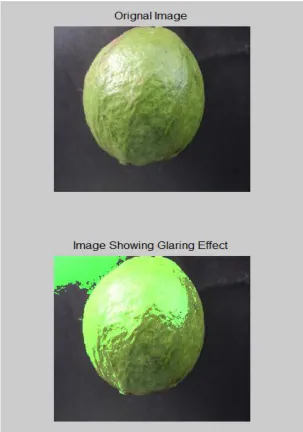
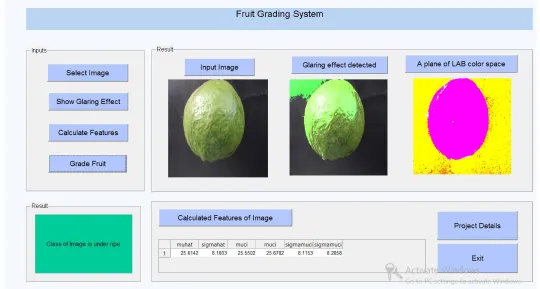
Generally image processing consists of cropping of image, detecting glare part and removing it, compare with bench marks and find out the final result. Various Mat Lab programs are designed for the various steps. We have written the different codes in Mat Tab for preprocessing of the images, for detecting and removing the glaring effects etc.
We have collected 100 images of Guava at different environment and at different ripeness conditions. We have imported all these images in MAT LAB for finding results. We have found that 91% result shown by Mat Lab code is accurate with the grade. Hence we can apply this technique to the actual application with satisfactory accuracy.
162 Figure 1. Sample Guava Image used for database
163 Table 1. Result of Mat lab Software for various Guava sample
Sr. No.
Image Result by Computer Vision
Technique 1
2
3
4
5
6
7
IV. CONCLUSION:
164 conditions. This preliminary research validated both the possibility and the feasibility of using computer vision-based technology to provide accurate ratings of Guava color in an orchard environment.
REFERENCES
[1] Judith A. Abbott, “Quality measurement of fruits and vegetables”, Elsevier-Postharvest Biology and Technology 15 (1999) 207 – 225.
[2] Tadhg Brosnan, Da-Wen Sun, “Improving quality inspection of food products by computer vision––a Review”, Elsevier- Journal of Food Engineering 61 (2004) 3–16.
[3] Yousef Al Ohali,”Computer vision based date fruit grading system: Design and implementation” Journal of King Saud University – Computer and Information Sciences (2011)23,29–36.
[4] Qi Wang, Hui Wang, Lijuan Xie, Qin Zhang, “Outdoor color rating of sweet cherries using Computer Vision”, Elsevier- Computers and Electronics in Agriculture 87 (2012) 113–120.
[5] Okoth E. M,Sila D.N, Onyango C. A, Owino .W.O, Musembi S. M, Mathooko F.M, “Evaluation of physical and sensory quality attributes of three mango varieties at three stages of ripeness, grown in lower eastern province of Kenya – part 1”, Journal of Animal &Plant Sciences, 2013. Vol.17, Issue 3: 2608-2618.ISSN 2071-7024.
[6] Aasima Rafiq, Hilal A Makroo, Poonam Sachdeva and Savita Sharma, “Application of Computer Vision System in Food Processing- A Review”, Aasima Rafiq et al Int. Journal of Engineering Research and Applications, ISSN : 2248- 9622, Vol. 3, Issue 6, Nov-Dec 2013, pp.1197-1205.
[7] Arman Arefi, and Asad Modarres Motlagh, “Development of an expert system based on wavelet transform and artificial neural networks for the ripe tomato harvesting robot”, Austrian journal of crop science AJCS 7(5):699-705 (2013) ISSN:1835-2707.
[8] Computing Techniques” , International Journal of Computer Science and Electronics Engineering (IJCSEE) Volume 2, Issue 2 (2014) ISSN 2320–4028.
[9] Keren Kapach, Ehud Barnea and Rotem Mairon, Yael Edan, Ohad Ben-Shahar, “Computer vision for fruit harvesting robots – state of the art and challenges ahead” Int. J. Computational Vision and Robotics, Vol. 3, Nos ½. [10]Mahendran R, Jayashree GC, Alagusundaram K, “Application of Computer Vision Technique On Sorting and
Grading of Fruits and Vegetables” Omics publishing group- Food Processing & Technology.
[11]Jyoti A Kodagali, S Balaji, “Computer Vision and Image Analysis based Techniques for Automatic Characterization of Fruits – a Review” International Journal of Computer Applications (0975 – 8887) Volume 50 – No.6, July 2012. [12]Misigo Ronald, Miriti Evans, “Classification of Selected Apple Fruit Varieties Using Naive Bayes” Misigo Ronald
et al Indian Journal of Computer Science and Engineering (IJCSE).