Cloud Integration for eHealth Data
Abdul Kader Saiod and Darelle Van Greunen
[email protected], [email protected]
Abstract
There is the new promise of Cloud Integration (CI) for outsourcing Electronic Health (eHealth) data, computation and processes that provide real-time data exchange of various application systems and repositories. CI technology combines eHealth data in cloud environments, which are operated by multiple devices over the network and Internet. In addition, many Healthcare Organisations (HCOs) are migrating their systems to a cloud platform to reduce their business cost. Although CI provides attractive and cost-effective opportunities, it is essential to remember that Cloud Computing (CC) paradigms are still under development and not mature. One of the main challenges in CI is that all data management, security, availability, maintenance and domain control is done via a third-party service provider. Therefore, HCOs have no control over these matters. Trust of a third-party service provider is one of the essential factors for CI and this adds a new dimension to the opportunity. As a result of the scalability of applications and the lower costs, CI is viewed as the preferred infrastructure for most eHealth systems, but without comprising the privacy of data. In this paper, we present a novel CI approach using the Hybrid Integration Method (HIM) combined with the promising features of Fuzzy-Ontology. The aim is to strengthen the management of eHealth business and IT environments. The key outcome of this paper is to present a new technique to merge data and to identify conflicting data entries. A series of experiments were performed to prove that the proposed HIM is effective and accurate for eHealth data integration.
1
Introduction
Cloud integration has become an exciting research topic in the database management field. In general, CI is an approach of consolidating data that reside at diverse sources and providing the user with a unified view of information [9, 15, 25]. In recent times, CI is considered to be an advantageous, on-demand network. It has the ability to configure computing resources to a shared group network such as applications, services, servers and archives. This terminology allows the heterogeneous cloud to provide a uniform eHealth service interface that will increase the quality of healthcare services in an adaptive framework. With managerial effort, CI systems can be delivered rapidly and lead to higher performance. The specific CI that is referred to in this paper is that of fast computation to authorised user on-demand access and the ability to store Big Data (BD). Although small and big HCOs are
Volume 12, 2019, Pages 300–309
evaluating CI and in increasing numbers are turning their IT infrastructure to the cloud environment, the key domain control and actual data security still remain with a third-party organisation. In addition, the majority of HCOs do not pay strong attention to these concerns, as there is pressure to lower business costs and improve communication with minimum effort [14]. Therefore, CC is quickly becoming an essential part of the healthcare industry. Soon, there will be more services on offer, and the development will be more significant. This paper focuses on using the novel Hybrid Integration Method combined with Fuzzy-Ontology to demonstrate the mapping of eHealth data in a cloud environment.
2
Context
Cloud integration is based on service-oriented architecture applications and HCOs can take advantage of the ability to combine all cloud applications as well as on-premises systems. The CI platform gives HCOs exceeding access and visibility into eHealth data as well as improved functional connectivity. In term of heterogeneous and big Electronic Health Records (EHRs), it is reality that the datasets are so big that the traditional Database Management Systems (DBMS) are not capable of handling the storage, management and analyse of the datasets [10]. The smaller HCOs have limited resources. Therefore, CI is used to cater for these smaller HCOs by providing adequate storage space to provide the exchange and sharing of EHRs [3]. CC has a high impact on parallel-distributed grid computing systems. The flexibility for the further development of these technologies is recommended in the literature. It is an advantageous location independent technology and contributes to enhancing the user experiences over the Internet. It can provide services for various application scenarios and database platforms. Lately, more and more HCOs are migrated onto the cloud platform. The necessity arises therefore to develop new technologies and methods for eHealth data integration using efficient HIM based on Fuzzy-Ontology. Together with HIM method, the CI will not only perform the function of receiving and displaying information but also automatically and accurately extract information from heterogeneous data sources. The proposed HIM will equivalently match two concepts across different data sources and automatically resolve any inconsistency that arises from multiple data entities. This paper aims to demonstrate the use of HIM to improve CI for heterogeneous and inconsistent eHealth data sources.
3
Challenges of Cloud Integration in eHealth Data
Often data inconsistency occurs, as generally, EHRs structure relies upon on other structures. Thus, in a distributed system, such data management is exceptionally cumbersome. Implementation of efficient CI in eHealth can result in improved business safety by reducing the data errors. The most critical challenges and constraints that hinder of the successful integration should be identified to improve the implementation of CC to achieve the maximum benefit in the business process. The main challenge is, what measures can be introduced to eradicate DQ issues in EHRs that will benefit the cloud integration of electronic health records and systems in large-scale databases?
The objective of this paper is to identify the feasibility of introducing CI to improve healthcare services that assume the statement that the eradication of DQ will benefit the healthcare services. Another important aspect of a CI is whether the system can materialise data, which is retrieved from the diverse sources through mappings [15]. The principal contribution of this paper is the improvement of a novel framework for an effective HIM method for eHealth data to achieve its maximum benefits and reduce the DQ challenges in HCOs.
4
Overview of Approaches and Recommendations for Cloud
Integration in eHealth data
The goal of the CI is to provide a patient-centric solution to the challenges currently facing the provincial healthcare sector. It does this by providing the means for diverse healthcare systems and data sources that securely share information. As a result, authorised users can have a seamless, efficient way to request information from different sources and input information into designated data sources. Two significant challenges, however, remain when it comes to diverse integration in eHealth systems. The first challenge is, of course, the security. Due to the unique nature of doctor-patient privacy, questions around EHRs and privacy have been shaping both public policy and private software development. The Health Insurance Portability and Accountability Act of 1996 (HIPAA) guidelines, for example, were designed to deal with the security of patient medical records. Challenges in this area remain and both the public and private sectors focused on strengthening the security of EHRs at all access and transmission points. The eHealth systems play a critical role in the translation of genomic information into healthcare services. Tremendous strides are made in making pooled EHRs available to data providers for healthcare services, yet still, more need to be done to harness the full capacity of largescale EHRs. Despite the widespread adoption of EHRs, the integration of eHealth data remains a critical challenge for the industry as it strives to achieve interoperability.
The digital record has evolved dramatically, from paper-based to an electronic base during the initial stage of evaluation. Now it has changed in physical space from occupying walls of shelving to server rooms to the cloud. It is now location independent and even divided into pockets [22]. Existing literature shows that there are currently, several techniques proposed to deal with large EHRs, which historically have faced DBMS [22]. After a deep analysis of several cutting-edge commercial solutions available on the software market and an intensive review of the literature, it appears there are still some literature limitations when integrating into the cloud platform. CC is the combination of a distributed computing system hosted in the cloud. CC promises new re-evaluation technology. Robust support is provided to access heterogeneous data sources physically, but only if they are standard database tables and a traditional DB structure. Whether an organisation is accessing their data via a cloud service or an administrator accessing data during normal business facility operations in a data centre, the regulators require that the data be accurate and maintained with the proper standards in place. According to the literature, METHODOLOGY is one of the most common renowned ontological methodology [6], and others are NeOn [26], DILIGENT [31], On-To-Knowledge [27], HCOME [13] and DOGMA [9].
definition, eHealth refers to these decision support systems that transaction processing with magnetic storage in the terabyte ranges, containing billions of table rows and serving large numbers of users. CC environment may store every transaction for billions of records and handle millions query per second over different organisations. To be of value to DQ, the data must be compatible and unequivocal. DQ issues are often the outcome of DBMS merges or systems or cloud integration procedures in which data fields that should be compatible are not according to design or distribution inconsistencies. Vast amounts of research and publications concerning CI mechanisms been carried out over the last few years. CI is moving forward technology to express eHealth data integration. The research field of CI in eHealth focuses on strategies for combining large-scale data residing at different heterogeneous sources and providing a user with a unified view of these data.
In healthcare, EHRs are becoming widely accepted as an efficient standard of storing medical information [4]. The information contained within these EHRs not only provides direct health information about patients but also used to monitor hospital activities for medical billing and demographical health management.
It does not evaluate the ease of data access for dynamic CI in EHRs. In addition, the existing traditional integration techniques and DBMS platform are not sufficient, as an organisation requires less effort, location independency and reduction of the business cost. The necessity arises, therefore, to find a new way to integrate eHealth data, using an efficient CI methodology, which satisfies the needs of HCOs. How eHealth data can be adapted to simplify the CI described above is an essential objective of this work.
5
eHealth Data Integration
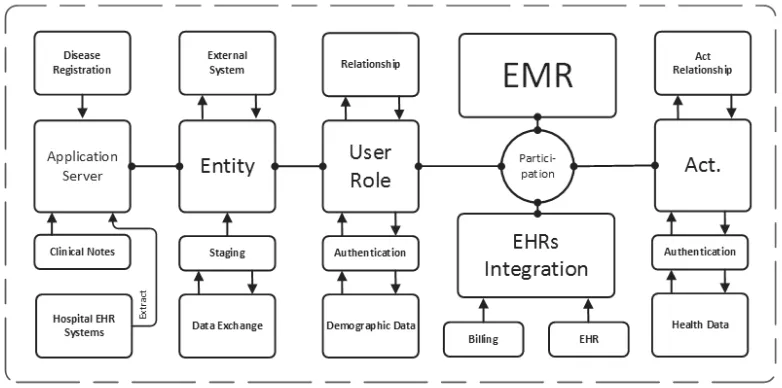
Most of the eHealth data is highly structured and heavily depend on claims data, but the prosperous scope provided by EHRs is absent. Furthermore, leveraging EHRs depends on the vendor-delivered implementation such as a Continuity of Care Documents (CCDs), which are one of the few analytics applications. They also have limitations via both design and integration that make them insufficient for populating health and productivity analytics. CCDs offer a consolidated and expedient way to implement EHRs. Many eHealth data sets are kept in a variety of unstructured formats, making it difficult to query directly via digital algorithms. Paper health records are standalone, lacking the ability to integrate with other paper forms or information.
Figure 1. The integration model of eHealth data architecture (researcher source - unpublished thesis).
It should also be able to accommodate the desire for the rich narrative text that makes up a significant portion of patient safety information from voluntary and mandatory reports. The DQ framework components are as follows [22]:
a) Profiling: Checking-up the database by screening all tables and columns in scope through several criteria;
b) Metadata comparator: Comparing the technical constraints on a database with the profiling results;
c) Business validation: Meetings organised with data owners and data stewards to identify pain points and categorise DQ checks by priority;
d) Business rules: Implemented in EHRs DBMS to logging and error handling, integration of manual checks and DQ issue exclusion;
In recent years, DQ has become a considerable focus on healthcare programs due to EHRs accountability enhancement. Large-scale data integrations are a combination of technical and business processes used to combine data from disparate sources into meaningful and valuable information. This provides a robust theoretical and practical framework to work with heterogeneous, complex, conflicting and automatic consensus methods for eHealth integration. A concept detection method could be semantically more meaningful, if the data integration process is a subset of the annotation process for trustable automatic data mapping, such as image, sound or video index by unique code.
6
Cloud-Based eHealth Architecture
the choice of hosting the software on their network (client-server) or systems where the software hosted on a remote server is accessed through the Internet (cloud-based). As the pressure to lower business costs, improve communication and adopt systems that will support business rises, CC is quickly becoming an essential part of the business.
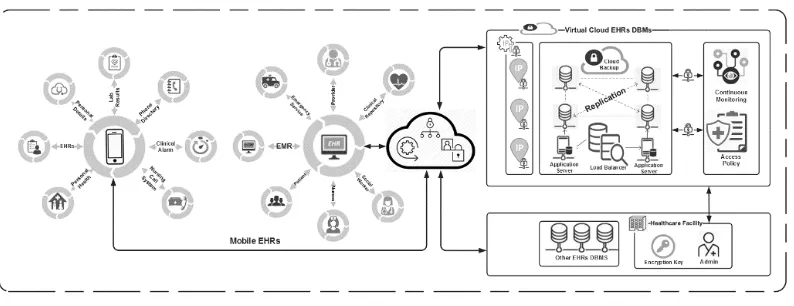
The cost of setting up client-server systems are a significant hurdle to a small organisation. With cloud-based DBMS systems, organisations benefit from economy of scale. Since many organisations use the same type of systems, high costs are minimised or eliminated. Client-servers require the organisation to purchase or lease expensive hardware. The description of cloud-based eHealth architecture is depicted in Figure 2.
Figure 2. Cloud-based eHealth architecture (researcher source - unpublished thesis).
The company must hire IT staff or pay for the services of IT personnel to set up, test, maintain and upgrade the hardware and software. With a cloud-based DBMS, the vendor or hosting company covers all of the costs of running the system. There are no hardware, network or maintenance costs to the practice over the typical equipment setup required to run a business.
7
Methodology
The methodology is defined as a generic combination of methods that commonly used as a whole in soft systems methodology, strategic options development and analysis or survey methodology covers the design and analysis of questionnaires [16]. The main contribution of this work is the improvement of a novel framework for an effective CI method to achieve its maximum benefits and reduce the CI challenges across organisations. The study has found a very simple descriptive yet guideline to develop crisp ontology presented by Noy [19]. There are other guidelines provided by Jarrar [9], on how to reapply the existing ontologies, the different development methodologies and descriptions of their features.
linguistic variable, which is used for fuzzifying and determining the ontologies. Generally, the selecting of this linguistic variable is problem dependent. The HIM based on Fuzzy-Ontology alignment terminology uses three core features, as follows [22]:
1. The background knowledge.
2. The capacity to manage vagueness and imprecise in the matching process. 3. Classifications in the resulting apprehension to improve the DQ in CI.
In the real world, it is too difficult to understand as the processes are grouped in each phase, which becomes too ambiguous. Initially, the fuzzy Ontomethodology was developed to provide guidelines for ontology semantic web searches. During the development and implementation process, the numerous amounts of Fuzzy-Ontology component defined and stored in the logic bank to reapply, can enhance the interoperability and share ontology ability in the health domain to reduce the workload.
8
Hybrid Integration Method Based on Fuzzy-Ontology
It has been extensively recognised that there is no universal single methodological approach that exists to solve every data integration problem [22]. The different methodologies offer different flow processes, which could be worse or extremely worse according to the interoperability, rationality, competency or ease of use. The ontological methodology for efficient task scheduler can provide sufficient methodological support to the CI. The principal aims of the HIM based on Fuzzy-Ontologies to tackle the conceptualisation of the fuzzified vagueness and formalisms. In other words, the principal task is how to illustrate the fuzzified vagueness and formalisms into linguistic logics in HIM. Use the Fuzzy-Ontologies in a standard and efficient way is the main contribution to address the DQ issues in CI. This methodology provides the guidelines that focus on the dispensation transformation from crisp ontology to fuzzy ones. This methodology consists of five generic steps, namely [22]:
1. Involving attainment crisp ontology. 2. Constituting the necessity for fuzziness. 3. Determining Fuzzy-Ontology components. 4. Formalising fuzzy components.
5. Affirming Fuzzy-Ontology.
The presented HIM methodology relies on the availability of crisp ontology. In order to best model and efficiently handle the imprecise and vague information, the ontology must follow the methodological guidelines. To finalise this concept, this paper presents a HIM development methodology, which could be helpful to improve existing Fuzzy-Ontology systems or develop a complete Fuzzy-Ontology integration system in CC. The proposed HIM methodology could enable the interoperability of CI integration systems and resolve issues of inconsistency large scale data resolution in terms of generality, completeness, accuracy, reusability, efficiency and shareability.
Based on ontology development methodologies, the section presents a formal Fuzzy-Ontology development paradigm. Its emphasis lies in introducing new changes brought about by Fuzzy-Ontologies in the development process. The principle emphasis lies in developing a different way with the new addition into Fuzzy-Ontologies for efficient CI. All new addition is the prior potential knowledge from real-life experience and principles of crisp and Fuzzy-Ontology. The HIM does not aim to completely reform existing development methodologies; it focuses on partial changes with new additions to the weak offerings of the existing methodologies. The proposed HIM is based on the three basic principle resources for CI for eHealth [22]:
3. Include practical experience from subsisting methodologies.
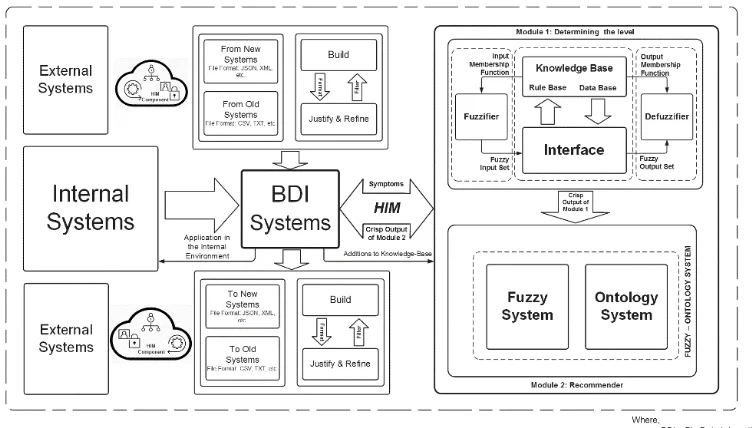
The eventual contrivance of our proposed HIM is to provide a methodological instruction to efficiently handle the BD as an accomplishment confirmation of the appropriate achievement. Despite this, as emphasised between indication and philosophical introduction, it is not easy to implement a universal qualitative and quantitative corresponding analysis with another subsistence approach. The description of the complete HIM structure based on Fuzzy-Ontology for CI systems is outlined in Figure. 3:
Figure 3. The complete HIM structure based on Fuzzy-Ontology for CI systems [21].
A widely accepted circumstance that there is still a quantitative limitation, is presented in the entire subsisting apprological ontology [2], together with that contrivance for constructing Fuzzy-Ontology, crisp or probabilistic ontologies. Vicelike, METHONTOLOGY is the renowned approach, which does not comprise any evaluation, even if it allows the systematic approach for constructing crisp ontology from scratch. Another example is applicability of NeON that was proven in several exploration platforms but did not provide any meticulous appraisement. According to our theory of implicit wisdom delegation, the HIM is aimed at the data standardisation to deal with DQ issues including imprecise and vague data according to the lessons learned from existing different approaches. The HIM provides a structured approach for the selection of an appropriate HAs based on Fuzzy-Ontology that can support the interoperability of CI systems for eHealth data.
9
Conclusion
technologies with minimum efforts. In real-time scenarios, the goal of the HID method algorithm is to efficiently integrate eHealth data and repair inconsistence data instantly and accurately. The overall scenario and challenges discussed demonstrate CI for eHealth data, which demonstrate the method to be effective with regard to the accurate performance of the healthcare services. This paper endeavours to be useful and to maximise the CI process to benefit the eHealth data of HCOs investment and to improve the quality of business services.
References
1. Bizer, C., Heath, T. and Berners-Lee, T. (2009). Linked Data - The Story So Far. International Journal on Semantic Web and Information Systems (IJSWIS), pp.3.
2. Carvalho R. N., Laskey K. B. and Costa P. C. G. D. (2016). "Uncertainty modeling process for semantic technology," PeerJ Comput. Sci., vol. 2, p. e77, Aug. 2016.
3. Charalampos T. and Marinos T. (2011) - CLOUD COMPUTING & E-GOVERNMENT: MYTH OR REALITY? tGov Workshop ’11 (tGOV11). March 17 – 18 2011, Brunel University, West London, UB8 3PH.
http://citeseerx.ist.psu.edu/viewdoc/download?doi=10.1.1.467.7221&rep=rep1&type=pdf
4. Cimino JJ. (2013). Improving the electronic health record are clinicians getting what they wished for?JAMA. JAMA. 2013;309(10):991-992. DOI:10.1001/jama.2013.890
5. Dolin, R. H., Alschuler L., Beebe C., Biron P. V., Boyer S. L., Essin D., Kimber E., Lincoln T. and Mattison J. E. (2001). The HL7 Clinical Document Architecture. J Am Med Inform Assoc 8 (6):552–569.
6. Fernández M., Gomez-Perez A. and Juristo N. (1997). “METHONTOLOGY: From ontological art towards ontological engineering, Stanford Univ.,” Stanford, CA, USA, Tech. Rep. SS-97-06, 1997.
7. Francky C. and Sven W. (2013). Custom Memory Management Methodology: Exploration of Memory Organisation for Embedded Multimedia System Design, de Greef Florin Banica Lode Nachtergaele Arnout Vandecappelle March 9, 2013, ISBN: 9781475728491
8. Hai, B. T., Trong, H. D. and Ngoc, T. N. (2013). A Hybrid Method for Fuzzy Ontology Integration. An International Journal, 44, pp. 133-154
9. Jarrar M. and Meersman R. (2009). "Ontology engineering - The DOGMA approach,'' in Adv. Web Semantics I, vol. 4891, T. S. Dillon, E. Chang, R. Meersman, and K. Sycara, Eds. Berlin, Germany: Springer, 2009, pp. 7-34.
10. Jiawei H., Micheline K. and Jian P. (2011). Data Mining: Concepts and Techniques: Edition 3, June 9, 2011, ISBN: 9780123814807
11. Jian M., Shujun M. and Zhao Y. (2009). RESTful Web Services: a Solution for Distributed Data Integration. 978-1-4244-4507-3/09/$25.00 ©2009 IEEE
12. Kamil, K. and Kazimierz, S. (2010). Transparent Integration of Distributed Resources within Object-Oriented Database Grid. Faculty of Electrical, Electronic, Computer and Control Engineering of the Technical University of Lodz.
14. Maryam G., Ali M. M., Mohamad A. and Ebrahim J. (2017). Leadership challenges in health care organizations: The case of Iranian hospitals. Journal Article published online 2017 Dec 17. DOI: 10.14196/mjiri.31.96
15. Matthias J., Maurizio L., Yannis V. and Panos V. (2013). Fundamentals of Data Warehouses: Edition 2 March 9, 2013, SBN: 9783662051535
16. Mingers J. (2003). A Classification of the Philosophical Assumptions of Management Science Methods. The Journal of the Operational Research Society Vol. 54, No. 6 (Jun., 2003), pp. 559-570. DOI: 10.1057/palgrave.jors.2601436
17. Momoh, A., Roy, R., and Shehab, E. (2010). Challenges in enterprise resource planning implementation: state-of-the-art. Business Process Management Journal Vol. 16 No. 4, Emerald Group Publishing Limited, DOI 10.1108/14637151011065919, pp. 537-565.
18. Näppilä, T. (2013) Serving Sophisticated Ad Hoc Information Needs Based on Beforehand Unknown, Autonomous, and Heterogeneous XML Data Sources, 2013, ISBN: 978-951-44-9285-3
19. Noy N. F. and McGuiness D. L. (2001). "Ontology development 101: A guide to creating your First ontology,'' Stanford Med. Informat., Stanford, CA, USA, Tech. Rep. SMI-2001-0880, 2001.
20. Risto, S., Olli J., Hanna, K. V. and Harri, H. (2011). Managing one master data – challenges and preconditions. Journal: Industrial Management & Data Systems, Volume: 111, Number: 1, Copyright © Emerald Group Publishing Limited ISSN: 0263-5577, pp. 146-162.
21. Roy H. (2012) Data Compression in digital system, 2012, ISBN: 978-1-4613-7764-1, DOI: 10.1007/978-1-4615-6031-9
22. Saiod A. K. and Darelle V. G. (2019). Novel Hybrid Approaches for Big Data Recommendations (Chapter Five). Book details: Big Data Recommender Systems Recent Trends and Advances. Editors: Osman Khalid, Samee U. Khan, Albert Y. Zomaya. Product Code: PBPC035A, ISBN: 978-1-78561-975-5
23. Saiod A. K., Darelle V. G. and Veldsman A. (2017). Electronic Health Records: Benefits and Challenges for Data Quality. © Springer International Publishing AG 2017. DOI: 10.1007/978-3-319-58280-1_6
24. Selcuk C. K. and Maria L. S. (2010). Data management for Multimedia Retrieval, 2010, ISBN: 978-0-521-88739-7
25. Shancang L., Lida X., Xinheng W. and Jue W. (2012). Integration of hybrid wireless networks in cloud services-oriented enterprise information systems, Volume 6, Issue 2, 2012, DOI: 10.1080/17517575.2011.654266
26. Suarez-Figueroa M. C. (2010). "NeOn methodology for building ontology networks: Specification, scheduling and reuse,'' M.S. thesis, Universidad Politécnica de madrid, Tech. Univ. of Madrid, Spain, 2010.
27. Sure Y., Staab S. and Studer R. (2004). "On-to-knowledge methodology (OTKM),'' in Handbook Ontologies, S. Staab and R. Studer, Eds. Berlin, Germany: Springer, 2004, pp. 117-132.
28. Tao C. A., Arif K., Markus S. and Ganesh V. (2010) iBLOB: Complex Object Management in Databases through Intelligent Binary Large Objects, 2010, DOI: 10.1007/978-3-642-16092-9_10, Print ISBN: 978-3-642-16091-2, Online ISBN: 978-3-642-16092-9
29. Umberto D’A., Miguel GE., Stefano M. and Ignazio S. (2015) - TMDs: Evolution, modeling, precision. DOI: http://dx.doi.org/10.1051/epjconf/20158502003
30. Vladimir Z. and John G. (2015) A systematic approach to reliability assessment in integrated databases, 14th Apr 2015, DOI 10.1007/s10844-015-0359-2