ISSN: 2334-2986 (Print), 2334-2994 (Online) Copyright © The Author(s). All Rights Reserved. Published by American Research Institute for Policy Development DOI: 10.15640/jea.v4n2a6 URL: https://doi.org/10.15640/jea.v4n2a6
The Valuable Age of the Urban Products
Dr. Haitham Alshimari
1& Mr. Adil Zamil Manshad Al-Saidi
2Abstract
Urban products have different values depending on their role in the urban environment. Some of these products keep their high values for long time and they may form a pub-icon for the local and global culture. Other products have segregation between rising and declining in their values based on many factors. The main factors that affect the urban product's value depend on the product's characteristics, the urban context, and the users. The new products take about one year to have their initial values. These values could be changed positively or negatively along the time. After some years, these values growing up dramatically while others are declining. The declining products need new initiations to arise their values. So, the research problem of this paper is; the values of the urban products are changing negatively or positively along the time with uncertainty of defining the main factors that caused this change. How could the urban product's value (the age value of the building) be changed? Therefore, the aim of this paper is to define the main factors that cause the urban products values' change. The research has built its hypothesis which is; the urban product's values affected by their characteristics, the context, and the users. These drivers could play the main role in upgrading or degrading the product's values. As the main problems of the urban product are physical, performance, and interaction with the surroundings. The threshold theory's philosophy could be used to lay a methodology to support the physical, performance, and interactional dimensions to exceed the problems that reduce the valuable age of the urban product.
Keywords: Valuable age, urban product, threshold theory, upgrade values, communicative, future heritage
1. Introduction
It is clear that every building could be seen as an urban product and is founded according spatial, cultural, and functional values. This product establishes in a surrounding with a special criteria. It could affect this surrounding positively or negatively based on its interactional values with the surrounding's criteria. Many of the urban products are declining performance and valuably which affect their surroundings negatively and they have become heaviness. As a result, new mechanisms should be used to rising up the entire value of the context and converse the interaction between the new building and its surrounding positively. This process could make the urban product stay longer through the valuable rising.
Four main drivers should be considered to evaluate the urban product; its impact on the planning process, the mechanisms used in the interaction with the context, the assessment by the users and the priority of the treatment (Flyvbjerg, B., 2004).
1 A lecturer at Al-Nahrain University, College of Engineering Department of Architecture College of Engineering/ Department of Architecture, PO box 64074, Jadriah, Baghdad, Iraq PO box 64074, Jadriah, Baghdad, Iraq.
In order to understand a new compounded term easily which is desperate as (the valuable age), it comes from two words (value) and (age); Firstly, the meaning of value engages with quantity and quality dimensions that things have.
-
Quantity means physical values such as an amount of goods, services or money (Free dictionary.com, 2015) and measurable.-
Quality means spiritual values performance, importance, effectiveness, and adjectives (good, bad) which are difficult to measure.Secondly, the (age) means the time that thing stays existing and doing its job. Everything has limited age especially things that have the physical values, but it could be maintainable. On the other hand, things that have spiritual values may stay longer than physicals. They could be threatened to decline or degrade through time too. When buildings considered as a mixture of physical and spiritual values, they have limited ages.
Consequently, (Valuable age) could be defined as the time that the urban product (building) could stay interacted physically and valuably with its context, audience and stakeholders or interests groups. This age appears from the first emerge of the product (as a concept and physical existence) to extend and interact with its context through the performance dimensions and the values that it has. This product will reach the elderly stage usually because the decrease in values and reduce in the interaction with its surrounding. It is hardly to find an urban product that could stay for long time keeping its values with the context.
The urban product could not flow through these stages as graduate-interact value because maintain or decrease this age connect with many drivers. Perhaps there were products reach the elderly age dramatically or could raise their values after declining status. Ultimately, it could be said that the valuable age of the product based on three main factors which are the physical factor, the performance factor and the interaction with the context factor.
1.1.The threshold theory
Threshold means a transitional stage between two situations or it is a limit could be exceeding. In architecture, it means the joint between inside and the outside and it creates the conditions of entrance and exit; thresholds prolong, manipulate, and give meaning to an act of passage (Stavrides, 2015). At the urban and regional studies, there is "Threshold theory" witch its indicators help the decision makers to answer how or when that limits would be more or less impact (Mahmood, 2007). Threshold theory is one of the urban planning and regional theories which try to connect the spatial plan with the economic plan.
It concentrates on planning changes through time and to transfer qualitative dimensions into measured quantitative dimensions, Threshold theory is an attempt to translate urban design into quantitative categories. (Malisz, 1969). It deals with three problems and could be divided into three types (Malisz, 1969):
1-
The lake between design experts who have emphasized a qualitative approach and economists, who are used to dealing with the quantitative aspects of the development.2-
The communication between planners at different levels.3-
The period of time that the plan should cover.It solves problems in a physical and empirical way, There are three kinds of thresholds according to the threshold theory (Malisz, 1969):
2-
The technological threshold: it is the second kind of limitations to the use of land and the growth of settlement, a city functions on the basis of a range of engineering systems that together constitute its infrastructure e.g. Water supply or transportation.3-
The structural threshold: : it is the third kind of limitations to the use of land and the growth of settlement which affect the internal form of city and necessitate its reshaping, particularly so far as its central area is concerned.According to the above, the threshold theory deals with the tangible material things such as the place, technology and the economy. The question here is: how can we use and employ the threshold theory as a dohtem to deal with the moral dimensions (meaning and value)?
1.2. The value and the product
Two levels of products should be considered in architecture which are; architectural scale and urban scale. The architectural scale deals with the values that the single building has. On the other hand, the urban scale deals with the architecture and its context.
1.2.1.
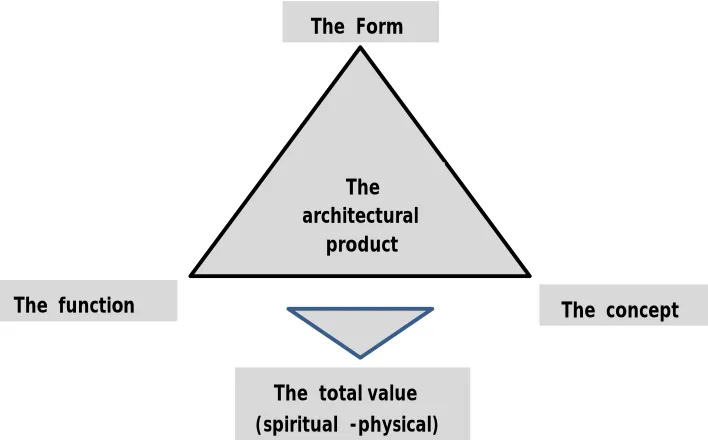
The value and the architectural productMost of the architectural studies consider the value of architectural product through three sides of view; Form (technical, symbols, building materials and construction), function (performance) and concept (meaning). One of these sides may dominate the others and stand out from which values, but the building needs all of them. Form is the tangible and physical side of the building, while the concept (meaning) is the moral or spiritual aspect. These two sides integrate in the buildings' appearance through the Form function relationship which is represents the common side of the building (physical and spiritual) to give the total value of the product.
1.2.2.
The urban product's valuesThe most important addition to the architectural scale value in the post-urban neighborhoods is context's impact.
Figure ( 1 ): The architectural product's value
The concept
The Form
The function
The architectural
product
The total value spiritual
The building's location becomes a critical factor to change the architectural product's values positively or negatively. There are two types of values that any urban product has; original and additional values. The original values could be divided into three types. Firstly, the gained values by the design concept and the correlation with the conceptual resource of the product until the physical appearance as a building. The clarity of these values depends on the designer's ability to present them physically. Secondly, the gained values by the physical appearance of the product that is related with forming the building and the interaction with the context. These values may appear to the common audience directly. Thirdly, the values that gained by the product's performance. These values emerge by the functional nature of the building such as educational, entertainment, cultural and commercial. These values have financial, economic, and social dimensions. The additional values are the values that are gained by the interaction between the product and the surroundings.
1.3. The dimensions of valuable age of the urban product
The research explores that the product's values correlate with three main dimensions affect the valuable age of the urban product both positively and negatively which are:
1.3.1.
The physical dimensionThis dimension consists of all the existence appearance of the building such as mass, elements, details and materials. On the other hand, the physical dimension considers the relations between these vocabularies. It deals with the choice of using a particular material for a particular purpose and putting it in a particular place ( S'Kropf, 1993). This dimension also consists of all changes that could affect the concept such as structure, colors, texture, and composition characteristics. Pompidou Centre and Sydney Opera House for example, have cooperated with architects on several important objects. Paris La Villette, etc. (Sebestyen, 2003). This stage means the existence of products and a beginning of the age.
Figure ( 1 ): The urban product's value
The concept
The Form
The function
The architectural
product
The total value spiritual
1.3.2.
The performance dimensionIt is the second base of the valuable age which consists of function, land-use, capacity, density, services, efficiency, plan program, environmental and the financial issues. It is an indicator to achieve comfortable places in the buildings (Al- kafajy, 2003). Technical services, Space distribution, accessibility, flexibility, human needs and economic are sub-dimensions of performance criteria. Environmental, aesthetic, symbolic, construction and execution could be classified as performance aspects (Jasim, 2010). All of these factors make the performance dimension a basic branch of the valuable ageof the product and any eruption in these values could affect the valuable age negatively. These negative effects may appear in urban district or a small city when the stakeholders make decisions about
after renovation
Hassan Fatthy For example, has designed Al-Qurna village (Al –omran, 2007), and has made his decision assuming that all the users are farmers when they are not. This assumption was the main reason that has made this village been abandoned after a short time. This could lead to the importance of the performance dimension as a driver of the valuable age of the urban product.
1.3.3.
The interactional dimension with the contextThe new urban product with its physical and functional values has been ready to interact with the context that has existed values too. The new product could be called the (new player) which has a potential and appearance power interacts with context's values and affects the valuable age of them negatively or positively.
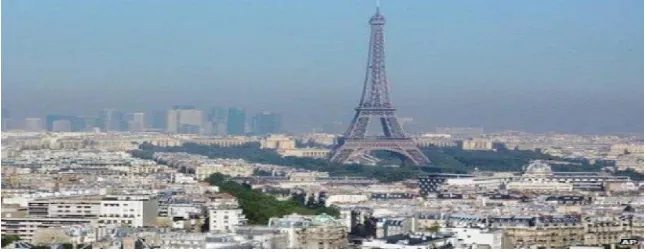
Figure 4: Eiffel Tower has become a pub-Icon after short time although it has been established for structural challenge of the iron
the spatial structure such as the high centrality in the eastern cities namely the Arabic.
Interaction rules and simulating the preferences of various users give the power to occupy the most desirable locations (Delden, 2014). Urban Interaction extends to the other aspects such as culture, economic, environment, and morphology. Arising the urban product by interaction with the context is the way that cities are spatially and temporally growing (Al joufie, 2012). This interaction assists the urban product to stay for a long time too. Designing buildings leads to create new urban interactions because they find new relations between professional designers, academics, policy makers and citizens, in a shift that we may describe as moving from a process of „city management‟ to one of „city making (Brynskov, 2014). This focuses on the complexity of interaction which needs more time to arrive the suitable level. That means it has along age.
1.4. The evaluation of the product
The evaluation of the urban product is made by the public audience, but this audience could be categorized into three groups, the first group is the users and the consumers. The second is the urban stewardships or urban managers who are classified into urban governors, stakeholders, elites, academics, developers, observers, legislators, and handcrafts. The third are the interests groups that are classified into investors, funders, contractors, and owners.
These groups have a great role in making the urban decisions. On the other hand, they affect all of the main urban theories such as communicative city and just of city. These theories try to determine the roles of these groups in the urban policies that contribute in producing buildings and urban forms.
The role of these groups various from interactive, collaborative, and subordinated to the actors (who produce and participate to make decisions). The groups could be categorized into stakeholder's states, civil society, and private enterprises. They affect the decision-making at the national, regional, city region, city, neighborhood, and district scale. They also, affect the urban sectors such as housing, education, health, and culture which are form the urban planning process (Vranken, 2011).
The groups have different points of view in how are places be made in the urban fabric. For example, the legislators and the governmental stakeholders give less importance for the expression (spiritual) values of the urban products. Conversely, they give more importance for the social and physical needs of a city. On the other hand, the investors, owners and the property holders (funders) are seeking for more financial benefits. The academic audience differs in their attribution from country to other and most of them concentrate on the theoretical issues. The elite‟s opinions always fused and disappeared without see the applications. This phenomenon is common in the Arab nations because of the centrality of decision making and urban management.
1.5. The threshold theory and the valuable age of the urban product:
In conclusion, it could be said that the threshold theory's philosophy could be used to lay a methodology to support the physical, formic, functional, and interactional dimensions to exceed problems that reduce the valuable age of the urban product. This methodology tries to lift up the product to the acceptable level, solve the declining problems and to keep rising up the valuable age of the product. In other phrase, threshold theory mostly treats with the urban horizontal expansion in terms of place, but now it could be used with the vertical expansion historically.
1.5.1. The positive and active interaction
The second factor is the quality of the urban place which is the ability to capture the imagination, dreams, and designs of young creative workers (Durmaz, 2012). The efficient place is a communicative, livable, vital, flexible, and beautiful. On the other hand, it should be an attractive, active, growing, and productive (Gilles &Puga, 2001). In addition, environmentally, the place should be a comfortable, pure, clean, and healthy.
In conclusion, the positive interaction depends on two elements; Social cohesion and the quality of urban place which form the soft infrastructure of the urban development. The effects of the interaction between the building and its surroundings could be classified into three directions:
1-
Upgrade the valuable age2-
Degrade the valuable age3-
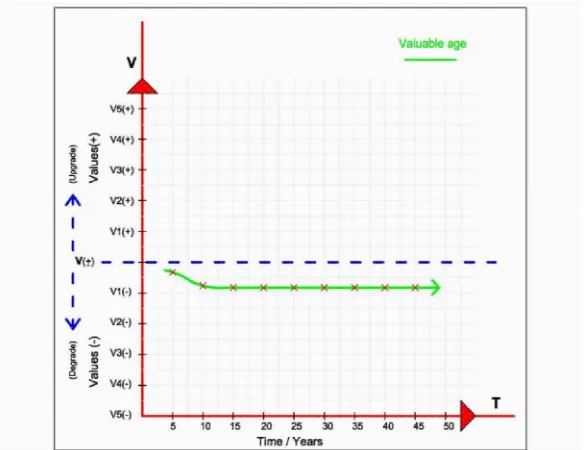
The equilibrium and rational stability of the valuable age. Upgrade is represented by supporting and keeping the positive values of the product and the context to increase the valuable age.Conversely, the declining could be represented by losing the product its values through the interaction or that the new product itself has no values.
On the other hand, equilibrium and stability is represented by keeping the new product its values and has a weak interaction with the context which could be seen in most of the infill projects.
1.6. The evaluation period
Time is a crucial factor in the evaluation process to give a chance for the product's values to appear and interact with the surroundings. This factor determines the evaluation intervals. All types of assessors (evaluators) should be considered especially the users (Brynskov, 2014).
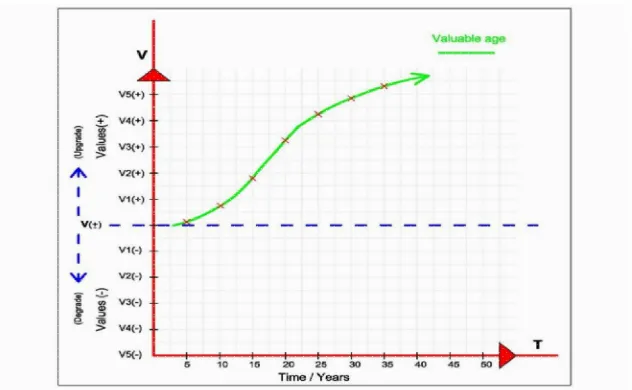
According to the new urban research views in data collection and analyzing, the researchers suggest a one year to begin and test the new urban product to assess its valuable age with the context. This process could be applied many times again later it could be reevaluated it any time required. It is common that any building could continue for 50 years. On the other hand, the master plan of a city continues for at least 25 years. That leads to assume that the valuable age of buildings should continue to at least 25 year and it is better to be more than 50 year. The urban product's values change into two directions which are one directional and multidirectional interval. The one directional single case for a long period that has a single interval could be divided into two situations;
1.6.1 The upgrade interval
Figure 5: One direction (single case, upgrade) of the valuable age (the authors).
Finally, all of these dimensions could be the main drivers to lift up the valuable age of the urban product. As a result these products will converse to be a heritage gradually such as in the ancient cultures. They become pub- icons to produce other buildings in the future and may reach to the direct analogy of these icons. Eifel Tower for example, has become a cultural symbol of France although it has been constructed to advertise for iron companies. These companies left the tower because of the high cost to remove. Then the tower has interacted with its context and audience. Finally it has become one of the most important symbols globally.
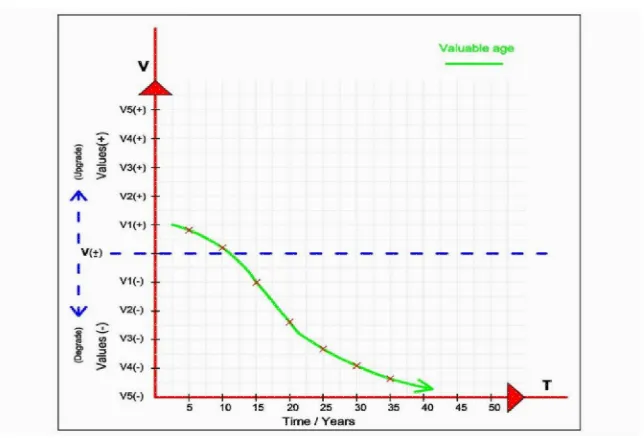
1.6.2. The degrade interval
Declining in the valuable age is effected by four main drivers. They are weakness in the potential values and design, the lack in the interaction with the context and the audience, producing negative values socially and securely and urban product is treated as a good to achieve the most benefit financially. The physical factor produces negative values when corruption is happened in it construction, services weakness, the form has no connection with the common sense, façade details are designed badly and the absence of the concept reference.
Figure 7: One direction (single case, degrade) of valuable age (the authors)
The functional factor could produce negative values when there is a functional failed facility weakness, the effectiveness declining of the function use and the space program deficit. On the other hand, the interaction factor could have negative values when there is no optimization with the context in terms of function and the form, communication weakness with the audience which may cause rejection, it produce negative social habits, security issues, difficult to arrive, the context has weak values and the interaction environmentally and healthily. There are many examples of urban products that deal with the project as a good achieve more financial benefits without concern the formic and the functional factor. Nevertheless, the site choice is not optimal for both the function and the context. .Some of the eastern cities has a lot of these projects that disappear. Some of small houses with area of about 45 m2 have been established to cover the demand of housing sector. These houses have cheap materials of construction and finishing with short range of age. In addition, they have been constructed illegally, if a city has a strong urban management and real legislations these products will be removed at the first opportunity. It is a clear example of “degrade direction.”
1.6.3 The valuable age with equilibrium and rational stability interval
Figure 8: One direction (single case, equilibrium) of valuable age (the authors).
Figure 9: one direction (single case, negative equilibrium) of valuable age (the authors).
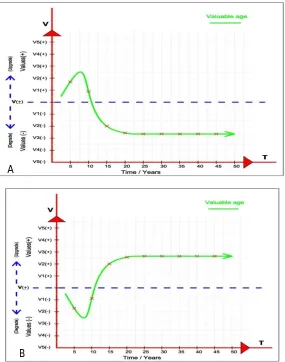
1.6.4 The multidirectional intervals of valuable age variable
Figure 10: Marseille apartments have been abandoned after a dramatic arise and becoming a pub-icon because of the functional failure
Figure (12): (A), (B) multi- directions (dual- cases) of valuable age (the authors).
A
1.7 The value dimensions and the threshold kinds
1.7.1 The physical threshold
It could discover the thresholds that causing the physical-formic weakness of the valuable age and exceed them by extracting the weakness factors. Declining t in the valuable age of the physical-formic dimension to lift up and get stable values by a great process depends on two strategies;
1-
Maintenance and rehabilitation: it contains all previous vocabularies (structure, infrastructure, skin and materials). These variables need high cost to support the valuable level of the product. This support could be transferred by adding or distract physical parts, replace and change materials or add finishing materials for facades, enter or remove technical treatments, activate the aesthetic elements, develop the infrastructure and other services, investigate the natural characteristics and the renewable energy resources to achieve more consumption reduction.2-
Re-read the design concept of the urban product to discover new meanings that were be neglected and the designer has established the concept, add values based on interpreting the unconscious actions used by the designer as propagandistic additions, activate the conceptual and meaningful connections with the audience; some meanings could not be well transferred by the designer.Figure ( 1 3 ): ( A), (B) multi - directions (Tri - cases) of valuable age (the authors).
A
1.7.2 The performance threshold
In order to exceed the performance (functional) threshold that causes declining the valuable age of the urban product or to keep arising and stable equilibrium, weakness factors of this decline should be defined. The process of treatment consists of many options;
-
Add some demand facilities to the main function such as mixed-use.-
Remove some ineffective functions of the product.-
Change the entire function especially when the valuable age declined significantly-
Re-organize the space program of the project and facilities-
Review the quality of the service-
Review the land-use demand and urban density.-
Activate the advertisement for the rehabilitation projects (propagandistic additions) and establish connection with investors.-
Meet the complementary services such as parking and stores which require addition areas.1.7.3 The interactional threshold
Many options should be considered to exceed the interactional threshold. These options could be summarized as:
-
Activate the utilizing interaction with the surroundings at the land-use level weather mixed use and specialized use.-
Achieve physical and form development of the surroundings by giving a great interest in the urban context and the street furniture which cold activate the context development)-
Encourage the social frequency of the urban product.( improve the social places)-
Achieve the easy access for visitors (accessibility).-
Achieve some urban expressions that have positive psychological impacts such as enclosure and human scale (psychological needs).-
Solve the urban environmental problems such as pollution and services absentee (environmental effects).-
Encourage the social habits and remove the negative behavior (social dimension).-
Encourage attribution with the stakeholders, investors and the users in the design process (decisions making).-
Increase the context effectiveness by advertisement and organize public actions such as festivals and other social events (propagandistic additions).Figure 14: thresholds of valuable age of product, (Size, and capacity) (the authors).
5.0 Conclusions:
[1] There is a valuable age for each urban product in parallel with its physical age.
1-
The valuable age could stay longer than the physical age and it could be the main reason to decline its existence.2-
There were three dimensions for the valuable age which are physical-formic, performance and the interactional factor. Each factor has its detailed characteristics that affect the entire valuable age.3-
Every new urban product has values could be expressed by power or energy. These values have negative or positive impact on the context valuable age.4-
The final valuable age of the urban fabric depend on the effect of the new player (new product) and its interaction with the context. This effect produce three intervals; lifting up, stability and decline. On the other hand, it has two situations; single and complicated.5-
The threshold theory in the urban planning and design could be developed to get a methodology to arise the valuable age of the urban products.6-
The valuable age thresholds are physical-formic, functional, and interactional. These thresholds' goal is to lift up the valuable age of the urban product.Resources
A. Jasim, Nagham “The Effect of The formal and Organizational Properties on the Aesthetic Evaluation of the Architectural Design Project "According to the specialty of the Iraqi Academic Experience” Architectural Department _University of Technology, 2010, p2-3.
Al joufie, mohammed ,” Urban growth and transport in Jeddah, dynamic modeling and assessment”, the university of twente, 2012.p 4-5
Al- kafajy ,ali,abdulrazaq, asmaa, and abood, audy ,” The building performance, evaluate the performance of pre-cast housing buildings at hay alsalam complex - as model”, technology university, architectural department,2010. http://www.uotechnology.edu.iq.iraqiarchmagazine.
Brynskov, Martin “(Urban Interaction Design Towards City Making”, Amsterdam ,2014.p5. “Ibid, Brynskov,”Urban Interaction Design …,2014, P 11.
"Ibid, Brynskov,” Urban Interaction Design …”, 2014, P24.
Council of Europe, “Concerted Development of Social Cohesion Indicators: Methodological Guide. Strasbourg: Publishing” Council of Europe,2005, p 23.
Delden , Hedwig van &Vanhout, Roel ,“ ET2050 ,Territorial Scenarios and ,Visions for Europe” Volume 5 ,Land-use Trends and Scenarios, Luxembourg,2014, p10.
Durmaz, S. Bahar, “CREATIVE CLUSTERS AND PLACE MAKING: ANALYSING
THE QUALITY OF PLACE IN SOHO AND BEYOGLU” , July 2012 ,p64. Depended on Florida, R.L. 2005.Cities and the creative class. New York: Routledge.2005,p86
Flyvbjerg, B."Phronetic Planning Research: Theoretical and Methodological Reflections", Planning Theory 7 Practice, Vol.5, No. 3, p.p 302, September 2004.
Gilles and Diego Puga, “Nursery Cities: Urban Diversity, Process Innovation, and the Life Cycle of Products”, 2001 VOL. 91 NO. 5. P1463.
Internet /( http:// www.thefree dictionary.com/value). access Nov.2015
Kearns, A, and R. Forrest “Social Cohesion and Multilevel Urban Governance”. Urban Studies , 2000,Vol. 37, No. 5-6: p 996.
Keung,J. "Existing building retrofit", Building and construction Authority, 2010, p.p 57. 15-) Mahmood ,Sabah ,” Assigning the best direction for cities expansion by using threshold theory”, (tikrit magazine, for economical and administrational sciences, Vol (3); issue 7, 2007) P22.
Malisz , B . ,” Implication of Theory for Urban and Regional planning”, Journal of town planning Institute , Vol. , 55 , No .3 ,March 1969 pp220-221.from the journal of the Town planning institute,I.V.,1969 p.p 108. Ibid, Malisz, “ Implication of Theory for Urban and …”,p220
Vranken, Jon,” Social Challenges of Cities of Tomorrow”, CentreOASeS – University of Antwerp (Belgium) 2011,p 11. http://Ec.europa.eu/regional - policy/ sources/docgener/studies/ pdf).
Sebestyen, Gyula” New Architecture and Technology” , Architectural Press , Oxford OX2 8DP, Burlington,2003, p 32.
S'Kropf, Karl,“ THE DEFINITION OF BUILT FORM IN URBAN MORPHOLOGY”, volume one , Department of Geography, Faculty of Arts ,University of Birmingham ,1993.p10.
Stavrides, Stavros,” Common Space as Threshold Space: Urban Commoning in Struggles to Re-appropriate Public Space, Spring 2015, pp. 09-20, p 12.