
A Note on the Zeroth
Order General Randić Index of
Cacti and Polyomino Chains
AKBAR ALI1,2,,AKHLAQ AHMAD BHATTI1 AND ZAHID RAZA1
(COMMUNICATED BY TOMISLAV DOŠLIĆ)
1
Department of Sciences and Humanities, National University of Computer and Emerging
Sciences, BBlock, Faisal Town, Lahore, Pakistan
2
Department of Mathematics, University of Gujrat, Hafiz Hayat Campus, Gujrat, Pakistan
ABSTRACT. The present note is devoted to establish some extremal results for the zerothorder general Randić index of cacti, characterize the extremal polyomino chains with respect to the aforementioned index, and hence to generalize two already reported results.
Keywords: Topological index, zerothorder general Randić index, polyomino chain, cacti.
1.
I
NTRODUCTIONThroughout this study, we consider only simple, finite and undirected graphs. For undefined notations and terminologies from (chemical) graph theory, see for example [16, 30]. Topological indices are numerical parameters of a molecular graph, which are invariant under graph isomorphism and reflect certain structural features of the corresponding molecule [30]. In 1975, Randić [28] introduced a topological index (and named it branching index, but nowadays this topological index is also known as connectivity index and the Randić index) for measuring the extent of branching of the carbon-atom skeleton of saturated hydrocarbons. This index is defined as
( ) = ( )
∈ ( )
Corresponding author ([email protected])
where is the edge connecting the vertices and , is the degree of the vertex , and
( ) is the edge set of the graph . The Randić index is the most investigated, most often applied, and most popular among all topological indices. Hundreds of papers and a few books have been devoted to this topological index [13].
The Randić index has been modified in several ways. For instance, general Randić
indices [5], higher-order Randić indices [20, 21], edge connectivity index [12], zerothorder general Randić index [17, 18, 23, 29], and modified Randić index [11, 24] are some of the variants of the Randić index. Details about the Randić index and its modifications can be found in the recent papers [3, 4, 9, 24, 29], recent review [13], and related references cited therein. In the current study, we are concerned with the zerothorder general Randić index which is defined as
= ( ) =
∈ ( )
where α is any real number different from 0 and 1. Li and Zheng [23] proposed this index and named it first general Zagreb index. But nowadays, most authors refer to it as to the zerothorder general Randić index. At this point it is worth mentioning that and . correspond to the first Zagreb index [14] and zerothorder Randić index [22] respectively. A polyomino system (sometimes referred as a lattice animal of squares [10]) is a finite 2-connected plane graph such that each interior face (also known as “cell”) is surrounded by a regular square of length one. Such system can be considered as an edge-connected union of cells in the planar square lattice. Details about the polyomino systems can be found in [2, 15, 19]. A polyomino system in which every square has only one or two neighboring squares is called a polyomino chain.
2.
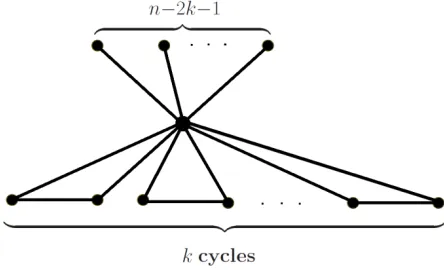
ZEROTHORDER GENERAL RANDIĆ INDEX OF CACTIAs usual, the star and cycle with vertices are denoted by and respectively. Let , be the class of all cacti with cycles and ≥5 vertices. Let ( , ) be the cactus obtained from by adding mutually independent edges (see the Figure 1). Let us assume that ( , ) = ( −1) [( − 1) + 1] + 2 (2 −1). To prove the main theorem of this section, we need some auxiliary results.
Figure 1. The Cactus ( , ).
Lemma 2.1. [17] If is a tree with vertices, then
( ) ≤ ( , 0) < 0 > 1
≥ ( , 0) 0 < < 1,
with equalities if and only if ≅ ( , 0).
Let us denote by ( , ) and ( , ) the graphs rooted at the vertices and ,
respectively. Let = ( , )⋈( , ) be the graph obtained from ( , ) and ( , ) by identifying with .
Theorem 2.2. [18] If is the unicyclic graph with vertices and contains the cycle of length , then
( ) ≤ ( − + 2) + ( −1)2 + − < 0 > 1
≥( − + 2) + ( −1)2 + − 0 < < 1,
with equalities if and only if ≅( , )⋈( , ).
The following corollary is an immediate consequence of the Theorem 2.2.
( ) ≤ ( , 1) < 0 > 1
≥ ( , 1) 0 < < 1,
with equalities if and only if ≅ ( , 1).
Proof. Let us take ( ) = ( − + 2) + ( −1)2 + − , where 3 ≤ ≤ . Then
the Lagrange’s mean-value theorem guarantees that there exist numbers Θ ∈ (1, 2) and
Θ ∈ (Θ , − + 2) such that ( ) = (1− )( − + 2− Θ )Θ . Note that
( ) is positive (respectively negative) for 0 < < 1 (respectively for < 0 or > 1). Hence the function ( ) attains its minimum (respectively maximum) value at = 3,
for 0 < < 1 (respectively for < 0 or > 1). Therefore, from the Theorem 2.2, desired result follows. ∎
Lemma 2.4. Let ( ) = −( − ) , where > ≥ 1. Then ( ) is decreasing (respectively increasing) for 0 < < 1 (respectively for < 0 or α >1).
Proof. Note that ( ) = ( −1)Θ where − <Θ< . It can be easily seen that
′( ) is negative (respectively positive) for 0 < < 1 (respectively for < 0 or
> 1). ∎
Now, we are ready to prove the main result of this section.
Theorem 2.5. Let be any cactus belongs to the collection , . Then
( ) ≤ ( , ) < 0 > 1
≥ ( , ) 0 < < 1,
with equalities if and only if ≅ ( , ).
Proof. We will use induction on + . For = 0, 1, the theorem directly follows from the Lemma 2.1 and Corollary 2.3. If = 2, then for = 5 there is only one cactus which is isomorphic to (5, 2). So, let us assume that ∈ , , where ≥ 2 and ≥ 6. We consider two cases:
Case 1. If G has at least one pendent vertex. Let be the pendent vertex adjacent with the vertex and = . Let ( ) = { , , , … , }. Without loss of generality, one can assume that = 1 for 0≤ ≤ −1 and ≥ 2 for ≤ ≤ −1. Let be the graph obtained from by removing the pendent vertices , , , … , , then ∈ , and
( ) = ( ) + + −( − ) .
( )− ( , ) ≤ ( − −1) −( −1) + −( − ) < 0 > 1
≥ ( − −1) −( −1) + −( − ) 0 < < 1,
with equalities if and only if ≅ ( − , ). By using the Lemma 2.4, one have
( )− ( , ) ≤ 0 < 0 > 1
≥ 0 0 < < 1,
with equalities if and only if ≅ ( − , ) and = −1.
Case 2. If G has no pendent vertex. Then there exist three vertices , and on some cycle of such that is adjacent with both the vertices , and = = 2, =
≥3. Then there are two further possibilities:
Subcase 2.1. If and are non-adjacent. Then, the graph = − +
belongs to the collection , and ( ) = ( ) + 2 . By using inductive hypothesis, one have
( )− ( , ) ≤ 2 −1−[( −1) −( −2) ] < 0 > 1
≥2 −1−[( −1) −( −2) ] 0 < < 1,
with equalities if and only if ≅ ( −1, ). But, on the other hand one have
2 −1−[( −1) −( −2) ] = (Θ − Θ ) < 0 < 0 > 1 > 0 0 < < 1,
where 1 <Θ < 2 and −2 < Θ < −1.
Subcase 2.2. If and are adjacent. Let be the graph obtained from by removing the vertices , . Note that the graph belongs to the collection , and
( ) = ( ) + 2 + −( −2) .
From inductive hypothesis, it follows that
( )− ( , ) ≤ ( −3) −( −1) + −( −2) < 0 > 1
≥ ( −3) −( −1) + −( −2) 0 < < 1,
with equalities if and only if ≅ ( −2, −1). By using the Lemma 2.4, one have
( )− ( , ) ≤ 0 < 0 > 1
≥ 0 0 < < 1,
3.
EXTREMAL POLYOMINO CHAINS WITH RESPECT TO THE ZEROTHORDER GENERAL RANDIĆ INDEXTo establish the main results of this section, we need some preparation. In a polyomino chain, a square having one (respectively two) neighboring square(s) is called terminal (respectively non-terminal). A non-terminal square having a vertex of degree 2 is a kink. A polyomino chain without kinks is known as linear chain (see the Figure 2).
Figure 2. A Linear Chain [1].
A polyomino chain consisting of only kinks and terminal squares is called zigzag chain (see the Figure 3).
Figure 3. A Zigzag Chain [1].
A segment is the maximal linear chain in a polyomino chain, including the kinks and/or terminal squares at its end. Denote by ( ) the number of vertices of degree in a graph . Now, we are in position to derive the main results of this section. The following theorem provides a general expression for evaluating the index.
Theorem 3.1. Let be a polyomino chain with ≥3 squares and kinks. Then
( ) = 2 × 3 + (2 + 4 −2 × 3 ) + 4 × 2 −2 × 3 .
Proof. By simple reasoning one have, ( ) = + 4, ( ) = , ( ) = 2 −2 −
If denotes the number of segments in a polyomino chain, then it is easy to see that
= −1. Hence, as the direct consequences of the Theorem 3.1, one have the following corollaries:
Corollary 3.2. [32] Let be a polyomino chain with ≥3 squares and segments.Then
( ) = 18 + 2 −4.
Corollary 3.3. Let , and be linear, zigzag and any polyomino chain respectively
with ≥3 squares.
1. If < 0 or > 1, then
2 × 3 + 4 × 2 −2 × 3 ≤ ( )≤(2 + 4 ) + 2(2 + 3 − 4 ),
the lower bound is attained if and only if ≅ and the upper bound is attained if and
only if ≅ .
2. If 0 < < 1, then
(2 + 4 ) + 2(2 + 3 − 4 )≤ ( )≤ 2 × 3 + 4 × 2 −2 × 3 ,
with left equality if and only if ≅ and the right equality holds if and only if ≅ .
Proof. Suppose that has kinks. Then from Theorem 3.1, it follows that
( ) = 2 × 3 + (2 + 4 −2 × 3 ) + 4 × 2 −2 × 3 .
Now, let us take ( ) = 2 + 4 −2 × 3 . It can be easily seen that
for ( ) > 0, ( ) is the maximum (respectively minimum) if and only if is the maximum (respectively minimum),
if ( ) < 0 then ( ) is the maximum (respectively minimum) if and only if is the minimum (respectively maximum) and
for ( ) = 0, ( ) is constant.
On the other hand, there exist real numbers Θ ,Θ such that 2 <Θ < 3 <Θ < 4 and
( ) = 4 −3 −(3 −2 ) = (Θ − Θ ) > 0 < 0 > 1 < 0 0 < < 1.
This completes the proof. ∎
Corollary 3.4. [32] If is a polyomino chain with ≥ 3 squares. Then
the lower bound is attained if and only if ≅ and the upper bound is attained if and
only if ≅ .
4. CONCLUSION
In the present study, we have proved the following two results.
If 0 < < 1 (respectively < 0 or > 1) then the cactus ( , ) attains the minimum (respectively maximum) value over the class of all cacti with
vertices and cycles.
If < 0 or > 1 then the linear chain (respectively the zigzag chain ) attains the minimum (respectively maximum) value over the set of all polyomino chains with squares and if 0 < < 1 then the situation is reversed.
ACKNOWLEDGMENT. The authors would like to express their sincere gratitude to the Editor-in-Chief (Professor Ali Reza Ashrafi) for his insightful comments and valuable suggestions, which led to a number of improvements in the earlier version of this manuscript.
R
EFERENCES[1] A. Ali, A. A. Bhatti, Z. Raza, Some vertex-degree-based topological indices of polyomino chains, J. Comput. Theor. Nanosci., in press.
[2] L. Alonso, R. Cerf, The three dimensional polyominoes of minimal area, Electron. J.
Combin. 3 (1996) 39 pp.
[3] M. An, L. Xiong, Extremal polyomino chains with respect to general Randić index, J.
Comb. Optim. (2014) DOI 10.1007/s1087801497816.
[4] V. Andova, M. Knor, P. Potočnik , R. Škrekovski, On a variation of the Randić index, Australas. J. Combin. 56 (2013) 6175.
[5] B. Bollobás, P. Erdös, Graphs of extremal weights, Ars Combin. 50 (1998) 225233.
[6] S. Chen, Cacti with the smallest, second smallest, and third smallest Gutman index, J.
Comb. Optim. (2014) DOI 10.1007/s108780149743z.
[8] H. Deng, S. Balachandran, S. K. Ayyaswamy, Y. B. Venkatakrishnan, The harmonic indices of polyomino chains, Natl. Acad. Sci. Lett. (2014) DOI 10.1007/s4000901402490.
[9] T. Divnić, L. Pavlović, B. Liu, Extremal graphs for the Randić index when minimum, maximum degrees and order of graphs are odd, Optimization (2014) DOI:10.1080/02331934.2014.919500.
[10] T. Došlić, Perfect matchings in lattice animals and lattice paths with constraints,
Croat. Chem. Acta 78 (2005) 251259.
[11] Z. Dvořák, B. Lidický, R. Škrekovski, Randić index and the diameter of a graph,
European J. Combin. 32 (2011) 434442.
[12] E. Estrada, Edge adjacency relationships and a novel topological index related to molecular volume, J. Chem. Inf. Comput. Sci. 35 (1995) 3133.
[13] I. Gutman, Degree-based topological indices, Croat. Chem. Acta 86 (2013) 351361.
[14] I. Gutman, N. Trinajstić, Graph theory and molecular orbitals. Total φ-electron energy of alternant hydrocarbons, Chem. Phys. Lett. 17 (1972) 535538.
[15] S. W. Golomb, Checker boards and polyominoes, Amer. Math. Monthly 61 (1954) 675682.
[16] F. Harary, Graph Theory, Addison-Wesley, Reading, MA, 1969.
[17] Y. Hu, X. Li, Y. Shi, T. Xu, Connected ( , )graphs with minimum and maximum zeroth-order general Randić index, Discrete Appl. Math. 155 (2007) 10441054.
[18] H. Hua, H. Deng, On unicycle graphs with maximum and minimum zeroth-order general Randić index, J. Math. Chem. 41 (2007) 173181.
[19] D. A. Klarner, Polyominoes, in: J. E. Goodman, J. O’ Rourke (Eds.), Handbook of
Discrete and Computational Geometry, CRC Press LLC, 1997.
[20] L. B. Kier, W. J. Murray, M. Randić, L.H. Hall, Molecular connectivity V: connectivity series concept applied to density, J. Pharm. Sci. 65 (1976) 12261230.
[21] L. B. Kier, L. H. Hall, Molecular Connectivity in Chemistry and Drug Research, Academic Press, New York, 1976.
[23] X. Li, J. Zheng, A unified approach to the extremal trees for different indices, MATCH
Commun. Math. Comput. Chem. 54 (2005) 195208.
[24] J. Li, B. Zhou, On the modified Randić index of trees, unicyclic graphs and bicyclic graphs, Miskolc Math. Notes 13 (2012) 415427.
[25] S. Lia, H. Yang, Q. Zhao, Sharp bounds on Zagreb indices of cacti with pendant vertices, Filomat 26 (2012) 11891200.
[26] F. Ma, H. Deng, On the sum-connectivity index of cacti, Math. Comput. Model. 54 (2011) 497507.
[27] J. Rada, The linear chain as an extremal value of VDB topological indices of polyomino chains, Appl. Math. Sci. 8 (2014) 51335143.
[28] M. Randić, On characterization of molecular branching, J. Am. Chem. Soc. 97 (1975) 66096615.
[29] G. Su, L. Xiong, X. Su, G. Li, Maximally edge-connected graphs and zeroth-order general Randić index for ≤ −1, J. Comb. Optim. (2014) DOI:10.1007/s108780149728y.
[30] N. Trinajstić, Chemical Graph Theory, 2nd revised ed., CRC Press, Boca Raton, Florida,1993.
[31] H. Wang, L. Kang, More on the Harary index of cacti, J. Appl. Math. Comput. 43 (2013) 369386.
![Figure 2. A Linear Chain [1].](https://thumb-us.123doks.com/thumbv2/123dok_us/8892198.1825842/6.612.209.407.318.464/figure-a-linear-chain.webp)
