Neighbourly Irregular Derived Graphs
B.BASAVANAGOUD1,,S.PATIL1,V.R.DESAI1,M.TAVAKOLI2 AND A.R.ASHRAFI3
1
Department of Mathematics, Karnatak University, Dharwad −580 003, Karnataka, India
2
Department of Mathematics, Ferdowsi University of Mashhad, P.O. Box 1159, Mashhad 91775, I. R. Iran
3
Department of Pure Mathematics, Faculty of Mathematical Sciences, University of Kashan, Kashan 87317−53153, I. R. Iran
ARTICLE INFO ABSTRACT
Article History:
Received 9 March 2016 Accepted 3 April 2016
Published online 15 December 2016 Academic Editor: TOMIŠLOV DOŠLIC
A connected graph G is said to be neighbourly irregular graph if no two adjacent vertices of G have same degree. In this paper, we obtain neighbourly irregular derived graphs such as semitotal-point graph, k-th semitotal-point graph, semitotal-line graph, paraline graph, quasi-total graph and quasivertex-total graph and also neighbourly irregular of
some graph products.
© 2017 University of Kashan Press. All rights reserved
Keywords:
Neighbourly irregular derived graphs product graphs
1.
I
NTRODUCTION ANDP
RELIMINARIESIn this paper, we are concerned with finite, simple, connected graph G with vertex set
V(G)={v1, v2, …, vn}and edge set E(G)={e1, e2, …, em}. If vi and vj are vertices of G, then
the edge connecting them will be denoted by vivj. The degree of a vertex v in G is denoted
by dG(v). The complement of G, denoted by G, is a graph which has the same vertex set as
G, in which two vertices are adjacent if and only if they are not adjacent in G and dG(v) = n – 1– dG(v) holds for all vV(G). Definitions not given here may be found in [4].
A graph G is said to be regular if all its vertices have the same degree. A connected graph G is said to be highly irregular if each neighbor of any vertex has different degree [1]. The graph G is said to be neighbourly irregular graph, abbreviated as NI graph, if no
Corresponding Author: (Email address: [email protected], [email protected]) DOI: 10.22052/ijmc.2016.40878
two adjacent vertices of G have the same degree. This concept was introduced by Bhragsam and Ayyaswamy [2]. In [2, 12], authors constructed NI graphs of order n for a given n and a partition of n with distinct parts and proved some properties of NI graphs related to graphoidal covering number, gracefulness, ply number, lace number, clique graph, minimal edge covering and studied the neighbourly irregularity of some graph products.
The line graph L(G) of a graph G is the graph with vertex set as the edge set of G
and two vertices of L(G) are adjacent whenever the corresponding edges in G have a vertex in common. The subdivision graph S(G) of a graph G whose vertex set is V(G) E(G) where two vertices are adjacent if and only if one is a vertex of G and other is an edge of G
incident with it.
2.
D
ERIVEDG
RAPHSIn this paper we considered the following graphs derived from the parent graph G:
1. The semitotal-point graph T2(G) as the graph [8] whose vertex set is V(G) E(G)
where two vertices are adjacent if and only if (i) they are adjacent vertices of G or (ii) one is a vertex of G and other is an edge of G incident with it. If u is a vertex of G, then dT2 G
u 2dG
u . If e is an edge of G, then dT2 G
e 2.2. The k-th semitotal-point graph T2k
G of G [6] is the graph obtained by adding k vertices to each edge of G and joining them to the endvertices of the respective edge. Obviously, this is equivalent to adding k triangles to each edge of G.3. The semitotal-line graph T1(G) as the graph [8] whose vertex set is V(G) E(G)
where two vertices are adjacent if and only if (i) they are adjacent edges of G or (ii) one is a vertex of G and other is an edge of G incident with it. If u is a vertex of G, then dT1 G
u dG
u . If e=uv is an edge of G, then dT1 G
e dG
u dG(v).4. The paraline graphPL(G)is a line graph of subdivision graph of G.
5. The quasi-total graph P(G) as the graph [9] whose vertex set is V(G) E(G) where two vertices are adjacent if and only if (i) they are nonadjacent vertices of G or (ii) they are adjacent edges of G or (iii) one is a vertex of G and other is an edge of G
incident with it. If u is a vertex of G, then dP(G)(u) = n – 1. If e = uv is an edge of G,
then dP(G)(u)=dG(u)+dG(v).
6. The quasivertex-total graph Q(G) as the graph [7] whose vertex set is V(G) E(G) where two vertices are adjacent if and only if (i) they are adjacent vertices of G or (ii) they are nonadjacent vertices of G (iii) they are adjacent edges of G or (iv) one is a vertex of G and other is an edge of G incident with it. If u is a vertex of G, then
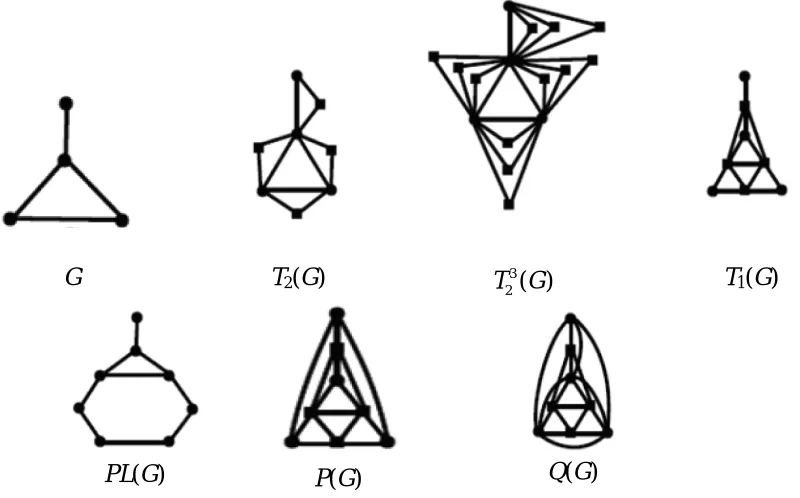
In Figure 1 self-explanatory examples of these derived graphs are depicted.
G T2(G) T23(G) T1(G)
PL(G) P(G) Q(G)
Figure 1. Various graphs derived from the graph G and T23
G is k-th semitotal-point graph of G for k = 3.The vertices of derived graphs depicted in Figure 1 except from the paraline graph
PL, corresponding to the vertices of the parent graph G, are indicated by circles. The vertices of these graphs corresponding to the edges of the parent graph G are indicated by squares. In this paper we obtain neighbourly irregular derived graphs.
Theorem 2.1 [12] Let G be a graph. The subdivision graph S(G) is NI if and only if G does not have any vertex of degree two.
Theorem 2.2 [12] For any graph G, its line graph L(G) is NI graph if and only if N(u) contains all vertices of different degree for all u V(G).
Theorem 2.3 [2] If G is NI graph, then G is not NI graph.
Theorem 2.4 [12] If G is NI graph, then L(G) is not NI graph.
3.
R
ESULTSTheorem 3.1 For any graph G, the semitotal-point graph T2(G) is NI if and only if G is NI
graph and no vertex of degree one is in G.
Proof. Suppose G is NI graph and no vertex of degree one is in G. In T2(G), let e = xy be
an edge. Then x, y V(G) or x V(G) and y E(G).
(a) x, y V(G). Since dG(x) dG(y), dT2 G
x 2dG
x 2dG
y dT2 G
y .(b) x V(G) and y E(G). Since no vertex of degree is one in G and dT2 G
y 2,
x 2d
x 2 d
ydT2G G T2G . Thus from all the cases T2(G) is NI graph.
Conversely, suppose G is not NI graph. Then dG(x) = dG(y) for some vertices x and y
are adjacent in G. So, dT2 G
x dT2 G
y . A contradiction to T2(G) is NI graph. SupposedG(v) = 1 for some v V(G). Let e = vy be an edge in T2(G). Then
v 2d
v 2 d
ydT2G G T2G . Again a contradiction to T2(G) is NI graph. □
Theorem 3.2 For any graph G, the kth semitotal-point graph is NI if and only if G is NI graph and k ≥ 2.
Proof. The proof of this theorem is similar to the proof of the Theorem 3.1, so is omitted. □
Theorem 3.3 For any graph G, its T1(G) is NI if and only if L(G) is NI graph.
Proof. Suppose L(G) is NI graph. In T1(G), let e = xy be an edge. Then x, y E(G) or x
V(G) and y E(G).
(a) x, y E(G). Let x = vivj and y = vivk, so that x and y are adjacent in T1(G). Since L(G)
is NI graph, we have dL G
x dL G
y , dG(vi) + dG(vj) – 2 dG(vi) + dG(vk) – 2 or dG(vi) + dG(vj) dG(vi) + dG(vk). Therefore dT1 G
x 2dT1 G
y .(b)x V(G) and y E(G). Let e = xy = viej for some vi V(G) and ej E(G). Therefore
G
T1 G
i G
i 1T x d v d v
d and dT1 G
y dT1 G ej dG
vi dG
vk where ej = vivk dG(vi) as dG
vk 0dG
x dT1 G
x . Therefore for every pair of adjacent vertices inT1(G) have different degree. Thus T1(G) is NI graph.
Conversely, suppose L(G) is not NI graph. Then dL(G)(ei) = dL(G)(ej) for some ei = vrvs
and ej = vrvk are adjacent vertices in L(G). Hence, dG(vr) + dG(vs) – 2 = dG(vr) + dG(vk) – 2,
dG(vr) + dG(vs) = dG(vr) + dG(vk). Therefore dT1 G
ei dT1 G ej . A contradiction to T1(G) isFrom Theorems 2.4, 2.5 and 3.3, we have the following corollaries.
Corollary 3.4 If G is NI graph, then T1(G) is not NI graph.
Corollary 3.5 For each integer k ≥ 1, there exists a graph G with maximum degree ∆(G) = k such that T1(G) is NI graph.
Theorem 3.6 For any graph G K2, the paraline graph PL(G) is not NI graph.
Proof. Let v be a vertex of degree at least two in G. Then neighbourhood of v in S(G) has at least two vertices of degree two. By Theorem 2.2, L(S(G))=PL(G) is not NI graph. □
Theorem 3.7. For any graph G K2, the quasi-total graph P(G) is not NI graph.
Proof. Let G K2 be a graph. We have the following cases:
Case 1. If G is not a complete graph, then there exist at least two vertices u, v V(G) such that dP(G)(u) = dP(G)(v) = n – 1. Therefore P(G) is not NI graph.
Case 2. If G is a complete graph, then there exist at least two edges ei, ej E(G)
such that dP(G)(ei) = dP(G)(ej). Therefore P(G) is not NI graph. □
Theorem 3.8 For any graph G with n vertices, the quasivertex-total graph Q(G) is NI if and only if G, Gand L(G) all are NI graphs and ∆(G) n –1.
Proof. Suppose G, Gand L(G) all are NI graphs. In Q(G), let e = xy be an edge, then x, y V(G) or x, y V(G) or x, y E(G) or x V(G) and y E(G).
(a) x, y V(G). Since dG(x) dG(y), dQ(G)(x) = n – 1 + dG(x) n – 1 + dG(y) = dQ(G)(y). (b) x, y V(G). Since dG(x) dG(y), dQ(G)(x) = n – 1 + dG(x) n – 1 + dG(y) = dQ(G)(y).
(c) x, y E(G). Let x = vivj and y = vivk. So that x and y are adjacent in Q(G). Therefore
dQ(G)(x) = dG(vi) + dG(vj) and dQ(G)(x) = dG(vi) + dG(vk). But dL(G)(x) dL(G)(y) as L(G)
is NI graph, dL(G)(x) = dG(vi) + dG(vj) – 2 and dL(G)(y) = dG(vi) + dG(vk) – 2. Therefore
dQ(G)(x) dQ(G)(y).
(d) x V(G) and y E(G). Let e = xy = viej for some vi V(G) and ej E(G). Then
dQ(G)(y) = dQ(G)(ej) = dL(G)(ej) + 2 where ej = vivj = dG(vi) + dG(vj) n – 1 + dG(vi) as
∆(G) n –1 dQ(G)(x). Thus in all the cases Q(G) is NI graph.
Conversely, suppose Q(G) is NI graph. We have to prove that G, Gand L(G) are all NI graphs. If G is not NI graph, then there exists an edge ek = vivj in G such that dG(vi) =
to Q(G) is NI graph. Suppose G is not NI graph, then there exists an edge ek = vivj in G
such that dG(vi) = dG(vj). Therefore n – 1 + dG(vi) = n – 1 + dG(vj) and so dQ(G)(vi) =
dQ(G)(vj). A contradiction to Q(G) is NI graph.
Suppose L(G) is not NI graph, then there exists two adjacent vertices ei = vrvs and
ej = vrvk in L(G) with dL(G)(ei) = dL(G)(ej). Thus dG(vr) + dG(vs) – 2 = dG(vr) + dG(vk) – 2.
Hence dG(vr) + dG(vs) = dG(vr) + dG(vk) and so dQ(G)(ei) = dQ(G)(ej). Again a contradiction to
Q(G) is NI graph. Suppose ∆(G) = n –1 = dG(v) and let e =uv be an edge. Then dQ(G)(e) =
dQ(G)(u). Again a contradiction to Q(G) is NI graph. □
From Theorems 2.3, 2.4 and 3.8 we have following result.
Theorem 3.9 There is no nontrivial graph G whose quasivertex-total graph Q(G) is NI graph.
4.
N
EIGHBOURLYI
RREGULARG
RAPHP
RODUCTSThe corona [10] of two graphs G and H is the graph obtained by taking one copy of G, |V(G)| copies of H and joining each i-th vertex of G to every vertex in the i-th copy of H. The edge corona [5] of two graphs G and H denoted by G H is obtained by taking one copy of G and |E(G)| copies of H and joining each end vertices of i-th edge of G to every vertex in the i-th copy of H.
Theorem 4.1 Let G and H be nontrivial graphs. Then G H is NI graph if and only if both G and H are NI graphs and, G does not have pendent vertex or ∆(H) < |V(H)| – 1, where ∆(H) is the maximum degree of the vertices of H.
Proof. To prove the result, we have to present some notations. Let G be the copy of G and Hi be the i-th copy of H in G H, 1 i |E(G)|. A vertex of G H corresponding to the
vertex u in H is denoted by u. Also, we denote a vertex of G H corresponding to the vertex v in G by v.
Let G and H be NI graphs and, G does not have pendent vertex or ∆(H) < |V(H)| – 1. Then it is clear that G H is NI graph.
Conversely, let G and H be two nontrivial graphs and G H is NI graph. Suppose uv E(G H ) such that u, v V(Hi), then dG H(u) – dG H (v) = dH (u) – dH(v) 0 and
so H is NI graph. Also, if uv E(G H ) such that u, v V(G), then dG H(u) – dG
H(v) = (|V(H)| + 1)(dG(u) – dG(v)) 0. Thus, G is NI graph. On the other hand, if uv
dG(u) – (dH(v) + 2) 0 and it shows that, G does not have pendent vertex or ∆(H) < |V(H)|
– 1. □
To present the next results, we need two definitions as follows: The cluster G{H} is obtained by taking one copy of G and |V(G)| copies of a rooted graph H, and by identifying the root of the i-th copy of H with the i-th vertex of G, i = 1, 2, …, |V(G)| [11].
Suppose G and H are graphs with disjoint vertex sets. Following Došlić [3], for given vertices y V(G) and z V(H) a splice of G and H by vertices y and z, (G H) (y, z), is defined by identifying the vertices y and z in the union of G and H.
Theorem 4.2 Let G and H be graphs. Then G{H} is NI graph if and only if both G and (H
ui G d
S )(r, x) are NI graphs, for each i = 1, 2, …, |V(G)|, where x is the vertex with maximum degree of the star SdG ui and r the root vertex of H.
Proof. Let G and (H
i u G d
S ) (r, x) be NI graphs, for each i = 1, 2, …, |V(G)|, where x is the vertex with maximum degree of the star SdG ui and r the root vertex of H. Then, it is
clear that G{H} is NI graph.
Conversely, let G{H} be NI graph. Also, suppose uv E(G{H}) and u, v are the vertices of G{H} corresponding to the vertices u, v in G, respectively. If u and v are vertices of a copy of G, then dG{H}(u' ) – dG{H}(v ) = dG(u) – dG(v) 0. So G is NI graph.
On the other hand, suppose uv E(G{H}) and u, v are the vertices of G{H} Hi
corresponding to the vertices u, v in H, respectively. Then, it is not difficult to see that dG{H}(u) – dG{H}(v) 0 if and only if
u d
v 0d r,x
i u G d S H x r, i u G d S
H .
So, (H
i u G d
S )(r, x) is NI graph. □
A
CKNOWLEDGMENT.
The research of second author is supported by UGC-UPE (Non-NET)-Fellowship, K. U. Dharwad, No. KU/Sch/UGC-UPE/2014-15/897, dated: 24 Nov 2014. The research of third author is supported by UGC- National Fellowship (NF) New Delhi. No. F./2014-15/NFO-2014-15-OBC-KAR-25873/(SA-III/Website) Dated: March-2015. The research of fifth author is supported by the University of Kashan under grant number 464092/69.R
EFERENCESOellermann, Highly irregular graphs, J. Graph Theory11 (1987) 235–249.
2. S. G. Bhragsam, S. K. Ayyaswamy, Neighbourly irregular graphs, Indian J. Pure Appl. Math.35(3) (2004) 389–399.
3. T. Došlić, Vertex-weighted Wiener polynomials for composite graphs, Ars Math. Contemp.1 (2008) 66–80.
4. F. Harary, Graph Theory, Addison-Wesley Publishing Co. Inc., Reading, Mass., 1969.
5. Y. Hou, W-C. Shiu, The spectrum of the edge corona of two graphs, Electron. J. Linear Algebra20 (2010) 586–594.
6. S. R. Jog, S. P. Hande, I. Gutman, S. B. Bozkurt, Derived graphs of some graphs,
Kragujevac J. Math.36(2) (2012) 309–314.
7. V. R. Kulli, B. Basavanagoud, On the quasivertex-total graph of a graph, J. Karnatak Uni. Sci.42 (1998) 1–7.
8. E. Sampathkumar, S. B. Chikkodimath, Semitotal graphs of a graph-I, J. Karnatak Uni. Sci.18 (1973) 274–280.
9. D. V. S. Sastry, B. Syam Prasad Raju, Graph equations for line graphs, total graphs, middle graphs and quasi-total graphs, Discrete Math.48 (1984) 113–119. 10.M. Tavakoli, F. Rahbarnia, A. R. Ashrafi, Studying the corona product of graphs
under some graph invariants, Trans. Comb. 3(3) (2014) 43–49.
11.Y. N. Yeh, I. Gutman, On the sum of all distances in composite graphs, Discrete Math.135 (1994) 359–365.