Dorota Waśko-Czopnik
1, A–D, Paweł Jóźków
2, A–D, Katarzyna Dunajska
2, A–D,
Marek Mędraś
2, E, Leszek Paradowski
1, E–FAssociations Between the Lower Esophageal
Sphincter Function and the Level of Physical Activity
Wzajemne zależności między czynnością dolnego zwieracza przełyku
i poziomem aktywności fizycznej
1 Department of Gastroenterology and Hepatology Wroclaw Medical University, Poland 2 University School of Physical Education in Wroclaw, Poland
A – research concept and design; B – collection and/or assembly of data; C – data analysis and interpretation;
D – writing the article; E – critical revision of the article; F – final approval of article; G – other
Abstract
Background. Gastroesophageal reflux disease (GERD) is a very frequent and multifactorial disease. It has been found that GERD is associated with obesity, smoking, esophagitis, diet and lifestyle. Physical activity is among the factors involved in the occurrence of GERD.
Objectives. The aim of the study was to evaluate the associations between the different parameters of lower esopha-geal pressure (LES) and the level of everyday physical activity in patients with GERD.
Material and Methods. The authorsexamined 100 consecutive patients who underwent manometry and pH-metry because of symptoms suggesting GERD. Physical activity was assessed by means of the International Physical Activity Questionnaire (IPAQ). In accordance with IPAQ categorical scoring, the authors divided the studied sub-jects into 3 groups according to their level of physical activity. The investigation comprised 59 men and 41 women, with the mean age 49 ± 14 years.
Results. The authors analyzed the relationships between the LES parameters (pressure, total LES length and HPZ length) and physical activity. The authors did not find any significant correlations between the studied parameters and the amount of physical activity. The authors also did not observe any association between the LES pressure and the level of physical activity. The subgroups distinguished on the basis of LESP did not differ as to the amount of everyday physical activity as well.
Conclusions. Although most data indicates that intense exercise exacerbates GERD symptoms, the authors did not find any associations between LES parameters and physical activity. In view of the present results maintaining the recommended level of everyday physical activity does not interfere with the mechanisms of GERD (Adv Clin Exp Med 2013, 22, 2, 185–191).
Key words: LES pressure, physical activity, reflux disease.
Streszczenie
Wprowadzenie. Choroba refluksowa przełyku (GERD) jest częstym schorzeniem o charakterze polietiologicznym. Uważa się, że jest związana z otyłością, paleniem tytoniu, dietą, zapaleniem przełyku i trybem życia. Także aktyw-ność fizyczna jest jednym z czynników odpowiedzialnych za dolegliwości o typie GERD.
Cel pracy. Ocena zależności między parametrami dolnego zwieracza przełyku a poziomem codziennej aktywności fizycznej u pacjentów z GERD.
Materiał i metody. Zbadano 100 kolejnych pacjentów poddanych manometrii przełykowej i pH-metrii z powodu podej-rzenia GERD. Aktywność fizyczna była oceniana za pomocą skróconej wersji Międzynarodowego Kwestionariusza Aktywności Fizycznej (IPAQ), na postawie którego pacjentów podzielono na trzy grupy w zależności od nasilenia aktywności fizycznej. Badaniem objęto 59 mężczyzn i 41 kobiet, a średni wiek wynosił 49 ± 14 lat.
Wyniki. Analizowano korelacje między parametrami dolnego zwieracza przełyku (ciśnienie, całkowita długość, długość odcinka śródbrzusznego) a aktywnością fizyczną. Nie odnotowano żadnych istotnych zależności między badanymi parametrami a aktywnością fizyczną.
Adv Clin Exp Med 2013, 22, 2, 185–191 ISSN 1899–5276
ORIGINAL PAPERS
The reflux of the gastric contents into the eso- phagus is a normal physiological event, but when the reflux causes symptoms or physical complica-tions the authors think about the gastro-esopha-geal reflux disease (GERD).
GERD is a multifactorial process [1]. In most patients the reflux disease results from an excessive exposure of the esophagus to the refluxed gastric contents, which is usually associated with a dysfunc-tion of the lower esophageal sphincter (LES) and the motility disorders of the corpus of the esophagus.
The prevalence of GERD appears to be highest in North America and Europe, whereas data from the Indian subcontinent, Africa, South America and the Middle East is sparse [2]. Epidemiological surveys show that GERD occurs in 14% of Rus-sians [4], 13% Japanese, 21–29% of Finish, 31% of Norwegians and up to 44% of Italians [5].
Nearly a quarter of the Italian population experi-ences GERD symptoms on at least 2 days of the week [6]. Typical symptoms are reported weekly by 5% of Japanese, 10% of French and about 20% of Ameri-cans [5]. According to some estimates the reflux disease decreases the quality of life comparably to ischemic heart disease, mild heart failure, diabetes or back pain [5]. What seems intriguing is that GERD-related symptoms suggest a worldwide increase in prevalence of approximately 4% per year [3].
It has been found that GERD is associated with obesity, smoking, esophagitis, diet and lifestyle [7]. Physical activity is among the factors involved in the occurrence of GERD [5, 8].
The major functional component of the gastro-esophageal junction, which prevents the reflux of the gastric content into the esophagus, is the intrin-sic tone of the lower esophageal sphincter. Other factors, such as the extrinsic squeeze of the LES seg-ment by the diaphragmatic crura, play a secondary role [9, 10]. For a long time it has been believed that the dysfunction of LES is the major cause of GERD. Nowadays, the authors know that the transient low-er esophageal sphinctlow-er relaxation (tLESR) is the main mechanism underlying the acid reflux in both healthy subjects and in patients with GERD [11]. About 50% of all reflux episodes occur during LES relaxations, but tLESR are usually of longer dura-tion than swallow-induced LES relaxadura-tions and last for 5–30 seconds. Their occurrence is unrelated to the basal lower esophageal sphincter pressure [12]. They are neutrally mediated and are independent
from the passive mechanical distraction of the gas-troesophageal junction (GJ), but must occur before the GJ can open [13]. In healthy subjects, the rate of the acid reflux during tLESR is more frequent at the proximal margin of the LES and this rate is not increased in patients with the reflux disease. These findings indicate that GERD is not a disorder of tLESR and it relates more to the proximal extend of the reluxate [14]. However, when tLESR occur in patients, they are twice as likely to be associated with acid reflux [15]. The lower esophageal sphinc-ter pressure may be considered as a natural barrier between the negative pressure in the intrathoracic cavity and the positive pressure in the intraabdomi-nal cavity. Normal LES pressure and the adequate intraabdominal LES length are sufficient to pre-vent reflux from the stomach into the esophagus. The normal value of the LES pressure is between 10 and 35 mm Hg. The LES pressure between 5 and 10 mmHg is enough to protect against reflux. The total length of the LES is 3 to 5 cm, involving the 2–2.5 cm intra-abdominal part of the LES, which is called the high-pressure zone (HPZ). If this part of the LES is shorter or longer than normal, there is a high probability of reflux. During physical exer-cise an increase of the intraabdominal pressure may produce frequent reflux episodes by overcoming the LES pressure, stimulate transient LESR especially in subjects with a hypotensive LES or with abnormal length of the HPZ [16]. It is well known that strenu-ous exercise exacerbates symptoms of the reflux dis-ease [16, 17]. Relationships between general motor activity and GERD have not been elucidated so far. The aim of the study was to evaluate associa-tions between the pressure of the lower esophageal sphincter, the length of the LES, the length of the HPZ and the level of everyday physical activity in patients with the reflux disease.
Material and Methods
The authors examined one hundred consecu-tive patients who underwent manometry and pH-metry because of symptoms suggesting GERD for at least 3 prior months. Before the investi-gation the enrolled subjects could not take any medications that potentially change the pH-metry and manometry results (prokinetic drugs, pro-ton pomp inhibitors for at least 14 days and H2
-Wnioski. Mimo iż wiele danych wskazuje, że intensywność wysiłku fizycznego nasila dolegliwości GERD, na podsta-wie wyników badań własnych nie potpodsta-wierdza się zależności między parametrami LES a aktywnością fizyczną. Poziom codziennego wysiłku fizycznego nie powinien wpływać na objawy GERD (Adv Clin Exp Med 2013, 22, 2, 185–191).
blockers for at least 7 days before the examina-tion). Each patient gave an informed consent to the study. Diagnostic procedures were performed in the Department of Gastroenterology and Hepa-tology of the Wroclaw Medical University during 24-hour intraesophageal pH-metry with use of the Digitrapper pH 400, with previously performed esophageal manometry. During manometry the authors estimated the lower esophageal sphincter pressure (LESP), the corpus manometry, the upper esophageal sphincter pressure (UESP), and the up-per border of LES (necessary for precise pH cath-eter fixation). Esophageal manometry was done with the use of a water-filled four channels cath-eter (Medtronic, Synecpol) and processed with the Upper Polygraph Software. The manometry catheter was placed transnasally into the esopha-gus with estimation of the LES localization and its measurement. PH-metry was done with the use of dual antimony pH electrodes with 10 cm spacing between them and with one electrode located at the tip. The data from the recorder was transferred to a computer and analyzed with dedicated soft-ware (Medtronic, Synecpol). GERD was diagnosed when: the total time pH < 4 was 3.4% (the upper border for the present laboratory), DeMeester score was above 14.75, the total number of refluxes was over 20 and the pathological duration of re-fluxes was confirmed (longer than 5 min).
Physical activity of the studied subjects was as-sessed with use of a short form International Physi-cal Activity Questionnaire (IPAQ, last 7 days rePhysi-call) [http://www.ipaq.ki.se/] before manometry and pH-metry. In accordance with IPAQ categorical scor-ing the authors divided studied subjects into three groups according to their level of physical activity: group I – low, group II – medium and group III – high. Patients from group III group moved at least 12,500 steps a day or the equivalent in moderate or vigorous activities, which means that this is at least an hour more moderate intensity activity over and above the basal level of activity or half an hour of vig-orous intensity activity over and above basal levels daily. By the basal levels IPAQ suppose 5,000 steps/ day. Patients in group II had half an hour of at least moderate intensity activity on most days and subjects from group I did not meet any of the above criteria.
The investigation comprised 59 men and 41 women. The mean age of the studied subjects was 49 ± 14 years. In group I it was 54 ± 13, in group II 50 ± 14 and in group III 43 ± 13. The mean body mass index (BMI) was 26.5 ± 4 (kg/m2). Patients
from group III were insignificantly taller and slim-mer (174 ± 10 cm, 75.7 ± 14 kg) than patients from group I (169 ± 8 cm, 76.3 ± 14 kg) and group II (170 ± 8 cm, 76.5 ± 15 kg). Alcohol drinking was reported by 15% of patients from group I and 26%
from groups II and III. Forty-four patients (44%) had jobs in which duties involved some physical effort. The level of physical activity reached 400 ± 410 (METs-minute/week) in group I, 1980 ± 1640 in group II and 8190 ± 4320 in group III.
The statistical analysis was performed with the use of Statistica 8.0 (2007, StatSoft Inc., USA). The normality of distribution was assessed by the Sha-piro-Wilk test. The data with distribution deviating from normal was successfully transformed using log base 10 (BMI, METs-minute/week) or radical (HPZ length). For evaluation of relationships between ev-eryday physical activity and the parameters of the esophageal manometry the analysis of variance (ANOVA) was performed. In order to determine correlations among studied parameters, Pearson correlation analysis was carried out. Quantitative variables were assessed in c2 test. The level of
statis-tical significance was determined at p < 0.05.
Results
The authors found that the LES pressure was between 2 and 73 mm Hg (mean ± SD: 28.26 ± 16.12). In 63 patients it was within the normal range, in 31 – above and in 16 – below. The total length of LES was between 1 and 82 mm (mean ± SD: 34.08 ± 12.75). It was shorter than normal in 36 patients, longer – in 8 and normal in 56 patients. The HPZ was between 1 and 26 mm (mean ± SD: 12.25 ± 5.87). Physiological limits were not exceed-ed in 10 patients, while in 86 the HPZ was shorter than normal and in 4 patients – longer (Tab. 1).
Table 1. Parameters describing the lower esophageal sphincter (LES) (LESP – lower esophageal sphincter pres-sure, HPZ – high pressure zone)
Tabela 1. Parametry charakteryzujące dolny zwieracz przełyku (LES – lower esophageal sphincter) (LESP – ciśnienie dolnego zwieracza przełyku, HPZ – strefa wzmożonego ciśnienia)
Parameter
(Parametr) Number of subjects (Liczba osób badanych) below
the normal range
above the normal range
within nor-mal range LESP [mm Hg]
(Ciśnienie LES) 16 31 63
Total LES length [mm]
(Całkowita długość LES) 36 8 56
HPZ [mm]
(Strefa wzmożonego ciśnienia)
Fig. 1. Parameters of the LES (means) in the distinguished groups of differ-ent level of physical activity: I – low, II – medium, III – high (LES – lower esophageal sphincter, HPZ – high pres-sure zone)
Ryc. 1. Parametry LES (średnie) w poszczególnych grupach pacjentów w zależności od stopnia aktywności fizycznej: I – niska, II – średnia, III – wysoka (LES – dolny zwieracz przełyku, HPZ – strefa wysokiego ciśnienia)
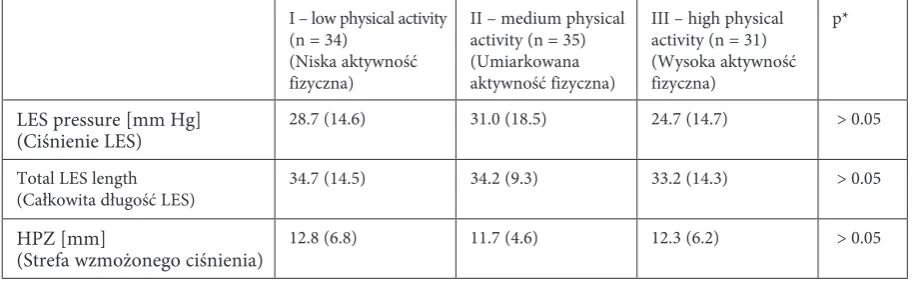
Table 2. The LES parameters in groups characterized by different physical activity levels Tabela 2. Parametry LES w grupach o różnym poziomie aktywności fizycznej
I – low physical activity (n = 34)
(Niska aktywność fizyczna)
II – medium physical activity (n = 35) (Umiarkowana aktywność fizyczna)
III – high physical activity (n = 31) (Wysoka aktywność fizyczna)
p*
LES pressure [mm Hg]
(Ciśnienie LES) 28.7 (14.6) 31.0 (18.5) 24.7 (14.7) > 0.05
Total LES length
(Całkowita długość LES) 34.7 (14.5) 34.2 (9.3) 33.2 (14.3) > 0.05
HPZ [mm]
(Strefa wzmożonego ciśnienia) 12.8 (6.8) 11.7 (4.6) 12.3 (6.2) > 0.05
Data presented as mean (SD); LES – lower esophageal sphincter; HPZ – high pressure zone.
Przedstawione dane oznaczone jako średnie (SD); LES – dolny zwieracz przełyku; HPZ – strefa wzmożonego ciśnienia. * p – in ANOVA.
The authors analyzed the relationships be-tween the LES parameters (pressure, total LES length and HPZ length) and physical activity in the three distinguished groups of patients. The authors did not find any significant correlations between the studied parameters and the amount of physical activity (Fig. 1, Tab. 2).
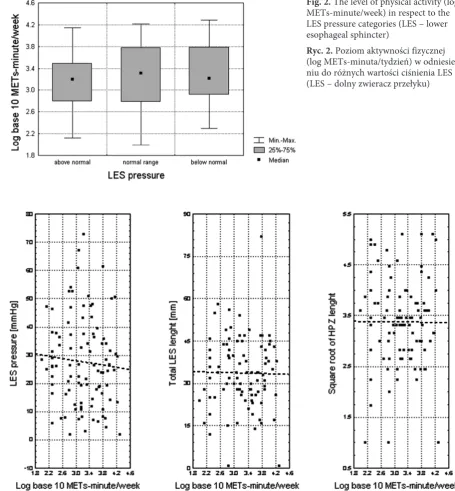
The authors also did not observe any asso-ciation between the LES pressure and the level of physical activity. The subgroups distinguished on the basis of LES pressure did not differ as to the amount of everyday physical activity as well (Figs. 2 and 3).
Discussion
GERD is a multifactorial process defined by either subjective complaints indicative of prob-lematic gastroesophageal reflux or objective com-plications directly attributable to reflux. [1, 3]. In
most patients the reflux disease is usually associ-ated with the dysfunction of the lower esophageal sphincter (LES) and the motility disorders of the corpus of the esophagus.
GERD is an increasing problem in devel-oped countries. Studies focused on GERD and its complications suggest a worldwide increase in its prevalence of approximately 4% per year [3]. Epidemiologic data and numerous studies indicate that GERD is associated with obesity, smoking, esophagitis, diet and lifestyle [3, 7]. Regular exer-cise is recommended for a healthy lifestyle, but it can be also an underestimated factor involved in the occurrence of GERD [5, 8].
sphinc-ter relaxations (tLESR) as the main mechanism underlying the acid reflux in both healthy subjects and in patients with GERD [11].
The LES pressure is a natural barrier between the pressures in the intrathoracic and in the in-traabdominal cavity (divided by the diaphragm). During physical exercise intraabdominal pressure increases. It may produce frequent reflux episodes and GERD symptoms [16, 17].
Peters et al. tried to establish the incidence of
gastrointestinal symptoms during prolonged ex-ercise of lower intensity. For 4 consecutive days the patients noticed information on: incidence, duration and severity of symptoms while walking a total distance of 203 km for men and 164 km for women. The results showed that 24% of the subjects experienced one or more symptoms (the most frequent were: nausea, headache, flatulence). Logistic regression analysis revealed that the oc-currence of gastrointestinal (GI) symptoms was
Fig. 2. The level of physical activity (log METs-minute/week) in respect to the LES pressure categories (LES – lower esophageal sphincter)
Ryc. 2. Poziom aktywności fizycznej (log METs-minuta/tydzień) w odniesie-niu do różnych wartości ciśnienia LES (LES – dolny zwieracz przełyku)
Fig. 3. Pearson’s linear correlation of the LES parameters and physical activity expressed as METs-minute/week (p > 0.05) (LES – lower esophageal sphincter, HPZ – high pressure zone)
a significant exercise-limiting factor. Relationships between GERD symptoms and age, gender, train-ing status and walktrain-ing speed were not confirmed [19].
GI disturbances are common amongst long-distance runners and their etiology is still un-known. Riddoch et al. investigated the prevalence of GI disturbances in marathon runners. After the Belfast City Marathon in the 1986, 471 of the competitors completed a questionnaire assessing the occurrence of the gastrointestinal symptoms during running. 83% of the respondents indicated that they occasionally or frequently suffered from one or more GI symptoms during or immediately after running. The most common ailments were bowel movements (53%) and diarrhea (38%), es-pecially among female runners (74% and 68% respectively). Symptoms from the upper GI tract were experienced more frequently by women than men and by younger rather than older runners. Both upper and lower GI symptoms were more common during a “hard” run than an “easy” run and were equally as common both during and af-ter running. Of those runners who suffered from GI disturbances, 72% thought that running was the cause and 29% believed their performance to be adversely affected [20].
Sullivan et al. also tried to look for correla-tions between running and lower and upper GI tract complaints by asking runners on their diet. The authors concluded that runners ate more fi-ber and had more frequent bowel movements that were more often loose. Heartburn, vomiting and bloating were more common when not training while retching; stitches and fecal incontinence were more common when running [21].
In another study Peters et al. tried to deter-mine the prevalence of exercise-related GI symp-toms among long-distance runners, cyclists, and triathletes. A questionnaire covering the preceding 12 months was sent to 606 well-trained endurance type athletes: 199 runners (114 men and 85 wom-en), 197 cyclists (98 men and 99 womwom-en), and 210 triathletes (110 men and 100 women). Symptoms were evaluated with respect to the upper (nausea, vomiting, belching, heartburn, chest pain) and the lower part of the GI tract (bloating, GI cramps, side ache, urge to defecate, defecation, diarrhea). It turned out that the runners experienced more often lower (prevalence 71%) than upper (36%) GI symptoms during exercise, the cyclists
experi-enced similar amount of upper (67%) and lower (64%) symptoms, triathletes during cycling had both upper (52%) and lower (45%) symptoms, and during running more often lower (79%) than up-per (54%) GI symptoms. Bloating, diarrhea, and flatulence occurred more frequently at rest than during exercise. In general, exercise-related GI symptoms were significantly related to: the occur-rence of GI symptoms during nonexercise periods, age, gender, diet and years of training. In conclu-sion it was stated that long-distance running is as-sociated mainly with lower GI symptoms, whereas cycling is associated with both upper and lower symptoms, but triathletes confirm this pattern during cycling and running [22].
In yet another trial of the same research group ambulant pH-metry was performed in 14 runners suffering from GERD symptoms. During exercise there were observed significantly longer reflux ep-isodes and they occurred more frequently. Seven subjects reported heartburn, regurgitation and/ or chest pain during exercise (irrespective of re-ceiving omeprazole). The authors concluded that running-induced acid reflux, but not symptoms, probably because most symptoms were not related to acid reflux [23].
The relationship between overall physical ac-tivity and GERD is ambiguous. The authors still do not know the primary factor causing GERD. It is quite probable that the dysfunction of the LES is not the most important mechanism of the disease. Maybe transient lower esophageal sphincter relax-ation (tLESR) is the main mechanism underlying the acid reflux in healthy subjects, in patients with GERD [11] and also during physical activity?
According to the present data there are no significant associations between the pressure of LES, the length of LES, the length of HPZ and the level of everyday physical activity in patients with GERD. The authors have found that tLESR oc-currences are unrelated to the basal LES pressure [12] and they are independent from the resting LES pressure. They probably occur before the LES opens [13].
Although most data indicates that intense ex-ercise exacerbates GERD symptoms, the authors did not find any associations between LES param-eters and physical activity. In view of the present results maintaining the recommended level of ev-eryday physical activity does not interfere with the mechanisms of GERD.
References
Dodds WJ, Hogan WJ, Helm JF et al.:
[1] Pathogenesis of reflux esophagitis. Gastroenterology 1981, 87, 376–394.
Sharma P,
Pandolfino JE,
[3] Kwiatek MA, Kahrilas PJ: The pathophysiologic basis for epidemiologic trends in gastroesopha-geal reflux disease. Gastroenterol Clin North Am 2008, 37, 827–843.
Lazebnik LB, Vasil’ev IuV, Masharova AA et al.:
[4] Prevalence of gastroesophageal reflux disease in Moscow: results of a population study. Ter Arkh 2008, 80(8), 66–68.
Jóźków P, Waśko-Czopnik D, Dunajska K et al.:
[5] The relationship between gastroesophageal reflux disease and the level of physical activity. Swiss Med Wkly 2007, 137, 465–470.
Zagari RM, Fuccio L, Wallander MA et al.:
[6] Gastro-oesophageal reflux symptoms, oesophagitis and Barrett’s oesophagus in the general population: the Loiano-Monghidoro study. Gut 2008, 57(10), 1354–1359.
Dore MP
[7] , Maragkoudakis E, Fraley K et al.: Diet, lifestyle and gender in gastro-esophageal reflux disease. Dig Dis Sci 2008, 53(8), 2027–2032.
Jóźków P, Waśko-Czopnik D, Dunajska K et al.:
[8] Gastroesophageal reflux disease and physical activity. Sports Med 2006, 36, 385–391
Boyle JJ, Altschuler SM, Nixon TE et al.:
[9] Role of diaphragm in the genesis of lower esophageal sphincter pressure in the cat. Gastroenterology 1985, 88, 723–728.
Mittal RK, Rochester DF, McCallum RW:
[10] Effect of the diaphragmatic contraction on lower esophageal sphincter pressure in man. Gut 1987, 28, 1564–1571.
Iwakiri K, Tanaka Y, Kawami N et al.:
[11] Pathophysiology of gastroesophageal reflux disease: motility factors. Nippon Rinsho 2007, 65, 829–835.
Holloway R:
[12] Motor defects in gastroesophageal diseases. In: Pharmacotherapy of gastrointestinal motor disorders. Edit: Dent J Sydney 1991, 145–155.
Massey BT, Simuncak C, LeCapitaine-Dana NJ et al.:
[13] Transient lower esophageal sphincter relaxations do not result from passive opening of the cardia by gastric distension. Gastroenterology 2006, 130, 89–95.
Iwakiri K, Hayashi Y, Kotoyori M et al.:
[14] Transient lower esophageal sphincter relaxations (TLESRs) are the major mechanism of gastroesophageal reflux but are not the cause of reflux disease. Dig Dis Sci 2005, 50, 1072–1077.
Trudgill NJ, Riley SA:
[15] Transient lower esophageal sphincter relaxations are no more frequent in patients with gastroesophageal reflux disease than in asymptomatic volunteers. Am J Gastroenteol 2001, 96, 2569–2574.
Collings KL, Pierce Pratt F, Rodriguez-Stanley S et al.:
[16] Esophageal reflux in conditioned runners, cyclists and weightlifters. Med Sci Sport Exerc 2003, 35, 730–735.
Pandolfino JE, Bianchi LK, Lee TJ et al.:
[17] Esophagogastric junction morphology predicts susceptibility of exer-cise-induced reflux. Am J Gastroenterol 2004, 99, 1430–1436.
Stein HJ, Korn O, Liebermann-Meffert D:
[18] Manometric vector volume analysis to assess lower esophageal sphinc-ter function. Ann Chir Gynaecol 1995, 84, 151–158.
Peters HP, Zweers M, Backx FJ et al.:
[19] Gastrointestinal symptoms during long-distance walking. Med Sci Sports Exerc. 1999, 31, 767–773.
Riddoch C, Trinick T:
[20] Gastrointestinal disturbances in marathon runners. Br J Sports Med 1988, 22, 71–74.
Sullivan SN, Wong C, Heidenheim P:
[21] Does running cause gastrointestinal symptoms? A survey of 93 randomly selected runners compared with controls. N Z Med J 1994, 24, 107, 328–331.
Peters HP, Bos M, Seebregts L et al.:
[22] Gastrointestinal symptoms in long-distance runners, cyclists, and triathletes: prevalence, medication, and etiology. Am J Gastroenterol 1999, 94, 1570–1581.
Peters HP, De Kort AF, Van Krevelen H et al.:
[23] The effect of omeprazole on gastro-oesophageal reflux and symp-toms during strenuous exercise. Aliment Pharmacol Ther 1999, 13, 1015–1022.
Address for correspondence:
Dorota Waśko-Czopnik
Department of Gastroenterology and Hepatology Wroclaw Medical University
Borowska 213 50-556 Wrocław Poland
Tel.: +48 71 733 21 55 e-mail: [email protected]
Conflict of interest: None declared