Regina Sierżantowicz
1, Hady R. Hady
2, Bożena Kirpsza
1, Lech Trochimowicz
1, 2,
Katarzyna Łagoda
3, Jerzy R. Ładny
2, Jacek Dadan
2Results and Post-Operative Complications
in the Surgical Treatment of Morbid Obesity
Ocena wyników leczenia chirurgicznego otyłości olbrzymiej
1Department of Surgical Nursing, Medical University of Białystok, Poland
2 First Department of General and Endocrinological Surgery, Medical University of Białystok, Poland
3 Department of Clinical Medicine, Medical University of Białystok, Poland
Abstract
Background. Obesity is a major medical, social and economic problem. The number of people with a Body Mass
Index (BMI) ≥ 30 kg/m2 tripled from 2000 to 2005, while the number with a BMI ≥ 40 doubled. Surgical treatment
of morbid obesity has been found to be highly effective but the risk of post-operative complications is higher for obese patients than for obese patients than for those of normal weight.
Objectives, Material and Methods. The aim of the study was to evaluate the results of surgical treatment of morbid obesity and to analyze the complications within a six-month period following Laparoscopic Adjustable Gastric Banding (LAGB), sleeve gastrectomy(SG)and Roux-En-Y Gastric Bypass (RYGB)among 108 patients hospitalized at the 1st Department of General and Endocrinological Surgery.
Results. Because BMI was a guiding factor in choosing which surgical treatment to apply, there were some highly significant differences in the pre-operative BMI of the groups scheduled for different forms of surgery: In the group scheduled for RYGB, the patients’ BMIs were higher than in the groups scheduled for LAGB or sleeve gastrectomy. Post-operative changes in BMI were more significant in the RYGB group than in the other two groups. The results presented indicated the occurrence of low rate of complications, which did not exceed values presented in the literature.
Conclusions. The study indicates that LAGB, SG and RYGB are effective methods in achieving reductions in BMI. It was also observed that using minimally invasive methods for bariatric procedures reduces the occurrence of
complications and shortens the hospital stay (Adv Clin Exp Med 2011, 20, 6, 745–752).
Key words: obesity, surgical treatment, post-operative complications.
Streszczenie
Wprowadzenie. Otyłość jest poważnym problemem medycznym, społecznym i ekonomicznym. Liczba osób z
oty-łością, w której BMI ≥ 30 kg/m2 w latach 2000–2005 potroiła się, a z BMI ≥ 40 wzrosła dwukrotnie. W 2004 r. na
konferencji uzgodnień Amerykańskiego Towarzystwa Chirurgii Metabolicznej i Bariatrycznej (ASMBS) uznano, ze chirurgiczne leczenie otyłości jest najbardziej skuteczną terapią otyłości olbrzymiej. W chirurgii bariatrycznej wyróżnia się metody restrykcyjne, restrykcyjno-wyłączające, łączące dwie wymienione metody oraz inne. Działania chirurgiczne stanowią ryzyko wystąpienia powikłań pooperacyjnych, które w znacznym stopniu zagrażają pacjen-tom otyłym, a rzadziej występują u osób szczupłych.
Cel pracy, materiał i metody. Ocena wyników leczenia chirurgicznego otyłości olbrzymiej oraz analiza występo-wania powikłań po LAGB, SG oraz RYGB wśród 108 chorych hospitalizowanych w I Klinice Chirurgii Ogólnej i Endokrynologicznej po 6 miesiącach od wykonania zabiegu.
Wyniki. Stwierdzono wysoko istotną (p = 0,0008) różnicę BMI przed zabiegiem w zależności od późniejszego zabie-gu operacyjnego. BMI w grupie przygotowywanej do zabiezabie-gu RYGB było większe niż w przypadku BMI u osób
przygotowywanych do LAGB lub sleeve gastrectomy, co miało wpływ na wybór takiej metody operacji. Zmiana
BMI w grupie po zabiegu RYGB była większa niż w przypadku zmiany BMI w grupach, którym wykonano zabiegi
LAGB i sleeve gastrectomy. Prezentowane wyniki własne wskazały na wystąpienie niewielkiego odsetka powikłań,
który nie wykracza poza podany w literaturze. Adv Clin Exp Med 2011, 20, 6, 745–752 ISSN 1230-025X
ORIGINAL PAPERS
Obesity is a major medical, social and eco-nomic problem. The number of people with a Body Mass Index (BMI) ≥ 30 kg/m2 tripled from 2000 to 2005, while the number with a BMI ≥ 40 dou-bled [1, 2]. The most dramatic increase in the number of obese people has been noticed during the last fifteen years in the United Sates, and it is currently estimated that 15% of the US population has a problem with obesity [3]. The World Health Organization (WHO) describes obesity as a dis-ease in which the accumulation of excess fat can negatively influence the health [3]. Comorbidities of obesity including type 2 diabetes, hypertension, cardiovascular diseases, depression, sleep apnea syndrome, spondyloarthrosis, osteoarthritis and particular types of tumors, especially cancers of the gastrointestinal tract occur more frequently among the obese. Research has shown that among obese patients, the average life expectancy is sig-nificantly diminished, especially in young patients with co-existing cardiovascular disease [4]. It has been statistically confirmed that in Europe 1 mil-lion deaths per year are caused by comorbidities of obesity and their complications, while in the US the rate is 300 thousand deaths per year. Studies have shown that the risk of death for people with a BMI > 35 is twice as high as the group with a BMI between 20 and 25, and for people with BMI > 40 it increases tenfold [5].
Many strategies have been adopted in the treatment and prevention of morbid obesity. The most common are recommendations concerning lifestyle changes, increasing physical activity, ad-hering to a proper diet and the use of various phar-maceuticals [6]. For slow and gradual loss of body mass (1 kg per week), the caloric value of the daily food ration should be 1000 calories for women and 1200 calories for men [7]. In cases where conser-vative treatment over a period of 2 to 5 years has failed, surgical treatment may be recommended.
At a 2004 consensus conference of the Ameri-can Society for Metabolic and Bariatric Surgery (ASMBS) it was concluded that the most effec-tive therapy for morbid obesity is surgical treat-ment [8]. Bariatric surgery distinguishes three main categories – restrictive (based on a reduction of food intake), malabsorbtive (reducing absorp-tion from the gastrointestinal tract) and restric-tive-malabsorbtive (combining the two afore-mentioned approaches) – as well as various other approaches [6, 9].
The restrictive methods include: Vertical Banded Gastroplasty (VBG), Laparoscopic Adjust-able Gastric Banding (LAGB), NonadjustAdjust-able Gas-tric Banding (NAGB – not currently used), Sleeve Gastrectomy (SG).
Restrictive-malabsorbtive methods rely on the formation of a 20–30 ml reservoir in the upper part of stomach, or the excision of 4/5ths of the stomach, and next Roux-en-Y entero-enteric anastomosis with a particular length of nutrition loop. This group includes: Gastric Bypass (GB), Biliopancre-atic Diversion with Duodenal Switch (BD-DS).
Other methods are also applied in bariatric surgery, such as electro stimulation of the stom-ach, which is still undergoing clinical examination. This method, which is regarded as entailing a low level of risk, involves placing an implantable gastric stimulator (IGS) in the middle part of the anterior wall of the stomach. A stimulator is implanted in a subcutaneous pouch in the upper left abdominal quadrant [10, 11].
Surgical procedures involve risks of postop-erative complications, which can be more danger-ous for obese patients than for those of normal weight [12, 13]. The aim of this study was to assess the results of surgical treatment of morbid obesity and to analyze the occurrence of complications after LAGB, SG and Roux-En-Y Gastric Bypass (RYGB).
Material and Methods
LAGB, SG and RYGB have been performed at the First Department of General and Endocrinolog-ical Surgery of the MedEndocrinolog-ical University of Białystok, Poland, since 2005. The group of participants in the study consisted of 73 women (67.6%) and 35 men (32.4%), from 20 to 60 years old (average age: 40 years old) with BMIs ranging from 41 to 52 (average value: 45.5). LAGB was performed on 18 patients (16. 6%), SG on 58 (53.3%) and RYGB on 32 (29.6%) (Table 1).
Among the comorbidities of obesity the follow-ing were recognized: type 2 diabetes in 60 patients (55.5%), hypertension in 41 patients (37.9%), de-pression in 34 patients (31.5%) and the presence of
Helicobacter pylori in 15 patients (13.9%) (Table 2). Patients qualified for the surgery were informed of possible post-operative complications. In the 15 patients with Helicobacter pylori conservative
Wnioski. Stwierdzono, żeLAGB, SG i RYGB są metodami skutecznymi w uzyskiwaniu spadku BMI. Zaobserwowano, że prowadzenie operacji bariatrycznych metodami małoinwazyjnymi zmniejsza powstanie powikłań, skraca pobyt
w szpitalu (Adv Clin Exp Med 2011, 20, 6, 745–752).
treatment was applied and a control gastroscopy was conducted after gastrological treatment. In the patients with hypertension and diabetes, measure-ments of blood pressure and blood glucose levels were conducted three times a day in the immediate post-operative period. All the patients underwent gastroscopy, abdominal USG and other tests, af-ter any necessary consultations with an endocri-nologist, dietician and (in women) gynecologist, depending on clinical state of the patient. In the peri-operative period, anticoagulant prophylaxis
was administered to all the patients, in accordance with accepted principles. The patients adopted a 1000-calorie diet four weeks before the surgery; immediately before surgery the patients were kept on a liquid diet.
In order to gather data for the study, question-naires were conducted among 108 patients after bariatric surgery in the First Department of Gen-eral and Endocrinological Surgery at the Medical University Hospital in Bialystok, Poland.
The study was approved by the Bioethical Commission of the Medical University of Bialys-tok, Poland. The research findings were analyzed using Statistica for Windows 8.0.
Results
Because BMI was a guiding factor in choosing which surgical treatment to apply, there were some highly significant differences in the pre-operative BMI of the groups scheduled for different forms of surgery: The pre-operative BMI values in the group scheduled for RYGB (anastomatosis, n = 58) were significantly higher (p = 0.0040) than in the group scheduled for LAGB (bypass, n = 18) and also significantly higher than in the group sched-uled for SG (resection, n = 32). The groups of pa-Table 1. The types of procedures performed
Tabela 1. Rodzaje zabiegów chirurgicznych
Type of procedure
(Rodzaj zabiegu) Women (Kobiety) n (%)
Men (Mężczyźni) n (%)
LAGB 10 (9.2) 8 (7.4)
SG 43 (39.8) 15 (13.9)
RYGB 20 (18.5) 12 (11.1)
All (Suma) 73 (67.6) 35 (32.4)
Table 2. Comorbidities of obesity Tabela 2. Choroby towarzyszące otyłości
Type of disease
(Choroba) n (%)
COPD (Chronic Obstructive Pul-monary Disease)
P.o.ch.p. (Przewlekła obturacyjna choroba płuc)
14 (12.9)
Type 2 diabetes
(Cukrzyca 2 typu) 60 (55.5) Cholelithiasis
(Kamica żółciowa) 13 (12) Coronary artery disease
(Choroba wieńcowa) 9 (8.3) Hypertension
(Nadciśnienie) 41 (37.9)
Depression
(Depresja) 34 (31.5)
Varicose veins of the lower limbs (Żylaki kończyn dolnych) 6 (5.5) Ulcers
(Owrzodzenia) 20 (18.5)
Kidney cancer
(Rak nerki) 3 (2.8)
Colorectal cancer
(Rak jelita grubego) 1 (0.9) No disease
(Brak chorób) 28 (25.9)
Fig. 1. BMI values before surgery according to the type of procedure
Ryc.1.BMIprzed zabiegiemw zależności od rodzaju zabiegu
28 30 32 34 36 38 40
LAGB
opaska zespolenieRYGB resekcjaSG
type of procedure rodzaj zabiegu BMI before surgery
BMI przed zabiegiem
tients scheduled for LAGB and SG did not differ significantly (p = 1.0000) in BMI values before the surgery.
In all three groups, there were no statistically significant differences between pre-surgery BMI values and the BMI scores just after the
proce-Fig. 2. BMI values six months after surgery, according to the type of procedure
Ryc. 2.BMI6 miesięcy po operacjiw zależności od rodzajuzabiegu
LAGB
opaska zespolenieRYGB resekcjaSG
type of procedure rodzaj zabiegu 24
26 28 30 32 34 36 38 40
BMI after surgery
BMI po zabiegu Median 25%-75% Min-Max
Table 3. BMI values recorded before and after surgery according to type of procedure Tabela 3. Wartości BMI zmierzone przed i po operacji w zależności od rodzaju zabiegu
Type of procedure (Rodzaj zabiegu)
Before surgery
(Przed operacją) After surgery (Po operacji) Signifi-cance
average standard deviation minimum lower quartile median upper quartile maximum average standard deviation minimum lower quartile median upper quartile maximum
All (Suma) 32.53 2.87 29.0 30.0 32.0 34.5 38.0 29.92 2.78 25.0 28.0 30.0 31.0 39.0 < 0.0001 LAGB (band)
n = 18 (16.6%)
31.44 2.71 29.0 30.0 30.0 32.0 38.0 29.94 2.64 27.0 28.0 29.5 30.0 35.0 0.0010
RYGB (anastomosis) n = 58 (53.8%)
34.16 2.86 29.0 32.0 34.0 36.5 38.0 29.12 2.89 25.0 27.0 29.0 30.0 39.0 < 0.0001
Sleeve gastrectomy (resection) n = 32 (29.6%)
31.96 2.59 29.0 30.0 31.0 34.0 38.0 30.34 2.70 26.0 28.0 30.0 32.0 39.0 < 0.0001
Significance 0.0008 0.1097
Fig. 3. BMI values according to the type of procedure
Ryc. 3. BMI w zależności od rodzaju zabiegu -10
-8 -6 -4 -2 0 2 4 6 8 10
BMI (change) BMI (zmiana)
Median 25%-75% Min-Max
LAGB
opaska zespolenieRYGB resekcjaSG
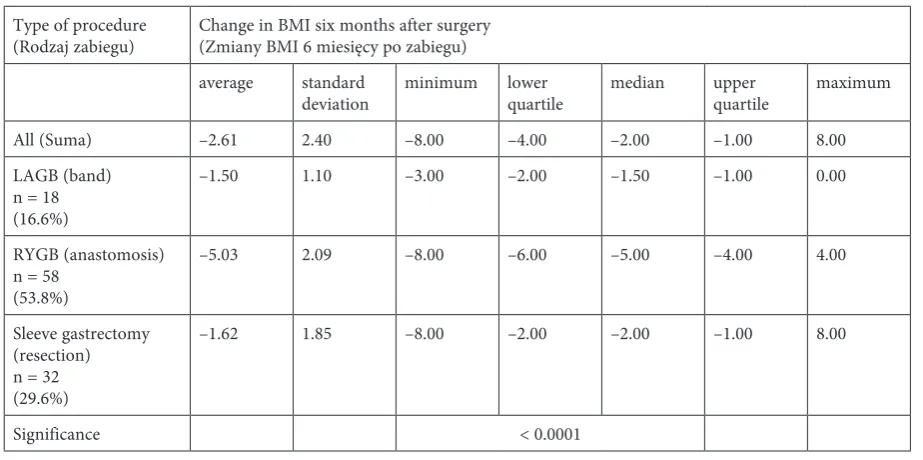
dures (p = 0.1097). This indicates that BMI values stabilized at a similar level regardless of the form of surgery. But in the evaluation of changes con-ducted six months after the bariatric operations, significant declines in BMI values were observed
(p < 0.01) in the entire group of patients, as well as when the patients were divided according to the type of treatment (Table 3).
Six months after the procedures, signifi-cant differences were noted between the various Table 4. Changes in BMI for the entire group and broken down by procedure
Tabela 4. Zmiany BMI dla całej grupy oraz w podziale na zabiegi
Type of procedure
(Rodzaj zabiegu) Change in BMI six months after surgery (Zmiany BMI 6 miesięcy po zabiegu) average standard
deviation minimum lower quartile median upper quartile maximum
All (Suma) –2.61 2.40 –8.00 –4.00 –2.00 –1.00 8.00
LAGB (band) n = 18 (16.6%)
–1.50 1.10 –3.00 –2.00 –1.50 –1.00 0.00
RYGB (anastomosis) n = 58
(53.8%)
–5.03 2.09 –8.00 –6.00 –5.00 –4.00 4.00
Sleeve gastrectomy (resection) n = 32 (29.6%)
–1.62 1.85 –8.00 –2.00 –2.00 –1.00 8.00
Significance < 0.0001
Table 5. Patients’ responses to questionnaires about early and late complications Tabela 5.Odpowiedzipacjentów wankiecie na temat powikłań wczesnych i późnych
Complication (Powikłanie) Number
(Liczba) Percentage of response (Odsetek odpowiedzi) Percentage of patients (Odsetek pacjentów) Early (Wczesne)
difficulties with bowel movements 1 0.88 0.93
vomiting 1 0.88 0.93
abdominal abscess 1 0.88 0.93
abscess in the gastric band area 1 0.88 0.93
infection of the wound 9 7.95 8.34
Late (Późne)
nausea 6 5.31 5.56
heartburn 4 3.54 3.70
displacement of the gastric band 4 3.54 3.70
migration of the band to the gastrointestinal tract 1 0.88 0.93
sudden loss of consciousness 1 0.88 0.93
constipation 1 0.88 0.93
epigastric discomfort 1 0.88 0.93
anemia 1 0.88 0.93
None (Brak) 83 73.45 76.85
groups’ BMI values depending on the type of sur-gical treatment (p < 0.0001). The BMI values in the group of patients who had undergone LAGB differed substantially (p < 0.0001) from those in the RYGB group; and the RYGB group’s BMIs dif-fered significantly (p < 0.0001) from those in the SG group. The LAGB and SG groups’ BMI values did not differ significantly (p = 1.0000). The differ-ence between in pre-operative and follow-up BMI was more pronounced in the RYGB group than in the other two groups (Table 4).
Laparoscopic techniques were used on all the patients participating in the research (n = 108). The duration of hospitalization depended on the type of bariatric procedure. There was no signifi-cant relationship between the occurrence of com-plications and the type of treatment. Migration of the band to the gastrointestinal tract was observed in one case. The band was eliminated endoscopi-cally (Table 5).
Discussion
Attempts to treat morbid obesity surgically were undertaken as early as the 1950s, in connec-tion with the inefficiency of conservative treat-ment. Bariatric surgery has been found to be the most effective treatment for obese patients [14]. Currently, surgical techniques that modify the gas-trointestinal tract to limit food consumption and/ or to limited digestion and absorption are used to achieve a reduction of body mass [14].
Among the new types of bariatric surgical pro-cedures that have recently appeared are the Roux-en-Y gastric bypass, vertical banded gastroplasty and vertical banded gastroplasty with the appli-cation of a silicon ring and biliopancreatic diver-sion [15].
The first vertical banded gastroplasty in Po-land was conducted in Zabrze in 1993; the first LAGB also took place in Zabrze, in 1998 [16]. In 2005, the First Department of General and Endo-crinological Surgery of the Medical University of Bialystok, Poland, began providing surgical treat-ment for obesity.
The results of treatment of morbid obesity are assessed by the percentage of body mass loss. The currently accepted criterion for assessing a bariat-ric procedure as succesful is excessive weight loss (EWL) of 50% or more. The strictest criterion, in-troduced by Kral in 1985 [16].
The majority of bariatric centers provide their own long-term post-operative monitoring (follow-up). During the first year after bariatric surgery, from three to eight follow-up examinations are ad-vised, during which changes in the patient’s body
mass, nutritional status, alleviation of comorbidi-ties and quality of life are estimated. Basic blood tests, examinations of iron, calcium, magnesium, vitamin B12 levels, and total protein and albumin concentrations are conducted [17–19].
In a study by Buchwald et al. assessing the ef-fects of bariatric procedures as reported in the lit-erature from 1990 to 2003, it was stated that the average body mass loss after LAGB, RYGB and biliopancreatic diversion with duodenal switch (BPD-DS) amounted to 48%, 62% and 70% respec-tively. The mortality rate amounted to 0.1%, 0.5% and 1.1% respectively [20].
The results of studies carried out in many centers in Poland and Europe show higher rates of weight loss among patients who have undergone RYGB than among those who have had LAGB [15, 16] Similar results were obtained in the current study: The average reduction in BMI was –1.50 (±1.10 SD) in theLAGB group, 5.03 (±2.09SD) in the RYGB group and 1.62 (±1.85 SD)in the SG group.
The choice of the appropriate procedure for a particular patient should not be based only on his/her preferences [15, 16]. At the authors’ cen-ter LAGB was performed on younger patients with fewer comorbidities. Cholecystectomy was per-formed before RYGB in cases where cholelithiasis was diagnosed.
Picot et al. [21] reviewed studies on the ef-fectiveness of bariatric procedures, including the vertical gastric band, laparoscopic adjustable gas-tric banding and sleeve gastrectomy. They also compared those studies with research regarding conservative treatment of obesity. The effective-ness of all the bariatric procedures mentioned was demonstrated, with slightly higher losses of body weight after sleeve gastrectomy in comparison to conservative treatment. Furthermore, they noted that surgical procedures caused remission of co-morbidities. The current study confirmed that a reduction of body mass causes serum carbohy-drate levels to stabilize in patients with type 2 dia-betes. However, the 6-month follow-up period was too short for a detailed assessment of remission of comorbidities.
According to Livingstone, the most frequent post-operative complications are thromboembolic complications, wound infections, pulmonary in-fections, the creation of anastomotic fistula, intra-peritoneal and gastrointestinal bleeding. Common long-term consequences are nutritional deficien-cy, hernia in the post-operative scar, anastomotic stricture or ulcer, peritoneal adhesions and other complications specific to particular procedures (e.g., migration of the gastric band) [26].
In the current study a low percentage of com-plications was found, not exceeding values given in the literature [27–29]. Among the early com-plications, the most frequent was wound infec-tion, observed in nine patients (8.3%) patients. As a consequence of the new situation in the up-per part of the gastrointestinal tract, nausea was experienced by six patients (5.5%), heartburn by four patients (3.7%) and one patient vomited (0.93%); these complaints disappeared after di-viding the patients’ meals into smaller portions. In four cases (3.7%), displacement of the gastric band was observed, and in one case (0.93%) mi-gration of the band to the gastrointestinal tract occurred. One patient (0.93%) who had under-gone RYGB suffered anemia despite vitamin
supplementation. The deficiency was treated us-ing intramuscular administration of agents con-taining iron. It should be noted that no fatalities occurred.
Currently, all of the patients involved in the study are under the care of the Medical University Hospital’s outpatient clinic. In addition to ongo-ing monitorongo-ing of body mass and diet, the patients’ biochemical parameters and quality of life are peri-odically evaluated using standardized surveys.
The authors concluded that obesity remains a serious social, medical and economic problem, and for this reason the use of bariatric procedures is recommended. LAGB, SG and RYGB are effi-cient methods to decrease BMI and to improve the patient’s general condition and quality of life. Bariatric surgery entails a high risk in connection with the large body mass and comorbidities that can complicate the management of patients dur-ing the operation and in the post-operative period. The use of minimally invasive methods in bariat-ric surgery reduces the occurrence of complica-tions and shortens the hospital stay. The surgical treatment of obesity requires an interdisciplinary approach and should therefor be provided at mul-tidisciplinary centers.
References
[1] Strum R: Increases in morbid obesity in the USA: 2000–2005. Pub Health 2007, 121, 492–496.
[2] Sowemimo O, Yood S, Courtney J et al.: Natural history of morbid obesity without surgical intervention. Surg Obes Relat Dis 2007, 3, 1, 73–77.
[3] Branca F, Nikogosian H, Lobstein T (eds.): The challenge of obesity in the WHO European region and the strat-egies for response: Summary. Copenhagen, WHO Regional Office for Europe, 2007.
[4] Fontaine KR, Redden DT, Wang C et al.: Years of life lost due to obesity. JAMA 2003, 298, 187–193.
[5] Tessier DJ, Eagon JC: Surgical Management of Morbid Obesity. Curr Probl Surg 2008, 45, 2, 68–137.
[6] Picot J, Jones J, Colquitt JL et al.: The clinical effectiveness and cost-effectiveness of bariatric (weight loss) surgery for obesity: a systematic review and economic evaluation. Health Technol Assess 2009, 13, 41, 1–190, 215–357.
[7] Clinical directives regarding treatment of patients with diabetes 2008. Exp Clin Diabetol 2008, 8, supl. A.
[8] EAES Guidelines for Endoscopic Surgery Twelve Years Evidence-Based Surgery in Europe. Sauerland S., Angrisani L., Belachew M. et al.: The EAES Clinical Practice Guidelines on Obesity Surgery 2005.
[9] Dadan J, Iwacewicz P, Hady HR: Quality of life evaluation after selected bariatric procedures using the Bariatric Analysis and Reporting Outcome System. Videosurg Other Miniinvasive Tech 2010, 5,3, 93–99.
[10] Hady HR, Dadan J, Iwacewicz P et al.: Our experience in laparoscopic bariatric procedure. Obes Surg 2010, 20, 8, abst. No P-59.
[11] Hady HR, Dadan J, Iwacewicz P et al.: The evaluation of chosen methods efficiency at pathological obesity surgi-cal treatment in our own material. Eur Surg 2009, 41, suppl. 229, 41–42.
[12] Wyleżoł M, Paśnik K, Dąbrowiecki S et al.: Polish recommendations for bariatric surgery. Videosurg Other Mini-invasive Tech 2009, 4 (Suppl 1).
[13] Paśnik K, Najdecki M, Koziarski T et al.: New trends in bariatric surgery. Pol Med J 2009, XXVI, 155, 539.
[14] Hady HR, Zbucki R, Łuba M et al.: Obesity as a Social Disease and the Influence of Environmental Factors on BMI in Own Material. Adv Clin Exp Med 2010, 19, 3, 369–378.
[15] Hady HR, Zbucki R, Iwacewicz P et al.: Complications after laparoscopic adjustable gastric banding (LAGB) op-erations. Obes Surg 2010, 20, 8, abstr. no. P-057.
[16] Stanowski E, Paśnik K: Surgical treatment of obesity – actual knowledge. Videosurg Other Miniinvasive Tech 2008, 3, 71–86.
[17] Hady HR, Dadan J, Iwacewicz P et al.: Quality of life after surgical treatment of morbid obesity. Obes Surg 2010, 20, 8, abstr. No 59.
[18] Delaet D, Schauer D: Obesity in adults. Clin Evid 2011, 17 online.
[20] Buchwald H, Avidor Y, Braunwald E et al.: Bariatric surgery: a systematic review and meta-analysis. JAMA 2004, 292, 1724–1737.
[21] Picot J, Jones J, Colquitt JL et al.: The clinical effectiveness and cost-effectiveness of bariatric (weight loss) surgery for obesity: a systematic review and economic evaluation. Health Technol Assess 2009, 13, 41, 1–190, 215–357.
[22] Scozzari G, Toppino M, Famiglietti F et al.: 10-year follow-up of laparoscopic vertical banded gastroplasty: good results in selected patients. Ann Surg 2010, 252, 5, 831–839.
[23] Wyleżoł MS, Zairska-Korczala K, Paśnik K: Bariatric surgery in Poland from 1993 to 2003. J Physiol Pharmacol 2005, 56, supl. 6, 109–115.
[24] Dadan J, Iwacewicz P, Hady RH: New trends in bariatric surgery. Videosurg Other Miniinvasive Tech 2008, 3/2.
[25] Ali MR, Fuller WD, Choi MP et al.: The results of surgical treatment of obesity. Surg Clin N Am 2005, 85, 835– 852.
[26] Livingston EH, Huerta S, Arthur D et al.: Male gender is a predictor of morbidity and age a predictor of patients undergoing gastric bypass surgery. Ann Surg 2002, 236, 576–582.
[27] Tice JA, Karliner L, Walsh J et al.: Gastric Banding or Bypass? A Systematic Review Comparing the Two Most Popular Bariatric Procedures. Am J Med 2008, 121, 885–893.
[28] Pannala R, Kidd M, Modlin IM: Surgery for Obesity: Panacea or Pandora’s Box? Digest Surg 2006, 23, 1–11.
[29] Hauser DL, Titchner RL, Wilson MA et al.: Long-term Outcomes of Laparoscopic Roux-en-Y Gastric Bypass in US Veterans. Obes Surg 2010, 20, 283–289.
Address for correspondence:
Regina Sierżantowicz
Department of Surgical Nursing Medical University of Bialystok M. Skłodowskiej-Curie 24a 15-274 Białystok
Poland
E-mail: [email protected]
Conflict of interest: None declared