Mahmood Ahmad
1, Rizwan Ahmad
1, Ghulam Murtaza
2Comparative Bioavailability and Pharmacokinetics
of Flurbiprofen 200 mg SR Pellets from India and France
Porównanie biodostępności i farmakokinetyki flurbiprofenu 200 mg
w granulach o spowolnionym uwalnianiu z Indii i Francji
1 Faculty of Pharmacy and Alternative Medicines, the Islamia University of Bahawalpur, Pakistan 2 Department of Pharmacy, COMSATS Institute of Information Technology, Abbottabad, Pakistan
Abstract
Background. Flurbiprofen, (±) 2-(2-fluoro-4-biphenyl)-propionic acid, is a chiral arylpropionic acid non-steroidal anti-inflammatory drug (NSAID). It is available in the form of 50 mg and 100 mg tablets and 200 mg sustained release pellets in Pakistan. Although there are numerous brands of flurbiprofen tablets in Pakistan like Ansaid®
(Upjohn), Jasic® (Libra) and Olgon® (Himont), only one preparation of flurbiprofen sustained release (SR) pellets,
Froben 200 mg SR®, is available in Pakistan.
Objectives. The aim of this study was to compare the bioavailability and pharmacokinetics of SR pellets of flur-biprofen; reference formulation (formulation A, Froben SR®, manufactured by Rottendorf Pharma Sarl, France and
marketed by Abbot Pharmaceuticals, Pakistan) and test formulation (formulation B, Titan Laboratories, India). Material and Methods. This comparative bioavailability and pharmacokinetic study involved a two-way random-ized crossover design, 18 fasting healthy young male subjects, prescheduled sampling time points, a washing out period of one week, a validated high-performance liquid chromatography method and calculation of pharmacoki-netic parameters from plasma flurbiprofen concentration versus time data using a non-compartmental approach. If the 90% CI for the ratios (test : reference) of ln-transformed AUC0-t, AUC0-∞ and Cmax lie between 0.80–1.25, the
two formulations are considered bioequivalent.
Results. The mean ± SEM values of Cmax, AUC0-t, AUC0-∞, Tmax, t½, and Ke for formulation A and B were found to
be non-significantly (p > 0.05) different from each other. The 90% CI for the mean ratios (test : reference) of ln- -transformed AUC0-t, AUC0-∞ and Cmax were within the predetermined acceptance limits for bioequivalence. Neither
the change in hematologic, biochemical and hepatic parameters for all subjects were observed before and after the study, nor did they report any clinical symptoms indicating adverse effects like headache and temperature. Conclusions. This single-dose study elaborated that the reference and test formulations met the pre-determined criteria for bioequivalence in fasting, healthy, male human subjects as there was no significant difference in the bio-availability and pharmacokinetic parameters for both formulations. Thus, the two formulations can be considered equivalent. The two formulations were also well-tolerated (Adv Clin Exp Med 2011, 20, 5, 599–604).
Key words: bioavailability, pharmacokinetics, bioequivalence, SR pellets of flurbiprofen, human plasma, HPLC.
Streszczenie
Wprowadzenie. Flurbiprofen, kwas (±) 2-(2-fluoro-4-bifenyl)-propionowy, jest chiralnym kwasem arylpropio-nowym, niesteroidowym lekiem przeciwzapalnym (n.l.p.z.). Jest dostępny w Pakistanie w postaci tabletek 50 mg i 100 mg oraz 200 mg granulatu o przedłużonym działaniu. Chociaż na rynku pakistańskim jest wiele preparatów flurbiprofenu, np. Ansaid® (Upjohn), Jasic®(Libra) i Olgon® (Himont), to jest tam dostępny tylko jeden preparat
flurbiprofenu w granulach o przedłużonym uwalnianiu (SR) – Froben 200 mg SR®.
Cel pracy. Porównanie biodostępności i farmakokinetyki flurbiprofenu w granulach o przedłużonym uwalnianiu; preparatu referencyjnego (preparat A, Froben SR®, produkowany przez Rottendorf Pharma Sarl, Francja, i
sprze-dawany przez Abbott Pharmaceuticals, Pakistan) i preparatu kontrolnego (preparat B, Titan Laboratories, Indie). Materiał i metody. Porównanie biodostępności i farmakokinetyki było randomizowanym badaniem w 2 grupach skrzyżowanych. Do badań włączono 18 zdrowych, młodych mężczyzn na czczo. Wybrano czas pobierania próbek. Czas wypłukiwania wynosił tydzień. Zastosowano sprawdzoną metodę wysoko sprawnej chromatografii cieczowej, a wskaźniki farmakokinetyczne stężenia flurbiprofenu w osoczu w funkcji czasu obliczono z użyciem podejścia
Adv Clin Exp Med 2011, 20, 5, 599–604 ISSN 1230-025X
ORIGINAL PAPERS
niekompartmentowego. Jeśli 90% przedziału ufności dla ilorazu (kontrolny : referencyjny) logarytmu naturalnego AUC0-t, AUC0-∞ i Cmax leży między 0,80–1,25, to oba preparaty są uważane za równoważne biologicznie.
Wyniki. Średnie ± SEM wartości Cmax, AUC0-t, AUC0-∞, Tmax, t½, i Ke dla preparatu A i B różnią się nieistotnie
statystycznie (p > 0,05). 90% przedziału ufności dla średnich ilorazów (kontrolny : referencyjny) logarytmu natu-ralnego AUC0-t, AUC0-∞ i Cmax mieściły się w określonym granicach dopuszczalnych dla biorównoważności. Nie
zaobserwowano zmian wskaźników hematologicznych, biochemicznych i wątroby wszystkich pacjentów przed i po badaniu. Żaden z nich nie zgłosił jakichkolwiek objawów klinicznych wskazujących na działania uboczne, takie jak ból głowy i podwyższona temperatura ciała.
Wnioski. Badanie z użyciem pojedynczej dawki wykazało, że oba preparaty spełniają wcześniej ustalone kryteria biorównoważności u zdrowych mężczyzn na czczo. Nie było znaczącej różnicy biodostępności i wskaźników far-makokinetycznych dla obu preparatów. Oba preparaty mogą więc być uznane za równoważne. Obie postacie leku były również dobrze tolerowane (Adv Clin Exp Med 2011, 20, 5, 599–604).
Słowa kluczowe: biodostępność, farmakokinetyka, biorównoważność, flurbiprofen w granulach o przedłużonym uwalnianiu, ludzkie osocze, HPLC.
Like tablets and capsules, pellets are intended to be administered orally. There are numerous ad-vantages of pellets over tablets and capsules, i.e. due to their multiparticulate nature, their administra-tion results in improved plasma profiles with less chance of dose dumping [1].They are amenable to being coated with different types of functional coatings. A functional coating is applied onto the pellets to get a desirable release rate such as enteric or sustained release (SR) action. Controlled release pellets are manufactured either for site-specific de-livery within the gastrointestinal tract or to sustain the action of the drug over an extended period of time [2–4].
Flurbiprofen, a chiral non-steroidal anti-in-flammatory drug, has anti-inanti-in-flammatory and an-algesic properties due to its inhibitory action on prostaglandin synthesis [5–7].It is available in the form of 50 mg and 100 mg tablet and 200 mg SR pellets in Pakistan. Although there are numer-ous brands of flurbiprofen tablets in Pakistan like Ansaid® (Upjohn), Jasic® (Libra) and Olgon®
(Hi-mont), only one preparation of flurbiprofen SR pel-lets, Froben 200 mg SR®, is available in Pakistan.
Since the machinery and technology of pellet manufacturing is different from that of tablet man-ufacturing, a fairly large sum of money is needed to establish the dedicated facility and manufactur-ing capability of pellets locally. Nevertheless, phar-maceutical manufacturers in Pakistan continue to maintain their presence by importing the ready-to-fill pellets from other countries. The manufac-turing, quality and performance of the imported ready-to-fill pellets need a thorough evaluation before approval from the local drug regulatory agency and subsequent authorization to market in the country.
The aim of this research was to study the in vitro and in vivo behavior of SR pellets of flurbipro-fen 200 mg (formulation B, test) from an Indian manufacturer, Titan Laboratories, in comparison to Froben 200 mg SR® (formulation A, reference),
manufactured in France by Rottendorf Pharma Sarl (France) and marketed by Abbott Lab. Karachi (Pakistan) from a comparative bioavailability and pharmacokinetics point of view since no such study is found in the literature. Titan Laboratories Pvt. Ltd. manufactures the SR pellets and exports them as ready-to-fill pellets. These pellets were obtained from Cherwell Pharma Laboratories, Hattar In-dustrial area (Haripur) which imported the pellets from India in ready-to-fill form. This study aims to evaluate the flurbiprofen pellets from Titan in com-parison to Froben SR® pellets. This study (15-M.
Phil./2008/Pharm.) was approved by the Board of Advance Studies and Research, the Islamia Univer-sity of Bahawalpur, and was carried out according to the Helsinki rules [8] for human use in research. For the in vitro dissolution and in vivo studies, the pellets equivalent to 200 mg of flurbiprofen filled into hard gelatin capsules (Size 000) were used.
Experiment
Instrumentation and Chemicals
Required
High-performance liquid chromatography-UV detector (HPLC-chromatography-UV, Agilent 1100 U.S.A.), dissolution apparatus (Pharma Test, Germany), UV-visible spectrophotometer (Shimadzu, Japan).
The pure flurbiprofen was gifted by Wil-son Pharmaceuticals, Pakistan. Analytical grade methanol, acetonitrile, di-potassium hydrogen phosphate, potassium hydroxide, phosphoric acid, hydrochloric acid, n-hexane and isopropyl alcohol were supplied by Merck, Germany. Heparinwas procured from FMC Biopolymers, USA.
In Vitro
Studies
formulation. Flurbiprofen pellets were assayed us-ing a UV-visible spectrophotometer. Flurbiprofen powder (Standard) 200 mg was dissolved by soni-cation in 100 ml of phosphate buffer pH 7.2. Simi-larly for pellets (Sample), 1000 mg of pellets were powdered and the powder equivalent to 200 mg of flurbiprofen was dissolved in 100 ml of phosphate buffer followed by filtration. One milliliter of each solution (reference and test) was diluted to 100 ml with a phosphate buffer and assayed spectrophoto-metrically at 247 nm. The percentage of flurbipro-fen in the pellets was calculated as follows [9]:
Percentage of Flurbiprofen = (Absorbance of sample/Absorbance of standard) ×100.
In vitro dissolution studies for the flurbiprofen SR pellets of reference and test preparations each containing equivalent to 200 mg of flurbiprofen per capsule were carried out in 900 ml of phosphate buffer pH 7.2 using USP apparatus-I (Pharma Test, Germany) equipped with an auto sampler (Phar-ma Test, Ger(Phar-many). The basket rotation speed was 100 rpm and the temperature was maintained at 37 ± 0.5°C. The dissolution samples withdrawn at predetermined time points and were assayed using a UV spectrophotometer at 247 nm after suitable dilution [10].
In Vivo
Studies
The study was an open, cross over, single dose bioavailability trial completing two periods of single dose treatments with a washing out period of one week. Due to the fear of vein pricking, no female, even after the offer of payment, was ready to enroll herself in the panel of subjects. Eighteen healthy non-smoker and non-alcoholic fasting healthy young male human subjects [18-50 years of age (Mean ± SD, 26.2 ± 5.9), 54-72 kg body weight (60.4 ± 8.2)] were enrolled in this study after taking a complete medical history, physical examination and laboratory tests such as complete blood and urine and liver function tests and sign-ing informed consent forms. No volunteers were suffering from any acute or chronic hematologic, biochemical or hepatic abnormality. According to their medical history, they were non-allergic to the flurbiprofen. All subjects were students and/ or officials of the Department of Pharmacy, thus the authors knew personally that they were non-smokers. The volunteers also accepted no pay-ment to participate in this study. These men of-ten participate in the in vivo studies conducted in the Department of Pharmacy. Due to such panel of subjects, it was easy to obtain reports about the side effects of medicines administered to them and to keep them retained in the sampling area 12 h
prior and 12 h after the sampling. Standard (FDA recommended) [11] low-fat meals were served to volunteers during the study. The subjects were in-structed to avoid the use of any medication within two weeks before the study and to fast overnight prior to treatment. A physician and two nurses looked after the whole sampling procedure. They monitored the subjects for their vital signs like blood pressure, respiration rate and temperature. A meeting of subjects with an unblinded physician was also arranged to know the adverse effects oc-curring during the study. Each volunteer received a single oral dose of flurbiprofen 200 mg, capsule filled reference and test pellets alternatively, on two different occasions. A 20-gauge venous can-nula was inserted into the cephalic vein for collec-tion of blood samples. Blood samples (5 ml, after the first 0.5 ml has been discarded) were collected in centrifuge tubes containing about 200 µl hepa-rin. One sample was collected before the drug was given (zero time) and then at 0.5, 1, 1.5, 2, 4, 6, 8, 10, 12, 16, 20, 24 h after dosing of flurbiprofen SR 200 mg pellets. Blood samples were centrifuged immediately at 1000 g for 10 min at room tem-perature (30ºC) and the plasma was separated and stored frozen at –20°C until analyzed.
The mobile phase consisted of 57.5% ace-tonitrile and 42.5% of 0.02 M dipotassium hydro-gen phosphate buffer. The pH of the mobile phase was adjusted to 3.0 with ortho-phosphoric acid and eluted at a flow rate of 1.0 ml/min [12]. The initial stock solution of flurbiprofen was prepared on a daily basis by dissolving 100 mg of flurbipro-fen in 100 ml of methanol followed by the prepa-ration of serial dilutions in the range of 0.098-25 µg/ml according to plasma spiking to construct a calibration curve. All the solutions were stored at –20 °C and protected from light. Blank plasma was spiked with flurbiprofen solutions to give concentrations of 25, 12.5, 6.25, 3.125, 1.56, 0.78, 0.39, 0.195 and 0.098 µg/ml (Coefficient of deter-mination, R2 = 0.9986, while straight line equation
was Y = 322.15X + 40.091). Mean recovery of flur-biprofen was 80–90%. The intra-day (within-run) and inter-day (between-run) accuracy (> 97.46%) and precision (< 5.02%) of the methods were de-termined on three separate days. A plasma sample (500 µl) containing flurbiprofen was acidified with 1 ml of half strength of ortho-phosphoric acid and vortexed for 2 minutes at 1400 rpm. To this 2.5 ml of Isopropyl alcohol: n-hexane mixture (20 : 80) was added and vortexed for 5 minutes followed by centrifugation at 6000 rpm for 10 minutes. The or-ganic layer was separated using the micropipette in 5 ml recti-vials®. The organic layer was evaporated
was injected into the chromatograph [12]. Analyses were performed using Agilent Liquid Chromatog-raphy, with a pump series 1100, Agilent UV detec-tor set at 247 nm. A reversed phase BDS Hypersil C18 column (250 mm × 4.6 mm internal diameter,
5 µm particle size) was used at 30°C. A sample of 20 µl was injected, with a run time of 12 minutes. Retention time was 6.9–7.45 min.
Pharmacokinetic and Statistical
Evaluation
Pharmacokinetic analysis of in vivo data was performed as per a non-compartmental method of analysis by using Kinetica® (Thermo Electron
Corporation 2007) [13]. The significance of differ-ence between the values of bioparameters of two formulations was calculated by a paired t-test us-ing MedCalc® software (Frank Schoonjans, 2007)
[13]. The level of significance was set at 0.05. The relative bioavailability (F%) was evaluated by dividing ln-transformed AUC0-t, AUC0-∞ and
Cmax of test formulation with the ln-transformed
AUC0-t, AUC0-∞ and Cmax of reference formulation,
respectively. The two compared formulations are considered bioequivalent if 90% class intervals for these ratios lie between 80 to 125% [13].
Results and Discussion
Flurbiprofen, (±) 2-(2-fluoro-4-biphenyl)-pro- pionic acid, is a chiral arylpropionic acid non-ste-roidal anti-inflammatory drug (NSAID) [14]. In the present study, flurbiprofen 200 mg SR pellets of reference and test formulation were evaluated by tests given in the United States Pharmacopoeia [10]for their performance through in vitro and in vivo studies. The formulation assay and the in vitro
dissolution results of the reference and test formu-lations were within the USP limits.
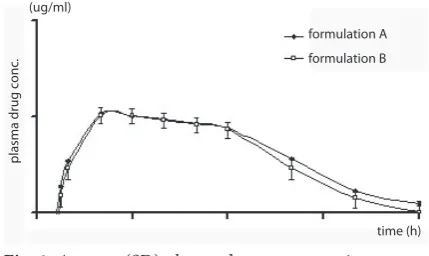
The plasma drug concentration (Mean ± SD) versus time profiles of the reference and test for-mulations after administration of 200 mg single doses are presented in Fig. 1. The mean ± SEM value of Cmax (µg/ml), AUC 0-t (µg h/ml) and
AUCo-∞ (µg h/ml) for reference formulation was
found to be 10.88 ± 0.154, 122.31 ± 1.7194 and 129.09 ± 1.8374 and for test formulation the values were 10.74 ± 0.204, 128.43 ± 3.2872 and 137.53 ± ± 3.4724, respectively. The Cmax values for both
formulations were non-significantly different from each other (P > 0.05) and are in accordance with previous studies [15, 16]. There was a non-significant (P > 0.05) difference between AUC 0-t
and AUCo-∞ for both formulations. The tmax for
reference (4.44 ± 0.1868) and test formulation (4.11 ± 0.1029) were non-significantly different from each other (P > 0.05). The half life (h) and elimination rate constant (h–1) for reference
for-Table 1. The pharmacokinetic parameters of flurbiprofen 200 mg SR pellets (reference and test formulation) in healthy human subjects (N = 18)
Tabela 1. Wskaźniki farmakokinetyczne flurbiprofenu 200 mg w granulach o przedłużonym uwalnianiu (preparat badany i kontrolny) u osób zdrowych (n = 18)
Bioparameters
(Wskaźniki biologiczne) Reference formulation (Preparat badany) Mean ± SEM
Test formulation (Preparat kontrolny) Mean ± SEM
P-Value
(Istotność statystyczna)
AUCo-∞ (µg h/mL) 129.09 ± 9.39 137.53 ± 14.56 P = 0.0938
AUC0-t (µg h/mL) 122.31 ± 12.36 128.43 ± 16.52 P = 0.1731
Cmax (µg/ml) 10.88 ± 1.17 10.74 ± 1.47 P = 0.6570
Tmax (h) 4.44 ± 0.1868 4.11 ± 0.1029 P = 0.0827
T½ (h) 4.53 ± 0.1006 4.74 ± 0.6842 P = 0.1050
plasma drug conc
.
(ug/ml)
time (h) formulation A formulation B
Fig. 1. Average (SD) plasma drug concentration versus time profile of flurbiprofen after administration of 200 mg SR reference and test pellet formulations (N = 18)
mulation was 4.53 ± 0.10 and 0.15 ± 0.016 while for test formulation, 4.74 ± 0.68 and 0.13 ± 0.0151, respectively. A non-significant (P > 0.05) differ-ence was found between these two parameters of both formulations. These results (Table 1) are in accordance with the previous findings [17, 18].
The 90% CI for the mean ratios (test : refer-ence) of ln-transformed AUC0-t (99.86–102.09),
AUC0-∞ (100.43–102.06) and Cmax (96.11–102.95)
were within the predetermined acceptance limits (0.80–1.25 or 80–125%) for bioequivalence (Table 2). Neither the change in hematologic, biochemi-cal and hepatic parameters for all subjects were observed before and after the study, nor did they
report any clinical symptoms indicating adverse effects like headache and temperature.
The objective of this comparative study was to analyze the bioavailability and pharmacokinet-ics of two oral pellet formulations of flurbiprofen (200 mg SR) from two different manufacturers. For in vivo studies, eighteen healthy human male subjects participated in this study. The in vitro
drug release tests of both formulations met USP criteria [10].
The mean ± SEM values of various pharma-cokinetic parameters like Cmax (µg/ml), AUC 0-t (µg
h/ml), AUCo-∞ (µg h/ml), Tmax and T1/2 for
refer-ence and test formulation were non-significantly (P > 0.05) different from each other, and are in ac-cordance with previous studies [14–16]. The com-parison of various pharmacokinetic parameters between the reference and test formulations sug-gests their similar rate and extent of absorption. The 90% CI for the mean ratios (test : reference) of ln-transformed AUC0-t, AUC0-∞ and Cmax were
within the predetermined acceptance limits (0.80-1.25 or 80–125%) for bioequivalence [13].
This pharmacokinetic and bioequivalence study was conducted in 18 fasting healthy young male human subjects. This investigation may have numerous limitations such as conductance of the study in different age groups and sex, multiple dosing, fed condition, large sample size, and vari-ous disease states in clinical practice.
The authors concluded that based on the re-sults of pharmacokinetic parameters and com-parative bioavailability criteria, both formulations are significantly (p < 0.05) similar to each other i.e. bioequivalent.
Table 2. Bioequivalence analysis of the two pellet formula-tions of flurbiprofen after administration of single oral 200 mg SR doses in healthy human subjects (N = 18)
Tabela 2. Analiza biorównoważności 2 preparatów flur
-biprofenu 200 mg w granulach o przedłużonym uwalnianiu po podaniu pojedynczej doustnej dawki 200 mg u osób zdrowych (n = 18)
Parameters
(Wskaźniki) Test/Reference (Kontrolny/ badany)
90% CI
Ln AUC0-∞
(µg h/mL) 101.25 100.43–102.06
Ln AUC0-t
(µg h/mL) 100.98 99.86–102.09
Ln Cmax
(µg/ml) 99.53 96.11–102.95
Ln – natural logarithm. Ln – logarytm naturalny.
Acknowledgement. The authors appreciate the cooperation of the subjects, physician and the nurses.
References
[1] Agarwal AM, Howard MA, Neau SH: Extruded and Spheronized Beads Containing No Microcrystalline Cellulose: Influence of Formulation and Process Variables. Pharm Dev Tech 2004, 9, 197–217.
[2] Alvarez L, Concheiro A, Gomez-Amoza JL, Souto C, Martinez-Pacheco R: Powdered cellulose as excipient for extrusion-spheronization pellets of a cohesive hydrophobic drug. Eur J Pharm Biopharm 2003, 55, 291–295. [3] Bornhoft M, Thommes M, Kleinebudde P: Preliminary assessment of carrageenen as excipient for extrusion/
/spheronization. Eur J Pharm Biopharm 2005, 59, 127–131.
[4] Charoenthai N, Kleinebudde P, Puttipipatkhachorn MS: Use of chitosan-alginate as alternative pelletization aid to microcrystalline cellulose in extrusion/spheronization. AAPS PharmScitech 2007, 96, 2469–2484.
[5] Pargal A, Kelkar MG, Nayak PJ: The effect of food on the bioavailability of ibuprofen and flurbiprofen from sus-tained release formulations. Biopharm Drug Dispos 1996, 17, 511–519.
[6] Patel BK, Jackson SHD, Swift CG, Hutt AJ: Disposition of flurbiprofen in man: influence of stereochemistry and age. Xenobiotica 2003, 33, 1043–1057.
[7] Suri A, Grundy BL, Derendorf H: Pharmacokinetics and pharmacodynamics of enantiomers of ibuprofen and flurbiprofen after oral administration. Int J Clin Pharmacol Therap 1997, 35, 1–8.
[8] World Medical Association Declaration of Helsinki. Ethical principles of medical research involving human sub-jects. http://www.wma.net/en/30publications/10plicies/b3/index.html. Accessed September 3, 2008.
[9] British Pharmacopoeia, 2004. Appendix XII G. Uniformity of Weight (Mass). London: British Pharmacopoeia Commission. P 1.
[11] U.S. Department of Health and Human Services. Guidance for industry: Modified release solid oral dosage forms scale-up and post-approval changes: chemistry, manufacturing, and controls, in vitro dissolution testing, and
in vivo bioequivalence documentation. Center for drug Evaluation and Research, Food and Drug Administration. Rockville 1995.
[12] Jin YX, Tang YH, Zeng S: Analysis of flurbiprofen, ketoprofen and etodolac enantiomers by pre-column deriva-tization RPHPLC and application to drug-protein binding in human plasma. J Pharm Biomed Anal 2008, 46, 953–958.
[13] Shargel L, Wu-Pong S, Yu ABC: Applied biopharmaceutics and pharmacokinetics. Eds.: The Mc-Graw-Hill, New York, USA 2005, 5th ed.
[14] Szpunar GJ, Abert KS, Wagner JG: Pharmcokinetics of Flurbiprofen in man II. Plasma protein binding. Res Comm Chem Pathol Pharmacol 1997, 64, 17–25.
[15] Jamali F, Collins DS, Brian WB, Molder S, Cheung R, McColl K, Heung HC: Comparative bioavailability of two flurbiprofen products: stereospecific versus conventional approach. Biopharm. Drug Dispos 1991, 12, 435–445. [16] Geisslinger G, Lotsch J, Menzel S, Kobal G, Brune K: Stereoselective disposition of flurbiprofen in healthy
sub-jects following administration of the pure enantiomers. Br J Clin Pharmacol 1994, 37, 392–394.
[17] Muraoka A, Tokumora T, Machida Y: Evaluation of the bioavailability of the flurbiprofen and its beta-cyclodex-trin inclusion in four different doses upon oral administration to rats. Eur J Pharm Biopharm 2004, 58, 667–671. [18] Risdall PC, Adams SS, Cramptn EL, Marrchant BT: The disposition and metabolism of flurbiprofen in several
species including man. Xenobiotica 1978, 8, 691–703.
[19] Young MA, Aarons L, Toon S: The pharmacokinetics of the enantiomers of flurbiprofen in patients with rheuma-toid arthritis. Br J Clin Pharmacol 1991, 31, 102–104.
Address for correspondence:
Mahmood Ahmad
Faculty of Pharmacy and Alternative Medicines The Islamia University of Bahawalpur
Bahawalpur-63100 Pakistan
E-mail: [email protected] Tel: +92 62 925 52 43, +92 300 968 22 58
Conflict of interest: None declared