every month at a reasonably rapid rate at www.threatenedtaxa.org. All articles published in JoTT are registered under Creative Commons Attribution 4.0 International License unless otherwise mentioned. JoTT allows allows unrestricted use, reproduction, and distribution of articles in any medium by providing adequate credit to the author(s) and the source of publication.
www.threatenedtaxa.org
ISSN 0974-7907 (Online) | ISSN 0974-7893 (Print) Building evidence for conservation globally
Journal of Threatened Taxa
For Focus, Scope, Aims, Policies, and Guidelines visit https://threatenedtaxa.org/index.php/JoTT/about/editorialPolicies#custom-0 For Article Submission Guidelines, visit https://threatenedtaxa.org/index.php/JoTT/about/submissions#onlineSubmissions For Policies against Scientific Misconduct, visit https://threatenedtaxa.org/index.php/JoTT/about/editorialPolicies#custom-2 For reprints, contact <[email protected]>
Communication
A comparative study on dragonfly diversity on a plateau and
an agro-ecosystem in Goa, India
Andrea R.M. D’Souza & Irvathur Krishnananda Pai
26 June 2019 | Vol. 11 | No. 8 | Pages: 14010–14021 DOI: 10.11609/jott.3667.11.8.14010-14021
Partner
Member
Publisher & Host
OPEN ACCESSCommunica
tion
DOI:https://doi.org/10.11609/jott.3667.11.8.14010-14021 | ZooBank: urn:lsid:zoobank.org:pub:019D45DF-38A7-46CB-BD76-38020240F158
Editor:K.A. Subramanian, Zoological Survey of India, Chennai, India. Date of publication: 26 June 2019 (online & print)
Manuscript details: #3667 | Received 08 July 2017 | Final received 05 May 2019 | Finally accepted 14 June 2019
Citation:D’Souza, A.R.M. & I.K. Pai (2019). A comparative study on dragonfly diversity on a plateau and an agro-ecosystem in Goa, India. Journal of Threatened Taxa 11(8): 14010–14021. https://doi.org/10.11609/jott.3667.11.8.14010-14021
Copyright: D’Souza & Pai 2019. Creative Commons Attribution 4.0 International License. JoTT allows unrestricted use, reproduction, and distribution of this article in any medium by adequate credit to the author(s) and the source of publication.
Funding: Self funding.
Competing interests:The authors declare no competing interests.
Author details: Andrea Runasia Menezes D’Souza was a post graduate student of Goa University and worked on dragonfly diversity as a part of her MSc dissertation. Presently she is working as Assistant professor in the Department of Zoology at Parvatibai Chowgule College of Arts and Science, Margao, Goa. Dr. Irvathur Krishnananda Pai is Professor and Head, department of Zoology, Goa University, Goa
Author contribution: ARMD was involved in field work, sample collection, data analysis, and manuscript preparation. IKP was responsible for designing the study, analyzing the data, directing and supervising and preparation of the manuscript.
Acknowledgements: The authors sincerely thank Prof. S.K. Shyama, Former Head of Department, Zoology, Goa University, for providing necessary facilities. We are also thankful to Mr. Parag Rangnekar, for his help in confirming the identification and to Mr. Kiran Gaude and Mr. Avelno D’Costa, Goa University, for their help in statistical analyses.
A comparative study on dragonfly diversity on a plateau
and an agro-ecosystem in Goa, India
Andrea R.M. D’Souza 1 & Irvathur Krishnananda Pai 21 Parvatibai Chowgule College of Arts and Science, Gogol-Margao, Goa 403602, India. 2 Department of Zoology, Goa University, Taleigao Plateau, Goa 403206, India. 1 [email protected], 2 [email protected] (corresponding author)
Abstract: The present study was carried out to fill the lacuna in the understanding of the diversity of odonates of Goa in general and dragonflies in particular on plateau and paddy fields in coastal villages—agricultural area at Velsao and Taleigao Plateau. Diversity in plateau ecosystem was higher possibly due to a greater plant and insect diversity on the plateau, in comparison with the monoculture paddy agro-ecosystem. Highest number of species recorded belonged to the family Libellulidae. Monthly diversity showed correlation with monthly average rainfall and humidity.
Keywords: Odonates, Taleigao Plateau, Velsao.
ISSN 0974-7907 (Online) ISSN 0974-7893 (Print)
INTRODUCTION
Initial work on odonates in the state of Goa was carried out by Prasad (1995), followed by Rangnekar et al. (2010, 2014), and Subramanian et al. (2013), indicating the diversity to be 87 species. Considerable amount of research has been carried out in the Western Ghats and the neighboring state of Maharashtra (Subramanian et al. 2011; Kulkarni & Subramanian 2013; Muthukumaravel et al. 2015; Tiple & Koparde 2015). Despite this, there are several lacunae in understanding the diversity of odonates in general and dragonflies in particular. Hence, this attempt is to study diversity, distribution patterns, specific species abundance and status of dragonflies in plateau and paddy field areas at Taleigao Plateau and paddy fields in a coastal village of Goa, in Velsao. In the present work we have analyzed the odonates from Goa in general and plateau and agro-ecosystem in particular, which has not been attempted previously.
MATERIALS AND METHODS
Study sites
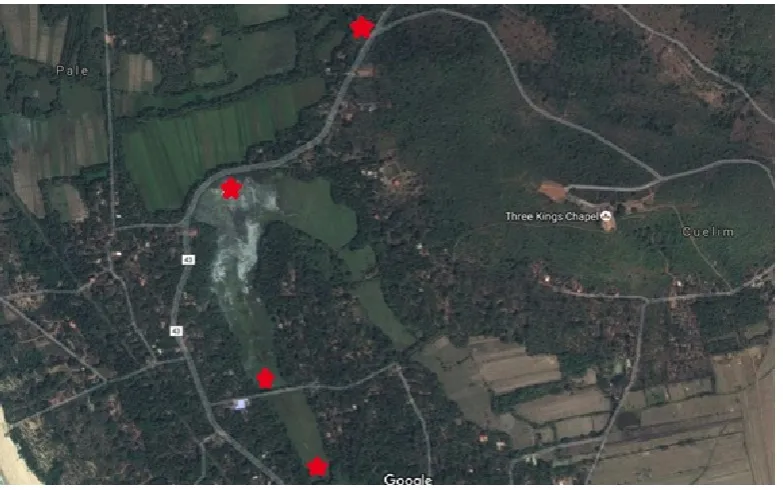
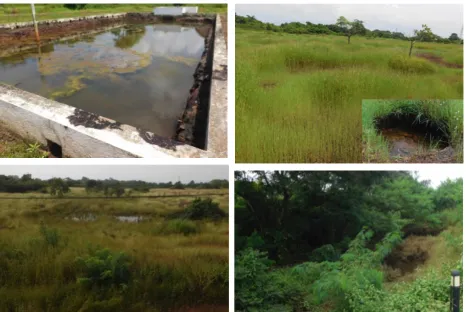
The areas chosen for the study include Velsao (15.3540N & 73.8910E, 11m) (Image 1), which is a coastal village and the Taleigao Plateau (15.4570N & 73.8340E, 50m) (Image 2) which is a lateritic region.
Velsao comprises of several paddy field ponds and streams; four sites were chosen (Image 3a–d) in the village. On the other hand, Taleigao Plateau is a lateritic region comprising several temporary monsoon water pools. Four sites (Image 4a–d) were chosen on Taleigao Plateau, representing the lateritic water pools.
At the plateau study site, the soil is mostly lateritic with vegetation belonging to Asclepiadaceae, Acanthaceae, Leguminosae Mimosaceae, Rubiaceae, Rutaceae families. Paddy fields are composed of loamy-clay mostly with water logging with vegetation comprising of Tridax sp., Gliricidia spp., Justicia spp.,
and Centella spp. seen around the paddy field bunds.
Weather parameters
Table 1 provides meteorological data of the sites under study. The monthly average temperature ranged between 26.86oC to 27.64oC; wind speed from 2.13– 6.84 km/h; sunshine was between 97.3–290.1 hr/ month; relative humidity was between 78.2–93.7 % and rainfall was from 1–449.5 mm/ month (Fig. 1).
METHODS
The study was conducted from August 2016 to February 2017. The sampling is done by monthly direct counts, by following all out opportunistic surveys, at the selected sites from 08.30 to 12.00 hr, which coincides
with the insect’s active period. Species observed were recorded and photographed, using Nikon Coolpix L840 and Nikon Coolpix S6300 cameras. A monthly record of species at the sites was maintained. Species which could not be identified in the field were collected using insect collecting net and maintained by dry preservation (Kapoor 2008) and identified using standard literature such as Fraser (1939), Subramanian (2009) and Nair (2011).
Statistical analysis
From the data obtained of dragonflies species at the sites diversity indices such as shannon diversity index,
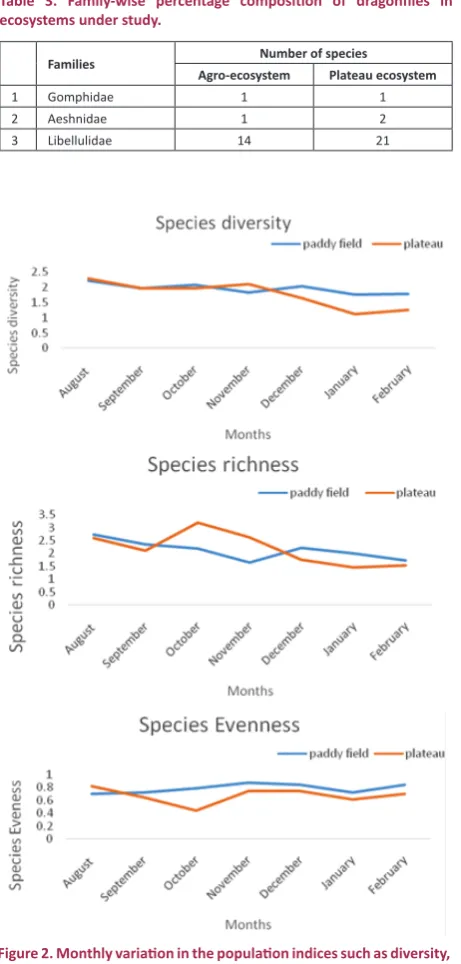
evenness index, species richness index and species abundance, were calculated using PAST software and MS-Excel. Correlation between the diversity indices and weather parameters was calculated using correlation coefficient (Fig. 2).
RESULTS
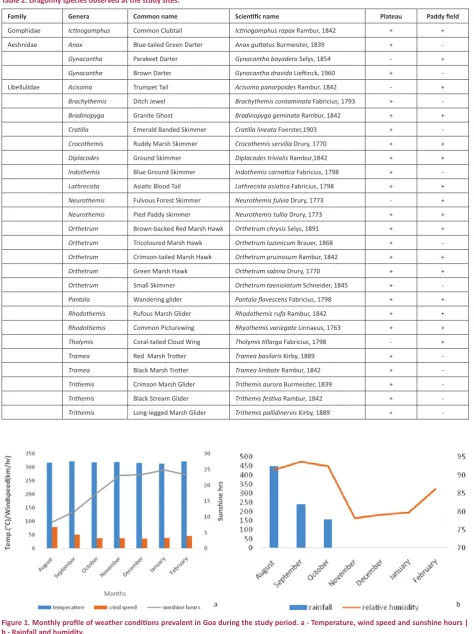
The list of dragonflies encountered at the study sites is given in Table 2. During the study period, a combined total of 28 species of dragonflies belonging to 18 genera and three families were encountered.
Table 1. Weather profile of Goa during the study period (August 2016 to February 2017).
Month Aug Sep Oct Nov Dec Jan Feb
Temperature (C°) 27.64 27.3 27.21 27.4 27.11 26.86 27.6
Wind speed (km/hr) 6.84 4.4 3.29 3.2 3.13 3.35 3.96
Sunshine hours 97.3 136 204.2 268.9 273.4 290.1 271.7
Relative humidity 91.5 93.7 92.52 78.2 78.48 79.74 86.14
Rainfall (mm) 449.5 242.9 157.3 1 - -
-(Source: Anonymous, Goa Meteorological Department, Panaji, Goa)
Table 2. Dragonfly species observed at the study sites.
Family Genera Common name Scientific name Plateau Paddy field
Gomphidae Ictinogomphus Common Clubtail Ictinogomphus rapax Rambur, 1842 + + Aeshnidae Anax Blue-tailed Green Darter Anax guttatus Burmeister, 1839 +
-Gynacantha Parakeet Darter Gynacantha bayadera Selys, 1854 - +
Gynacantha Brown Darter Gynacantha dravida Lieftinck, 1960 +
-Libellulidae Acisoma Trumpet Tail Acisoma panorpoides Rambur, 1842 - +
Brachythemis Ditch Jewel Brachythemis contaminata Fabricius, 1793 +
-Bradinopyga Granite Ghost Bradinopyga geminata Rambur, 1842 + +
Cratilla Emerald Banded Skimmer Cratilla lineata Foerster,1903 +
-Crocothemis Ruddy Marsh Skimmer Crocothemis servilia Drury, 1770 + +
Diplacodes Ground Skimmer Diplacodes trivialis Rambur,1842 + +
Indothemis Blue Ground Skimmer Indothemis carnatica Fabricius, 1798 +
-Lathrecista Asiatic Blood Tail Lathrecista asiatica Fabricius, 1798 + +
Neurothemis Fulvous Forest Skimmer Neurothemis fulvia Drury, 1773 - +
Neurothemis Pied Paddy skimmer Neurothemis tullia Drury, 1773 + +
Orthetrum Brown-backed Red Marsh Hawk Orthetrum chrysis Selys, 1891 + +
Orthetrum Tricoloured Marsh Hawk Orthetrum luzonicum Brauer, 1868 +
-Orthetrum Crimson-tailed Marsh Hawk Orthetrum pruinosum Rambur, 1842 + +
Orthetrum Green Marsh Hawk Orthetrum sabina Drury, 1770 + +
Orthetrum Small Skimmer Orthetrum taeniolatum Schneider, 1845 +
-Pantala Wandering glider Pantala flavescens Fabricius, 1798 + +
Rhodothemis Rufous Marsh Glider Rhodothemis rufa Rambur, 1842 + +
Rhodothemis Common Picturewing Rhyothemis variegate Linnaeus, 1763 + +
Tholymis Coral-tailed Cloud Wing Tholymis tillarga Fabricius, 1798 - +
Tramea Red Marsh Trotter Tramea basilaris Kirby, 1889 +
-Tramea Black Marsh Trotter Tramea limbate Rambur, 1842 +
-Trithemis Crimson Marsh Glider Trithemis aurora Burmeister, 1839 +
-Trithemis Black Stream Glider Trithemis festiva Rambur, 1842 +
-Trithemis Long-legged Marsh Glider Trithemis pallidinervis Kirby, 1889 +
-Figure 1. Monthly profile of weather conditions prevalent in Goa during the study period. a - Temperature, wind speed and sunshine hours | b - Rainfall and humidity.
Table 3. Family-wise percentage composition of dragonflies in
ecosystems under study.
Families Number of species
Agro-ecosystem Plateau ecosystem
1 Gomphidae 1 1
2 Aeshnidae 1 2
3 Libellulidae 14 21
Table 4. General composition of dragonfly community and species indices in paddy field and plateau ecosystem.
Agro-ecosystem ecosystemPlateau
Affiliations
Total no. of individuals recorded 308 402
Total no. of species 16 24
Total no. of genera 12 16
Total no. of families 3 3
Species indices
Species diversity (H’) 1.944 ± 0.158 1.762 ± 0.405
Species evenness (J’) 0.782 ± 0.066 0.674 ± 0.111 Species richness (SR) 2.113 ± 0.347 2.172 ± 0.603
Of the above, 24 species belonging to 16 genera and three families were sighted in the plateau ecosystem; while 16 species belonging to 12 genera and three families were sighted in the agro-ecosystem. There were 12 species of dragonflies belonging to 12 genera that were common to both the ecosystems (Fig. 3).
a. Agro-ecosystem
A total of 16 species belonging to 12 genera and three families were sighted in the agro-ecosystem. Most number of species noted during post monsoon
Figure 2. Monthly variation in the population indices such as diversity,
evenness and richness.
(October–December) were 13, monsoon (August, September) were 12, and winter (January and February) were nine. Species diversity (H’) was found to be 1.944 ± 0.158, species evenness (J’) was 0.782 ± 0.066, and species richness (SR) recorded was 2.11 ± 0.347 (Table 3).
b. Plateau ecosystem
A total of 24 species belonging to 16 genera and three families were sighted in the plateau ecosystem. Most species were noted in post monsoon (17), followed by monsoon (14) and winter (7).
Species diversity (H’) was 1.762 ± 0.405, species evenness (J’) 0.674 ± 0.111, and species richness (SR) 2.172 ± 0.603 (Table 3).
Weather parameters vs. dragonflies
Table 5. Seasonal variations in species indices of dragonflies in (a) agro-ecosystem and (b) plateau.
(a1) Abundance and species richness at the agro-ecosystem
Family Common name Scientific name Monsoon Post-monsoon Winter
Gomphidae Common Clubtail Ictinogomphus rapax Rambur, 1842 4 1 1
Aeshnidae Blue-tailed Green Darter Anax guttatus Burmeister, 1839 - -
-Parakeet Darter Gynacantha bayadera Selys, 1854 - -
-Brown Darter Gynacantha dravida Lieftinck,1960 - 1
-Libellulidae Trumpet Tail Acisoma panorpoides Rambur, 1842 4 7
-Ditch Jewel Brachythemis contaminata Fabricius, 1793 - -
-Granite Ghost Bradinopyga geminata Rambur, 1842 2 4
-Emerald Banded Skimmer Cratilla lineata Foerster,1903 - - -Ruddy Marsh Skimmer Crocothemis servilia Drury, 1770 - -
-Ground Skimmer Diplacodes trivialis Rambur,1842 11 27 17
Blue Ground Skimmer Indothemis carnatica Fabricius, 1798 - - -Asiatic Blood Tail Lathrecista asiatica Fabricius, 1798 1 1 1 Fulvous Forest Skimmer Neurothemis fulvia Drury, 1773 - - 1 Pied Paddy Skimmer Neurothemis tullia Drury, 1773 30 28 20 Brown-backed Red Marsh
Hawk Orthetrum chrysis Selys, 1891 - 4
-Blue Marsh Hawk Orthetrum glaucum Brauer, 1865 - -
-Tricoloured Marsh Hawk Orthetrum luzonicum Brauer, 1868 - - -Crimson-tailed Marsh
Hawk Orthetrum pruinosum Rambur, 1842 5 9 4
Green Marsh Hawk Orthetrum sabina Drury, 1770 9 17 6
Small Skimmer Orthetrum taeniolatum Schneider, 1845 - - -Wandering Glider Pantala flavescens Fabricius, 1798 11 22 10
Rufous Marsh Glider Rhodothemis rufa Rambur, 1842 14 15 7
Common Picturewing Rhyothemis variegata Linnaeus, 1763 2 2 -Coral-tailed Cloud Wing Tholymis tillarga Fabricius, 1798 10 -
-Red Marsh Trotter Tramea basilaris Kirby,1889 - -
-Black Marsh Trotter Tramea limbata Rambur,1842 - -
-Black Stream Glider Trithemis festiva Rambur, 1842 - -
-Long-legged Marsh Glider Trithemis pallidinervis Kirby, 1889 - - -Species indices Monsoon monsoonPost- Winter
Species diversity (H') 2.145 2.138 1.801 Species evenness (J') 0.711 0.652 0.673 Species richness (SR) 2.373 2.435 1.903
a) Agro-ecosystem
(b) Plateau ecosystem
Species indices Monsoon Post-monsoon Winter
Species diversity (H') 2.203 2.077 1.289
Species evenness (J') 0.646 0.469 0.578
Species richness (SR) 2.49 3.056 1.764
(b1) Abundance and species richness at the Plateau ecosystem
Family Common name Scientific name Monsoon Post-monsoon Winter
Gomphidae Common Clubtail Ictinogomphus rapax Rambur, 1842 - 3
-Aeshnidae Blue-tailed Green Darter Anax guttatus Burmeister, 1839 - 1
-Parakeet Darter Gynacantha bayadera Selys,1854 - -
-Brown Darter Gynacantha dravida Lieftinck,1960 - -
-Libellulidae Trumpet Tail Acisoma panorpoides Rambur, 1842 - -
-Ditch Jewel Brachythemis contaminata Fabricius, 1793 - 1
-Granite Ghost Bradinopyga geminata Rambur, 1842 9 10 3
Emerald Banded Skimmer Cratilla lineata Foerster, 1903 - - 1 Ruddy Marsh Skimmer Crocothemis servilia Drury, 1770 10 6 1
Ground Skimmer Diplacodes trivialis Rambur, 1842 19 39 18
Blue Ground Skimmer Indothemis carnatica Fabricius, 1798 17 10 -Asiatic Blood Tail Lathrecista asiatica Fabricius, 1798 - 1 -Fulvous Forest Skimmer Neurothemis fulvia Drury, 1773 - -
-Pied Paddy skimmer Neurothemis tullia Drury, 1773 3 1
-Brown-backed Red Marsh
Hawk Orthetrum chrysis Selys, 1891 - -
-Blue Marsh Hawk Orthetrum glaucum Brauer, 1865 - 1
-Tricoloured Marsh Hawk Orthetrum luzonicum Brauer, 1868 - - -Crimson-tailed Marsh
Hawk Orthetrum pruinosum Rambur, 1842 2 -
-Green Marsh Hawk Orthetrum sabina Drury, 1770 18 17
Small Skimmer Orthetrum taeniolatum Schneider, 1845 1
Wandering Glider Pantala flavescens Fabricius, 1798 59 67 5 Rufous Marsh Glider Rhodothemis rufa Rambur, 1842 3 6
Common Picturewing Rhyothemis variegata Linnaeus, 1763 14 2 1 Coral-tailed Cloud Wing Tholymis tillarga Fabricius, 1798 - -
-Red Marsh Trotter Tramea basilaris Kirby, 1889 7 4
-Black Marsh Trotter Tramea limbata Rambur, 1842 18 12
-Black Stream Glider Trithemis festiva Rambur, 1842 5 7
-Long-legged Marsh Glider Trithemis pallidinervis Kirby, 1889 1 -
-DISCUSSION
A combined total of 28 species of dragonflies recorded at both sites makes about 59.5% of the total dragonflies recorded in the state so far (Rangnekar 2014).
The highest diversity recorded belonged to family Libellulidae (23) followed by Aeshnidae (3) (in plateau ecosystem) and Gomphidae (1). All over the world,
species belonging to family Libellulidae dominate unshaded habitats with stagnant water, include species with great migratory ability and distributions covering more than one continent including isolated islands (Kalkman et al 2008).
Figure 3. Monthly variation in the number of dragonfly species and number of dragonflies recorded.
monoculture paddy agro-ecosystem, which supports a lesser number of plant species and thus fewer insect species that are the prey base for dragonflies. Aquatic bodies in paddy fields were mostly covered by invasive weed like Salvinia, which hampers the growth of other native aquatic plant and animal diversity (Balzan 2012).
In the present study, seasonal variation in dragonfly species was also observed. Highest number of species and individuals were recorded during post monsoon, followed by monsoon and least in winter in both the ecosystems. Species diversity (H’) was highest in monsoon followed by post monsoon and winter. Similar studies were carried out by Muthukumaravel et al. (2015). This may be attributed to drying up of the habitats which results in reduction in food resources post monsoon.
Monthly diversity of dragonflies showed a significant positive correlation with the monthly average rainfall in the agroecosystem and relative humidity in both the ecosystems. Similar observations were reported by Kalita et al.(2015) and Muthukumaravel et al. (2015). Weather plays an important role in the survival and activity patterns of adult odonates (Aguilar 2008). These environmental factors, along with vegetation directly affect diversity and distribution of food resources (Morais et al. 1999). The influence of rainfall is seen on density and distribution of vegetation, which leads to
increase in abundance of herbivorous insects (prey for dragonflies).
It was observed that the species diversity (Fig. 2) in both ecosystems continue to be fairly similar in months August to October, however declined in January and February in the plateau ecosystem, along with a decline in the species richness, which can be attributed to the drying up of temporary water bodies following the monsoon season in the plateau ecosystem. Highest number of species was recorded in the month of October on the plateau ecosystem. Many of the species have their flight period during this period and a higher diversity of odonates could be attributed to this (Kulkarni & Subramanian 2013).
Neurothemis tullia shows the highest species abundance, followed by Diplacodes trivialis and
Rhodothemis rufa in the paddy field ecosystem and
Pantala flavescens in the plateau ecosystem followed by
Diplacodes trivialis. Similar studies at agricultural areas were also reported by Kulkarni & Subramanian (2013).
Dragonflies are important bio-indicator species (Stewart 1998; Nair 2011). Presence of species like
Brachythemis contaminata, which is known as a dragonfly of polluted waters (Subramanian 2009), was recorded at some of the sites in the plateau ecosystem, may indicate deterioration of the aquatic body. The presence of Neurothemis fulvia, Neurothemis tullia, Bradinopyga geminata and Trithemis festiva at the sites can indicate superior quality water and species
Brachythemis contaminata, Orthetrum chrysis, and Orthetrum sabina which are common species at the sites could possible indicate lower water quality.
Most of the species recorded belong to the Least Concern category of the IUCN Red List, while one species
Indothemis carnatica is Near Threatened.
REFERENCES
Aguilar, A.C. (2008).Dragonflies and Damselflies: Model Organisms for
Ecological and Evolutionary Research. New York: Oxford University
Press, 8pp
Anonymous (2016). Weather charts. Retrieved from Meteorological
Centre: http://www.imdgoa.gov.in/. Accessed on 1st February 2017
Balzan, M.V. (2012). Associations of Dragonflies (Odonata) to Habitat
Variables within the Maltese Islands: A Spatio-Temporal Approach. Journal of Insect Science 12: 87. https://doi. org/10.1673/031.012.8701
Fraser, F. (1939). The Fauna of British India (Vol. III)., pp420–427. Taylor and Francis, London.
Kalkman, V.E., V. Clausnitzer, K.D.B. Dijkstra., G.O. Albert, R.P. Dennis
& J.V. Tol (2008). Global diversity of dragonflies (Odonata) in
freshwater. Hydrobiologia 595(1): 351–363.
Kapoor, V.C. (2008). Theory and Practice of Animal Taxonomy (6th ed.).
Table 6. Species abundance from most abundant to least abundant.
Scientific name Agro-ecosystem Scientific name Plateau ecosystem
Neurothemis tullia Drury, 1773 25.324 Pantala flavescens Fabricius, 1798 32.506
Diplacodes trivialis Rambur, 1842 17.857 Diplacodes trivialis Rambur,1842 18.858
Pantala flavescens Fabricius, 1798 13.961 Orthetrum sabina Drury, 1770 8.684
Rhodothemis rufa Rambur, 1842 11.688 Tramea limbata Rambur,1842 7.444
Orthetrum sabina Drury, 1770 10.389 Indothemis carnatica Fabricius, 1798 6.699
Orthetrum pruinosum Rambur, 1842 5.8441 Bradinopyga geminata Rambur, 1842 5.459
Acisoma panorpoides Rambur, 1842 3.5714 Crocothemis servilia Drury, 1770 4.218
Tholymis tillarga Fabricius, 1798 3.246 Rhyothemis variegata Linnaeus, 1763 4.218
Ictinogomphus rapax Rambur, 1842 1.948 Trithemis festiva Rambur, 1842 2.977
Bradinopyga geminata Rambur, 1842 1.948 Tramea basilaris Kirby,1889 2.729
Orthetrum chrysis Selys, 1891 1.298 Rhodothemis rufa Rambur, 1842 2.233
Rhyothemis variegata Linnaeus, 1763 1.298 Neurothemis tullia Drury, 1773 0.992
Lathrecista asiatica Fabricius, 1798 0.974 Ictinogomphus rapax Rambur, 1842 0.744
Gynacantha bayadera Selys, 1854 0.324 Orthetrum pruinosum Rambur, 1842 0.496
Neurothemis fulvia Drury, 1773 0.324 Anax guttatus Burmeister, 1839 0.248
Anax guttatus Burmeister, 1839 0 Brachythemis contaminata Fabricius, 1793 0.248
Gynacantha dravida Lieftinck, 1960 0 Cratilla lineata Foerster,1903 0.248
Brachythemis contaminata Fabricius, 1793 0 Lathrecista asiatica Fabricius, 1798 0.248
Cratilla lineata Foerster, 1903 0 Orthetrum glaucum Brauer, 1865 0.248
Crocothemis servilia Drury, 1770 0 Orthetrum taeniolatum Schneider, 1845 0.248
Indothemis carnatica Fabricius, 1798 0 Trithemis pallidinervis Kirby, 1889 0.248
Orthetrum glaucum Brauer, 1865 0 Gynacantha bayadera Selys,1854 0
Orthetrum luzonicum Brauer, 1868 0 Gynacantha dravida Lieftinck,1960 0
Orthetrum taeniolatum Schneider, 1845 0 Acisoma panorpoides Rambur, 1842 0
Tramea basilaris Kirby, 1889 0 Neurothemis fulvia Drury, 1773 0
Tramea limbata Rambur, 1842 0 Orthetrum chrysis Selys, 1891 0
Trithemis festiva Rambur, 1842 0 Orthetrum luzonicum Brauer, 1868 0
Trithemis pallidinervis Kirby, 1889 0 Tholymis tillarga Fabricius, 1798 0
Image 5. Common Clubtail Ictinogomphus rapax Rambur, 1842.
Image 6. Ditch Jewel Brachythemis
contaminata Fabricius, 1793. Image 7. Granite Ghost Bradinopyga
geminata Rambur, 1842.
Image 8. Ruddy Marsh Skimmer
Crocothemis servilia Drury, 1770.
Image 9. Ground Skimmer Diplacodes trivialis Rambur, 1842 (male and female).
Image 10. Blue Ground Skimmer Indothemis
carnatica Fabricius, 1798. Image 11. Pied Paddy skimmer tullia Drury, 1773 (male and female).Neurothemis
Image 12. Rufous Marsh Glider
Rhodothemis rufa Rambur, 1842 (male and
female).
Image 13. Common Picturewing Rhyothemis variegata Linnaeus, 1763.
Image 14. Coral-tailed Cloud Wing Tholymis tillarga Fabricius, 1798.
Image 15. Long-legged Marsh Glider Trithemis pallidinervis Kirby, 1889.
© Authors
© Authors
© Authors
© Authors
© Authors
© Authors © Authors
© Authors © Authors
© Authors
© Authors
© Authors
© Authors
Kalita, H., R.K. Avasthe & K. Ramesh (2015). Effect of weather
parameters on population buildup of different Insect pests and their natural enemies. Indian Journal of Hill Farming 28(1): 69–72.
Kulkarni, A.S. & K.A. Subramanian (2013). Habitat and seasonal
distribution of Odonata (Insecta) of Mula and Mutha river basins, Maharashtra, India. Journal of Threatened Taxa 5(7): 4084–4095.
https://doi.org/10.11609/JoTT.o3253.4084-95
Morais, H.C., I.R. Diniz & D.M.S. Silva (1999). Caterpillar seasonality
in a central Brazilian Cerrado. Revista de Biologia Tropical 47: 1025–
1033.
Muthukumaravel, K., R. B. Raja, A. Amsath, S. Prabakaran & Y.
Chezhian (2015). Seasonal variation of dragonflies diversity in
Muthupet mangrove forest, Tamilnadu, India. International Journal
of Pure and Applied Zoology, 3(2): 188-192.
Nair, M.V. (2011).Dragonflies & Damselflies of Orissa and Eastern
India, pp13–24. Wildlife Organization, Forest & Environment Department, Government of Orissa.
Prasad, M. (1995). On a collection of Odonata from Goa. Fraseria (N.S.)
2(1/2): 7-8.
Rangnekar, P. (2014). Further additions to Odonata fauna in
Goa. Journal of Threatened Taxa 6(3): 5585–5589. https://doi. org/10.11609/JoTT.o3641.5585-9
Rangnekar, P., M. Borkar & O. Dharwadkar (2010). Additions to The
Odonata (Insecta) of Goa. Journal of Threatened Taxa 2(4): 805–814.
https://doi.org/10.11609/JoTT.o2286.805-14
Stewart, D.S. (1998). Conserving Dragonfly assemblages relative to
river dynamics in an African savanna game reserve. Conservation
Biology 12(3): 683–692.
Subramanian, K. (2009). Dragonflies of India, a Field Guide. Vigyan Prasar, Noida, New Delhi, 86pp.
Subramanian K.A., F. Kakkassery & M.V. Nair (2011). The status and
distribution of dragonflies and damselflies (Odonata) of the Western Ghats, pp. 63–72. In: Molur S., K.G. Smith, B.A. Daniel, W.R.T. Darwall (eds.). The status and distribution of freshwater biodiversity in the Western Ghats, India. International Union for Conservation of Nature and Zoo Outreach Organization, Coimbatore, Tamil Nadu, 63pp+CD-Rom.
Subramanian, K.A., P. Rangnekar & D. Naik (2013). Idionyx (Odonata:
Corduliidae) of the Western Ghats with a description of a new species. Zootaxa 3652(2): 277–288
Tiple, A.D., & P. Koparde (2015). Odonata of Maharashtra, India with
Notes on Species Distribution. Journal of Insect Science 15(1): 47.
https://doi.org/10.1093/jisesa/iev028
ISSN 0974-7907 (Online) | ISSN 0974-7893 (Print)
June 2019 | Vol. 11 | No. 8 | Pages: 13951–14086 Date of Publication: 26 June 2019 (Online & Print)
DOI: 10.11609/jott.2019.11.8.13951-14086 www.threatenedtaxa.org
publishing peer-reviewed articles online every month at a reasonably rapid rate at www.threatenedtaxa.org. All articles published in JoTT are registered under Creative Commons Attribution 4.0 International License
unless otherwise mentioned. JoTT allows allows unrestricted use, reproduction, and distribution of articles in any medium by providing adequate credit to the author(s) and the source of publication.
Communications
The status of wild canids (Canidae, Carnivora) in Vietnam
– Michael Hoffmann, Alexei Abramov, Hoang Minh Duc, Le Trong Trai, Barney Long, An Nguyen, Nguyen Truong Son, Ben Rawson,
Robert Timmins, Tran Van Bang & Daniel Willcox, Pp. 13951–13959
Diel activity pattern of meso-carnivores in the suburban tropical dry evergreen forest of the Coromandel Coast, India
– Kangaraj Muthamizh Selvan, Bawa Mothilal Krishnakumar, Pasiyappazham Ramasamy & Thangadurai Thinesh, Pp. 13960–13966
On the importance of alpha behavior integrity in male Capybara
Hydrochoerus hydrochaeris (Mammalia: Rodentia: Caviidae) following immuno-contraceptive treatment
– Derek Andrew Rosenfield & Cristiane Schilbach Pizzutto, Pp. 13967– 13976
Dietary analysis of the Indian Flying Fox Pteropus giganteus
(Brunnich, 1782) (Chiroptera: Pteropodidae) in Myanmar through the analysis of faecal and chewed remnants
– Moe Moe Aung & Than Than Htay, Pp. 13977–13983
Report on three ectoparasites of the Greater Short-nosed Fruit Bat
Cynopterus sphinx Vahl, 1797 (Mammalia: Chiroptera: Pteropodidae) in Cachar District of Assam, India
– Anisur Rahman & Parthankar Choudhury, Pp. 13984–13991
A checklist of mammals of Tamil Nadu, India
– Manokaran Kamalakannan & Paingamadathil Ommer Nameer, Pp. 13992–14009
A comparative study on dragonfly diversity on a plateau and an agro-ecosystem in Goa, India
– Andrea R.M. D’Souza & Irvathur Krishnananda Pai, Pp. 14010–14021
Review
Contributions to the knowledge of moths of Bombycoidea
Latreille, 1802 (Lepidoptera: Heterocera) of Bhutan with new records –Jatishwor Singh Irungbam & Meenakshi Jatishwor Irungbam, Pp. 14022–14050
Short Communications
First camera trap documentation of the Crab-eating Mongoose
Herpestes urva (Hodgson, 1836) (Carnivora: Feliformia: Herpestidae) in Barandabhar Corridor Forest in Chitwan, Nepal – Trishna Rayamajhi, Saneer Lamichhane, Aashish Gurung, Pramod Raj Regmi, Chiranjibi Prasad Pokheral &
Babu Ram Lamichhane, Pp. 14051–14055
First camera trap record of Red Panda Ailurus fulgens (Cuvier, 1825) (Mammalia: Carnivora: Ailuridae) from Khangchendzonga, Sikkim, India
– Tawqir Bashir, Tapajit Bhattacharya, Kamal Poudyal & Sambandam Sathyakumar, Pp. 14056–14061
First record of black scavenger fly of the genus
Meroplius Rondani, 1874 (Diptera: Sepsidae) from Pakistan – Noor Fatima, Ansa Tamkeen & Muhammad Asghar Hassan, Pp. 14062–14064
Scully’s Balsam Impatiens scullyi Hook.f. (Balsaminaceae): a new record for India from Himachal Pradesh
– Ashutosh Sharma, Nidhan Singh & Wojciech Adamowski, Pp. 14065–14070
Notes
Odisha’s first record of a free-tailed bat (Mammalia: Chiroptera: Molossidae): what could it be?
– Subrat Debata & Sharat Kumar Palita, Pp. 14071–14074
Additions to the flora of Arunachal Pradesh State, India – Umeshkumar Lalchand Tiwari, Pp. 14075–14079
A report on additions to the flora of Andaman & Nicobar Islands, India
– Johny Kumar Tagore, Ponnaiah Jansirani & Sebastian Soosairaj, Pp. 14080–14082
Range extension of Trigonella uncata Boiss. & Noë (Leguminosae) in peninsular India and a new record for Maharashtra State, India – Shrikant Ingalhalikar & Adittya Vishwanath Dharap, Pp. 14083–14086