This is an open access journal, and articles are distributed under the terms of the Creative Commons Attribution-Non Commercial-ShareAlike 4.0 License, which allows others to remix, tweak, and build upon the work non-commercially, as long as appropriate credit is given and the new creations are licensed under the identical terms.
© 2017 Journal of Advanced Pharmacy Education & Research | Published by SPER Publication 378
Type 2 diabetes is associated with FTO polymorphism through
its effect on increasing the maximum BMI in western region of
Saudi Arabia
Najlaa Filimban
1,2, Safaa Qusti
1, Nadia Ghannam
3, Nehad Shaer
2, Mohammed Y. Sakka
4, Amani
Al-Mars
2, Fatma Gazzaz
2, Ashraf Dallol
2, Adel Abuzenadh
21Faculty of Science, Biochemistry Department, King AbdulAziz University, KSA, 2Center of Innovations for Personalized Medicine, King AbdulAziz University, KSA, 3Diabetes and Endocrinology Center of Excellence, Clinical Nutrition Department, International Medical Center, KSA, 4King Fahad Medical Research Center, King
Abdulaziz University, KSA
Correspondence: Safaa Qusti, Faculty of Science, Biochemistry Department, King AbdulAziz University, KSA, E. Mail: [email protected]
ABSTRACT
Background: Several FTO variants have been known to be associated with obesity and typ2 diabetes. Since these variants have been identified in genome-wide association studies (GWAS) in white Europeans, they attracted wide attention for being known to enhance the risk of obesity in different populations. FTO rs9930506 polymorphism was recognized in previous studies as genetic candidate leading to increase obesity measure. Yet it is believed ethnicity variation may cause the differences in response to environment signal.
Objective: The aim of this study is to estimate the genotype and allele frequency in diabetic and healthy individuals in the western region of Saudi Arabia and then investigate the relation of single nucleotide polymorphism to BMI, gender and age in diabetic case compared to control. Genotyping of rs9930506 was performed using TaqMan® OpenArray® Real-Time PCR.
Results: Observation has showed allele A frequency of SNP rs9930506 was 54.9% and 98.3% for DM and healthy control samples respectively. However, alleleG frequency was detected in DM and control subjects as 45.14 % and 1.7% respectively. Evidence indicates that the frequency of allele G is higher in DM case compared to healthy individuals. Also, a strong significant association between FTO SNP rs9930506 and T2DM was reported (P=0.000, U.C. =0.631). Data have shown associations between T2D and BMI, gender and age (P=0.00) suggesting that obese individuals with T2D have a higher frequency 11.138 times compared to obese in healthy control. Additionally, our finding highlighted the impact of the genotype AA of rs9930506 on DM group and determined with a remarkable effect in particular of being obese and male aged from 32 to 53 (P=0.011, OR=56.5).
Conclusion: All together, this study is considered as an initiative to point out to the association of FTO rs9930506 to obesity and T2DM via BMI trait in the most diverse region (western)in Saudi Arabia. This study suggested that male obese are the most affected individuals indicating that FTO SNP exerts different role based on gender and age. Knowing the genetic personal variations will assist in creating strategies to control theses metabolic diseases.
Keywords: BMI trait, FTO, obesity, SNP, type 2 diabetes mellitus
Introduction
complex interplay between the genes and the environment[1].
Earlier it was suggested that variations from person to person observed in response to obsegenic factors owing to a genetic
influence to increase fat accumulation in adipose tissues[2]. Thus,
predisposition to obesity relies more likely on the individual’s genetic variation and the exposure to specific behavior factors, such as diet and physical inactivity[3]. A common variant in FTO
(fat mass and obesity-associated) gene was firstly found associated with diabetes mediated by the effect of obesity measure (body mass index; BMI(kg/m2
) in a genome-wide association study (GWAS). It is believed that FTO candidate variants that linked to the imbalance in energy uptake mostly found in FTO intronicregion[4-6]
. The FTO gene is located in chromosome segment 16q12.2 and highly expressed in the hypothalamus. It is found to regulate the food intake. Yet the exact role by FTO variants in the energy metabolism leading to obesity is still unrevealed[7-9]. Data from a meta-analysis study of Access this article online
Website: www.japer.in E-ISSN: 2249-3379
How to cite this article:Najlaa Filimban, Safaa Qusti, Nadia Ghannam,
Nehad Shaer, Mohammed Y. Sakka, Amani Al-Mars, Fatma Gazzaz, Ashraf Dallol, Adel Abuzenadh. Type 2 Diabetes is Associated with FTO polymorphism through its Effect on increasing the maximum BMI in Western region of Saudi Arabia. J Adv Pharm Edu Res 2017;7(4):378-386. Source of Support: Nil, Conflict of Interest: None declared.
379
Journal of Advanced Pharmacy Education & Research | Oct-Dec 2017 | Vol 7 | Issue4
white European individuals pointed out to the association of FTO rs9939609 A allele with BMI, increasing in insulin, glucose, and triglyceride levels [10]. Other previous studies have
confirmed and replicated the finding of the FTO rs9939609 polymorphism and its impact on BMI [11]. In contrast, various
studies did support the involvement of FTO variants in with the accumulation of excess fat [12]
. A replication studying African Americans demonstrated incompatible evidence with those in European population as it focused on FTO locus to fine mapping and narrow variants that might implicated in obesity influencing [13]
.
Beside BMI, it is very advantageous to consider other factors such as age and gender that might alter the individual’s risk to obesity and diabetes in the presence of FTO variants. Previous studies have reported the association of FTO SNPs with the increase in BMI and occurred accordingly in males and females [14-16]. Moreover, it was observed from a meta-analysis
of 32 GWAS that seven regions known to be associated with BMI have a great impact on waist-hip ratios in women compared in men [17]
. Also, a recent study in Mexican population demonstrated a remarkable finding to study the interaction of rs9930506 with BMI, age and gender. Data showed a significant elevation in BMI in women who are a carrier of the minor allele of FTO rs9930506 suggesting the contribution of this SNP to the risk of obesity [18].
Thus, evidence suggested the involvement of FTO SNPs in the distribution of body fat [17] pointing to the differential
mechanisms to develop the disease in males and females. Apparently, it is thought that ethnic variation and race-specific inheritance are mainly attributed for the difference between individuals in responding to the environmental stimuli. The demographic diversity is a compelling reason to assess the genetic variations in Saudi Arabia. Saudi population features variability in social background and religious beliefs widely distributed all over the country; specifically, between the eastern and western provinces. Therefore, it has become more incentive to study each region discreetly. Additionally, there are insufficient data reported in regard to the frequency of genetic variations of FTO SNP rs9930506, nor its linking to obesity-measure (BMI) and the incident of obesity in Saudi society. Therefore, our aim is to assess the frequency of genotypes and alleles of FTO SNP rs9930506 and evaluate the possible association of this SNP to T2DM via BMI in addition to age and gender. Population study was performed by Center of Innovation for Personalized Medicine on diabetic patients in the western region of Saudi Arabia.
Materials and Methods
Participants with Type II diabetes were recruited in collaboration with Endocrinology and Diabetes center at
International Medical Hospital (IMC), Jeddah. In addition, healthy human volunteers were participated from king Abdul Aziz University campus. Informed consent and questionnaire forms were completed and signed by each individual joined the study. Clinical parameters were recorded: age, sex, body weight, height, and BMI=weight/height2 (kg/m2).
Genomic DNA was isolated from peripheral whole blood samples using QIAampDNA Mini Blood Kit (Qiagen) and from sputum samples using prepIT•L2P Reagent (DNA Genotek, Canada). Genotyping of FTO variant rs9939509 was performed using by Taqman ®OpenArray® Genotyping Real-Time PCR Assays (C__29819994_10, Thermo Fisher Scientific, USA). QuantStudio™ 12K Flex Real- Time PCR System (Thermo Fisher Scientific, USA) was used for SNP detection and allele base calling.
Statistical Analysis
Data analysis was carried out using SPSS Inc. Software, version 24 .0 (SPSS Inc., Chicago.IL, USA). Genotypes and allelic frequencies were estimated within our cohort population to determine the significance differences between diabetes mellitus and healthy control groups.
Chi-Square and Fisher’s Exact test were used to observe the difference between the case (diabetic patient) and the control (healthy subjects) groups. The entire data were further classified according to BMI, age, and sex in subgroups to determine the association between rs9930506 variant and these factors for patient and control. Odd ratio (OR) and Uncertainty Coefficient (U.C.) (considered as > 0.7 strong association) were calculated to determine the risk of obesity and development of T2DM. Additionally, logistic regression was performed to estimate the likelihood of having diabetes mellitus between the carrier of rs9930506 AA genotype and the carrier of GG/AG genotype. With Univariate Model unadjusted odds ratio was calculated for predictors separately (BMI, age, and gender) with DM group in regard to control as a dependent variable. Whereas Multivariate Mode, adjusted odds ratio was assessed to determine the impact of the combined factors collectively for each genotype.
Results
Filimban, et al., Type 2 diabetes is associated with FTO polymorphism
Journal of Advanced Pharmacy Education & Research | Oct-Dec 2017 | Vol 7 | Issue4 380
listed in Table 2. FTO genotypes (AA, AG, and GG) frequencies were calculated for DM group as 12.5%, 84.7% and 2.6% respectively, whereas for control group as 97.2%, 2% and 0.8% respectively. Also allele A and G frequencies were estimated as 54.9% and 45.1% respectively for DM group and 98.3% and 1.7% respectively for healthy individuals.
* BMI was measured as body weight/height (Kg/m2), underweight: < 18.5, healthy: 18.5 to 25, overweight: 25 to 30, obese: >30
The association of FTO genotype rs9930506 with DM
The relationship between each FTO SNPrs9930506 and the case-control group was studied. Result has revealed that there is a strong significant association between FTO SNP rs9930506 (P=0.000, U.C. =0.631) and T2DM (see Table 4). This association is in particular between the genotype AG and T2DM (OR=264.05) in relative to other genotypes of the same SNP (AA/GG). Besides data have suggested that AG genotype is more likely to be present in diabetic patients with a relative risk = 40.333.
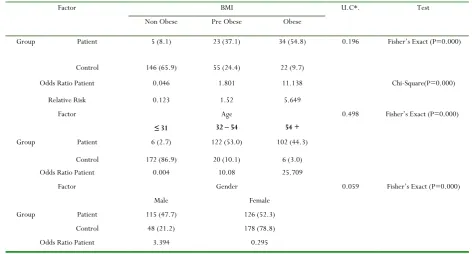
Overview of the relationship between each factor (BMI, age, and gender) with each group (DM and healthy subjects)
Notably, there is an association between increasing in BMI and the presence of T2D (Fisehr’s Exact; P=0.00, Chi Square;
P=0.000). However, the association is weak measured by (U.C.
= 0.196). Data have shown that obese participants with T2D have a higher frequency by (OR=11.138 times) compared to obese control with a relative risk of getting T2DM in obese participants by 5.649 more than non-obese. Additionally, data analysis has shown a correlation between the age group 54+ and in the presence of T2DM with (P= 0.00, OR=25.709, U.C. = 0.498). However, a weak association was found between gender category and T2DM (P=0.00, U.C. =0.059). See Table 3.
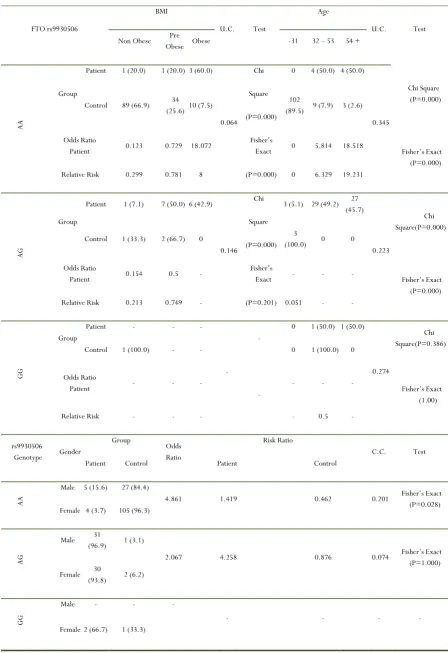
Effect of each FTO rs9930506 genotype on (BMI, age, and gender) for diabetic and control group
Further the impact of BMI categories on diabetic patient and control in the presence of FTO variants was conducted in depth. Observations showed a significant association between BMI classifications and group categories (Chi square; P=0.000, Fisher’s Exact; P=0.007) for the genotype AA of FTO SNP rs9930506; however, the relation was weak (U.C.=0.064). The effect of BMI on obese patients is (OR=18.072) times higher than on obese in healthy control with a relative risk=8.000. The association between age and group categories were examined for the same genotype and found that there is a significant association (Chi square; P=0.000, and Fisher’s Exact;
P=0.000), yet it is moderate relationship (U.C. = 0.345).
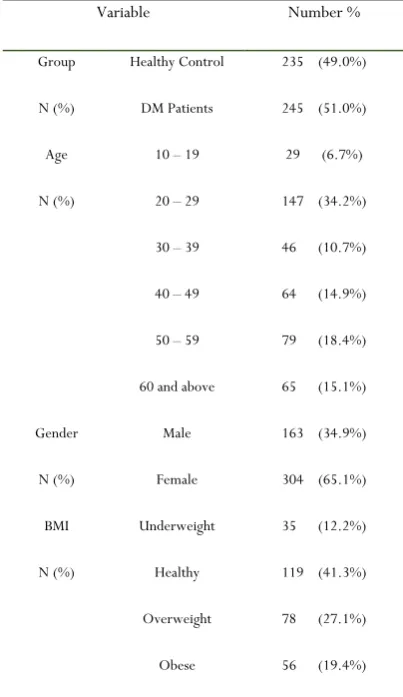
Table 1. Demographic of the study population
Variable Number %
Group Healthy Control 235 (49.0%)
N (%) DM Patients 245 (51.0%)
Age 10 – 19 29 (6.7%)
N (%) 20 – 29 147 (34.2%)
30 – 39 46 (10.7%)
40 – 49 64 (14.9%)
50 – 59 79 (18.4%)
60 and above 65 (15.1%)
Gender Male 163 (34.9%)
N (%) Female 304 (65.1%)
BMI Underweight 35 (12.2%)
N (%) Healthy 119 (41.3%)
Overweight 78 (27.1%)
Obese 56 (19.4%)
Table 2. Genotype and allele frequency
FTO
rs9930506 Total =216 DM (n=72)
Control (n=144)
Genotype frequency
AA 149 (69.0%) 9 (12.5%) 140 (97.2%)
AG 64 (29.6%) 61 (84.7%) 3 (2%)
GG 3 (1.4%) 2 (2.6%) 1 (0.8%)
Allele frequency
A 79 (54.9%) 283 (98.3%)
381
Journal of Advanced Pharmacy Education & Research | Oct-Dec 2017 | Vol 7 | Issue4
Particularly, patients at the age of 54 and above are more affected by (OR=18.518) times than those of healthy control at the same age. Subsequently, people aged 54+ with this genotype are more susceptible of getting diabetes mellitus by (Relative Risk=19.231) than young individuals Table 5. Also, there is no impact observed for the genotype AG between BMI, and gender subgroups and diabetes (Chi-square (P = 0.240) and Fisher’s Exact (P = 0.201)), Fisher’s Exact, P=1.000) respectively. In regards of gender, it is notable to mention that there was a linked between this factor and the groups (Fisher’s Exact; P=0.028, C.C.= 0.201). The association was significant indicating the odds of male patients are 4.861 times higher than the odds of female patients with a relative risk to have DM for males equal to 1.419 times than females Table 5.
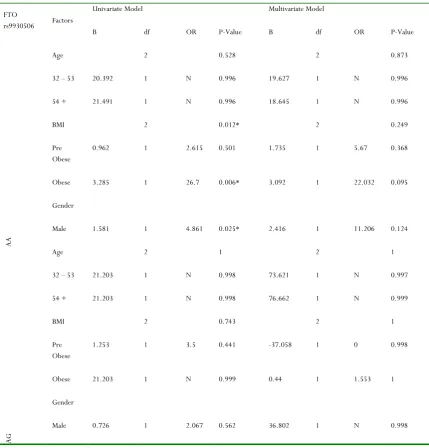
From data analysis using univariate model, unadjusted odds ratio for each predicator (age, BMI and gender) was determined, a significant impact was reported for the genotype AA of FTO SNP rs9930506 on BMI and gender but not on age at this model; P=0.006 and P=0.025 respectively (Table 6A). The odds of obese category for DM were calculated as 26.7 higher compared to the odds of non-obese for healthy control. However, the odds of males with DM were 4.861 higher compared to the odds of females in healthy subjects. Clearly, when the factors (predictors) were combined using Multivariate Model, the genotype AA of rs9930506 has a significant effect with DM group (P=0.011). It can be inferred that the odds ratio of being diabetic, obese, and male who are age ranged from 32 to 53 were 56.5 times increase compared to the odds of non-obese females at the age less than 32 (Table 6B).
Table 3: The relation between study factors (BMI, Gender, and Age ) and DM and control groups
Factor BMI U.C*. Test
Non Obese Pre Obese Obese
Group Patient 5 (8.1) 23 (37.1) 34 (54.8) 0.196 Fisher’s Exact (P=0.000)
Control 146 (65.9) 55 (24.4) 22 (9.7)
Odds Ratio Patient 0.046 1.801 11.138 Chi-Square(P=0.000)
Relative Risk 0.123 1.52 5.649
Factor Age 0.498 Fisher’s Exact (P=0.000)
≤ 31 32 – 54 54 +
Group Patient 6 (2.7) 122 (53.0) 102 (44.3)
Control 172 (86.9) 20 (10.1) 6 (3.0) Odds Ratio Patient 0.004 10.08 25.709
Factor Gender 0.059 Fisher’s Exact (P=0.000)
Male Female
Group Patient 115 (47.7) 126 (52.3) Control 48 (21.2) 178 (78.8) Odds Ratio Patient 3.394 0.295
Table 4.FTO rs9930506 variant association with each group
Genotype rs9930506 *U.C Test
AA AG GG
Group Patient 9(12.5) 61(84.7) 2(2.6) 0.631 Fisher’s Exact
Control 140(97.2) 3(2) 1(0.80)
Odds Ratio Patient 0.004 264.05 4.143 Chi-Square
Filimban, et al., Type 2 diabetes is associated with FTO polymorphism
Journal of Advanced Pharmacy Education & Research | Oct-Dec 2017 | Vol 7 | Issue4 382
Table 5. Impact of rs9930506 genotype on BMI, gender, and age for each group
FTO rs9930506
BMI
U.C. Test
Age
U.C. Test Non Obese Pre
Obese Obese -31 32 – 53 54 +
AA
Group
Patient 1 (20.0) 1 (20.0) 3 (60.0)
0.064 Chi
Square
(P=0.000)
0 4 (50.0) 4 (50.0)
0.345
Chi Square (P=0.000) Control 89 (66.9) 34
(25.6) 10 (7.5)
102
(89.5) 9 (7.9) 3 (2.6)
Odds Ratio
Patient 0.123 0.729 18.072
Fisher’s Exact
(P=0.000)
0 5.814 18.518
Fisher’s Exact (P=0.000) Relative Risk 0.299 0.781 8 0 6.329 19.231
AG
Group
Patient 1 (7.1) 7 (50.0) 6 (42.9)
0.146 Chi
Square
(P=0.000)
3 (5.1) 29 (49.2) 27 (45.7)
0.223
Chi Square(P=0.000) Control 1 (33.3) 2 (66.7) 0 3
(100.0) 0 0
Odds Ratio
Patient 0.154 0.5 -
Fisher’s Exact
(P=0.201)
- - -
Fisher’s Exact (P=0.000) Relative Risk 0.213 0.749 - 0.051 - -
GG
Group
Patient - - -
- -
0 1 (50.0) 1 (50.0)
0.274
Chi Square(P=0.386) Control 1 (100.0) - - 0 1 (100.0) 0
Odds Ratio
Patient - - -
-
- - -
Fisher’s Exact (1.00)
Relative Risk - - - - 0.5 -
rs9930506
Genotype Gender
Group
Odds Ratio
Risk Ratio
C.C. Test Patient Control Patient Control
AA
Male 5 (15.6) 27 (84.4)
4.861 1.419 0.462 0.201 Fisher’s Exact (P=0.028) Female 4 (3.7) 105 (96.3)
AG
Male 31
(96.9) 1 (3.1)
2.067 4.258 0.876 0.074 Fisher’s Exact (P=1.000) Female 30
(93.8) 2 (6.2)
GG
Male - - -
- - - -
383
Journal of Advanced Pharmacy Education & Research | Oct-Dec 2017 | Vol 7 | Issue4
Discussion
Since FTO gene was identified in genome wide screening of European populations as obesity- related traits, it brought a lot of attention to the importance of this locus (16q12.2). Several FTO variants were previously recognized and showed association and type 2 diabetes suggesting the growing in adiposity have led to adverse metabolic consequences[5, 19, 20]
. Up to date, the precise function of FTO is not certain. Yet evidence has suggested that it has a role in regulating energy intake, particularly controlling the individual’s behaviors in response to food[21, 22]
. Most of the studies conducted were restricted to European white population, which might lead to misleading results. The FTO- related obesity trait or type 2 diabetes
associations’ studies are required further investigation in non-Caucasian ancestry.
In this study, we reported a strong association of FTO SNP rs9930506 with obesity and the incidence of T2DM mellitus in diabetic-healthy cohort performed at King Abdulaziz University with IMC hospital. Our findings have revealed that G-allele frequency of this SNP was 45.14% higher in diabetes mellitus group compared to those in their counterpart in healthy group (1.7%). Further, our data analysis has indicated a strong association between FTO rs9930506 genotype AA with DM group specifically for obese, male aged between 32 and 53 compared to who are non-obese, female and age < 32 (P= 0.011, OR= 56.5)). Also, our study pointed out to a remarkable association between rs9930506 AG polymorphism and T2DM among other genotypes of the same SNP (P=0.000,
Table 6A. Unadjusted and adjusted odds ratio (OR) estimates of factors for each genotype (Logistic Regression) for patient in regards to control
FTO
rs9930506 Factors
Univariate Model Multivariate Model
B df OR P-Value B df OR P-Value
AA
Age 2 0.528 2 0.873
32 – 53 20.392 1 N 0.996 19.627 1 N 0.996
54 + 21.491 1 N 0.996 18.645 1 N 0.996
BMI 2 0.012* 2 0.249
Pre Obese
0.962 1 2.615 0.501 1.735 1 5.67 0.368
Obese 3.285 1 26.7 0.006* 3.092 1 22.032 0.095
Gender
Male 1.581 1 4.861 0.025* 2.416 1 11.206 0.124
AG
Age 2 1 2 1
32 – 53 21.203 1 N 0.998 73.621 1 N 0.997
54 + 21.203 1 N 0.998 76.662 1 N 0.999
BMI 2 0.743 2 1
Pre Obese
1.253 1 3.5 0.441 -37.058 1 0 0.998
Obese 21.203 1 N 0.999 0.44 1 1.553 1
Gender
Filimban, et al., Type 2 diabetes is associated with FTO polymorphism
Journal of Advanced Pharmacy Education & Research | Oct-Dec 2017 | Vol 7 | Issue4 384
OR= 264.05). Previous study performed on Polish adults has indicated that this genotype has a strong relationship on BMI and obesity[23]
. Another study in Italian population demonstrated a robust association of rs9930506 G-allele with increased BMI[24]
.
Minor allele frequency (MAF) of FTO rs9930506 (allele G) estimation in our study was similar to that observed in European, nevertheless genotype AA was more likely to be associated with T2DM through BMI measure. In contrast,
inconsistent findings were observed in Asian population when such association between FTO genotype and obesity measure or T2DM was conducted. It has been reported that the minor allele frequencies for rs9939609 and rs9930506 ( 0.12 and 0.20 respectively) in Chinese Han population were substantially lower than those observed in white people (0.48 and 0.45)[25].
Additionally unlike European population, there was no support evident for the association between FTO genotype and BMI[26].
Differences observed in genotype association between DM compared to healthy control might be attributed to ethnic diversity, sample size and collection and exposure to the environmental signal. Moreover, gender and age differences were observed as obesity and T2DM were associated with FTO variant. Similarly, it was reported by Jacobsson et al. that rs9939609 SNP might have an obesity effect based on gender among girls[15].
Looking for insights into FTO function was attempted by several researches before its variants were identified in 2007 as obesity-associated trait. Common SNPs among the entire genome were correlated with complex diseases. Successfully, genome wide association study was conducted to identify variants in FTO region that leading to the risk to develop T2DM through linking of BMI. Finding has suggested that individuals with the homozygous risk allele of FTO have a modest effect on BMI with 3 Kg more than homozygous for those with the protective allele, However, FTO SNPs effect on adiposity are still elusive because lack of knowledge whether of this effect is directly by FTO or collectively with other genes in the same locus[5, 6, 27, 28]. Indeed, the first two intronic region
and exon 2 of FTO as well as other elements of the neighbor genes harbor the association signal of BMI-related SNPs. It was found that the retinitis pigmentosa GTPase regulator-interacting protein 1-like (RPGRIP1L) gene is in a proximal distance to the 5` end of FTO[5]
. Primarily FTO gene was discovered when homozygous deletion of the genes located within a 1.6 mega base on chromosome 8 was created in the mouse causing developmental defects in the nervous system and deformity in the head and face[29, 30]
. Similar profound
observations were reported in human patient who suffer with anisomastia. Chromosomal duplications at the region 16q11-q13, a region harboring FTO gene, have been described in those patients resulting into disruption of genes positioned on this segment. Mental retardation, facial abnormalities and obesogenic behavior are more likely to be manifested[31].
Moreover, since FTO protein is related to dioxygenases family that plays a role in DNA repair mechanism, demathylation of 3-mthylthymine it was asserted that a homozygous FTO SNP at position (c.947G>A) is responsible for polymalformation syndrome affecting Palestinian Arab family. Genetic analysis of the family pedigree suggested that non-synonymous mutation results in amino acid substitution (P.R316Q; arginine toglutamine) at 316 position of FTO protein with loss of function[32]
. Obviously, association of variants does not mean these variants are the causative of the disorder. Therefore, attempting continues to elucidate the correlation between FTO variants the obesity epidemic by examining the clinical involvement FTO function interrupted. Accordingly, it has been demonstrated by a study in china that the overexpression of FTO mRNA has a potential to increase liver enzymes (ALT and AST) in Non-alcoholic fatty liver diseases (NAFLD)[33].
Interestingly, genotyping of FTO rs17817449 T/G, rs9939609 T/A, and rs8050136 C/A, in African American population has revealed a significant association between this SNP and the risk to develop colorectal adenomas[34]
. Further, multivariate analysis has postulated that diabetic individuals who are carrier of heterozygote T/A variant of FTO rs9939609 are more likely to be susceptible of having pancreatic cancer in comparing to those with T/T homozygote[35]. In summary, FTOrs9930506 is associated with
higher BMI and it is gender and age dependent. The results also demonstrated that the increase in fat mass attributable to FTO variants leading to the risk of obesity and developing type 2 diabetes. It is apparent that the effect of FTO focused mostly on the individual’s appetite. Therefore, identifying FTOSNPs that link to obesity might provide a deep insight to understand the mechanisms underlie the correlation between obesity and T2D to facilitate the individual’s management of diet behavior. However, further powered studies are required to assess the effects of FTO variants on other metabolic traits correlated with both conditions.
Acknowledgment
This work was supported and funded by Center of Innovation for Personalized Medicine at King Abdulaziz University.
Abbreviation
385
Journal of Advanced Pharmacy Education & Research | Oct-Dec 2017 | Vol 7 | Issue4
U.C. – Uncertainty Coefficient FTO – Fat Mass and Obesity-Related NAFLD - Non-alcoholic fatty liver diseases
References
1.Loos, R.J. and T. Rankinen, Gene-diet interactions on body weight changes. J Am Diet Assoc, 2005. 105(5 Suppl 1): p. S29-34.
2.Berthoud, H.R., The neurobiology of food intake in an obesogenic environment. Proc Nutr Soc, 2012. 71(4): p. 478-87.
3.Comuzzie, A.G. and D.B. Allison, The search for human obesity genes. Science, 1998. 280(5368): p. 1374-7. 4.Chang, L., S.H. Chiang, and A.R. Saltiel, Insulin
signaling and the regulation of glucose transport. Mol Med, 2004. 10(7-12): p. 65-71.
5.Frayling, T.M., et al., A common variant in the FTO gene is associated with body mass index and predisposes to childhood and adult obesity. Science, 2007. 316(5826): p. 889-94.
6.Scuteri, A., et al., Genome-wide association scan shows genetic variants in the FTO gene are associated with obesity-related traits. PLoS Genet, 2007. 3(7): p. e115.
7.Gerken, T., et al., The obesity-associated FTO gene encodes a 2-oxoglutarate-dependent nucleic acid demethylase. Science, 2007. 318(5855): p. 1469-72. 8.Dina, C., et al., Variation in FTO contributes to
childhood obesity and severe adult obesity. Nat Genet, 2007. 39(6): p. 724-6.
9.Jia, G., et al., Oxidative demethylation of 3-methylthymine and 3-methyluracil in single-stranded DNA and RNA by mouse and human FTO. FEBS Lett, 2008. 582(23-24): p. 3313-9.
10.Freathy, R.M., et al., Common variation in the FTO gene alters diabetes-related metabolic traits to the extent expected given its effect on BMI. Diabetes, 2008. 57(5): p. 1419-26.
11.Fang, H., et al., Variant rs9939609 in the FTO gene is associated with body mass index among Chinese children. BMC Med Genet, 2010. 11: p. 136. 12.de Miguel-Yanes, J.M., et al., Genetic risk
reclassification for type 2 diabetes by age below or above 50 years using 40 type 2 diabetes risk single nucleotide polymorphisms. Diabetes Care, 2011. 34(1): p. 121-5.
13.Peters, U., et al., A systematic mapping approach of 16q12.2/FTO and BMI in more than 20,000 African Americans narrows in on the underlying functional variation: results from the Population Architecture
using Genomics and Epidemiology (PAGE) study. PLoS Genet, 2013. 9(1): p. e1003171.
14.Shahid, A., et al., Common variant of FTO gene, rs9939609, and obesity in Pakistani females. Biomed Res Int, 2013. 2013: p. 324093.
15.Jacobsson, J.A., et al., Major gender difference in association of FTO gene variant among severely obese children with obesity and obesity related phenotypes. Biochem Biophys Res Commun, 2008. 368(3): p. 476-82.
16.Tan, L.J., et al., Replication of 6 obesity genes in a meta-analysis of genome-wide association studies from diverse ancestries. PLoS One, 2014. 9(5): p. e96149.
17.Heid, I.M., et al., Meta-analysis identifies 13 new loci associated with waist-hip ratio and reveals sexual dimorphism in the genetic basis of fat distribution. Nat Genet, 2010. 42(11): p. 949-60.
18.Saldaña-Alvarez, Y., et al., Gender-Dependent Association of FTO Polymorphisms with Body Mass Index in Mexicans. PLoS One, 2016. 11(1): p. e0145984.
19.Thorleifsson, G., et al., Genome-wide association yields new sequence variants at seven loci that associate with measures of obesity. Nat Genet, 2009. 41(1): p. 18-24.
20.Hinney, A., et al., Genome wide association (GWA) study for early onset extreme obesity supports the role of fat mass and obesity associated gene (FTO) variants. PLoS One, 2007. 2(12): p. e1361.
21.Cecil, J.E., et al., An obesity-associated FTO gene variant and increased energy intake in children. N Engl J Med, 2008. 359(24): p. 2558-66.
22.Karra, E., et al., A link between FTO, ghrelin, and impaired brain food-cue responsivity. J Clin Invest, 2013. 123(8): p. 3539-51.
23.Wrzosek, M., et al., Association between rs9930506 polymorphism of the fat mass & obesity-associated (FTO) gene & onset of obesity in Polish adults. Indian J Med Res, 2016. 143(3): p. 281-7.
24.Sentinelli, F., et al., Association of FTO polymorphisms with early age of obesity in obese Italian subjects. Exp Diabetes Res, 2012. 2012: p. 872176.
25.Li, H., et al., Variants in the fat mass- and obesity-associated (FTO) gene are not obesity-associated with obesity in a Chinese Han population. Diabetes, 2008. 57(1): p. 264-8.
Filimban, et al., Type 2 diabetes is associated with FTO polymorphism
Journal of Advanced Pharmacy Education & Research | Oct-Dec 2017 | Vol 7 | Issue4 386
27.Saunders, C.L., et al., Meta-analysis of genome-wide linkage studies in BMI and obesity. Obesity (Silver Spring), 2007. 15(9): p. 2263-75.
28.Scott, L.J., et al., A genome-wide association study of type 2 diabetes in Finns detects multiple susceptibility variants. Science, 2007. 316(5829): p. 1341-5. 29.Peters, T., K. Ausmeier, and U. Rüther, Cloning of
Fatso (Fto), a novel gene deleted by the Fused toes (Ft) mouse mutation. Mamm Genome, 1999. 10(10): p. 983-6.
30.Anselme, I., et al., Defects in brain patterning and head morphogenesis in the mouse mutant Fused toes. Dev Biol, 2007. 304(1): p. 208-20.
31.Stratakis, C.A., et al., Anisomastia associated with interstitial duplication of chromosome 16, mental retardation, obesity, dysmorphic facies, and digital anomalies: molecular mapping of a new syndrome by fluorescent in situ hybridization and microsatellites to 16q13 (D16S419-D16S503). J Clin Endocrinol Metab, 2000. 85(9): p. 3396-401.
32.King, H., R.E. Aubert, and W.H. Herman, Global burden of diabetes, 1995-2025: prevalence, numerical estimates, and projections. Diabetes Care, 1998. 21(9): p. 1414-31.
33.Guo, J., et al., Fat mass and obesity-associated gene enhances oxidative stress and lipogenesis in nonalcoholic fatty liver disease. Dig Dis Sci, 2013. 58(4): p. 1004-9.
34.Nock, N.L., et al., FTO polymorphisms are associated with adult body mass index (BMI) and colorectal adenomas in African-Americans. Carcinogenesis, 2011. 32(5): p. 748-56.