295 Information Technology and Control 2018/2/47
A Hybrid Optimal Controller Based
on the Robust Decoupled Sliding
Mode and Adaptive Feedback
Linearization
ITC 2/47
Journal of Information Technology and Control
Vol. 47 / No. 2 / 2018 pp. 295-309
DOI 10.5755/j01.itc.47.2.16288 © Kaunas University of Technology
A Hybrid Optimal Controller Based on the Robust Decoupled
Sliding Mode and Adaptive Feedback Linearization
Received 2016/09/24 Accepted after revision 2018/03/13
http://dx.doi.org/10.5755/j01.itc.47.2.16288
M. J. Mahmoodabadi, T. Soleymani
Department of Mechanical Engineering, Sirjan University of Technology, Sirjan, Iran
M. Andalib Sahnehsaraei
Iranian Gas Transmission Co., National Iranian Gas Company (NIGC), Ramsar, Iran
Corresponding author: [email protected]
In this paper, a robust adaptive control method for a class of fourth-order systems is proposed. The used struc-ture for this controller is a combination of decoupled sliding mode approach and feedback linearization tech-nique. The decoupled sliding mode is applied to guarantee the sliding condition, and by applying the feedback linearization method, a linear control law with adaptive coefficients is employed. The final control effort is de-fined as the weighting summation of the decoupled sliding mode and feedback linearization controllers. Then, the controller coefficients are optimized using the multi-objective genetic algorithm. Finally, to show effective-ness of the proposed approach, it is applied to handle the cart-pole, ball-beam, and ball-wheel systems and the results are compared with those reported in the literature.
KEYWORDS: Feedback linearization, Decoupled sliding mode, Robust adaptive control, Multi-objective ge-netic algorithm.
1. Introduction
Over the past few years, control of nonlinear systems with uncertainties as a pivotal problem in the field of control engineering has been intensively studied by
Information Technology and Control 2018/2/47 296
method has major advantages, such as guaranteed stability, robustness against parametric variations, fast dynamic response, and ease of implementation. In the sliding-mode control theory, control dynam-ics have two sequential modes [13, 15]. The first is the reaching mode and the second is the sliding mode. At the first stage, a parameter, called sliding surface, is defined as a weighting summation of error and at the second stage, a control law is designed in order to push the states toward the sliding surface. Mahmoodabadi et al. proposed an optimal robust sliding mode track-ing controller for a biped robot [11]. Unlike the SMC technique which can be applied to the systems with the canonical form only, Decoupled Sliding Mode Control (DSMC) is suitable to control systems with the non-canonical forms. In DSMC, the fourth order systems are divided into two subsystems; then, the sliding surfaces are separately designed for each of them, and a control law which converts the state vari-ables to the desired vector is designed. This control law can be used for both subsystems since the targets of the subsystems are achieved. In [6], the control of nonlinear systems based on DSMC with reliance on concepts of fuzzy-neural network is presented. Mah-moodabadi et al. introduce an online optimal control based on DSMC in order to decrease dependence of initial conditions on electromechanical systems [10]. Mahmoodabadi et al. presented an optimal control for the inverted pendulum system using DSMC [9]. In [2, 3], DSMC with time-varying coefficients for sliding surfaces is investigated in which the coefficients are computed based on fuzzy rules.
Another way to control uncertain systems with known dynamic structure, but unknown constant or slowly-varying parameters is adaptive control [13]. This type of controller usually includes a control law whose parameters are adjusted based on a suitable mechanism, and the most important part in such a controller is tuning mode of the control parameters. In [12], an adaptive robust PID control subject to su-pervisory decoupled sliding mode control is proposed for an inverted pendulum and cart system. In [14], an adaptive robust hybrid of PID and sliding control is designed for a biped robot.
In addition, much attention always have been paid to the linearization of nonlinear systems and use of a lin-ear controller by reslin-earchers. The method of Jacobean linearization equations has been used for many years,
but this method is applicable for small range around the equilibrium point. Feedback linearization (FBL), as one of nonlinear control methods, uses the method of changing variables instead of approximating vari-ables, and is applicable to a wider range in comparison with the Jacobean method [7, 13]. In [4], an FBL meth-od is approximately applied to a ball-beam system, and [5] uses the FBL method to control of a ball-wheel sys-tem. In [1], a combination of FBL and DSMC is imple-mented to control a cart-pole system.
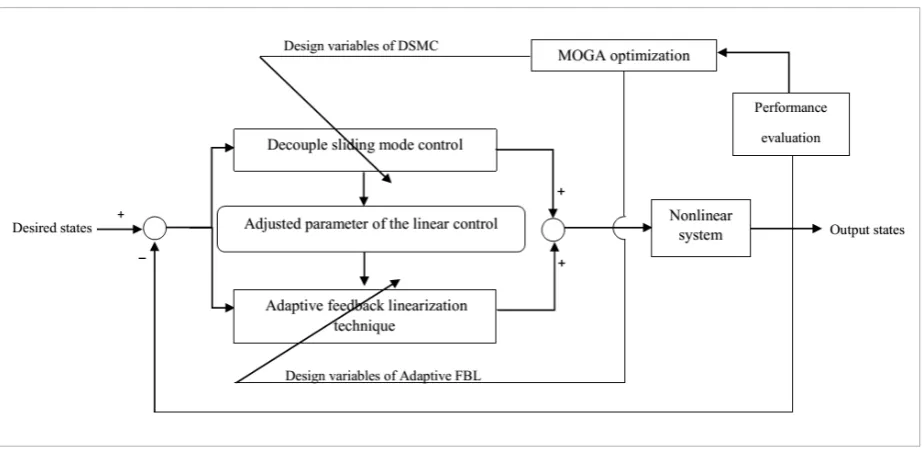
In the present paper, a control law based on the weighting sum of the FBL and DSMC methods is proposed, as the main idea of this is to enhance effi-ciency and robustness against uncertainties. First, FBL and DSMC are simultaneously implemented; then, the coefficients of FBL controller are set based on an approximate gradient descend method so that the sliding condition in DSMC method can be met. Thereafter, the control parameters are obtained using the multi-objective genetic algorithm optimization (MOGA) so that the integral of time multiplied by ab-solute error is minimized. The good advantage of this work that plays the key role in the control field is to have a series of optimum points as Pareto front. The paper is organized in five sections. Section 2 re-views the DSMC and FBL methods. The proposed control strategy is presented in Section 3. In Section 4, numerical simulation of the proposed method is given for three popular systems in control laboratory setting compared with conventional methods in other articles. Finally, conclusions are provided in Section 5.
2. Decoupled Sliding Mode and
Feedback Linearization Controllers
Consider a fourth order under actuated nonlinear system in the non-canonical form as follows:
2
coefficients for sliding surfaces is investigated in which the coefficients are computed based on fuzzy rules.
Another way to control uncertain systems with known dynamic structure, but unknown constant or slowly-varying parameters is adaptive control [13]. This type of controller usually includes a control law whose parameters are adjusted based on a suitable mechanism, and the most important part in such a controller is tuning mode of the control parameters. In [12], an adaptive robust PID control subject to supervisory decoupled sliding mode control is proposed for an inverted pendulum and cart system. In [14], an adaptive robust hybrid of PID and sliding control is designed for a biped robot.
In addition, much attention always have been paid to the linearization of nonlinear systems and use of a linear controller by researchers. The method of Jacobean linearization equations has been used for many years, but this method is applicable for small range around the equilibrium point. Feedback linearization (FBL), as one of nonlinear control methods, uses the method of changing variables instead of approximating variables, and is applicable to a wider range in comparison with the Jacobean method [7, 13]. In [4], an FBL method is approximately applied to a ball-beam system, and [5] uses the FBL method to control of a ball-wheel system. In [1], a combination of FBL and DSMC is implemented to control a cart-pole system.
In the present paper, a control law based on the weighting sum of the FBL and DSMC methods is proposed, as the main idea of this is to enhance efficiency and robustness against uncertainties. First, FBL and DSMC are simultaneously implemented; then, the coefficients of FBL controller are set based on an approximate gradient descend method so that the sliding condition in DSMC method can be met. Thereafter, the control parameters are obtained using the multi-objective genetic algorithm optimization (MOGA) so that the integral of time multiplied by absolute error is minimized. The good advantage of this work that plays the key role in the control field is to have a series of optimum points as Pareto front. The paper is organized in five sections. Section 2 reviews the DSMC and FBL methods. The proposed control strategy is presented in Section 3. In Section 4, numerical simulation of the proposed method is given for three popular systems in control laboratory setting compared with conventional methods in other articles. Finally, conclusions are provided in Section 5.
2. Decoupled Sliding Mode and Feedback Linearization Controllers
Consider a fourth order under actuated nonlinear system in the non-canonical form as follows:
𝑥𝑥𝑥𝑥̇1(𝑡𝑡𝑡𝑡) =𝑥𝑥𝑥𝑥2(𝑡𝑡𝑡𝑡) (1)
𝑥𝑥𝑥𝑥̇2(𝑡𝑡𝑡𝑡) =𝑓𝑓𝑓𝑓1(𝐱𝐱𝐱𝐱) +𝑔𝑔𝑔𝑔1(𝐱𝐱𝐱𝐱)𝑢𝑢𝑢𝑢(𝑡𝑡𝑡𝑡) +𝑑𝑑𝑑𝑑1(𝑡𝑡𝑡𝑡) (2)
𝑥𝑥𝑥𝑥̇3(𝑡𝑡𝑡𝑡) =𝑥𝑥𝑥𝑥4(𝑡𝑡𝑡𝑡) (3)
𝑥𝑥𝑥𝑥̇4(𝑡𝑡𝑡𝑡) =𝑓𝑓𝑓𝑓2(𝐱𝐱𝐱𝐱) +𝑔𝑔𝑔𝑔2(𝐱𝐱𝐱𝐱)𝑢𝑢𝑢𝑢(𝑡𝑡𝑡𝑡) +𝑑𝑑𝑑𝑑2(𝑡𝑡𝑡𝑡), (4)
where 𝐱𝐱𝐱𝐱(𝑡𝑡𝑡𝑡) = [𝑥𝑥𝑥𝑥1(𝑡𝑡𝑡𝑡),𝑥𝑥𝑥𝑥2(𝑡𝑡𝑡𝑡),𝑥𝑥𝑥𝑥3(𝑡𝑡𝑡𝑡),𝑥𝑥𝑥𝑥4(𝑡𝑡𝑡𝑡)]T denotes the state vector, 𝑓𝑓𝑓𝑓1(𝐱𝐱𝐱𝐱),𝑓𝑓𝑓𝑓2(𝐱𝐱𝐱𝐱),𝑔𝑔𝑔𝑔1(𝐱𝐱𝐱𝐱) , and 𝑔𝑔𝑔𝑔2(𝐱𝐱𝐱𝐱)are
nonlinear functions,𝑢𝑢𝑢𝑢(𝑡𝑡𝑡𝑡) is the control input, and 𝑑𝑑𝑑𝑑1(𝑡𝑡𝑡𝑡) and 𝑑𝑑𝑑𝑑2(𝑡𝑡𝑡𝑡) are external disturbances. The
disturbances are assumed to be bounded as |𝑑𝑑𝑑𝑑1(𝑡𝑡𝑡𝑡)|≤ 𝐷𝐷𝐷𝐷1(𝑡𝑡𝑡𝑡)and |𝑑𝑑𝑑𝑑2(𝑡𝑡𝑡𝑡)|≤ 𝐷𝐷𝐷𝐷2(𝑡𝑡𝑡𝑡).
(1)
2
coefficients for sliding surfaces is investigated in which the coefficients are computed based on fuzzy rules.
Another way to control uncertain systems with known dynamic structure, but unknown constant or slowly-varying parameters is adaptive control [13]. This type of controller usually includes a control law whose parameters are adjusted based on a suitable mechanism, and the most important part in such a controller is tuning mode of the control parameters. In [12], an adaptive robust PID control subject to supervisory decoupled sliding mode control is proposed for an inverted pendulum and cart system. In [14], an adaptive robust hybrid of PID and sliding control is designed for a biped robot.
In addition, much attention always have been paid to the linearization of nonlinear systems and use of a linear controller by researchers. The method of Jacobean linearization equations has been used for many years, but this method is applicable for small range around the equilibrium point. Feedback linearization (FBL), as one of nonlinear control methods, uses the method of changing variables instead of approximating variables, and is applicable to a wider range in comparison with the Jacobean method [7, 13]. In [4], an FBL method is approximately applied to a ball-beam system, and [5] uses the FBL method to control of a ball-wheel system. In [1], a combination of FBL and DSMC is implemented to control a cart-pole system.
In the present paper, a control law based on the weighting sum of the FBL and DSMC methods is proposed, as the main idea of this is to enhance efficiency and robustness against uncertainties. First, FBL and DSMC are simultaneously implemented; then, the coefficients of FBL controller are set based on an approximate gradient descend method so that the sliding condition in DSMC method can be met. Thereafter, the control parameters are obtained using the multi-objective genetic algorithm optimization (MOGA) so that the integral of time multiplied by absolute error is minimized. The good advantage of this work that plays the key role in the control field is to have a series of optimum points as Pareto front. The paper is organized in five sections. Section 2 reviews the DSMC and FBL methods. The proposed control strategy is presented in Section 3. In Section 4, numerical simulation of the proposed method is given for three popular systems in control laboratory setting compared with conventional methods in other articles. Finally, conclusions are provided in Section 5.
2. Decoupled Sliding Mode and Feedback Linearization Controllers
Consider a fourth order under actuated nonlinear system in the non-canonical form as follows:
𝑥𝑥𝑥𝑥̇1(𝑡𝑡𝑡𝑡) =𝑥𝑥𝑥𝑥2(𝑡𝑡𝑡𝑡) (1)
𝑥𝑥𝑥𝑥̇2(𝑡𝑡𝑡𝑡) =𝑓𝑓𝑓𝑓1(𝐱𝐱𝐱𝐱) +𝑔𝑔𝑔𝑔1(𝐱𝐱𝐱𝐱)𝑢𝑢𝑢𝑢(𝑡𝑡𝑡𝑡) +𝑑𝑑𝑑𝑑1(𝑡𝑡𝑡𝑡) (2)
𝑥𝑥𝑥𝑥̇3(𝑡𝑡𝑡𝑡) =𝑥𝑥𝑥𝑥4(𝑡𝑡𝑡𝑡) (3)
𝑥𝑥𝑥𝑥̇4(𝑡𝑡𝑡𝑡) =𝑓𝑓𝑓𝑓2(𝐱𝐱𝐱𝐱) +𝑔𝑔𝑔𝑔2(𝐱𝐱𝐱𝐱)𝑢𝑢𝑢𝑢(𝑡𝑡𝑡𝑡) +𝑑𝑑𝑑𝑑2(𝑡𝑡𝑡𝑡), (4)
where 𝐱𝐱𝐱𝐱(𝑡𝑡𝑡𝑡) = [𝑥𝑥𝑥𝑥1(𝑡𝑡𝑡𝑡),𝑥𝑥𝑥𝑥2(𝑡𝑡𝑡𝑡),𝑥𝑥𝑥𝑥3(𝑡𝑡𝑡𝑡),𝑥𝑥𝑥𝑥4(𝑡𝑡𝑡𝑡)]T denotes the state vector, 𝑓𝑓𝑓𝑓1(𝐱𝐱𝐱𝐱),𝑓𝑓𝑓𝑓2(𝐱𝐱𝐱𝐱),𝑔𝑔𝑔𝑔1(𝐱𝐱𝐱𝐱) , and 𝑔𝑔𝑔𝑔2(𝐱𝐱𝐱𝐱)are
nonlinear functions,𝑢𝑢𝑢𝑢(𝑡𝑡𝑡𝑡) is the control input, and 𝑑𝑑𝑑𝑑1(𝑡𝑡𝑡𝑡) and 𝑑𝑑𝑑𝑑2(𝑡𝑡𝑡𝑡) are external disturbances. The
disturbances are assumed to be bounded as |𝑑𝑑𝑑𝑑1(𝑡𝑡𝑡𝑡)|≤ 𝐷𝐷𝐷𝐷1(𝑡𝑡𝑡𝑡)and |𝑑𝑑𝑑𝑑2(𝑡𝑡𝑡𝑡)|≤ 𝐷𝐷𝐷𝐷2(𝑡𝑡𝑡𝑡).
(2)
2
coefficients for sliding surfaces is investigated in which the coefficients are computed based on fuzzy rules.
Another way to control uncertain systems with known dynamic structure, but unknown constant or slowly-varying parameters is adaptive control [13]. This type of controller usually includes a control law whose parameters are adjusted based on a suitable mechanism, and the most important part in such a controller is tuning mode of the control parameters. In [12], an adaptive robust PID control subject to supervisory decoupled sliding mode control is proposed for an inverted pendulum and cart system. In [14], an adaptive robust hybrid of PID and sliding control is designed for a biped robot.
In addition, much attention always have been paid to the linearization of nonlinear systems and use of a linear controller by researchers. The method of Jacobean linearization equations has been used for many years, but this method is applicable for small range around the equilibrium point. Feedback linearization (FBL), as one of nonlinear control methods, uses the method of changing variables instead of approximating variables, and is applicable to a wider range in comparison with the Jacobean method [7, 13]. In [4], an FBL method is approximately applied to a ball-beam system, and [5] uses the FBL method to control of a ball-wheel system. In [1], a combination of FBL and DSMC is implemented to control a cart-pole system.
In the present paper, a control law based on the weighting sum of the FBL and DSMC methods is proposed, as the main idea of this is to enhance efficiency and robustness against uncertainties. First, FBL and DSMC are simultaneously implemented; then, the coefficients of FBL controller are set based on an approximate gradient descend method so that the sliding condition in DSMC method can be met. Thereafter, the control parameters are obtained using the multi-objective genetic algorithm optimization (MOGA) so that the integral of time multiplied by absolute error is minimized. The good advantage of this work that plays the key role in the control field is to have a series of optimum points as Pareto front. The paper is organized in five sections. Section 2 reviews the DSMC and FBL methods. The proposed control strategy is presented in Section 3. In Section 4, numerical simulation of the proposed method is given for three popular systems in control laboratory setting compared with conventional methods in other articles. Finally, conclusions are provided in Section 5.
2. Decoupled Sliding Mode and Feedback Linearization Controllers
Consider a fourth order under actuated nonlinear system in the non-canonical form as follows:
𝑥𝑥𝑥𝑥̇1(𝑡𝑡𝑡𝑡) =𝑥𝑥𝑥𝑥2(𝑡𝑡𝑡𝑡) (1)
𝑥𝑥𝑥𝑥̇2(𝑡𝑡𝑡𝑡) =𝑓𝑓𝑓𝑓1(𝐱𝐱𝐱𝐱) +𝑔𝑔𝑔𝑔1(𝐱𝐱𝐱𝐱)𝑢𝑢𝑢𝑢(𝑡𝑡𝑡𝑡) +𝑑𝑑𝑑𝑑1(𝑡𝑡𝑡𝑡) (2)
𝑥𝑥𝑥𝑥̇3(𝑡𝑡𝑡𝑡) =𝑥𝑥𝑥𝑥4(𝑡𝑡𝑡𝑡) (3)
𝑥𝑥𝑥𝑥̇4(𝑡𝑡𝑡𝑡) =𝑓𝑓𝑓𝑓2(𝐱𝐱𝐱𝐱) +𝑔𝑔𝑔𝑔2(𝐱𝐱𝐱𝐱)𝑢𝑢𝑢𝑢(𝑡𝑡𝑡𝑡) +𝑑𝑑𝑑𝑑2(𝑡𝑡𝑡𝑡), (4)
where 𝐱𝐱𝐱𝐱(𝑡𝑡𝑡𝑡) = [𝑥𝑥𝑥𝑥1(𝑡𝑡𝑡𝑡),𝑥𝑥𝑥𝑥2(𝑡𝑡𝑡𝑡),𝑥𝑥𝑥𝑥3(𝑡𝑡𝑡𝑡),𝑥𝑥𝑥𝑥4(𝑡𝑡𝑡𝑡)]T denotes the state vector, 𝑓𝑓𝑓𝑓1(𝐱𝐱𝐱𝐱),𝑓𝑓𝑓𝑓2(𝐱𝐱𝐱𝐱),𝑔𝑔𝑔𝑔1(𝐱𝐱𝐱𝐱) , and 𝑔𝑔𝑔𝑔2(𝐱𝐱𝐱𝐱)are
nonlinear functions,𝑢𝑢𝑢𝑢(𝑡𝑡𝑡𝑡) is the control input, and 𝑑𝑑𝑑𝑑1(𝑡𝑡𝑡𝑡) and 𝑑𝑑𝑑𝑑2(𝑡𝑡𝑡𝑡) are external disturbances. The
disturbances are assumed to be bounded as |𝑑𝑑𝑑𝑑1(𝑡𝑡𝑡𝑡)|≤ 𝐷𝐷𝐷𝐷1(𝑡𝑡𝑡𝑡)and |𝑑𝑑𝑑𝑑2(𝑡𝑡𝑡𝑡)|≤ 𝐷𝐷𝐷𝐷2(𝑡𝑡𝑡𝑡).
(3)
2
coefficients for sliding surfaces is investigated in which the coefficients are computed based on fuzzy rules.
Another way to control uncertain systems with known dynamic structure, but unknown constant or slowly-varying parameters is adaptive control [13]. This type of controller usually includes a control law whose parameters are adjusted based on a suitable mechanism, and the most important part in such a controller is tuning mode of the control parameters. In [12], an adaptive robust PID control subject to supervisory decoupled sliding mode control is proposed for an inverted pendulum and cart system. In [14], an adaptive robust hybrid of PID and sliding control is designed for a biped robot.
In addition, much attention always have been paid to the linearization of nonlinear systems and use of a linear controller by researchers. The method of Jacobean linearization equations has been used for many years, but this method is applicable for small range around the equilibrium point. Feedback linearization (FBL), as one of nonlinear control methods, uses the method of changing variables instead of approximating variables, and is applicable to a wider range in comparison with the Jacobean method [7, 13]. In [4], an FBL method is approximately applied to a ball-beam system, and [5] uses the FBL method to control of a ball-wheel system. In [1], a combination of FBL and DSMC is implemented to control a cart-pole system.
In the present paper, a control law based on the weighting sum of the FBL and DSMC methods is proposed, as the main idea of this is to enhance efficiency and robustness against uncertainties. First, FBL and DSMC are simultaneously implemented; then, the coefficients of FBL controller are set based on an approximate gradient descend method so that the sliding condition in DSMC method can be met. Thereafter, the control parameters are obtained using the multi-objective genetic algorithm optimization (MOGA) so that the integral of time multiplied by absolute error is minimized. The good advantage of this work that plays the key role in the control field is to have a series of optimum points as Pareto front. The paper is organized in five sections. Section 2 reviews the DSMC and FBL methods. The proposed control strategy is presented in Section 3. In Section 4, numerical simulation of the proposed method is given for three popular systems in control laboratory setting compared with conventional methods in other articles. Finally, conclusions are provided in Section 5.
2. Decoupled Sliding Mode and Feedback Linearization Controllers
Consider a fourth order under actuated nonlinear system in the non-canonical form as follows:
𝑥𝑥𝑥𝑥̇1(𝑡𝑡𝑡𝑡) =𝑥𝑥𝑥𝑥2(𝑡𝑡𝑡𝑡) (1)
𝑥𝑥𝑥𝑥̇2(𝑡𝑡𝑡𝑡) =𝑓𝑓𝑓𝑓1(𝐱𝐱𝐱𝐱) +𝑔𝑔𝑔𝑔1(𝐱𝐱𝐱𝐱)𝑢𝑢𝑢𝑢(𝑡𝑡𝑡𝑡) +𝑑𝑑𝑑𝑑1(𝑡𝑡𝑡𝑡) (2)
𝑥𝑥𝑥𝑥̇3(𝑡𝑡𝑡𝑡) =𝑥𝑥𝑥𝑥4(𝑡𝑡𝑡𝑡) (3)
𝑥𝑥𝑥𝑥̇4(𝑡𝑡𝑡𝑡) =𝑓𝑓𝑓𝑓2(𝐱𝐱𝐱𝐱) +𝑔𝑔𝑔𝑔2(𝐱𝐱𝐱𝐱)𝑢𝑢𝑢𝑢(𝑡𝑡𝑡𝑡) +𝑑𝑑𝑑𝑑2(𝑡𝑡𝑡𝑡), (4)
where 𝐱𝐱𝐱𝐱(𝑡𝑡𝑡𝑡) = [𝑥𝑥𝑥𝑥1(𝑡𝑡𝑡𝑡),𝑥𝑥𝑥𝑥2(𝑡𝑡𝑡𝑡),𝑥𝑥𝑥𝑥3(𝑡𝑡𝑡𝑡),𝑥𝑥𝑥𝑥4(𝑡𝑡𝑡𝑡)]T denotes the state vector, 𝑓𝑓𝑓𝑓1(𝐱𝐱𝐱𝐱), 𝑓𝑓𝑓𝑓2(𝐱𝐱𝐱𝐱),𝑔𝑔𝑔𝑔1(𝐱𝐱𝐱𝐱) , and 𝑔𝑔𝑔𝑔2(𝐱𝐱𝐱𝐱) are
nonlinear functions,𝑢𝑢𝑢𝑢(𝑡𝑡𝑡𝑡) is the control input, and 𝑑𝑑𝑑𝑑1(𝑡𝑡𝑡𝑡) and 𝑑𝑑𝑑𝑑2(𝑡𝑡𝑡𝑡) are external disturbances. The
disturbances are assumed to be bounded as |𝑑𝑑𝑑𝑑1(𝑡𝑡𝑡𝑡)|≤ 𝐷𝐷𝐷𝐷1(𝑡𝑡𝑡𝑡)and |𝑑𝑑𝑑𝑑2(𝑡𝑡𝑡𝑡)|≤ 𝐷𝐷𝐷𝐷2(𝑡𝑡𝑡𝑡).