This is an open access journal, and articles are distributed under the terms of the Creative Commons Attribution-Non Commercial-ShareAlike 4.0 License, which allows others to remix, tweak, and build upon the work non-commercially, as long as appropriate credit is given and the new creations are licensed under the identical terms.
© 2019 Journal of Advanced Pharmacy Education & Research | Published by SPER Publication
145
The impact of pressure ulcer training program on nurses
’
performance
Masoumeh Sardari
1, Roghayeh Esmaeili
2*, Nadereh Naderi Ravesh
2, Maliheh Nasiri
21 M.Sc. student in nursing, student research committee, faculty of nursing and midwifery, Shahid Beheshti University of Medical Sciences, Tehran, Iran. 2 Assistant professor,
faculty of nursing and midwifery, Shahid Beheshti University of Medical Sciences, Tehran, Iran.
Correspondence:Rogaieh Esmaeili, Assistant Professor, faculty of nursing and midwifery, Shahid Beheshti University of Medical Sciences, Tehran, Iran. Email: [email protected].
ABSTRACT
Introduction: Pressure ulcers are one of the 5 common causes of patient injury in the world which are preventable problems concerning patient safety. The nursing staff has to care about the patients' skin and prevent pressure ulcers. Therefore, this study was aimed to determine the impact of pressure ulcer care program on the performance of nurses at the intensive care unit (ICU) over the prevention of pressure ulcer. Methods: This experimental study was performed on nurses working in intensive care units. 66 nurses were included in the study by two-stage sampling method, including random sampling and random allocation, and were divided into intervention and control groups. Research materials included a researcher-made observation checklist. In the intervention group, the training program for pressure ulcer care included a training workshop, presentation of pamphlets and educational CDs and was presented during three 90-minute-length training sessions in groups of 9. Nurses' performance over pressure ulcer prevention in the control and intervention groups were evaluated before and two weeks after the intervention. Results: Mean score of nurses' performance before and after training in the control group were (57.04±9.65) and (57.69±10.13) respectively and in the intervention group were (54.56±11.45) and (86.28±6.19) respectively. A significant difference was observed between the nurses’ performance before and after training in the intervention group (P value<0.001). Conclusion: The results of the present study showed that nurses' performance over pressure ulcer prevention is not desirable, and the training program of pressure ulcer care can improve their performance in this regard. Therefore, the use of these training methods is recommended to improve the clinical performance of the nurses.
Keywords: Pressure Ulcer, Performance of Nurses, Pressure Ulcer Care, Intensive Care Unit, Nurses Training
Introduction
A pressure ulcer is a cell death or local injury of the skin, the underlying tissue, or both. Pressure ulcers result from in tissue blood circulation due to pressure or pressure with friction,
shear force, or both, and usually develop on the skin, covering the prominent bones. [1] Today, pressure ulcers are one of the 5 common causes of patient injury in the world and preventable problem regarding patient safety is known. [2]
Pressure ulcers occur mostly among the elderly and immobility patients with acute and neurological deficits. [3] Researches show that ICUs have a higher incidence rate of pressure ulcer (up to 59%) in health care. [4] There are several factors in ICU patients that increase the pressure ulcer risk. Typically, these patients have respiratory equipment, urinary catheter, several intravenous catheters, restricting devices, and infusion of vasoactive drugs due to the reduced blood pressure, all of which make the patient unable to move and increases the risk of pressure ulcers. [5]
The incidence of pressure ulcer was reported to be in long-term care unit 2.3 to 23.9 %, in acute care unit 0.4 to 38.6 %, at home care 0 to 17 % and in rehabilitation centers 0 to 6 %. [4] In the intensive care unit of educational hospitals affiliated to Access this article online
Website: www.japer.in E-ISSN: 2249-3379
How to cite this article: Masoumeh Sardari, Roghayeh Esmaeili, Nadereh Naderi Ravesh, Maliheh Nasiri. The impact of pressure ulcer training program on nurses’ performance over the pressure ulcer prevention at the intensive care unit. J Adv Pharm Edu Res 2019;9(3):145-149.
Tehran University of Medical Sciences, the prevalence of bedsores reported to be between 3.7 to 44 %. In a study which was conducted in the ICU of Kerman hospitals over a year, the incidence of pressure ulcer was reported to be 5.34%. [6] Pressure ulcer increases the length of hospitalization and costs of healthcare for patients’ examination and treatment. The Agency for Healthcare Research and Quality (AHRQ) reported that the length of hospitalization for patients with pressure ulcers is three times longer than the patients without pressure ulcers. [7] This causes the infection emergence, hospitalization complications and increased mortality rates. [8]
Unfortunately, despite advances in technology and preventive equipment, the incidence of pressure ulcer in patients admitted to intensive care units has not diminished, and the incidence of pressure ulcers remains a major problem in all healthcare systems. The literature study has shown that nurses’ lack of knowledge and skills can affect the performance and success of the pressure ulcers preventive interventions and may be associated with an increase in the prevalence of pressure ulcers. Therefore, nurses’ proper knowledge and skills are necessary to prevent, identify and plan appropriate care of the pressure ulcers. [9]
In general, the presence or absence of pressure ulcers is related to the quality of nursing care and the general health of the patient. [10] The prevention of pressure ulcers is a priority in nursing care and is considered a key indicator of the quality of nursing care. However, the strategies for treating and preventing pressure ulcers are not often emphasized. [11] Although guidelines have been provided over the years, the results of various studies indicate that the guidelines for the prevention of pressure ulcers have not been completely implemented in nursing performance and practice. [12] Considering that the nursing staffs are primarily responsible for the patient's skin care and for the preventive measures of pressure ulcers, [13] it is important to know the role of nurses in preventing pressure ulcers and how this role is affected by education and experience. [14]
Although the basic education about pressure ulcer is offered in nursing academic programs, further education is necessary to prevent pressure ulcers and clinical mastery in treatment. [15] Educational and care programs can be a predicting factor of the behavior, considering that educational and care programs are considered to be means of transferring basic information to patients and caretakers, if the programs can be effectively used for manipulating information to prevent and treat pressure ulcers, and if they are in accordance with patient characteristics and trainee’s knowledge, they will be very effective. [16] Considering the importance of pressure ulcers prevention as a patient safety indicator in ICUs and the problems these ulcers bring for the patient and therapeutic systems, and that the studies show the nurses education on the pressure ulcer is usually in form of a lecture or a conference, and most studies have only examined nurses’ knowledge about pressure ulcer, therefore, using different educational programs and examining their impacts on nurses' performance level seems to be necessary. Therefore, in this study, the impact of pressure ulcer training programs on nurses' performance at the ICUs of Alborz province over the prevention of pressure ulcer was investigated.
Methods and Materials
The present experimental study with pre-post tests of two control and intervention groups was conducted on nurses’ performance at intensive care units related to Alborz University of Medical Sciences. The sampling method was two-stage, including random sampling and random allocation. In the first
and determination of pressure ulcer risk factors. In the second training course, held in the second week in a 90-minute session, nurses were presented with the educational content on pressure ulcer prevention. The researcher used slideshow, educational film, the learners’ participation, creation of opportunities for team learning and exchange of information and clinical experiences. Before each training session, a pretest was conducted to assess the nurses’ knowledge level and after each training session, a post-test was conducted to assess the effectiveness of the course and to determine the weaknesses; and immediately after the post-test, the test results were presented to the nurses and in case there were weaknesses and confusions about content and educational concepts, the necessary explanations were provided for each case personally. For the same purpose, an educational CD with a booklet was prepared and given to the cases. However, the control group did not take these interventions. Stage Three: At this stage, the researcher reviewed the nurses' performance at different working hours through direct and indirect examination (written reports in patients’ hospital records) of the control and intervention groups two weeks after conduction of the pressure care program, and completed the checklist. The results obtained before and after intervention were compared in control and intervention groups. The data were analyzed using descriptive and analytical statistics and SPSS software version16. Descriptive statistics were used for descriptive indicators such as standard deviation and mean of scores. Independent t-test
and paired t-test were used to compare mean scores in two groups.
Results
Of total 70 nurses, 4 cases excluded from the research due to the displacement from the ICU and 66 cases participated in the 2 groups of intervention (34 cases) and control (32 cases). The results of the study showed that most of the cases were female (92.4%), married (69.7%), had a bachelor degree (93.9%), had 1-6 year work experience (45.45%), had 1-5 year work experience in the ICU (65.15%), were of permanent staffs (40.9%), and had rotational shift work (92.4%). Also, most of the cases (86.4%) had passed no pressure ulcer training courses. There was not any significant difference regarding the demographic variables between the 2 groups.
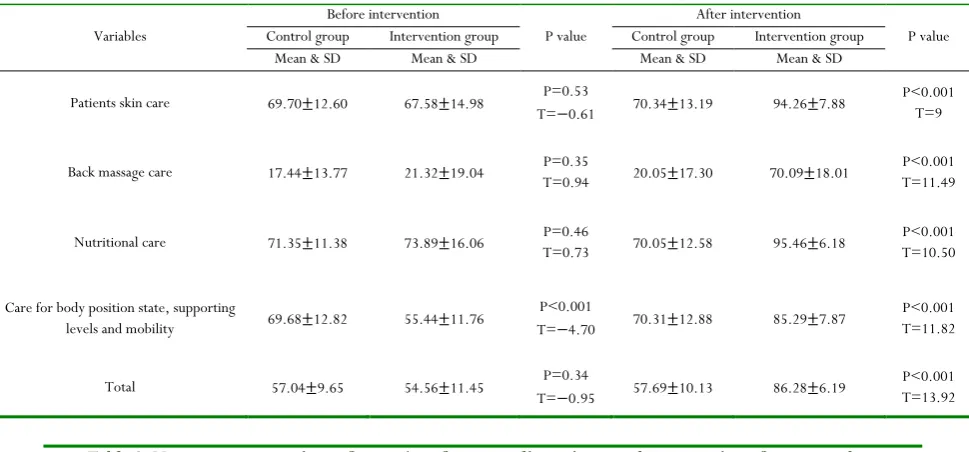
Results demonstrated that the mean score of nurses’ performance on prevention of the pressure ulcers before the educational program was 57.04±9.65 in control group and 54.56±11.45 in the intervention group and there was not any significant difference between the 2 groups. After conducting an educational program the mean score in the control group was 57.69±10.13 and in the intervention group was 86.28±6.19 that showed a significant difference between the groups (P value 0<001), Table 1. Moreover, there was a significant difference in the intervention group regarding the mean score of nurses’ performance before and after the intervention (P-value 0,001), Table 2.
Table 1: mean score comparison of nurses' performance dimensions on the prevention of pressure ulcer before and two weeks after intervention in both control and intervention groups
Variables
Before intervention
P value
After intervention
P value Control group Intervention group Control group Intervention group
Mean & SD Mean & SD Mean & SD Mean & SD
Patients skin care 69.70±12.60 67.58±14.98 P=0.53
T=−0.61 70.34±13.19 94.26±7.88
P<0.001 T=9
Back massage care 17.44±13.77 21.32±19.04 T=0.94 P=0.35 20.05±17.30 70.09±18.01 P<0.001 T=11.49
Nutritional care 71.35±11.38 73.89±16.06 T=0.73 P=0.46 70.05±12.58 95.46±6.18 P<0.001 T=10.50
Care for body position state, supporting
levels and mobility 69.68±12.82 55.44±11.76
P<0.001
T=−4.70 70.31±12.88 85.29±7.87
P<0.001 T=11.82
Total 57.04±9.65 54.56±11.45 P=0.34
T=−0.95 57.69±10.13 86.28±6.19
P<0.001 T=13.92
Table 2: Mean score comparison of nurses' performance dimensions on the prevention of pressure ulcer separately in the control and intervention groups before and two weeks after the intervention
Variables
Control group
P value
Intervention group
P value Before intervention After intervention Before intervention After intervention
Mean & SD Mean & SD Mean & SD Mean & SD
Patients skin care 69.70±12.60 70.34±13.19 P=0.46
T=−0.74 67.58±14.98 94.26±7.88
P<0.001 T=−11.36
Back massage care 17.44±13.77 20.05±17.30 P=0.22
T=−1.24 21.32±19.04 70.09±18.01
P<0.001 T=−13.15
Care for body position state, supporting levels
and mobility
69.68±12.82 70.31±12.88 P<0.53
T=−0.62 55.44±11.76 85.29±7.87
P<0.001 T=−16.96
Total 57.04±9.65 57.69±10.13 P=0.33
T=−0.98 54.56±11.45 86.28±6.19
P<0.001 T=−19.62
Discussion and Conclusion
One of the main indicators of the nursing care quality in the health centers is the incidence rate of pressure ulcers, therefore, the nurses should have proper knowledge and performance on pressure ulcer in order to provide qualified nursing care and rehabilitation. As the findings indicated, the mean score of performance in the control and intervention group was 55.8% before the intervention and it was close to the study results by Saifollahi and et al. (2016), and the mean score of nursing care quality in the prevention of the pressure ulcer was 50.5%. [6] Also, in this study, regarding the scores of nurses' performance area in prevention of pressure ulcer, the lowest score (19.38) was in the area of skin massage that was consistent with Saifollahi and et al., that also had the lowest score (36.52) in the area of skin care. The insufficient knowledge in providing proper care in skin massage, shortage of nursing staff and a heavy workload can result in the low score level of nurses' performance in this regard.
In the present study, regarding the mean scores of pressure ulcer prevention before the intervention in both groups, the lowest mean scores were related to the following conditions: changing patients’ body position state every 2 hours (10.6); slow and circular back massage (15.3); avoiding the massage of the red skin areas (22.5); daily replacement of patients’ bed sheets (24.2); avoiding the pull of patient on the bed sheets during replacement (27.3); and the removal of pressure from the heel (27.5); The use of olive oil in dry skin massage and use of talc powder in fatty skin massage was not observed. Besides, the highest scores of measures were related to avoiding the use of pillow with plastic covers; using of water with body temperature when skin cleansing; Checking the fluid intake and output; feeding the patient unable to eat; the use of gavage or TPN, that obtained 100% score, and replacing the bedding if wet (98.5); use of loose and cotton cloth for patients (96.9); use of puree and soft food; putting patients’ organs in the right position state (93.9); use of supplements in diets of thin and weak patients (92.5); skin cleansing (88.15). In a study by Hoviattalab et al (2014), changing the patients’ position state was performed in less than half of the patients (40.6%) and removing the pressure off the heel was done in half of the patients (50%). [12] However, the results show that the performance rate of these measures by nurses participating in this study was much lower than that of Hoviattalab et al. Besides, in the study of Hoviattalab et al., reduction of exposure to moisture (98.8%) and skin cleansing (93.8%) were highly adopted measures for the patients and is consistent with the present study. Protecting skin during patient transport (90.63 %) was one of the main measures performed in Hoviattalab et al., while in this study, avoiding the patient being
pulled over the bed surface during the movement (27.3) was one of the measures that had the lowest score.
In the present study, after the educational intervention, improvement in nurses' performance in the intervention group was made and there was a significant difference between the mean score of pressure ulcer prevention before and after the intervention. The results were consistent with the results of research by Goljabini et al. (2017) that assessed the impact of clinical-based instruction on nurses' performance in the prevention of pneumonia related to the ventilator. [17] The results of this study showed that nurses' performance after the intervention had a significant upgrade in comparison to the control group. Results of the present study are consistent with the results obtained by Hazrati et al. (2016) that examined the effectiveness of training in small groups on the performance of nurses at ICU in following drug-food instructions through the use of intestinal stomach feeding tube, and the results of the study showed that before training, most nurses in both control and intervention groups did not have proper performance and conducting the training course for the intervention group improved their performance. [18] Also, the results of this study are consistent with the results of Fallahinia and et al. study (2018); [19] since in this study, after the training, the mean score of standard suction increased with a significant difference compared to pre-training scores. The results of the present study are also consistent with the findings of Varaei et al. (2016), which showed that the multimedia training program improved the knowledge and performance of the nurses about the immune injection. [20] According to the researcher, the desirable results in all four studies, suggests that educational approaches can be effective in improving the quality of nursing clinical care.
Conclusion
Research Limitation
Information about the pressure ulcers that the nurses may obtain through studying books or social networks was out of control of the researcher that might affect the results of the intervention.
References
1. Thomas HC. Clinical guide to skin & wound care ,
Wolters Kluwer, Philadelphia. 2012.
2. Nuru N, Zewdu F, Amsalu S, Mehretie Y. Knowledge
and practice of nurses towards prevention of pressure ulcer and associated factors in Gondar University Hospital, Northwest Ethiopia. BMC nursing. 2015 Dec;14(1):34.
3. Qaddumi J, Khawaldeh A. Pressure ulcer prevention
knowledge among Jordanian nurses: a cross-sectional study. BMC nursing. 2014 Dec;13(1):6.
4. Tayyib N, Coyer F, Lewis P. Saudi Arabian adult
intensive care unit pressure ulcer incidence and risk factors: a prospective cohort study. International wound journal. 2016 Oct;13(5):912-9.
5. Cooper KL. Evidence-based prevention of pressure
ulcers in the intensive care unit. Critical care nurse. 2013 Dec 1;33(6):57-66.
6. Saifollahi Z, Bolourchifard F, Borhani F, Ilkhani M,
Jumbarsang S. Correlation between Nurses’ Knowledge
and Quality of Nursing Care for Prevention of Pressure Ulcers in Intensive Care Units. Journal of hayat. 2016 May 15;22(1):90-101.
7. Gill EC. Reducing hospital acquired pressure ulcers in
intensive care. BMJ Open Quality. 2015 Jan 1;4(1):u205599-w3015.
8. Lee YJ, Kim JY, Korean Association of Wound Ostomy
Continence Nurses. Effects of pressure ulcer classification system education programme on knowledge and visual differential diagnostic ability of
pressure ulcer classification and incontinence‐associated
dermatitis for clinical nurses in Korea. International wound journal. 2016 Mar;13:26-32.
9. Hsu MY, Tsao WY, Sung HC. The effectiveness of
educational programs in promoting nurses' knowledge of pressure ulcers: a systematic review protocol. JBI Database of Systematic Reviews and Implementation Reports. 2013 May 1;11(5):132-9.
10. Mwebaza I, Katende G, Groves S, Nankumbi J. Nurses’
knowledge, practices, and barriers in care of patients
with pressure ulcers in a Ugandan teaching hospital. Nursing research and practice. 2014;2014.
11. Aydin AK, Karadag A. Assessment of nurses' knowledge
and practice in prevention and management of deep tissue injury and stage I pressure ulcer. Journal of Wound Ostomy & Continence Nursing. 2010 Sep 1;37(5):487-94.
12. Hoviattalab K, Hashemizadeh H, D'Cruz G, Halfens RJ,
Dassen T. Nursing practice in the prevention of pressure ulcers: an observational study of G erman H ospitals. Journal of clinical nursing. 2015 Jun;24(11-12):1513-24.
13. Iranmanesh S, Rafiei H, Foroogh Ameri G. Critical care
nurses' knowledge about pressure ulcer in southeast of Iran. International wound journal. 2011 Oct;8(5):459-64.
14. Samuriwo R. Effects of education and experience on
nurses’ value of ulcer prevention. British journal of
nursing. 2010 Nov 10;19(20):S8-18.
15. Altun I, Zencirci AD. Knowledge and management of
pressure ulcers: impact of lecture-based interactive workshops on training of nurses. Advances in skin & wound care. 2011 Jun 1;24(6):262-6.
16. Soozani, A., Raei, M., Montazeri, A.S., Nasiri, E.,
Hamidzadeh, A. and Pourheidari, M. The effect of education on knowledge and performance of nurses in prevention and control of pressure sore. Modern Care Journal. 2012; 9(1): 16-23
17. Goljabini S, Hemmati Maslak Pak M, Khalkhali HR,
Valizadeh MA. Effect o Education based Clinical Guidelines on Function of Nurses in the Prevention of Ventilatorassociated Pneumonia (VAP). The J Urmia Nurs Midwifery Fac. 2017;15(7):559-66.
18. Hazrati Maranglo A, Mohammadpour Y, Radfar M. The
Effectiveness of Small Group Teaching on the Nurses’performance of Food-Drug Administration Through Enternal Feeding Tube in Intensive Care Unit Patients Hospitalized in Imam Khomeini Hospital in 2014. The Journal of Urmia Nursing and Midwifery FacultY. 2016;14(2):128-35.
19. Fallahinia G, Gharabaghi A, Azizi A, Moghimbeigi A.
The Effect of Standard Suction Training by Group
Method Education on Nurses’ Performance in Critical
Care Unit. Scientific Journal of Hamadan Nursing & Midwifery Faculty. 2018 Aug 15;26(3):154-45.
20. Varaei SH, Mamashli L, Ghiyasvandian SH, Bahrani N.
The Effect of Multimedia Education Program on Knowledge and Practice of Nurses about Safe Injection.