Volume 3, Issue 4 (2014) pp. 310-316
310 | Page Original Article
Energy Efficient Fuzzy Clustering Algorithm in Wireless
Sensor Networks
Mahboobeh Eshaghi Gorji
Department of Engineering and Research Branch, Mazandaran Branch, Islamic Azad University, Mazandaran, Iran
*Corresponding Author E-mail: [email protected]
Received: 24 August 2014, Revised: 30 September 2014, Accepted: 20 October 2014
ABSTRACT
Wireless sensor network consist of many sensor nodesthat deploy in area unattended, these nodes sense area’s eventsand send data to sink, an important property of these nodes is energy constraint, and so considering energy efficiency in theproposed protocols in this area is unavoidable. One of the mostpractical solutions is clustering, that means, instead of sendingraw data by nodes individually, after Cluster head election,nodes form clusters and send their data to cluster head, then cluster head send processed data to sink, and this consume lessenergy. LEACH is one prominent clustering protocol in wsn thatuses probability theory without considering location and energy. In this work we propose a new clustering protocol that solvessome LEACH problems in clustering. Our proposed algorithmimproves the performance and increase the network lifetime.This work uses fuzzy logic theory in two parts in algorithm: 1)CH election and 2) cluster membership. We simulate proposedalgorithm in MATLAB, based on results we can conclude thatour proposed algorithm works better than LEACH.
Keywords: Wireless, Network, Energy efficient.
Introduction
This document is a template. An electronic copy can bedownloaded from the conference website. For questions onpaper guidelines, please contact the conference publicationscommittee as
indicated on the conference
website.Information about final paper
submission is available from
theconference website. A wireless sensor network consists of alarge number of sensor nodes. These nodes can control over avast area effectively, collect
311 | Page gather environment informationand send
them to the sink (SANTI, 2005). Sensor network can be used in military securityapplications, controlling and
monitoring the traffic,
industrialautomation, controlling the procedures and machinery,environmental
monitoring, biological and
medicalapplications, reconstruction
engineering like maintaining
andcontrolling bridges, structures and expressways (Thuraisingham, 2004) Sensor nodes have limited computation capability, limitedpower and small memory size. The energy is the majorconstraint in WSNs, So, in designing these networks, we mustconsider these factors. As said in recent paragraph, sensornodes must send data to sink, and by considering that thetransmission has most energy consumption in compare withother functions in WSNs, so, to achieve energy efficiency,often in these networks, we use algorithms that reduce thevolume of the transmissions. One kind of the famousalgorithms to reach this goal is clustering. In theclustering algorithms, sensor nodes divide into clusters. Ineach cluster, one node is selected as the head of the clusterand is called the cluster head. The Cluster head collects datafrom nodes in the cluster and aggregates the data and send theaggregated data to the base station. In this way, only thecluster head communicates with the base station that causesthe overall data transmission be reduced . Till now,several clustering protocols have been proposed for wirelesssensor networks ,one of them is LEACH [11] which is alocalized clustering method based on the probability model.All sensor nodes evenly elect themselves as a cluster headbased on the probability model to distribute the energyconsumption.
Recently, in a cluster head election method usingfuzzy logic is introduced to overcome the defects of LEACH.They probed that the network lifetime can be efficientlyprolonged by using three fuzzy variables (energy, localdistance). This mechanism has some demerits: 1) in CHelection, sum of the distance from cluster members to CHcandidate is used as a parameter, in election, some nodes thathave equal energy, the node by lower summation is selectedas CH, but this cause more energy consumption 2) in CHelection, the algorithm uses probability, this causes that if anode has high energy, but because of random property ofalgorithm, this node isn’t selected as CH.We propose a fuzzy algorithm to maximize networklifetime by using similar parameters in [10] and differentfuzzy rules in 1) CH election and also 2) cluster membership.This will prolong the network lifetime. In the rest, in section 2the proposed algorithm is explained and in section 3, thisalgorithm is evaluated and compared with similar works inthis field. Finally, we will summarize our work and results.
PROPOSED ALGORITHM
312 | Page membership part, we use CH’s energy and
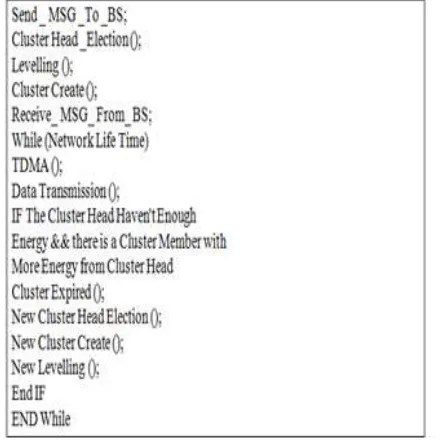
distance to CH as parameter, a key difference between our algorithm and other clustering algorithms is cluster expiration, in other works, cluster head selection performs periodically, but in our work, when CH achieves some conditions, its cluster expires and only in this part, clustering perform, this reduces overhead of doing clustering and also, by doing this locally, clustering consumes less energy. In figure 1, pseudo code of our algorithm is presented:
Figure 1. Pseudo code of our algorithm
At the beginning, sink selects CH
candidates based onenergy and
neighbours number parameter, and then removethe CHs which are in each other range, then in levelling, CHsform spanning tree to do transmission in multi hop manner. Incluster create, nodes select their CHs and form clusters.In continue, CHs setup TDMA scheduling , by applyingTDMA to cluster members, each node send data in its timeslot, this prevent collision and then to provide energyefficiency, go to sleep mode until next slot, and this causenodes consume less energy.In data transmission, cluster members send data to theirCHs and CHs after aggregation send aggregated data to sink.In if statement, if a CH’s energy reaches less that a threshold,which CH cannot work more than a few rounds and also, thereis a cluster member with higher energy, this cluster expiresand cluster headselections perform.
To apply fuzzy in our algorithm, we use Mamdani system,in new cluster head election, we use energy and sum ofneighbours distance as fuzzy variables, the membershipfunction and rule base are presented in fig. 2 and table I.
Table I. Rule Base of Cluster Head Election
Energy Local Dist Weight1
Low Far Very Low
Low Medium Low
Low Close Rather Low
Medium Far Med Low
Medium Medium Med Medium Close Med High
High Far Rather High
High Medium High
313 | Page And in, in new cluster create, energy and
distance are fuzzyvariables, the
314 | Page
Table II. Rule Base of Cluster Create
Dist Energy Weight2
Close Low Very Low
Close Medium Low
Close High Rather Low
Medium Low Med Low
Medium Medium Med
Medium High Med High
Far Low Rather High
Far Medium High
Far High Very High
Performance Evaluation
All In this section we present simulation results. Toevaluate the efficiency of the proposed algorithm, we simulatethe algorithm and LEACH in MATLAB. Thesimulation areais considered a 300*300 square area that 200-400 nodes aredeployed in this area randomly. The initial energy of all nodesis equal 0.5J. Thecommunication range of all nodes is set to85 meter and the range to communicateCHs is 150 meter. We use the communication model used in. Equation (1)represents the amountof energy consumption in transmitting apacket with k bits over distance d. Eelecis the amount ofenergy consumption to run the transmitter or receiver circuitry.Efsand Emp is the amount of energy dissipated in the RFamplifier according to thedistance d0 which can be obtainedfrom Equation (2).
(1)
(2) The amount of energy consumption in receiving a packetwith k bits can be calculated as follow:
The amount of energy consumption for aggregatingreceived packets from sensor nodes in cluster heads with kbits can be calculated like follow
The variable k is sum of sensors sensed data and clusterhead sensed data. EDA is the per bit energy consumption toaggregating in cluster head.In fig. 4, wecompare network life time in three algorithmswith 200-600 nodes. In this work we suppose the network lifetime is until that 37.5 percent of nodes finish their energy. Fig4 shows results of 10 simulation scenarios. In average for 400nodes, thenetwork lifetime of LEACH is 68.4 and thenetwork lifetime of none
fuzzy proposed is 349.8 and
fuzzyproposed is 574.7. Fuzzy proposed algorithm is moreefficient than LEACH and none fuzzy proposed. This isbecause the fuzzyalgorithm considers the energy and sumneighbors distance in cluster head election and energy anddistance in cluster create.
316 | Page In figure 6 we compare total energy of the
network with threealgorithm for 300 nodes at 10 simulation scenarios, we findthat fuzzy algorithm is more energyefficient than others.
Conclusion
In this paper we propose an energy efficient clusteringalgorithm that uses fuzzylogic, by using energy, distance andnum of neighbors as fuzzy variables to CH selection and alsoin cluster membership. As showed in simulation results, weimprove the performance and reduce energy consumption
References
Akyildiz I.F., W. Su, Y.
Sankarasubramaniam, E. Cayirci., “Wireless sensor networks: a survey”, Journal of Computer Networks, Vol. 38, March 2002, pp. 393-422.
SANTI, P. (2005). "Topology Control in Wireless Ad Hoc and Sensor Networks", John Wiley & Sons.
CHONG, C.Y. & KUMAR, S.P. (2003). "Sensor Networks: Evolution Opportunities and Challenges". Proceedings of the IEEE, 91, 247-1256.
COMAN, A., NASCIMENTO, M. A. & SANDER, J. (2004) "A Framework for Spatio-Temporal Query Processing Over Wireless Sensor Networks". Proceedings of the First Workshop on Data Management for Sensor Networks (DMSN 2004). Toronto, Canada.104-110.
THURAISINGHAM, B. (2004). "Secure Sensor Information Management and Mining". IEEE SIGNAL PROCESSING MAGAZINE, vo1.21, no.3, 2004.1053, 14-19.
Manjeshwar A., and Agarwal, D.P. (2001). “TEEN: a Routing Protocol for Enhanced Efficiency in Wireless Sensor Networks”, Parallel and Distributed Processing Symposium,pp. 2009-2015, April.
Alkaraki J.N., and Kamal, A.E. (2004). “Routing Techniques in Wireless Sensor Networks: A Survey”, IEEE Wireless Communication, pp. 6-23, December.
Park, S.H., Cho, J.S., Jung, S.M., Han, Y.J., and Chung,T.M. (2007). “Architecture of Context-Aware Integrated Security Management Systems for Smart Home Environment”, APNOMS2007, LNCS 4773, pp. 543-546, October
Lindsey S. and Raghavendra, C. (2002). “PEGASIS: Power-Efficient Gathering in Sensor Information Systems”, IEEE Aerospace Conference Proceedings,vol. 3, pp. 1125-30.
Jong-Myoung K., Seon-Ho P., Young-Ju H., and Tai-Myoung C. (2008). " CHEF: Cluster Head Election mechanism using Fuzzy logic in Wireless Sensor Networks".Feb. 17-20, ICACT, 654-659
Abbasi, A.A., Younis, M. (2007). "A survey on clustering algorithms for wireless
sensor networks", Computer
Communications 30 2826–2841.
How to cite this article: Mahboobeh Eshaghi Gorji. Energy Efficient Fuzzy Clustering Algorithm in Wireless Sensor Networks. International Journal of Advanced
Studies in Humanities and Social Science, 2014, 3(4), 310-316.