The Journal of Threatened Taxa is dedicated to building evidence for conservation globally by publishing peer-reviewed articles online every month at a reasonably rapid rate at www.threatenedtaxa.org. All articles published in JoTT are registered under Creative Commons Attribution 4.0 International License unless otherwise mentioned. JoTT allows unrestricted use of articles in any medium, reproduction, and distribution by providing adequate credit to the authors and the source of publication.
OPEN ACCESS
www.threatenedtaxa.org
ISSN 0974-7907 (Online) | ISSN 0974-7893 (Print) Building evidence for conservation globally
Journal of Threatened Taxa
For Focus, Scope, Aims, Policies and Guidelines visit http://threatenedtaxa.org/index.php/JoTT/about/editorialPolicies#custom-0 For Article Submission Guidelines visit http://threatenedtaxa.org/index.php/JoTT/about/submissions#onlineSubmissions For Policies against Scientific Misconduct visit http://threatenedtaxa.org/index.php/JoTT/about/editorialPolicies#custom-2 For reprints contact <[email protected]>
Conservation Application
Taking the first steps: Initial mapping of the human-wildlife
interaction of the Mauritius Fruit Bat Pteropus niger
(Mammalia: Chiroptera: Pteropodidae) in Mauritius by
conservation organizations
Brandon P. Anthony, Vikash Tatayah & Deborah de Chazal
26 July 2018 | Vol. 10 | No. 8 | Pages: 12073–12081 10.11609/jott.4063.10.8.12073-12081
12073
Conser
va
tion Applica
tion
DOI: http://doi.org/10.11609/jott.4063.10.8.12073–12081
Editor: Anonymity requested. Date of publication: 26 July 2018 (online & print)
Manuscript details: Ms # 4063 | Received 08 February 2018 | Final received 30 March 2018 | Finally accepted 15 June 2018
Citation: Anthony, B.P., V. Tatayah & D. de Chazal (2018). Taking the first steps: Initial mapping of the human-wildlife interaction of the Mauritius Fruit Bat Pteropus
niger (Mammalia: Chiroptera: Pteropodidae) in Mauritius by conservation organizations. Journal of Threatened Taxa 10(8): 12073–12081; http://doi.org/10.11609/ jott.4063.10.8.12073-12081
Copyright: © Anthony et al. 2018. Creative Commons Attribution 4.0 International License. JoTT allows unrestricted use of this article in any medium, reproduction and distribution by providing adequate credit to the authors and the source of publication.
Funding: This work was supported by Central European University Foundation of Budapest Academic Travel Grant BPF/11783.
Competing interests: The authors declare no competing interests.
Author Details: Dr. Brandon P. Anthony is an Associate Professor in the Environmental Sciences and Policy Department at the Central European University (CEU) in Budapest, Hungary. Prior to joining CEU, he served as advisor to the Hungarian Nature Conservation Institute, and as a park supervisor and agricultural habitat biologist in Canada. He has conducted research in North America, Africa, and Eurasia on a diverse range of fields including nature conservation, human-wildlife conflict, protected area management, community livelihoods, and amphibian ecology. Dr. Vikash Tatayah is the Conservation Director of the Mauritian Wildlife Foundation. He has been active in conservation for over 20 years. He manages conservation programmes on Mauritius, Rodrigues and outer islands that have allowed the recovery of a long list of threatened plants and animals. He participates in fund-raising for projects and public relations initiatives, is a link with the Government of Mauritius and represents the Mauritian Wildlife Foundation on national conservation and environment consultations. He also represents the organization with several key international conservation organisations and universities. He has been a leading advocate for protection of bats. Deborah de Chazal is the Executive Director of the Mauritian Wildlife Foundation. She has been active in the organisation for over 15 years. She has overall responsibility for all operations and directly manages the education, ecotourism, fundraising, financial and administrative activities with an oversight on the conservation programmes ensuring coordination between the functions. She has been actively involved in seeking and implementing solutions to protect bats.
Author Contribution: Designed study (BPA); data collection (BPA, VT); data analysis (BPA); write up (BPA, VT, DDC).
Acknowledgements: We thank MWF for logistical support, all workshop participants for their involvement, and Viktor Lagutov for Figure 1.
Taking the first steps: Initial mapping of the human-wildlife
interaction of the Mauritius Fruit Bat Pteropus niger
(Mammalia: Chiroptera: Pteropodidae) in Mauritius by
conservation organizations
Brandon P. Anthony 1, Vikash Tatayah 2& Deborah de Chazal 3
1 Department of Environmental Sciences and Policy, Central European University, Nádor utca 9, Budapest 1051, Hungary
2,3 Mauritian Wildlife Foundation, Grannum Rd., Vacoas, Mauritius
1 [email protected] (corresponding author), 2 [email protected], 3 [email protected]
ISSN 0974-7907 (Online) ISSN 0974-7893 (Print)
OPEN ACCESS
Journal of Threatened Taxa | www.threatenedtaxa.org | 26 July 2018 | 10(8): 12073–12081
Abstract: Interactions between people and wildlife have both positive and negative aspects. Negative interactions, commonly termed
human-wildlife conflict (HWC), have increased in recent decades due to a number of factors including difficulties in identifying and communicating the complexities of stakeholder values and positions over wildlife and its management. Here, we present the perceptions of two conservation organizations on the landscape of HWC involving the threatened Mauritius Fruit Bat Pteropus niger, Kerr 1792 in Mauritius, including damage to fruit crops and controversial government culls in 2015 and 2016. Participants identified 18 stakeholders in the conflict varying in importance and influence, examined where and how hostility is manifested, and delineated both perceived and real costs of the conflict. Additionally, 13 environmental and 17 social risk factors associated with the conflict were categorized, along with potential policy and management options for mitigation. We argue that initial in-house workshops are advantageous in understanding conservation conflicts before extending dialogue with other stakeholders.
INTRODUCTION
Human-wildlife conflict (HWC) traditionally arises from a rivalry or antagonism between humans and wildlife (Woodroffe et al. 2005), or between people over wildlife and/or its management (Madden 2004; Redpath et al. 2013). The former typically emerge from territorial proximity between humans and wildlife, conflict over the same resource or even a direct threat to human wellbeing. People-people conflicts on the other hand, characteristically emerge when disparate values clash in the face of management decisions (Nyhus 2016).
While humans and wildlife have a long history of interaction, the frequency and complexity of conflicts has grown in recent decades, mainly because of the exponential increase in human populations and concomitant human footprint, expansion of some wildlife distributions (Chapron et al. 2014), as well as a frequent inability of institutions that are meant to mediate such conflicts to respond effectively (Anthony et al. 2010). HWC often pits disparate values against one another (Tajfel 1981; Kellert 1993; Young et al. 2010) and demands attention from economic, legal, social and environmental policy makers (Knight 2000; White et al. 2009; Nyhus 2016). Moreover, these values influence people’s behaviour towards wildlife and institutions responsible for conservation (Manfredo & Dayer 2004; Manfredo 2008; Dickman et al. 2013). Therefore, HWCs are best managed through a shared understanding of the broader context of the situation, necessitating both natural and social science approaches (Dickman 2010; Redpath et al. 2013), and often utilizing workshops (Madden 2004; Reed et al. 2009; WWF 2015). This shared understanding is of key importance to finding long-lasting solutions to such conflicts, and to avoid potential escalation (Treves et al. 2009; Anthony et al. 2010).
The identification, differentiation and meaningful involvement of all affected stakeholders and the mapping of their goals and opinions on the resource(s) in question and potential mitigation strategies are crucial before crafting or implementing management decisions (Reed 2008; Reed et al. 2009; White et al. 2009; Redpath et al. 2013). Recent cases where stakeholder analysis and participatory strategies have been applied with the aim of conflict resolution range from conflicts concerning Hen Harriers Circus cyaneus in Scotland (White et al. 2009), Eastern Imperial Eagles Aquila heliaca in Hungary (Kovács et al. 2016), to livestock depredation by large carnivores in South Africa (Anthony & Swemmer 2015). Before engaging with wider actors, however, it has been suggested that organizations first develop a
coherent understanding of the issue within their own institution and/or with institutions that share common values, serving to enhance channels of communication and catering to a unified backing of wider stakeholder engagement (FAO 2002), particularly in contexts where complex multi-actor governance models exist (Funtowicz et al. 1999). Thus, there has been greater realization by management authorities that focusing on both wildlife and human dimensions together is critical, as opposed to treating them separately, even within organizations (Clark et al. 1996; Baruch-Mordo et al. 2009; Treves et al. 2009).
Mauritius Fruit Bats
Bats are the only mammals native to the Mascarene Islands, consisting of Mauritius, Réunion and Rodrigues (Fig. 1). Historically, three fruit bat species occupied these islands: one is now extinct (Pteropus subniger), leaving one species each on Mauritius (P. niger, Kerr 1792) and Rodrigues (P. rodricensis). Once widespread over Mauritius, the Mauritius Fruit Bat population decreased considerably from its original population due to habitat loss and degradation, cyclones, invasive alien species, climate change and illegal hunting (Hutson & Racey 2013; Vincenot et al. 2017). Due to lack of major cyclones for well over a decade, however, the population has increased, thus shifting its IUCN Red List status from Endangered (2008) to Vulnerable (in 2013), which was also based on an assurance that culling would not be considered (Hutson & Racey 2013). Assessing the status of this bat species has been complicated by discrepancies in population estimates yielded by different census techniques, ranging in 2015 from ~50,000 by the Mauritian Wildlife Foundation (MWF), to ~90,000 by the National Parks and Conservation Service (NPCS) (Hansard 2016). In October 2016 a population estimate was undertaken by the NPCS in collaboration with the Forestry Service and MWF, using both evening dispersal counts and direct counts, which are believed to be more accurate (Kunz 2003), yielding an estimate of ~62,000 individuals.
Journal of Threatened Taxa | www.threatenedtaxa.org | 26 July 2018 | 10(8): 12073–12081
Mapping of human-wildlife interaction of Mauritius Fruit Bat Anthony et al.
12075 and 11.4% on Lychee Litchi chinensis and Large Mango
Mangifera indica trees, respectively (Oleksy 2015),
to over 50% of Lychee trees (Hansard 2016). Despite a subsidized tree netting scheme, and due in part to alleged significant increases in fruit damage by bats and the lobbying of fruit growers for its lethal control, the government passed the Native Terrestrial Biodiversity and National Parks Act in November 2015, legalizing the culling of any wildlife that has attained ‘pest’ status. Consequently, a highly controversial government sanctioned cull was conducted in November-December 2015, with a reported 30,938 bats culled (Hansard 2016). A second official cull was conducted in December 2016 in which 7,380 bats were killed (Hansard 2017). This culling largely contributed to a subsequent uplisting of the species from Vulnerable to Endangered by the IUCN in 2018 (Kingston et al. 2018).
The Mauritian Fruit Bat cull has pitted a number of stakeholders and their values against one another (MWF 2016). This sensitive situation, involving disputed bat population and fruit damage estimates, and the role of culling to alleviate fruit damage, requires joint actions from fruit growers, local organizations and governmental bodies, and also calls for a deeper understanding of the conflict by conservation organizations to provide a basis for developing effective management strategies. In order
to improve this understanding, we utilized a workshop targeted specifically to conservation organizations to map how they perceive the conflict landscape by identifying the scope and scale of human-bat interaction issues associated with relevant actors in Mauritius, and to propose strategies to navigate forward. It specifically aimed to explore intra-stakeholder complexities involved in preventing and resolving conflicts and fostering coexistence between people and bats, acknowledging data deficiencies along the way.
METHODS
As an overarching framework, but restricted to organizations with similar values, we utilized Lasswell’s (1971) general strategy for problem solving that undertakes five ‘intellectual tasks’:
(1) clarify the goals of people involved or affected by the problem and its solution.
(2) describe the history and trends of the problem (including empirical data on the biophysical and cultural context of the problem and relevant processes such as decision making).
(3) understand the relationships of all factors that have influenced, affected, or caused the problem.
(4) project the trajectory, severity, and consequences of future developments.
(5) invent, appraise, and select alternatives. In addition, we incorporated a number of relevant sub-frameworks drawing from examples from the literature on the targeted theme.
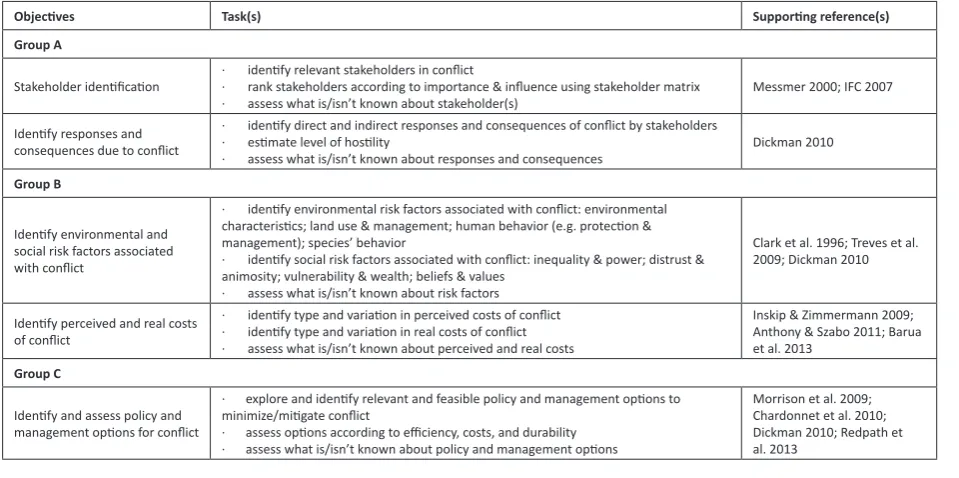
To implement this framework, we convened a one-day workshop for MWF and NPCS staff in May 2017. All staff who were directly or indirectly engaged with the fruit bat conflict were invited, and included organization directors, project managers, and field-level officers. Participants were provided with a pre-workshop package consisting of a schedule, and group member allocation along with assigned readings and tasks. The workshop consisted of introductory sessions on the background of human-wildlife conflict and its mitigation, the Mauritius Fruit Bat, and an outline for group exercises (see Appendix 1). These were followed by three parallel group sessions, the composition of which was based on maintaining equally sized groups and personnel expertise and awareness. Each group had a number of iterative tasks to complete including an ongoing assessment of knowledge gaps and/or research needs (Table 1). A group-appointed rapporteur recorded notes on both a flip chart and notebook, then communicated findings back to all workshop participants at the end of the day. Notes for each group were subsequently compiled and categorized according to pre-defined conceptual codes according to the sub-frameworks used, and were largely descriptive in nature.
Secondly, in June 2017, we administered a follow-up questionnaire to all workshop participants consisting of two parts. First, we captured information on length of involvement in their organization, and perceived knowledge of the fruit bat conflict prior to the workshop. Second, we requested their opinion as to (i) whether the workshop met their expectations, (ii) assisted them to see and appreciate the wider conflict landscape, (iii) what was particularly useful with the workshop, and (iv) how it could be improved. Univariate statistics were computed using SPSS ver. 22 (IBM Corp 2013). Qualitative responses to questionnaire items were analysed using emergent content coding (Stemler 2001).
RESULTS
A total of 20 participants representing staff from MWF (18) and NPCS (2) attended the workshop, and contributed to its results. Below, we present findings from the group exercises, including coded indications of knowledge level of the respective concept/stakeholder by workshop participants (bold = well known; normal font = somewhat known; italics = unknown).
Group A
Group A participants identified 18 stakeholders involved in human-bat interaction, ranging from highly influential and important fruit-growers, to leisure parks holding relatively little influence and power in the
Table 1. Workshop outline and group tasks for participants
Objectives Task(s) Supporting reference(s)
Group A
Stakeholder identification · · identify relevant stakeholders in conflict rank stakeholders according to importance & influence using stakeholder matrix
· assess what is/isn’t known about stakeholder(s) Messmer 2000; IFC 2007
Identify responses and consequences due to conflict
· identify direct and indirect responses and consequences of conflict by stakeholders · estimate level of hostility
· assess what is/isn’t known about responses and consequences Dickman 2010 Group B
Identify environmental and social risk factors associated with conflict
· identify environmental risk factors associated with conflict: environmental characteristics; land use & management; human behavior (e.g. protection & management); species’ behavior
· identify social risk factors associated with conflict: inequality & power; distrust & animosity; vulnerability & wealth; beliefs & values
· assess what is/isn’t known about risk factors
Clark et al. 1996; Treves et al. 2009; Dickman 2010
Identify perceived and real costs of conflict
· identify type and variation in perceived costs of conflict · identify type and variation in real costs of conflict · assess what is/isn’t known about perceived and real costs
Inskip & Zimmermann 2009; Anthony & Szabo 2011; Barua et al. 2013
Group C
Identify and assess policy and management options for conflict
· explore and identify relevant and feasible policy and management options to minimize/mitigate conflict
· assess options according to efficiency, costs, and durability · assess what is/isn’t known about policy and management options
Journal of Threatened Taxa | www.threatenedtaxa.org | 26 July 2018 | 10(8): 12073–12081
Mapping of human-wildlife interaction of Mauritius Fruit Bat Anthony et al.
12077 conflict. In addition, there were a number of ‘unknown’
actors of varied influence and importance, including the role of religious organizations (Table 2). Group A also explicated a number of current interactions between stakeholder groups, outlining the perceived level of hostility, stakeholder activity, and current expressions of the conflict. These interactions represented public, government, and NGO sectors (Appendix 2), ranging from varied responses to media campaigns, frustration with current mitigation strategies (tree netting), and conflicting government mandates across ministries.
Group B
Group B participants identified 13 environmental and 17 social risk factors associated with the human-bat interaction, along with knowledge gaps (Appendix 4), which would necessitate targeted investigation before and during extended dialogue with other stakeholders. Environmental risk factors included the influence that climatic conditions (e.g., cyclones), forest health and composition, fruiting season, fruit tree pruning and protection, and bat behaviour have on the conflict. Social risk factors were also varied, ranging from market disparities, powerful lobbying interests, media influence, distrust, and folklore.
Further, Group B participants assessed both the perceived and real costs of conflict, with an indication of level of knowledge concerning these factors (Appendix 3). Most discrepancies between perceived and real costs of the conflict were economical in nature, including those relating to fruit tree maintenance, the price of fruit, and the potential impact on tourism if Mauritius’ world renowned reputation in conservation is seen as eroding.
Group C
Group C was assigned to outline what policy and management measures are, and potentially could be,
leveraged to mitigate conflict between fruit bats and the various stakeholders. Results are outlined in Appendix 5, conforming to the same scheme of level of knowledge about the effectiveness of policy and management options. Measures identified by workshop participants included extended tree netting and pruning service to fruit growers (both backyard and larger orchards), initiating decoy crops, increased bat awareness campaigns, stricter control on fruit prices, and expanded research on bat ecology.
Workshop Assessment
Fifteen (75%) workshop participants completed and returned the questionnaire, representing both the MWF (13), and the NPCS (combined response from 2 participants). Length of time employed in their respective organizations ranged from 0.5-20 years (x̅ = 7.9, sd = 5.63). On a 10 point scale (1=very low to 10=very high), prior knowledge regarding the fruit bat conflict ranged from 5 to 9 (x̅ = 7.4, sd=1.39), and was greater among those who held higher positions within their organization and/or those who worked directly with the bat issue.
On a scale of 1 to 10 (1=not at all to 10=completely), participants rated whether the workshop met their expectations, and opportunity was granted to explain their response. Scores ranged from 3 to 8 (x̅ = 6.0, sd =1.65). Those with higher scores noted that the workshop helped to (i) increase appreciation of the wider legal, social, and institutional aspects of the conflict, (ii) provide intra-agency exposure and awareness of the conflict complexity, and (iii) provide a much-needed platform to hear other agency views (and challenges) associated with the conflict.
Workshop participants were asked more specifically to rate how well the workshop helped them to see the wider social and management aspects of the issue both within their own organization and with another Table 2. Stakeholder matrix based on influence and importance of stakeholder (bold = well known; normal font = somewhat known; italics =
unknown)
Importance
Unknown Little/No importance Some importance Significant importance
In
fluence
Significant influence government (Cabinet) fruit growers (commercial + backyard)
Somewhat influential movies public
press
fruit sellers/traders private companies NPCS
FAREI
funders
Little/No influence hunters leisure parks tourists conservationists (MWF)
Unknown Religious organizations nature-lovers (IUCN; NGOs; individuals) net sellers
conservation organization. Scores ranged widely (x̅ = 6.1, sd = 2.53), with those with higher scores noting how well the workshop helped them to understand the breadth of stakeholders directly or indirectly involved in the conflict, to see underlying issues, and recognize political dimensions of conservation conflicts (including public and political resistance). Others commented on how well the workshop disclosed how even two pro-conservation organizations can have disparate opinions on how to manage such conflicts. For those who perceived themselves to have moderate experience in conflict management and resolution, the workshop did not add much to their understanding of the breadth of social and management facets of this particular conflict. Participants believed the workshop was particularly useful in that, before extending dialogue with other stakeholders, it:
• involved group sessions within conservation-oriented stakeholders in which issues could be openly discussed and debated;
• encouraged wider understanding of models by which conservation conflicts can be framed; and
• provided pre-workshop readings and introductory sessions which facilitated improved framing of workshop tasks.
Finally, ideas on improving such workshops included eventually expanding stakeholder representation, extending its duration to 3–4 days, developing a common strategy to move forward, providing a broader array of theories, case studies, and bat research, and allowing for prolonged inter-group discussions on findings.
DISCUSSION
Our initial findings demonstrate that inter- and intra-organizational workshops designed to map conservation conflict landscapes, before extending dialogue with a wider spectrum of stakeholders, can be of immense value in a number of ways. First, a broader array of stakeholders can be acknowledged at the onset, each with varying degrees of influence and importance which, in turn, allows for more strategic and prioritized engagement (IFC 2007). Second, conflict nodes between stakeholders and their intensity can be identified, facilitating more nuanced strategies for addressing particular conflict dimensions, and allowing for a more appreciative inquiry of the conflict typology that currently exists, or may develop in the future. Third, delineating environmental and social risk factors including both perceived and real conflict costs can assist the designing of more complex
mitigation strategies including more focused awareness raising campaigns, as well as leveraging existing and potential policy and management options (Dickman 2010). Finally, by recognizing where knowledge gaps exist, conservation organizations can channel appropriate resources towards research needs and/or solicit support from other stakeholders for both research and appropriate monitoring.
We believe initial conflict mapping workshops of this nature can elevate pan-organizational understanding of conservation conflicts and build consensus by identifying, appreciating, and eventually communicating the positions and values of stakeholders, and their justification. Of course, this is only the first step in realizing true resolution, as other stakeholders may have vastly different or contrasting opinions, attitudes and values concerning the conflict (White et al. 2009). Moreover, we recognize that in-house workshops represent only one of many options for participatory and non-participatory processes which can be used to address conservation conflicts (Reed et al. 2009). Nevertheless, our assessment demonstrates that organizations would benefit from in-house workshops in order to develop an inclusive and coherent approach to engage other stakeholders before taking that next step.
Our findings also suggest that such workshops should extend to a minimum of three days, eventually involve more stakeholders, and generate more tangible outcomes in terms of mitigation strategies. We recommend, however, that such preliminary workshops be restricted to a limited number of stakeholders sharing similar values, involving relevant personnel who interact both directly or indirectly with other stakeholders (including the general public) in HWC issues. Doing so prompts a more collective and nuanced strategy for navigating forward as an organization, and for reducing the risk of conflict escalation. In our case, the fate of an entire species, and the services it provides, may depend on it.
REFERENCES
Anthony, B.P., P. Scott & A. Antypas (2010). Sitting on the fence?
Policies and practices in managing human-wildlife conflict in Limpopo Province, South Africa. Conservation & Society 8(3): 225–240.
Anthony, B.P. & L. Swemmer (2015). Co-defining program success:
Identifying objectives and indicators for a livestock damage compensation scheme at Kruger National Park, South Africa. Journal
for Nature Conservation 26: 65–77.
Anthony, B.P. & A. Szabo (2011). Protected areas: conservation
cornerstones or paradoxes? Insights from Human-Wildlife Conflicts in Africa and Southeastern Europe, pp. 255–282. In: López-Pujol, J. (ed.). The Importance of Biological Interactions in the Study of
Biodiversity. InTech Publishers, Rijeka, Croatia, 402pp.
Aziz, S.A., K.J. Olival, S. Bumrungsri, G.C. Richards & P.A. Racey (2016).
Journal of Threatened Taxa | www.threatenedtaxa.org | 26 July 2018 | 10(8): 12073–12081
Mapping of human-wildlife interaction of Mauritius Fruit Bat Anthony et al.
12079
legislation and mitigation, pp. 377-426. In: Voigt, C.C. & T. Kingston (eds.). Bats in the Anthropocene: Conservation of Bats in a Changing
World. Springer, Heidelberg, i–ix, 606pp.
Barua, M., Bhagwat, S.A. & S. Jadhav (2013). The hidden dimensions of
human-wildlife conflict: Health impacts, opportunity and transaction costs. Biological Conservation 157: 309–316.
Baruch-Mordo, S., S.W. Breck, K.R. Wilson & J. Broderick (2009). A
tool box half full: How social science can help solve human-wildlife conflict. Human Dimensions of Wildlife 14(3): 219–223.
Chapron, G., P. Kaczensky, J.D.C. Linnell, M. von Arx, D. Huber, H. Andrén & J.V. López-Bao (2014). Recovery of large carnivores in
Europe’s modern human-dominated landscapes. Science 346(6216): 1517–1519.
Chardonnet, P., B. Soto, H. Fritz, W. Crosmary, N. Drouet-Hoguet, P. Mesochina, M. Pellerin, D. Mallon, L. Bakker, H. Boulet & F. Lamarque (2010). Managing the Conflicts between People and Lion:
Review and Insights from the Literature and Field Experience. Wildlife
Management Working Paper 13. Food and Agriculture Organization of the United Nations, Rome, 66pp.
Clark, T.W., A.P. Curlee & R.P. Reading (1996). Crafting effective
solutions to the large carnivore conservation problem. Conservation
Biology 10(4): 940–948.
Dickman, A.J. (2010). Complexities of conflict: the importance of
considering social factors for effectively resolving human-wildlife conflict. Animal Conservation 13(5): 458–466.
Dickman, A., S. Marchini & M. Manfredo (2013). The human
dimension in addressing conflict with large carnivores. Key Topics in
Conservation Biology 2: 110–126.
FAO (2002). Methodological Guide for Designing and Implementing
a Multimedia Communication Strategy. Food and Agriculture
Organization of the United Nations, Rome, 44pp.
Funtowicz, S.O., J. Martinez-Alier, G. Munda & J.R. Ravetz (1999).
Information Tools for Environmental Policy under Conditions of Complexity. Environmental Issues Series No. 9, European
Environment Agency, Copenhagen, 34pp.
Hansard (2016). Debate No. 08 of 2016, Tuesday 24 May 2016,
Republic of Mauritius, Sixth National Assembly, First Session. http:// mauritiusassembly.govmu.org/English/hansard/Documents/2016/ hansard0816.pdf
Hansard (2017). Debate No. 23 of 2017, Tuesday 31 October 2017,
Republic of Mauritius, Sixth National Assembly, First Session.
Hutson, A.M. & P.A. Racey (2013). Pteropus niger. The IUCN Red
List of Threatened Species 2013: e.T18743A22084054. http:// doi.org/10.2305/IUCN.UK.2013-2.RLTS.T18743A22084054. en Downloaded on 02 July 2018.
IBM Corp. (2013). IBM SPSS Statistics for Windows, Version 22.0.
Armonk, NY: IBM Corp.
Inskip, C. & A. Zimmermann (2009). Human-felid conflict: a review of
patterns and priorities worldwide. Oryx 43(1): 18–34.
International Finance Corporation (IFC) (2007). Stakeholder
Engagement: A Good Practice Handbook for Companies Doing Business in Emerging Markets. IFC, Washington, DC, 201pp.
Kellert, S.R. (1993). The biological basis for human values of nature, pp.
42–72. In: Kellert, S.R. & E.O. Wilson (eds.). The Biophilia Hypothesis. Island Press, Washington, DC, 496pp.
Kingston, T., V. Florens, R. Oleksy, K. Ruhomaun & V. Tatayah (2018).
Pteropus niger. The IUCN Red List of Threatened Species 2018:
e.T18743A86475525. Downloaded on 07 July 2018.
Knight, J. (ed.) (2000). Natural Enemies: People-wildlife Conflicts in
Anthropological Perspective. Routledge, New York, 254pp.
Kovács, E., V. Fabók, A. Kalóczkai & H.P. Hansen (2016). Towards
understanding and resolving the conflict related to the Eastern Imperial Eagle (Aquila heliaca) conservation with participatory management planning. Land Use Policy 54: 158–168.
Kunz, T.H. (2003). Censusing bats: Challenges, solutions, and sampling
biases, pp. 9–19. In: O’Shea, T.J. & M.A. Bogan (eds.). Monitoring
Trends in Bat Populations of the United States and Territories: Problems and Prospects. U.S. Geological Survey, Biological Resources
Discipline, Information and Technology Report,
USGS/BRD/ITR--2003–0003, Springfield VA, 274pp.
Lasswell, H.D. (1971). A Pre-view of the Policy Sciences. Elsevier, New
York, 173pp.
Madden, F. (2004). Creating coexistence between humans and wildlife:
global perspectives on local efforts to address human-wildlife conflict. Human Dimensions of Wildlife 9(4): 247–258.
Manfredo, M.J. (2008). Who Cares about Wildlife? Social Science
Concepts for Exploring Human-Wildlife Relationships and Conservation Issues. Springer, New York, 228pp.
Manfredo, M.J. & A.A. Dayer (2004). Concepts for exploring the
social aspects of human-wildlife conflict in a global context. Human
Dimensions of Wildlife 9: 1–20.
Messmer, T.A. (2000). The emergence of human-wildlife conflict
management: turning challenges into opportunities. International
Biodeterioration and Biodegradation 45: 97–102.
Morrison, K., R. Victurine & C. Mishra (2009). Lessons Learned,
Opportunities and Innovations in Human Wildlife Conflict Compensation and Insurance Schemes. WCS TransLinks Program, Bronx, NY, 24pp.
MWF (2016). Fruit damage claims do not justify a cull of the Mauritius
Fruit Bat. Statement issued 9 December 2016, Mauritian Wildlife Foundation http://www.mauritian-wildlife.org/application/index. php?tpid=30&tcid=81
Nyhus, P.J. (2016). Human-wildlife conflict and coexistence. Annual
Review of Environment and Resources 41(1): 143–171.
Oleksy, R. (2015). The impact of the Mauritius Fruit Bat (Pteropus
niger) on commercial fruit farms and possible mitigation measures.
Report to The Rufford Foundation; http://www.rufford.org/projects/ ryszard_oleksy
Redpath, S.M., J. Young, A. Evely, W.M. Adams, W.J. Sutherland, A.A. Whitehouse, R.A. Lambert, J.D.C. Linnell, A. Watt & R.J. Gutiérrez (2013). Understanding and managing conservation conflicts. Trends
in Ecology & Evolution 28(2): 100–109; http://doi.org/10.1016/j. tree.2012.08.021
Reed, M.S. (2008). Stakeholder participation for environmental
management: a literature review. Biological Conservation 141: 2417–2431.
Reed, M.R., A. Graves, N. Dandy, H. Posthumus, K. Hubacek, J. Morris, C. Prell, C.H. Quinn & L.C. Stringer (2009). Who’s in and why? A
typology of stakeholder analysis methods for natural resource management. Journal of Environmental Management 90(5): 1933– 1949.
Stemler, S. (2001). An overview of content analysis. Practical
Assessment, Research & Evaluation 7(17): 1–6; http://PAREonline.
net/getvn.asp?v=7&n=17
Tajfel, H. (1981). Human Groups and Social Categories: Studies in Social
Psychology. Cambridge University Press, Cambridge, UK, 384pp.
Treves, A., R.B. Wallace & S. White (2009). Participatory planning of
interventions to mitigate human–wildlife conflicts. Conservation
Biology 23(6): 1577–1587.
Vincenot, C.E., F.B.V. Florens & T. Kingston (2017). Can we protect
island flying foxes? Science 355(6332): 1368–1370.
White, R.M., A. Fischer, K. Marshall, J.M.J. Travis, T.J. Webb, S. di Falco, Salvatore, S.M. Redpath, & R. van der Wal (2009). Developing
an integrated conceptual framework to understand biodiversity conflicts. Land Use Policy 26(2): 242–253.
Woodroffe, R., S. Thirgood & A. Rabinowitz (eds.) (2005). People and
Wildlife: Conflict or Co-existence (No. 9). Cambridge University Press,
Cambridge, UK, 497pp.
WWF (2015). Human Tiger Conflict Workshop Report. World Wide
Fund for Nature, Kuala Lumpur, Malaysia, 21pp.
Young, J.C., M. Marzano, R.M. White, D.L. McCracken, S.M. Redpath, D.N. Carss, C.P. Quine & A.D. Watt (2010). The emergence of
Appendix 2. Outline of selected stakeholder interactions leading to particular responses and consequences
Stakeholders Level of Hostility Activity Current Response/Consequences
MWF x Public High
MWF educates and raises public awareness on bat conservation to improve attitudes towards bats and their conservation
· little/no change in attitude
· people still unaware of importance of bats
· some public participate in saving injured bats, but majority do not.
Fruit growers x MWF High MWF: Provide info to farmers (netting / pruning) but with mixed results
· Fruit growers believe MWF ‘do not understand their problems’ · because MWF has low influence, the opinion of growers is strongly influencing government decision
· damage level not based on scientific results
Government x Civil
society High
Government mandated to both protect wildlife and farmer interests, and wants to appease voters through approving bat culls
· Ministry of Agro-Industry and Food Security has conflicting mandates (wildlife protection and food production)
· Conservation and animal welfare NGOs lobby for bat protection
Press x Public Minimal Press reporting on bat issue to public
· Press provide media coverage (good info)
· Press communicate wrong or distorted info, leading to negative public opinion
· Press has been ambivalent: strongly encourage culling before cull, and after cull was more nuanced
· Public: blame MWF for high population of bats · Encourages illegal culling
Appendix 3. Perceived and real cost factors identified by workshop participants
Note: bold = well known; normal font = somewhat known; italics = unknown
Perceived Costs of Conflict Real Costs of Conflict
· cleaning under fruit trees
· removal of fruit trees leads to less fruit
· ▲ price of fruit · availability of fruits:
less fruit on backyard tree to eat or give to neighbours; market fruit usually available, just expensive
· bat extinction will deprive future generations of wildlife · less fruit leads to ▼ revenue
· sleep disturbance
· affects tourist industry negatively if bats culled
· Mauritius international reputation as biodiversity champion tarnished · ▼ bats leads to ▼ forest regeneration
· psychological impact of culling
· physical injury from installation/ removal of netting · boycott in export of Mauritian fruits if bats culled
· subsidy of netting · cost of culling
· cost of surveys (bat population and questionnaire) · cost of nets and installation and removal · cost of pruning
· cleaning under trees
· other methods to keep bats away (guarding, lights, fire crackers, shooting)
Appendix 1. Human-Wildlife Conflict Workshop- Schedule
Time Activity
08:30-09:00 Welcome & Intro to HWC 09:00-09:30 Fruit bat case study - overview
09:30-10:00 Intro to workshop sessions 10:00-10:30 Tea/Coffee break
10:30-12:00 Group Work I: groups (A/B/C) 12:00-13:00 Lunch
13:00-15:00 Group Work II: groups (A/B/C) + finalizing presentation
15:00-16:00 Working groups report findings (knowledge gaps & research needs) [20’ per group]
Journal of Threatened Taxa | www.threatenedtaxa.org | 26 July 2018 | 10(8): 12073–12081
Mapping of human-wildlife interaction of Mauritius Fruit Bat Anthony et al.
12081 Appendix 5. Existing and potential policy options identified by participants, and level of knowledge regarding these options
Note: bold = well known; normal font = somewhat known; italics = unknown
Existing Policy/Management Proposed Policy/Management Relevant Considerations
Netting subsidy (75%) scheme Full canopy netting
· extend netting scheme to more than (current) half of all trees in orchards <2 acres, and 5 for backyard growers.
· service provider to train (i) teams in community allowing free net installation for backyard growers, and (ii) orchard staff which would increase uptake and effectiveness in orchards
Tree pruning Tree pruning and compensation against losses identify team of wood cutters
Sacrificial (decoy) crops Provide incentive in private sector to plant sacrificial crop free of charge to farmers
Culling (as and when required) Controlled hunting · find appropriate hunting season and target number of bats · seen as last option
More study on bat ecology Investigate local knowledge (e.g. use of smoke as deterrent) Pick your own Pick your own scheme to lower price
Price control of fruit Government to implement measures to ensure free market without price fixing
Awareness campaign · identify target group and effective communication method· leisure parks: interaction with bats
Threatened Taxa
Appendix 4. Environmental and social risk factors identified by workshop participants
Note: bold = well known; normal font = somewhat known; italics = unknown; arrows indicate effect between variables
Environmental Risk Factors Social Risk Factors
Environmental characteristics/land use and management • ▼native forest extent leads to▲ bats’ reliance on exotic fruits • ▼forest quality leads to ▲ bats’ reliance on exotic fruits • ▲ urbanisation leads to ▼tree abundance/density • ▼cyclones leads to ▲ bat population
• lychee season leads to less native food source for bats
• ▲ commercial fruit growers leads to ▲ fruit which, in turn, leads to ▲ bats
Inequality and power
• lobbying by influential groups (fruit exporters, NGOs)
• political decision based on popularity (backyard growers as large voting base)
• press influence (affects public perception)
• lack of education leads to less informed judgement
• control of fruit price (for economic gain) and/or unfair trade practices (limiting supply) can lead to and maintain inflated fruit prices
Human Behaviour
• ▲ pruning and netting effectiveness leads to ▼bat damage to fruits • ▲ capacity/willingness to utilize netting leads to ▼ bat damage to fruits • ▲ bat culling leads to ▲ illegal killing of bats by public
• orchard owners: ▲ resources for tree protection leads to ▲ tree protection • backyard growers: ▼ resources for tree protection leads to ▲ bats feeding in backyards
Vulnerability and Wealth
• Backyard growers and small scale planters cannot afford netting nor installation which leads to inability to reduce damage by bats and birds • Returns from harvest significant percentage of annual revenue for orchard owners
• Physical incapacity to install nets may deter use
Behaviour and management of conflict-causing species • bats non-territorial, thus damage by bats widespread • ▲ protection by law leads to ▲ bat population
Distrust and animosity
• people upset because of fruit predated by bats, noise and faeces/ residue
• annoyance over legal protection of bats leads many Mauritians to consider bats as ‘pests’
• Distrust towards conservationists (‘do not understand farmers losing fruits’; ‘all they want to do is to protect bats’)
Beliefs and Values
• as bats are believed to be nocturnal, their habits are unknown • hunting is considered normal (acceptable) killing
• perceptions of bats due to folklore (‘evil creatures’)
• bats are considered by some to be edible, thus it is more acceptable to kill them (cultural for some sections of the population)
• religions do not promote killing
ISSN 0974-7907 (Online); ISSN 0974-7893 (Print)
July 2018 | Vol. 10 | No. 8 | Pages: 11999–12146 Date of Publication: 26 July 2018 (Online & Print)
DOI: 10.11609/jott.2018.10.8.11999-12146 www.threatenedtaxa.org
peer-reviewed articles online every month at a reasonably rapid rate at www.threatenedtaxa.org. All articles published in JoTT are registered under Creative Commons Attribution 4.0 International License
unless otherwise mentioned. JoTT allows unrestricted use of articles in any medium, reproduction, and distribution by providing adequate credit to the authors and the source of publication.
Communications
Habitat suitability and threat analysis of Greater One-horned Rhinoceros
Rhinoceros unicornis Linnaeus, 1758 (Mammalia: Perissodactyla:
Rhinocerotidae) in Rautahat District, Nepal
-- Saru Rimal, Hari Adhikari & Shankar Tripathi, Pp. 11999–12007
Camera-trapping survey to assess diversity, distribution and photographic capture rate of terrestrial mammals in the aftermath of the ethnopolitical conflict in Manas National Park, Assam, India
-- Dipankar Lahkar, M. Firoz Ahmed, Ramie H. Begum, Sunit Kumar Das, Bibhuti Prasad Lahkar, Hiranya K. Sarma & Abishek Harihar, Pp. 12008–12017
In plain sight: Bacular and noseleaf morphology supports distinct specific status of Roundleaf Bats Hipposiderospomona Andersen, 1918 and Hipposiderosgentilis Andersen, 1918 (Chiroptera: Hipposideridae)
-- Bhargavi Srinivasulu & Chelmala Srinivasulu, Pp. 12018–12026
The amphibian diversity of selected agroecosystems in the southern Western Ghats, India
-- M.S. Syamili & P.O. Nameer, Pp. 12027–12034
Taxonomic status and additional description of White’s Stalked-eyed Fly
Cyrtodiopsis whitei (Curran, 1936) (Diptera: Diopsidae) from India with a key
to the allied species and note on its habitat
-- Basant Kumar Agarwala, Pp. 12035–12043
Community structure of benthic macroinvertebrate fauna of river Ichamati, India
-- Arnab Basu, Indrani Sarkar, Siddartha Datta & Sheela Roy, Pp. 12044–12055
Conservation status of Mascarene Amaranth Aerva congesta Balf.F. Ex Baker (Eudicots: Caryophyllales: Amaranthaceae): a Critically Endangered endemic herb of the Mascarenes, Indian Ocean
-- Kersley Bruno Pynee, David Harold Lorence & Poojanraj Khurun, Pp. 12056– 12063
Vegetative and reproductive phenology of Aquilaria malaccensis Lam. (Agarwood) in Cachar District, Assam, India
-- Birkhungur Borogayary, Ashesh Kumar Das & Arun Jyoti Nath, Pp. 12064– 12072
Conservation Application
Taking the first steps: Initial mapping of the human-wildlife interaction of the Mauritius Fruit Bat Pteropus niger (Mammalia: Chiroptera: Pteropodidae) in Mauritius by conservation organizations
-- Brandon P. Anthony, Vikash Tatayah & Deborah de Chazal, Pp. 12073–12081
Peer Commentary
The term human-wildlife conflict creates more problems than it resolves: better labels should be considered
-- Priya Davidar, Pp. 12082–12085
Short Communications
First photographic evidence of Snow Leopard Panthera uncia (Mammalia: Carnivora: Felidae) outside current protected areas network in Nepal Himalaya
-- Rinzin Phunjok Lama, Tashi R. Ghale, Madan K. Suwal, Rishi Ranabhat & Ganga Ram Regmi, Pp. 12086–12090
Small carnivores of Silent Valley National Park, Kerala, India
-- Devika Sanghamithra & P.O. Nameer, Pp. 12091–12097
Status survey and conservation of the House Sparrow Passer domesticus (Aves: Passeriformes: Passeridae) through public participation in Kannur, Kerala, India
-- R. Roshnath, C.P. Arjun, J. Ashli, D. Sethu & P. Gokul, Pp. 12098–12102
The ecology and distribution of percoid fish Dario neela from Wayanad in the Western Ghats of Kerala, India
-- Dencin Rons Thampy & C.P. Shaji, Pp. 12103–12107
A checklist of the ornamental fishes of Himachal Pradesh, the western Himalaya, India
-- Indu Sharma & Rani Dhanze, Pp. 12108–12116
Odonate diversity of Nalsarovar Bird Sanctuary - a Ramsar site in Gujarat, India
-- Darshana M. Rathod & B.M. Parasharya, Pp. 12117–12122
Root holoparasite Balanophora polyandra Griff. (Balanophoraceae) in eastern Himalaya (Sikkim, India): distribution, range, status and threats
-- Prem K. Chhetri, Alexander R. O’Neill & Bijoy Chhetri, Pp. 12123–12129
Notes
Transfer of Storena gujaratensis Tikader & Patel, 1975 to the genus
Suffasia Jocqué, 1991 (Araneae: Zodariidae)
-- Reshma Solanki, Manju Siliwal & Dolly Kumar, Pp. 12130–12132
Intraguild predation of green lacewing larvae (Neuroptera: Chrysopidae) on spider eggs and spiderlings
-- K.K. Srikumar, S. Smitha, B. Suresh Kumar & B. Radhakrishnan, Pp. 12133– 12136
Rediscovery, extended distribution and conservation assessment of
Cinnamomum goaense (Lauraceae) in the Western Ghats, India -- M.P. Geethakumary, S. Deepu & A.G. Pandurangan, Pp. 12137–12139
Coltriciella dependens (Berk. & M.A. Curtis) Murrill, a new addition to
wood-rotting fungi of India
-- Ayangla S. Pongen, Kuno Chuzho, N.S.K. Harsh, M.S. Dkhar & Manoj Kumar, Pp. 12140–12143
Book Review
The need of conservation laws coherent with communities for complete success
-- S. Suresh Ramanan & Lalit Upadhyay, Pp. 12144–12145
Miscellaneous