The Journal of Threatened Taxa is dedicated to building evidence for conservation globally by publishing peer-reviewed articles online every month at a reasonably rapid rate at www.threatenedtaxa.org. All articles published in JoTT are registered under Creative Commons Attribution 4.0 International License unless otherwise mentioned. JoTT allows unrestricted use of articles in any medium, reproduction, and distribution by providing adequate credit to the authors and the source of publication.
OPEN ACCESS
www.threatenedtaxa.org
ISSN 0974-7907 (Online) | ISSN 0974-7893 (Print)
Building evidence for conservation globally
Journal of Threatened Taxa
For Focus, Scope, Aims, Policies and Guidelines visit https://threatenedtaxa.org/index.php/JoTT/about/editorialPolicies#custom-0 For Article Submission Guidelines visit https://threatenedtaxa.org/index.php/JoTT/about/submissions#onlineSubmissions For Policies against Scientific Misconduct visit https://threatenedtaxa.org/index.php/JoTT/about/editorialPolicies#custom-2 For reprints contact <[email protected]>
Communication
Individual identification of Duttaphrynus melanostictus
(Schneider, 1799) (Amphibia: Anura: Bufonidae) based on
dorsal wart patterns
Uddalak Tathagato Bindhani & Abhijit Das
26 November 2018 | Vol. 10 | No. 13 | Pages: 12755–12768 10.11609/jott.2823.10.13.12755-12768
Threatened Taxa
Member
Partners
12755
Communica
tion
DOI:https://doi.org/10.11609/jott.2823.10.13.12755-12768
Editor: Hinrich Kaiser, Victor Valley College, Victorville, California. Date of publication: 26 November 2018 (online & print)
Manuscript details: Ms # 2823 | Received 22 March 2017 | Final received 26 September 2018 | Finally accepted 01 November 2018
Citation: Bindhani, U.T. & A. Das (2018). Individual identification of Duttaphrynus melanostictus (Schneider, 1799) (Amphibia: Anura: Bufonidae) based on dorsal wart patterns. Journal of Threatened Taxa 10(13): 12755–12768; https://doi.org/10.11609/jott.2493.10.13.12755-12768
Copyright: © Bindhani & Das 2018. Creative Commons Attribution 4.0 International License. JoTT allows unrestricted use of this article in any medium, reproduction and distribution by providing adequate credit to the authors and the source of publication.
Funding: None.
Competing interests: The authors declare no competing interests.
Author Details: Mr. Uddalak Tathagato Bindhani is Project Fellow (Ecology) in the project entitled ‘Population Management of species involved in Human-Wildlife
Conflict’, at the Wildlife Institute of India. He is interested in understanding the effects of anthropogenic activities on the behavioural ecology of wild fauna. Dr. Abhijit Das is Scientist/Faculty with the Department of Endangered Species Management, Wildlife Institute of India. His research interests lie in understanding the evolutionary origin and diversification of Himalayan herpetofauna.
Author Contribution: UTB conducted the field study, undertook photography and analyzed the data. AD designed the study and supervised UTB.
Acknowledgements: The authors are thankful to the Director, Dean and Course Coordinator of the Forest Research Institute, Dehradun, for providing the opportunity
to undertake this research as part of the Masters course for Uddalak. They extend their heartfelt gratitude towards the Director, Dean and Research Coordinator of the Wildlife Institute of India for necessary logistic and academic support during the course of the dissertation period. The authors thank the Uttarakhand Forest Department for kindly granting necessary permissions with respect to field work. They also take this chance to acknowledge the enthusiasm, support and encouragement provided by Dr. C. Ramesh, Dr. Divya Ramesh, Mr. Ayan Sadhu, Mr. Debanjan Sarkar, Mr. Debjyoti Dutta, Ms. Preeti Sharma, Mr. Purnendu Sardar, Mr. Rahul De and Mr. Romeet Saha during the field work, analysis and preparation of this manuscript.
Individual identification of Duttaphrynus melanostictus
(Schneider, 1799) (Amphibia: Anura: Bufonidae) based on
dorsal wart patterns
Uddalak Tathagato Bindhani 1 & Abhijit Das 2
1 Forest Research Institute (Deemed) University, Forest Research Institute, P. O. New Forest, Dehradun, Uttarakhand
248006, India
1,2 Wildlife Institute of India, Post Box #18, Chandrabani, Dehradun, Uttarakhand 248001, India 1 [email protected] (corresponding author), 2[email protected]
ISSN 0974-7907 (Online) ISSN 0974-7893 (Print)
OPEN ACCESS
Journal of Threatened Taxa | www.threatenedtaxa.org | 26 November 2018 | 10(13): 12755–12768
Abstract: Thedorsal surface of Duttaphrynus melanostictus is covered with keratinized warts of various sizes and shapes. Using combinations and patterns of cranial and mid dorsal warts, we attempted to identify individual toads from a natural population as a non-invasive alternative to existing marking techniques based on toe clipping, pit tagging, and subcutaneous elastomer injections to facilitate population estimates. An accuracy of 100% identification was achieved via this method, making it a potent tool for population studies in this species that is faster, cheaper and less disruptive than standard marking techniques.
Journal of Threatened Taxa | www.threatenedtaxa.org | 26 November 2018 | 10(13): 12755–12768
12756
INTRODUCTION
Accurate estimates of population size are essential for the effective management and conservation of species, and capture-recapture methods are frequently employed in an attempt to obtain rigorous population estimates (Begon 1979; Donnelly et al. 1994; Lettink 2012). The ability to recognize individuals within a population is fundamental to most capture-recapture methods. Individuals can potentially be recognized by artificial marks, or for species that exhibit sufficient phenotypic variation, by natural markings (Heyer et al. 1994; Sutherland 2006). Artificially marking animals usually involves capturing and handling, which can stress individuals and/or lead to injury (Bradfield 2004). Marking often creates a wound, which is a potential site of infection. In the case of amphibians, artificial marking usually involves tagging, toe-clipping, branding, tattooing, subcutaneous elastomer injections, or subcutaneous pit tags (Donnelly et al. 1994). Studies of the effects of these artificial marking techniques on behaviour and survival rates have reported conflicting results, indicating that it may be difficult to make broad generalisations about the effects of these techniques on amphibians (Donnelly et al. 1994; Bradfield 2004; Lettink 2012).
Negative effects of artificial marking techniques on amphibians have significant implications for population monitoring via capture-recapture methods. Altered behaviour and increased mortality resulting from marking violate an assumption that underlies most capture-recapture methods, namely that the probability of recapture is not affected by marking (Caughley et al. 1994) and does not jeopardise reproduction and growth. This is especially relevant to studies of threatened species.
The use of natural features or markings to identify individuals within a population is non-invasive, and therefore does not pose the same risk as invasive artificial marking techniques. Individuals or a particular region of their bodies can be either drawn or photographed, and the resulting images compared with the images for all previous captures (Bradfield 2004; Caorsi et al. 2012). The Common Asian Toad Duttaphrynus melanostictus, is a widespread amphibian species in the Indian sub-continent that exhibits a preference for human modified habitats and homesteads (Daniels 2005). Each D. melanostictus shows a distinct pattern of black, keratinized warts on the dorsal surface. These warts are typically paired except in toads less than 6 months old, and their patterns are not sexually dimorphic (Daniel
2002; Daniels 2005).
The objectives of this study were to determine whether photographic identification of naturally marked animals can be used to identify individual Duttaphrynus melanostictus. An earlier observation suggested that individual toads differed from one another in the pattern of dorsal warts, but no description of warts and methodology for identification was provided (Daniels 1994). Thus, we classified dorsal warts with respect to their position and combination and developed a simple method for efficient identification of individuals via visual analysis.
MATERIALS AND METHODS
Study site
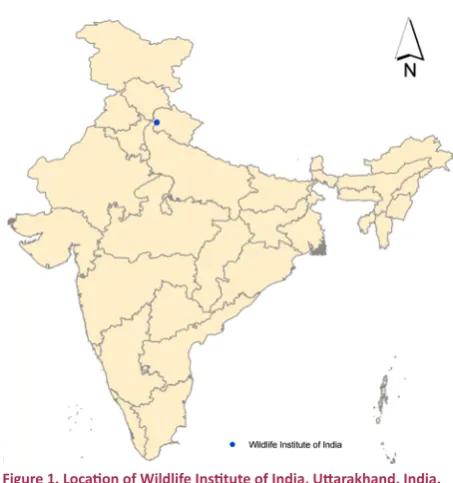
The following study was conducted at the Chandrabani Forest Division (30.2830E & 77.9740N),
Wildlife Institute of India campus, Dehradun (Fig. 1). The study area is ~3.44ha. The region is characterized with a sub-tropical climate, experiencing cold winters, warm springs, hot summers and a strong monsoon. The average annual rainfall received is usually around ~2073.3mm.
The vegetation is natural and semi-natural represented by a mosaic of natural scrub, woodland, various successional stages of Shorea robusta forest including stream bank vegetation and grassy banks. Thirty-three species of herpetofauna inhabit the campus; amphibians: 11 species belonging to four families (Bufonidae, Microhylidae, Rhacophoridae, Dicroglossidae), with two species of toads, and reptiles: 22 species belonging to nine families (Colubridae, Typhlophidae, Elapidae, Agamidae, Varanidae, Natricidae, Trionichydae, Geoemydidae, Scincidae) as listed on the campus database (www.wii.gov.in). All wildernesses are in close proximity to and in certain parts, interspersed with human habitation.
The study was conducted from mid March to the first week of May 2015. Dehradun, having already received its early showers at the end of February and early March, marked the onset of breeding activity of Duttaphrynus melanostictus. Tadpoles started appearing at the natal site by the end of March to early April.
Methods
Journal of Threatened Taxa | www.threatenedtaxa.org | 26 November 2018 | 10(13): 12755–12768 12757
portrait mode and the second in landscape mode. This was done in order to obtain clear and properly focussed image sets for the dorsal side of each individual. This also helped in negating the problems in analysing the wart patterns due to discrepancies in the position of the animal when being photographed. If an animal exhibited certain distinct marks (such as deformity or scar), features or patterns on any part of the body, a third digital image was generated to showcase the distinctive features. The digital images generated were assigned unique identification codes, affixed with other data of the animal collected, and clear black and white photographs were obtained by printing a single photograph in the complete frame of an A4 sheet. The photographs were then subjected to visual analysis and manual scrutiny in order to determine the distinctive aspects of individuals.
For the purpose of this study the dorsal warts and associated structures were classified with respect to the position of their occurrence on toads as follows (Image 1; Table 1):
Snout warts: Keratinized small tubercles present in between cranial ridges in front of upper eyelids. The position and pattern of distribution with respect to the cranial ridges as well as arrangements of these warts are used as one character. It is a discontinuous character as toads may lack tubercles or warts in this region.
Crown warts: The region of the head from the point where the cranial ridge is notched along the eye to the anterior end of the parotoid glands is termed the crown
(sensu stricto Daniel 2002), hence keratinized tubercles present in this region toad are referred to as crown warts. The position of these warts with respect to the cranial ridges, parotoid glands and the first primary dorsal wart pair exhibits great variation, as do their shapes and patterns of appearance. This is a discontinuous character, with some toads lacking crown warts.
Mid-dorsal groove: An associated structure aiding in the classification of dorsal warts and subsequent identification of individuals. A distinct dorsal groove is observed along the vertebral axis of the toad on the dorsal side. It becomes conspicuous along the plane of the anterior portion parotoid glands, just behind the crown, and runs all through the entire length of the body up to the vent. The mid-dorsal groove is usually smooth and usually lacks any tubercles or warts but a few keratinized tubercles might be found in the groove. The region shows distinct lateral undulations.
Primary dorsal wart pairs: Two series of large warts along the middle of the dorsal surface of the toad’s body and exhibiting a certain degree of symmetry on either side of the distinct mid-dorsal groove. The primary dorsal warts are considerably enlarged and usually more keratinized in the adults. The primary dorsal warts appear to maintain a constant distance from the mid-dorsal groove. A certain wart of a pair may often be found associated in close proximity to a small secondary or satellite wart alongside it. They show great variability in their position and pattern of distribution. They are commonly found to be oval or spheroid in shape though some individuals do exhibit a conspicuous shape.
1st primary dorsal wart pair: It is the first large, distinct
and keratinized wart encountered after the crown warts. It follows just behind the origin of the mid-dorsal groove, in the hind neck region, and is placed within one-third of the length of the parotoid glands from the anterior end. It often exhibits variability in shape and in the symmetry of its position on either side of the mid-dorsal groove. A satellite wart is found quite rarely. It is a continuous Figure 1. Location of Wildlife Institute of India, Uttarakhand, India.
Table 1. Depicting the dorsal warts and their coding.
Character Type Code
Snout Warts Discontinuous (not encountered in all individuals) SW
Crown Warts Discontinuous CW
1st Primary Dorsal Wart Pair Continuous
(encountered in all individuals) 1PD
2nd Primary Dorsal Wart
Pair Continuous 2PD
3rd Primary Dorsal Wart
Pair Continuous 3PD
12758 Journal of Threatened Taxa | www.threatenedtaxa.org | 26 November 2018 | 10(13): 12755–12768
character being observed in all individuals.
2nd & 3rd primary dorsal wart pair: These are found
closely associated to each other usually towards the distal end with respect to the plane of the parotoid glands. Variability in shape is less conspicuous and they usually are spheroid or ovate. Often found associated with a satellite wart. Varies with respect to position and pattern. It is a continuous character, being encountered in all individuals.
Parotoid warts: These warts are encountered along the parotoid glands on either side of the mid-dorsal groove and in the region between the 1st and 2nd primary
dorsal wart pairs. They exhibit great variability with respect to their pattern, shape, position and distribution. It is a discontinuous character as certain toads don’t bear these warts.
The above mentioned potential characters may be coded as shown in Table 1.
The photographs of the Duttaphrynus melanostictus individuals, obtained during the duration of the nocturnal surveys at the study site, were subjected to rigorous visual scrutiny, matching and analysis. We then attempted to segregate the individual toads based on the combinations of dorsal warts required to effectively distinguish and identify individuals. This allowed us to arrive at a pattern to be followed during visual analysis of photographs while sequestering individual toads to a sub-group.
RESULTS
The 1st primary dorsal wart pair was found to be the
initial basis of analyzing the dorsal warts, owing to its apparent consistency in position and shape. The other dorsal wart characteristics were now used in combination to the 1st primary dorsal wart pair to distinguish and
identify the individuals. Visual matching and analysis thus led to the development of a combination of dorsal wart characters based on which the individuals were subjected to effective individual identification and subsequent grouping as mentioned in Table 2.
The photographs of the Duttaphrynus melanostictus individuals, obtained during the duration of the nocturnal surveys at the study site, were subjected to rigorous visual scrutiny, matching and analysis (Appendix 2). We then attempted to segregate the individual toads based on the combinations of dorsal warts required to effectively distinguish and identify individuals. This allowed us to arrive at a pattern to be followed during visual analysis of photographs while sequestering individual toads to a sub-group.
DISCUSSION
12759 capturing, marking, releasing and recapturing animals
have become an indispensable tool to monitor and estimate trends in populations. Mark-recapture techniques are advantageous, being statistically more accurate and robust than uncorrected counts of indices of relative abundance (Lettink 2012).
Visual image matching of natural markings is significantly more accurate than invasive techniques like toe-clipping and computer-assisted image matching, which though useful for large datasets are constrained by the position and posture of the animal, glare, shadows, lighting, background colour, equipment and cumbersome processing protocols to be followed, which can expose animals to prolonged durations of stress and handling (Caorsi et al. 2012; Sanchez et al. 2018). Invasive techniques like toe-clipping, especially for the first finger, might adversely affect amplexus in males owing to the loss of the nuptial callosities on phalanges. Thus there is a need for non-invasive identification techniques, as amphibians are most active during the breeding season (Sutherland 2006).
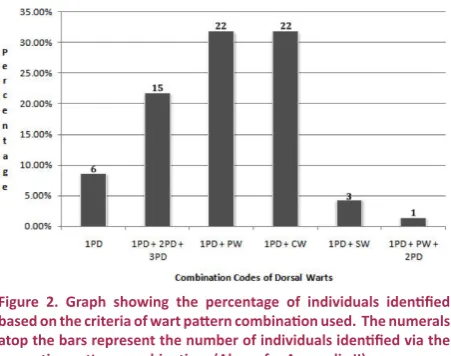
Dorsal warts were found to be a reliable and Figure 2. Graph showing the percentage of individuals identified based on the criteria of wart pattern combination used. The numerals atop the bars represent the number of individuals identified via the respective pattern combination. (Also refer Appendix II).
Table 2. Dorsal wart pattern combinations used for individual identification of toads.
Combination of dorsal wart characters Combination code Remarks
1st primary dorsal wart pair only 1PD Based on variability of shape, size, pattern, satellite wart
and symmetry. 1st primary dorsal wart pair + 2nd primary dorsal wart pair + 3rd primary
dorsal wart pair 1PD + 2PD + 3PD Based on variability of satellite warts, pattern and position.
1st primary dorsal wart pair + parotoid warts 1PD + PW Based on variability of pattern, position and size.
1st primary dorsal wart pair + crown warts 1PD + CW Based on variability of pattern, position and size.
1st primary dorsal wart pair + snout warts 1PD + SW Based on variability of pattern and position.
1st primary dorsal wart pair + parotoid warts + 2nd primary dorsal wart pair 1PD + PW + 2PD Based on variability of shape, size, pattern, satellite wart
and symmetry.
cheap way to ascertain and monitor populations in Duttaphrynus melanostictus. Thus, the technique may also be used in capture-recapture studies of this species. The study achieved an accuracy of 100%, whereby the digital image sets of the toads successfully distinguished and identified all 69 individuals (Appendix 1).
The results indicate that it should be possible to efficiently process photographs of unidentified captures in a full-scale monitoring programme by using the combination code key to identify and determine the identity of any given capture.
Analysis of photographs of 69 toads identified six combinations which resulted in optimal allocation of individuals into captures and recaptures. The decision as to which of these combinations to use in future studies shall depend on the clarity of the photographs of the dorsal side of the toad taken in the field. It is recommended that the 1st primary dorsal wart pair
should be considered initially.
The 2nd primary dorsal wart pair was always found
to be in symmetry, pattern and variation with the 3rd primary dorsal wart pair or the parotoid warts if
present. Thus, establishment of individual identity was never made based on the 2nd and 3rd primary dorsal wart
patterns alone, and thus were considered a separate combined character combination with the 1st primary
dorsal wart pair.
It might also be mentioned that there were eight toads (~ 11.59%) that also exhibited certain distinct marks, patterns, wounds or infections. Preliminarily these could be used as a cue for individual identification, especially when in the field, complementing the dorsal wart patterns. But, it was seen that there was no constancy (wounds and infections heal, body marks might be lost during moulting and sloughing of skin etc.) of these characters, and thus they are unsuitable for application to individual identification in the long run.
This synchronized scientific method is simple to
Journal of Threatened Taxa | www.threatenedtaxa.org | 26 November 2018 | 10(13): 12755–12768
12760
follow and easy to implement, and thus can even be utilized by laymen in the field of biology to monitor toads in their backyards. The study also holds great value, both scientific and economic, in keeping tabs of toad populations threatened from road related mortality. It thus shows great potential to be successfully utilized and implemented in citizen science programmes aimed at studying amphibians.
REFERENCES
Begon, M. (1979). Investigating Animal Abundance: Capture-recapture
for Biologists. Edward Arnold (Publishers) Ltd., 97pp.
Bradfield, K.S. (2004). Photographic Identification of Individual Archey’s Frogs, Leiopelma archeyi, from Natural Markings. Department of Conservation, Wellington, New Zealand, 36pp.
Caorsi, V.Z., R.R. Santos & T. Grant (2012). Clip or snap? An evaluation
of toe-clipping and photo-identification methods for identifying
individual Southern Red-Bellied Toads, Melanophryniscus
cambaraensis. South American Journal of Herpetology 7(2): 79–84.
Caughley, G. & A.R.E. Sinclair (1994). Wildlife Ecology and
Management. Blackwell Science, Oxford, 334pp.
Daniel, J.C. (2002). The Book of Indian Reptiles and Amphibians.
Bombay Natural History Society and Oxford University Press, Bombay, 252pp.
Daniels, R.J. (1994). Dorsal warts identify individual common Indian toads. Cobra 16: 22–24.
Daniels, R.R. (2005). Amphibians of peninsular India. Universities Press, India, 337pp.
Donnelly, M.A., C. Guyer, J.E. Juterbock & R.A. Alford (1994).
Techniques for marking amphibians; pp 277– 284. In:Heyer, W.R., M.A. Donnelly, R.W. McDiarmid, L-A.C. Hayek & M.S. Foster (eds.). Measuring and Monitoring Biological Diversity: Standard Methods
for Amphibians. Smithsonian University Press, Washington DC,
384pp.
Heyer, W.R., M.A. Donnelly, R.W. McDiarmid, L-A.C. Hayek & M.S. Foster (eds.) (1994). Measuring and Monitoring Biological Diversity:
Standard Methods for Amphibians. Smithsonian University Press,
Washington DC.
Lettink, M. (2012). Herpetofauna: population estimates (using capture - mark - recapture data) Version 1.0. Inventory and monitoring
toolbox: herpetofauna. Department of Conservation, Govt. Of New
Zealand, 27pp.
Sanchez, E., S. Gippner, M. Vences, K. Preißler, I.J. Hermanski, B.A. Caspers, E.T. Krause, S. Steinfartz & F.W. Kastrup (2018). Automatic
quantification of color proportions in dorsal black and yellow colored amphibians, tested on the Fire Salamander (Salamandra
salamandra). Herpetology Notes 11: 73–76.
Stuart, S.N., J.S. Chanson, N.A. Cox, B.E. Young, A.S. Rodrigues, D.L. Fischman & R.W. Waller (2004). Status and trends of amphibian
declines and extinctions worldwide. Science 306(5702): 1783–1786;
https://doi.org/10.1126/science.1103538
Sutherland, W.J. (ed.). (2006). Ecological Census Techniques: A
Handbook. Cambridge University Press, United Kingdom, 448pp.
Whittaker, K., M.S. Koo, D.B. Wake & V.T. Vredenburg (2013). Global
declines of amphibians, pp. 691–699. In: Levin, Simon A. (eds.)
Encyclopedia of Biodiversity: Vol III. Academic Press, 5504pp;
https://doi.org/10.1016/B978-0-12-384719-5.00266-5
Journal of Threatened Taxa | www.threatenedtaxa.org | 26 November 2018 | 10(13): 12755–12768 12761 Appendix 1. Data sheet table, as prepared, for the creation of dorsal wart pattern combination codes and thus, distinctly identifying individuals
of D. melanostictus from the Wildlife Institute of India campus, where ‘1’ represents the character being used and ‘0’ represents that the
character wasn’t utilized for identifying the individual:
Individual Id. 1 – PDW 2 – PDW 3 – PDW SW CW PW
#1. 1 0 0 0 0 0
#2. 1 0 0 0 0 1
#3. 1 0 0 0 1 0
#4. 1 0 0 0 0 1
#5. 1 1 1 0 0 0
#6. 1 0 0 0 1 0
#7. 1 0 0 0 1 0
#8. 1 0 0 0 0 1
#9. 1 0 0 0 0 1
#10. 1 0 0 0 0 0
#11. 1 0 0 0 0 1
#12. 1 0 0 0 0 1
#13. 1 0 0 0 1 0
#14. 1 0 0 0 0 1
#15. 1 0 0 0 1 0
#16. 1 0 0 0 0 1
#17. 1 1 1 0 0 0
#18. 1 1 1 0 0 0
#19. 1 0 0 0 0 1
#20. 1 1 1 0 0 0
#21. 1 0 0 0 1 0
#22. 1 1 1 0 0 0
#23. 1 0 0 0 1 0
#24. 1 0 0 0 1 0
#25. 1 0 0 0 0 0
#26. 1 0 0 0 1 0
#27. 1 0 0 0 1 0
#28. 1 0 0 0 1 0
#29. 1 0 0 0 0 1
#30. 1 0 0 0 0 1
#31. 1 1 1 0 0 0
#32. 1 0 0 1 0 0
#33. 1 1 1 0 0 0
#34. 1 1 0 0 0 1
#35. 1 1 1 0 0 0
#36. 1 1 1 0 0 0
#37. 1 0 0 0 0 1
#38. 1 0 0 0 1 0
#39. 1 1 1 0 0 0
#40. 1 1 1 0 0 0
#41. 1 0 0 0 1 0
#42. 1 0 0 0 1 0
Journal of Threatened Taxa | www.threatenedtaxa.org | 26 November 2018 | 10(13): 12755–12768
12762
#44. 1 1 1 0 0 0
#45. 1 0 0 0 0 1
#46. 1 0 0 0 1 0
#47. 1 0 0 0 0 1
#48. 1 1 1 0 0 0
#49. 1 0 0 0 1 0
#50. 1 0 0 0 1 0
#51. 1 0 0 0 0 1
#52. 1 0 0 0 1 0
#53. 1 0 0 1 0 0
#54. 1 0 0 0 0 1
#55. 1 0 0 0 0 0
#56. 1 0 0 0 0 1
#57. 1 1 1 0 0 0
#58. 1 0 0 0 1 0
#59. 1 0 0 0 0 1
#60. 1 0 0 1 0 0
#61. 1 0 0 0 0 1
#62. 1 0 0 0 0 1
#63. 1 0 0 0 1 0
#64. 1 0 0 0 0 0
#65. 1 0 0 0 1 0
#66. 1 1 1 0 0 0
#67. 1 0 0 0 1 0
#68. 1 0 0 0 0 1
Journal of Threatened Taxa | www.threatenedtaxa.org | 26 November 2018 | 10(13): 12755–12768
Journal of Threatened Taxa | www.threatenedtaxa.org | 26 November 2018 | 10(13): 12755–12768
Journal of Threatened Taxa | www.threatenedtaxa.org | 26 November 2018 | 10(13): 12755–12768
12768
ISSN 0974-7907 (Online); ISSN 0974-7893 (Print)
November 2018 | Vol. 10 | No. 13 | Pages: 12715–12858 Date of Publication: 26 November 2018 (Online & Print)
DOI: 10.11609/jott.2018.10.13.12715-12858
www.threatenedtaxa.org
peer-reviewed articles online every month at a reasonably rapid rate at www.threatenedtaxa.org. All articles published in JoTT are registered under Creative Commons Attribution 4.0 International License
unless otherwise mentioned. JoTT allows unrestricted use of articles in any medium, reproduction, and distribution by providing adequate credit to the authors and the source of publication.
Articles
The pattern of bird distribution along the elevation gradient of the Sutlej River basin, western Himalaya, India
-- Balraj Santhakumar, P. Ramachandran Arun, Ramapurath Kozhummal Sony, Maruthakutti Murugesan & Chinnasamy Ramesh, Pp. 12715–12725
Morphological variations in marine pufferfish and porcupinefish (Teleostei: Tetraodontiformes) from Tamil Nadu, southeastern coast of India
--K. Kaleshkumar, R. Rajaram, P. Purushothaman & G. Arun, Pp. 12726–12737
Communications
Possible range decline of Ganges River Dolphin Platanista gangetica (Mammalia: Cetartiodactyla: Platanistidae) in Indian Sundarban
-- Sangita Mitra & Mahua Roy Chowdhury, Pp. 12738–12748
Retrospective study on epidemiology of snakebites in Sarpang District, southern Bhutan
-- Bal Krishna Koirala, Jaganath Koirala & Sunil Sapkota, Pp. 12749–12754
Individual identification of Duttaphrynus melanostictus (Schneider, 1799) (Amphibia: Anura: Bufonidae) based on dorsal wart patterns
-- Uddalak Tathagato Bindhani & Abhijit Das, Pp. 12755–12768
A preliminary checklist of butterflies from the northern Eastern Ghats with notes on new and significant species records including three new reports for peninsular India
-- Rajkamal Goswami, Ovee Thorat, Vikram Aditya & Seena Narayanan Karimbumkara, Pp. 12769–12791
Aquatic and semi aquatic Hemiptera community of Sonebeel, the largest wetland of Assam, northeastern India
-- Anupama Saha & Susmita Gupta, Pp. 12792–12799
Short Communications
First record of colour aberration in Basra Reed Warbler Acrocephalus griseldis (Hartlaub, 1891) (Passeriformes: Acrocephalidae) from Central Marshes of southern Iraq, with notes on its intraspecific/interspecific behavior
-- Omar F. Al-Sheikhly, Mukhtar K. Haba, Nadheer A. Faza’a & Ra’ad H. Al-Asady, Pp. 12800–12804
Avian fauna of Amboli Ghat, Sindhudurg District, Maharashtra State, India
-- Varun Satose, Vikrant Choursiya, Rakesh Deulkar & Sasikumar Menon, Pp. 12805–12816
DNA barcoding and morphological characterization of moth Antoculeora
ornatissima (Walker, 1858) (Lepidoptera: Noctuidae), a new range record from
western Himalayan region of India
-- Twinkle Sinha, P.R. Shashank & Pratima Chaudhuri Chattopadhyay, Pp. 12817– 12820
Odonata of eastern Bangladesh with three new records for the country
-- M. Kawsar Khan, Pp. 12821–12827
Two new species of phytoseid mites Euseius (Acari: Phytoseiidae) from Kerala, India
-- P.P. Santhosh, Mary Anithalatha Sadanandan & M.P. Rahul, Pp. 12828– 12832
Notes
First photographic record of tiger presence at higher elevations of the Mishmi Hills in the Eastern Himalayan Biodiversity Hotspot, Arunachal Pradesh, India
-- Aisho Sharma Adhikarimayum & G.V. Gopi, Pp. 12833–12836
An old collection reveals an additional distribution record of the Greater Long-tongued Fruit Bat Macroglossus sobrinus K. Anderson, 1911 (Chiroptera: Pteropodidae) from southern West Bengal, India
-- Tauseef Hamid Dar, M. Kamalakannan, C. Venkatraman & Kailash Chandra, Pp. 12837–12839
Breeding reports and conservation implications of the Endangered Black-bellied Tern Sterna acuticauda J.E. Gray, 1831 (Aves: Charadriiformes: Laridae) in Odisha, eastern India
-- Tuhinansu Kar, Himanshu Shekhar Palei & Subrat Debata, Pp. 12840–12843
A first record of the Redbelly Yellowtail Fusilier Caesio cuning (Bloch, 1791) (Teleostei: Caesionidae) from Visakhapatnam coastal waters, India
-- Muddula Krishna Naranji, Govinda Rao Velamala & Kondamudi Ramesh Babu, Pp. 12844–12846
A record after 92 years, and a first report of the moth Mecodina metagrapta Hampson, 1926 (Lepidoptera: Erebidae: Aganainae) from the Western Ghats’ part of Maharashtra, India
-- Aparna Sureshchandra Kalawate, Pp. 12847–12849
A new record of the Malay Cardamom Amomum aculeatum Roxb. (Zingiberaceae) for mainland India
-- Sameer Chandrakant Patil & P. Lakshminarasimhan, Pp. 12850–12853
New distribution records of the leopard plants Ligularia amplexicaulis DC. and Ligularia sibirica (L.) Cass. (Asteraceae) in the Indian Himalaya
-- Bikarma Singh, Sumit Singh & Bishander Singh, Pp. 12854–12858
Miscellaneous
National Biodiversity Authority
Threatened Taxa