Emilia Mikołajewska
1, Dariusz Mikołajewski
2Exoskeletons in Neurological Diseases
– Current and Potential Future Applications
Egzoszkielety w terapii schorzeń neurologicznych
– zastosowania obecne i przyszłe
1 Rehabilitation Clinic, Military Clinical Hospital No. 10 and Polyclinic, Bydgoszcz, Poland 2 Division of Applied Informatics, Department of Physics, Astronomy and Applied Informatics,
Nicolaus Copernicus University in Toruń, Poland
Abstract
Anexoskeleton is a distinctive kind of robot to be worn as an overall, effectively supporting or, in some cases sub-stituting for, the user’s own movements. The development of exoskeletons can lead to important changes in the rehabilitation of disabled people by introducing an alternative to wheelchairs. Exoskeletons can be an efficient tool in gait re-education and in the restoration of upper limb functions, and they can support therapists and caregivers in tasks that require major physical effort. The functionality of exoskeleton can easily be extended by a “disabled person integrated IT environment”, described by authors. Exoskeletons can also be easily adapted to the needs of severely ill or aged people (Adv Clin Exp Med 2011, 20, 2, 227–233).
Key words:neurologicaldiseases, rehabilitation, robotics, exoskeleton, hospital care, home care.
Streszczenie
Egzoszkielet to szczególny rodzaj robota zakładanego na użytkownika w formie kombinezonu skutecznie wspo-magającego lub, w wybranych przypadkach, zastępującego jego ruch. Rozwój egzoszkieletów może doprowadzić do zmian w rehabilitacji osób niepełnosprawnych dzięki wprowadzeniu alternatywy dla wózków dla osób niepeł-nosprawnych, wykorzystanie egzoszkieletów jako skutecznych narzędzi do reedukacji chodu i czynności kończyn górnych oraz jako wsparcie terapeutów i opiekunów osób niepełnosprawnych, ciężko chorych i w podeszłym wieku przy wykonywaniu czynności związanych ze znacznym wysiłkiem fizycznym. Funkcjonalność egzoszkieletu może zostać zwiększona dzięki włączeniu go w przedstawione przez autorów „zintegrowane środowisko teleinformatycz-ne osoby niepełnosprawteleinformatycz-nej”. Prezentowateleinformatycz-ne rozwiązania mogą w łatwy sposób być przystosowateleinformatycz-ne do potrzeb osób ciężko chorych lub w podeszłym wieku (Adv Clin Exp Med 2011, 20, 2, 227–233).
Słowa kluczowe: choroby neurologiczne, rehabilitacja, robotyka, egzoszkielet, opieka szpitalna, opieka domowa.
Adv Clin Exp Med 2011, 20, 2, 227–233 ISSN 1230-025X
REvIEwS
© Copyright by wroclaw Medical University
An exoskeleton is a distinctive kind of ro-bot to be worn as an overall or frame, effectively supporting, or in some cases substituting for, the user’s own movements [1–4]. The aim of this ar-ticle is to discuss the possible use of exoskeletons in the treatment of neurological diseases, including neurorehabilitation. The authors have reviewed publications in the PubMed database (Figure 1); the keyword “exoskeleton” does not occur in the MeSH database.
Exoskeletons are still at the early stages of their development. They need detailed technical and clinical research not only in the area of safety,
but also in terms of their influence on the human body, biomechanics and mind. It seemsthat in the future exoskeletons may become aform of therapy in neurological diseases and neurorehabiltiation.
Exoskeletons can be divided into two catego-ries: those for all four extremities (arms/legs) and those for the lower extremities only.
frequency of specified keywords częstotliwość występowania poszczególnych słów kluczowych
key words słowa kluczowe number of articles liczba artykułów exoskeleton (not useful in the case)
exoskeleton +
rehabilitation disabled peopleexoskeleton + 573
49
2
1890: N. Jagn (USA)
patents an "apparatus for facilitating walking, running and jumping"
19th century 20th century 21st century
1959: R. Heinlein (USA) writes
the novel Starship Troopers, which
inspires exoskeleton designers 1966: GE Research (USA) produces the first exoskeleton 1991: J. Dick of Applied Motion Inc. (USA) patents the SpringWalker Body Amplifier 2001–2008: The Defense Advanced Research Projects Agency (USA) develops exoskeletons including XOS, HULC and BLEEX 2008–2015: The Defense Advanced Research Projects Agency (USA) develops advanced version of XOS
exoskeleton since 2000: exoskeletons including HAL5, Re Walk, WPAS and RoboKnee researched in USA, Japan, Great Britain, Germany Italy and elsewhere
Fig. 1. Results of investigation of the PubMed
database (U.S. National Library of Medicine) [5]
Ryc. 1. wyniki przeszukiwania bazy danych
PubMed (U.S. National Library of Medicine) [5]
Fig. 2. Milestones in the history of exoskeletons
Ryc. 2. Kamienie milowe w historii egzoszkieletów
Exoskeletons
medical military multipurpose
HAL5, Y. Sankai, University of Tsukuba and Cybercyne Inc., Japan
ReWalk B1 and B2, Argo Medical Technologies, Israel
WPAS (Wearable Power Assist Suit) K. Yamamoto, Kanagawa Institute of Technology, Japan RoboKnee, B.T. Krupp, C.J. Morse,Yobotics Corporation, USA
BLEEX 2, H. Kazerooni, University of California, USA ExoCarrier, Berkeley Bionics, USA ExoClimber, Berkeley Bionics, USA XOS Exoskeleton, Sarcos Research Corporation and Raytheon, USA HULC (Human Universal Load Carrier), Lockheed Martin and Berkeley Bionics, USA
Fig. 3. The main current exoskeletons
Generally, the main features that are impor-tant for exoskeleton users are: the means and level of support; the ways the device is controlled and how the user conveys intentions: EEG, electromy-ography (EMG), angle sensors, pressure sensors, etc.; the weight; limitations due to the user’s height and length of limbs; the time and effort needed for fitting and pre-setting the exoskeleton before its first use; convenience and comfort in all-day use; the time needed to recharge batteries; in some cases, the possibility of folding and transporting ready-to-use (programmed) exoskeleton; the exo-skeleton’s self-diagnostic capabilities; compatibility with local intelligent systems (smart home, i-wear, Ambient Intelligence, etc.) at home, at work, in the hospital, etc.; trends in the development of exoskeletons, including their integration into dis-abled people’s wider environments, including the need for sufficient levels of home care and therapy, telerehabilitation and distant supervision (distant measurement of parameters, alerts, etc.).
Further technical developments are needed to solve current limitations and problems with exo-skeletons: longer-lasting power batteries; lighter and stronger materials for the frame; more powerful actuators; more sophisticated control systems, such as EEG instead of EMG, advanced neuroprostheses and Brain-Computer Interfaces (BCIs), more effi-cient processes of fitting and customizing.
Support for User Intent
in Exoskeletons
Information for the exoskeleton control sys-tem can usually be provided by several sets of sen-sors: EMG sensors or sensors of other bioelectric activity attached to skin; angle sensors, pressure sensors, gyroscopes, accelerometers, etc., attached to the frame of the exoskeleton: in the future, EEG sensors, pulse rate sensors, etc., attached to the skin or implanted. Additionally, the power system provides information about the working load in each part of the exoskeleton and about the power reserve. Generally, the procedure of assisting the user with an intended movement is as follows: 1) analysis of the current situation: posture, limb positions, etc., based on signals collected from EMG or other sensors (muscle contraction, etc.); 2) when the user attempts to move: the exoskel-eton control system analyzes the sensor signals and determines the user’s intended movement; 3) the control system selects a pre-programmed move-ment pattern, adjusts it to the user’s current po-sition and supports the movement with actuators using the appropriate force; 4) after completing the movement, the control system analyzes the new situation – posture, limb positions, etc. – assessing and preparing for the user’s next possible move-ments [7–9].
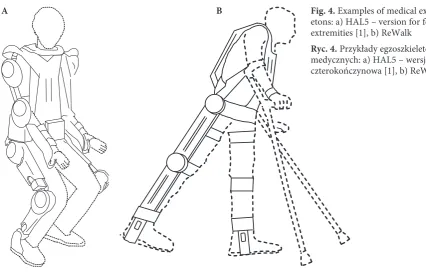
This algorithm also includes balance control (necessary for fall protection) [10] and co-ordina-tion of several movements at the same time. An exoskeleton can have two or more control systems working together, e.g. the HAL5 exoskeleton with
Fig. 4. Examples of medical exoskel-etons: a) HAL5 – version for four extremities [1], b) Rewalk
Ryc. 4. Przykłady egzoszkieletów medycznych: a) HAL5 – wersja czterokończynowa [1], b) Rewalk
two control systems: Cybernic voluntary Con-trol, based on bio-electric signals observed on the surface of the skin, and the Robotic Autonomous Control System, based on a database of elementary movements, allowing for exoskeleton movements despite poor bio-electric signals from the user.
For patients with hemiparesis, it is important to provide more support for the affected side. For safety reasons it is necessary for the exoskeleton to work properly even in emergency situations, e.g. when the sensors unexpected malfunction. Also, an exoskeleton being worn by user must not col-lapse even if the battery is low. An easy-to-operate emergency switch-off systems for disable people (e.g. a puff/sip switch) is also necessary.
Medical Uses
of Exoskeletons
Generally an exoskeleton is a technical tool that expands and improves selected abilities of the user. From a medical point of view, it can serve as a multi-purpose medical device: as an alternative to
wheelchairs (both powered and manual), provid-ing mobility and increasprovid-ing patients’ possibilities, especially in climbing stairs. Using an exoskeleton is closer to natural human mobility than using a wheelchair; as an efficient supplementary tool in gait re-education and as an option in restoring upper-limb functions. Exoskeletons are perceived as probably more effective than the traditional as-sistance and support of therapists and rehabilita-tive devices (e.g. rehabilitarehabilita-tive robots) [13–15]; to support therapists and caregivers in tasks requir-ing major physical effort, e.g. patient transfer; as a tool for gaining a better understanding of human body posture and movement.
Because of this wide range of possibilities it is important to develop medical exoskeletons, de-signed for use in the therapy of patients with CNS diseases, stroke or spinal cord injury (SCI). In this kind of therapy exoskeletons can provide: all-day supported mobility, with a full range of motions and proper movement patterns; the possibility of training in (or re-learning of) all functional activi-ties: lying, sitting, standing, walking, transfer, stair climbing, ascending/descending slopes and activi-INTEGRATED
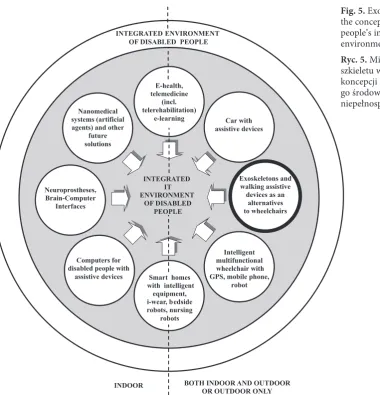
IT ENVIRONMENT
OF DISABLED PEOPLE
Exoskeletons and walking assistive devices as an
alternatives to wheelchairs
Intelligent multifunctional wheelchair with GPS, mobile phone,
robot Smart homes
with intelligent equipment, i-wear, bedside robots, nursing
robots Nanomedical
systems (artificial agents) and other
future solutions
Neuroprostheses, Brain-Computer
Interfaces
E-health, telemedicine
(incl. telerehabilitation)
e-learning Car with
assistive devices
Computers for disabled people with
assistive devices
INTEGRATED ENVIRONMENT OF DISABLED PEOPLE
BOTH INDOOR AND OUTDOOR OR OUTDOOR ONLY INDOOR
Fig. 5. Exoskeletons within the concept of disabled people’s integrated IT environment [6]
ties of daily living (ADLs) in a way similar to nor-mal life (some exoskeletons even permit the users to drive cars); efficient support for weak patients, improving their muscle strength, bone density, cardiovascular system and endurance, to prepare them for normal functioning; the possibility of nearly-natural all-day functioning, with posture and movements that are better for the digestive, respiratory and urinary systems; a reduction in the energy expenditure required for exercises [16–18].
Because exoskeletons are multi-purpose ro-bots their wide implementation could decrease the number of rehabilitation tools needed, and the total cost of rehablitation. Generally, the use of exoskeletons can: increase the possibilities and effectiveness of rehabilitation, especially neurore-habilitation, through intensive all-day functional therapy during normal life activities; increase the accessibility of rehabilitation, including home re-habilitation and home care; increase the user’s safety (fall protection); save money and time, de-creasing the average hospital stay and the number of therapists needed per patient (especially in gait re-education); stimulate developments in other branches, e.g. geriatric therapy and care.
These developments require additional clinical research following the Evidence-Based Medicine paradigm, to provide standards and guidelines for prescribing, selecting and fitting the exoskeleton and conducting the therapy; for effectivity assess-ment, safety and troubleshooting; for the training of medical staff, especially physiotherapists; and for the training of users and carers. Clinical research on the medical exoskeleton HAL5 (Hybrid Assistive Limb 5) is being conducted at Danderyds Hospital in Sweden and Odense Universitetshospital in Den-mark; and on the exoskeleton Rewalk at the Chaim Sheba Medical Center Neurological Rehabilitation Department (Israel), and at the MassRehab Massa-chusetts Rehabilitation Commission (USA).
The Prospects
for Clinical Use
The clinical use of exoskeletons requires the co-operation of a whole multidisciplinary team, including biomedical engineers. It calls for careful preparation, and could consist of the stages de-scribed below.
1) Patient preparation:
– explaining the procedures to the patient; – assessment of the patient’s health status (in-cluding secondary health problems, indications and contraindications);
– functional diagnosis: what the patient can do, hidden potentials, deficits and limitations;
– anthropometric measurements; – clinical gait analysis;
– other movement analysis: upper limbs and spine evaluation;
– assessment of the patient’s way of life and ADLs;
– discussion of the preferences, goals and mo-tivation of the patient and caregivers (e.g. in the area of home rehabilitation);
– assessment of the patient’s possibilities for controlling the exoskeleton (cognitive and func-tional deficits, limitations and weaknesses);
– choice of exoskeleton type and features (di-mensions, ranges of adjustment, modes of support and control, etc).
It is important to emphasize the fact that an exoskelton works with the user, so the user must be able to control the exoskeleton properly. Using the exoskeleton should help the patient to achieve therapeutic goals, functional independence and an improved quality of life more efficiently than tra-ditional therapy.
2) Exoskeleton fitting and set-up:
– matching the exoskeleton features to the pa-tient’s current health status and anthropometric measurements;
– implementing patterns of the patient’s pos-ture (lying, sitting, standing, etc.), transfer (sitting to standing, etc.), gait and other activities such as stair climbing, ascending/descending a slope and ADLs;
– adjusting the level of exoskeletal support and the exoskeleton control modes;
– trials with the patient and fine-tuning adjust-ments.
Exoskeletons need to be comfortable, conve-nient and functional for all-day use, and allow the user to move in the most natural way possible.
3) Clinical trials with the patient:
– training with the patient and caregivers, in-cluding emergency situations;
– assessment of the effectiveness of the thera-py, including the influence of other rehabilitation methods used at the same time;
– assessment of functioning, comfort and convenience, and of the patient’s adaptation to human-robot interaction;
– analysis and implementation of conclusions in both the exoskeleton technology and the way the therapy is conducted.
At present, stages 1–3 can last up to several months. There is a clear need to reduce this time span by introducing standards and clinical guide-lines.
4) Normal clinical use:
– assessment of the goals and results of the therapy, including the patient’s preferences;
– implementation of the conclusions;
– if necessary, establishing a program of nor-mal home use.
The use of an exoskeleton during acute rehabil-itation and hospitalization is a only a supplement to other forms of therapy, such as physiotherapy, kinesitherapy and pharmacotherapy, However, if a patient needs only exoskeleton therapy (e.g. in gait re-education), this can be provided on an out-patient basis or at home. Additional studies are needed to establish standards and guidelines for the safe and effective use of exoskeletons in home rehabilitation programs under the regular over-sight of a therapist.
5) Normal home use and rehabilitation (op-tional):
– normal all-day home use of the exoskeleton, including therapy (from simple exercises to telere-habilitation),
– ongoing assessment of the patient’s health status and functional abilities, including secondary changes such as pressure ulcers;
– continued assessment of the goals and re-sults of the therapy;
– ongoing assessment of the technical condi-tion of the exoskeleton;
– analysis and implementation of conclusions. It is important to emphasize that in a sig-nificant percentage of patients it may be possible to abandon the exoskeleton after therapy and to live normally without it, and the therapy should be conducted in a manner that takes this into ac-count.
All of the procedures proposed above call for more clinical research and detailed guidelines.
Conclusions
Exoskeletons can significantly change the model of therapy inneurological diseases and the lives of disabled people, improving their quality of life and their chances for independence, education, work and entertainment.The further development of control systems, especially neuroprostheses and brain-computer interfaces, can significantly im-prove access to this form of therapy for people with severe deficits. Broadening the medical uses of exoskeletons can stimulate development of oth-er branches such as goth-eriatric thoth-erapy and care.
References
[1] Mikołajewska E: Egzoszkielet HAL 5 (article in Polish). Mag Pielęg Położ 2007, 5, 42.
[2] Mikołajewska E: Neurorehabilitacja. Zaopatrzenie ortopedyczne. wydawnictwo Lekarskie PZwL, warszawa 2009, 74–76.
[3] Dollar AM, Herr H: Lower extremity exoskeletons and active orthoses: challenges and state-of-art. IEEE Transactions on Robotics 2008, 24(1), 1–15.
[4] Yang C-Y, Zhang J-F,Chen Y et al.: A review of exoskeleton-type systems and their key technologies. Proceedings of the Institution of Mechanical Engineers, Part C: J Mech Eng Sci 2008, 222(8), 1599–1612.
[5] MEDLINE/PubMed (U.S. National Library of Medicine) http://www.ncbi.nlm.noh.gov/pubmed – access 24.02.2011
[6] Mikołajewska E, Mikołajewski D: wheelchair development from the perspective of physical therapists and bio-medical engineers. Adv Clin Exp Med 2010, 19, 6, 771–776.
[7] Fleischer C, Reinicke C, Hummel G: Predicting the intended motion with EMG signals for an exoskeleton ortho-sis controller. Proc 2005 IEEE Int Conf Robot Auton Syst (IROS), 2029–2034.
[8] Suzuki K, Kawamura Y, Hayashi T et al.: Intention based walking support for paraplegia patient. Proc IEEE Int Conf on Systems, Man and Cybernetics 2005, 2707–2713.
[9] Fleischer C: Controlling exoskeletons with EMG signals and a biomechanical body model. PhD Thesis. Technische Universität Berlin 2007.
[10] Cass AB: Preliminary specifications for an exoskeleton for the training of balance in balance impaired individuals. MSc Degree Thesis. virginia Polytechnic Institute and State University 2008.
[11] Mikołajewska E, Mikołajewski D: Automatyzacja wózków dla niepełnosprawnych (article in Polish). Acta Bio- -Opt Inform Med 2010, 1, 13–14.
[12] Mikołajewska E: wózki dla niepełnosprawnych (article in Polish). Prakt Fizjoter Rehabil 2010, 5, 34–37.
[13] Mikołajewska E, Mikołajewski D: Roboty rehabilitacyjne (article in Polish). Rehabil Prakt 2010, 4, 49–53.
[14] Mikołajewska E, Mikołajewski D: Roboty rehabilitacyjne i pielęgnacyjne (article in Polish). Mag Pielęg Położ 2009, 12, 42.
[15] Mikołajewska E: Lokomat jako element nowoczesnej reedukacji chodu (article in Polish). Prakt Fizjoter Rehabil 2010, 10, 15–18.
[17] Tsukahara A, Hasegawa Y, Sankai Y: Standing-up Motion Support for Paraplegic Patient with Robot Suit HAL. Proceedings of IEEE 11th International Conference on Rehabilitation Robotics 2009, 211–217.
[18] Hasegawa Y, Jang J, Sankai Y: Cooperative walk control of paraplegia patient and assistive system. Proceedings of the 2009 IEEE/RSJ International Conference on Intelligent Robots and Systems, 4481–4486.
Address for correspondence:
Emilia MikołajewskaRehabilitation Clinic
Military Clinical Hospital No. 10 and Polyclinic Powstańców warszawy 5
85-681 Bydgoszcz, Poland E-mail: [email protected]
Conflict of interest: None declared