Temporal windows and visual capacity
Andreas Wutz
PhD thesis
CIMeC - Doctoral school in Cognitive and Brain Sciences
26th cycle 2013
Supervision:
Acknowledgments
Thanks to my dad who gave me strength. Thanks to my mum who gave me confidence. Thanks to David who started to believe in me and with whom it was an honor to think with. Thanks to Doris who brought me here. Thanks to my friends who directed me elsewhere. Thanks to Jen who showed me the way. Thanks to Prof. Caramazza, Nathan and Christoph who taught me so much. Thanks to Dea who helped me to finish this thing.
Signs of gratitude also to Vladimir Horowitz and Frédéric Chopin, the Talking Heads, Daft Punk, the XX and Bon Iver for all these hours.
Table of contents
1. Temporal windows and visual capacity 10
1.1 Temporal windows in vision 10
1.1.1 Evidence for ‘perceptual moments’ in vision 10 1.1.2 Functional characteristics of ‘perceptual moments’ 13 1.1.3 Stability of information and sensitivity to change within a
‘perceptual moment’ 14
1.2 Units of information in vision 16
1.2.1 Object files and object individuation 16
1.2.2 Visual capacity limits 18
1.2.3 Temporal dynamics of individuation:
Visual persistence and temporal integration 21
1.3 Computation, algorithm and implementation of temporal windows in
vision 23
2. Rapid enumeration within a fraction of a single glance:
The role of visible persistence in object individuation capacity 25
2.1 Methods and materials 28
2.1.1 Subjects 28
2.1.2 Stimuli and apparatus 28
2.1.3 Procedure 30
2.1.3.1 Enumeration with variable mask-item(s) SOA 30
2.1.3.2 Enumeration with variable mask contrast 32
2.1.3.3 Identification with variable mask-item(s) SOA 33
2.1.4 Data analysis 35
2.2 Results 35
2.2.1 Enumeration with variable mask-item(s) SOA 35
2.2.2 The role of temporal effects of masking versus a generic reduction in
visibility 39
2.2.3 Identification 40
2.3 Discussion 43
3. Temporal buffering and visual capacity:
The time course of object formation underlies capacity limits in visual
cognition 47
3.1 Methods and materials 52
3.1.1 Subjects 52
3.1.2 Stimuli and apparatus 53
3.1.3 Procedure 54
3.1.3.1 Forward masking versus backward masking 55
3.1.3.2 Enumeration versus change detection 58
3.1.3.3 Target detection 59
3.1.4 Data analysis 60
3.2 Results 61
3.2.2 Visual masking and target detection 66
3.2.3 Visual masking and object capacity 69
3.3 Discussion 72 4. Temporal windows in visual processing: ‘Pre-stimulus brain state’ and ‘post-stimulus phase reset’ segregate visual transients on different temporal scales 77 4.1 Methods and materials 80 4.1.1 Subjects 80 4.1.2 Stimuli and procedure 81 4.1.3 MEG measurement 84
4.1.4 MEG data analysis 85 4.1.4.1 Event-related fields 85
4.1.4.2 Time-frequency analysis 86 4.1.4.3 Inter-trial coherence 86
4.1.4.4 Source localization 87
4.1.4.5 DICS beamforming of oscillatory sources 87
4.1.4.6 LCMV beamforming of evoked sources 88 4.1.4.7 Statistical analysis 88
4.2 Results 89 4.2.1 Behavioral data 89 4.2.2 MEG data 91 4.2.2.1 Pre-mask oscillatory power 92
4.2.2.2 Visual evoked response 96 4.2.2.3 Inter-trial coherence (ITC) vs. amplitude of the evoked field 98 4.2.2.4 Visual evoked activity for short and long SOAs 100
4.2.2.5 Target-related response profile 102
4.2.2.6 Interaction between pre-mask oscillatory power and visual evoked response across SOA 103
4.3 Discussion 105
4.3.1 Pre-stimulus oscillatory power 106
4.3.2 Post-stimulus phase reset 108
4.3.3 Temporal integration windows 109
5. General Discussion about the relationship between temporal and informational resolution in vision 111
5.1 The temporal window bandwidth determines visual object capacity limits 112
5.2 Inverse relationship between temporal and informational resolution in vision 114
5.3 Synchrony between carrier and coding: a perceptual moment 117
6. References 121
List of Figures
1.1 Oscillations in behavior 11
1.2 Perceptual framing and neuronal oscillations 12 1.3 Illustration of the “problem of moving ghosts” 15 1.4 Stimuli in an enumeration task that measures object individuation 18 1.5 Enumeration performance as a function of number of presented items 18 1.6 Change detection performance as a function of number of presented items 19 1.7 Schematic depiction of integration masking 22 1.8 Illustration of temporal windows in object processing 24 2.1 Illustration of the mask and target stimuli and of one trial in the
enumeration experiment with the manipulation of SOA 31 2.2 Schematic depiction of the enumeration experiment with the manipulation
of mask contrast 33
2.3 Schematic depiction of the identification experiment with the manipulation
of SOA 34
2.4 Results of the enumeration experiments with the manipulation of SOA and
mask contrast 37
2.5 Results of the identification experiment with the manipulation of SOA 41 3.1 Illustration of how the temporal limits of visual object processing can result
in capacity limits for individuation and identification 49 3.2 Illustration of the mask and target stimuli 54 3.3 Schematic depiction of the 2 – by – 2 design 55 3.4 One trial for forward and backward masking conditions 57 3.5 Results of the four crossed conditions in the main experiment 64
3.6 Results of the control conditions 68
3.7 Results of the four crossed conditions in the main experiment translated
into capacity K 70
4.1 Temporal integration masking: stimuli, trial sequence & expected MEG
effects 83
4.2 Higher pre – mask β power within incorrect compared to correct trials 93 4.3 Pre-mask β power effect occurs mostly in long SOA trials 95 4.4 Stronger mask evoked response within correct compared to incorrect trials 97 4.5 Differential evoked response profiles for short and long SOA trials 101 4.6 Interaction between pre-mask oscillatory power and visual evoked
response across SOA 105
5.1 Temporal evolution of visual object processing 113 5.2 Relationship between the bandwidth of sensory persistence and
individuation capacity 115
5.4 Schematic depiction how synchrony between spatio-temporal carrier and routinely encoding defines one perceptual moment of time 118
SF2.1 Results of the enumeration experiment with the manipulation of SOA 140 SF2.2 Results of the enumeration experiment with the manipulation of mask
contrast 141
SF2.3 Results of the identification experiment with the manipulation of SOA 142 SF2.4 Response matrices displaying the number of responses across all trials
and subjects 143
SF4.1 Time-frequency plot showing the percent in signal change in oscillatory
power 147
SF4.2 Temporal evolution of t-values of the contrast correct vs. incorrect trials 148 SF4.3 Schematic depiction of possible reasons for differences in event-related
List of Tables
3.1 Results of the two-way within-subjects ANOVA for the four crossed
conditions 62
4.1 Behavioral results 90
ST2.1 Results of the two-way within-subjects ANOVA for the enumeration
experiment with the manipulation of SOA 144 ST2.2 Descriptive statistics of the enumeration experiment with the
manipulation of SOA 144
ST2.3 Descriptive statistics of the enumeration experiment with the
manipulation of mask contrast 145
ST2.4 Descriptive statistics of the identification experiment with the
manipulation of SOA 146
ST4.1 Average number of trials over subjects within the respective
1. Temporal windows and visual capacity
The present work aims to arrive at a functional understanding of the visual computations within one perceptual instant of time. When perceiving the external world, we feel
surrounded by a sensory environment that extends continuously into both space and
time. However, the content of conscious thought consists of coherent scenes containing a limited number of discrete objects as an invariant percept within one particular
instance of time. Here, vision is investigated as a process that extracts spatio-temporally invariant information about the physical world and at the same time integrates the current perceptual representation into a dynamic stream of visual impressions.
1.1 Temporal windows in vision
1.1.1 Evidence for ‘perceptual moments’ in vision
Phenomenologically, the visual environment appears temporally continuous and also classical physics are built on the premise of a continuous flow of time:
“Absolute, true and mathematical time by itself and from its own nature flows equably without relation to anything external” (Newton, 1689, p. 6).
However, whether visual perception operates upon a continuous signal or on a discrete sequence of events is still subject to debate (VanRullen& Koch, 2003). A first definition of such a perceptual moment was introduced by von Baer as ‘the longest possible time interval for an organism still to be considered as a ‘time point’‘ (von Baer, 1864). Shortly after, Ernst Mach estimated the duration of this interval. Temporal duration shorter than 30-40 ms cannot be discriminated (Mach, 1965). Intervals below that threshold appear to have no duration at all and are experienced as time points.
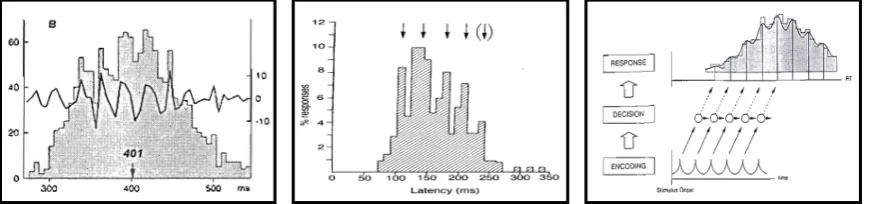
information arriving within these perceptual moments is collapsed into a single percept and these temporal frames are simultaneously segmented into discrete informational chunks. Such temporal windows in visual processing have been a core feature within several variants of a ‘perceptual moment hypothesis’, in which the visual system quantizes incoming sensory information into temporally successive packages of finite duration (Stroud, 1956; White, 1963; Shallice, 1964; Allport, 1968; for review see Pöppel, 2009). Further evidence for discrete processing comes from periodicities in response histograms of choice reaction times or eye movement frequencies (Figure 1.1).
Figure 1.1 Oscillations in behavior
Periodicities in manual reaction times (left and right panel) and eye movement
frequencies (middle panel) are indicative of discrete processing cycles (Figures adapted from Jokeit, 1990; Pöppel & Logothetis, 1986 and Dehaene, 1993)
Whereas such ‘behavioral oscillations’ are indicative of discrete informational chunks on the decision or motor level, they do not necessarily imply discrete processing on the level of sensory encoding (Figure 1.1 right panel). More direct support for such
‘perceptual framing’ is revealed in electrophysiological studies that show that the temporal relation between sensory stimulation and neural processes alters the
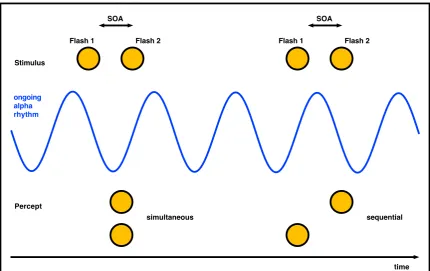
perceptual outcome. Along these lines, psychophysical threshold estimates have been shown to vary with the phase of ongoing oscillatory activity (Mathewson, Gratton,
occipital alpha rhythm (Varela, Toro, Roy & Schwartz, 1981; Gho & Varela, 1988; Figure 1.2).
Figure 1.2 Perceptual framing and neuronal oscillations
Two successive events can be perceived as simultaneous or sequential depending on their temporal relation to the phase of ongoing oscillatory activity (Figure adapted from Varela, 1981; Gho & Varela, 1988 and VanRullen & Koch, 2003)
The majority of approaches towards perceptual moments reviewed here can be categorized to the concept of ‘cinematographic vision’ (Sacks, 1992): vision as consisting of a rapidly flickering series of stills, as in a slide show.
Indeed, such oscillatory biasing between active and inactive states has been in particular linked to ongoing background processes of temporal attention (VanRullen, Carlson & Cavanagh, 2007; Hanslmayr, Gross, Klimesch, & Shapiro, 2011). In this way attentional sampling might alter transient sensory detection (Landau & Fries, 2012). Visual information as a result of such camera-like passive registration is considered to
Flash 1 Flash 2 Flash 1 Flash 2
SOA SOA
ongoing alpha rhythm
Stimulus
Percept
simultaneous sequential
be virtually unlimited in capacity, but also fragile and easily over-written by subsequent input (Wundt, 1989; Sperling, 1960; Breitmeyer & Ögmen, 2006). Such short-lived and fragile snapshots can be used to compute global summary statistics of the raw sensory image. For example, the average size of a set of objects can be computed even when the display properties change continuously (Albrecht & Scholl, 2010). Since the time course of oscillations is inherently predictable, periodic sampling of such global scene properties might provide long-term stability and continuity of ‘the gist’ of the sensory image. Indeed, such ‘virtual representations’ have been conceptualized as a layout upon which “focused attention” extracts individual objects in a scene (Rensink, 2000) and they could help to integrate sensory information globally across different frames of reference (Corbett & Melcher, under review).
1.1.2 Functional characteristics of ‘perceptual moments’
The present work, however, augments the camera-metaphor of vision by focusing on the computations within the snapshot. This includes exploring a second main characteristic of brain oscillations apart from their temporal periodicity: robust phase synchronization to transient input (Buszaki & Draguhn, 2004). Resets might either be induced top-down via saccadic eye-movements or shifts in attentional focus or evoked by real-world transitions (i.e. stimulus onset). In fact, evoked responses to successfully detected and entirely missed stimuli differ extensively (Busch et al., 2009). Temporal attention has classically been described as involving an initial transient component (Nakayama & Mackeben, 1989) and also oscillatory variations in susceptibility to sensory input have to be understood in relation to an initial reset event (Landau & Fries, 2012).
capacity-limited and stable set of individual entities (Sperling, 1960; 1963). Within the first unit cycle from phase reset, persisting information from the sampled sensory image is segmented into invariant object representations (Kahneman, Triesman & Gibbs, 1992; Rensink, 2000). Invariant perceptual form has to be segregated virtually in real-time in order to encompass the problems of a retinotopic snapshot representation within a dynamically changing sensory surrounding (Ögmen & Herzog, 2010).
In contrast to this demand for high temporal resolution, coherent integration of visual information over time relies on synchrony of convergent inputs. “Synchrony is defined by the temporal window within which some trace of an earlier event is retained,
which then alters the response to a subsequent event” (Buszaki & Draguhn, 2004; p. 2). In order to perceive visual continuity new information arriving within this critical window
of sensory accumulation should change the current perceptual representation. The present work examines this balance between sensitivity to change and reading-out invariant perceptual form within a rapid temporal window in response to transient reset
as a potential ‘perceptual moment’ in vision.
1.1.3 Stability of information and sensitivity to change within a ‘perceptual moment’
The perception of a stable and coherent external world comprehensively relies on parsing of the sensory environment into individual informational units (Spelke, 1988). Humans do not perceive the physical world as a collection of unrelated features, but as organized and structured percepts of objects and scenes (Tipper, Brehaut & Driver, 1990; Kahneman, Treisman & Gibbs, 1992; Baylis & Driver, 1993; Scholl, Pylyshyn & Feldman, 2001). In this way, objects (or more abstract demonstrative pointers to them) form fundamental perceptual units of information, providing a link between sensation and
Moreover, stability and continuity of the current perceptual representation is preserved despite of dynamic changes of the sensory input. During normal vision sensory information undergoes drastic and complex changes due to either real-world transitions or internal shifts in processing focus. Saccadic eye-movements create large discontinuities in the flow of visual information at a rate of 3-4 alterations per second (for review see Rayner, 1998). Likewise, the sensory image can change rapidly in dynamic environments. A briefly presented stimulus remains visible for another 100 - 120 ms after its onset, a phenomenon called visual persistence (Haber & Standing, 1970; Coltheart, 1980; Di Lollo, 1980; explained in more detail below). If the visual system operates upon
retinotopic snapshot-like images, fast changing or moving objects would be expected to appear smeared along the motion path (Figure 1.3).
Figure 1.3 Illustration of the ‘problem of moving ghosts’
Stationary objects remain long enough on a well-defined location in the image, so that its associated features can be firmly attached to this location. The visual persistence of objects in motion, however, would be spread along successive locations of its motion path (‘the problem of moving ghosts’, Ögmen, 2007; Ögmen & Herzog, 2010). In normal vision, however, motion blur is only seldom perceived (Ramachandran, Rao &
Vidyasagar, 1974; Burr, 1980; Hogben & Di Lollo, 1985).
Perceiving visual stability and continuity therefore imposes a fundamental functional dichotomy on visual processing: the construction of stable and coherent objects and scenes while also remaining sensitive to new information in the sensory image with high temporal resolution (Melcher, 2011). Given that sensory input arrives continuously, the visual system must mediate between stable and flexible
representations virtually in real time.
1.2 Units of information in vision
1.2.1 Object files and object individuation
Extracting objects from sensory input is called object individuation and involves selecting features from a crowded scene, binding them into a unitary representation and
individuating this spatiotemporal unit from other individuals in the image (Treisman & Gelade, 1980; Xu & Chun, 2009).
(acronym for FINgers of INSTantiation), Pylyshyn, 1989), proto objects (Rensink, 2000) or object files (Kahneman, Treisman & Gibbs, 1992; Xu & Chun, 2006). Reduced to its minimum such an object file can be defined as an entity whose recent spatio-temporal history can be reviewed and therefore still can be referred to as the same entity despite of changes in its location over time (Kahneman et al., 1992).
The concept of object files can also be very intuitively understood as the percept evoking the following well-known statement:
“It is a bird! It is a plane! … It is Superman!”
Whereas identity information about the object in focus is not known, the observer
perceives a unitary representation that is individual, discrete and well differentiated from its background (Smith, 1998). Object representations on this level of processing are commonly measured with an enumeration task that solely requires knowing whether an object is an individual rather than its identity. The number of open object files serves as a measure of stability and coherence of the current perceptual representation, since only successful individuation allows for further and more elaborate processing.
In a dynamic surrounding, non-retinotopic perceptual form must be computed to encompass the ‘moving ghost problem‘ (Ögmen, 2007). In this context, individuation as a measure of local saliency has been hypothesized as a metric within a dynamic
1.2.2 Visual capacity limits
It has long been noted that individuation is limited in capacity: we can quickly and
effortlessly perceive that there are exactly three items but not that there are exactly thirty items (Jevons, 1871; Figure 1.4).
Figure 1.4 Stimuli in an enumeration task that measures object individuation. Three items in the left panel can be simultaneously apprehended. Individuation of 30 items in the right panel requires successive perceptual steps (counting)
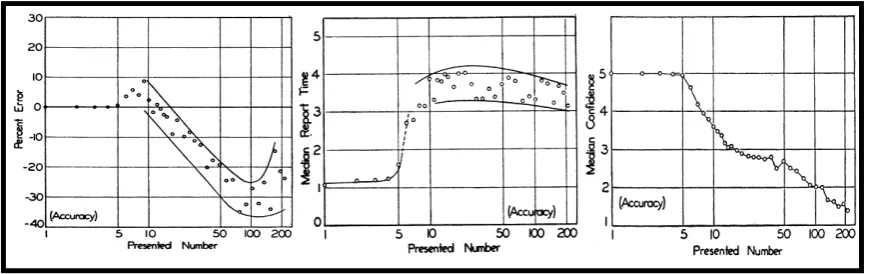
Enumeration is equally quick, accurate and effortless within a narrow range of one to four objects. Performance for set sizes exceeding this range, however, deteriorates more with every additional item to be enumerated (Figure 1.5).
Figure 1.5 Enumeration performance as a function of number of presented items
The left panel shows the proportions of errors, the middle panel shows reaction time and the right panel shows reported confidence in judgment on a 1-5 scale (Figures adapted
from Kaufmann, Lord, Reese & Volkmann, 1949).
Whereas enumeration of five or more items has to rely on serial and time-consuming counting or imprecise estimation, smaller numerosities are presumably simultaneously apprehended by a qualitatively distinct mechanism known as “subitizing” (Kaufmann, Lord, Reese & Volkmann, 1949). Conceptually, subitizing determines the informational capacity of vision within one processing iteration.
Some of these individuated object files are elaborated subsequently during object identification. It is at this stage that identity information becomes available to the
observer and the content of the object files can be consolidated into durable and reportable representations in visual working memory (Xu & Chun, 2006). As
individuation precedes identification, the capacity of the latter has its upper bound in the limit of the former (Melcher & Piazza, 2011; Piazza, Fumarola, Chinello & Melcher, 2011, Dempere-Marco, Melcher & Deco, 2012; compare Figure 1.5 left panel and Figure 1.6).
Although human cognition is remarkably powerful, its online workspace, working
memory, appears to be highly limited in the number of informational units it processes (Sperling, 1960; Luck & Vogel, 1997; Cowan, 2000). It is interesting to note that this
capacity is linked to cognitive abilities in general. For example, inter-individual variability in measures of fluid intelligence and capacity estimates are highly correlated (Engle, Tuholski, Laughlin & Conway, 1999; Cowan et al., 2005; Fukuda, Vogel, Mayr & Awh, 2010) and reduced capacity is often found in patients with neuropsychiatric disorders (Karatekin & Asarnow, 1998; Lee, Cowan, Vogel, Rolan, Valle-Inclán & Hackley, 2010). In light of its importance for cognitive functioning, the search for the root of this capacity limitation is fundamental to the study of cognition.
Object individuation appears to be the initial (but along with identification and
consolidation not the only) bottleneck in visual processing from an unlimited in capacity, but fragile, purely bottom-up and in parallel computed sensory representation (iconic
memory: Sperling, 1960, 1963; Neisser, 1967) to a capacity limited, durable and cognitively structured visual store (visual short-term memory: Sperling, 1960, 1963; Phillips & Baddeley, 1971). In addition to its influence on visual working memory and visual cognition in general, it is at the stage of object individuation that stability of the current perceptual representation is achieved through the establishment of spatio-temporally invariant object files. There are a number of competing theories for why subitizing, and individuation in general, is limited to sets of only about three or four items (for review, see Piazza, Fumarola, Chinello & Melcher, 2011), but it is widely assumed that this limit arises from a uniform process in one instant. In other words, the
1.2.3 Temporal dynamics of individuation: Visual persistence and temporal integration
Previous examinations on the temporal dynamics of individuation, however, might have under-sampled its time scale, since information about the sensory image might be available longer than its actual physical presence (Sperling, 1960). Therefore a description of subitizing as purely instantaneous, mapping the apprehension of
information on perceptual time with a transient impulse δ-function (Dirac, 1958), might be inadequate.
Following stimulus onset a briefly presented visual display has a limited
perceptual persistence during which time it may be processed and categorized (Wundt, 1899; Sperling, 1960; Loftus, Duncan & Gehrig, 1992). This interval has been described as a sensory integration period over time. When two visual stimuli are presented in rapid succession (within 100 – 150 ms), their trailing visual persistence are partly integrated into a single percept. Ongoing neural processes still active from the first stimulus can dramatically reduce the visible persistence of the second stimulus, a phenomenon called masking by integration of contours (Di Lollo, 1980). Integration masking occurs when
target and mask information are combined together, as a consequence of the imprecise temporal resolution of the visual system (Scheerer, 1973 a; Enns & Di Lollo, 2000;
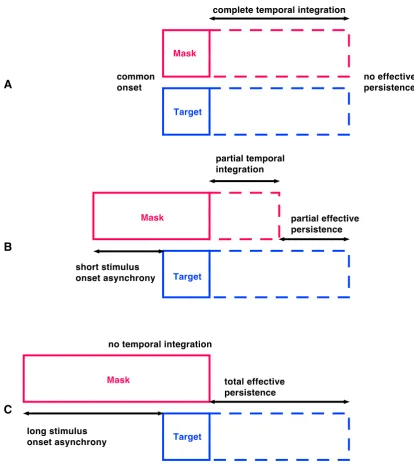
Figure 1.7 Schematic depiction of integration masking
Depending on the stimulus onset asynchrony between mask and target display varying portions of visual persistence of the two stimuli are temporally integrated. A Both displays are completely integrated into a single percept since they are presented at the same time. B Short stimulus onset asynchronies between mask and target result in partial temporal integration and reduced effective persistence of the target display. C When both displays are presented distant in time (> 100-150 ms), temporal integration does not occur and target information is accessible for the full time of its persistence (Figures adapted from Di Lollo, 1980).
Target
Target
Target
Mask
Mask
Mask
complete temporal integration
partial temporal integration
no temporal integration
no effective persistence common
onset
partial effective persistence
short stimulus onset asynchrony
total effective persistence
long stimulus onset asynchrony A
B
Within this temporal window of sensory persistence, however, individual information can also be accumulated. Hence, individuation capacity could be a consequence of the window bandwidth. Fractionating sensory persistence with integration masking provides a means to obtain more fine-grained temporal information about object individuation mechanisms within one perceptual instant.
1.3 Computation, algorithm and implementation of temporal windows in vision
The following three chapters characterize the relationship between temporal windows
and informational capacity in visual processing based on Marr’s three different, but
complementary, levels of description (Marr, 1982).
First, this link is described on the computational level by showing that limiting the
time to access the sensory image, by fractionating the perceptual instant, reduces the
informational capacity of the observer, unit by unit. Hence, and in contrast to common
assumption, I show that reading-out individual and stable object-files is not an
instantaneous process. Computationally, the goal of implementing a temporal window
might be to accumulate sensory evidence in order to converge within the inherent
capacity limitations of the visual percept.
Second, an algorithm is proposed that describes the transformations of the visual
signal within the “psychophysical process” (Wundt, 1989) as a succession of temporal
epochs from transient sensory detection to the read-out of individual and then
identifiable objects. I describe the input-output relationships between three stages in
object processing – detection, individuation and identification - and define temporal
buffering as the respective boundary condition between stability and flexibility of the
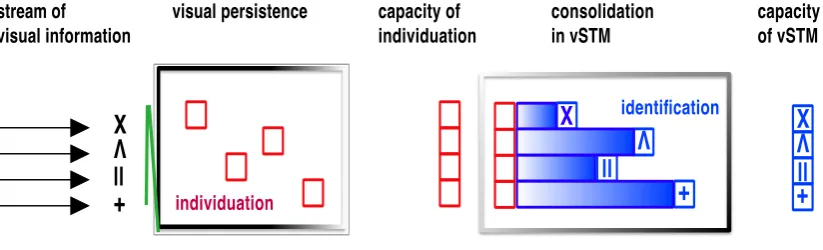
Figure 1.8 Illustration of temporal windows in object processing
Under normal viewing conditions, the stream of visual information is individuated during the period of visual persistence of the sampled sensory image. Items that are
individuated are potential “object files” which can then be identified and consolidated into visual short-term memory (vSTM).
Third, the implementation of such a temporal windowing mechanism within neuronal
processing is explored as a trace of interactions in sensory persistence within the α -phase locked component of the visual evoked response. I show that -phase synchrony
mediates between temporal segregation and integration of temporally close visual
transients, but this synchrony plays less of a role if the onsets of successive stimuli fall in
different temporal integration windows.
Finally, in the last chapter I discuss the findings from the three studies and
propose that visual computations within one perceptual instant of time can be described as equilibrating temporal and informational resolution of the environment. Fragmenting the continuous stream of visual information into temporal windows provides a neuronal mechanism to accumulate sensory evidence over time and almost simultaneously read-out spatio-temporally invariant representations. In this way temporal windows provide stability and continuity within a dynamically changing visual environment.
stream of visual information
visual persistence consolidation
2. Rapid enumeration within a fraction of a single glance:
The role of visible persistence in object individuation capacity
The study reported here has been published under the above title by Wutz, A., Caramazza, A., & Melcher, D. in Visual Cognition (2012).
The number of items that can be individuated at a single glance is limited. Here, we investigate object individuation at a higher temporal resolution, in fractions of a single glance. In two experiments involving object individuation we manipulated the duration of visual persistence of the target items with a forward masking procedure. The number of items as well as their stimulus onset asynchrony (SOA) to the mask was varied
As noted by Spelke, “the organization of the perceived world into units may be a central task of human systems of thought” (1988, p. 229). Extracting objects from sensory input is called object individuation and involves selecting features from a crowded scene, binding them into a unitary representation and individuating this spatiotemporal unit from other individuals in the image (Treisman & Gelade, 1980; Pylyshyn, 1989; Kahneman, Treisman & Gibbs, 1992; Xu & Chun, 2009). It has long been noted that individuation is limited in capacity: we can quickly and effortlessly perceive that there are exactly three items but not that there are exactly thirty items (Jevons, 1871). Whereas enumeration of five or more items has to rely on serial and time-consuming counting or imprecise estimation, smaller numerosities are presumably simultaneously apprehended by a qualitatively distinct mechanism known as “subitizing” (Kaufmann, Lord, Reese & Volkmann, 1949). There are a number of competing theories for why subitizing, and individuation in general, is limited to sets of only about 3 or 4 (for review, see Piazza, Fumarola, Chinello & Melcher, 2011), but it is widely assumed that this limit arises from
a uniform process in one instant.
Here we examine what happens at a smaller time scale, within a single glance, to critically evaluate the assumption that subitizing is indeed instantaneous. Previous theories of subitizing have attempted to account for spatial or numerical limits (Pylyshyn & Storm, 1988; Pylyshyn, 1989). We consider an alternative hypothesis based on time, in which the effective duration of the stimulus limits the time available to individuate items. A briefly presented visual display has a limited perceptual persistence during which time it may be processed and categorized (Wundt, 1899; Sperling, 1960; Loftus, Duncan & Gehrig, 1992). Object individuation within a single glance can be viewed, then, as a race for items to be individuated before this window closes. If individuation is
rapid enumeration. We test whether the “magic number” is actually a “magic time period” for the individuation of items being held in a rapidly decaying sensory memory. Our experimental goal was to fractionate time into smaller units to watch the unfolding of the object individuation process.
In order to vary the effective duration of the items on the screen we used a special form of visual masking. Masking can occur when two successive visual stimuli are presented within 100-150 ms from each other, effectively being integrated into a single percept (Di Lollo, 1980; Loftus & Irwin, 1998). Ongoing neural processes still active from the first stimulus can dramatically reduce the visible persistence of the second stimulus, a phenomenon called masking by integration of contours (Di Lollo, 1980). This forward masking manipulation makes it possible to quantitatively change the duration of visual persistence (and iconic memory access) by varying the onset
asynchrony between the first and second display. This experimental manipulation provides a means to obtain more fine-grained temporal information about object
individuation mechanisms.
To measure object individuation within a fraction of a single glance, we
conducted two experiments in which we independently varied stimulus onset asynchrony (SOA) between the forward mask and the target items, as well as the number of items (Figure 2.1). The target items were presented superposed upon the mask and the time course of their visible persistence was altered by the onset asynchrony to the mask display. The first experiment investigated enumeration within and beyond the subitizing range, while the second experiment required participants to identify whether a previously viewed target shape was present among a variable number of shapes. Both experiments shared the selection and individuation of discrete entities from a crowded scene,
both experiments, any similarities in the results between the experiments can be ascribed to the effects of this manipulation on object individuation in isolation from additional mechanisms.
Since enumeration performance is affected by item visibility, with a uniform effect within the subitizing range (Palomares & Egeth, 2010; Palomares, Smith, Pitts & Carter,
2011), we also ran a control condition in order to disentangle the effects of the mask on temporal processing from its more generic effect on item visibility. We report that
reducing the effective persistence of the items, unlike other methods that simply reduce item visibility in general, leads to a specific effect within the subitizing range which is consistent with our hypothesis that capacity limits are caused, at least in part, by temporal limits on the individuation process.
2.1 Methods and materials
2.1.1 Subjects
Fourteen observers participated in the enumeration (13 female, mean age M = 22.5 y, SD = 3.9 y) and the identification experiment on visible persistence (9 female, M = 23.9 y, SD = 9.1 y). There were 8 participants in the control experiment on item visibility (3 female, M = 29.1 y, SD = 2.0 y). All participants provided informed consent as approved by the institutional ethics committee, took part in exchange for course credits and had normal or corrected-to-normal vision.
2.1.2 Stimuli and apparatus
1997). Participants were seated in a dimly lit room, approximately 50 cm from a 19’’ Mitsubishi monitor (1600x1200 resolution) running at 85 Hz. On each trial a different pattern of 200 randomly oriented, partially crossing black lines (luminance: 0.07 cd/m2; mean line length = 1.2° visual angle, SD = 0.24°; mean line width = 0.12°, SD = 0.04°; mean size of whole pattern = 18° vertically by 10° horizontally) was presented centered on a white background (luminance: 99.93 cd/m2; Figure 2.1). This pattern remained on the screen and then after a variable onset delay a variable number of items (1-4 or 6) appeared which were linearly superposed upon the random line pattern by use of the image processing technique ‘alpha blending’.
2.1.3 Procedure
2.1.3.1 Enumeration with variable mask-item(s) SOA
All subjects received verbal and written instructions about the task and completed fifteen practice trials, in which the random line pattern was made 80% transparent by
multiplying its alpha channels by a factor of 0.8. Each trial began with a central fixation dot (black, 0.4°) on a white background for 500 ms, followed by a white blank screen for another 500 ms. Then the random line pattern was presented for one of four durations, in order to control the stimulus onset asynchrony (SOA) between the onset of the mask and the item(s). There were four different stimulus onset asynchronies: 0 ms (common onset), 24, 47 or 141 ms. The target display, in which the item(s) to be enumerated were superposed upon the masking pattern, was always presented for the same brief duration of 71 ms. This target display was immediately followed by a white screen until the
participant’s response, which was recorded by pressing the corresponding number on a keyboard (Figure 2.1 D).
Although reaction time was recorded, the analyses focused on the proportion of correct trials to avoid any potential effects of participants searching for the correct number key. Our approach is consistent with previous studies, which have measured correct performance while directly manipulating the presentation time of the stimulus, rather than depending on reaction time in order to avoid potential confounds at the response level (Reed, 1973; McElree & Carrasco, 1999). The participants were instructed that one to eight items could be presented, whereas only one to four or six items were actually shown. This manipulation was required in order to prevent a
response bias to always report the highest possible numerosity when in doubt, as might
subjects was aware that there had been no displays with five, seven or eight items. The experiment consisted of eight blocks of 60 trials. Each of the 20 possible combinations of mask-item(s) SOA and target numerosity was shown three times per block in random order. The experiment lasted approximately 45 minutes.
!"
!"
!"
!"
fixation dot offset
mask onset
blank pre-mask interval (500 ms)
target(s) onset (1-4 or 6 items)
mask & target offset
blank screen (-response)
SOA
(0, 24, 47, 141 ms)
71 ms
0
TIME (ms)
141
47
24
X
X
D
X
X X
X
X X
V
||
V
+
Figure 2.1 Illustration of the mask and target stimuli used in the experiments (panels A-C) and of one trial in the enumeration experiment with the manipulation of SOA (panel D)
A Display with random line pattern and target letters 'X' superposed upon it. Note that the target items are virtually invisible when presented simultaneously with the random line pattern. B The same display shown in the left panel but with the random line pattern shown 60% transparent for illustrative reasons. C Example of the two-line drawings used as targets, superimposed on the random line patterns shown here at 60% transparence. In the experiments on visible persistence, the random line patterns were always shown at full contrast, as shown in panel A. Mask contrast was an independently varied factor in the control experiment on item visibility. D Illustration of one trial in the enumeration experiment with the manipulation of SOA. Throughout the trials, the two independent factors target numerosity (1, 2, 3, 4 or 6) and mask-target(s) SOA (0, 24, 47 or 141 ms) were varied. The targets superposed upon the masking pattern (here shown 60% transparent for illustrative reasons) were always presented for 71 ms, followed by a blank screen until the subject’s response.
2.1.3.2 Enumeration with variable mask contrast
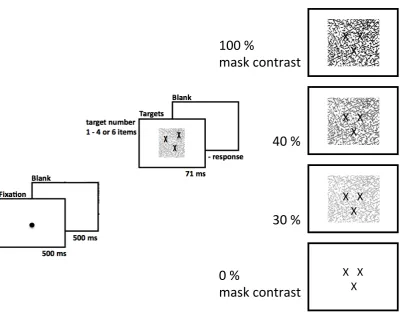
Figure 2.2 Schematic depiction of the enumeration experiment with the manipulation of mask contrast
Throughout the trials, the two independent factors target numerosity (1, 2, 3, 4 or 6) and mask contrast (100%, 40%, 30%, 0%) were varied. The temporal onset of mask and target display was the same and both displays were always presented for 71 ms, followed by a blank screen until the subject’s response.
2.1.3.3 Identification with variable mask-item(s) SOA
The procedure for the identification task was the same as in the enumeration experiment
except for the following changes. First, a target shape was shown centrally at the beginning of the trial for 500 ms, followed by a 500 ms white blank screen. The task on
each trial was to state whether or not the target shape was one of the items presented in the subsequent display. The target shape was present on 50% of the trials. Participants responded by pressing a key corresponding to target absent or present. Based on the
Mask Targets
Mask Targets
Mask Targets
Mask Targets
!"""!"
"""!"
#$$"%""
&'()"*+,-.'(-"
/$"%""
!"""!"
"""!"
!"""!"
"""!"
!"""!"
"""!"
0$"%""
$"%""
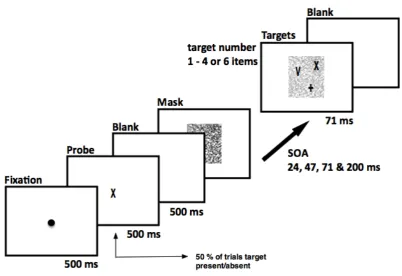
results of the enumeration experiment, and taking account of the additional requirement of identification in this task, the mask-item(s) SOAs were slightly changed with respect to the first experiment to be fit within the range of 24 to 200 ms. Within one block every combination of the three factors -- SOA (24, 47, 71, 200 ms), set size (1-4 or 6) and target presence (present/absent) -- was shown three times and in random order (Figure 2.3). Experiment 2 comprised eight blocks of 120 trials and lasted approximately 90 minutes.
Figure 2.3 Schematic depiction of the identification experiment with the manipulation of SOA
2.1.4 Data analysis
As the study was designed to investigate object individuation within the subitizing range, data for numerosities from one to four items were fed into a two-way (masking level - by - number) within-subject analysis of variance (ANOVA) for all reported experiments. The residuals of all reported variables were normally distributed as shown by a
Kolmogorov-Smirnov test. In case sphericity for the given factor was not tenable, F-Ratios have been adjusted with a Greenhouse-Geisser correction. To further investigate interactions
between the two factors, post-hoc t-tests between performance at each numerosity (1-4) and a baseline condition (see below) were conducted (p-values Bonferroni-corrected). Due to technical difficulties, reaction time data for the enumeration experiment with variable mask-item(s) SOA were available for only twelve of the fourteen subjects.
2.2 Results
2.2.1 Enumeration with variable mask-item(s) SOA
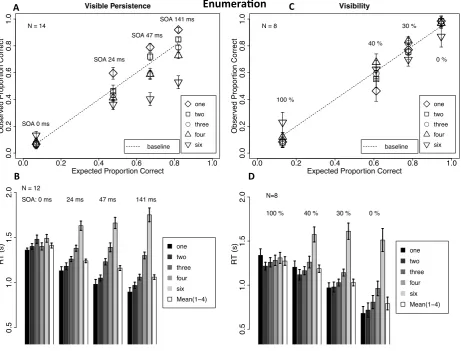
In contrast to previous studies showing good enumeration performance up to about 4 items, the masking manipulation used here led to a dramatic effect on proportion correct (Pc) and reaction times (RT) even within the subitizing range (Figure 2.4 A & B,
supplemental Figure SF2.1). This effect is confirmed by a within-subjects ANOVA on the accuracy and the reaction times, which revealed main effects of SOA (Pc: F(3, 39) = 198.9, p < .001, ηp2 = .939; RT: F(1.7, 18.7) = 33.7, p < .001, ηp2 = .754) and item numerosity (Pc: F(3, 39) = 14.5, p < .001, ηp2 = .526; RT: F(1.6, 17.9) = 29.9, p < .001,
four items across participants, a similar ANOVA with a subitizing range of up to three items was calculated and comparable results were obtained (see supplemental Table ST2.1).
Visual inspection of Figure 2.4 A & B confirms a qualitative difference in
performance between small and large numerosities (Kaufman et al., 1949; Piazza et al.,
2011). Accuracy meliorated less for six items (39.6 % increase) compared to four (64.5%) and reaction times for six items increased with longer SOAs. However, the
different SOA conditions affected enumeration differently even for small numerosities within the subitizing range. To better understand these differences, average
performance for one to four items at each SOA was used as a baseline condition (BL) for subsequent paired comparisons. The mean proportion of correct trials across
Figure 2.4 Results of the enumeration experiments with the manipulation of SOA (panels A & B) and mask contrast (panels C & D)
A Observed proportion as a function of expected proportion of correct trials, given stochastic independence of the probability of a correct response and numerosity within the subitizing range at every level of mask-Item(s) SOA for different item numerosities. B Reaction times at each mask-item(s) SOA for different item numerosities and for the average reaction time within numerositiy one to four. C Observed proportion as a function of expected proportion of correct trials, given stochastic independence of the probability of a correct response and numerosity within the subitizing range at every level of mask contrast for different item numerosities. D Reaction times at each mask contrast for different item numerosities and for the average reaction time within numerositiy one to four. Vertical deviations from the dashed lines indicate differences between observed and expected values. Error bars display one standard error of the mean for within-subject designs. Individual performance values have been centered on the mean performance of each subject before calculating the standard error.
!
!
! !
0.0 0.2 0.4 0.6 0.8 1.0
0.0 0.2 0.4 0.6 0.8 1.0 Visible Persistence
Expected Proportion Correct
Obser ved Propor tion Correct ! ! ! ! ! one two three four six baseline SOA 0 ms
SOA 24 ms
SOA 47 ms SOA 141 ms N = 14
R T (s) 0.5 1.0 1.5 2.0 one two three four six Mean(1−4) SOA: 0 ms 24 ms 47 ms 141 ms
N = 12
!
! !
!
0.0 0.2 0.4 0.6 0.8 1.0
0.0 0.2 0.4 0.6 0.8 1.0 Visibility
Expected Proportion Correct
Obser ved Propor tion Correct ! ! ! ! ! one two three four six baseline 100 % 40 % 30 % 0 % N = 8
R T (s) 0.5 1.0 1.5 2.0 one two three four six Mean(1−4) 100 % 40 % 30 % 0 %
N=8 !"#$%&'()"*
+* ,*
The forward mask was effective at limiting the effective duration of the target stimulus. In the case of 0 ms SOA, enumeration accuracy did not exceed expected performance at chance level (12.5 % correct) for all item numerosities (min = 6 %, max = 13 % correct; one-tailed t(13)s < 0.3, ds < 0.09) and reaction times were generally quite high.
Behavioral performance therefore indicates a high level of uncertainty within the observers, confirming the phenomenological experience that targets were virtually invisible when the mask and the item(s) were presented simultaneously.
As SOA increased to 24 ms, accuracy improved for all item numerosities within the subitzing range (M = 47.6 %), but most strongly for one-item displays (59.6 %). Only accuracy for one item was higher than the baseline (t(13) = 4.2, p < .005, d = 1.1), whereas the other numerosity levels (two, three and four items) showed no significant difference (abs (t(13)s) < 1.9, abs (d)s < 0.5). Reaction times for one item were
significantly lower than the baseline (t(11) = -3.1, p < .05, d = -0.9). Overall, these results show that the small increase in SOA affected object individuation most strongly for one-item displays. In other words, at the 24 ms SOA the assumption of stochastic
independence of target set size, within the subitizing range, was violated.
For a mask-item(s) SOA of 47 ms one-item and, marginally significant, two-item
displays (showing a 26 % increase compared to the 24 ms SOA) were more accurately enumerated than the baseline (two vs. BL: t(13) = 2.6, p < .095, d = 0.7). Reaction time data revealed the same pattern of results: One and two items yielded faster reaction times compared to the baseline average (both t(11)s < -4.3, p < .005, both ds < -1.2). These results suggest that there was a particular benefit in enumeration for one and two item displays with the 47 ms SOA condition.
At the longest SOA tested, performance for three item displays finally
still significantly worse than the baseline (Pc: t(13) = -4.9, p < .001, d = -1.3; RT: t(11) = 5.5, p < .001, d = 1.6). Therefore, at the 141 ms SOA there was an additional
improvement in performance for the three-item displays.
2.2.2 The role of temporal effects of masking versus a general reduction in visibility
As described above (see Introduction and Methods), a control condition varying mask contrast was used to distinguish between time constraints on enumeration and a more general effect of reduced visibility. The pattern of results (Figure 2.4 C & D,
supplemental Figure SF2.2) shows that reducing item visibility per se had a quite different effect on enumeration compared to those reported above with variable mask-item(s) SOA. One particularly obvious difference between the two conditions is shown by greater accuracy for large numerosities (6 items) in the contrast control task when the mask contrast was high. Good performance for six items reflects a bias towards
reporting higher responses under this condition, perhaps due to confusing the mask with the target. This finding is interesting because it shows that better performance for small numerosities in the main experiment, described above, was not due to a tendency to guess a small number when visibility was poor. When the mask was not presented at all (0 % contrast), accuracy was equally high for all set sizes within the subitizing range. In addition, RTs showed a clear qualitative distinction between small and large
numerosities, even though the slope was not completely flat within the subitizing range (Figure 2.4 C & D). Therefore the observed enumeration performance with these stimuli in this unmasked condition fits well into the existing literature (see Folk, Egeth, & Kwak, 1988; Mandler & Shebo, 1982).
14) = 9.0, p < .005, ηp2 = .564) within the subitizing range (Figure 2.4 C & D). Furthermore, for both accuracy and reaction times, a main effect of numerosity was observable (Pc: F(3, 21) = 4.5, p < .02, ηp2 = .393; RT: F(3, 21) = 4.3, p < .02, ηp2 = .381). As the pattern of this effect, however, is quite the opposite for these two measures (Figure 2.4 C & D), enumeration performance cannot really be distinguished within the subitizing range with respect to a possible speed-accuracy trade-off. Most importantly, the two factors (mask contrast and item numerosity) within the subitizing range, did not interact (Pc: F(6, 42) = 1.9, p > .1, ηp2 = .210; RT: F(2.5, 17.3) = 1.4, p > .2, ηp2 = .166; Figure 2.4 C & D). Thus, the overall trend showing that manipulating item visibility in general had a uniform effect across small item numerosities was consistent with previous studies (Palomares & Egeth, 2010; Palomares et al., 2011). These results suggest that the effect of masking on enumeration observed in the first experiment is not simply due to alterations in item visibility in general but to constraints on the temporal aspects of visual processing, namely the time course of visible persistence of the to be
enumerated items.
2.2.3 Identification
In the first experiment, object individuation was operationalized by enumeration. Of course, enumeration is a complex task. Therefore, it was useful to include a second task, which shared the first two stages of processing (selection and individuation) with Experiment 1 but differed in later stages. Thus, the second experiment isolated individuation from the “numerical cognition” aspects of enumeration and added an additional identification component.
rejections) were significantly altered by mask-item(s) SOA (Pc: F(3, 39) = 47.7, p < .001,
ηp2 = .786; RT: F(1.6, 21.2) = 14.2, p < .001, ηp2 = .521) and set size (Pc: F(3, 39) = 30.7,
p < .001, ηp2 = .702; RT: F(3,39) = 29.0, p < .001, ηp2 = .690). An interaction was found between SOA and set size for the accuracy measure (Pc: F(9, 117) = 3.6, p < .002, ηp2 = .215; Figure 2.5). Again, post-hoc t-tests between each numerosity from one to four and their mean at every level of SOA were conducted to highlight the pattern of interactions of the masking manipulation within the subitizing range (Figure 2.5, supplemental Figure SF2.3).
Figure 2.5 Results of the identification experiment with the manipulation of SOA A Observed proportion as a function of expected proportion of correct trials, given stochastic independence of the probability of a correct response and set size within the subitizing range at every level of mask-Item(s) SOA for different item set sizes. B
Reaction times at each mask-item(s) SOA for different item set sizes and for the average reaction time within set sizes one to four. Vertical deviations from the dashed line
indicate differences between observed and expected values. Error bars display one standard error of the mean for within-subject designs. Individual performance values have been centered on the mean performance of each subject before calculating the standard error.
!
! !
!
0.65 0.70 0.75 0.80 0.85 0.90
0.5 0.6 0.7 0.8 0.9 1.0
Expected Proportion Correct
Obser ved Propor tion Correct ! ! ! ! ! one two three four six baseline
SOA 24 ms
SOA 47 ms SOA 71 ms
SOA 200 ms N = 14
R T (s) 0.6 0.8 1.0 1.2 one two three four six
Mean(1−4) SOA: 24 ms 47 ms 71 ms 200 ms
N=14
!"#$%&'(%)$*
Accuracy for a single item was higher than baseline performance at the 24 ms SOA (t(13) = 3.3, p < .025, d = 0.9), but this was found only for the single item condition (abs(t(13)s) < 1.9, abs (d)s < 0.5). This confirms the particular benefit in the individuation of one item with a very short SOA found in the enumeration task (Experiment 1).
With 47 ms and 71 ms SOA, accuracy for one- and two-item displays were
significantly above the baseline average (all t(13)s > 2.9, p < .05, all ds > 0.75). Reaction times for one item were faster than the baseline for both SOAs (both t(13)s < -3.8, p <
.01, both ds < -1.0). The striking difference in identification accuracy for two-item displays compared to baseline performance suggests that, as in the enumeration experiment, there was a shift in the number of items preferentially processed.
Accuracy and reaction times for three-item displays converged towards baseline performance only at the longest SOA (200 ms). Identification for four items remained less accurate (74.3 %; t(13) = -5.7, p < .001, d = -1.5) and slower (0.87 s; t(13) = 5.3, p < .001, d = 1.4) than baseline. As the performance measures for larger set sizes (4 & 6) seem to saturate, this pattern of results suggests an increase in capacity as a function of
SOA with a limit of around three items. It is important to note that the persistent one item benefit in enumeration was also found with a binary (present/absent) response. This
finding strongly argues against the possibility that a tendency to report the ordinal extremes (1 or 8 items) completely explains the results of the first experiment (see also supplemental Figure SF2.4 for response matrices at each SOA). Moreover, a table showing reaction times and accuracy for each experiment is included in the
2.3 Discussion
The main finding was that the masking procedure affected performance within the subitizing range. This effect was observable in two tasks that both required object individuation but differed in response selection. Thus, it is likely that masking interacted with the individuation of multiple objects and not with subsequent response-limited
processes. Furthermore, this effect was not caused by generic alterations in item visibility, as shown by the control condition of the first experiment. Instead, the
manipulation of the SOA appeared to temporally fractionate the effective persistence of the visual image and this limited the capacity of object individuation. Thus, theories that try to explain the “magical number four” by a limit in a simultaneous process may under-sample its timescale. We suggest that a more thorough analysis of the temporal
dynamics of individuation might help to explain capacity limitations.
It is important to note that the effect of mask-target(s) SOA cannot be explained by an improvement in the visual system’s readiness to process temporally trailing displays. Di Lollo (1980) showed that presenting a mask with a variable SOA, but
changing also the mask configuration simultaneously with target display onset, disrupted performance regardless of SOA. Based on that earlier result we can exclude attentional
pre-cueing as a major determinant of the current pattern of findings.
Although we focus here on rapid individuation, rather than memory, for objects, previous studies of visual working memory have also reported an effect of time
(Gegenfurtner & Sperling, 1993; Vogel, Woodman & Luck, 2006). In those earlier studies, a backward mask was used to limit the display duration of multiple items in a visual working memory paradigm. Our study differs in several ways. First, we focus on
numerosity of multiple items or the identity of a single item. Second, we examined the first tens of milliseconds of visual processing, while the earlier studies—which were interested in higher cognitive aspects of working memory—focused on mental processes happening after 100 ms. In other words, the earlier studies investigated what happened after the glance, while we explored the unfolding of object individuation within the glance.
Here, we examined object individuation as a process in which multiple objects
race to emerge from a complex scene as unique, individual objects, within a very short window of time. However, in interpreting a time-limited process it is important to
acknowledge the mathematical complexity of determining whether unobservable processes are parallel or serial based on input-output relationships or its statistics (Townsend, 1971). The finding that subitizing is not purely instantaneous, but evolves within a single glance, could be accounted for by either a serial or parallel mechanism. Vanishing access to sensory information could limit the time to serially repeat a number of actions. A theoretical implementation of such a serial mechanism to extract
information from a visual scene was proposed by Ullman (1984). Elemental operations, like shifting the processing focus or indexing a salient item, are combined into
sequences or visual routines to allow real-time execution of computationally complex tasks, like enumeration. The subitizing phenomenon therefore may reflect the cardinal number of such a visual routine applied upon the sensory image during the time of its persistence.
164). It is therefore reasonable that the time required for a temporally evolving, parallel process to reach threshold depends on the number of items it processes. Processing intensity in visual neurons can be modulated by attention (Moran & Desimone, 1985). Given that subitizing has been demonstrated to require attention (Egeth, Leonard & Palomares, 2008; Olivers & Watson, 2008), the computational speed of object
individuation in parallel may be a function of the degree to which attentional resources have to be shared among multiple items. Increasing attentional load e.g. by increasing target-distractor similarity (Watson, Maylor, Allen & Bruce, 2007) or adding an attention demanding dual task (Olivers & Watson, 2008), might slow down the core individuation process to an extent that the read-out of information cannot be accomplished within the time in which the sensory input is available to the mechanism at work. In these
situations, one might expect that the observers rely on counting or estimation
mechanisms even for small numbers of items, instead of specialized subitizing, which is in general accordance with recent findings (Burr, Turi & Anobile, 2010). Our results are
consistent with, but go beyond, recent evidence for a role of attention in subitizing by providing testable hypotheses for how and when attention might limit subitizing
performance.
In a similar way, competitive interactions between potential proto-objects in a type of saliency map could explain numerosity-dependent processing rates for a parallel mechanism. When there is only one salient object, the proto-object would emerge in a fraction of a single glance. Competition among multiple items may require more time to converge into a stable percept both at the stage of individuation and at the level of memory (Dempere-Marco, Melcher & Deco, 2011). Subitizing, therefore, might be explained if the duration of the decay of sensory information was on average equal to
If sensory input is available indefinitely to the observer, e.g. under unlimited viewing conditions, a new cycle of read-out of information can be initiated after the initial glance, in order to refresh the initial sensory image. One example is “counting”, a
process which is generally considered to require multiple perceptual steps and the use of saccadic eye movements (Kowler & Steinman, 1977). When the sensory image contains more informational units than those individuated during the “initial glance”, an increase in both reaction times and eye movement frequencies for item numerosities above the subitizing range would be expected (Watson, Maylor & Bruce, 2007).
3. Temporal buffering and visual capacity:
The time course of object formation underlies capacity limits in visual cognition
The study reported here has been published under the above title by Wutz, A., & Melcher, D. in Attention, Perception, & Psychophysics (2013).
Capacity limits are a hallmark of visual cognition. The upper boundary in our ability to individuate and remember objects is well known, but - despite its central role in visual information processing - not well understood. Here we investigate the role of temporal limits in the perceptual processes of forming ‘object files’. Specifically, we examined the two fundamental mechanisms of object file formation - individuation and identification - by selectively interfering with visual processing using forward and backward masking with variable stimulus onset asynchronies (SOAs). While target detection was almost unaffected by these two types of masking, they showed distinct effects on the two different stages of object formation. Forward ‘integration’ masking selectively impaired object individuation, whereas backward ‘interruption’ masking only affected identification and the consolidation of information into visual working memory. We therefore conclude that the inherent temporal dynamics of visual information processing are an essential component in creating the capacity limits in object individuation and visual working memory.
One of the fundamental goals of perception is to enable us to interact with objects in the environment. According to Wundt, the interaction of an observer with the external environment (the “psychophysical process”) can be subdivided into three temporally successive and distinct stages (Wundt, 1899, 1900). The first stage (“perception”) describes the entrance of an object into the field of vision, allowing it to be detected. In a subsequent stage, termed “apperception”, the addressed object occupies the focus of the observer’s attention. Finally, the observer develops the volition to react to the object either cognitively, by storing it into memory, or behaviorally with a grasping or a saccadic eye movement.
Wundt’s description emphasizes how object recognition involves a temporal succession of distinct processing stages - from an unlimited in capacity, but fragile, purely bottom-up and in parallel computed sensory representation (iconic memory: Sperling, 1960, 1963; Neisser, 1967) to a capacity limited, durable and cognitively structured visual store (visual short-term memory: Sperling, 1960, 1963; Phillips & Baddeley, 1971) leading to a an action that results in an isomorphic one-to-one relation between observer and object.
As shown in Figure 3.1 A, Wundt’s stage of apperception can be further
identity information becomes available to the observer and the content of the object files can be consolidated into durable and reportable representations in visual working memory. The number of objects available at this stage is variable, depending on object complexity, task demand and representation resolution (Alvarez & Cavanagh, 2004; Xu & Chun, 2009). As individuation precedes identification, the capacity of the latter has its upper bound in the limit of the former (Melcher & Piazza, 2011; Piazza, Fumarola, Chinello & Melcher, 2011, Dempere-Marco, Melcher & Deco, 2012).
Figure 3.1 Illustration of how the temporal limits of visual object processing can result in capacity limits for individuation and identification
A Under normal viewing conditions, the stream of visual information is individuated during the period of visual persistence of the sampled sensory image. Items that are individuated are potential “object files” which can then be identified and consolidated into visual short-term memory (vSTM). B Integration masking via forward masking reduces the effective persistence of the target items, leading to a reduction in capacity for individuation and consequently also for identification. C Interruption masking does not
stream of visual information
visual persistence consolidation
influence the initial individuation of items but instead disrupts the identification and consolidation of items into vSTM.
The goal of the present report is to investigate whether capacity limitations in object
processing can be traced to temporal constraints on the distinct object processing
stages. We therefore try to embed the ongoing debate about the roots of capacity limits
in vision (reflected in the ‘subitizing’ phenomenon (Jevons, 1871; Kaufman et al, (1949)) and visual working memory (Luck & Vogel, 1994; Cowan, 2000) into the already well-established body of work about the temporal dynamics of the visual system (Wundt,
1989; Sperling, 1960, 1963; Loftus, Duncan & Gehrig, 1992).
Specifically, we use two types of masking—integration and interruption
masking—in order to influence either the individuation or identification stage of object file formation.Visual masking refers to the reduction of the visibility of one stimulus, called the target, by another stimulus shown before and/or after it, called the mask (Enns & Di Lollo, 2000; Breitmeyer & Öğmen, 2006). It is usually explained in terms of a two-factor theory: integration and interruption masking (Scheerer, 1973a, b). Integration masking occurs when target and mask information are combined together, as a consequence of the imprecise temporal resolution of the visual system. Integration masking can occur
with either forward or backward masking for short SOA values (up to around 100 ms
between the target and the mask). In contrast, ‘interruption masking’ affects higher- level
mechanisms that are engaged in object recognition and yields a J-shaped masking
function, as it can only occur for masks appearing temporally after the target display
(Enns & Di Lollo, 2000; Breitmeyer & Öğmen, 2006). The effect of this kind of masking is thought to reflect a disruption of processing after perceptual analysis is already
completed, but before the representation has been consolidated into visual working
Our hypothesis is that integration masking should selectively affect the
individuation stage by reducing the effective persistence of the target items (Figure 3.1
B). Integration masking is very effectively implemented with a specific forward masking technique that makes it possible to quantitatively change the duration of visual
persistence (and iconic memory access) and the degree of temporal integration by varying the onset asynchrony between the first and second display (Di Lollo, 1980). Also, in the case of backward masking with a very short SOA we would expect
integration masking to occur and to limit the effective visual persistence of the target and
thus the individuation processes.
In contrast, we predict that interruption masking should selectively affect the
identification of items, after individuation has largely finished, since the consolidation of
targets into vSTM would be interrupted (Figure 3.1 C). Interruption masking should only
occur for backward masking with longer SOAs (greater than around 100 ms). We
therefore expect to see a specific influence of such backward masking on visual memory
but not on individuation.
We investigated the two stages of object file formation (individuation and
identification/consolidation) using the two forms of contour masking (integration and
interruption) in a fully counter-balanced two-by-two design. In order to watch the
temporal unfolding of object file formation, we em