Objectives
Describe the biological species concept.
Distinguish between microevolution and macroevolution. List types of reproductive barriers between species.
Explain how geographic isolation and adaptive radiation contribute to species diversity. Key Terms
biological species concept geographic isolation macroevolution adaptive radiation
speciation punctuated equilibrium
reproductive isolation
In 1928, a young biologist named Ernst Mayr led an expedition into the remote mountains of New Guinea to study the wildlife. He found a great variety of birds, eventually identifying 138 species based on their different appearances. Mayr was surprised to learn that his list of bird species agreed almost exactly with the species of local birds recognized by the local natives. To Mayr, the experience was evidence that species represent recognizably distinct forms of life. How do today's biologists identify species? How do species arise? These questions are essential to understanding the diversity of life on Earth.
What Is a Species?
From Microevolution to Macroevolution
Microevolution and adaptation explain how populations evolve, as you read in Chapter 14. But if that were all that happened, Earth would be inhabited only by a highly adapted version of the first form of life.
Recall from Chapter 14 that microevolution refers to change in the allele frequencies within a
population. In contrast, the term macroevolution encompasses more dramatic biological changes, many of which are evident in the fossil record. These changes include the origin of different species, the extinction of species, and the evolution of major new features of living things, such as wings or flowers. The origin of new species is known as speciation (spee shee AY shun). It is the main focus of the study of macroevolution, for with speciation comes biological diversity. Figure 15-2 shows a simple example of how speciation can lead to an increase in the number of species. In this case, the ancestral (original) species branches into two separate species, increasing the diversity of life.
Figure 15-2
If one species evolves into two or more surviving species, diversity increases.
Reproductive Barriers Between Species
Clearly, a fly will not mate with a frog or a fern. But what about species that are not so different? The inability to interbreed marks species as separate. If so, what keeps existing species that are similar and closely related from interbreeding? For example, the western spotted skunk and the eastern spotted skunk are so similar that only other spotted skunks and expert biologists can tell them apart. Where the skunks' ranges overlap in the Great Plains region, individuals from these two species do not mate. Why not? Some kind of reproductive barrier keeps the two species from interbreeding—a condition known as reproductive isolation. Some of the barriers that contribute to reproductive isolation include the
Timing Two similar species may have different breeding seasons. The skunks fit this category. Western spotted skunks breed in the fall, but the eastern species breeds in late winter. The timing of their breeding seasons keeps these species separate even where they coexist in the Great Plains.
Behavior Two similar species may have different courtship or mating behaviors. For example, eastern and western meadowlarks are almost identical in shape, coloring, and habitat. Like the skunks, the ranges of these birds in the central United States overlap. Yet they remain separate species because their courtship rituals differ, including the songs that attract mates.
Habitat Some species remain reproductively isolated because they are adapted to different habitats in the same general location. For example, certain lakes in British Columbia, Canada, contain two different species of three-spined stickleback fish. One species is adapted to living along the lake bottom, feeding on small snails. Fish of the other species spend most of their lives in the open water, filtering plankton (small floating organisms). The two species' preferences for different habitats help maintain their isolation.
Other Reproductive Barriers In addition to timing, behavior, and habitat, other barriers can keep species reproductively isolated. For instance, two seemingly similar species may be unable to mate because their reproductive structures are physically incompatible. Or, as in the case of some plants, the insects or other animals that transfer flower pollen may do so only among plants of a single species.
Some reproductive barriers come into play after fertilization takes place. A hybrid zygote may fail to develop. Or, some hybrid offspring may mature into adults, but they are infertile. (Remember that the definition of a species requires that its members be able to produce fertile offspring.)
In most cases, reproductive isolation results from a combination of two or more barriers. Such barriers often come about as "side effects" of other adaptations. For example, the different breeding seasons of the eastern and western spotted skunks probably were individual adaptations of each skunk species. These adaptations likely arose when the ancestral populations of the two species were isolated in different locations. If reproductive isolation keeps species separate after the species arise, then the origin of these barriers is the key to the origin of new species.
Geographic Isolation and Speciation
Geologic processes constantly change and rearrange Earth's features. Such change can separate different populations of one species. A mountain range may gradually emerge, slowly splitting a
population of organisms that cannot cross it. A creeping glacier may slowly divide a population. In other cases, populations become separated when a small group disperses from the main population and colonizes an isolated location, such as an island. Separation of populations as a result of geographic change or dispersal to geographically isolated places is called geographic isolation.
the north rim is the closely related white-tailed antelope squirrel (Ammospermophilus leucurus). Such small rodents may find a deep canyon or wide river too daunting to cross. In contrast, birds, mountain lions, and coyotes can navigate mountain ranges, rivers, and canyons. The windblown pollen of pine trees or the seeds of plants carried on animals also move back and forth.
The separation of a small "splinter" population from its main population is a crucial event in the origin of species. Once separate, the splinter population may follow its own evolutionary course. Recall from Chapter 14 that genetic drift—change in a gene pool due to chance—plays a key role in microevolution. Changes in allele frequencies caused by genetic drift and natural selection can accumulate in the splinter population, making it less and less like the main population.
For each small, isolated population that becomes a new species, many more simply perish. Life in some environments is harsh, and most colonizing populations probably fail to survive in their new location. Even if such populations survive and adapt to their local environments, they do not necessarily evolve into new species. Speciation has occurred only if one population can no longer breed with the other population, even if the two populations should come back into contact. Figure 15-6 shows two possible outcomes for populations that meet again after having been geographically separate. In one case, the changes do not prevent interbreeding, and the populations are still one species. In the other case, the two populations have evolved in ways that prevent them from interbreeding. They have become two species.
Figure 15-6
Adaptive Radiation
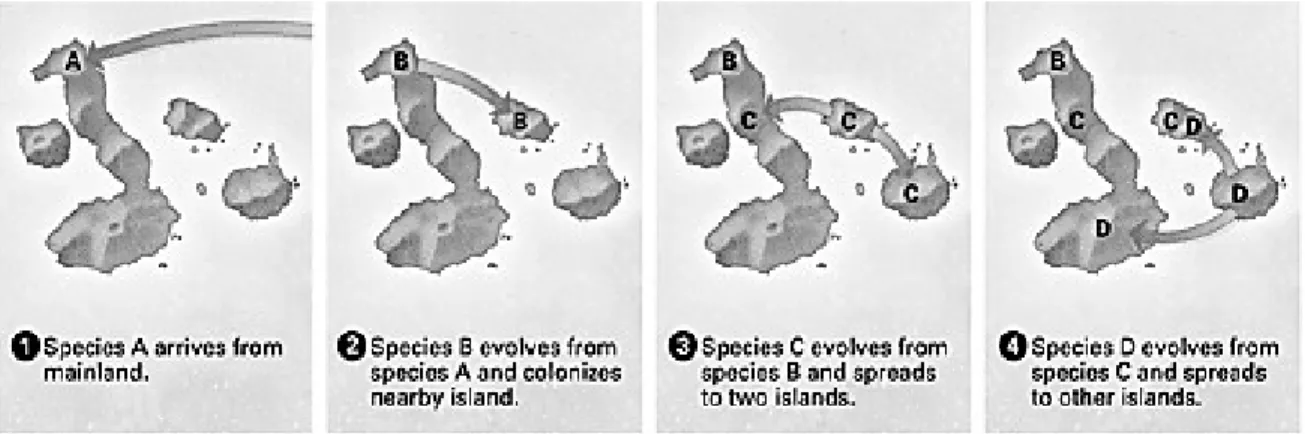
Since Darwin's time, islands have served as living laboratories for studying speciation. Islands often have species found nowhere else. The isolation and diverse habitats of some islands create conditions that seem to favor speciation. Only a few organisms manage to be the first to colonize new islands. Those that do, enter a diverse, "empty" environment. The small populations of colonizing species may undergo evolutionary change. Some of these organisms may move on to other islands in the chain, where the process repeats itself. New and varying species may evolve through genetic drift and adaptation to the different habitats. Such evolution from a common ancestor that results in diverse species adapted to different environments is called adaptive radiation.
Figure 15-7 illustrates a simplified model for adaptive radiation of birds. In this example, one species is the common ancestor of several new species that arise on the islands. After migrating from the mainland, species A may have undergone significant change in its gene pool and become species B. Later, a few birds of species B may have migrated to a neighboring island. This population could have evolved into species C. Some of these birds could later move back to the first island. They might coexist with species B if reproductive barriers keep the two species separate. Species C could also move among other islands where the same evolutionary processes might continue. Geographic isolation is a key factor in this example because it prevents the splinter populations from breeding with the "parent" population on the mainland.
Figure 15-7
Adaptive radiation on an island chain may lead to several new bird species evolving from one founding population.
The Tempo of Speciation
On the time scale of the fossil record, species often seem to arise abruptly. A new fossil species may appear rather suddenly (in geological terms) in a layer of rock, and persist for thousands or millions of years without noticeable change. Then, it may disappear from the fossil record as suddenly as it appeared.
Over the past 30 years, some evolutionary biologists have developed a model to address these
observations. Now known as punctuated equilibrium, the model suggests that species often diverge in spurts of relatively rapid change. Then many newly formed species may remain mostly unchanged, at least in ways that are evident in the fossil record. The term punctuated equilibrium comes from the idea that long periods of little change (equilibrium) in a species are broken, or punctuated, by shorter times of speciation.
Given a model of gradual adaptation through natural selection, how could species have sudden bursts of change? Speciation can sometimes be quite rapid. In just a few hundred to a few thousand generations, genetic drift and natural selection can cause significant change in a small population that is occupying a challenging new environment.
Figure 15-9
In contrast to a more gradual model of evolution, punctuated equilibrium
You may also wonder how speciation in a few thousand generations can be called abrupt. The fossil record indicates that successful species last, on average, about one to five million years. A particular species may have accumulated most of its unique changes in its first 50,000 years. Though this time span may seem long on a human scale, it only represents a hundredth of the lifetime of a typical species and a short interval of time on the scale of the fossil record. This explanation would account for the
punctuated equilibrium that scientists often observe in the fossil record. Remember, too, that the best candidates for speciation are small populations. Fossils from such populations are rare. By the time a new species grew in number and became widespread enough that it might leave a fossil record, its distinctive features would have already evolved.
Keep in mind that punctuated equilibrium does not contradict or weaken Darwin's theory. The theory of natural selection can account for observations of punctuated equilibrium in the fossil record. Natural selection and adaptation still happen, but mostly during that time when a species is "young."
Concept Check 15.1
1. Why are donkeys and horses considered different species? 2. What is macroevolution?