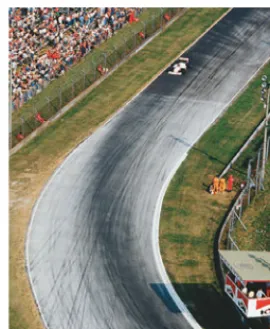
P (c) (d)
(e)
(f) (b) (a)
(g)
CHAPTER-OPENING QUESTIONS—Guess now!
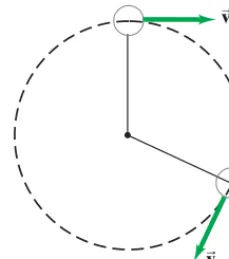
1. You revolve a ball around you in a hori-zontal circle at constant speed on a string, as shown here from above. Which path will the ball follow if you let go of the string when the ball is at point P?
2. A space station revolves around the Earth as a satellite, 100 km above Earth’s surface. What is the net force on an astronaut at rest inside the space station?
(a) Equal to her weight on Earth.
(b) A little less than her weight on Earth.
(c) Less than half her weight on Earth.
(d) Zero (she is weightless).
(e) Somewhat larger than her weight on Earth.
A
n object moves in a straight line if the net force on it acts along the direction of motion, or the net force is zero. If the net force acts at an angle to the direction of motion at any moment, then the object moves in a curved path. An example of the latter is projectile motion, which we discussed in Chapter 3. Another important case is that of an object moving in a circle, such as a ball at the end of a string being swung in a circle above one’s head, or the nearly circular motion of the Moon about the Earth.C
H
A
P
T
E
R
Circular Motion;
Gravitation
109
CONTENTS5–1 Kinematics of Uniform Circular Motion
5–2 Dynamics of Uniform Circular Motion
5–3 Highway Curves: Banked and Unbanked
*5–4 Nonuniform Circular Motion
5–5 Newton’s Law of Universal Gravitation
5–6 Gravity Near the Earth’s Surface
5–7 Satellites and “Weightlessness”
5–8 Planets, Kepler’s Laws, and Newton’s Synthesis
5–9 Moon Rises an Hour Later Each Day
5–10 Types of Forces in Nature
5
In this Chapter, we study the circular motion of objects, and how Newton’s laws of motion apply. We also discuss how Newton conceived of another great law by applying the concepts of circular motion to the motion of the Moon and the planets. This is the law of universal gravitation, which was the capstone of Newton’s analysis of the physical world.
5–1
Kinematics of
Uniform Circular Motion
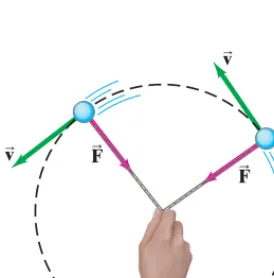
An object that moves in a circle at constant speed v is said to experience uniform circular motion. The magnitudeof the velocity remains constant in this case, but the directionof the velocity continuously changes as the object moves around the circle (Fig. 5–1). Because acceleration is defined as the rate of change of velocity, a change in direction of velocity is an acceleration, just as a change in its magnitude is. Thus, an object revolving in a circle is continuously accelerating, even when the speed remains constant ( in Fig. 5–1). We now investi-gate this acceleration quantitatively.
Acceleration is defined as
where is the change in velocity during the short time interval We will eventually consider the situation in which approaches zero and thus obtain the instantaneous acceleration. But for purposes of making a clear drawing, Fig. 5–2, we consider a nonzero time interval. During the time interval the particle in Fig. 5–2a moves from point A to point B, covering a distance
along the arc which subtends an angle The change in the velocity vector is and is shown in Fig. 5–2b (note that ).
Now we let be very small, approaching zero. Then and are also very small, and will be almost parallel to Fig. 5–2c; will be essentially perpendicular to them. Thus points toward the center of the circle. Since by definition, is in the same direction as (equation above), it too must point toward the center of the circle. Therefore, this acceleration is called centripetal acceleration (“center-pointing” acceleration) or radial acceleration (since it is directed along the radius, toward the center of the circle), and we denote it by
Now that we have determined the direction, next we find the magnitude of the radial (centripetal) acceleration, Because the line CA in Fig. 5–2a is perpen-dicular to and line CB is perpendicular to then the angle between CA and CB is also the angle between and Hence the vectors and in Fig. 5–2b form a triangle that is geometrically similar†to triangle ACB in Fig. 5–2a.
If we take to be very small (letting be very small) and set
because the magnitude of the velocity is assumed not to change, we can write
This is an exact equality when approaches zero, for then the arc length equals the chord length AB. We want to find the instantaneous acceleration, so we let approach zero, write the above expression as an equality, and then solve for
To get the centripetal acceleration, we divide by
But ¢l兾¢t is the linear speed, v, of the object, so the radial (centripetal) [¢t S 0]
aR = ¢¢vt = vr ¢¢lt.
¢t: ¢v aR,
[¢t S 0] ¢v = vr ¢l.
¢v: ¢t ¢l ¢t
¢v
v L ¢rl.
v = v1 = v2 ¢t
¢u
¢vB v B 2, vB 1, v B 2. v B 1 ¢u vB 2, vB 1,
aR.
a B
R. ¢vB
a B ,
¢vB ¢
v B vB 1, vB 2 ¢u ¢l
¢t v
B
2 = v
B
1 + ¢v
B vB
2 - v
B
1 = ¢v
B ,
¢u.
¢l ¢t,
¢t ¢t.
¢vB
aB = v B
2 - v
B 1
¢t = ¢
v B
¢t,
v1 = v2 = v
†Appendix A contains a review of geometry.
A Δl
r r Δθ θ Δ B C (a) r r lim Δt Δt→0
C (c) (b) 1 2 1 1 2 2 = Δ 2− 1
Δ = vB vB v B vB a B v B
vB vB v B v B v B FIGURE 5;2 Determining the change in velocity, for a particle moving in a circle. The length is the distance along the arc, from A to B.
¢l
¢vB,
2 1
vB
vB
acceleration is
[radial (centripetal) acceleration] (5;1)
[Equation 5–1 is valid at any instant in circular motion, and even when vis not constant.]
To summarize,an object moving in a circle of radius r at constant speedvhas an accelerationwhose direction is toward the center of the circle andwhose magni-tude is It is not surprising that this acceleration depends on vandr. The greater the speed v,the faster the velocity changes direction; and the larger the radius, the less rapidly the velocity changes direction.
The acceleration vector points toward the center of the circle when vis con-stant. But the velocity vector always points in the direction of motion, which is tangential to the circle. Thus the velocity and acceleration vectors are perpen-dicular to each other at every point in the path for uniform circular motion (Fig. 5–3). This is another example that illustrates the error in thinking that acceleration and velocity are always in the same direction. For an object falling in a vertical path, and are indeed parallel. But in uniform circular motion, and are perpendicular, not parallel (nor were they parallel in projectile motion, Section 3–5).
Circular motion is often described in terms of the frequencyf,the number of revolutions per second. The periodTof an object revolving in a circle is the time required for one complete revolution. Period and frequency are related by
(5;2) For example, if an object revolves at a frequency of then each revolution takes An object revolving in a circle (of circumference ) at constant speedvtravels a distance in one revolution which takes a time T. Thus
Acceleration of a revolving ball. A 150-g ball at the end of
a string is revolving uniformly in a horizontal circle of radius 0.600 m, as in Fig. 5–1 or 5–3. The ball makes 2.00 revolutions in a second. What is its centripetal acceleration?
APPROACH The centripetal acceleration is We are given r, and we can find the speed of the ball,v,from the given radius and frequency.
SOLUTION If the ball makes 2.00 complete revolutions per second, then the ball travels in a complete circle in a time interval equal to 0.500 s, which is its periodT. The distance traveled in this time is the circumference of the circle,
whereris the radius of the circle. Therefore, the ball has speed
The centripetal acceleration†is
EXERCISE A In Example 5–1, if the radius is doubled to 1.20 m, but the period stays the same, the centripetal acceleration will change by a factor of:
(a) 2; (b) 4; (c) (d) (1 e) none of these. 4;
1 2; aR = v
2
r =
(7.54m兾s)2
(0.600m) = 94.7m兾s
2. v = 2Tpr = 2p(0.600m)
(0.500s) = 7.54m兾s. 2pr,
aR = v2兾r.
EXAMPLE 5;1
v = distance
time = 2pr
T .
2pr
2pr
1 3s.
(= rev)
3rev兾s,
T = f1.
v B a B v
B aB
aR = v2兾r. aR = v
2
r .
SECTION 5–1 Kinematics of Uniform Circular Motion
111
C A U T I O N
The direction of motion and the acceleration are not in the same direction; instead,aB⊥vB
(aB) (vB)
†Differences in the final digit can depend on whether you keep all digits in your calculator for v
(which gives ), or if you use (which gives ). Both results are valid since our assumed accuracy is about &0.1m兾s(see Section 1–4).
aR=94.8m兾s2 v =7.54m兾s
aR= 94.7m兾s2
2 2
1
1
v
B
v
B
aB a
B
FIGURE 5;3 For uniform circular motion,aBis always perpendicular to vB.
C A U T I O N
Moon’s centripetal acceleration. The Moon’s nearly circu-lar orbit around the Earth has a radius of about 384,000 km and a period Tof 27.3 days. Determine the acceleration of the Moon toward the Earth.
APPROACH Again we need to find the velocity vin order to find
SOLUTION In one orbit around the Earth, the Moon travels a distance where is the radius of its circular path. The time required for one complete orbit is the Moon’s period of 27.3 d. The speed of the Moon in its orbit about the Earth is The period T in seconds is
Therefore,
We can write this acceleration in terms of (the acceleration of gravity at the Earth’s surface) as
NOTE The centripetal acceleration of the Moon, is not
the acceleration of gravity for objects at the Moon’s surface due to the Moon’s gravity. Rather, it is the acceleration due to the Earth’sgravity for any object (such as the Moon) that is 384,000 km from the Earth. Notice how small this acceleration is compared to the acceleration of objects near the Earth’s surface.
5–2
Dynamics of
Uniform Circular Motion
According to Newton’s second law an object that is accelerating must have a net force acting on it. An object moving in a circle, such as a ball on the end of a string, must therefore have a force applied to it to keep it moving in that circle. That is, a net force is necessary to give it centripetal acceleration. The magnitude of the required force can be calculated using Newton’s second law for the radial component, where is the centripetal acceleration,
and is the total (or net) force in the radial direction:
[circular motion] (5;3) For uniform circular motion the acceleration is which is directed toward the center of the circle at all times. Thus the net force too must be directed toward the center of the circle (Fig. 5–4). A net force is necessary because if no net force were exerted on the object, it would not move in a circle but in a straight line, as Newton’s first law tells us. The direction of the net force is continually changing so that it is always directed toward the center of the circle. This force is sometimes called a centripetal (“pointing toward the center”) force. But be aware that “centripetal force” does not indicate some new kind of force. The term “centripetal force” merely describes the directionof the net force needed to provide a circular path: the net force is directed toward the circle’s center. The forcemust be applied by other objects. For example, to swing a ball in a circle on the end of a string, you pull on the string and the string exerts the force on the ball. (Try it.) Here, the “centripetal force” that provides the centripetal accelera-tion is tension in the string. In other cases it can be gravity (on the Moon, for example), a normal force, or even an electric force.
aR, (v = constant),
©FR = maR = mv 2
r . ©FR
aR = v2兾r,
aR ©FR = maR,
A©FB = maBB,
aR = 2.78 * 10–4g, L 0.0003g.
aR = 2.72 * 10–3m兾s2a g
9.80m兾s2b = 2.78 * 10
–4g g = 9.80m兾s2
= 0.00272m兾s2 = 2.72 * 10–3m兾s2. aR = v
2
r =
(2pr)2 T2r =
4p2r T2 =
4p2A3.84 * 108mB
A2.36 * 106sB2 T = (27.3d)(24.0h兾d)(3600s兾h) =v2.36= * 106s.
2pr兾T.
r = 3.84 * 108m
2pr,
aR.
EXAMPLE 5;2
C A U T I O N
Distinguish the Moon’s gravity on objects at its surface from the Earth’s gravity acting
on the Moon (this Example)
C A U T I O N
Centripetal force is not a new kind of force (Every force must be exerted by an object)
FB
F B vB
v B
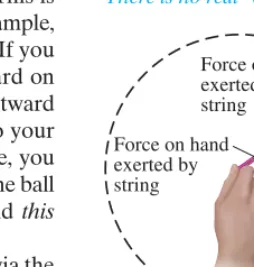
There is a common misconception that an object moving in a circle has an outward force acting on it, a so-called centrifugal (“center-fleeing”) force. This is incorrect:there is no outward forceon the revolving object. Consider, for example, a person swinging a ball on the end of a string around her head (Fig. 5–5). If you have ever done this yourself, you know that you feel a force pulling outward on your hand. The misconception arises when this pull is interpreted as an outward “centrifugal” force pulling on the ball that is transmitted along the string to your hand. This is not what is happening at all. To keep the ball moving in a circle, you pullinwardlyon the string, and the string exerts this inward force on the ball. The ball exerts an equal and opposite force on the string (Newton’s third law), and this
is the outward force your hand feels (see Fig. 5–5).
The force on the ballin Fig. 5–5 is the one exerted inwardlyon it by you, via the string. To see even more convincing evidence that a “centrifugal force” does not act on the ball, consider what happens when you let go of the string. If a centrifugal force were acting, the ball would fly outward, as shown in Fig. 5–6a. But it doesn’t; the ball flies off tangentially (Fig. 5–6b), in the direction of the velocity it had at the moment it was released, because the inward force no longer acts. Try it and see!
EXERCISE B Return to Chapter-Opening Question 1, page 109, and answer it again now. Try to explain why you may have answered differently the first time.
Force on revolving ball (horizontal). Estimate
the force a person must exert on a string attached to a 0.150-kg ball to make the ball revolve in a horizontal circle of radius 0.600 m. The ball makes 2.00 revo-lutions per second as in Example 5–1. Ignore the string’s mass.
APPROACH First we need to draw the free-body diagram for the ball. The forces acting on the ball are the force of gravity, downward, and the tension force that the string exerts toward the hand at the center (which occurs because the person exerts that same force on the string). The free-body diagram for the ball is shown in Fig. 5–7. The ball’s weight complicates matters and makes it impos-sible to revolve a ball with the cord perfectly horizontal. We estimate the force assuming the weight is small, and letting in Fig. 5–7. Then will act nearly horizontally and, in any case, provides the force necessary to give the ball its centripetal acceleration.
SOLUTION We apply Newton’s second law to the radial direction, which we assume is horizontal:
where and Thus
NOTE We keep only two significant figures in the answer because we ignored the
ball’s weight; it is about of our result,
which is small but maybe not so small as to justify stating a more precise answer forFT.
1 10 mg = (0.150kg)A9.80m兾s2B = 1.5N,
= (0.150kg)(7.54m兾s)
2
(0.600m) L 14N.
FT = mv 2
r
v = 2pr兾T = 2p(0.600m)兾(0.500s) = 7.54m兾s.
aR = v2兾r
(©F)R = maR,
FBT
f L 0
F
B
T mgB
(T = 0.500s),
EXAMPLE 5;3 ESTIMATE
SECTION 5–2 Dynamics of Uniform Circular Motion
113
C A U T I O N
There is no real “centrifugal force”
Force on hand exerted by string
Force on ball exerted by string
FIGURE 5;5 Swinging a ball on the end of a string (looking down from above).
(b)
(c) (a)
DOESN’T HAPPEN
HAPPENS
v
B
vB
FIGURE 5;6 If centrifugal force existed, the revolving ball would fly outward as in (a) when released. In fact, it flies off tangentially as in (b). In (c) sparks fly in straight lines tangentially from the edge of a rotating grinding wheel.
r φ
mgB T F B
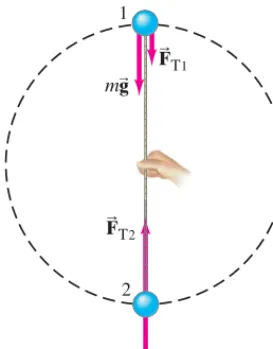
Revolving ball (vertical circle). A 0.150-kg ball on the end of a 1.10-m-long cord (negligible mass) is swung in a verticalcircle. (a) Deter-mine the minimum speed the ball must have at the top of its arc so that the ball continues moving in a circle. (b) Calculate the tension in the cord at the bottom of the arc, assuming the ball is moving at twice the speed of part (a).
APPROACH The ball moves in a vertical circle and is notundergoing uniform circular motion. The radius is assumed constant, but the speed v changes because of gravity. Nonetheless, Eq. 5–1 is valid at each point along the circle, and we use it at the top and bottom points. The free-body diagram is shown in Fig. 5–8 for both positions.
SOLUTION (a) At the top (point 1), two forces act on the ball: the force of gravity, and the tension force the cord exerts at point 1. Both act down-ward, and their vector sum acts to give the ball its centripetal acceleration We apply Newton’s second law, for the vertical direction, choosing downward as positive since the acceleration is downward (toward the center):
[at top]
From this equation we can see that the tension force at point 1 will get larger if (ball’s speed at top of circle) is made larger, as expected. But we are asked for the minimumspeed to keep the ball moving in a circle. The cord will remain taut as long as there is tension in it. But if the tension disappears (because is too small) the cord can go limp, and the ball will fall out of its circular path. Thus, the minimum speed will occur if (the ball at the topmost point), for which the equation above becomes
[minimum speed at top]
We solve for keeping an extra digit for use in (b):
This is the minimum speed at the top of the circle if the ball is to continue moving in a circular path.
(b) When the ball is at the bottom of the circle (point 2 in Fig. 5–8), the cord exerts its tension force upward, whereas the force of gravity, still acts downward. Choosing upwardas positive, Newton’s second law gives:
[at bottom]
The speed is given as twice that in (a), namely We solve for
= (0.150kg)(6.566m兾s)
2
(1.10m) + (0.150kg)A9.80m兾s
2B = 7.35N.
FT 2 = mv2 2
r + mg
FT 2: 6.566m兾s.
v2
FT 2 - mg = mv2 2
r .
(©F)R = maR
mgB,
FT 2
= 3.283m兾s L 3.28m兾s.
v1 = 1gr = 3A9.80m兾s2B(1.10m) v1,
mg = mv1r2.
FT 1 = 0
v1
v1 FT1
FT 1 + mg = mv1 2
r .
(©F)R = maR
aR. F
B
T 1,
mgB,
(aR = v2兾r)
EXAMPLE 5;4
C A U T I O N
Circular motion only if cord is under tension
N
FB
N
F
B
mgB
mgB a
B
a
B FIGURE 5;9 Exercise C.
1
2
m m
T2
T1
F
B
FB g
B
gB
FIGURE 5;8 Example 5–4. Free-body diagrams for positions 1 and 2.
Tetherball. The game of tetherball is played with a ball tied to a pole with a cord. After the ball is struck, it revolves around the pole as shown in Fig. 5–10. In what direction is the acceleration of the ball, and what force causes the acceleration, assuming constant speed?
RESPONSE If the ball revolves in a horizontal plane as shown, then the accel-eration points horizontally toward the center of the ball’s circular path (not toward the top of the pole). The force responsible for the acceleration may not be obvious at first, since there seems to be no force pointing directly horizontally. But it is the net force (the sum of and here) that must point in the direction of the acceleration. The vertical component of the cord tension, balances the ball’s weight, The horizontal component of the cord tension,
is the force that produces the centripetal acceleration toward the center.
FTx,
mgB.
FTy,
FBT
mgB
CONCEPTUAL EXAMPLE 5;5
SECTION 5–3 Highway Curves: Banked and Unbanked
115
P H Y S I C S A P P L I E D
Driving around a curve
Ty
T
Tx
m
FB FB
FB
g B
FIGURE 5;10 Example 5–5.
Force on car
(sum of friction forces acting on each tire)
Tendency for passenger to go straight
Force on passenger
FIGURE 5;11 The road exerts an inward force (friction against the tires) on a car to make it move in a circle. The car exerts an inward force on the passenger.
5–3
Highway Curves:
Banked and Unbanked
An example of circular dynamics occurs when an automobile rounds a curve, say to the left. In such a situation, you may feel that you are thrust outward toward the right side door. But there is no mysterious centrifugal force pulling on you. What is happening is that you tend to move in a straight line, whereas the car has begun to follow a curved path. To make you go in the curved path, the seat (friction) or the door of the car (direct contact) exerts a force on you (Fig. 5–11). The car also must have a force exerted on it toward the center of the curve if it is to move in that curve. On a flat road, this force is supplied by friction between the tires and the pavement.
is, all the forces or components that act radially, toward or away from the center of the circular path. The sum of these forces (or components) provides the centrip-etal acceleration,
3. Choose a convenient coordinate system, preferably with one axis along the acceleration direction. 4. Apply Newton’s second lawto the radial component:
[radial direction] ©FR = maR = mv
2
r . aR = v2兾r.
P
R
O
B
L
E
M
S
O
LV I
N G
Uniform Circular Motion
1. Draw a free-body diagram, showing all the forces acting on each object under consideration. Be sure you can identify the source of each force (tension in a cord, Earth’s gravity, friction, normal force, and so on). Don’t put in something that doesn’t belong (like a centrifugal force).
If the wheels and tires of the car are rolling normally without slipping or sliding, the bottom of the tire is at rest against the road at each instant. So the friction force the road exerts on the tires is static friction. But if static friction is not great enough, as under icy conditions or high speed, the static friction force is less than and the car will skid out of a circular path into a more nearly straight path. See Fig. 5–12. Once a car skids or slides, the friction force becomes kinetic friction, which is smaller than static friction.
Skidding on a curve. A 1000-kg car rounds a curve on a
flat road of radius 50 m at a speed of Will the car follow the curve, or will it skid? Assume: (a) the pavement is dry and the coefficient of static friction is (b) the pavement is icy and
APPROACH The forces on the car are gravity mg downward, the normal force exerted upward by the road, and a horizontal friction force due to the road. They are shown in Fig. 5–13, which is the free-body diagram for the car. The car will follow the curve if the maximum static friction force is greater than the mass times the centripetal acceleration.
SOLUTION In the vertical direction (y) there is no acceleration. Newton’s second law tells us that the normal force on the car is equal to the weightmgsince the road is flat:
so
In the horizontal direction the only force is friction, and we must compare it to the force needed to produce the centripetal acceleration to see if it is sufficient. The net horizontal force required to keep the car moving in a circle around the curve is
Now we compute the maximum total static friction force (the sum of the friction forces acting on each of the four tires) to see if it can be large enough to provide a safe centripetal acceleration. For (a), and the maximum friction force attainable (recall from Section 4–8 that ) is
Since a force of only 4500 N is needed, and that is, in fact, how much will be exerted by the road as a static friction force, the car can follow the curve. But in (b) the maximum static friction force possible is
The car will skid because the ground cannot exert sufficient force (4500 N is needed) to keep it moving in a curve of radius 50 m at a speed of
The possibility of skidding is worse if the wheels lock (stop rotating) when the brakes are applied too hard. When the tires are rolling, static friction exists. But if the wheels lock (stop rotating), the tires slide and the friction force, which is now kinetic friction, is less. More importantly, the directionof the friction force changes suddenly if the wheels lock. Static friction can point perpendicular to the velocity, as in Fig. 5–13b; but if the car slides, kinetic friction points oppositeto the velocity. The force no longer points toward the center of the circle, and the car cannot continue in a curved path (see Fig. 5–12). Even worse, if the road is wet or icy, locking of the wheels occurs with less force on the brake pedal since there is less road friction to keep the wheels turning rather than sliding. Antilock brakes (ABS) are designed to limit brake pressure just before the point where sliding would occur, by means of delicate sensors and a fast computer.
54km兾h.
AFfrBmax = msFN = (0.25)(9800N) = 2450N.
AFfrBmax = msFN = (0.60)(9800N) = 5880N. FfrⱕmsFN
ms = 0.60, (©F)R = maR = mv
2
r = (1000kg)
(15m兾s)2
(50m) = 4500N.
FN = mg = (1000kg)A9.80m兾s2B = 9800N. 0 = ©Fy = FN - mg
FN FN
ms = 0.25.
ms = 0.60;
15m兾s (54km兾h).
EXAMPLE 5;6
mv2兾r
P H Y S I C S A P P L I E D
Antilock brakes (b)
(a) gB
N
fr
fr
m
FB FB
FB
FIGURE 5;13 Example 5–6. Forces on a car rounding a curve on a flat road. (a) Front view, (b) top view.
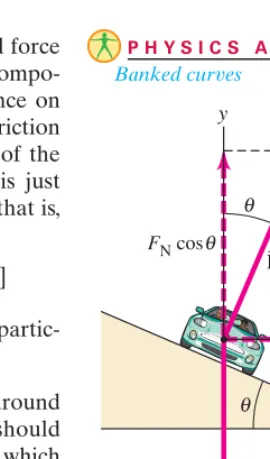
The banking of curves can reduce the chance of skidding. The normal force exerted by a banked road, acting perpendicular to the road, will have a compo-nent toward the center of the circle (Fig. 5–14), thus reducing the reliance on friction. For a given banking angle there will be one speed for which no friction at all is required. This will be the case when the horizontal component of the normal force toward the center of the curve, (see Fig. 5–14), is just equal to the force required to give a vehicle its centripetal acceleration—that is, when
[no friction required]
The banking angle of a road, is chosen so that this condition holds for a partic-ular speed, called the “design speed.”
u,
FNsinu = mv 2
r .
FNsinu
u,
SECTION 5–3 Highway Curves: Banked and Unbanked
117
P H Y S I C S A P P L I E D
Banked curves
C A U T I O N
is not always equal to mg
FN FNcosθ
θ
θ
FNsinθ
y
x
m
R N
g B
FB
a B
FIGURE 5;14 Normal force on a car rounding a banked curve, resolved into its horizontal and vertical components. The centripetal acceleration is horizontal (not parallel to the sloping road). The friction force on the tires, not shown, could point up or down along the slope, depending on the car’s speed. The friction force will be zero for one particular speed.
EXERCISE D To negotiate a flat (unbanked) curve at a fasterspeed, a driver puts a couple of sand bags in his van aiming to increase the force of friction between the tires and the road. Will the sand bags help?
Banking angle. (a) For a car traveling with speed varound
a curve of radius r, determine a formula for the angle at which a road should be banked so that no friction is required. (b) What is this angle for a road which has a curve of radius 50 m with a design speed of
APPROACH Even though the road is banked, the car is still moving along a horizontal circle, so the centripetal acceleration needs to be horizontal. We choose our xand yaxes as horizontal and vertical so that which is hori-zontal, is along the x axis. The forces on the car are the Earth’s gravity mg
downward, and the normal force exerted by the road perpendicular to its surface. See Fig. 5–14, where the components of are also shown. We don’t need to consider the friction of the road because we are designing a road to be banked so as to eliminate dependence on friction.
SOLUTION (a) Since there is no vertical motion, and gives
or
[Note in this case that because ]
We substitute this relation for into the equation for the horizontal motion,
which becomes
or
This is the formula for the banking angle no friction needed at this speed v.
(b) For and ( ),
so
We have been using the centripetal acceleration where r is the radius of a circle. For a road, and in many other situations, we don’t have a full circle, but only a portion of a circle: still works and we often call rthe radius of curvatureof that portion of a circle we are dealing with.
a = v2兾r
a = v2兾r
u = tan–1(0.40) = 22°.
tanu = (14m兾s)
2
(50m)A9.8m兾s2B = 0.40, ⫽ 14m兾s
v = 50km兾h
r = 50m
u: tanu = v
2
rg. mg
cosusinu = m
v2 r FNsinu = mv 2
r , FN
cosuⱕ1.
FNⱖmg FN = cosmgu. FNcosu - mg = 0
©Fy = may ay = 0
FN FN
aR, 50km兾h?
5–4
Nonuniform Circular Motion
Circular motion at constant speed occurs when the net force on an object is exerted toward the center of the circle. If the net force is not directed toward the center but is at an angle, as shown in Fig. 5–15a, the force has two components. The component directed toward the center of the circle, gives rise to the cen-tripetal acceleration, and keeps the object moving in a circle. The component tangent to the circle, acts to increase (or decrease) the speed, and thus gives rise to a component of the acceleration tangent to the circle, When the speed of the object is changing, a tangential component of force is acting.When you first start revolving a ball on the end of a string around your head, you must give it tangential acceleration. You do this by pulling on the string with your hand displaced from the center of the circle. In athletics, a hammer thrower accelerates the hammer tangentially in a similar way so that it reaches a high speed before release.
The tangential component of the acceleration, has magnitude equal to the rate of change of the magnitudeof the object’s velocity:
The radial (centripetal) acceleration arises from the change in directionof the velocity and, as we have seen (Eq. 5–1), has magnitude
The tangential acceleration always points in a direction tangent to the circle, and is in the direction of motion (parallel to which is always tangent to the circle) if the speed is increasing, as shown in Fig. 5–15b. If the speed is decreasing,
points antiparallel to In either case, and are always perpendicular to each other; and their directions changecontinually as the object moves along its circular path. The total vector acceleration is the sum of the two components:
Since and are always perpendicular to each other, the magnitude of at any moment is
Two components of acceleration. A race car starts from
rest in the pit area and accelerates at a uniform rate to a speed of in moving on a circular track of radius 500 m. Assuming constant tangential acceleration, find (a) the tangential acceleration, and (b) the radial acceler-ation, at the instant when the speed is
APPROACH The tangential acceleration relates to the change in speed of the car, and can be calculated as The centripetal acceleration relates to the change in the directionof the velocity vector and is calculated using
SOLUTION (a) During the 11-s time interval, we assume the tangential accel-eration is constant. Its magnitude is
(b) When the centripetal acceleration is
NOTE The radial (centripetal) acceleration increases continually, whereas the tangential acceleration stays constant.
aR = v 2
r =
(15m兾s)2
(500m) = 0.45m兾s
2. v = 15m兾s,
atan = ¢¢vt =
(35m兾s - 0m兾s)
11s = 3.2m兾s
2. atan
aR = v2兾r. atan = ¢v兾¢t.
v = 15m兾s.
11s, 35m兾s
EXAMPLE 5;8
a = 3atan2 + aR2.
a B aBtan
a B R
aB
= aB
tan + aBR.
aB
aBR a
B tan v
B . aBtan
v B ,
aR = v 2
r . atan = ¢¢vt.
atan,
aBtan. FBtan,
aBR,
FBR,
*
tan R
tan R
FB
F
B
F
B
a
B
aB a
B
(a)
(b)
FIGURE 5;15 The speed of an object moving in a circle changes if the force on it has a tangential component, Part (a) shows the force and its vector components; part (b) shows the acceleration vector and its vector components.
FB
SECTION 5–5 Newton’s Law of Universal Gravitation
119
5–5
Newton’s Law of Universal Gravitation
Besides developing the three laws of motion, Isaac Newton also examined the motion of the planets and the Moon. In particular, he wondered about the nature of the force that must act to keep the Moon in its nearly circular orbit around the Earth. Newton was also thinking about the problem of gravity. Since falling objects accelerate, Newton had concluded that they must have a force exerted on them, a force we call the force of gravity. Whenever an object has a force exerted onit, that force is exerted by some other object. But what exertsthe force of gravity? Every object on the surface of the Earth feels the force of gravity and no matter where the object is, the force is directed toward the center of the Earth (Fig. 5–16). Newton concluded that it must be the Earth itself that exerts the gravitational force on objects at its surface.
According to legend, Newton noticed an apple drop from a tree. He is said to have been struck with a sudden inspiration: If gravity acts at the tops of trees, and even at the tops of mountains, then perhaps it acts all the way to the Moon! With this idea that it is the Earth’s gravity that holds the Moon in its orbit, Newton developed his great theory of gravitation. But there was controversy at the time. Many thinkers had trouble accepting the idea of a force “acting at a distance.” Typical forces act through contact—your hand pushes a cart and pulls a wagon, a bat hits a ball, and so on. But gravity acts without contact, said Newton: the Earth exerts a force on a falling apple and on the Moon, even though there is no contact, and the two objects may even be very far apart.†
Newton set about determining the magnitude of the gravitational force that the Earth exerts on the Moon as compared to the gravitational force on objects at the Earth’s surface. The centripetal acceleration of the Moon, as we calculated in Example 5–2, is In terms of the acceleration of gravity at the Earth’s surface,
That is, the acceleration of the Moon toward the Earth is about as great as the acceleration of objects at the Earth’s surface. The Moon is 384,000 km from the Earth, which is about 60 times the Earth’s radius of 6380 km. That is, the Moon is 60 times farther from the Earth’s center than are objects at the Earth’s surface. But Again that number 3600! Newton concluded that the gravitational force or exerted by the Earth on any object decreases with the square of its distance rfrom the Earth’s center:
The Moon is 60 Earth radii away, so it feels a gravitational force only times as strong as it would if it were at a point on the Earth’s surface.
Newton realized that the force of gravity on an object depends not only on distance but also on the object’s mass. In fact, it is directly proportional to its mass, as we have seen (Eq. 4–3). According to Newton’s third law, when the Earth exerts its gravitational force on any object, such as the Moon, that object exerts an equal and opposite force on the Earth (Fig. 5–17). Because of this symmetry, Newton reasoned, the magnitude of the force of gravity must be proportional to
bothmasses:
where and are the masses of the Earth and the other object, respectively, andris the distance from the Earth’s center to the center of the other object.
mObj mE
FG r
mEmObj r2 ,
1 602 =
1 3600 FG r
1
r2.
FG Fgrav 60 * 60 = 602 = 3600.
1 3600 aR =
0.00272m兾s2
9.80m兾s2 g L
1 3600g.
g = 9.80m兾s2, aR = 0.00272m兾s2.
FG,
†To deal with the conceptual difficulty of “action at a distance,” the idea of a gravitational field was
intro-duced many years later: every object that has mass produces a gravitational field in space. The force one object exerts on a second object is then due to the gravitational field produced by the first object at the position of the second object. We discuss fields in Section 16–7.
Moon
Gravitational force exerted on Moon by Earth
Earth
Gravitational force exerted on Earth by the Moon
ME
FB
EM
FB
FIGURE 5;17 The gravitational force one object exerts on a second object is directed toward the first object; and, by Newton’s third law, is equal and opposite to the force exerted by the second object on the first. In the case shown, the gravitational force on the Moon due to Earth, is equal and opposite to the gravitational force on Earth due to the Moon, That is, FBME = –F
B EM.
F B
EM. F
B ME,
G
G
G FB
FB
F B
NEWTON’S
LAW
OF
UNIVERSAL
GRAVITATION
Light source (narrow beam) Rod
Scale
Mirror Fiber
A B
r
FIGURE 5;18 Schematic diagram of Cavendish’s apparatus. Two spheres are attached to a light horizontal rod, which is suspended at its center by a thin fiber. When a third sphere (labeled A) is brought close to one of the suspended spheres (labeled B), the gravitational force causes the latter to move, and this twists the fiber slightly. The tiny movement is magnified by the use of a narrow light beam directed at a mirror mounted on the fiber. The beam reflects onto a scale. Previous determination of how large a force will twist the fiber a given amount then allows the experimenter to determine the magnitude of the gravitational force between the two objects, A and B.
Newton went a step further in his analysis of gravity. In his examination of the orbits of the planets, he concluded that the force required to hold the different planets in their orbits around the Sun seems to diminish as the inverse square of their distance from the Sun. This led him to believe that it is also the gravitational force that acts between the Sun and each of the planets to keep them in their orbits. And if gravity acts between these objects, why not between all objects? Thus he proposed his law of universal gravitation, which we can state as follows:
Every particle in the universe attracts every other particle with a force that is proportional to the product of their masses and inversely proportional to the square of the distance between them. This force acts along the line joining the two particles.
The magnitude of the gravitational force can be written as
(5;4) where and are the masses of the two particles,ris the distance between them, and Gis a universal constant which must be measured experimentally.
The value of G must be very small, since we are not aware of any force of attraction between ordinary-sized objects, such as between two baseballs. The force between two ordinary objects was first measured by Henry Cavendish in 1798, over 100 years after Newton published his law. To detect and measure the incredibly small force between ordinary objects, he used an apparatus like that shown in Fig. 5–18. Cavendish confirmed Newton’s hypothesis that two objects attract one another and that Eq. 5–4 accurately describes this force. In addition, because Cavendish could measure and raccurately, he was able to determine the value of the constant Gas well. The accepted value today is
(See Table inside front cover for values of all constants to highest known precision.) Equation 5–4 is called an inverse square lawbecause the force is inversely propor-tional to
[Strictly speaking, Eq. 5–4 gives the magnitude of the gravitational force that one particle exerts on a second particle that is a distance raway. For an extended object (that is, not a point), we must consider how to measure the distance r. A correct calculation treats each extended body as a collection of particles, and the total force is the sum of the forces due to all the particles. The sum over all these particles is often done using integral calculus, which Newton himself invented. When extended bodies are small compared to the distance between them (as for the Earth–Sun system), little inaccuracy results from considering them as point particles. Newton was able to show that the gravitational force exerted on a particle outside a uniform sphere is the same as if the entire mass of the spherewas concentrated at its center.†Thus Eq. 5–4 gives the correct force between two uniform spheres where r
is the distance between their centers.]
r2.
G = 6.67 * 10–11N⭈m2兾kg2. m1, m2,
FG, m2
m1
FG = Gm1m2 r2 ,
Can you attract another person
gravita-tionally? A 50-kg person and a 70-kg person are sitting on a bench close to each
other. Estimate the magnitude of the gravitational force each exerts on the other.
APPROACH This is an estimate: we let the distance between the centers of the two people be (about as close as you can get).
SOLUTION We use Eq. 5–4, which gives
rounded off to an order of magnitude. Such a force is unnoticeably small unless extremely sensitive instruments are used (6 1兾100,000of a pound).
FG = Gm1m2 r2 L
A6.67 * 10–11N⭈m2兾kg2B(50kg)(70kg)
(0.5m)2 L 10
–6
N,
1
2m
EXAMPLE 5;9 ESTIMATE
SECTION 5–6
121
Spacecraft at What is the force of gravity acting on a
2000-kg spacecraft when it orbits two Earth radii from the Earth’s center (that is, a distance above the Earth’s surface, Fig. 5–19)? The mass of the Earth is
APPROACH We could plug all the numbers into Eq. 5–4, but there is a simpler approach. The spacecraft is twice as far from the Earth’s center as when it is at the surface of the Earth. Therefore, since the force of gravity decreases as the square of the distance the force of gravity on the satellite will be only one-fourth its weight at the Earth’s surface.
SOLUTION At the surface of the Earth, At a distance from the Earth’s center of is as great:
FG = 14mg = 1
4(2000kg)A9.80m兾s2B = 4900N. 1
4
2rE, FG
FG = mg. 1
22 =
1 4B, Aand
FG mE = 5.98 * 1024kg.
rE = 6380km
2rE.
EXAMPLE 5;10
Motion
2rE
rE
FIGURE 5;19 Example 5–10; a spacecraft in orbit at r = 2rE.
Note carefully that the law of universal gravitation describes a particular
force (gravity), whereas Newton’s second law of motion tells how an object accelerates due to anytype of force.
5–6
Gravity Near the Earth’s Surface
When Eq. 5–4 is applied to the gravitational force between the Earth and an object at its surface, becomes the mass of the Earth becomes the mass of the object m, and rbecomes the distance of the object from the Earth’s center, which is the radius of the Earth This force of gravity due to the Earth is the weight of the object on Earth, which we have been writing as mg. Thus,We can solve this for g, the acceleration of gravity at the Earth’s surface:
(5;5) Thus, the acceleration of gravity at the surface of the Earth,g, is determined by and (Don’t confuse Gwith g; they are very different quantities, but are related by Eq. 5–5.)
UntilG was measured, the mass of the Earth was not known. But once G
was measured, Eq. 5–5 could be used to calculate the Earth’s mass, and Caven-dish was the first to do so. Since and the radius of the Earth is
then, from Eq. 5–5, we obtain the mass of the Earth to be
Equation 5–5 can be applied to other planets, where g,m, and rwould refer to that planet.
mE = grE 2
G =
A9.80m兾s2BA6.38 * 106mB2
6.67 * 10–11 N⭈m2兾kg2 = 5.98 * 10
24kg.
rE = 6.38 * 106m,
g = 9.80m兾s2 rE.
mE
g = GmE rE2
.
mg = GmmE rE2
.
rE.
m2 mE, m1
(F = ma)
C A U T I O N
Distinguish Newton’s second law from the lawof universal gravitation
C A U T I O N
Distinguish G from g
Gravity on Everest. Estimate the effective
value of g on the top of Mt. Everest, 8850 m (29,035 ft) above sea level (Fig. 5–20). That is, what is the acceleration due to gravity of objects allowed to fall freely at this altitude? Ignore the mass of the mountain itself.
APPROACH The force of gravity (and the acceleration due to gravity g) depends on the distance from the center of the Earth, so there will be an effective value on top of Mt. Everest which will be smaller than gat sea level. We assume the Earth is a uniform sphere (a reasonable “estimate”).
SOLUTION We use Eq. 5–5, with replaced by
which is a reduction of about 3 parts in a thousand (0.3%).
g = GmE r2 =
A6.67 * 10–11 N⭈m2兾kg2BA5.98 * 1024kgB
A6.389 * 106mB2 = 9.77 m兾s 2,
6389km = 6.389 * 106m: r =
6380km + 8.9km =
rE
g¿
EXAMPLE 5;11 ESTIMATE
5–7
Satellites and “Weightlessness”
Satellite Motion
Artificial satellites circling the Earth are now commonplace (Fig. 5–21). A satellite is put into orbit by accelerating it to a sufficiently high tangential speed with the use of rockets, as shown in Fig. 5–22. If the speed is too high, the spacecraft will not be confined by the Earth’s gravity and will escape, never to return. If the speed is too low, it will return to Earth. Satellites are typically put into circular (or nearly circu-lar) orbits, because such orbits require the least takeoff speed.
P H Y S I C S A P P L I E D
Artificial Earth satellites
FIGURE 5;21 A satellite, the International Space Station, circling the Earth.
It is sometimes asked: “What keeps a satellite up?” The answer is: its high speed. If a satellite in orbit stopped moving, it would fall directly to Earth. But at the very high speed a satellite has, it would quickly fly out into space (Fig. 5–23) if it weren’t for the gravitational force of the Earth pulling it into orbit. In fact, a satellite in orbit is falling (accelerating) toward Earth, but its high tangential speed keeps it from hitting Earth.
For satellites that move in a circle (at least approximately), the needed acceler-ation is centripetal and equals The force that gives a satellite this acceleration is the force of gravity exerted by the Earth, and since a satellite may be at a considerable distance from the Earth, we must use Newton’s law of universal gravitation (Eq. 5–4) for the force acting on it. When we apply Newton’s second law, in the radial direction, we find
(5;6) where m is the mass of the satellite. This equation relates the distance of the satellite from the Earth’s center, r, to its speed, v, in a circular orbit. Note that only one force—gravity—is acting on the satellite, and that ris the sum of the Earth’s radius rEplus the satellite’s height habove the Earth:r = rE + h.
GmmE
r2 = m
v2 r , ©FR = maR
v2兾r.
27,000 km/h (circular orbit)
30,000 km/h (elliptical orbit)
40,000 km/h (escape from Earth)
FIGURE 5;22 Artificial satellites launched at different speeds.
Without gravity
With gravity
FIGURE 5;23 A moving satellite “falls” out of a straight-line path toward the Earth.
Note that Eq. 5–5 does not give precise values for g at different locations because the Earth is not a perfect sphere. The Earth not only has mountains and valleys, and it bulges at the equator, but also its mass is not distributed precisely uniformly. (See Table 5–1.) The Earth’s rotation also affects the value of g. However, for most practical purposes, when an object is near the Earth’s surface, we will simply use g = 9.80m兾s2 and write the weight of an object as mg.
EXERCISE E Suppose you could double the mass of a planet but keep its volume the same. How would the acceleration of gravity,g, at the surface change?
TABLE 5;1 Acceleration Due to Gravity at Various Locations
Elevation g
Location (m)
New York 0 9.803 San Francisco 0 9.800 Denver 1650 9.796 Pikes Peak 4300 9.789 Sydney, Australia 0 9.798 Equator 0 9.780 North Pole 0 9.832
(calculated)
If we solve Eq. 5–6 for v, we find and we see that a satellite’s speed does not depend on its own mass. Satellites of different mass orbiting at the same distance above Earth have the same speed and period.
v = 2GmE兾r
SECTION 5–7 Satellites and “Weightlessness”
123
P H Y S I C S A P P L I E D
Geosynchronous satellites
Geosynchronous satellite. Ageosynchronoussatellite is
one that stays above the same point on the Earth, which is possible only if it is above a point on the equator. Why? Because the center of a satellite orbit is always at the center of the Earth; so it is not possible to have a satellite orbiting above a fixed point on the Earth at any latitude other than 0°. Geosynchronous satellites are commonly used for TV and radio transmission, for weather forecasting, and as communication relays.†Determine (a) the height above the Earth’s surface such a satellite must orbit, and (b) such a satellite’s speed. (c) Compare to the speed of a satellite orbiting 200 km above Earth’s surface.
APPROACH To remain above the same point on Earth as the Earth rotates, the satellite must have a period of 24 hours. We can apply Newton’s second law,
where if we assume the orbit is circular.
SOLUTION (a) The only force on the satellite is the gravitational force due to the Earth. (We can ignore the gravitational force exerted by the Sun. Why?) We apply Eq. 5–6 assuming the satellite moves in a circle:
This equation has two unknowns,randv.So we need a second equation. The satellite revolves around the Earth with the same period that the Earth rotates on its axis, namely once in 24 hours. Thus the speed of the satellite must be
where We substitute this into the
“satellite equation” above and obtain (after cancelling on both sides):
After cancelling an r, we can solve for
We take the cube root and find
or 42,200 km from the Earth’s center. We subtract the Earth’s radius of 6380 km to find that a geosynchronous satellite must orbit about 36,000 km (about ) above the Earth’s surface.
(b) We solve for vin the satellite equation, Eq. 5–6:
or about 11,000 km h We get the same result if we use (c) The equation in part (b) for v shows So for
we get
or about 28,000 km h兾 (L 17,000mi兾h).
v¿ = v
A
r
r¿ = (3070m兾s)B
(42,200km)
(6580km) = 7770m兾s, 6380km + 200km = 6580km,
r = rE + h = v r 11兾r.
v = 2pr兾T.
(L 7000mi兾h). 兾
v = BGmr E = CA6.67 * 10
–11N⭈m2兾kg2BA5.98 * 1024kgB
A4.22 * 107mB = 3070m兾s,
6rE
r = 4.22 * 107m,
= 7.54 * 1022m3.
r3 = GmET 2
4p2 =
A6.67 * 10–11N⭈m2兾kg2BA5.98 * 1024kgB(86,400s)2
4p2 r3
:
GmE r2 =
(2pr)2 rT2 .
mSat T = 1day = (24h)(3600s兾h) = 86,400s.
v = 2pr
T , GmSatmE
r2 = mSat v2
r . a = v2兾r
F = ma,
EXAMPLE 5;12
†Geosynchronous satellites are useful because receiving and transmitting antennas at a given place
Weightlessness
People and other objects in a satellite circling the Earth are said to experience apparent weightlessness. Let us first look at a simpler case: a falling elevator. In Fig. 5–24a, an elevator is at rest with a bag hanging from a spring scale. The scale reading indicates the downward force exerted on it by the bag. This force, exerted on the scale, is equal and opposite to the force exerted by the scale upward on the bag, and we call its magnitude w(for “weight”). Two forces act on the bag: the downward gravitational force and the upward force exerted by the scale equal to w.Because the bag is not accelerating when we apply
to the bag in Fig. 5–24a we obtain
wheremgis the weight of the bag. Thus, and since the scale indicates the force wexerted on it by the bag, it registers a force equal to the weight of the bag, as we expect.
Now let the elevator have an acceleration,a. Applying Newton’s second law, to the bag as seen from an inertial reference frame (the elevator itself is not now an inertial frame) we have
Solving for w,we have
We have chosen the positive direction up. Thus, if the acceleration ais up, ais positive; and the scale, which measures w,will read more than mg. We call wthe
apparentweightof the bag, which in this case would be greater than its actual weight (mg). If the elevator accelerates downward,awill be negative and w,the apparent weight, will be less than mg. The direction of the velocity doesn’t matter. Only the direction of the acceleration (and its magnitude) influences the scale reading.
Suppose the elevator’s acceleration is upward; then we find
That is, the scale reads times the actual weight of the bag (Fig. 5–24b). The apparent weight of the bag is times its real weight. The same is true of the per-son: her apparent weight (equal to the normal force exerted on her by the elevator floor) is times her real weight. We can say that she is experiencing g’s, just as astronauts experience so many g’s at a rocket’s launch.
If, instead, the elevator’s acceleration is (downward), then That is, the scale reads half the actual weight. If the elevator is in free fall (for example, if the cables break), then and The scale reads zero. See Fig. 5–24c. The bag appears weight-less. If the person in the elevator accelerating at let go of a box, it would not fall to the floor. True, the box would be falling with acceleration g. But so would the floor of the elevator and the person. The box would hover right in front of the person. This phenomenon is called apparent weightlessness because in the reference frame of the person, objects don’t fall or seem to have weight—yet gravity does not disappear. Gravity is still acting on each object, whose weight is still mg.
–g w = mg - mg = 0.
a = –g w = mg - 1
2mg =
1
2mg.
a = –1
2g
112
112
112
112
= 3
2mg.
w = mg + mA1 2gB
1
2g
aB
vB [a is + upward]
w = mg + ma.
w - mg = ma. ©F = ma,
w = mg,
w - mg = 0, ©F = ma
(a = 0),
(c) (a)
3 2
m
w⫽0
m
w⫽mg
m
w⫽ mg 0
50
0
50
0
50
(b)
⫽0
1 2 (up)
⫽
⫽ (down) wB
wB
g B
g B g B
a
a
a g
g
FIGURE 5;24 (a) A bag in an elevator at rest exerts a force on a spring scale equal to its weight. (b) In an elevator accelerating upward at the bag’s apparent weight is times larger than its true weight. (c) In a freely falling elevator, the bag experiences “weightlessness”: the scale reads zero.
The “weightlessness” experienced by people in a satellite orbit close to the Earth (Fig. 5–25) is the same apparent weightlessness experienced in a freely falling elevator. It may seem strange, at first, to think of a satellite as freely falling. But a satellite is indeed falling toward the Earth, as was shown in Fig. 5–23. The force of gravity causes it to “fall” out of its natural straight-line path. The accel-eration of the satellite must be the accelaccel-eration due to gravity at that point, because the only force acting on it is gravity. Thus, although the force of gravity acts on objects within the satellite, the objects experience an apparent weightlessness because they, and the satellite, are accelerating together as in free fall.
Figure 5–26 shows some examples of “free fall,” or apparent weightlessness, experienced by people on Earth for brief moments.
A completely different situation occurs if a spacecraft is out in space far from the Earth, the Moon, and other attracting bodies. The force of gravity due to the Earth and other celestial bodies will then be quite small because of the distances involved, and persons in such a spacecraft would experience real weightlessness.
SECTION 5–8
125
FIGURE 5;25 This astronaut is out-side the International Space Station. He must feel very free because he is experiencing apparent weightlessness.
(a) (b) (c)
FIGURE 5;26 Experiencing “weightlessness” on Earth.
FIGURE 5;27 Time exposure showing movement of stars over a period of several hours.
5–8
Planets, Kepler’s Laws, and
Newton’s Synthesis
Where did we first get the idea of planets? Have you ever escaped the lights of the city to gaze late at night at the multitude of stars in the night sky? It is a moving experience. Thousands of years ago, the ancients saw this sight every cloudless night, and were fascinated. They noted that the vast majority of stars, bright or dim, seemed to maintain fixed positions relative to each other. The ancients imagined these fixed starsas being attached to a huge inverted bowl, or sphere. This celestial sphererevolved around the Earth almost exactly once a day (Fig. 5–27), from east to west. Among all the stars that were visible to the naked eye (there were no telescopes until much later, about 1600), the ancients saw five stars that changed position relative to the fixed stars over weeks and months. These five wandering stars were called planets(Greek for wandering). Planets were thus visible at night as tiny points of light like other stars.
The ancient idea that the Sun, Moon, and planets revolve around the Earth is called the geocentricview ( in Greek). It was developed into a fine theoretical system by Ptolemy in the second century B.C. Today we believe in a heliocentric system ( in Greek), where the Earth is just another planet, between Venus and Mars, orbiting around the Sun. Although a heliocentric view was proposed in ancient times, it was largely ignored until Renaissance Italy of the fifteenth century. The real theory change (see Section 1–1 and Fig. 1–2) began with the heliocentric theory of Nicolaus Copernicus (1473–1543) and then was greatly advanced by the experimental observations of Galileo around 1610 using his newly developed telescope. Galileo observed that the planet Jupiter has moons (like a miniature solar system) and that Venus has phases like our Moon, not explainable by Ptolemy’s geocentric system. [Galileo’s famous encounter with the Church had little to do with religious faith, but rather with politics, personality conflict, and authority. Today it is generally understood that science and faith are different approaches that are not in conflict.]
30*
helios = Sun geo = Earth
TABLE 5;2 Planetary Data Applied to Kepler’s Third Law
Mean Distance
to Sun,s Period,T
Planet (Earth yr)
Mercury 57.9 0.241 3.34 Venus 108.2 0.615 3.35 Earth 149.6 1.000 3.35 Mars 227.9 1.88 3.35 Jupiter 778.3 11.86 3.35 Saturn 1427 29.5 3.34 Uranus 2870 84.0 3.35 Neptune 4497 165 3.34 (Pluto)† 5900 248 3.34 †Pluto, since its discovery in 1930, was considered a ninth planet. But its small mass and the recent discovery of other objects beyond Neptune with similar masses has led to calling these smaller objects, including Pluto, “dwarf planets.” We keep it in the Table to indicate its great distance, and its consistency with Kepler’s third law.
a1024km3 yr2b
(106km)
s3
Ⲑ
T2Sun 1
4
3
2
FIGURE 5;29 Kepler’s second law. The two shaded regions have equal areas. The planet moves from point 1 to point 2 in the same time it takes to move from point 3 to point 4. Planets move fastest when closest to the Sun.
Kepler’s Laws
Also about 1600, more than a half century before Newton proposed his three laws of motion and his law of universal gravitation, the German astronomer Johannes Kepler (1571–1630) had worked out a detailed description of the motion of the planets around the Sun. Kepler’s work resulted in part from the many years he spent examining data collected (without a telescope) by Tycho Brahe (1546–1601) on the positions of the planets in their motion through the night sky.
Among Kepler’s writings were three empirical findings that we now refer to as Kepler’s laws of planetary motion. These are summarized as follows, with additional explanation in Figs. 5–28 and 5–29.
Kepler’s first law: The path of each planet around the Sun is an ellipse with the Sun at one focus (Fig. 5–28).
Kepler’s second law: Each planet moves so that an imaginary line drawn from the Sun to the planet sweeps out equal areas in equal periods of time (Fig. 5–29).
Kepler’s third law: The ratio of the squares of the periods Tof any two planets revolving around the Sun is equal to the ratio of the cubes of their mean dis-tances from the Sun. [The mean distance equals the semimajor axis s( the distance from the planet’s near point N and far point M from the Sun, Fig. 5–28).] That is, if and represent the periods (the time needed for one revolution about the Sun) for any two planets, and and represent their mean distances from the Sun, then
We can rewrite Kepler’s third law as
meaning that should be the same for each planet. Present-day data are given in Table 5–2; see the last column.
In Examples and Problems we usually will assume the orbits are circles, although it is not quite true in general.
s3兾T2 s13 T12 =
s23 T22,
¢T1
T2≤ 2
= ¢s1s2≤
3
.
s2 s1 T2
T1
= half
F1 Sun F2 Planet P
M N
s s
FIGURE 5;28 Kepler’s first law. An ellipse is a closed curve such that the sum of the distances from any point P on the curve to two fixed points (called the foci, and
) remains constant. That is, the sum of the distances, is the same for all points on the curve. A circle is a special case of an ellipse in which the two foci coincide, at the center of the circle.
F1P + F2P,
F2
F1
Where is Mars? Mars’ period (its “year”) was noted by
Kepler to be about 687 days (Earth days), which is
(Earth years). Determine the mean distance of Mars from the Sun using the Earth as a reference.
APPROACH We are given the ratio of the periods of Mars and Earth. We can find the distance from Mars to the Sun using Kepler’s third law, given the Earth–Sun distance as (Table 5–2; also Table inside front cover).
SOLUTION Let the distance of Mars from the Sun be and the Earth–Sun
distance be From Kepler’s third law:
So Mars is 1.52 times the Earth’s distance from the Sun, or 2.28 * 1011m. sMS
sES = a TM TEb
2 3
= a1.88yr
1yr b
2 3
= 1.52.
sES = 1.50 * 1011m.
sMS, 1.50 * 1011m
(687d兾365d) = 1.88yr
EXAMPLE 5;13
Kepler’s Third Law Derived, Sun’s Mass, Perturbations
We will derive Kepler’s third law for the special case of a circular orbit, in which case the mean distance sis the radius rof the circle. (Most planetary orbits are close to a circle.) First, we write Newton’s second law of motion,
SECTION 5–8
127
Kepler’s third law
assume the mass of the Sun is much greater than the mass of its planets, so we ignore the effects of the planets on each other. Then
Here is the mass of a particular planet, its distance from the Sun, and its speed in orbit; is the mass of the Sun, since it is the gravitational attraction of the Sun that keeps each planet in its orbit. The period of the planet is the time required for one complete orbit, which is a distance equal to the circum-ference of a circle. Thus
We substitute this formula for into the previous equation:
We rearrange this to get
(5;7a) We derived this for planet 1 (say, Mars). The same derivation would apply for a second planet (say, Saturn) orbiting the Sun,
where and are the period and orbit radius, respectively, for the second planet. Since the right sides of the two previous equations are equal, we have
or, rearranging,
(5;7b) which is Kepler’s third law. Equations 5–7a and 5–7b are valid also for elliptical orbits if we replace rwith the semimajor axis s.
¢T1
T2≤ 2
= ¢r1r2≤
3
,
T12兾r13 = T22兾r23 r2 T2
T22 r23 =
4p2
GMS,
T12 r13 =
4p2
GMS
.
Gm1MS
r12 = m1
4p2r1 T12 . v1 v1 = 2pTr1
1
.
2pr1,
T1 MS
v1 r1
m1
Gm1MS
r12 = m1 v12
r1. ©F = ma
MS
The Sun’s mass determined. Determine the mass of the
Sun given the Earth’s distance from the Sun as
APPROACH Equation 5–7a relates the mass of the Sun to the period and distance of any planet. We use the Earth.
SOLUTION The Earth’s period is We solve Eq. 5–7a for
MS = 4p2r
ES 3
GTE2 =
4p2A1.5 * 1011mB3
A6.67 * 10–11N⭈m2兾kg2BA3.16 * 107sB2 = 2.0 * 10
30kg.
MS:
3.16 * 107s. TE =
1yr = A36514dBA24h兾dBA3600s兾hB = MS
rES = 1.5 * 1011m.
EXAMPLE 5;14
Accurate measurements on the orbits of the planets indicated that they did not precisely follow Kepler’s laws. For example, slight deviations from perfectly elliptical orbits were observed. Newton was aware that this was to be expected because any planet would be attracted gravitationally not only by the Sun but also (to a much lesser extent) by the other planets. Such deviations, or perturbations, in the orbit of Saturn were a hint that helped Newton formulate the law of universal gravitation, that all objects attract each other gravitationally. Observa-tion of other perturbaObserva-tions later led to the discovery of Neptune. DeviaObserva-tions in the orbit of Uranus could not all be accounted for by perturbations due to the other known planets. Careful calculation in the nineteenth century indicated that these deviations could be accounted for if another planet existed farther out in the solar system. The position of this planet was predicted from the deviations in the orbit of Uranus, and telescopes fo