(a) (b) (c)
(d)
Easy Intermediate Difficult Very difficult
Work and Energy
138
CONTENTS
6 – 1 Work Done by a Constant Force 6 – 2 Work Done by a Varying Force 6 – 3 Kinetic Energy, and the
Work-Energy Principle 6 – 4 Potential Energy 6 – 5 Conservative and
Nonconservative Forces 6 – 6 Mechanical Energy and
Its Conservation 6 – 7 Problem Solving Using
Conservation of Mechanical Energy
6 – 8 Other Forms of Energy and Energy Transformations; The Law of Conservation of Energy 6 – 9 Energy Conservation with
Dissipative Forces: Solving Problems
6–10 Power
6
C
H
A
P
T
E
R
Displacement Force
This baseball pitcher is about to accelerate the baseball to a high velocity by exerting a force on it. He will be doing work on the ball as he exerts the force over a displacement of perhaps several meters, from behind his head until he releases the ball with arm outstretched in front of him. The total work done on the ball will be equal to the kinetic energy
acquired by the ball, a result known as the work-energy principle.
A1 2mv2B
CHAPTER-OPENING QUESTION—Guess now!
A skier starts at the top of a hill. On which run does her gravitational potential energy change the most: (a), (b), (c), or (d); or are they (e) all the same? On which run would her speed at the bottom be the fastest if the runs are icy and we assume no friction or air resistance? Recogniz-ing that there is always some friction, answer the above two questions again. List your four answers now.
U
ntil now we have been studying the translational motion of an object in terms of Newton’s three laws of motion. In that analysis,forcehas played a central role as the quantity determining the motion. In this Chapter and the next, we discuss an alternative analysis of the translational motion of objects in terms of the quantities energy and momentum. The significance of energy and momentum is that they are conserved. That is, in quite general cir-cumstances they remain constant. That conserved quantities exist gives us not only a deeper insight into the nature of the world, but also gives us another way to approach solving practical problems.The conservation laws of energy and momentum are especially valuable in dealing with systems of many objects, in which a detailed consideration of the forces involved would be difficult or impossible. These laws apply to a wide range of phenomena. They even apply in the atomic and subatomic worlds, where Newton’s laws are not sufficient.
This Chapter is devoted to the very important concept of energy and the closely related concept of work. These two quantities are scalars and so have no direction associated with them, which often makes them easier to work with than vector quantities such as acceleration and force.
SECTION 6–1 Work Done by a Constant Force
139
F B
F cos =F
dB
θ θ
FIGURE 6–1 A person pulling a crate along the floor. The work done by the force is
where is the displacement.
dB
W = Fdcosu,
FB
6–1
Work Done by a Constant Force
The word workhas a variety of meanings in everyday language. But in physics, work is given a very specific meaning to describe what is accomplished when a force acts on an object, and the object moves through a distance. We consider only translational motion for now and, unless otherwise explained, objects are assumed to be rigid with no complicating internal motion, and can be treated like particles. Then the workdone on an object by a constant force (constant in both magnitude and direction) is defined to be the product of the magnitude of the displacement times the component of the force parallel to the displacement. In equation form, we can write
where is the component of the constant force parallel to the displacement We can also write
(6;1) whereFis the magnitude of the constant force,dis the magnitude of the displace-ment of the object, and is the angle between the directions of the force and the displacement (Fig. 6–1). The factor appears in Eq. 6–1 because
is the component of that is parallel to Work is a scalar quantity—it has no direction, but only magnitude, which can be positive or negative.
Let us consider the case in which the motion and the force are in the same direction, so and in this case, For example, if you push a loaded grocery cart a distance of 50 m by exerting a horizontal force of 30 N on the cart, you do of work on the cart.
As this example shows, in SI units work is measured in newton-meters A special name is given to this unit, the joule(J):
[In the cgs system, the unit of work is called the erg and is defined as In British units, work is measured in foot-pounds. Their
equivalence is ]
A force can be exerted on an object and yet do no work. If you hold a heavy bag of groceries in your hands at rest, you do no work on it. You do exert a force on the bag, but the displacement of the bag is zero, so the work done by you on the bag is You need both a force and a displacement to do work. You also do no work on the bag of groceries if you carry it as you walk horizontally across the floor at constant velocity, as shown in Fig. 6–2. No horizontal force is required to move the bag at a constant velocity. The person shown in Fig. 6–2 exerts an upward force on the bag equal to its weight. But this upward force is perpendicular to the horizontal displacement of the bag and thus is doing no work. This conclusion comes from our definition of work, Eq. 6–1:
because and Thus, when a particular force is perpendicu-lar to the displacement, no work is done by that force. When you start or stop walking, there is a horizontal acceleration and you do briefly exert a horizontal force, and thus do work on the bag.
cos 90° = 0.
u = 90°
W = 0, FBP
W = 0.
1J = 107erg = 0.7376ft⭈lb. 1erg = 1dyne⭈cm.
1J = 1N⭈m.
(N⭈m).
30N * 50m = 1500N⭈m
W = Fd. cosu = 1;
u = 0
dB. FB
A= F∑∑B
Fcosu cosu
u
W = Fdcosu,
dB. F
B F∑∑
W = F∑∑d,
m
P
FB
g B
dB FIGURE 6–2 The person does no work on the bag of groceries because
is perpendicular to the displacementdB.
FBP
C A U T I O N
When we deal with work, as with force, it is necessary to specify whether you are talking about work done bya specific object or done ona specific object. It is also important to specify whether the work done is due to one particular force (and which one), or the total (net) work done by the net forceon the object.
140
CHAPTER 6C A U T I O N
Negativework
C A U T I O N
State that work is done
onorbyan object
y
x
37° (40 m)
P
S S
m
N
S
S θ =
F
F
fr
S S
F
g B
xB FIGURE 6–3 Example 6–1.
A 50-kg crate is pulled along a floor.
Work done on a crate. A person pulls a 50-kg crate 40 m along a horizontal floor by a constant force which acts at a 37° angle as shown in Fig. 6–3. The floor is rough and exerts a friction force
Determine (a) the work done by each force acting on the crate, and (b) the net work done on the crate.
APPROACH We choose our coordinate system so that the vector that repre-sents the 40-m displacement is (that is, along the xaxis). Four forces act on the crate, as shown in the free-body diagram in Fig. 6–3: the force exerted by the person the friction force the gravitational force exerted by the Earth, and the normal force exerted upward by the floor. The net force on the crate is the vector sum of these four forces.
SOLUTION (a) The work done by the gravitational force and by the normal force is zero, because they are perpendicular to the displacement ( in Eq. 6–1):
The work done by is
The work done by the friction force is
The angle between the displacement and is 180° because they point in opposite directions. Since the force of friction is opposing the motion (and
), the work done by friction on the crate is negative. (b) The net work can be calculated in two equivalent ways.
(1) The net work done on an object is the algebraic sum of the work done by each force, since work is a scalar:
(2) The net work can also be calculated by first determining the net force on the object and then taking the component of this net force along the displacement:
Then the net work is
In the vertical (y) direction, there is no displacement and no work done.
= (100N cos 37° - 50N)(40m) = 1200J.
Wnet = AFnetBxx = AFPcosu - FfrBx FPcosu - Ffr.
AFnetBx =
= 0 + 0 + 3200J - 2000J = 1200J.
Wnet = WG + WN + WP + Wfr
cos 180° = –1
F B fr
xB
= (50N)(40m)(–1) = –2000J.
Wfr = Ffrxcos 180°
WP = FPxcosu = (100N)(40m)cos 37° = 3200J.
FBP
WN = FNxcos 90° = 0. WG = mgxcos 90° = 0
u = 90°
x B AFBNB
AFBGB F
B N mgB
; FBG =
FBfr; F
B P;
x B
F B
fr = 50N. FP = 100N,
EXAMPLE 6;1
In Example 6–1 we saw that friction did negative work. In general, the work done by a force is negative whenever the force (or the component of the force, ) acts in the direction opposite to the direction of motion.
F∑∑
EXERCISE A A box is dragged a distance dacross a floor by a force which makes an angle with the horizontal as in Fig. 6–1 or 6–3. If the magnitude of is held constant but the angle is increased, the work done by (a) remains the same; (b) increases; (c) decreases; (d) first increases, then decreases.
FBP
u F
B
P
u F
B
3. Apply Newton’s lawsto determine unknown forces. 4. Find the work donebya specific forceonthe object by using for a constant force. The work done is negative when a force opposes the displacement. 5. To find the net work done on the object, either (a) find the work done by each force and add the results algebraically; or (b) find the net force on the object, and then use it to find the net work done, which for constant net force is:
Wnet = Fnetdcosu. Fnet,
W = Fdcosu
P
R
O
B
L
E
M
S
O
LV I
N G
Work
1. Draw a free-body diagramshowing all the forces act-ing on the object you choose to study.
2. Chooseanxycoordinate system. If the object is in motion, it may be convenient to choose one of the coordinate directions as the direction of one of the forces, or as the direction of motion. [Thus, for an object on an incline, you might choose one coordinate axis to be parallel to the incline.]
SECTION 6–1
141
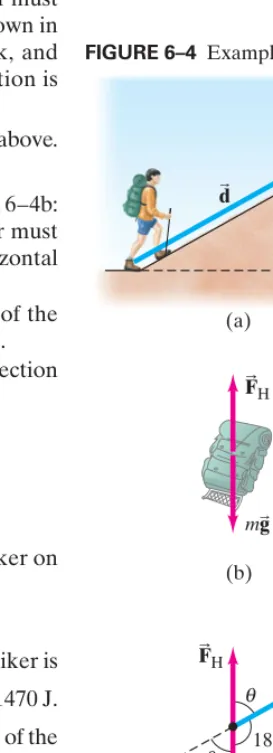
Work on a backpack. (a) Determine the work a hiker mustdo on a 15.0-kg backpack to carry it up a hill of height as shown in Fig. 6–4a. Determine also (b) the work done by gravity on the backpack, and (c) the net work done on the backpack. For simplicity, assume the motion is smooth and at constant velocity (i.e., acceleration is zero).
APPROACH We explicitly follow the steps of the Problem Solving Strategy above.
SOLUTION
1. Draw a free-body diagram. The forces on the backpack are shown in Fig. 6–4b: the force of gravity, acting downward; and the force the hiker must exert upward to support the backpack. The acceleration is zero, so horizontal forces on the backpack are negligible.
2. Choose a coordinate system. We are interested in the vertical motion of the backpack, so we choose the ycoordinate as positive vertically upward. 3. Apply Newton’s laws. Newton’s second law applied in the vertical direction
to the backpack gives (with )
So,
4. Work done by a specific force. (a) To calculate the work done by the hiker on the backpack, we use Eq. 6–1, where is shown in Fig. 6–4c,
and we note from Fig. 6–4a that So the work done by the hiker is
The work done depends only on the elevation change and not on the angle of the hill, The hiker would do the same work to lift the pack vertically by height h. (b) The work done by gravity on the backpack is (from Eq. 6–1 and Fig. 6–4c)
Since (Appendix A–7), we have
NOTE The work done by gravity (which is negative here) does not depend on the angle of the incline, only on the vertical height hof the hill.
5. Net work done. (c) The network done on the backpack is because the net force on the backpack is zero (it is assumed not to accelerate significantly). We can also get the net work done by adding the work done by each force:
NOTE Even though the network done by all the forces on the backpack is zero, the hiker doesdo work on the backpack equal to 1470 J.
Wnet = WG + WH = –1470J + 1470J = 0. Wnet = 0, = –(15.0kg)A9.80m兾s2B(10.0m) = –1470J.
= –mgh
WG = mg(–dcosu)
cos(180° - u) = –cosu
WG = mg dcos(180° - u).
u.
= (147N)(10.0m) = 1470J.
WH = FH(dcosu) = FHh = mgh dcosu = h.
WH = FH(dcosu),
u
FH = mg = (15.0kg)A9.80m兾s2B = 147N. FH - mg = 0.
©Fy = may ay = 0
FBH,
mgB ,
h = 10.0m, EXAMPLE 6;2
P R O B L E M S O L V I N G Work done by gravity depends on height of hill (not on angle)
y
x
θ
(a)
(b)
h
θ θ
(c)
θ
180° − m
m
H
H
FB
FB g B
gB d B
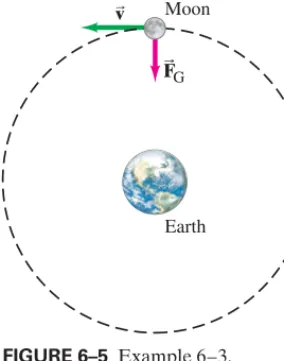
Does the Earth do work on the Moon? The Moon revolves around the Earth in a nearly circular orbit, kept there by the gravitational force exerted by the Earth. Does gravity do (a) positive work, (b) negative work, or (c) no work on the Moon?
RESPONSE The gravitational force exerted by the Earth on the Moon (Fig. 6–5) acts toward the Earth and provides its centripetal acceleration, inward along the radius of the Moon’s orbit. The Moon’s displacement at any moment is tangent to the circle, in the direction of its velocity, perpendicular to the radius and perpendicular to the force of gravity. Hence the angle between the force and the instantaneous displacement of the Moon is 90°, and the work done by gravity is therefore zero This is why the Moon, as well as artificial satellites, can stay in orbit without expenditure of fuel: no work needs to be done against the force of gravity.
6–2
Work Done by a Varying Force
If the force acting on an object is constant, the work done by that force can be calculated using Eq. 6–1. But in many cases, the force varies in magnitude or direction during a process. For example, as a rocket moves away from Earth, work is done to overcome the force of gravity, which varies as the inverse square of the distance from the Earth’s center. Other examples are the force exerted by a spring, which increases with the amount of stretch, or the work done by a vary-ing force that pulls a box or cart up an uneven hill.
The work done by a varying force can be determined graphically. To do so, we plot the component of parallel to the direction of motion at any point) as a function of distance d, as in Fig. 6–6a. We divide the distance into small segments For each segment, we indicate the average of by a horizontal dashed line. Then the work done for each segment is
which is the area of a rectangle wide and high. The total work done to move the object a total distance is the sum of the areas of the rectangles (five in the case shown in Fig. 6–6a). Usually, the average value of for each segment must be estimated, and a reasonable approximation of the work done can then be made.
If we subdivide the distance into many more segments, can be made smaller and our estimate of the work done would be more accurate. In the limit as approaches zero, the total area of the many narrow rectangles approaches the area under the curve, Fig. 6–6b. That is, the work done by avariable force in moving an object between two points is equal to the area under the vs. d curve between those two points.
6–3
Kinetic Energy, and
the Work-Energy Principle
Energyis one of the most important concepts in science. Yet we cannot give a simple general definition of energy in only a few words. Nonetheless, each specific type of energy can be defined fairly simply. In this Chapter we define translational kinetic energy and some types of potential energy. In later Chapters, we will examine other types of energy, such as that related to heat and electricity. The crucial aspect of energy is that the sum of all types, the total energy, is the same after any process as it was before: that is, energy is a conserved quantity.
For the purposes of this Chapter, we can define energy in the traditional way as “the ability to do work.” This simple definition is not always applicable,†but it
is valid for mechanical energy which we discuss in this Chapter. We now define and discuss one of the basic types of energy, kinetic energy.
F∑∑
¢d ¢d
F∑∑
d = dB - dAF∑∑
¢d ¢W = F∑∑¢d,
F∑∑ ¢d.
FB (= Fcosu,
F∑∑
*
(cos 90° = 0).
FBG
u
F B G
CONCEPTUAL EXAMPLE 6;3
142
CHAPTER 6 Work and Energy†Energy associated with heat is often not available to do work, as we will discuss in Chapter 15.
Moon
Earth
G
FB v B
FIGURE 6–5 Example 6–3.
200
100
0 200
100
(a)
dA Distance,d dB
0
dA Distance,d dB
(b)
Δd4
F
(N)
F
(N)
(F )4
SECTION 6–3 Kinetic Energy, and the Work-Energy Principle
143
Kinetic energy(defined)
WORK-ENERGY PRINCIPLE
WORK-ENERGY PRINCIPLE
1 2
net
F B
net
F B
vB vB
dB
FIGURE 6–7 A constant net force accelerates a car from speed to speed over a displacementd. The net work done is Wnet = Fnetd.
v2
v1
Fnet
C A U T I O N
Work-energy valid only for network A moving object can do work on another object it strikes. A flying cannonball
does work on a brick wall it knocks down; a moving hammer does work on a nail it drives into wood. In either case, a moving object exerts a force on a second object which undergoes a displacement. An object in motion has the ability to do work and thus can be said to have energy. The energy of motion is called kinetic energy, from the Greek word kinetikos, meaning “motion.”
To obtain a quantitative definition for kinetic energy, let us consider a simple rigid object of mass m(treated as a particle) that is moving in a straight line with an initial speed To accelerate it uniformly to a speed a constant net force is exerted on it parallel to its motion over a displacement d, Fig. 6–7. Then the net work done on the object is We apply Newton’s second law,
and use Eq. 2–11c which we rewrite as
where is the initial speed and is the final speed. Substituting this into we determine the work done:
or
(6;2) We definethe quantity to be the translational kinetic energy (KE)of the object:
(6;3)
(We call this “translational” kinetic energy to distinguish it from rotational kinetic energy, which we will discuss in Chapter 8.) Equation 6–2, derived here for one-dimensional motion with a constant force, is valid in general for translational motion of an object in three dimensions and even if the force varies.
We can rewrite Eq. 6–2 as:
or
(6;4)
Equation 6–4 is a useful result known as the work-energy principle. It can be stated in words:
The net work done on an object is equal to the change in the object’s kinetic energy.
Notice that we made use of Newton’s second law, where is the net
force—the sum of all forces acting on the object. Thus, the work-energy principle is valid only if Wis the networkdone on the object—that is, the work done by all forces acting on the object.
Fnet Fnet = ma,
Wnet = ¢ke = 12mv22 -1 2mv12.
Wnet = ke2 - ke1
ke = 12mv2. 1 2mv2
Wnet = 12mv22 -1 2mv12.
Wnet = Fnetd = mad = mav2
2 - v 1 2
2d bd = ma
v22 - v12
2 b
Fnet = ma,
v2
v1
a = v22 - v12
2d , Av22 = v12 + 2adB,
Fnet = ma, Wnet = Fnetd.
Fnet v2,
The work-energy principle is a very useful reformulation of Newton’s laws. It tells us that if (positive) net work Wis done on an object, the object’s kinetic energy increases by an amount W. The principle also holds true for the reverse situation: if the net work Wdone on an object is negative, the object’s kinetic energy decreases by an amount W. That is, a net force exerted on an object oppo-site to the object’s direction of motion decreases its speed and its kinetic energy. An example is a moving hammer (Fig. 6–8) striking a nail. The net force on the hammer ( in Fig. 6–8, where is assumed constant for simplicity) acts toward the left, whereas the displacement of the hammer is toward the right. So the net
work done on the hammer, is negative and the
hammer’s kinetic energy decreases (usually to zero).
Figure 6–8 also illustrates how energy can be considered the ability to do work. The hammer, as it slows down, does positive work on the nail:
and is positive. The decrease in kinetic energy of the hammer ( by Eq. 6–4) is equal to the work the hammer can do on another object, the nail in this case.
The translational kinetic energy is directly proportional to the mass of the object, and it is also proportional to the squareof the speed. Thus, if the mass is doubled, the kinetic energy is doubled. But if the speed is doubled, the object has four times as much kinetic energy and is therefore capable of doing four times as much work.
Because of the direct connection between work and kinetic energy, energy is measured in the same units as work: joules in SI units. [The energy unit is ergs in the cgs, and foot-pounds in the British system.] Like work, kinetic energy is a scalar quantity. The kinetic energy of a group of objects is the sum of the kinetic energies of the individual objects.
The work-energy principle can be applied to a particle, and also to an object that can be approximated as a particle, such as an object that is rigid or whose internal motions are insignificant. It is very useful in simple situations, as we will see in the Examples below.
A⫽ 1 2mv2B
= Fd
Wn = (±F)(±d) = Fd
Wh = (F)(d)(cos 180°) = –Fd,
dB FB
–FB
144
CHAPTER 6 Work and Energy(on nail) (on hammer) F
B dB
−FB
FIGURE 6–8 A moving hammer strikes a nail and comes to rest. The hammer exerts a force Fon the nail; the nail exerts a force on the hammer (Newton’s third law). The work done on the nail by the hammer is positive
The work done on the hammer by the nail is negative AWh = –FdB.
AWn = Fd 7 0B. –F
v1= 20 m/s v2= 30 m/s
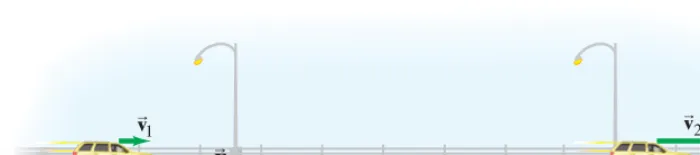
FIGURE 6–9 Example 6–4.
Work on a car, to increase its kinetic energy. How much net work is required to accelerate a 1000-kg car from to
(Fig. 6–9)?
APPROACH A car is a complex system. The engine turns the wheels and tires which push against the ground, and the ground pushes back (see Example 4–4). We aren’t interested right now in those complications. Instead, we can get a useful result using the work-energy principle, but only if we model the car as a particle or simple rigid object.
SOLUTION The net work needed is equal to the increase in kinetic energy:
= 2.5 * 105J.
= 1
2(1000kg)(30m兾s)2 -1
2(1000kg)(20m兾s)2
= 1 2mv22
-1 2mv12
W = ke2 - ke1
30m兾s
20m兾s EXAMPLE 6;4 ESTIMATE
EXERCISE B (a) Make a guess: will the work needed to accelerate the car in Example 6–4 from rest to be more than, less than, or equal to the work already calculated to accelerate it from 20m兾sto 30m兾s?(b) Make the calculation.
Work to stop a car. A car traveling
can brake to a stop in a distance d of 20 m (Fig. 6–10a). If the car is going twice as fast, what is its stopping distance (Fig. 6–10b)? Assume the maximum braking force is approximately independent of speed.
RESPONSE Again we model the car as if it were a particle. Because the net stop-ping force Fis approximately constant, the work needed to stop the car, is proportional to the distance traveled. We apply the work-energy principle, noting that and are in opposite directions and that the final speed of the car is zero:
Then
Thus, since the force and mass are constant, we see that the stopping distance,d, increases with the square of the speed:
If the car’s initial speed is doubled, the stopping distance is times as great, or 80 m.
(2)2 = 4
d r v2
.
= 0 - 12mv12.
–Fd = ¢ke = 12mv22 -1 2mv12
Wnet = Fdcos 180° = –Fd.
dB FB
Fd, 120km兾h,
60km兾h
CONCEPTUAL EXAMPLE 6;5
SECTION 6–4 Potential Energy
145
P H Y S I C S A P P L I E D Car’s stopping distance to initial speed squared r(d= 20 m)
(d= ?)
(b)
(a) v1= 60 km/h
v1= 120 km/h
v2= 0
v2= 0
FB
FB
dB
dB
FIGURE 6–10 Example 6–5. A moving car comes to a stop. Initial velocity is (a) 60km兾h,(b) 120km兾h.
EXERCISE C Can kinetic energy ever be negative?
EXERCISE D (a) If the kinetic energy of a baseball is doubled, by what factor has its speed increased? (b) If its speed is doubled, by what factor does its kinetic energy increase?
6–4
Potential Energy
We have just discussed how an object is said to have energy by virtue of its motion, which we call kinetic energy. But it is also possible to have potential energy, which is the energy associated with forces that depend on the position or configuration of an object (or objects) relative to the surroundings. Various types of potential energy (PE) can be defined, and each type is associated with a particular force.
The spring of a wind-up toy is an example of an object with potential energy. The spring acquired its potential energy because work was done onit by the person winding the toy. As the spring unwinds, it exerts a force and does work to make the toy move.
Gravitational Potential Energy
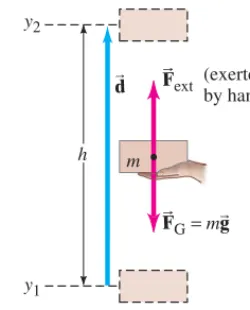
Let us seek the form for the gravitational potential energy of an object near the surface of the Earth. For an object of mass mto be lifted vertically, an upward force at least equal to its weight, mg, must be exerted on it, say by a person’s hand. To lift the object without acceleration, the person exerts an “external force” If it is raised a vertical height h, from position to in Fig. 6–11 (upward direction chosen positive), a person does work equal to the product of the “external” force she exerts, upward, multiplied by the vertical displacement h. That is,
(6;5a) Gravity is also acting on the object as it moves from to and does work on the object equal to
where because and point in opposite directions. So
(6;5b) Next, if we allow the object to start from rest at and fall freely under the action of gravity, it acquires a velocity given by (Eq. 2–11c) after falling a heighth. It then has kinetic energy and if it strikes a stake, it can do work on the stake equal to mgh(Section 6–3).
Thus, to raise an object of mass mto a height h requiresan amount of work equal to mgh(Eq. 6–5a). And once at height h, the object has the abilityto do an amount of work equal to mgh. We can say that the work done in lifting the object has been stored as gravitational potential energy.
We therefore define the gravitational potential energyof an object, due to Earth’s gravity, as the product of the object’s weight mgand its height yabove some reference level (such as the ground):
(6;6) The higher an object is above the ground, the more gravitational potential energy it has. We combine Eq. 6–5a with Eq. 6–6:
(6;7a) That is, the change in potential energy when an object moves from a height to a height is equal to the work done by a net external force to move the object from position 1 to position 2 without acceleration.
Equivalently, we can define the change in gravitational potential energy, in terms of the work done by gravity itself. Starting from Eq. 6–5b, we obtain
or
(6;7b) That is, the change in gravitational potential energy as the object moves from position 1 to position 2 is equal to the negative of the work done by gravity itself.
Gravitational potential energy depends on the vertical heightof the object
above some reference level(Eq. 6–6). In some situations, you may wonder from what point to measure the height y. The gravitational potential energy of a book held high above a table, for example, depends on whether we measure yfrom the top of the table, from the floor, or from some other reference point. What is physically important in any situation is the change in potential energy, because that is what is related to the work done, Eqs. 6–7; and it is that can be measured. We can thus choose to measure yfrom any reference level that is convenient, but we must choose the reference level at the start and be consistent throughout. The changein potential energy between any two points does not depend on this choice.
¢pe
¢pe, ¢peG = –WG.
WG = –Ape2 - pe1B = –¢peG WG = –mgAy2 - y1B
¢peG,
y2
y1
Wext = pe2 - pe1 = ¢peG.
Wext = mgAy2 - y1B
peG = mgy.
1 2mv2 =
1
2m(2gh) = mgh,
v2 = 2ghy2
= –mgAy2 - y1B.
WG = –mgh
dB F B G
u = 180°
WG = FGdcosu = mghcos 180°,
y2,
y1
= mgAy2 - y1B.
Wext = Fextdcos 0° = mgh
Fext = mg
y2
y1
Fext = mg.
146
CHAPTER 6 C A U T I O NChange in PEiswhat is physically meaningful
(exerted by hand)
y1 y2
h
= m
ext
m G
F
B
F
B
dB
gB
FIGURE 6–11 A person exerts an upward force to lift a brick from y1to y2.
Fext = mg
C A U T I O N work done by net external force¢peG =
SECTION 6–4 Potential Energy
147
210 m
3 1
15 m y
FIGURE 6–12 Example 6–6.
Potential energy changes for a roller coaster. A 1000-kg roller-coaster car moves from point 1, Fig. 6–12, to point 2 and then to point 3. (a) What is the gravitational potential energy at points 2 and 3 relative to point 1? That is, take at point 1. (b) What is the change in potential energy when the car goes from point 2 to point 3? (c) Repeat parts (a) and (b), but take the reference point to be at point 3.
APPROACH We are interested in the potential energy of the car–Earth system. We take upward as the positive ydirection, and use the definition of gravitational potential energy to calculate the potential energy.
SOLUTION (a) We measure heights from point 1 which means initially that the gravitational potential energy is zero. At point 2, where
At point 3, since point 3 is below point 1. Therefore,
(b) In going from point 2 to point 3, the potential energy change is
The gravitational potential energy decreases by
(c) Now we set Then at point 1, so the potential energy initially is
At point 2, so the potential energy is
At point 3, so the potential energy is zero. The change in potential energy going from point 2 to point 3 is
which is the same as in part (b).
NOTE Work done by gravity depends only on the vertical height, so changes in gravitational potential energy do not depend on the path taken.
pe3 - pe2 = 0 - 2.5 * 105J = –2.5 * 105J,
y3 = 0,
pe2 = 2.5 * 105J.
y2 = 25m,
pe1 = (1000kg)A9.8m兾s2)(15m) = 1.5 * 105J.
y1 = ±15m
y3 = 0.
2.5 * 105J.
= –2.5 * 105J.
pe3 - pe2 = A–1.5 * 105JB - A9.8 * 104JB
Apefinal - peinitialB pe3 = mgy3 = (1000kg)A9.8m兾s2B(–15m) = –1.5 * 105J.
y3 = –15m,
pe2 = mgy2 = (1000kg)A9.8m兾s2B(10m) = 9.8 * 104J.
y2 = 10m,
Ay1 = 0B,
(y = 0)
y = 0 EXAMPLE 6;6
C A U T I O N
Potential energy belongs to a system, not to a single object
An important result we discussed earlier (see Example 6–2 and Fig. 6–4) concerns the gravity force, which does work only in the vertical direction: the work done by gravity depends only on the vertical height h, and not on the path taken, whether it be purely vertical motion or, say, motion along an incline. Thus, from Eqs. 6–7 we see that changes in gravitational potential energy depend only on the change in vertical height and not on the path taken.
Potential energy belongs to a system, and not to a single object alone. Poten-tial energy is associated with a force, and a force on one object is always exerted by some other object. Thus potential energy is a property of the system as a whole. For an object raised to a height yabove the Earth’s surface, the change in gravitational potential energy is mgy. The system here is the object plus the Earth, and properties of both are involved: object (m) and Earth (g).
Potential Energy Defined in General
Potential Energy of Elastic Spring
We now consider potential energy associated with elastic materials, which includes a great variety of practical applications. Consider the simple coil spring shown in Fig. 6–13. The spring has potential energy when compressed (or stretched), because when it is released, it can do work on a ball as shown. To hold a spring either stretched or compressed an amount xfrom its natural (unstretched) length requires the hand to exert an external force on the spring of magnitude which is directly proportional to x. That is,
wherekis a constant, called the spring stiffness constant(or simply spring constant), and is a measure of the stiffness of the particular spring. The stretched or compressed spring itself exerts a force in the opposite direction on the hand, as shown in Fig. 6–14:
[spring force] (6;8) This force is sometimes called a “restoring force” because the spring exerts its force in the direction opposite the displacement (hence the minus sign), acting to return it to its natural length. Equation 6–8 is known as the spring equationand also as Hooke’s law, and is accurate for springs as long as xis not too great.
To calculate the potential energy of a stretched spring, let us calculate the work required to stretch it (Fig. 6–14b). We might hope to use Eq. 6–1 for the work done on it, where xis the amount it is stretched from its natural length. But this would be incorrect since the force is not constant but varies over the distance x, becoming greater the more the spring is stretched, as shown graphically in Fig. 6–15. So let us use the average force, Since varies linearly, from zero at the unstretched position to kx when stretched to x, the average force is where xhere is the final amount stretched (shown as in Fig. 6–15 for clarity). The work done is then
Hence the elastic potential energy, is proportional to the square of the amount stretched:
[elastic spring] (6;9) If a spring is compresseda distance xfrom its natural (“equilibrium”) length, the average force again has magnitude and again the potential energy is given by Eq. 6–9. Thus xcan be either the amount compressed or amount stretched from the spring’s natural length.†Note that for a spring, we choose the reference
point for zero PEat the spring’s natural position.
Potential Energy as Stored Energy
In the above examples of potential energy—from a brick held at a height y, to a stretched or compressed spring—an object has the capacity or potentialto do work even though it is not yet actually doing it. These examples show that energy can be
stored, for later use, in the form of potential energy (as in Fig. 6–13, for a spring). Note that there is a single universal formula for the translational kinetic energy of an object, but there is no single formula for potential energy. Instead, the mathematical form of the potential energy depends on the force involved.
1 2mv
2,
f = 1 2kx,
peel = 1 2kx
2.
peel,
Wext = fx = A12kxB(x) = 1 2kx2.
xf f =
1
2[0 + kx] = 1 2kx,
Fext
f.
Fext(= kx) W = Fx,
FS = –kx. FS Fext = kx,
Fext
148
CHAPTER 6 Work and Energy†We can also obtain Eq. 6–9 using Section 6–2. The work done, and hence equals the area
under the Fvs.xgraph of Fig. 6–15. This area is a triangle (colored in Fig. 6–15) of altitude kxand basex, and hence of area (for a triangle) equal to 12(kx)(x)=
1 2kx
2.
¢pe,
(a) Unstretched
(b)Stretched
(c) Compressed
x x= 0
x S
S ext
FB F B
F B
ext FB
FIGURE 6–14 (a) Spring in natural (unstretched) position. (b) Spring is stretched by a person exerting a force to the right (positive direction). The spring pulls back with a force where
(c) Person compresses the spring by exerting an external force to the left; the spring pushes back with a force where FS 7 0 because x 6 0.
FS = –kx,
FBext Ax 6 0B
FS = –kx.
FBS,
FBext
xf F—= kxf
Fext
=kx
F
0 x
1 2
FIGURE 6–15 As a spring is stretched (or compressed), the magnitude of the force needed increases linearly as xincreases: graph of vs.xfrom
to x = xf.
x = 0
F = kx
(a) (b) (c)
6–5
Conservative and
Nonconservative Forces
The work done against gravity in moving an object from one point to another does not depend on the path taken. For example, it takes the same work to lift an object of mass m vertically a height has to carry it up an incline of the same vertical height, as in Fig. 6–4 (see Example 6–2). Forces such as gravity, for which the work done does not depend on the path taken but only on the initial and final positions, are called conservative forces. The elastic force of a spring (or other elastic material), in which is also a conser-vative force. An object that starts at a given point and returns to that same point under the action of a conservative force has no net work done on it because the potential energy is the same at the start and the finish of such a round trip.
Many forces, such as friction and a push or pull exerted by a person, are nonconservative forcessince any work they do depends on the path. For example, if you push a crate across a floor from one point to another, the work you do depends on whether the path taken is straight or is curved. As shown in Fig. 6–16, if a crate is pushed slowly from point 1 to point 2 along the longer semicircular path, you do more work against friction than if you push it along the straight path.
F = –kx,
(= mgh)
SECTION 6–5 Conservative and Nonconservative Forces
149
TABLE 6–1 Conservative and Nonconservative ForcesConservative Nonconservative Forces Forces
Gravitational Friction Elastic Air resistance Electric Tension in cord
Motor or rocket propulsion Push or pull by
a person
1 2
fr F
B Ffr
B
fr
FB FBP
P F B P
FB
FIGURE 6–16 A crate is pushed slowly at constant speed across a rough floor from position 1 to position 2 via two paths, one straight and one curved. The pushing force is in the direction of motion at each point. (The friction force opposes the motion.) Hence for a constant magnitude pushing force, the work it does is
so if the distance traveled dis greater (as for the curved path), then Wis greater. The work done does not depend only on points 1 and 2; it also depends on the path taken.
W = FPd,
F B P
You do more work on the curved path because the distance is greater and, unlike the gravitational force, the pushing force is in the direction of motion at each point. Thus the work done by the person in Fig. 6–16 does not depend onlyon points 1 and 2; it depends also on the path taken. The force of kinetic friction, also shown in Fig. 6–16, always opposes the motion; it too is a nonconservative force, and we discuss how to treat it later in this Chapter (Section 6–9). Table 6–1 lists a few conservative and nonconservative forces.
Because potential energy is energy associated with the position or configura-tion of objects, potential energy can only make sense if it can be stated uniquely for a given point. This cannot be done with nonconservative forces because the work done depends on the path taken (as in Fig. 6–16). Hence,potential energy can be defined only for a conservative force. Thus, although potential energy is always associated with a force, not all forces have a potential energy. For example, there is no potential energy for friction.
F B P
150
CHAPTER 6 Work and Energy CONSERVATION OFMECHANICAL ENERGY
Work-Energy Extended
We can extend the work-energy principle(discussed in Section 6–3) to include potential energy. Suppose several forces act on an object which can undergo translational motion. And suppose only some of these forces are conservative. We write the total (net) work as a sum of the work done by conservative forces, and the work done by nonconservative forces,
Then, from the work-energy principle, Eq. 6–4, we have
where Then
Work done by a conservative force can be written in terms of potential energy, as we saw in Eq. 6–7b for gravitational potential energy:
We combine these last two equations:
(6;10) Thus, the work done by the nonconservative forces acting on an object is equal to the total change in kinetic and potential energies.
It must be emphasized that allthe forces acting on an object must be included in Eq. 6–10, either in the potential energy term on the right (if it is a conserva-tive force), or in the work term on the left (but not in both!).
6–6
Mechanical Energy and
Its Conservation
If we can ignore friction and other nonconservative forces, or if only conservative forces do work on a system, we arrive at a particularly simple and beautiful rela-tion involving energy.
When no nonconservative forces do work, then in the general form of the work-energy principle (Eq. 6–10). Then we have
(6;11a) or
(6;11b) We now define a quantity E, called the total mechanical energyof our system, as the sum of the kinetic and potential energies at any moment:
Now we can rewrite Eq. 6–11b as
(6;12a) or
(6;12b) Equations 6–12 express a useful and profound principle regarding the total mechanical energy of a system—namely, that it is a conserved quantity. The total mechanical energy Eremains constant as long as no nonconservative forces do work: ke + pe at some initial time 1 is equal to the ke + pe at any later time 2.
cconservativeforces only d
E2 = E1 = constant.
cconservativeforces only d
ke2 + pe2 = ke1 + pe1
E = ke + pe.
cconservativeforces only d
Ake2 - ke1B + Ape2 - pe1B = 0.
cconservativeforces only d
¢ke + ¢pe = 0
WNC = 0 WNC
WNC = ¢ke + ¢pe. WC = –¢pe.
WNC = ¢ke - WC. ¢ke = ke2 - ke1.
WC + WNC = ¢ke Wnet = ¢ke Wnet = WC + WNC.
WNC: WC,
6–7
Problem Solving Using
Conservation of Mechanical Energy
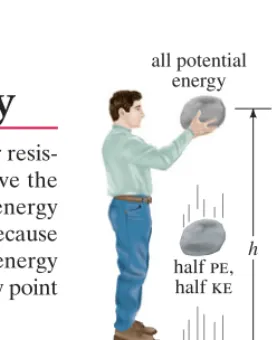
A simple example of the conservation of mechanical energy (neglecting air resis-tance) is a rock allowed to fall due to Earth’s gravity from a height habove the ground, as shown in Fig. 6–17. If the rock starts from rest, all of the initial energy is potential energy. As the rock falls, the potential energy mgydecreases (because the rock’s height above the ground ydecreases), but the rock’s kinetic energy increases to compensate, so that the sum of the two remains constant. At any point along the path, the total mechanical energy is given by
wherevis its speed at that point. If we let the subscript 1 represent the rock at one point along its path (for example, the initial point), and the subscript 2 represent it at some other point, then we can write
or (see also Eq. 6–12a)
(6;13) Just before the rock hits the ground, where we chose all of the initial poten-tial energy will have been transformed into kinetic energy.
y = 0,
[gravity only]
1
2mv12 + mgy1 = 12mv22 + mgy2.
total mechanical energy at point 1 = total mechanical energy at point 2
E = ke + pe = 12mv
2 + mgy
h
halfpe, halfke
all kinetic energy
y1=h
y2= 0
y
all potential energy
pe ke
pe ke pe ke
FIGURE 6–17 The rock’s potential energy changes to kinetic energy as it falls. Note bar graphs representing potential energy peand kinetic energykefor the three different positions.
SECTION 6–7 Problem Solving Using Conservation of Mechanical Energy
151
CONSERVATION OFMECHANICAL ENERGY
Falling rock. If the initial height of the rock in Fig. 6–17 is calculate the rock’s velocity when it has fallen to 1.0 m above the ground.
APPROACH We apply the principle of conservation of mechanical energy, Eq. 6–13, with only gravity acting on the rock. We choose the ground as our reference level
SOLUTION At the moment of release (point 1) the rock’s position is and it is at rest: We want to find when the rock is at posi-tion Equation 6–13 gives
The m’s cancel out and , so
Solving for we find
The rock’s velocity 1.0 m above the ground is downward.
NOTE The velocity of the rock is independent of the rock’s mass. 6.3m兾s
v2 = 32gAy1 - y2B = 32A9.8m兾s2BC(3.0m) - (1.0m)D = 6.3m兾s.
v2
gy1 = 12v22 + gy2.
v1 = 0 1
2mv12 + mgy1 = 12mv22 + mgy2.
y2 = 1.0m.
v2
v1 = 0.
y1 = 3.0m
(y = 0).
y1 = h = 3.0m,
EXAMPLE 6;7
To say it another way, consider Eq. 6–11a which tells us that is, if the kinetic energy KEof a system increases, then the potential energyPEmust decrease by an equivalent amount to compensate. Thus, the total,
remains constant:
If only conservative forces do work, the total mechanical energy of a system neither increases nor decreases in any process. It stays constant—it is conserved. This is the principle of conservation of mechanical energyfor conservative forces. In the next Section we shall see the great usefulness of the conservation of mechanical energy principle in a variety of situations, and how it is often easier to use than the kinematic equations or Newton’s laws. After that we will discuss how other forms of energy can be included in the general conservation of energy law, such as energy associated with friction.
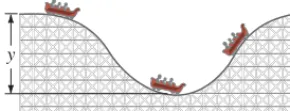
Roller-coaster car speed using energy conservation. Assuming the height of the hill in Fig. 6–18 is 40 m, and the roller-coaster car starts from rest at the top, calculate (a) the speed of the roller-coaster car at the bottom of the hill, and (b) at what height it will have half this speed. Take
at the bottom of the hill.
APPROACH We use conservation of mechanical energy. We choose point 1 to be where the car starts from rest at the top of the hill In part (a), point 2 is the bottom of the hill, which we choose as our reference level, so In part (b) we let be the unknown.
SOLUTION (a) We use Eq. 6–13 with and which gives or
(b) Now will be an unknown. We again use conservation of energy,
but now and Solving for the unknown gives
That is, the car has a speed of when it is 30verticalmeters above the lowest point, both when descending the left-hand hill and when ascending the right-hand hill.
14m兾s
(14m兾s)2
2(9.8m兾s2) = 30m.
y2 = y1
-v22
2g = 40m
-y2
v1 = 0.
v2 = 1
2(28m兾s) = 14m兾s 1
2mv12 + mgy1 = 1
2mv22 + mgy2,
y2
= 32A9.8m兾s2B(40m) = 28m兾s.
v2 = 22gy1
mgy1 = 1 2mv22
y2 = 0,
v1 = 0
y2
y2 = 0.
Ay1 = 40mB.
Av1 = 0B
y = 0
EXAMPLE 6;8
152
CHAPTER 6 Work and EnergyThe mathematics of the roller-coaster Example 6–8 is almost the same as in Example 6–7. But there is an important difference between them. In Example 6–7 the motion is all vertical and could have been solved using force, acceleration, and the kinematic equations (Eqs. 2–11). For the roller coaster, where the motion is not vertical, we could nothave used Eqs. 2–11 because ais not constant on the curved track of Example 6–8. But energy conservation readily gives us the answer. y
FIGURE 6–18 A roller-coaster car moving without friction illustrates the conservation of mechanical energy.
There are many interesting examples of the conservation of energy in sports, such as the pole vault illustrated in Fig. 6–20. We often have to make approxima-tions, but the sequence of events in broad outline for the pole vault is as follows. The initial kinetic energy of the running athlete is transformed into elastic potential energy of the bending pole and, as the athlete leaves the ground, into gravitational potential energy. When the vaulter reaches the top and the pole has straightened out again, the energy has all been transformed into gravitational potential energy (if we ignore the vaulter’s low horizontal speed over the bar). The pole does not supply any energy, but it acts as a device to storeenergy and thus aid in the transformation of kinetic energy into gravitational potential energy, which is the net result. The energy required to pass over the bar depends on how high the center of mass (CM) of the vaulter must be raised. By bending their bodies, pole vaulters keep their CMso low that it can actually pass slightly beneath the bar (Fig. 6–21), thus enabling them to cross over a higher bar than would otherwise be possible. (Center of mass is covered in Chapter 7.)
As another example of the conservation of mechanical energy, let us consider an object of mass mconnected to a compressed horizontal spring (Fig. 6–13b) whose own mass can be neglected and whose spring stiffness constant is k. When the spring is released, the mass mhas speed vat any moment. The potential energy of the system (object plus spring) is where xis the displacement of the spring from its unstretched length (Eq. 6–9). If neither friction nor any other force is acting, conservation of mechanical energy tells us that
[elasticPEonly] (6;14) where the subscripts 1 and 2 refer to the velocity and displacement at two differ-ent momdiffer-ents.
1 2mv12 +
1 2kx12 =
1 2mv22 +
1 2kx22, 1
2kx2,
SECTION 6–7 Problem Solving Using Conservation of Mechanical Energy
153
FIGURE 6–20 Transformation ofenergy during a pole vault:
ke S peel S peG.
FIGURE 6–21 By bending her body, a pole vaulter can keep her center of mass so low that it may even pass below the bar.
pe
pe ke pe ke
Paul
Corinne
h
ke
FIGURE 6–19 Example 6–9.
Speeds on two water slides. Two water slides at a pool are shaped differently, but start at the same height h(Fig. 6–19). Two riders start from rest at the same time on different slides. (a) Which rider, Paul or Corinne, is traveling faster at the bottom? (b) Which rider makes it to the bottom first? Ignore friction and assume both slides have the same path length.
RESPONSE (a) Each rider’s initial potential energy mgh gets transformed to kinetic energy, so the speed vat the bottom is obtained from The mass cancels and so the speed will be the same, regardless of the mass of the rider. Since they descend the same vertical height, they will finish with the same speed. (b) Note that Corinne is consistently at a lower elevation than Paul at any instant, until the end. This means she has converted her potential energy to kinetic energy earlier. Consequently, she is traveling faster than Paul for the whole trip, and because the distance is the same, Corinne gets to the bottom first.
1
2mv2 = mgh.
Two kinds of potential energy. A ball of mass
starting from rest, falls a vertical distance before striking a vertical coiled spring, which it compresses an amount (Fig. 6–23). Determine the spring stiffness constant kof the spring. Assume the spring has negligible mass, and ignore air resistance. Measure all distances from the point where the ball first touches the uncompressed spring ( at this point).
APPROACH The forces acting on the ball are the gravitational pull of the Earth and the elastic force exerted by the spring. Both forces are conservative, so we can use conservation of mechanical energy, including both types of poten-tial energy. We must be careful, however: gravity acts throughout the fall (Fig. 6–23), whereas the elastic force does not act until the ball touches the spring (Fig. 6–23b). We choose ypositive upward, and at the end of the spring in its natural (uncompressed) state.
SOLUTION We divide this solution into two parts. (An alternate solution follows.)
Part 1: Let us first consider the energy changes as the ball falls from a height Fig. 6–23a, to just as it touches the spring, Fig. 6–23b. Our system is the ball acted on by gravity plus the spring (which up to this point doesn’t do anything). Thus
We solve for
This is the speed of the ball just as it touches the top of the spring, Fig. 6–23b.
Part 2: As the ball compresses the spring, Figs. 6–23b to c, there are two conser-vative forces on the ball—gravity and the spring force. So our conservation of energy equation is
Substituting (the ball comes to rest for an
instant), and we have
We know m, and Y, so we can solve for k:
= (2.60kg)
(0.150m)2 C(3.283m兾s)
2 + 2A9.80m兾s2B(0.150m)D = 1590N兾m.
k = 2
Y2C 1
2mv22 + mgYD =
m Y2 Cv2
2 + 2gYD
v2, 1
2mv22 + 0 + 0 = 0 - mgY + 1
2k(–Y)2.
y3 = –Y = –0.150m,
v3 = 0
v2 = 3.283m兾s,
y2 = 0, 1
2mv22 + mgy2 + 12ky22 = 12mv32 + mgy3 + 12ky32.
E2(ball touches spring) = E3(spring compressed)
v2 = 12gh = 32A9.80m兾s2B(0.550m) = 3.283m兾s L 3.28m兾s.
= 1
2mv22 + 0.
0 + mgh
= 1
2mv22 + mgy2 1
2mv12 + mgy1
y2 = 0,
y1 = h = 0.550m,
y = 0
y = 0
Y = 15.0cm
h = 55.0cm
m = 2.60kg, EXAMPLE 6;11
154
CHAPTER 6 hY
y= y2=0 y= y3= −Y y= y1= h
h m
m
m
(a) (b) (c)
FIGURE 6–23 Example 6–11. A falling ball compresses a spring.
pe ke
pe ke
6.0 cm
(a)
=0
2 1
kx12 E=12
(b) mv22
v
v
E=12
FIGURE 6–22 Example 6–10. (a) A dart is pushed against a spring, compressing it 6.0 cm. The dart is then released, and in (b) it leaves the spring at velocity v2.
Toy dart gun. A dart of mass 0.100 kg is pressed against the spring of a toy dart gun as shown in Fig. 6–22a. The spring, with spring stiffness constant and ignorable mass, is compressed 6.0 cm and released. If the dart detaches from the spring when the spring reaches its natural length what speed does the dart acquire?
APPROACH The dart is initially at rest (point 1), so We ignore friction and use conservation of mechanical energy; the only potential energy is elastic.
SOLUTION We use Eq. 6–14 with point 1 being at the maximum compression of the spring, so (dart not yet released) and Point 2 we choose to be the instant the dart flies off the end of the spring (Fig. 6–22b), so
and we want to find Thus Eq. 6–14 can be written
Then
and v2 = 2v22 = 3.0m兾s.
= (250N兾m)(–0.060m)
2
(0.100kg) = 9.0m
2兾s2,
v22 =
kx12
m
0 + 12kx12 = 1
2mv22 + 0.
v2.
x2 = 0
x1 = –0.060m.
v1 = 0
ke1 = 0.
(x = 0),
6–8
Other Forms of Energy and
Energy Transformations;
The Law of Conservation of Energy
Besides the kinetic energy and potential energy of mechanical systems, other forms of energy can be defined as well. These include electric energy, nuclear energy, thermal energy, and the chemical energy stored in food and fuels. These other forms of energy are considered to be kinetic or potential energy at the atomic or molecular level. For example, according to atomic theory, thermal energy is the kinetic energy of rapidly moving molecules—when an object is heated, the molecules that make up the object move faster. On the other hand, the energy stored in food or in a fuel such as gasoline is regarded as potential energy stored by virtue of the relative positions of the atoms within a molecule due to electric forces between the atoms (chemical bonds). The energy in chemical bonds can be released through chemical reactions. This is analogous to a compressed spring which, when released, can do work. Electric, magnetic, and nuclear energies also can be considered examples of kinetic and potential (or stored) energies. We will deal with these other forms of energy in later Chapters.Energy can be transformed from one form to another. For example, a rock held high in the air has potential energy; as it falls, it loses potential energy and gains in kinetic energy. Potential energy is being transformed into kinetic energy. Often the transformation of energy involves a transfer of energy from one object to another. The potential energy stored in the spring of Fig. 6–13b is transformed into the kinetic energy of the ball, Fig. 6–13c. Water at the top of a waterfall (Fig. 6–24) or a dam has potential energy, which is transformed into kinetic energy as the water falls. At the base of a dam, the kinetic energy of the water can be transferred to turbine blades and further transformed into electric energy, as discussed later. The potential energy stored in a bent bow can be transformed into kinetic energy of the arrow (Fig. 6–25).
In each of these examples, the transfer of energy is accompanied by the performance of work. The spring of Fig. 6–13 does work on the ball. Water does work on turbine blades. A bow does work on an arrow. This observation gives us a further insight into the relation between work and energy:work is donewhen energy is transferred from one object to another.†
SECTION 6–8 Other Forms of Energy and Energy Transformations; The Law of Conservation of Energy
155
†If the objects are at different temperatures, heat can flow between them instead, or in addition. SeeChapters 14 and 15.
FIGURE 6–24 Gravitational potential energy of water at the top of Yosemite Falls gets transformed into kinetic energy as the water falls. (Some of the energy is transformed into heat by air resistance, and some into sound.)
FIGURE 6–25 Potential energy of a bent bow about to be transformed into kinetic energy of an arrow.
P R O B L E M S O L V I N G Quicker Solution
Alternate Solution Instead of dividing the solution into two parts, we can do it all at once. After all, we get to choose what two points are used on the left and right of the energy equation. Let us write the energy equation for points 1 and 3 in Fig. 6–23. Point 1 is the initial point just before the ball starts to fall (Fig. 6–23a), so and Point 3 is when the spring is fully compressed (Fig. 6–23c), so The forces on the ball in this process are gravity and (at least part of the time) the spring. So conservation of energy tells us
where we have set for the spring at point 1 because it is not acting and is not compressed or stretched. We solve for k:
just as in our first method of solution.
k = 2mg(h +Y)
Y2 =
2(2.60kg)A9.80m兾s2B(0.550m + 0.150m)
(0.150m)2 = 1590N兾m
y = 0
0 + mgh + 0 = 0 - mgY + 12kY2 1
2mv12 + mgy1 + 1
2k(0)2 = 1
2mv32 + mgy3 + 1 2ky32
y3 = –Y = –0.150m.
v3 = 0,
y1 = h = 0.550m.
6–9
Energy Conservation with
Dissipative Forces: Solving Problems
In our applications of energy conservation in Section 6–7, we neglected friction and other nonconservative forces. But in many situations they cannot be ignored. In a real situation, the roller-coaster car in Fig. 6–18, for example, will not in fact reach the same height on the second hill as it had on the first hill because of fric-tion. In this, and in other natural processes, the mechanical energy (sum of the kinetic and potential energies) does not remain constant but decreases. Because frictional forces reduce the mechanical energy (but notthe total energy), they are calleddissipative forces. Historically, the presence of dissipative forces hindered the formulation of a comprehensive conservation of energy law until well into the nineteenth century. It was only then that heat, which is always produced when there is friction (try rubbing your hands together), was interpreted in terms of energy. Quantitative studies by nineteenth-century scientists (discussed in Chapters 14 and 15) demonstrated that if heat is considered as a transfer of energy (thermal energy), then the total energy is conserved in any process. For example, if the roller-coaster car in Fig. 6–18 is subject to frictional forces, then the initial total energy of the car will be equal to the kinetic plus potential energy of the car at any subsequent point along its path plus the amount of thermal energy produced in the process (equal to the work done by friction).
Let us recall the general form of the work-energy principle, Eq. 6–10:
where is the work done by nonconservative forces such as friction. Consider an object, such as a roller-coaster car, as a particle moving under gravity with nonconservative forces like friction acting on it. When the object moves from some point 1 to another point 2, then
We can rewrite this as
(6;15) For the case of friction, where dis the distance over which the friction (assumed constant) acts as the object moves from point 1 to point 2. ( and are in opposite directions, hence the minus sign from cos 180° = –1 in Eq. 6–1.)
dB FB
WNC = –Ffrd,
ke1 + pe1 + WNC = ke2 + pe2.
WNC = ke2 - ke1 + pe2 - pe1.
WNC
WNC = ¢ke + ¢pe,
156
CHAPTER 6 Work and EnergyOne of the great results of physics is that whenever energy is transferred or transformed, it is found that no energy is gained or lost in the process.
This is the law of conservation of energy, one of the most important princi-ples in physics; it can be stated as:
The total energy is neither increased nor decreased in any process. Energy can be transformed from one form to another, and transferred from one object to another, but the total amount remains constant.
We have already discussed the conservation of energy for mechanical systems involving conservative forces, and we saw how it could be derived from Newton’s laws and thus is equivalent to them. But in its full generality, the validity of the law of conservation of energy, encompassing all forms of energy including those associated with nonconservative forces like friction, rests on experimental obser-vation. Even though Newton’s laws are found to fail in the submicroscopic world of the atom, the law of conservation of energy has been found to hold in every experimental situation so far tested.
Work-Energy versus Energy Conservation
The law of conservation of energy is more general and more powerful than the work-energy principle. Indeed, the work-energy principle should not be viewed as a statement of conservation of energy. It is nonetheless useful for mechanical problems; and whether you use it, or use the more powerful conservation of energy, can depend on your choice of the systemunder study. If you choose as your system a particle or rigid object on which external forces do work, then you can use the work-energy principle: the work done by the external forces on your object equals the change in its kinetic energy.
On the other hand, if you choose a system on which no external forces do work, then you need to apply conservation of energy to that system directly.
Consider, for example, a spring connected to a block on a frictionless table (Fig. 6–26). If you choose the block as your system, then the work done on the block by the spring equals the change in kinetic energy of the block: the work-energy principle. (Energy conservation does not apply to this system—the block’s energy changes.) If instead you choose the block plus the spring as your system, no external forces do work (since the spring is part of the chosen system). To this system you need to apply conservation of energy: if you compress the spring and then release it, the spring still exerts a force†on the block, but the subsequent
motion can be discussed in terms of kinetic energy plus potential energy whose total remains constant.
You may also wonder sometimes whether to approach a problem using work and energy, or instead to use Newton’s laws. As a rough guideline, if the force(s) involved are constant, either approach may succeed. If the forces are not constant, and/or the path is not simple, energy may be the better approach because it is a scalar.
Problem solving is not a process that can be done by simply following a set of rules. The Problem Solving Strategy on the next page, like all others, is thus
nota prescription, but is a summary to help you get started solving problems involv-ing energy.
A1 2kx2B,
A1 2mv2B
SECTION 6–9 Energy Conservation with Dissipative Forces: Solving Problems
157
mk
FIGURE 6–26 A spring connected to a block on a frictionless table. If you choose your system to be the block plus spring, then
is conserved.
E = 1
2mv2 + 1 2kx2
P R O B L E M S O L V I N G Use energy, or Newton’s laws? EXERCISE F Return to the Chapter-Opening Question, page 138, and answer it again
now. Try to explain why you may have answered differently the first time.
With and Eq. 6–15 with becomes
(6;16a)
That is, the initial mechanical energy is reduced by the amount We could also write this equation as
(6;16b)
and state equally well that the initial mechanical energy of the car (point 1) equals the (reduced) final mechanical energy of the car plus the energy transformed by friction into thermal energy.
Equations 6–16 can be seen to be Eq. 6–13 modified to include nonconserva-tive forces such as friction. As such, they are statements of conservation of energy. When other forms of energy are involved, such as chemical or electrical energy, the total amount of energy is always found to be conserved. Hence the law of conservation of energy is believed to be universally valid.
£gravity andfriction acting §
1 2mv12
or
ke1
+
+ mgy1
pe1
=
=
1 2mv22
ke2
+
+ mgy2
pe2
+
+ Ffrd
Ffrd,
Ffrd.
cfriction actinggravity and d 1
2mv12 + mgy1 - Ffrd = 12mv22 + mgy2.
WNC = –Ffrd
pe = mgy,
ke = 12mv2
P R O B L E M S O L V I N G Choosing the system
†The force the spring exerts on the block, and the force the block exerts back on the spring, are not
Friction on the roller-coaster car. The roller-coaster car in Example 6–8 reaches a vertical height of only on the second hill, where it slows to a momentary stop, Fig. 6–27. It traveled a total distance of 400 m. Determine the thermal energy produced and estimate the average friction force (assume it is roughly constant) on the car, whose mass is 1000 kg.
APPROACH We explicitly follow the Problem Solving Strategy above.
SOLUTION
1. Draw a picture. See Fig. 6–27.
2. The system. The system is the roller-coaster car and the Earth (which exerts the gravitational force). The forces acting on the car are gravity and friction. (The normal force also acts on the car, but does no work, so it does not affect the energy.) Gravity is accounted for as potential energy, and friction as a term
3. Choose initial and final positions. We take point 1 to be the instant when the car started coasting (at the top of the first hill), and point 2 to be the instant it stopped at a height of up the second hill.
4. Choose a reference frame. We choose the lowest point in the motion to be for the gravitational potential energy.
5. Is mechanical energy conserved? No. Friction is present.
6. Apply conservation of energy. There is friction acting on the car, so we use conservation of energy in the form of Eq. 6–16b, with
and Thus
7. Solve. We solve the above equation for the energy dissipated to thermal energy:
The friction force, which acts over a distance of 40