Thin layer and deep bed drying basic theories and modelling: a
review
Esther Magdalene Sharon. M
1*, Banuu Priya E. P
2, Subhashini. S
3 (1. Assistant Professor, College of Food and Dairy Technology, Tamil Nadu Veterinary and Animal Sciences University;2. Assistant Professor, Kongu Engineering College;
3. PhD Scholar, College of Food and Dairy Technology, Tamil Nadu Veterinary and Animal Sciences University.)
Abstract: A comprehensive review of the fundamental theories governing the drying process is presented. The development of models of drying of agricultural products for thin layer and deep bed drying are discussed. The factors affecting drying and the biochemical changes which happen during drying are listed. Importance of moisture diffusion and activation energy consumption for modeling and optimizing the drying processes are highlighted.
Keywords: drying, moisture content, thin layer drying, deep bed drying, models
Citation: Sharon, M., E.P. Priya, and S. Subhashini. 2016. Thin layer and deep bed drying basic theories and modelling: a review. Agric Eng Int: CIGR Journal, 18(1):314-325.
1 Introduction
1Drying refers to the removal of relatively small amount of moisture from a solid or nearly solid material by evaporation. It is achieved by the evaporation of moisture from the grain. Therefore, drying involves both heat and mass transfer operations simultaneously (Ertekin and Firat, 2014; Chakraverty, 1994). In convective drying, the heat required for evaporating moisture from the drying product is supplied by the external medium, which is usually air. Heat is transferred from the drying air to the liquid water and water vapor in the grain, whereas mass is transferred out of the grain in the form of vapor (evaporated liquid) (Noomhorm and Verma, 1986).
The drying process involves two basic mechanisms; the migration of moisture from the interior of an individual grain to the surface and the evaporation of moisture from the surface to the surrounding air (Trim and Robinson, 1994). Grain drying can be achieved by
Received date: 2015-09-11 Accepted date: 2015-11-22
*Corresponding author: Esther Magdalene Sharon. M,
Department of Food Science and Technology, College of Food and Dairy Technology, Tamil Nadu Veterinary and Animal Sciences University, Chennai - 600052, Tamil Nadu, India. Tel: +91 9629946083, Email: [email protected].
circulating air at varying degrees of heat through a mass of grain (Lucia and Assennato, 1994). As it moves, the air imparts heat to the grain, while absorbing the humidity of the outmost layer. However, this process does not take place uniformly inside the drying chamber or among individual grains, or within each grain. Indeed, the water present in the outer layers of the grain evaporates much faster and more easily than that of the internal layer (Loewer et al., 1994). This implies that it is much easier to lower the moisture content of the grain from 35% to 25% than from 25% to 15%.
these mechanisms would be reactivated, but their efficiency depends on the damage accumulated. Moreover, Herter and Burris (1989a) found that after drying, the respiration rate of dried grain was reduced due to lack of moisture. In ideal and efficient drying situations, grain should be dried uniformly and quickly, but its end use quality should not be badly affected (Patindol et al., 2003).
Trim and Robinson (1994) stated that drying conditions must be chosen critically to avoid adverse effect on quality parameters. It is therefore important to understand the principles of grain drying (whether it is being dried by natural or artificial drying system) to ensure that a high quality product is obtained. The bed dryer can be divided into two types: thin-layer dryer and deep-layer dryer based on depth of particles.
2. Thin layer drying
In thin layer drying, through a grain layer having a single kernel depth (Jayas et al., 1991) the air conditions (pressure, flow, temperature, and humidity) remain constant during the drying time, and the sample weight is taken periodically to determine the moisture content. Sometimes, thin layer lab tests also measure the conditions of the exhausted air, temperature and moisture; these are useful to validate the heat and mass balance equations. The Thin layer is the basic drying lab test for grains; this is mainly used to find the constant values for the drying or rewetting empirical equations (Misra and Brooker, 1980). According to Chakraverty, (1994), layer thickness up to 20cm is considered as thin layer drying.
3. Deep bed drying
Deep bed dryers, also known as fixed bed dryers, are one of the most common types of agricultural dryers, designed for heterogeneous drying of grain in a deep layer (more than 20 cm deep) where drying is faster at the inlet end of the dryer than that at the exhaust end (Lopez et al.,1998). Deep bed dryer consist of silo or bin (rectangular warehouses) fitted with ducting or false floors through which air is forced. Depth up to 3.5 m of grains
may be dried at one time (Hall, 1970). Drying begins at the inlet end and progresses through the entire bed. It is found that the lower zone dries rapidly. Air moves from the lower to the upper zone and increases its moisture content and cools due to evaporation. Thus a gradient of temperature and relative humidity is formed between the lower and the upper zone, which is a measure of the drying rate. Final moisture content is the mean moisture of these zones (Ekechukwu, 1999).
Deep bed drying is a complicated process involving simultaneous heat and mass transfer phenomena, which depend on various factors such as temperature, velocity, relative humidity and pressure of the air, physical nature, initial moisture content of the drying material and the bed depth (Akpinar et al., 2003; Movagharnejad et al., 2007). By adjusting these parameters, a moderate drying operation can be achieved without over-drying in the lower zone. In order to design, simulate, control, and optimize the drying process for achieving the best product quality, it is important to know the drying behavior (Senadeera et al., 2003).
Lerman and Wennberg (2011) studies on drying zone research shows that increasing drying air temperature and velocity increase the drying zone velocity. For shallow crop beds under high air flow rates, the drying zone may extend completely through the bed and the desired final average moisture content reached before the bottom layer reaches equilibrium with the drying air. This ensures that over-drying does not result. However, for high crop depths, there is a tendency to have over drying for regions below the drying zone (Ekechukwu et al., 1999).
Drying front preparation
in moisture, although an associated change in temperature also occurs.
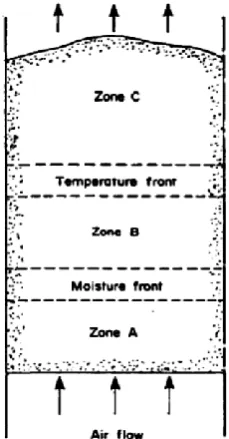
When monitoring a ventilated grain bulk the formation of three zones (A, B and C) is usually noted. These three zones are separated by two fronts (temperature and moisture) which move through the grain in the direction of airflow (Sanderson et al., 1988) is shown in Figure 1.
Figure 1 Movements of moisture and temperature front in a deep bed dryer (Sutherland et al., 1983)
1) In zone A (which begins where the air enters the grain) when the grain reaches equilibrium with the incoming air, the intergranular air and grain temperatures are equal. The grain moisture content has reached equilibrium with the vapor pressure of the incoming air.
2) The zone B, bounded by temperature and moisture fronts, is the transition zone. In the faster moving temperature front the major effect is a change in temperature from the initial grain temperature towards the air temperature.
3) In zone C, the grain temperature and moisture content have not changed from their initial values. The temperature of the intergranular air is equal to the grain temperature. The vapor pressure of the air leaving the grain mass is in equilibrium with the grain moisture content in zone C.
An associated small change in moisture content also occurs. In the slower moving moisture front, the major effect is a change in moisture, although an associated change in temperature also occurs. The drop in temperature which occurs in a drying front is due to evaporative cooling. This cooling may help to locate the drying front in a ventilated grain bulk which is subjected to drying. Similarly, Chakraverty (1994) stated that moisture ranges from 16 to 20% is wet zone, 13 to 15% drying zone and 12% is dried zone in deep bed drying.
4 Factors affecting drying
Drying is depend upon many factors, namely air temperature, air flow rate, relative humidity, exposure time, types, variety and size of grain, initial moisture content and grain depth.
4.1 Air temperature
Raghavan et al., (2007) showed that larger amount of air and high drying air temperature reduces the drying time; however, this increase the energy consumption, and damage the grain. Simmonds et al., (1953) showed that the drying rate of wheat was sharply dependent upon the temperature of air varying from 21°C to 70°C. The rate of drying increases with the rise of air temperature. But the equilibrium moisture content falls as air temperature increases. These observations are true for other grains also.
4.2 Safe drying temperature
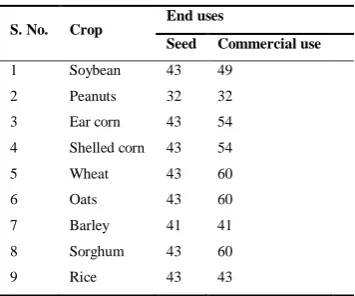
temperature than those listed may be used when the grain is dried under controlled conditions carefully, so that the maximum temperature of the kernels, at any time, does not exceed (Hall, 1980).
Table 1 Safe drying temperature (°C) of heated air for various end uses.
S. No. Crop
End uses
Seed Commercial use
1 Soybean 43 49
2 Peanuts 32 32
3 Ear corn 43 54
4 Shelled corn 43 54
5 Wheat 43 60
6 Oats 43 60
7 Barley 41 41
8 Sorghum 43 60
9 Rice 43 43
4.3 Air velocity
In deep bed drying, the length of constant-rate drying period increases between 189 and 246% when the air velocity decreases from 0.28 to 0.22 m/s; the length of falling-rate drying period increases by between 178% and 281% when the air velocity decreases from 0.28 to 0.22 m/s (Bengtsson, 2008). Woodforde et al., (1988) results show that for a particular air temperature the difference between moisture content at the top and bottom of the bed decreases with higher air flow rate. In some instances with the lower air flow rate meager drying takes place at the top of the bed (87°C and 0.94 lb min l ft2 of air). The effect of condensation is apparent, since the final moisture content is higher than the initial in the top layer. The trend for the utilization of heat improves with lower air flow rate. Henderson and Pabis, (1962) found that air rate has no observable effect on thin layer drying of wheat when air flow was turbulent Air flow rate varying from 10 to 68 cm3sec-1 had no significant effect on the drying rate of wheat. But in case of paddy and corn it has been found that air rate has some effect on rate of drying.
4.4 Initial moisture content and air humidity
It is an accepted fact that drying of the grain is essential for its safe storage. A better storability of the grain can be ensured if the moisture content is within safe
limits. As a rule of thumb, a one percent decrease in the moisture content with 5.5°C reduction in temperature of the grain doubles the storage life. Grains are often harvested at moisture content levels that are too high for safe storage. In fact, high moisture content is one of the most important factors affecting products physical, chemical, and nutrient quality during the storage period. Therefore, implementing a proper postharvest process is an essential step to have grains with a high quality (Harchegani et al., 2012).
4.5 Depth of the bin and drying time
The drying period is increased as the depth of the particles increases. As air passes up through a bed of particles, the relatively humidity (RH) of the air will increase until reaching 100%. At this point, no more drying is possible. The region between the upper boundary for dry particles to the point at which RH = 100% is called drying zone (Bengtsson, 2008). The changes of deep bed drying rate were effected at different temperatures and different bed depths. Zhang et al., (2011) showed that temperature and bed depth has an impact on the drying rate: As the air temperature is higher, the drying rate is faster and as the drying bed depth is larger, the drying rate is slower.
4.6 Air movement
on the air exit side. The pressure drop through the layer of grain depends on the rate of airflow, the physical characteristics of the grain kernels, the bed porosity, the thickness of the layer, the percentage of impurities in the grain, and the method of filling the dryer.
5 Quality changes during drying
5.1 Physical changes
Siddique and Wright (2003) proposed that during drying internal cracks, split seed coats and discoloration occurs. Membrane damage was considered as another reason of quality loss. Seyedin et al., (1984) proposed that high drying temperatures lead to membrane damage, as indicated by increased electrolyte and sugar leakage after exposure to 50°C drying temperature leading to germination loss. Herter and Burris (1989b) suggested that membrane injury due to high temperature drying was too severe so the slow imbibition could not improve membrane integrity. Moreover, Baker et al., (1991) studied the drying rate effects on seed corn viability and explained that faster drying caused greater stress on cell membranes. Siddique and Wright (2003) referred to the research of Nautiyal and Zala (1991) who reported that higher temperature and faster drying rate may cause greater membrane damage in Spanish groundnut. Air temperatures of 60 and 70°C negatively affected the physiological quality. Therefore, in order to avoid damages to adzuki beans quality, it is recommended that the drying temperature should not exceed 50°C.
5.2 Biochemical changes
Enzyme and protein denaturation are the major reasons for quality loss of grains during drying. Baker et al., (1991)stated that at least one of the enzymes, involved in the germination process, was denatured after high temperature drying. The denaturation rate directly related to both temperature and initial moisture content of grains. Meanwhile Siddique and Wright (2003) mentioned Abdalla and Roberts (1968) as well as Nellist and Hughes (1973)found that severe heat damage of seed involved inactivation of enzymes. Herter and Burris
(1989b)mentioned the literature review on heat stress and Levitt (1980) presented evidence that heat injury involved protein denaturation and that proteins become more heat tolerant at lower moisture contents. Levitt (1980) expressed that there was no injury observed with some dry grains until the temperature was high enough to break the valence bonds in proteins and other protoplasmic compounds.
Starch reduction in grain might be another cause of deterioration of grains. Seyedin et al., (1984) claimed that after drying corn at high temperature, there was a substantial reduction of starch grains in the embryonic axis while the electrolyte and sugar leakage was significantly increased. It was suggested that the starch hydrolysis in the embryonic axis caused the sugar leakage upon hydration. Dried Black gram is used for milling and making fermented products. The fermentation ability of Black gram is affected with an increase in drying temperature. As the drying temperature decreases the batter volume reduces (Tiwari et al., 2008).
6 Drying models
Drying models have been developed and used as powerful and useful tools for describing complex drying systems such as predicting the moisture content and temperature distributions inside the grain kernels, within the drying bed and optimizing the drying and tempering processes to improve the grain quality. They are helpful in designing new or improving existing drying systems or for the control of the drying operation (Sharma et al., 1982; Yang et al., 2001). Conducting drying experiments is a time and cost consuming procedure, especially for the industry. Therefore, using drying models that have a reasonable accuracy is generally preferred. Various interactions of grain and ambient air conditions can be analyzed by some approximate drying models. These basic models include (Chen and Wu, 2001);
Physical properties of air and water vapour,
Heat and mass transfer between grain and air,
Rates of heat and moisture transfer within the grain.
In many modelling cases, the solution of two or more coupled partial differential equations describing heat and mass transfer are required. Moreover, some algebraic equations used are nonlinear. These complexities make the analytical solution difficult and thus numerical solutions are preferred. According to Bronlund (1997) and Bronlund and Davey (2003), the most common methods available to solve the models numerically are
Explicit finite and implicit finite differences schemes, and
Finite elements methods.
Each of these methods has advantages and disadvantages. The easiest method to implement is the explicit finite difference scheme within which the predictions of the dependent variables are made based on known values. This method can lead to numerical instability problems, however, especially if changes in the variables are occurring quickly.
Under that situation, the implicit finite difference method should be used. In this method, the predictions are based not only on known values but also future values of the variable. For that to happen, the series of equations must be solved simultaneously. The finite element method is especially powerful and useful for solution of problems where the geometry of the system is irregular. It has been successfully used to obtain approximate solutions of complex problems in heat transfer, fluid mechanics and solid mechanics (Jia et al., 2002). The method involves the division of a continuous domain into a finite number of simple sub-domains, the elements, and the use of variational concepts to approximate any continuous quantity (temperature, moisture content, displacement) over that domain by collection of simple piecewise continuous functions defined over each element. It is more difficult to implement and most often an existing package is used.
6.1 Thin layer model
Thin layer in this context refers to the thin thickness of a grain bed within which all the kernels have almost the same exposure to the drying medium. According to ASAE (2003), ASAE (2004) and ASAE (2005), material in a thin layer is exposed fully to an air stream during drying and the depth (thickness) of the layer should be uniform and should not exceed three layers of particles. Thin layer models describe the drying phenomena in a unified way, regardless of the controlling mechanism. They have been used to estimate drying times of several products such as tea (Temple and Boxtel, 1999), rapeseed, apricots (Togrul and Pehlivan, 2002) and to generate drying curves. In their development, the moisture content of the material at any time after it has been subjected to a constant RH and temperature conditions is generally measured and correlated to the drying parameters (Togrul and Pehlivan, 2004).
The validity of a deep-bed model was found to depend on the goodness of fit of the thin-layer drying model as the deep beds of grain have been assumed to be composed of many thin layers. Thus, the thin-layer drying models that help to define the mass and energy transfer mechanisms contribute to simulation of and optimizing the design of drying and storage equipment (Noomhorm and Verma, 1986; Wongwises and Thongprasert, 2000; Iguaz et al., 2003).
A simplified form of the diffusion model has been proposed by Lewis (1921) who reasoned that the drying rate is proportional to the difference between the instantaneous moisture content of the material and its equilibrium value. Thus,
d
dt ( ) upon integrating Equation (2) we get
e)
e) exp( t)
where,
k rate constant, min-1
M moisture content at any time (% d.b), M0 initial moisture content (% d.b), and
The model is analogous to Newton's law of cooling and is based on the assumption that the resistance to moisture flow is concentrated in a layer at the surface of the drying material. This equation, also called the exponential or logarithmic model, has been widely used in grain drying studies but does not describe the complete drying curve (Sharaf-Eldeen et al.,1979),
Page (1949) introduced an empirical exponent to overcome the shortcomings of the logarithmic model. He suggested the following Equation (3):
e)
e) exp( )
where, n exponent.
The Page equation has been reported to describe well the drying behavior of cereal grains (Sharaf-Eldeen et al., 1979; Hutchinson and Otten, 1983; Jayas et al., 1991).
A number of researchers have used two and multiple-term exponential models to describe the drying data (Henderson and Henderson, 1968; Rowe and Gunkel, 1972; Henderson, 1974; Sharaf-Eldeen et al., 1980; Noomhorm and Verma, 1986; Byler et al., 1987). The two-term equation proposed by Sharaf-Eldeen et al., (1980) has been used to describe the drying data for peanuts over a wide range of moisture contents (St. John and Otten, 989 . Erte in and Yaldiz 4 stated that idilli’s model (Midilli 2002) was the best most fit the drying of eggplant, while Pardeshi et al., 9 chose Thompson’s model to be the best fit model during the drying of green peas. Ertekin and Heybeli (2014) indicate that the rational function model for mint leaf drying temperatures of 60 and 70°C and Modified Henderson Pabis-II model were superior.
6.1.1 Moisture diffusivity and activation energy
Diffusivity kinetic models are used to interpret the phenomenon of drying and thus the estimated values will be optimized by the model hypothesis such as boundary conditions, geometry, constant or variable physical and transport properties of isothermal and non-isothermal drying. Diffusion has been established that the
predominant mechanism of moisture transfer in particulate materials of biological nature is that of molecular diffusion (Brooker et al., 1974) and that the drying kinetics may be represented by Fick's second law of diffusion using Equation (4):
m
t ( m) 4 where,
m moisture content, % t time, min
D moisture diffusivity, cm2/min
The diffusion coefficient is defined as the volumetric flow rate of moisture transfer per unit area per unit thickness of grain. It is a rate term which does not directly include the driving potential which, in this case, is the moisture gradient (Henderson and Pabis, 1961; Brooker et al., 1974). The solution to the diffusion equation depends on whether the diffusion coefficient is considered to be a constant or a variable as weIl as on the boundary conditions considered. The analytic solutions of equation 2.6 for bodies of regular shape, such as sphere, cylinder and slab have been given by Newman (1931a, b) and Crank (1975). The diffusion in an infinite planar slab for long drying time is given by Akpinar (2006) in Equation (5):
o
8
∑exp( n t
4 )
n
where,
MR moisture ratio,
M moisture content at any time (% d.b), M0 is the initial moisture content (% d.b),
n 1, 2, 3, . . . the number of terms taken into consideration,
t the time of drying in second,
D effective moisture diffusivity in m2/s and L the half thickness of the slab in m.
Only the first term of Equation (5) is used for long drying times (Lopez et al.,2000), hence:
8 exp( t
The analytic solution is based on the assumption that the surface moisture content of the grain is in equilibrium with the temperature and relative humidity of the surrounding air, temperature of grain is in equilibrium with drying air, and the diffusion coefficient remain unchanged during the course of drying. Equation (6) has been commonly used in grain drying research (Becker and Sallans, 1955; Chittenden and Hustrulid, 1966; Whitaker and Young, 1972; Steffe and Singh, 1980). Experimental evidence shows that the diffusion coefficient increases with temperature of the drying air. The temperature dependence can be expressed by an Arrhenius type Equation (7)(Lopez et al.,2000; Akpinar et al.,2003).
exp( Ea
Ta)
where,
Ea the energy of activation (kJ/mol),
R universal gas constant (8.3143 kJ mol-1 K-1), Ta absolute air temperature (K), and
D0 the pre-exponential factor of the Arrhenius
equation (m2/s).
It may be observed that Equation (7) does not take into account the continuously changing moisture content during drying. Further, it is based on the assumptions that temperature and the surface moisture content of grain are in equilibrium with the surrounding. Because of these simplifying assumptions, Equation (7) does not describe the drying data over the entire range (Becker and Sallans, 1955). Limitations of this equation were soon realized, and efforts were made to correlate the diffusion coefficient with moisture content and temperature. Some researchers have also inc1uded the more realistic boundary conditions, used in solving the diffusion equation.
It has been claimed by several researchers that the diffusion coefficient varies as the drying process progresses (Parti and Dugmanics, 1990; Evin, 2012; Doymaz, 2012; Motevali et al., 2012; Han and Keum, 2011; Tanaka et al., 2015; Shittu and Raji, 2011; Khir et al., 2014; Khatchatourian, 2012; Shen et al., 2011; Kumar
et al., 2012; Manikantan et al., 2014; Lopez et al., 2014; Sharon, 2014b). The diffusion coefficient can also be related with moisture content and inlet air temperature.
It may be observed that several models have been proposed since the sixties, to describe drying curves for grains. The main feature of these models is that they take into account the changes in moisture content which occurs during drying. Some models have also included the air temperature, while others have used more realistic boundary conditions. It may also be pointed out that none of these diffusion models have been tested for describing deep bed drying behavior of grains.
6.2 Deep bed model
To develop models applicable to deep bed drying the basic assumption is that deep bed can be regarded as a series of thin layers, (Gunasekaran and Thompson, 1986; Misra and Brooker, 1980) and provided that it is possible to predict moisture changes in a thin bed, it should then be possible to do for a thick bed. This approach has been unsuccessful because the number of calculations required to reach a reasonable answer is so great that if carried out without electronic aid it would render a useful solution impracticable, and because a simplification has been made which is likely to be significantly erroneous.
In a Deep Bed Model, each thin layer modifies the quality of the air; therefore, only the first thin layer receives an invariable air flow reducing its moisture faster than subsequent layers. The earliest model to calculate the moisture at any location and time in the deep bed was done by Hukill (1947). It has been used by several authors to describe the drying process (Boyce 1965; Gunasekaran and Thompson, 1986; Lecorvaisier et al., 2010; Lopes et al., 2005; Sharon, 2015b). Some references for other deep bed models developed are presented by Morey et al., 1978; Sharp, 1982 and Parry, 1985.
7 Conclusions
drying. The postharvest losses of agricultural products in the rural areas of the developing countries can be reduced drastically by using well-designed drying systems. Among the different types of dryers, the deep bed dryer has been demonstrate to be feasible for bulk drying. Furthermore, before using the deep bed drying systems on large scale, simulation models must be performed to simulate the short and long terms performance of the drying systems with and without the storage media to estimate the drying curves of the dried products and investigate the cost benefits of the deep bed drying of agricultural products.
References
Abdalla, F.H. and E.H. Roberts. 1968. Effects of temperature, moisture and oxygen on the induction of chromosome damage in seeds of barley, broad beans and peas during storage. Annals of Botany, 32(1): 119-136.
Akpinar, E., A.Midilli, , and Y.Becer. 2003. Single layer drying behaviour of potato slices in a convective cyclone dryer and mathematical modelling. Energy Conservation Management, 44(1): 1689-1705.
ASAE. 2003. Thin-Layer Drying of Agricultural Crops. ASAE Standard S448.1 JUL01.
ASAE. 2004. Thin-Layer Drying of Agricultural Crops. ASAE S448.1 JUL01.
ASAE. 2005. Thin-Layer Drying of Agricultural Crops. ASAE Standard S448.1 JUL01.
Baker, K.D., M.R.Paulsen, and J.V. Zweden,. 1991. Hybrid and drying rate effects on seed corn viability. Transactions of the ASAE, 34(2):499-506.
Becker, H.A. and H.R. Sallans. 1955. A study of internal moisture movement in the drying of the wheat kernel. Cereal Chemistry, 32(3): 212-226.
Bengtsson, P. 2008. Experimental analysis of low-temperature bed drying of wooden biomass particles. Drying Technology, 26(5): 602-610.
Boyce, D. S. 1965. Grain moisture and temperature changes with position and time during through drying. Journal of Agricultural EngineeringResearch, 10(4): 333-341. Bronlund, J. 1997. The modelling of caking in bulk lactose. A
thesis presented for partial fulfillment of the requirements for the degree of Doctor of Philosophy in Process and Environmental Technology at Massey University. New Zealand.
Bronlund, J. and L.Davey. 2003. Introduction to Mathematical Modelling. Lecture note on concentration processes, kinetics and modeling. Massey University, New Zealand.
Brooker, Bakker-Arkema, F. W. and C. W.Hall. 1974. Grain drying systems. In I. Publishing Company (Ed.), Drying Cereal Grains (pp. 145 184). Westport, Connecticut: AVI Publishing Company, Inc.
Byler, R. K., Anderson, C. R., & Brook, R. C. 1987. Statistical methods in thin layer parboiled rice drying models. Transactions of the ASAE, 30(2):533-538.
Chakraverty, A. 1994. Post harvest technology of cereals, pulses and oilseeds, Third edition, Oxford and IBH Publishing Co. Pvt. Ltd. New Delhi.
Chen C. H. and P. C.Wu. 2001. Thin-layer drying model for rough rice with high moisture content. Journal of Agricultural Engineering Research, 80(1): 45-52. Chittenden, D. H. and A.Hustrulid. 1966. Determining drying
constants for shelled corn. Transactions of the ASAE, 9(1): 52-55.
Crank, J. 1975. The Mathematics of Diffusion. Oxford University Press, Oxford, U.K.
Doymaz, I. 2012. Evaluation of some thin-layer drying models
of persimmon slices (Diospyros kaki L.). Energy
Conversion and Management, 56(1): 199-205.
Ekechukwu, O. V. 1999. Review of solar-energy drying systems I: an overview of drying principles and theory. Energy Conversion and Management, 40(6): 593-613.
Ertekin, C. and N.Heybeli. 2014. Thin‐Layer Infrared Drying of Mint Leaves. Journal of Food Processing and Preservation, 38(4): 1480-1490.
Ertekin, C., and M. Z.Firat. 2014. A Comprehensive Review of Thin Layer Drying Models Used in Agricultural Products. Critical reviews in food science and nutrition. DOI:10.1080/10408398.2014.910493.
Ertekin, C. and O.Yaldiz. 2004. Drying of eggplant and selection of a suitable thin layer drying model. Journal of Food Engineering, 63(3): 349-359.
Evin, D. 2012. Thin layer drying kinetics of Gundelia
tournefortii L. Food and Bioproducts Processing, 90(2):
323-332.
Gunasekaran, S. and T. L.Thompson. 1986. Optimal energy management in grain drying. CRC Critical Reviews in Food Science and Nutrition, 25(1): 1-48.
Hall, C. W. 1980. Drying and storage of agricultural crops. AVI Publishing Company Inc.
Hall, C.W. 1970. Handling and Storage of Food Grains in Tropical and Subtropical Areas. FAO Agricultural Development Paper No. 90.
Han, J. W., and D. H.Keum. 2011. Thin layer drying
characteristics of rapeseed (Brassica napus L.). Journal
of Stored Products Research, 47(1): 32-38.
Henderson S. M. 1974. Progress in developing the thin layer drying equation. Transactions of the ASAE, 17(1): 1167 1172.
Henderson, J .M. and S.M.Henderson. 1968. A computational procedure for deep-bed drying analysis. Journal of Agriculture Engineering Research, 13(2):87-95.
Henderson, S.M. and S.Pabis. 1961. Grain drying theory. I. Temperature effect on drying coefficient. Journal of Agriculture Engineering Research, 6(3): 169-174. Henderson, S.M. and S.Pabis. 1962. Grain drying theory, IV.
The effect of air flow rate on the drying Index. Journal of Agriculture Engineering Research, 7(2): 85-89. Herter, U. and J.S. Burris. 1989a. Changes in moisture,
temperature, and quality of corn seed during high-temperature drying. Canadian Journal of Plant Science, 69, (3):749-761.
Herter, U. and J.S.Burris. 1989b. Preconditioning reduces the susceptibility to drying injury in corn seed. Canadian Journal of Plant Science, 69(3): 775-789.
Hukill. W.V. 1974. Grain drying. Storage of Cereal Grain and Their Products. Vol. III. C.M. Christemen (ed), 481-508. American Association of Cereal Chemistry, St. Paul, MN. Hutchinson, D. and L.Otten. 1983. Thin-layer air drying of
soybeans and white beans. International Journal of Food Science & Technology, 18(4): 507-522.
Iguaz, A., San Martin, M. B., Mate, J. I., Fernandez, T., and Virseda, P. 2003. Modelling effective moisture diffusivity of rough rice (Lido cultivar) at low drying temperatures. Journal of Food Engineering. 59(2):253-258.
Jayas, D. S., Cenkowski, S., Pabis, S., and Muir, W. E.. 1991. Review of thin-layer drying and wetting equations. Drying Technology, 9(3): 551-588.
Jayas, D. S., and White, N. D. 2003. Storage and drying of grain in Canada: low cost approaches. Food Control, 14(4): 255-261.
Jia C. C., Yang W., Siebenmorgen T. J. and Cnossen A. G. 2002. Development of computer simulation software for single grain kernel drying, tempering and stress analysis. Transactions of the ASAE, 45(5): 1485-1492.
Khatchatourian, O. A. 2012. Experimental study and mathematical model for soya bean drying in thin layer. Biosystems Engineering, 113(1): 54-64.
Khir, R., Pan, Z., Thompson, J. F., El‐Sayed, A. S., Hartsough, B. R.,
& El‐Amir, M. S. 2014. Moisture removal
characteristics of thin layer rough rice under sequenced
infrared radiation heating and cooling. Journal of Food
Processing and Preservation, 38(1): 430-440.
Kumar, K., Kumar, N., and Sharma, H. K. (2012). Mathematical modelling of thin layer drying of fresh green pea (Pisum
sativum) husk. International Journal of Postharvest
Technology and Innovation, 2(4): 400-413.
Lecorvaisier, E., Darche, S., da Silva, Z. E., and da Silva, C. K. F. 2010. Theoretical model of a drying system including
turbulence aspects. Journal of Food Engineering, 96(3): 365-373.
Lerman, P. and Wennberg, O. 2011. Experimental method for designing a biomass bed dryer. Biomass and Bioenergy, 35(1): S31-S39.
Levitt, J. 1980. Responses of Plants to Environmental Stresses, Volume 1, Academic Press, New York.
Loewer, O. J., Bridges, T. C., and Bucklin, R. A. 1994. On-farm drying and storage systems. American Society of Agricultural Engineers (ASAE).
Lopes, D. C., Martins, J. H., Neto, A. J. S., and Filho, A. J. S. 2005. Simulação da secagem de grãos com baixas temperaturas utilizando-se o modelo de Hukill: uma nova abordagem. Exacta, 3(1): 85-93.
Lopez, A., Iguaz, A., Esnoz, A., and Virseda, P. 2000. Thin-layer drying behaviour of vegetable wastes from wholesale market. Drying Technology, 18(4-5): 995-1006.
Lopez, A., Pique, M. T., Boatella, J., Ferran, A., Garcia, J., and Romero, A. 1998. Drying characteristics of the hazelnut. Drying Technology, 16(3-5): 627-649.
Lopez, R., Vaca, M., Terres, H., Lizardi, A., Morales, J., Flores, J., and Chávez, S. 2014. Kinetics Modeling of the Drying
of Chickpea (Cicer Arietinum) with Solar
Energy. Energy Procedia, 57(1): 1447-1454.
Lucia de, M., and Assennato, D. 2006. Agricultural engineering in development: post-harvest operations and management of food grains. FAO Agricultural Services Bulletin (FAO).
Manikantan, M. R., Barnwal, P., and Goyal, R. K. 2014. Drying
characteristics of paddy in an integrated dryer. Journal of
Food Science and Technology, 51(4): 813-819.
Martins J. H. and Christ D. 1999. Thin Layer Drying Rate and Loss of Viability Modelling for Rapeseed. Journal of Agricultural Engineering Research, 74(1): 33-39. Midilli, A. K., H. and Yapar, Z. 2002. A new model for
single-layer drying. Drying Technology, 20(7): 1503 1513.
Misra, MX and DB. Brooker. 1980. Thin-layer drying and rewetting equations for shelled yellow corn. Transactions of the ASAE, 23(5): 1254-1260.
Morey, R. V., Keener, H. M., Thompson, T. L., White, G. M., and Bakker-Arkema, F. W. 1978. The present status of grain drying simulation. American Society of Agricultural Engineers, paper No. 78-3009.
Motevali, A., Abbaszadeh, A., Minaei, S., Khoshtaghaza, M. H., and Ghobadian, B. 2012. Effective moisture diffusivity, activation energy and energy consumption in thin-layer
drying of Jujube (Zizyphus jujube Mill). Journal of
Agricultural Science and Technology, 14(3):523-532.
Nautiyal, P. C., and Zala, P. V. 1991. Effect of drying methods on seed viability and seedling vigour in Spanish groundnut (Arachis hypogaea L.). Seed Science and Technology, 19(2): 451-459.
Nellist, M.E. and Hughes, M. 1973. Physical and biological process in the drying of seed. Seed Science and Technology, 1(1): 613-643.
Newman, A.B. 1931a. The drying of porous solids: Diffusion calculations. Transactions of the American Institute of Chemical Engineers, 27(1):311-333.
Newman, A.B. 1931b. The drying of porous solids: Diffusion and surface emission equations. Transactions of the American Institute of Chemical Engineers, 27(1):203-220. Noomhorm, A. and Verma, L.R. 1986. Generalized single-layer
rice drying models. Transactions of the ASAE, 29(2): 587-591.
Noomhorn A. and Verma R. L. 1986. Deep-Bed Rice Drying simulation using two generalized single-layer models. Transactions of the ASAE, 29(5): 1456-1461.
Olmos A., Trelea I. C., Courtois F., Bonazzi C. and Trystram G. 2002. Dynamic optimal control of bath rice drying process. Drying Technology, 20(7):1319- 1345. Page, G.E. 1949. Factors influencing the maximum rates of air
drying shelled corn in thin layers. M.Sc. Thesis. Purdue University, U.S.A.
Pardeshi, I. L., S. Arora and P. A. Borker. 2009. Thin-layer drying of green peas and selection of a suitable thin-layer drying model. Drying Technology, 27(2):288-295. Parry, J.C. 1985. Mathematical modelling and computer
simulation of heat and mass transfer in agricultural grain drying a review. Journal of Agricultural Engineering Research, 32(1): 1-29.
Parti, M., and Dugmanics, I. 1990. Diffusion coefficient for corn drying. Transactions of the ASAE, 33(5): 1652-1656. Patindol J., Wang Y. J., Siebenmorgen T. and Jane J. F. 2003.
Properties of flours and starches as affected by rough rice drying regime. Cereal Chemistry, 80(1): 30-34.
Raghavan, V. G. S., and Sosle, V. 2007. Grain Drying. In A. S. Mujumdar (Ed.), Handbook of industrial drying (pp. 563-573). Boca Raton, FL: CRC/Taylor and Francis. Rowe, R.J. and Gunkel, W.W. 1972. Simulation of temperature
and moisture content of alfalfa during thin layer drying. Transactions of ASAE, 15(5): 805-810.
Sanderson, D. B., Muir, W. E., and Sinha, R. N. 1988. Intergranular air temperatures of ventilated bulks of wheat. Journal of Agricultural Engineering Research, 40(1): 33-43.
Senadeera, W., Bhandari, B. R. Young, G., and Wijesingbe, B. 2003. Influence of shapes of selected vegetable materials on drying kinetics during fluidized bed drying. Journal of Food Engineering, 58(3): 277-283.
Sharaf-eldeen Y. I., Blaisdell J. L. and Hamdy M. Y. 1980. A model for ear corn drying. Transaction of the ASAE 23(5):1261 1271.
Sharaf-Eldeen, Y.L, Hamdy, M.Y. and Blaisdell, J.L. 1979. Falling rate drying of fully exposed biological materials: A review of mathematical models. ASAE Paper No. 79-6522.
Sharon, M., Abirami, C. K., Alagusundaram, K., and RPS, J. Alice. 2015a. Moisture dependent physical properties of black
gram. Agricultural Engineering International: CIGR
Journal, 17(1): 181- 187.
Sharon, M., Abirami, C. V., and Alagusundaram, K. (2014). Grain
storage management in India. Journal of Post-Harvest
Technology, 2(1), 12-24.
Sharon, M., Abirami, C. V., and Alagusundaram, K. 2014b. Modeling moisture diffusivity and activation energy of high moisture black gram in an in-bin deep bed
dryer. Trends in Biosciences, 7(14): 1755-1762.
Sharon, M., Abirami, C. V., & Alagusundaram, K. 2015b. Effect of drying air temperature, bed depth and drying time on
deep bed drying of black gram using RSM. Journal of Food Legumes, 28(1): 54-60.
Sharp, J.R. (1982). A review of low temperature drying simulation models. Journal of Agricultural Engineering Research, 27(1): 169-190.
Shen, F., Peng, L., Zhang, Y., Wu, J., Zhang, X., Yang, G., and Deng, S. 2011. Thin-layer drying kinetics and quality changes of sweet sorghum stalk for ethanol production as
affected by drying temperature. Industrial Crops and
Products, 34(3): 1588-1594.
Shittu, T. A., and Raji, A. O. 2011. Thin layer drying of African Breadfruit (Treculia africana) seeds: modeling and
rehydration capacity. Food and Bioprocess
Technology, 4(2): 224-231.
Simmonds M.A., G.T. Ward and E. McEwen. 1953. The drying of wheat grain. The mechanism of drying. Transactions of Institute of Chemical Engineering, 31(1): 265-278. St. John, C. and Otten, L. 1989. Thin-layer microwave drying of
peanuts. Canadian Agricultural Engineering, 31(2), 265-270.
Steffe, J.F. and Singh, R.P. 1980. Liquid diffusivity of rough rice components. Transactions of the ASAE, 23(3): 767-774,782.
Sutherland, J. W., Banks, P. J., and Griffiths, H. J. 1971. Equilibrium heat and moisture transfer in air flow through grain. Journal of Agricultural Engineering Research, 16(4): 368-386.
Tanaka, F., Tanaka, F., Tanaka, A., and Uchino, T. 2015. Mathematical modelling of thin-layer drying according to
particle size distribution in crushed feed rice. Biosystems
Engineering, 136(1): 87-91.
Temple S. J. and Boxter B. V. A. 1999. Thin Layer Drying of Black Tea. Journal of Agricultural Engineering Research, 74(2): 167-176.
Attributes of Paddy. Drying Technology. 22(7): 1731-1754.
Tiwari, B. K., Mohan, R. J., and Vasan, B. S. 2008. Effect of different premilling treatments on dehulling of black gram (Phaseolus mungo L.). Journal of Food Processing and Preservation, 32(4): 610-620.
Togrul I. T. and Pehlivan D. 2004. Modelling of thin layer drying kinetics of some fruits under open-air sun drying process. Journal of Food Engineering, 65(3): 413-425. Togrul T. I. and Pehlivan D. 2002. Mathematical Modelling of
Solar Drying of Apricots in Thin Layers. Journal of Food Engineering, 55(3):209-216.
Trim, D. S., and Robinson, A. P. 1994. Drying methods. FAO Agricultural Services Bulletin (FAO).
Valentini, S.R. De T., Biagi, J.D. and Gomes, R.A.R. 1999. Effect of drying processes on peroba-rosa (Aspidosperma
polyneuron M. Arg.) seed germination. Seed Science and Technology, 27(1): 283-290.
Whitaker, T.B. and J.H. Young. 1972. Simulation of moisture movement in peanut kernels: Evaluation of the diffusion equation. Transactions of the ASAE, 15(1):163-166. Wongwises S. and Thongprasert M. 2000. Thin Layer and Deep
Bed Drying of Long Grain Rough Rice. Drying Technology, 18(7): 1583-1599.
Woodforde J. and Lawton P.J. 1988. Drying cereal grain in beds Six inches deep. Journal of Food Engineering, 10(2):
146-171.