The Role of Cloud-MANET Framework in the
Internet of Things (IoT)
https://doi.org/10.3991/ijoe.v14i12.8338
Tanweer Alam(*), Mohamed Benaida Islamic University of Madinah, Madinah, Saudi Arabia
Abstract—In the next generation of computing, Mobile ad-hoc network (MANET) will play a very important role in the Internet of Things (IoT). The MANET is a kind of wireless networks that are self-organizing and auto con-nected in a decentralized system. Every device in MANET can be moved freely from one location to another in any direction. They can create a network with their neighbors’ smart devices and forward data to another device. The IoT-Cloud-MANET framework of smart devices is composed of IoT, cloud compu-ting, and MANET. This framework can access and deliver cloud services to the MANET users through their smart devices in the IoT framework where all com-putations, data handling, and resource management are performed. The smart de-vices can move from one location to another within the range of the MANET network. Various MANETs can connect to the same cloud, they can use cloud service in a real time. For connecting the smart device of MANET to cloud needs integration with mobile apps. My main contribution in this research links a new methodology for providing secure communication on the internet of smart de-vices using MANET Concept in 5G. The research methodology uses the correct and efficient simulation of the desired study and can be implemented in a frame-work of the Internet of Things in 5G.
Keywords—Mobile Ad Hoc Networks (MANET), Cloud Computing, Internet of Things (IoT), Smart Devices, 5G Network.
1
Introduction
Internet of Things. The most wireless network of today consists of cells. Each cell con-tains a base station that can be wired or wirelessly connected [2]. The smart devices have a very useful feature of Wi-Fi Direct [3]. Using this feature any device can connect to each other and form an ad hoc network [4]. If one device has internet then this device can connect to the cloud and create an internet of smart devices network. It is expected that by 2020, the development of the internet of smart devices connected together ex-ponentially with 50 billion smart devices [5]. This development will not depend on mankind’s population but the reality that units we utilize consistently (See fig 1 for statistics between 2003-2020) [6]. The reality of interconnectedness things is cooperat-ing man to machines and machine to another machine. They will be talkcooperat-ing to each other [7]. But Monitoring and tracking of movable devices are one of the most compre-hensive issues [8].
Fig. 1. IOT device statistics between 2003-2020 [43]
This evolutionary paradigm enables its users to deploy a connection to a network of computing resources in an effortless fashion, where users can rapidly scale up or down their demands with trivial interaction from the service provider [9].
1.1 The growth of the Internet of Things
Fig. 2. Siemens Analysis of the growth of cloud-based data vs. total data [17]
Connection using ubiquitous computing that uses the fixed cell network or mobility by using sensor connectivity [18]. These technologies should be enhanced regularly so that it allows the progress of internet of smart devices including multi-sensor frame-work to store, compute, analyze and process capabilities with smaller in size and lowest energies required [19]. The main contribution of this article links a new secure commu-nication model using cloud computing and MANET technologies in the area of the internet of things. The communication security idea depends on three main points in the designing of the internet of things architecture [20]. It is not easy to manage infor-mation getting from millions of sensors in a centralized framework of smart devices collection [21]. It is not easy to manage network resources in a large network that can collect environment information from the centralized framework [22]. It is very hard to manage sensors that execute the same kind of data parallel and stored in the centralized framework. According to Siemens research, up to 2020, near about 26 billion physical objects will be connected together on the internet (See fig 2) [23]. That time is not far away when billions of physical things linked together in real time. They can communicate with each other and forwarding and process required data in the cloud. But there is a lack of technical standardization security perspective on the internet of smart thing.
1.2 Cloud Computing
Cloud computing has been regarded as one of the most popularized computing adigms [24]. It came likewise an outcome for developments done past computing par-adigms which incorporate parallel computing, grid computing, disseminated computing also other computing paradigms [25]. Cloud computing gives its customers three es-sential administration models: SaaS, PaaS, and IaaS. Software as a service (SaaS) is mainly intended to end users who need to use the software as a part of their daily activ-ities [26]. Platform as a service (PaaS) is mainly intended for application developers who need platforms to develop their software or application [27]. Infrastructure as a
0% 10% 20% 30% 40% 50% 60% 70% 80% 90% 100%
2005 2010 2012 2015 2020
service (IaaS) is mainly intended to network architects who need infrastructure capa-bilities [28].
1.3 Cloud-MANET Model
The smart device to smart device communication in the cloud-MANET framework of the internet of things is a novel methodology that discovers and connected nearby smart devices with no centralized infrastructure [29]. The proposed technique will be very useful in machine to machine (M2M) networks because, in the M2M network, there are several devices nearby to each other. The smart device users will use cloud service to discover the devices, minimize useful information in big data and can process videos, images, text, and audio. In the proposed framework, the smart device will con-sider as service nodes.
1.4 Motivation
The MANET is a very popular network to get connected anywhere at any time [30]. Cloud provides service for storing and accessing information. The integration of cloud and MANET provides the facilities to access the cloud inside MANET of smart devices. In real life situation, the group of smart device users wants to connect to each other in a meeting at a place where no network services are present. These users may form MANET among smart devices. Also, they can use cloud service only if one device has internet in the group.
1.5 Research organization
The organization of the rest of the research paper is as follows: 1- Introduction, 2- Cloud-MANET in IoT, 3-Communication security issues, 4- Working with proposed research and 5-represents the conclusion.
1.6 Research contributions
can be very efficient and useful to save power as well as the efficiency of spectrums. The cloud-based services in MANET modeling for the device to device communication can be a very useful approach to enhance the capabilities of smart devices. The smart device users will use cloud service to discover the devices, minimize useful information in big data and can process videos, images, text, and audio.
2
Cloud-MANET in IoT
2.1 Discovering the smart devices in MANET
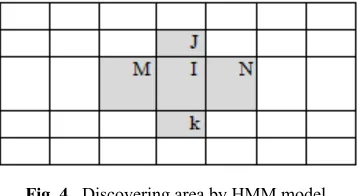
The Ad hoc network can connect all smart devices in the decentralized system [31]. The smart devices are located on the 3D plane in the directions of the x-axis, y-axis, and z-axis. The whole area is divided into cells over the wireless network. The area of all cells is fixed so that the smart devices can travel within the range of MANET Cell [32]. The smart device discovers the neighborhood devices in a binary digit within the same cell area. For discovering the smart devices, the hidden Markov model (HMM) is utilized in the 2Dimensional plane area. This model is connected to the working area and devices move inside the area and this model found neighborhood devices within the range [33]. We form the transition matrix in the area of the wireless network, dis-cover all the smart devices and put in the transition matrix. The following parameters are used for discovering the smart devices. This model contains the following parame-ters. Let S=S1, S2………SN where S=state, S1 is the first state, S2 is the second state and so on [34].
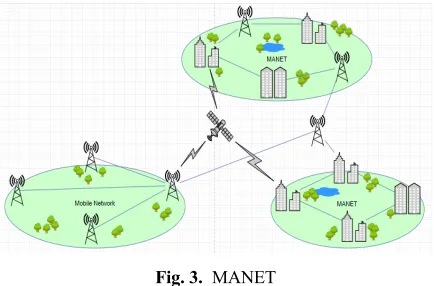
Fig. 3. MANET
Fig. 4. Discovering area by HMM model
The smart devices in MANET can be used to discover the signals using the Viterbi algorithm. Let O1, O2,. . . , On are the observation of discovering the devices. Every smart device sends a report of observations in meanwhile. This algorithm discovers the way at each step by maximizing the likelihood. This process is so expensive and time consuming for the rush of devices. The matrix represents the information in every cell. When the smart device enters in a new cell, it removes previous data and updates the information with the new data. For discovering the smart devices, the gradient model (GM) works to find the devices and share the ideas to development and send the infor-mation. GM finds the gradient distribution over the time. If time=0 then the gradient value will be 1. If time is greater than the total time then the value of the gradient will be 0. Otherwise, the gradient is proportional to one upon time power of the event.
Table 1. PBM, HMM vz. GM statistics
PBM HMM GM
Average Path Length 8 8.3 15
Average Stretch Factor 2.2 2.3 3.91
Success Rate 96.5% 95% 89.5%
So, the achievement rate of the PBM model is best in the examination of HMM and Gradient Model. So, we utilize the PBM model for outlining the Ad Hoc Network among smart devices.
2.2 Place smart devices in the range of MANET
The smart devices are put within range of MANET that considers coverage and con-nectivity. Every smart device is expected to have a connection and an altered corre-spondence range. At first, MANET has a dynamic state. MANET is inactive all the time, when one device wants to make the connection with another device then it creates the connection with their neighborhood within the discovering area. A resting smart device additionally occasionally awakens to enter into a ready state. The ready state detects the devices and comes back to the dynamic state.
2.3 Implement MANET
The smart device to smart device communication in the IoT-MANET framework is a novel methodology that discovers and connected nearby smart devices with no cen-tralized infrastructure. The existing cellular network doesn’t allow connecting all smart devices without centralized infrastructure even if they are very near to each other. The proposed technique will be very useful in machine to machine (M2M) networks be-cause, in the M2M network, there are several devices nearby to each other. So, the implementation of MANET model in the smart device to smart device communication can be very efficient and useful to save power as well as the efficiency of spectrums. The cloud-based services in MANET modeling for the device to device communication can be a very useful approach to enhance the capabilities of smart devices [36]. The smart device users will use cloud service to discover the devices, minimize useful in-formation in big data and can process videos, images, text, and audio. In this article, I proposed a new framework to enhance the capability of MANET and cloud computing on the internet of smart devices that can be useful in the 5G heterogeneous network. In the proposed framework, the smart device will consider as service nodes. This model also covers the security and reliability as well as vulnerability issue of communication. The smart devices are electronic devices that are connected to other devices or network through network protocols such as a smartphone, tablets, smartwatch etc. The cloud computing enables sharing the resources, storages, and services using mobile applica-tions. This study is focused on secure communication among smart devices in the area of Cloud-MANET. In Cloud-MANET, the smart devices are dynamically joined and created a network on their own called MANET and they can access cloud service [37]. This algorithm is implemented as a mobile application and tested in cloud-MANET of smart devices. The results are found positive and can be implemented in the framework of the internet of things in 5G heterogeneous networks.
The cloud-MANET framework of smart devices is composed of cloud computing and MANET [39]. This framework can access and deliver cloud services to the MANET users through their smart devices where all computations, data handling, and resource management are performed. The smart devices can move from one location to another. Various MANETs can connect to the same cloud, they can use cloud service in a real time. For connecting the smart device of MANET to cloud needs integration with mo-bile apps. The MANET model of smart devices in a local communication can work very well using the cloud, it is failed when it connects in exist wired networking frame-work. For working in wireless and wired infrastructure, an access point will be required like gateways. The communication process to connect a smart device with another de-vice in the cloud-MANET framework, every smart dede-vice must be configured univer-sally using routing IP address [39]. Also, every device requires searching neighbor de-vice as well as gateways that use its prefixed and assign the universally routing IP ad-dresses. When these devices will connect to each other using cloud services then the main issue is the security of communication. The question is arising here how is the communication secure in the public cloud and MANET model? The proposed algo-rithm for secure communication in the IoT-MANET model is implemented and inte-grated with mobile apps. Java programming is used to develop a mobile app. This mo-bile app should be installed on every smart device of MANET infrastructure. The ex-periment was conducted using the smart device with proposed research implementation and other existing algorithms were installed on same configuration devices. We notice the performance of the proposed research was better than all existing algorithms.
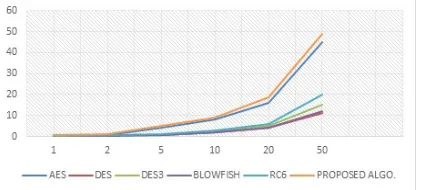
Fig. 6. Algorithms performance in comparisons of block size and time is taken.
In the future, this algorithm may be integrated with Wi-Fi Direct protocol and im-plement it on smart devices. The experimental results of the proposed algorithm have a better performance than all other existing algorithms. DES algorithm showed the poor performance while RC6 showed very good performance. This study can play very im-portant roles in the framework of the Internet of Things where smart devices will communicate with each other securely.
3
Working with proposed research
nodes and connectivity also resources such as storage and energy efficiency [40]. In Cloud computing, cloud providers retain network infrastructure, storage facilities, and software applications that support flexibility, efficiency, and scalability [41]. In Cloud MANET mobility model, smart devices of MANET can communicate with each other but at least one smart device must be connected to cellular or Wi-Fi networks. All smart devices of MANET should be registered in cloud individually. The proposed model will activate in disconnected mode. When a MANET is activated then cloud services will activate in a real-time and provide services to the smart devices of MANET [42]. The smart devices send a request to the cloud for a session of connectivity. Cloud pro-vides the best connection to the smart device. The expression in the integral will be 0 if the limit tends to ∞. After computing session life by using the above probabilistic function, every smart device requires computing the values of σ and µ. These two pa-rameters are related to the connection establishment among MANETs and Cloud ser-vice that can be measured through smart deser-vices using the following function. eµ(1/2)σ2. When a smart device estimates the connection life between MANET and Cloud, it will transfer or receive data securely. The connection will be activated and stability will be high. We consider that every smart device is assured to establish the route between MANET and cloud when they create a session in the cloud. The smart devices can move through the maximum speed 20m/s from one location to another lo-cation by using the Gauss-Markov mobility model. The proposed framework consists of three algorithms. The firstly discover the smart devices within the range of MANET then discovering the gateway point to connect to the cloud and the thirdly is used to establish a connection, provide session and transfer data from one smart device to an-other using cloud as a service.
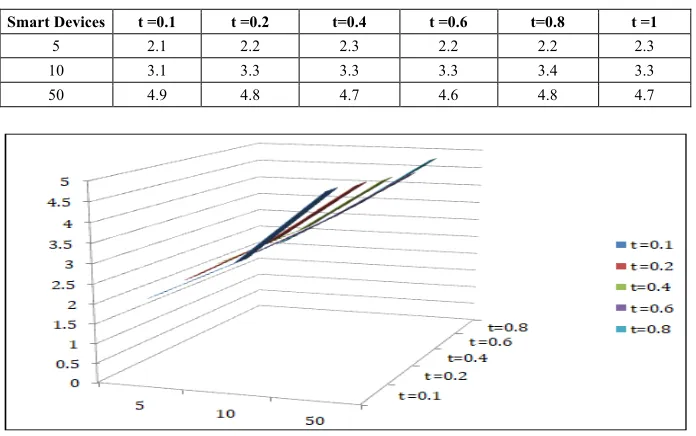
Table 2. Transmission in Cloud-MANET of Smart devices at 10 m/s. Smart Devices t =0.1 t =0.2 t=0.4 t =0.6 t=0.8 t =1
5 2.1 2.2 2.3 2.2 2.2 2.3
10 3.1 3.3 3.3 3.3 3.4 3.3
50 4.9 4.8 4.7 4.6 4.8 4.7
Table 3. Transmission in Cloud-MANET of Smart devices at 20 m/s. Devices t =0.1 t =0.2 t =0.4 t =0.6 t =0.8 t =1
5 2 2.1 2 2.2 2.5 2.4
10 3 3.2 3.1 3.5 3.4 3.3
50 7 7.2 7.5 7.8 7.4 7.3
Fig. 8. Transmission in Cloud-MANET of Smart devices at 20 m/s.
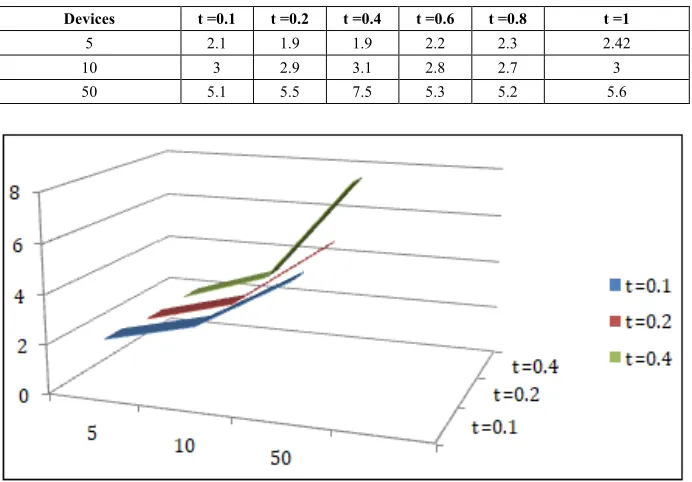
Table 4. Transmission in Cloud-MANET of Smart devices at 50 m/s. Devices t =0.1 t =0.2 t =0.4 t =0.6 t =0.8 t =1
5 2.1 1.9 1.9 2.2 2.3 2.42
10 3 2.9 3.1 2.8 2.7 3
50 5.1 5.5 7.5 5.3 5.2 5.6
The following algorithm is used to find the new position of the smart devices in MANET.
Current Location:- Location L1=getNewLocation (new Point(x1,y1)); New location:- Location L2=getNewLocation (new Point(x2,y2));
Find distance between L1 and L2:- Distance (d)=√(x2-x1)2-(y2-y1)2 Find random location (X, Y) of smart device at the diagonal of triangle. X=Math.random(d.getX());
Y=Math.random(d.getY());
Find the actual location of the smart device according to the diagonal of the triangle. The device may be up or down from diagonal. If the device is upper than the diagonal then increase the value of X and Y as follows.
X= X + ∆X; Y= Y + ∆Y ; Otherwise X= X − ∆X; Y= Y − ∆Y;
Return the new Location(X, Y)
The following algorithm will compute the velocity of smart devices in the Cloud-MANET framework.
Input: Number of smart devices, transmission function value (t). Output: Velocities of smart devices.
Initialization: Counter=0, V=0.
Step 1: Find all the probabilities of smart devices in each direction. Step 2: Find entropy per symbol.
Step 3: Find Transmission in bits/sec. Step 4: Find velocity (V) in m/s. Step 5: Counter=Counter+1;
if counter < Number of devices go to step 2 otherwise stop.
The complexity of the algorithm is O(n2).
4
Conclusion
This study enhances the role of a Cloud-MANET framework for communication among internet of smart devices. The research outcome is to establish a new framework in IoT. The proposed research is used the correct and efficient simulation of the desired study and can be implemented in a framework of the Internet of Things. The cloud-based services in MANET modeling for the device to device communication can be a very useful approach to enhance the capabilities of smart devices. The smart device users will use cloud service to discover the devices, minimize useful information in big data and can process videos, images, text, and audio. The proposed algorithm for the communication in the IoT-MANET model is implemented and integrated with mobile apps. Java programming is used to develop such mobile apps.
5
References
[1]Tanweer Alam, "A Reliable Communication Framework and Its Use in Internet of Things (IoT)", International Journal of Scientific Research in Computer Science, Engi-neering and Information Technology (IJSRCSEIT), ISSN: 2456-3307, Volume 3, Issue 5, pp.450- 456, May-June.2018 URL: http://ijsrcseit.com/CSEIT1835111
[2]Nasser, N., Hasswa, A. and Hassanein, H., 2006. Handoffs in fourth generation hetero-ge-neous networks. IEEE Communications Magazine, 44(10), pp.96-103. https://doi.org/10.1109/MCOM.2006.1710420
[3]Want, R., Schilit, B.N. and Jenson, S., 2015. Enabling the internet of things. Computer, 48(1), pp.28-35. https://doi.org/10.1109/MC.2015.12
[4]Pelusi, L., Passarella, A. and Conti, M., 2006. Opportunistic networking: data for-warding in disconnected mobile ad hoc networks. IEEE Communications Maga-zine, 44(11). https://doi.org/10.1109/MCOM.2006.248176
[5] https://www.cisco.com/c/en/us/solutions/collateral/enterprise/cisco-on-cisco/Cisco_IT_Trends_IoE_Is_the_New_Economy.html
[6]Statista. Internet of Things (IoT): number of connected devices worldwide from 2012 to 2020, [online], URL =http://www.statista.com/statistics/471264/iot-number-of-connected-devices-worldwide, 2016.
[7]T. Alam and M. Aljohani, "An approach to secure communication in mobile ad-hoc net-works of Android devices," 2015 International Conference on Intelligent Informat-ics and Biomedical Sciences (ICIIBMS), Okinawa, 2015, pp. 371-375. https://doi.org/10.1109/ICII BMS.2015.7439466
[8]T. Alam and M. Aljohani, "Design and implementation of an Ad Hoc Network among An-droid smart devices," 2015 International Conference on Green Computing and In-ternet of Things (ICGCIoT), Noida, 2015, pp. 1322-1327. https://doi.org/10.1109/ICGCIoT. 2015.7380671
[9]M. Aljohani and T. Alam, "An algorithm for accessing traffic database using wireless tech-nologies," 2015 IEEE International Conference on Computational Intelligence and Compu-ting Research (ICCIC), Madurai, 2015, pp. 1-4. https://doi.org/10.1109/ICCIC.2015. 7435818
Intelligence and Computing Research (ICCIC), Madurai, 2015, pp. 1- 5. https://doi.org/10.1109/ICCIC.2015.7435817
[11]Tanweer Alam and Mohammed Aljohani. 2016. Design a New Middleware for Com-muni-cation in Ad Hoc Network of Android Smart Devices. In Proceedings of the Sec-ond Inter-national Conference on Information and Communication Technology for Competitive Strat-egies (ICTCS '16). ACM, New York, NY, USA, Article 38, 6 pages. https://doi.org/10.1145/ 2905055.2905244
[12]Aljohani, Mohammed, and Tanweer Alam. "Real Time Face Detection in Ad Hoc Net-work of Android Smart Devices." Advances in Computational Intelligence: Proceed-ings of Inter-national Conference on Computational Intelligence 2015. Springer Singa-pore, 2017.DOI: https://doi.org/10.1007/978- 981-10-2525-9_24
[13]Alam, Tanweer. "Middleware Implementation in Cloud-MANET Mobility Model for Inter-net of Smart Devices", International Journal of Computer Science and Network Security, 17(5), 2017. Pp. 86-94.
[14]Sharma, Abhilash, Tanweer Alam, and Dimpi Srivastava. "Ad Hoc Network Architec-ture Based on Mobile Ipv6 Development." Advances in Computer Vision and Infor-mation Technology (2008): 224.
[15]Alam, Tanweer. "Fuzzy control based mobility framework for evaluating mobility models in MANET of smart devices." ARPN Journal of Engineering and Applied Sci-ences 12.15 (2017): 4526-4538.
[16]Singh, Parbhakar, Parveen Kumar, and Tanweer Alam. "Generating Different Mobility Sce-narios in Ad Hoc Networks.", International Journal of Electronics Communica-tion and Computer Technology, 4(2), 2014
[17]Zanella, A., Bui, N., Castellani, A., Vangelista, L. and Zorzi, M., 2014. Internet of things for smart cities. IEEE Internet of Things journal, 1(1), pp.22-32.
[18]Estrin, D., Culler, D., Pister, K. and Sukhatme, G., 2002. Connecting the physical world with pervasive networks. IEEE pervasive computing, 1(1), pp.59-69. https://doi.org/10.1109/MPRV.2002.993145
[19]Botta, A., De Donato, W., Persico, V. and Pescapé, A., 2016. Integration of cloud com-puting and internet of things: a survey. Future Generation Computer Systems, 56, pp.684-700. https://doi.org/10.1016/j.future.2015.09.021
[20]Atzori, L., Iera, A. and Morabito, G., 2010. The internet of things: A survey. Computer networks, 54(15), pp.2787-2805. https://doi.org/10.1016/j.comnet.2010.05.010
[21]Akyildiz, I.F., Su, W., Sankarasubramaniam, Y. and Cayirci, E., 2002. Wireless sensor net-works: a survey. Computer networks, 38(4), pp.393-422. https://doi.org/10.1016/S1389-1286(01)00302-4
[22]D. Chakraborty, A. Joshi, Y. Yesha, and T. Finin. Toward distributed service discov-ery in pervasive computing environments. IEEE Transactions on Mobile Computing, 5(2):97–112, Feb 2006. https://doi.org/10.1109/TMC.2006.26
[23] https://www.siemens.com/innovation/en/home/pictures-of-the-future/digitalization-and-software/internet-of-things-facts-and-forecasts.html
[24]Zhang, Q., Cheng, L. and Boutaba, R., 2010. Cloud computing: state-of-the-art and re-search challenges. Journal of internet services and applications, 1(1), pp.7-18. https://doi.org/10.1007/s13174-010-0007-6
[25]Alam, Tanweer, and B. K. Sharma. "A New Optimistic Mobility Model for Mobile Ad Hoc Networks." International Journal of Computer Applications 8.3 (2010): 1-4.
[27]Alam, Tanweer, et al. "Scanning the Node Using Modified Column Mobility Model." Com-puter Vision and Information Technology: Advances and Applications (2010): 455. [28]Alam, Tanweer. " A reliable framework for communication in internet of smart devices
us-ing IEEE 802.15.4." ARPN Journal of Engineerus-ing and Applied Sciences 13.10 (2018) [29]Alam, Tanweer, Parveen Kumar, and Prabhakar Singh. "SEARCHING MOBILE NODES
USING MODIFIED COLUMN MOBILITY MODEL.", International Journal of Computer Science and Mobile Computing, (2014).
[30]Pelusi, L., Passarella, A. and Conti, M., 2006. Opportunistic networking: data for-warding in disconnected mobile ad hoc networks. IEEE communications Magazine, 44(11). https://doi.org/10.1109/MCOM.2006.248176
[31]Conti, M. and Giordano, S., 2007. Multihop ad hoc networking: The reality. IEEE Commu-nications Magazine, 45(4). https://doi.org/10.1109/MCOM.2007.343617
[32]Li, F. and Wang, Y., 2007. Routing in vehicular ad hoc networks: A survey. IEEE Ve-hicular technology magazine, 2(2). https://doi.org/10.1109/MVT.2007.912927
[33]Sparacino, F., Wren, C., Azarbayejani, A. and Pentland, A., 2002, June. Browsing 3-D spaces with 3-D vision: body-driven navigation through the Internet city. In null (p. 224). IEEE.
[34]Gallager, R.G., 1996. Markov Processes with Countable State Spaces. In Discrete Sto-chas-tic Processes (pp. 187-222). Springer, Boston, MA. https://doi.org/10.1007/978-1-4615-2329-1_6
[35]Tierney, L., 1994. Markov chains for exploring posterior distributions. the Annals of Statis-tics, pp.1701-1728.
[36]Huang, D., Zhang, X., Kang, M. and Luo, J., 2010, June. MobiCloud: building secure cloud framework for mobile computing and communication. In 2010 fifth IEEE inter-national symposium on service oriented system engineering (pp. 27-34). Ieee. https://doi.org/10.1109/SOSE.2010.20
[37]Bonomi, F., Milito, R., Zhu, J. and Addepalli, S., 2012, August. Fog computing and its role in the internet of things. In Proceedings of the first edition of the MCC workshop on Mobile cloud computing (pp. 13-16). ACM. https://doi.org/10.1145/2342509.2342513
[38]Bai, F. and Helmy, A., 2004. A survey of mobility models. Wireless Adhoc Networks. Uni-versity of Southern California, USA, 206, p.147.
[39]Zhou, B., Dastjerdi, A.V., Calheiros, R.N., Srirama, S.N. and Buyya, R., 2015, June. A con-text sensitive offloading scheme for mobile cloud computing service. In Cloud Computing (CLOUD), 2015 IEEE 8th International Conference on (pp. 869-876). IEEE. https://doi.org/10.1109/CLOUD.2015.119
[40]Angin, P., 2013. Autonomous Agents-Based Mobile-Cloud Computing (Doctoral dis-serta-tion, Purdue University).
[41]Dantu, K., Rahimi, M., Shah, H., Babel, S., Dhariwal, A. and Sukhatme, G.S., 2005, April. Robomote: enabling mobility in sensor networks. In Proceedings of the 4th in-ternational symposium on Information processing in sensor networks (p. 55). IEEE Press. https://doi.org/10.1109/IPSN.2005.1440957
[42]Bhardwaj, S., Jain, L. and Jain, S., 2010. Cloud computing: A study of infrastructure as a service (IAAS). International Journal of engineering and information Technol-ogy, 2(1), pp.60-63.
6
Authors
Tanweer Alam is with the Department of computer science, the Islamic University
of Madinah since 2013. He is awarded by Ph.D. (Computer Science and Engineering), M.Phil. (Computer Science), MTech (Information Technology), MCA (Computer Ap-plications) and M.Sc. (mathematics). His area of research including Mobile Ad Hoc Network (MANET), Smart Objects, Internet of Things, Cloud Computing and wireless networking. He is a single author of twelve books. He is the member of various associ-ations such as International Association of Computer Science and Information Tech-nology (IACSIT), International Association of Engineers, Internet Society (ISOC), Computer Science Teachers Association (CSTA), Indian Society of Technical Educa-tion (ISTE) etc. His Scopus Author Id is 57189067051 and Researcher Id is M-7780-2017 ([email protected]).
Mohamed Benaida is an Assistant Professor in the Islamic University of Madinah
faculty of computer science and information systems and received his Bachelor of Sci-ence in Computer SciSci-ence and information systems at Salford University and a Masters in Computer Aided Product Development and Engineering Management, and he re-ceived his Ph.D. in usability from Salford University (United Kingdom). His main area of research interest is Human-Computer Interaction includes; Usability, language and web design and Internet of Things ([email protected]).
![Fig. 1. IOT device statistics between 2003-2020 [43]](https://thumb-us.123doks.com/thumbv2/123dok_us/565422.2055815/2.595.190.409.304.396/fig-iot-device-statistics.webp)
![Fig. 2. Siemens Analysis of the growth of cloud-based data vs. total data [17]](https://thumb-us.123doks.com/thumbv2/123dok_us/565422.2055815/3.595.144.452.147.298/fig-siemens-analysis-growth-cloud-based-data-total.webp)