CURRICULUM AND EDUCATION ARTICLE
“
Are Humans Evolving?
”
A Classroom Discussion
to Change Student Misconceptions Regarding
Natural Selection
Tessa M. Andrews&Steven T. Kalinowski& Mary J. Leonard
Published online: 28 June 2011
#Springer Science+Business Media, LLC 2011
Abstract Natural selection is an important mechanism in the unifying biological theory of evolution, but many undergraduate students struggle to learn this concept. Students enter introductory biology courses with predict-able misconceptions about natural selection, and traditional teaching methods, such as lecturing, are unlikely to dispel these misconceptions. Instead, students are more likely to learn natural selection when they are engaged in instruc-tional activities specifically designed to change misconcep-tions. Three instructional strategies useful for changing student conceptions include (1) eliciting naïve conceptions from students, (2) challenging nonscientific conceptions, and (3) emphasizing conceptual frameworks throughout instruction. In this paper, we describe a classroom dis-cussion of the question “Are humans evolving?” that employs these three strategies for teaching students how natural selection operates. Our assessment of this activity shows that it successfully elicits students’ misconceptions
and improves student understanding of natural selection. Seventy-eight percent of our students who began this exercise with misconceptions were able to partially or completely change their misconceptions by the end of this discussion. The course that this activity was part of also showed significant learning gains (d = 1.48) on the short form of the Conceptual Inventory of Natural Selection. This paper includes all the background information, data, and visual aids an instructor will need to implement this activity.
Keywords Evolution . Natural selection . Science education . Active learning . Conceptual change . Human evolution . College biology
Introduction
In order to learn, students must actively construct knowl-edge by linking new concepts with prior ideas (Jones and Brader-Araje 2002). Not surprisingly then, students learn more when they analyze, synthesize, and evaluate ideas in the classroom than when they merely listen to lectures (Hake 1998a; Bonwell and Eison 1991). There are many ways to stimulate such thinking during lectures; small group discussions, for example, are particularly effective at increasing learning and motivation (Smith et al. 2009; Springer et al.1997). Alternatively, instructors can use part of a class period to have students write, analyze data, or solve problems (Bonwell and Eison 1991; Hake 1998b; Crouch and Mazur 2001). A growing body of literature Electronic supplementary material The online version of this article
(doi:10.1007/s12052-011-0343-4) contains supplementary material, which is available to authorized users.
T. M. Andrews (*)
:
S. T. KalinowskiDepartment of Ecology, Montana State University, 310 Lewis Hall,
Bozeman, MT 59717, USA e-mail: [email protected]
M. J. Leonard
shows that such activities, often called interactive engage-ment or active learning (AL), tend to be twice as effective as standard lectures (e.g., Hake1998a; Crouch and Mazur
2001; Knight and Wood 2005).
Although instruction that employs AL is more effective than lecturing, AL strategies alone are unlikely to help students recognize and replace misconceptions. Natural selection is one of the most important biological processes for introductory biology students to understand, but many students enter introductory biology courses with preexisting ideas that prevent them from learning how natural selection operates (Mayr1982; Bishop and Anderson1990; Greene
1990; Lord and Marino1993; Gregory2009). For example, students often believe that evolution occurs as individuals change—either because they need to, because they use or disuse body parts, or because the environment directly changes them (Gregory 2009). Such misconceptions are remarkably resistant to instruction. Simply telling students that these ideas are incorrect is almost completely ineffec-tive, and students are very likely to retain misconceptions after taking traditional lecture-based courses. Nehm and Reilly (2007) reported that 86% of students completing a traditional introductory biology course had at least one major miscon-ception regarding natural selection. When Nehm and Reilly added active learning to their course, students’understanding of natural selection increased, but 70% of students still retained misconceptions (Nehm and Reilly2007).
Instruction is much more effective when teachers use active learning strategies specially designed to change student misconceptions. There are a variety of instructional approaches available for teaching for conceptual change (TCC). In the approach we describe here, three instructional strategies are useful for helping students replace miscon-ceptions with scientific conmiscon-ceptions: (1) eliciting students’ naive conceptions, (2) challenging non-scientific concep-tions, and (3) emphasizing conceptual frameworks (Posner et al. 1982; Vosniadou 2008). Metacognition—or consid-ering one’s own thinking, learning, and knowing—is an important component of each of these three strategies of TCC. In order to correct a misconception, a student must continually monitor what she is learning, how it relates to what she already knows, and how her thinking may be changing (Hewson et al.1998).
Multiple examples of a concept help prepare students to transfer their knowledge to novel questions (Bransford et al.
2000; Catrambone and Holyoak1989) while facilitating the TCC strategies described above. Experts in biology organize their knowledge around larger concepts, such as natural selection, but students need practice with multiple examples of these concepts in order to be able to recognize when the concept is relevant to a new problem (Bransford et al.2000). By presenting multiple examples and pointing out similarities and differences between the examples,
instructors help students make connections and see mean-ingful patterns that may seem obvious to the instructor, but may have gone unnoticed by the student (Bransford et al.
2000). Students who learn to recognize these patterns will build more sophisticated conceptual frameworks and will be more likely to transfer their understanding to new questions (Bransford et al.2000; Catrambone and Holyoak
1989).
Educators and researchers have made many calls for instruction that teaches for conceptual change (Bransford et al. 2000; Alters and Nelson 2002; Hestenes 1979; Kalinowski et al.2010; Nelson2008). Biology instructors are beginning to answer this call for classroom and lab activities (Heitz et al. 2010; Kalinowski et al.2006a, b), but there are still too few TCC activities for introductory biology courses. The purpose of this paper is to describe a classroom activity that uses TCC strategies to teach students how natural selection works. Essentially, the lesson is a class discussion in which students attempt to answer the question“Are humans evolving?”This activity can be used in a class of any size and requires no special materials. We designed this activity to elicit students’ conceptions about natural selection, to challenge miscon-ceptions that students have, and to emphasize conceptual frameworks. The activity provides students with detailed examples of natural selection at work. In this paper, we will describe the classroom activity, provide background information an instructor would need to use the activity, and present data which show that this activity effectively corrects common misconceptions about natural selection.
Activity Description
The fundamental goal of this activity is to improve students’ understanding of natural selection. More specif-ically, this classroom activity had the following objectives:
1. Elicit student misconceptions about natural selection; 2. Facilitate rejection of non-scientific ideas about natural
selection; and
3. Engage students in an activity they perceive to be interesting and valuable.
Before using this activity, instructors will need to describe the basic mechanisms of natural selection. In our course, we preceded the human evolution discussion with a lecture that emphasized there are three requirements for natural selection: variation for a trait in a population, heritability of the trait, and differential reproductive success.
“Human Evolution Question,” on index cards. Written responses are important because writing forces students to clarify their thoughts, and the index cards can be collected to provide the instructor with a glimpse of how students in the course are thinking about the question. After students finished writing their individual responses, the instructor asked them to discuss their answers in small groups in order to determine whether they could come to a group consensus. These peer discussions provide students with an opportunity to verbalize, clarify, and defend their ideas, and allow them to“try out”their ideas on peers before they present them to a larger audience. Small group discussions may lead to greater learning than classroom-wide discus-sions because students are more likely to participate when other students, instead of instructors, lead discussions (Philips and Powers1979).
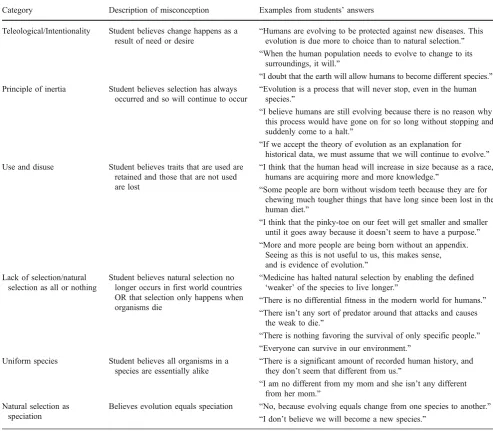
The instructor then solicited verbal answers from a wide range of students. He used a class list to randomly call on students and recorded their answers on a PowerPoint slide. This approach ensured that the answers obtained were representative of the class and helped prevent students from taking a passive role in the activity. Student answers to this question are predictable (Table1, also see Gregory2009for an extensive review of common misconceptions about natural selection). For example, students will argue that humans are evolving to “lose” their appendix, to have worse eyesight, to have less hair, to have larger brains, and to be fatter. In contrast, other students will report that human evolution has stopped because “there isn’t any sort of predator around that attacks and causes the weak to die.” Next, the instructor proposed to work through the list of student ideas and began by pointing out that there was a wide Table 1 Common misconceptions and examples of students’answers
Category Description of misconception Examples from students’answers
Teleological/Intentionality Student believes change happens as a result of need or desire
“Humans are evolving to be protected against new diseases. This evolution is due more to choice than to natural selection.”
“When the human population needs to evolve to change to its surroundings, it will.”
“I doubt that the earth will allow humans to become different species.” Principle of inertia Student believes selection has always
occurred and so will continue to occur
“Evolution is a process that will never stop, even in the human species.”
“I believe humans are still evolving because there is no reason why this process would have gone on for so long without stopping and suddenly come to a halt.”
“If we accept the theory of evolution as an explanation for historical data, we must assume that we will continue to evolve.” Use and disuse Student believes traits that are used are
retained and those that are not used are lost
“I think that the human head will increase in size because as a race, humans are acquiring more and more knowledge.”
“Some people are born without wisdom teeth because they are for chewing much tougher things that have long since been lost in the human diet.”
“I think that the pinky-toe on our feet will get smaller and smaller until it goes away because it doesn’t seem to have a purpose.”
“More and more people are being born without an appendix. Seeing as this is not useful to us, this makes sense, and is evidence of evolution.”
Lack of selection/natural selection as all or nothing
Student believes natural selection no longer occurs in first world countries OR that selection only happens when organisms die
“Medicine has halted natural selection by enabling the defined
‘weaker’of the species to live longer.”
“There is no differential fitness in the modern world for humans.”
“There isn’t any sort of predator around that attacks and causes the weak to die.”
“There is nothing favoring the survival of only specific people.”
“Everyone can survive in our environment.” Uniform species Student believes all organisms in a
species are essentially alike
“There is a significant amount of recorded human history, and they don’t seem that different from us.”
“I am no different from my mom and she isn’t any different from her mom.”
Natural selection as speciation
Believes evolution equals speciation “No, because evolving equals change from one species to another.”
diversity of answers and that some of them contradicted each other. He asked students to apply the three requirements of natural selection to assess each idea. For example, students frequently propose that humans are evolving to have less hair (becoming more bald). The instructor would then ask the student to consider each requirement (i.e., Is there variation in baldness?Yes.; Is baldness heritable?Yes, at least for some types.; and Are bald men having more children than men with full heads of hair? Probably not.). We have found that structuring this discussion with the requirements for natural selection quickly dispels some student misconceptions, including the ideas that humans are evolving to be fatter, smarter, and balder. Unlike a misconception such as
“individuals evolve” which has likely been built over a lifetime of personal experience with being able to“adapt”to new situations, these ideas are probably not created until we ask this specific question.
After the discussion of students’ ideas—most of which relate to traits that are probably not evolving—the instructor discussed two traits that likely are favored by natural selection: HIV resistance and height. He began by presenting how HIV may be selecting for specific immune system genes. We suggest presenting the height example second because human height has been affected by both genetic and environmental factors, and students find this combination challenging. The next section of this paper provides instruc-tors with the background information necessary to discuss how natural selection may be affecting HIV resistance and height (Table2details additional resources that can be found in the Electronic Supplementary Material,ESM).
At the end of the discussion of HIV resistance and human height, the instructor asked students to review and
critique their original answers to the Human Evolution Question. On the same index card, he asked students to
“Re-read your answer to the question (Are contemporary populations of humans evolving?) and evaluate your reasoning. Is there anything you said that was incorrect? Was there an important part of the answer you were missing?” Hereafter, we call this the“Revision Question.” Asking students to examine how their ideas have changed encourages metacognition and promotes conceptual change. We knew from past years that our students can be reluctant to criticize their previous answers. To encourage them to think critically about their initial ideas (Hewson et al.
1998), the instructor provided students with five sample student answers and asked them to critique the answers in groups before he asked them to critique their own answers. Each group discussed one sample answer and then the class discussed what was correct and incorrect about each answer. Table1provides examples of student answers that display common misconceptions; these examples can be used for this part of the activity. At the end of class, the instructor collected both the Human Evolution Question and the Revision Question and used them to gauge student learning in preparation for the next class period.
Two Examples of Contemporary Human Evolution to Use in the Classroom
As we discussed above, it is important that instructors expose students to multiple examples of a concept (Catrambone and Holyoak 1989). This section of the paper (and the supple-mental materials described in Table 2) provide the
back-Table 2 Supplemental material description
Discussion tools Goal of this item:
Sample student(s)–instructor dialogue To show the pattern of logic we use to directly address student misconceptions Relevant cartoon To provide a visual representation of a common student misconception (humorously)
Example tools Goal of this item:
CCR5and HIV interaction diagram To show students how theCCR5protein interacts with HIV on a cell surface
CCR5DNA sequences To provide a concrete representation of variation in the population at theCCR5locus Table of allele frequencies To show students how the frequency of the mutation varies around the world and provide
a basis for discussing how evolution is likely to change allele frequencies in parts of the world differentially affected by HIV
Graph of human height change over the last two centuries
To provide a visual representation of the change in human height that students often mention as evidence of evolution
Details about height data To provide instructors with a large data set that can be used to create graphs and address questions about human height
Histogram of height To show students how height varies in the human population
Heritability of height graph To provide a simple visual representation of the evidence that height is heritable by comparing father and son height
Map of chromosome sections associated with human stature
ground information necessary to present these examples of human evolution to students, as well as numerous citations an instructor could use to find additional information.
HIV Resistance and theCCR5Locus
AIDS is a disease of the human immune system caused by the human immunodeficiency virus (HIV) that kills over 2 million people each year (Joint United Nations Programme on HIV/ AIDS2009). Most people in the world are highly susceptible to HIV infection, but individuals who are homozygous for a rare allele at theCCR5 locus are essentially immune to the disease (Samson et al.1996). Simply put, HIV enters a white blood cell by binding to theCCR5protein. A rare resistant allele, calledCCR5-Δ32, has a 32-base pair deletion in the DNA sequence of theCCR5 gene. This deletion causes a frame shift, creating a non-functional receptor and preventing HIV from infecting the cell (Samson et al.1996).
Is There Variation in the Population?
CCR5-Δ32 has a frequency of around 10% in many European countries and in Russia (Samson et al. 1996; Stephens et al.1998), but this mutated allele is essentially absent in Asia and Africa (Samson et al.1996). Students often believe that mutations occur because they are needed, and if that were true, the CCR5-Δ32 mutation should be most common in Africa where HIV is more prevalent.
The reason why European populations have high frequencies of the CCR5-Δ32 allele is not well under-stood. Mathematical models suggest that a random drift of a neutral allele cannot explain the high frequency of CCR5-Δ32 in European populations (Stephens et al.
1998), meaning that selection was likely responsible. However, debate remains about what may have caused this selection pressure. Some researchers suggest that outbreaks of the bubonic plague, which killed 25–33% of Europeans about 650 years ago, are the most likely source of strong selective pressure for this mutation (Stephens et al. 1998). Other researchers argue that the plague would not have provided sufficient selective pressure to create the current frequency and distribution of the CCR5-Δ32 allele (Galvani and Slatkin 2003). Studies have also shown that the CCR5-Δ32 allele does not confer resistance to the plague in mice (Mecsas et al.
2004). Instead, Galvani and Slatkin (2003) suggest it is more likely that theCCR5-Δ32allele conferred resistance to smallpox and was therefore strongly selected. Finally, one hypothesis proposes that selective pressure from outbreaks of both smallpox and hemorrhagic plague explains the current frequency and distribution of the mutatedCCR5allele (Duncan et al.2005).
Is This Trait Heritable?
The immunity conferred by CCR5-Δ32 is inherited as a simple Mendelian trait, so it is heritable. We use this example to emphasize to students that the ability of organisms to survive and reproduce is influenced by genotypes present at a specific loci. This should help students connect natural selection with Mendelian genetics (two of the most important concepts in biology). We also show students the DNA sequence ofCCR5andCCR5-Δ32 alleles in order to provide a concrete example of how DNA sequences influence phenotypes (Kalinowski et al. 2010). Later, we use CCR5-Δ32allele frequencies as an example to illustrate Hardy–Weinberg proportions.
Does Having This Trait Affect the Ability of an Individual to Survive or Reproduce?
Two copies of CCR5-Δ32 (homozygosity) confer a high level of resistance to HIV infection (Samson et al. 1996). Even one copy of CCR5-Δ32 provides protection from AIDS (Stewart et al.1997), most likely by prolonging the transition from HIV infection to AIDS. As long as HIV affects an individual’s reproductive success in the human population, there will be selection for theCCR5-Δ32allele. Globally, only 42% of individuals in need of treatment for AIDS are being treated (Joint United Nations Programme on HIV/AIDS2009), suggesting that ifCCR5-Δ32exists in a population, it will be selected for.
Human Height
Students frequently suggest that humans are evolving to be taller, and human height provides an ideal example to illustrate some of the complexities of natural selection. As students suspect, human heighthasincreased substantially over the past three decades (Smith and Norris 2004; Freedman et al.2000). However, only some of that change in certain populations seems to be due to evolution rather than improved nutrition and medical care (Mueller and Mazur2001).
Is There Variation Within the Population?
Is Height Heritable?
Human height is highly heritable, and in fact, the first studies of heritability examined human height. Sir Francis Galton started this work and his younger colleague, Karl Pearson, developed the statistical method of correlation to analyze father–son height data. Current studies estimate heritability of height in humans to be 0.8, meaning that about 80% of the variation in height within populations is due to genetics (Visscher2008).
Height is a quantitative trait, which means that it is controlled by many genes of small effect. At least 20 genes have been found that contribute 0.2–0.6 cm to height per allele (Weedon et al.2007,2008). These genes explain only about 3% of the variation in human height (Weedon et al.
2008), which suggests that many more genes of small effect will be found.
Twin studies are an interesting method of understanding heritability. Studies show that after birth, monozygotic (identical) twins grow to be more similar in height than dizygotic (fraternal) twins. Monozygotic twins reared apart are more different in stature than monozygotic twins reared together, but are still more similar than dizygotic twins who grew up together (Chambers et al. 2001). In dizygotic twins aged 14–36 months, 61–82% of variation in height can be attributed to genes (Chambers et al.
2001).
Does Being Taller (or Shorter) Affect an Individual’s Ability to Survive or Reproduce?
Several studies have shown a positive relationship between height and reproductive success—in particular for men. For example, height was positively related to number of children in a sample of Polish men (after controlling for other factors that affected height in this sample, such as locality of residence; Pawlowski et al. 2000). A study of West Point Cadets (class of 1950) also showed that taller men had more children (Mueller and Mazur 2001). This study did not control for potential environmental differ-ences, but used a highly homogeneous sample—mostly middle-class men of European descent who came from rural backgrounds and had parents who had at least a high school degree. Finally, a study of British men born in 1958 found that taller men were less likely to be childless than shorter men, and men who were taller than average were more likely to find a long-term partnerandto have several long-term partners (Nettle2002b). This study controlled for socioeconomic status and serious health problems. Together, this research suggests that—in some populations—men are evolving to be taller, but it is likely that in other populations, male height is not evolving; selection could even be moving height in the other direction.
Selection for taller men is likely due to sexual selection, meaning that the increase in reproductive success is mediated by opportunities to mate. Women frequently prefer taller men for dates, sexual partners, or husbands (Buss and Schmitt1993; Ellis1992; De Backer et al.2008). For example, a study of personal ads showed that 80% of women advertised for men six feet or taller, even though the average American male is five feet nine inches. Interestingly, studies of reproductive success do not show that taller men have more children within any single marriage, but instead are more likely to remarry and have a second family (Mueller and Mazur2001).
Female preference for tall men is not likely to lead to unconstrained directional selection. Extremely tall men (those in the top decile) are slightly more likely to be childless. They are also more likely to have a work-impairing, long-standing illness, and they have a slightly higher mortality (Nettle 2002b). Additionally, mating partners who are more similar in height are more likely to have non-induced labor and have higher numbers of live-born children (Nettle 2002a,b).
The relationship between a woman’s height and fitness is more complicated. In developed countries such as America and England, the average woman is five feet four inches. In these countries, shorter women have the highest reproductive success and are least likely to be childless (Nettle2002a). In contrast, in less developed countries such as Guatemala and Gambia, a woman’s height is positively related to reproductive success. In these countries, tall women are more likely to have healthier children (Sear et al.2004; Pollet and Nettle2008). In all studies, the effect of height on reproductive success of women is less drastic than in men.
What Else Affects Human Height?
nutritional status to deteriorate, and malnourished chil-dren are more susceptible to illness (Eveleth and Tanner
1990).
In summary, height is highly heritable in ideal con-ditions, but the effects of childhood illness and malnutrition can have large and lasting effects on overall height. This point is both important and challenging for many students. Understandably, they have a hard time imagining the mechanisms through which genes could have some effect but not complete control, and instead often consider a trait a result ofeither nature or nurture, but not both.
Assessment of Activity Goals
We assessed the effectiveness of the human evolution activity described above in an introductory biology course on ecology and evolution. The first half of this course dealt with evolution and was taught by one of us (STK). The course had 58 students and met for lecture three times per week for 50 minutes and three hours once a week for a laboratory (e.g., Kalinowski et al.2006a,b). Most students in this course reported planning to pursue a career in medicine (e.g., physician, pharmacist, physician’s assis-tant). In this section of this paper, we present assessments of how well the human evolution paper met its three goals: (1) to elicit misconceptions, (2) to facilitate the rejection of misconceptions, and (3) to engage students in an activity they found interesting and educationally useful.
Goal 1—To Elicit Student Misconceptions About Natural Selection
We reviewed students’ initial responses to the Human Evolution Question and categorized all answers as either: “definitely containing a misconception,” “ proba-bly containing a misconception,” and “not containing a misconception.” While scoring answers, we defined a misconception as an idea that: (1) is inconsistent with a scientific understanding of natural selection, (2) repre-sents a misunderstanding of one of the major aspects of natural selection, and (3) is commonly held. This meant that we did not necessarily score factually incorrect ideas as misconceptions. Two raters independently coded all students’ responses, and disagreements were resolved through discussion.
Table 1 displays the variety of misconceptions elicited by this activity. Forty-four percent of our students’answers to the Human Evolution Question definitely exhibited a misconception, and another 10% of their answers suggested they held misconceptions, but the response was too incomplete or unclear to easily classify as a specific misconception.
Goal 2—To Facilitate Rejection of Non-scientific Ideas About Natural Selection
We measured student rejection of misconceptions using three different tools. First, we compared the misconceptions displayed in the initial Human Evolution Question (cate-gorized as stated above) to misconceptions displayed on the Revision Question. For the Revision Question, we mea-sured whether students rejected misconceptions by catego-rizing their answer as showing signs of“no improvement,”
“partial improvement,” or “complete improvement.” Two raters independently coded all students’ responses, and disagreements were resolved through discussion.
Twenty-seven (54%) of our students began this activity with misconceptions (i.e., gave responses scored as either“ definite-ly”or“probably”containing a misconception). By the end of this discussion, 78% (n=21) of these students had at least partially improved their answers on the Revision Question. Eleven students had completely improved their answers by correcting all misconceptions and ten students partially improved their answers by correcting misconceptions. In total, 68% of our students provided an initial or revised answer that contained no misconceptions and another 20% revised their answers to partially correct misconceptions. Only 12% of students ended this activity unable to at least partially correct misconceptions they had about natural selection.
Next, we used the ten-question version of the Conceptual Inventory of Natural Selection, called the CINS-II Short Form (CINS-II; Anderson et al. 2002; Anderson 2003; Fisher K, Williams K, Lineback J, Anderson D. Conceptual Inventory of Natural Selection II—Short-Form, 2011, unpublished) to measure student learning gains. Each distractor on the multiple-choice CINS-II questions represents a common student misconception about natural selection. We used the CINS-II because we wanted to see whether the activity described in this paper contributed to an improved under-standing of natural selection, not just human evolution. We pre-tested students on the first day of the class and post-tested at the end of the eight-week evolution section of the course. The pretest/posttest design measured learning over a period that included more activities than the discussion presented here. However, the human evolution activity served as the major lesson on natural selection, so we expect that it contributed significantly to student learning gains. We compared the percentage of students who displayed miscon-ceptions on the pretest and posttest of the CINS-II. We used a paired-samples t test (one-tailed) to test the null hypothesis that the difference between posttest and pretest scores was zero and then calculated an effect size using Cohen’sd. We corrected the pooled standard deviation used to calculatedfor the correlation between measures (Dunlap et al.1996).
the ten-question CINS-II after instruction (mean = 8.83, SD = 1.42) than before instruction (mean = 6.57, SD = 2.08; t(45) = 6.86, p< 0.0001, one-tailed with α= 0.025), mean-ing that they displayed fewer misconceptions and instead selected scientifically accepted answers. This corresponds to an effect size of Cohen’sd= 1.48 with a 95% confidence interval from 1.07 to 2.08. This indicates that the class average increased by almost 1.5 standard deviations, which is considered a large positive effect.
For our third measure of how students’misconceptions changed during this activity, students filled out an evalua-tion of the discussion described in this paper during the class period after this activity. We asked students two open-ended questions, including what they thought the instructor hoped they learned from the activity and whattheyfelt was the most important thing they learned from the activity. In response to these questions, students commonly wrote down the non-scientific conceptions they had rejected during this activity. Most often, students reported that they had learned that populations, rather than individuals, evolve. Table 3 provides descriptions of the concepts students reported learning and the number of students who named these concepts. Interestingly, some of the concepts reported by multiple students were not a main focus of the lesson, but are valuable lessons for how evolution proceeds (e.g., evolution takes place over a long time rather than in one generation). In 70% (n=35) of student responses to these questions, students reiterated the importance of using the three requirements (i.e., variation, heritability, selection) for natural selection to determine whether a trait is evolving, suggesting that the activity successfully emphasized the importance of considering these requirements.
Goal 3—To Engage Students in an Activity They Found to be Interesting and Valuable
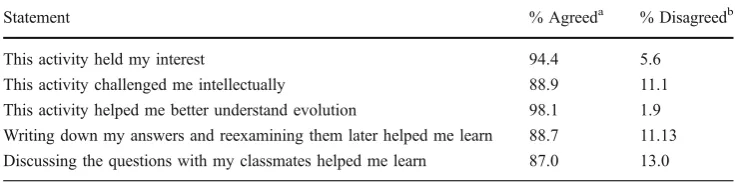
Some instructors have experienced student resistance when they change from lecturing to more interactive classes that include activities like the one described in this paper (Hestenes 1979), so on the evaluation mentioned above, we asked students to provide their opinions about this activity. The evaluations were anonymous and voluntary, and 93% (n=54) of our class completed the evaluations. We asked students to indicate on a six-point Likert scale (strongly disagree, somewhat disagree, slightly disagree, slightly agree, somewhat agree, and strongly agree) how well the activity held their interest and better helped them understand evolution. We also asked students to use the same scale to provide their opinions about specific parts of this classroom exercise, including how helpful they found writing and reexamining their answers and discussing answers with classmates.
When asked if the activity held their interest, 94.4% agreed and 88.9% agreed that the activity was intellectually challenging (Table 4). Overall, students responded posi-tively to writing and reexamining their answers and discussing questions with classmates (Table4).
Discussion
Over 75% of the students in our course who initially displayed misconceptions regarding natural selection rec-ognized and began to change their misconceptions after two hours dedicated to this activity. We could never have achieved this magnitude of learning gains with traditional Table 3 Concepts learned during this activity, as reported by students
Concept learned No. of students
Reproductive success (not just survival) needs to be considered when we think about selection 2
Individuals do not evolve or change their own genes 9
Evolution is a continuous process 1
The environment doesn’t directly change DNA sequences 5
The environment doesn’t directly cause evolution 4
Evolution takes place over a long time period, not one generation 7
Other students have many different ideas about evolution 2
Statement % Agreeda % Disagreedb
This activity held my interest 94.4 5.6
This activity challenged me intellectually 88.9 11.1 This activity helped me better understand evolution 98.1 1.9 Writing down my answers and reexamining them later helped me learn 88.7 11.13 Discussing the questions with my classmates helped me learn 87.0 13.0 Table 4 Student opinions about
the human evolution activity
a
Answers include“slightly agree,” “somewhat agree,”and
“strongly agree” b
lecture methods. Regrettably, recent research has shown that it is not unusual for introductory science courses to produce negligible student learning gains (Hake 1998a; Andrews et al. 2010). Natural selection is particularly challenging to learn, and some studies show that targeted instruction produces only modest changes in students’ conceptions (Bishop and Anderson1990; Nehm and Reilly
2007). Our students’learning gains compare favorably with other studies that have tested AL and TCC strategies to teach natural selection (Bishop and Anderson1990; Nehm and Reilly 2007; Jensen and Finley1996, 1997), and this activity would be relatively easy for an instructor to incorporate into his or her course.
We were interested in how well our students retained what they had learned during this activity, so we included the Human Evolution Question on the final exam, which students took 12 weeks after this activity (8 of those 12 weeks were dedicated to teaching ecology). Only 4% of our students displayed misconceptions on the final exam version of the Human Evolution Question (96% of students who participated in this activity also took the final exam). This is a marked improvement from their answers to the Revision Question (where 32% of student answers failed to completely correct misconcep-tions). Because this retesting took place three months after the activity, we suspect that rather than simply retaining this information, students continued to build their understanding of natural selection (and thereby their ability to answer this question without displaying mis-conceptions) in the four additional weeks dedicated to evolution. Throughout the evolution section of this course, we consistently embedded AL and TCC strate-gies into our instruction, and our results suggest that these methods effectively produce learning gains in undergraduate introductory biology students. In agree-ment with learning research (Bransford et al. 2000), it also suggests that a holistic and scientifically accepted understanding of natural selection is not built during a single class activity. Rather, these complex conceptual frameworks are built over time as students are forced to question their ideas, incorporate new ideas, and apply these newly integrated ideas (Posner et al.1982).
As with any classroom activity, instructors will need to carefully incorporate a discussion of contemporary human evolution into their courses. In a previous implementation of this activity, we did not give students enough practice with natural selection before this activity; as a result, the question was too difficult and students became frustrated. To answer the Human Evolution Question, students will need to be able to recall the requirements for natural selection and to apply them to humans. In our course, we used the class period before this activity to illustrate these requirements with
examples of selection at work. Specifically, students discussed dog breeding (i.e., artificial selection), selec-tion for coat color in old field mice (see Kalinowski et al. 2010), and neck length in giraffes. Students’ mis-conceptions regarding natural selection are frequently so persistent that students may be unprepared for the human evolution question unless instructors have previously addressed common student misconceptions regarding inheritance. For example, we used the discussion of dog breeding (see the “elaborated example” in Kalinowski et al. 2010) to illustrate to students that evolution does not proceed via the inheritance of acquired traits.
Our human evolution discussion was designed to teach students how natural selection operates. This emphasis does not minimize the importance of other causes of evolution (e.g., mutation, genetic drift, gene flow). Before this exercise, we introduce natural selection asoneprocess that causes evolution, and we talk in detail about genetic mutation as a source of variation, but we do not cover other evolutionary processes until after our students understand natural selection. As the class proceeds, we return to the examples in this exercise as we teach gene flow and genetic drift.
Beyond content, the format of this activity (e.g., small group discussions, classroom-wide discussions) may be foreign to students and thus slightly intimidating. First, students accus-tomed to passively sitting in class may be reluctant to participate in class discussions because they are afraid of providing an incorrect answer. Second, students in the habit of acting as receivers and recorders of facts during class may be uncomfortable allowing for uncertainty while discussing a question. We encourage the incorporation of AL and TCC methods before the human evolution discussion to familiarize students with a more interactive classroom environment.
without this testing, an instructor cannot know if he or she has successfully taught the students anything.
Alternative hypotheses to explain our students’ signif-icant learning gains include an exceptional instructor, exceptional students, or simply an exceptional amount of time in preparation for teaching. We do not believe any of these hypotheses adequately explain why this activity produced impressive learning gains (and misconception rejection). First, our initial implementation of this activity did not produce the sort of learning gains we eventually produced, suggesting that our instruction was not exceptional, but merely practiced. The suggestions for implementation in this section are the lessons we learned. Most students in our course plan to pursue careers in medicine. These aspirations may correspond to increased motivation to succeed, increased past success with school, and higher than average standardized test scores, but also less positive traits such as a highly competitive attitude that hinders cooperative group work and a fear of new classroom methods that they perceive as likely to interfere with their proven ability to succeed in tradition-al classrooms. We acknowledge that these differences may contribute to the learning gains we found, but other studies have found AL and TCC methods more effective than traditional methods in science classes with non-majors and non-majors from a broader range of science disciplines than our sample (e.g., Hake 1998a; Bonwell and Eison 1991; Crouch and Mazur 2001; Bishop and Anderson1990; Jensen and Finley 1996), suggesting that these methods produce learning gains for a wide range of students. Finally, though we have obviously dedicated a substantial amount of time to refining this activity, we also know that instructors who use only lecture methods often devote equal amounts of time to class preparation. Time and dedication alone do not produce significant learning gains.
As we continue to incorporate AL and TCC methods into our course, we envision a course where most of the learning takes place in activities that use TCC and AL strategies, particularly when covering topics about which students hold many misconceptions. As studies showing the inadequacy of using only lectures continue to accumulate, we believe it is ethically questionable and scientifically irresponsible to continue using predominantly lectures to teach college science. This activity is one step toward a course based on research on the effectiveness of teaching methods and, we hope, a step toward a reformed paradigm of how we teach college biology.
Acknowledgments Students in the spring 2008 and spring 2009 section of Ecology and Evolution graciously participated in this study and provided feedback. Support for this study was provided by NSF-CCLI 0942109. Several authors and artists generously allowed us to use or to direct readers to their work in theESM. Two anonymous
reviewers also provided useful comments on previous drafts of this manuscript.
References
Ali MA, Uetake T, Ohtsuki F. Secular changes in relative leg length in post-war Japan. American Journal of Human Biology. 2000;12:405–16. Alters BJ, Nelson CE. Perspective: teaching evolution in higher
education. Evolution. 2002;56:1891–901.
Anderson DL. Natural selection theory in non-majors biology: instruction, assessment, and conceptual difficulty. PhD disserta-tion, University of California, San Diego and San Diego State University, San Diego, CA, 2003.
Anderson DL, Fisher KM, Norman GJ. Development and evaluation of the conceptual inventory of natural science. Journal of Research in Science Teaching. 2002;39:952–78.
Andrews TM, Kalinowski ST, Leonard ML, Colgrove CA. [Learning natural selection in college biology courses: The relationship between teaching methods and learning gains]. Unpublished raw data, 2010. Bishop B, Anderson C. Student conceptions of natural selection and
its role in evolution. Journal of Research in Science Teaching. 1990;27:415–27.
Bonwell CC, Eison JA. Active learning: creating excitement in the classroom. ASHE-ERIC Higher Education Report No. 1, The George Washington University, School of Education and Human Development, Washington, DC, 1991.
Bransford JD, Brown AL, Cocking RR, editors. How people learn: brain, mind, experience, and school. Washington: National Academy Press; 2000.
Buss DM, Schmitt D. Sexual strategies theory: an evolutionary perspective on human mating. Psychological Review. 1993;100:204–32.
Catrambone R, Holyoak KJ. Overcoming contextual limitations on problem-solving transfer. Journal of Experimental Psychology: Learning, Memory, and Cognition. 1989;15:1147–56.
Chambers ML, Hewitt JK, Schmitz S, Corley RP, Fulker DW. Height, weight, and bodymass index. In: Emde RN, Hewitt JK, editors. Infancy to early childhood: genetic and environmental influences on developmental change. New York: Oxford University Press; 2001. p. 292–306.
Crouch CH, Mazur E. Instruction: ten years of experience and results. American Journal of Physics. 2001;69:970–6.
De Backer C, Braeckman J, Farinpour L. Mating intelligence in personal ads. In: Geher G, Miller G, editors. Mating intelligence: sex, relationships, and mind’s reproductive system. New York: Taylor & Francis Group; 2008. p. 77–101.
Duncan SR, Scott S, Duncan CJ. Reappraisal of the historical selective pressures for the CCR5-Δ32 mutation. Journal of Medical Genetics. 2005;42:508.
Dunlap WP, Cortina JM, Vaslow JB, Burke MJ. Meta-analysis of experiments with matched groups or repeated measures designs. Psychological Methods. 1996;1:170–7.
Ellis B. The evolution of sexual attraction: evaluation mechanisms in women. In: Barkow J, Cosmides L, Tooby J, editors. The adapted mind: evolutionary psychology and the generation of culture. New York: Oxford University Press; 1992. p. 267–88.
Eveleth PB, Tanner JM. Worldwide variation in human growth. New York: Cambridge University Press; 1990.
allele. Proceedings of the National Academy of Sciences. 2003;100:15276–9.
Greene ED. The logic of university students’ misunderstanding of natural selection. Journal of Research in Science Teaching. 1990;27:875–85.
Gregory TR. Understanding natural selection: essential concepts and common misconceptions. Evolution: Education and Outreach. 2009;2:156–75.
Hake RR. Interactive-engagement versus traditional methods: a six-thousand-student survey of mechanics test data for introductory physics courses. American Journal of Physics. 1998;66:64–74.
Hake RR. Interactive engagement methods in introductory physics mechanics courses. Physics Education Research Supplement to American Journal of Physics 66. 1998b. http://physics.indiana. edu/~hake/. Accessed 19 October 2010 (Ref. 14).
Heitz JG, Cheetham JA, Capes EM, Jeanne RL. Interactive evolution modules promote conceptual change. Evolution Education & Outreach. 2010;3:436–42.
Hestenes D. Wherefore a science of teaching? The Physics Teacher. 1979;17:235–42.
Hewson PW, Beeth ME, Thorley NR. Teaching for conceptual change. In: Fraser BJ, Tobin KG, editors. International handbook for science education. Great Britain: Kluwer; 1998. p. 199–218.
Jensen MS, Finley FN. Changes in students’ understanding of evolution resulting from different curricular and instructional strategies. Journal of Research in Science Teaching. 1996;33:879–900.
Jensen MS, Finley FN. Teaching evolution using a historically rich curriculum & paired problem solving instructional strategy. The American Biology Teacher. 1997;59:208–12.
Joint United Nations Programme on HIV/AIDS. (2009). Global facts & figures 2009. http://www.unaids.org/en/KnowledgeCentre/ HIVData/EpiUpdate/EpiUpdArchive/2009/default.asp. Accessed 18 October 2010.
Jones MG, Brader-Araje L. The impact of constructivism on education: language, discourse, and meaning. American Com-munication Journal 5, 2002. http://acjournal.org/holdings/vol5/ iss3/special/jones.htm. Accessed 18 October 2010.
Kalinowski SK, Leonard MJ, Andrews TM. Nothing in evolution makes sense except in the light of DNA. Cell Biology Education—Life Science Education. 2010;9:87–97 (also pub-lished in the 2010 Highlights issue).
Kalinowski ST, Taper ML, Metz AM. Can mutation and natural selection mimic design? A guided inquiry laboratory for undergraduate students. Genetics. 2006a;174:1073–9.
Kalinowski ST, Taper ML, Metz AM. How are humans related to other primates? A guided inquiry laboratory for undergraduate students. Genetics. 2006b;172:1379–83.
Knight JK, Wood WB. Teaching more by lecturing less. Cell Biology Education—Life Sciences Education. 2005;4:298–310. Lord T, Marino S. How university students view the theory of
evolution. Journal of College Science Teaching. 1993;22:353–7. Mayr E. The growth of biological thought. Cambridge: Harvard
University Press; 1982.
Mecsas J, Franklin G, Kuziel WA, Brubaker RR, Falkow S, Mosier DE. CCR5 mutation and plague protection. Nature. 2004;427:606.
Mueller U, Mazur A. Evidence of unconstrained directional selection for male tallness. Behavioral Ecology and Sociobiology. 2001;50:302–11.
Nehm RH, Reilly. Biology majors’knowledge and misconceptions of natural selection. Bioscience. 2007;57:263–72.
Nelson CE. Teaching evolution (and all of biology) more effectively: strategies for engagement, critical reasoning, and confronting misconceptions. Integrative and Comparative Biology. 2008;48:213–25.
Nettle D. Women’s height, reproductive success and the evolution of sexual dimorphism in modern humans. Proceedings of the Royal Society of London. 2002a;269:1919–23.
Nettle D. Height and reproductive success in a cohort of British men. Human Nature. 2002b;13:473–91.
Ogden CL, Fryar CD, Carroll MD, Flegal KM. Mean body weight, height, and body mass space index, United States 1960–2002. Advance data from Vital and Health Statistics No. 347. National Center for Health Statistics: Hyattsville, MD, 2004.
Pawlowski B, Dunbar RIM, Lipowicz A. Taller men have more reproductive success. Nature. 2000;403:156.
Philips HJ, Powers RB. The college seminar: participation under instructor-led and student-led discussion groups. Teaching of Psychology. 1979;6:67–70.
Pollet TV, Nettle D. Taller women do better in a stressed environment: height and reproductive success in rural Guatemalan women. American Journal of Human Biology. 2008;20:264–9.
Posner GJ, Strike KA, Hewson PW, Gertzog WA. Accommodation of a scientific conception: toward a theory of conceptual change. Science Education. 1982;66:211–27.
Samson M, Libert F, Doranz BJ, Rucker J, Liesnard C, Farber C, et al. Resistance to HIV-1 infection in Caucasian individuals bearing mutant alleles of the CCR-5 chemokine receptor gene. Nature. 1996;382:722–5.
Schwekendiek D, Pak S. Recent growth of children in the two Koreas: a meta-analysis. Economics and Human Biology. 2009;7:109–12. Sear R, Allal N, Mace R. Height, marriage and reproductive success
of Gambian women. Socioeconomic Aspects of Human Behav-ioral Ecology. 2004;23:203–24.
Smith MK, Wood WB, Adams WK, Wieman C, Knight JK, Guild N, et al. Why peer discussion improves student performance on in-class concept questions. Science. 2009;323:122–4.
Smith SA, Norris BJ. Changes in the body size of UK and US children over the past three decades. Ergonomics. 2004;47:1195–207. Springer L, Stanne ME, Donovan SS. Effects of small-group learning
on undergraduates in science, mathematics, engineering, and technology: a meta-analysis (online). National Institute for Science Education: University of Wisconsin-Madison, 1997.
http://www.wceruw.org/archive/nise/Publications/. Accessed 25 May 2009.
Stephens JC, Reich DE, Goldstein DB, Doo Shin H, Smith MW, Carrington M, et al. Dating the origin of the CCR5-Δ32 AIDS-resistance allele by the coalescence of haplotypes. The American Journal of Human Genetics. 1998;62:1507–15.
Stewart GJ, Ashton LJ, Biti RA, French RA, Bennetts BH, Newcombe NR, et al. Increased frequency of CCR5-Δ32 heterozygotes among long-term non-progressors with HIV-1 infection. AIDS. 1997;11:1833–8.
Visscher PM. Sizing up human height variation. Nature Genetics. 2008;40:489–90.
Vosniadou S. International handbook of research on conceptual change. New York: Routledge; 2008.
Weedon MN, Lango H, Lindgren CM, Wallace C, Evans DM, Mangino M, et al. Genome-wide association analysis identified 20 loci that influence adult height. Nature Genetics. 2008;40:575–83.