CURRICULUM AND EDUCATION
Teleological pitfalls in reading evolutionary
trees and ways to avoid them
Thilo Schramm
*and Philipp Schmiemann
Abstract
Despite evolution being the central idea in modern biology, considerable variation exists in its acceptance around the globe, and reports of anti-evolutionist and creationist movements are widespread. Educators need to re-evaluate the approaches used for teaching students about evolution in order to facilitate its understanding and acceptance. A major hurdle in understanding the concepts of evolution is that humans tend to view the world in a teleological way. Learners create obstacles to understanding the concepts of evolution by ascribing purpose or intent-driven actions to animals, processes, or inanimate objects. An indispensable learning tool in the field of evolution is the evolutionary tree, as it is a direct representation of evolutionary hypotheses. The ability to read and understand this form of repre-sentation is prerequisite to fully understanding the concepts of evolution. In this work, we present issues faced when attempting to teach students to read evolutionary trees as well as troublesome diagrammatic properties that may foster teleological thinking. Further, we present teaching practices and methods that may be used to avoid the above challenges (from diagrammatic and instructional perspectives). With this work, we aim to raise awareness among edu-cators about the different potential teleological pitfalls in the field of teaching how to read evolutionary trees, and to present different approaches for minimizing teleological reasoning and thinking in evolution education.
Keywords: Evolutionary theory, Teleology, Phylogenetic tree, Learning process
© The Author(s) 2019. This article is distributed under the terms of the Creative Commons Attribution 4.0 International License (http://creat iveco mmons .org/licen ses/by/4.0/), which permits unrestricted use, distribution, and reproduction in any medium, provided you give appropriate credit to the original author(s) and the source, provide a link to the Creative Commons license, and indicate if changes were made. The Creative Commons Public Domain Dedication waiver (http://creativecommons.org/ publicdomain/zero/1.0/) applies to the data made available in this article, unless otherwise stated.
Background
In modern biology, evolution and evolutionary analyses play an increasingly important role (Futuyma 2013; Tay-lor et al. 2018), further corroborating Dobzhansky’s claim that evolution is biology’s unifying principle (Dobzhan-sky 1973; Futuyma 2013; Kelemen 2012). However, stu-dents at all educational levels struggle to grasp the central concepts of evolutionary biology, which hinders their understanding of biology in general (Abrams and South-erland 2001; Ariew 2003; Cunningham and Wescott 2009; Gregory and Ellis 2009; Kattmann 2008; Werth 2012). As evolutionary trees are the most direct repre-sentation of macro-evolutionary processes and are used as hypotheses concerning the relative relatedness of spe-cies, they are an indispensable tool in the learning and communication about evolution (Baum et al. 2005; Mei-sel 2010; Nehm and Kampourakis 2014). The concepts
of reading and interpreting evolutionary trees are poorly understood by students of biology, similar to how they find it difficult to understand evolution (Baum et al. 2005; Gregory 2008; Kummer et al. 2016; Omland et al. 2008).
The theory of evolution is known to spark contro-versies globally, regardless of country or culture. The acceptance of the theory of evolution in a population varies between different countries, with some countries showing a high percentage of acceptance (80% in France, 75% in New Zealand) to some countries showing lower percentages of acceptance (54% in Missouri, US; 17% in Malaysia) (Campbell 2018; Friedrichsen et al. 2018; Lay et al. 2018; Quessada and Clément 2018). In addition, the share of the population holding creationist beliefs also varies between the states and regions. It has been reported that the acceptance of creationism and intel-ligent design is on the rise in different countries (Reiss 2018). The level of acceptance of the theory of evolu-tion and its wide range is attributed to different factors, including religious views, cultural traditions, geographi-cal diversity, and individual proficiency (Borgerding and
Open Access
*Correspondence: [email protected]
Deniz 2018; Deniz and Borgerding 2018). Accepting evo-lution and understanding its concepts are closely linked. However, the tendency to think teleologically hinders student understanding of the theory of evolution (Barnes et al. 2017; González Galli and Meinardi 2011).
In this work, we aim to present theoretical considera-tions about the teleological pitfalls in teaching how to read evolutionary trees, based on data from earlier stud-ies. These pitfalls will be structured into three parts: two major cognitive hurdles—the great chain-of-being and the complexity idea—and troublesome diagrammatic properties of evolutionary trees. In addition, we present different approaches to overcome these pitfalls.
Teleology
The concepts and processes of evolutionary biology seem to be poorly understood by high-school students, mem-bers of the public, and even post-secondary students and graduates of biology (Gregory 2009; Nehm and Schonfeld 2007, 2008). One of the fundamental difficulties in learn-ing evolutionary biology is that human belearn-ings tend to see the world from a purpose-driven and goal-oriented perspective (Gregory 2009; Kelemen and Rosset 2009). This might be because we expect other living beings, processes, and inanimate objects to behave as humans would, with planned and purposeful actions (Mead and Scott 2010a, b). Thus, it is not surprising that not only novice learners but also other humans tend to see evo-lution as a purposeful and directed process (Catley et al. 2010; Kampourakis 2014; Kelemen 2012).
Teleological thinking is a way of thinking wherein objects or processes behave with the underlying inten-tion to fulfill their specific goal (Kelemen 1999a; Rosen-berg and McShea 2008). This notion is specifically strong in children; however, it persists through their high school and university years (Gregory 2009; Kelemen and Rosset 2009; Southerland et al. 2001; Trommler et al. 2018). Fur-thermore, in teleological explanations, inanimate objects or parts of living beings (such as organs) are often falsely attributed with consciousness and goal-directed actions (Tamir and Zohar 1991).
The teleological bias occurs in students during their preschool years when trying to understand many aspects of the natural world. Children at this age typically view the existence of organismal traits as serving the physical good of the organism, while viewing artifacts’ properties as existing for the benefit of external agents (Keil 2002; Kelemen 1999a). Further, preschool and elementary school children ascribe both living organisms and arti-facts as being “made for something” (Kelemen 1999b, c). While young adolescents can grasp the complex concept of evolution—that animals can change substantially over a period of time—they tend to have a teleological bias
because of the explanation that animals change with the purpose to adapt (Evans 2001). During their secondary schooling, students often argue teleologically about the existence of traits in animals. For example, they explain that canines need structures such as claws and teeth to catch their prey (Kampourakis and Zogza 2007).
A major reason for teleological reasoning in biology is the general tendency of humans to think in a goal-directed manner. As our everyday lives involve overcom-ing difficulties, completovercom-ing tasks, and fulfillovercom-ing needs, we are inclined to regard many situations with a goal-ori-ented perspective, and therefore, we exhibit a teleologi-cal bias to the purpose or function of objects or processes (Gregory 2009).
Teleology and evolution
Teleological thinking can emerge in different forms in the context of evolution. One example is that evolution-ary processes are seen based on the following three ideas (González Galli and Meinardi 2011): (1) The process of evolution aims to create certain lineages or species (especially humans). (2) The process of evolution aims at securing the survival of species. (3) Individual variations arise to fulfill needs forced upon species by the environ-ment and to overcome survival challenges. Another way that teleological thinking can become apparent is when learners answer evolutionary questions containing the word “why” with responses that are more reflective of the questions “For what purpose?” or “What is it for?” instead of the scientifically accurate sense of “What is the cause?” (Kelemen 1999a). These interpretations can imply that students assume biological processes to follow a function instead of being the result of a complex set of influencing factors.
Different beliefs and concepts in evolution that can form hard to overcome misconceptions are based on tele-ological ideas (Kampourakis 2014). As some students see evolutionary change as a means of overcoming survival challenges, they assume that evolution is a development of increasing complexity. By purposefully overcoming challenges, species become more complex and are there-fore “more (highly) developed” than other species. There-fore, the notion of seeing the taxonomic system as an increasing order of complexity could be a consequence of teleological thinking as proposed by Kummer et al. (2016). In the course of this work, we will lay out this idea in more detail.
Evolutionary trees as representation of evolution
communication (Baum and Smith 2013). Evolutionary trees are diagrammatic hypotheses about relative rela-tionships among taxa and are seen as the most direct form of representation of macro-evolutionary processes (Baum et al. 2005). They not only show the results of evo-lution by displaying the relative relationships of selected species, but also act as a tool to investigate evolutionary processes (Baum and Smith 2013). Therefore, the ability to work with evolutionary trees is seen as prerequisite to fully understanding the concepts and processes of evolu-tionary biology (Catley et al. 2012; Meisel 2010).
The aspects of reading, interpreting, and utilizing evo-lutionary trees are subsumed under the term “tree-read-ing”, which, along with aspects of creating a hypothesis for an evolutionary tree from given data, is called tree-thinking (Baum and Smith 2013; Halverson 2011). In this paper, we will focus on the aspect of tree-reading. The ability of reading evolutionary trees consists of a number of different skills, ranging from the knowledge of dia-grammatic elements, such as internal nodes, over-read-ing and interpretover-read-ing new traits (apomorphies), evaluatover-read-ing relative relationships of species, and forming monophy-letic groups to compare and contrast different evolu-tionary trees (Halverson 2011; Novick and Catley 2016; Schramm et al. 2019).
Despite the relevance of tree-thinking, numerous stud-ies show that students struggle with these kinds of rep-resentations and that working with evolutionary trees is an issue at all educational levels (Baum et al. 2005; Blac-quiere and Hoese 2016; Bokor et al. 2014; Kummer et al. 2016; Meir et al. 2007). This can be explained, as numer-ous known factors can affect the difficulty of reading evolutionary trees. Reading evolutionary tree diagrams is a complex task and is influenced by factors such as knowledge of evolutionary concepts (MacDonald and Wiley 2012) and prior knowledge about the morphology of species (Novick and Catley 2014). Besides student-related factors, factors on the side of the diagram can affect the reading difficulty of a tree (e.g., Catley et al. 2012; MacDonald and Wiley 2012; Novick et al. 2010). Furthermore, numerous persistent and widespread mis-conceptions have been reported, such as the idea that straight, uninterrupted lines represent no evolutionary change, or that the order of presented species represents their relative relationship (as opposed to the branching pattern) (e.g., Gregory 2008; Meisel 2010).
As teleological thinking is seen as one of the major hurdles in teaching evolutionary biology (Barnes et al. 2017; González Galli and Meinardi 2011), educators and researchers attempted to examine what leads students to adopt or discard teleological reasoning and how to teach evolutionary biology in the best manner so as to foster scientific interpretations of evolutionary concepts.
Just as teleological thinking is seen as a central issue in learning about evolutionary biology, the ability to read evolutionary trees is seen as a crucial prerequisite in order to fully understand the theory of evolution. In addition, tree-reading is seen as a major skill in modern evolutionary biology, but studies show that students at all educational levels show major deficits in these skills (Catley et al. 2012; Gregory 2008; Kummer et al. 2016; Omland 2014). In this work, we want to examine the results of ongoing research and theoretical considera-tions on tree-reading with the focus on identifying and presenting typical teleological pitfalls in teaching as a part of evolutionary biology. Subsequently, we want to present ideas about how evolutionary trees can be used in a constructive way in order to teach tree-reading sci-entifically and inspire activities that can help students appropriately deploy teleological reasoning.
Teleological pitfalls
Teleological reasoning is seen as a central hindrance in learning about evolutionary concepts, and therefore, we want to present different misconceptions and settings in practice where teleology might interfere with teach-ing tree-readteach-ing. In this section, we present the two overarching misconceptions of evolutionary biology, the chain of being and the complexity idea, and we explain how these ideas can reveal themselves in the context of evolutionary trees and the ways in which they might be unintentionally reinforced by teaching practices. In the second part of the section, we focus on the properties of evolutionary tree diagrams, which can facilitate teleologi-cal interpretations.
Pitfalls in evolutionary trees Chain of being
species and thus, it is a teleological perspective (Catley et al. 2012). Furthermore, it implies that different species are more or less evolved or complex. Today, no scientifi-cally justifiable basis can be applied to rank species with regards to their complexity or their “rank” in the natu-ral system (e.g., Gould 1996). Nevertheless, the general idea of the Chain of Being is not only present today, but is actually a frequently reported and widespread miscon-ception (Gregory 2008; Kummer et al. 2016; Nee 2005; Philips et al. 2011).
A more recent description of thinking in line with the Chain of Being is what has been termed “developmental thinking” (O’Hara 1997), where evolution is seen as sto-ries of individual development while investigating the developmental history of one species from a root to the present without taking into account the branching nature of lineages.
Considering evolutionary processes and concepts, rep-resentations in the linear style of the chain of being (or developmental thinking) do not show relevant concepts such as: the splitting of populations leading to speciation, extinctions, the relative relationships of different species, new evolutionary traits (apomorphies), or any other indi-cators of a modern understanding of evolution.
Pop‑cultural influence on teleological reasoning
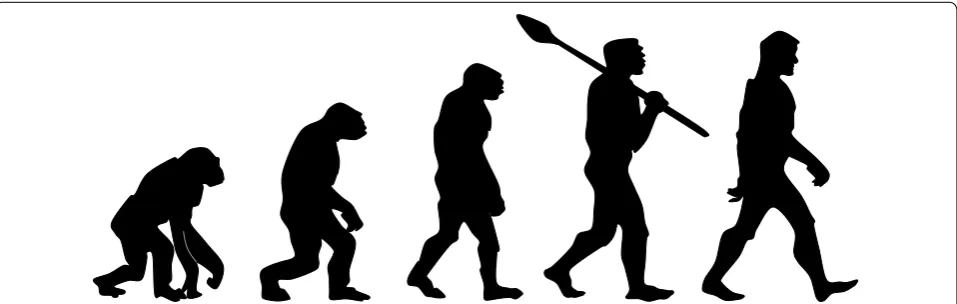
Probably the most prominent iconographic depic-tion of the concept of evoludepic-tion in popular culture fol-lows the idea of the chain of being. The typical form of this well-known iconography (see Fig. 1) shows a linear progression from left to right in varying compositions. Sometimes starting from unicellular life, with different steps leading to modern humans on the left, but most prominently, from a crooked ape on the left, to an upright
human on the right (Baum and Smith 2013; Clark 2009; Gould 1995).
This kind of iconography can convey different ideas not supporting the concepts of evolution. The direct line from a “simple” or “primitive” ape to the upright, devel-oped human could imply that evolutionary processes strive to increase the complexity of living beings and that humans are the pinnacle of the living world. This notion could be further supported by the typical increase in heights of the presented organisms from left to right. Furthermore, one could interpret this image to support the idea that humans developed from apes but are not apes themselves. Thus, this kind of image represents the idea of the chain of being as a valid depiction of evolu-tionary processes and thus fosters teleological thinking (Werth 2012).
Complexity idea
As biologists explored the diversity of life and tried to organize living things into different groups, they expanded the concept of the chain of being. Instead of a linear progression of complexity, branching depictions were used, often in the form of actual tree-like pictures. In these early organizational works, classification was mainly based on morphological structures and differ-ent groups were typically seen as more or less “primi-tive” or “complex.” In these tree-like-depictions, “lesser” groups were presented closer to the stem of the tree, whereas “highly complex” organisms or groups, includ-ing men, were presented on the branches at the top of the tree (Matuk 2007; Mogie 2000). Evolutionary trees in this form of the tree of life are still used in educational literature and only in a minority of the cases are these diagrams put in an appropriate historical context (Catley and Novick 2008).
The idea that different species are more or less evolved, or the notion of “higher” or “lower” species is problem-atic as it nourishes the idea that evolution pursues a rise in complexity over the course of time as a type of pur-pose, thus being deeply teleological (Kummer et al. 2016). In the context of tree-reading, it can be seen as the most problematic form of teleological interpretations, as multiple common misconceptions in reading evolution-ary trees are heavily based on this idea (Baum et al. 2005; Dees et al. 2014; Gregory 2008; Mogie 2000; Omland et al. 2008). In the following text, we will call this concept the “complexity idea”.
The complexity idea can be an indication of teleologi-cal thinking in evolution, as it backs the concept that evo-lutionary processes are “aimed” at inevitably bringing up more complex forms resulting in modern humans (Mogie 2000). As it is the core of many different (teleological) misconceptions, with regards to evolution in general and depictions of evolutionary processes in specific, we lay out different factors promoting the complexity idea in the context of evolutionary biology below.
Reading across the tips
A common misconception in reading evolutionary trees based on the complexity idea is called “reading across the tips” (Gregory 2008). It describes the concept that students tend to ignore the branching pattern of a given tree and rather read the presented organisms in the order they are presented, as a direct line of rising complexity, depending on the orientation of the tree, from left to right or from bottom up (Blacquiere and Hoese 2016; Gregory 2008; Kummer et al. 2016). This leads to students largely ignoring the branching pattern of the tree and thus draw-ing wrong inferences about the information presented. As the organisms are seen as being arranged in a con-tinuum of rising complexity, this misconception reveals the notion that species can be arranged according to their “higher” or “lower” development.
Order of teaching evolution
The complexity idea might be unintentionally supported by many scientists and educators by the way they pre-sent information. Multiple books about evolution, some by well-known scientists, are structured in support of the idea of increasing complexity by following an arrange-ment similar to the Chain of Being (Nee 2005). Often, they begin with describing the origin of life and the first living organisms and continue with events like the first eukaryotic cell, multicellularity, leaving the water, first mammals, and in the end, human beings. This common order of how to present evolutionary history is suited to nourish the idea that evolution works on increasing the complexity of life and that humans are the pinnacle of
biological life (Nee 2005). By sustaining the notion that evolution is a process producing beings that are ever more complex and that one can follow a “complexity lad-der” through the domains of life, the interpretation of evolution being a process with the purpose to spawn ever more complex beings might be enticing. Teaching this way could support the complexity idea and associated teleological views about evolution.
Teleological wording
The way an educator chooses his or her wording can have a considerable influence on the way students understand a topic. This is especially true in the case of evolution-ary biology, as many professional biologists and educa-tional textbooks regularly use teleological formulations, despite not intending to teach teleological interpreta-tions (González Galli and Meinardi 2011; Hanke 2004; Ruse 2009; Werth 2012). For example, one could say that the heart evolved to pump blood, and the underly-ing meanunderly-ing of this statement is that the heart underwent an evolutionary process, adapting and shaping it, which resulted in a better-adapted morphological structure. The statement is not meant in a way that the heart was originally designed as a blood-pump. Another example is the statement that a species lives in flocks to defend against predators. Here, the reason of living in flocks is an evolutionary adaptation and not the idea of an indi-vidual organism that living in a group could be a good way to repel predators. Typically, educators assume that their students understand their teleological formulations as metaphors and do not want to foster teleological rea-soning. This raises the risk that students might become used to teleological wording and adopt it without regard-ing the metaphorical nature or might directly adopt teleological reasoning (Kelemen 2012; Werth 2012). Fur-thermore, textbooks often focus on the functions of bio-logical systems or processes without shedding much light on the causes. This can lead to students analyzing bio-logical concepts from a teleobio-logical perspective (Abrams and Southerland 2001). The issue of teleological wording is not only present in educational textbooks or oral pres-entations, but also in peer-reviewed publications, espe-cially with the use of the classification into “higher” and “lower” species, and therefore, in the form of the com-plexity idea.
Effects of representational elements and styles
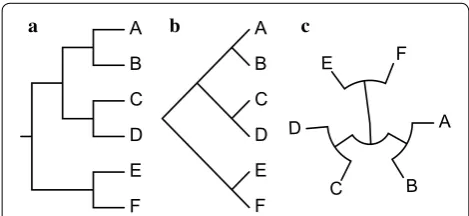
present evolutionary relatedness had yet to be found (Pietsch 2012). In modern phylogenetics, three forms of evolutionary tree diagrams are most prevalent: rec-tangular trees (also called tree diagrams), diagonal trees (also called ladder diagrams or trees), and circular trees (Fig. 2), although the latter are rather scarcely used (Catley and Novick 2008; MacDonald and Wiley 2012). Different representational styles can lead to different interpretations of a given tree, especially with novice learners (Catley et al. 2012), although all styles carry the same informational value. Furthermore, the absence or presence of certain elements of a tree can change the dif-ficulty of reading the tree or influence the way it is read. In the following, we will present different aspects of the representational style of evolutionary trees that can fos-ter teleological ideas while working with them.
Diagonal trees
Diagonal trees can especially support misconceptions in reading evolutionary trees. For example, students tend to interpret diagonal trees by seeing long lines as an entity, determined by its terminal taxon (see taxon A or F in Tree b in Fig. 2). This interpretation leads to interpreting branching events as other groups developing “away from the main branch,” and thus, implying the idea of a main line of development, usually culminating in humans, with different other, inferior developmental lines (Greg-ory 2008; Halverson and Friedrichsen 2013; Omland 2014). This interpretation is especially prominent as stu-dents follow the Gestalt principle of good continuation. Depending on which species are presented at the end of one long, continuous line, the representation can support teleological interpretations. For example, if humans are presented at the end of the uninterrupted long line at one side of the tree, it could be seen as a directed evolutionary
process culminating in the development of humans, with other taxa as mere side branches of this development.
Anagenetic diagrams
Anagenetic diagrams are largely used when represent-ing the evolutionary history of modern humans and in the case of the evolutionary history of the horse (Catley and Novick 2008). These diagrams typically put differ-ent species into perspective based on the fossil record, and at least two different species are linked directly and successively along a single branch of the tree without a bifurcation event (Catley and Novick 2008). This form of presentation can easily be interpreted as the repre-sentation of anagenetic processes, one species turn-ing into another, without a branchturn-ing event occurrturn-ing (Philips et al. 2011). The idea that evolutionary pro-cesses are transformation propro-cesses, turning one species into another, is seen as being linked to the teleological interpretation of the presented data (Novick et al. 2014; Philips et al. 2011; Scott 2010). Here again, we can find the complexity idea, as one species seems to develop into a new and “higher developed” species, leading to extant species we know today (Novick et al. 2014).
Orientation of the tree
Besides the style of the tree, the orientation of the trees can have an influence on the way learners interpret the presented information. If extant species in a tree are sented along a vertical axis (so the flow of time is pre-sented horizontally), novice learners tend to interpret the tree in a teleological way by ascribing species at the top to be highly developed. The interpretation with the tree rotated and extant species presented along a horizontal line is less common (Philips et al. 2011).
Lines represent no change
Many learners possess the misconception that lines in an evolutionary tree represent no alterations and only nodes represent evolutionary changes; therefore, this can be seen as a concept similar to the idea of main branches, described in the context of diagonal trees discussed above. The concept that lines represent no change can be interpreted as teleological fallacy, as it can imply that evolutionary changes occur for the reason of speciation (Kummer et al. 2016). A consequence of this idea can be the well reported misconception that students attempt to evaluate relative relations of species by counting nodes along the lines between different species (Gregory 2008; Meir et al. 2007).
Unbalanced trees
The number and arrangement of taxa in a given tree can have a major influence on the way learners read a tree.
a b c
A
B C
D E
A B C D E F A
B C D E F
F
When presented with a tree where different clades or parts of the tree feature very unequal numbers of pre-sented species, students tend to interpret the clade with less groups as a more primitive one (Gregory 2008; Mei-sel 2010). Just as the general idea of different species being differently “developed” or more or less primitive is not supported by evolutionary reasoning, this concept is also flawed. As every evolutionary tree shows a selection of species or groups, typically any branch can be pro-vided with a number of additional branching events to tip the proportion of the number of presented species in the interpreted clades.
Age of groups
A form of evaluating relative relationships in a tree that is tightly linked to the complexity idea is the notion that different extant groups in a tree are older or younger; this implies that the older group is less evolved or more basal than the younger group. The idea of this concept is that different taxonomic groups emerged at different times throughout the history of the earth; for example, the first organisms later classified as birds lived before the first organisms later classified as humans (see Fig. 3). Novices in reading evolutionary trees tend to attribute groups with early branching events as being less evolved because of the time of divergence in a presented tree (Gregory 2008).
In a given tree, all extant species are the same age. The time from the root of the tree to the tips is the same for all presented species (extinct species not factored in), and therefore, their total time of evolution is the same (Baum and Smith 2013). As trees presented in publica-tions can only show parts of the complete evolutionary tree of all living beings, the number of branching events along a given lineage cannot be interpreted meaningfully. If a tree is presented with a scaled time axis, branching events on different lineages can be set into relations by stating that one branching event occurred before the
other. Nevertheless, this does not justify any interpre-tation of less or more advanced clades in a tree (Baum and Smith 2013; Mogie 2000), which could be the basis for teleological interpretations, following the complexity idea.
Interpreting focal taxa
The positioning of humans in evolutionary trees is a common feature in teaching tree-reading (Sandvik 2009). Presenting humans (or the taxonomic group containing humans, like mammals or vertebrates) in a tree in a posi-tion at the outer side of the branching pattern can sup-port interpretations of the species being presented in an ascending order of complexity (complexity idea). Such a prominent position can also corroborate anthropocen-tric tendencies and the interpretation that evolutionary processes culminated in modern humans (Sandvik 2009; Philips et al. 2011). Both interpretations can be seen as a feature of teleological reasoning (Meisel 2010; O’Hara 1997; Philips et al. 2011). Often, humans are presented in a prominent position in evolutionary trees, at the edge of the diagram, depending upon the general orientation at the far right or the top of the tree. By positioning humans at the edge of the tree diagram, their position implicitly places focus on them, implying that humans deserve focus or are a type of endpoint. Interpreting a tree this way can lead to the conclusion that evolutionary pro-cesses took place in order to lead to humans as a special group of organisms, in an extreme form, to humans as the pinnacle of life on earth (Meisel 2010; Philips et al. 2011; Sandvik 2009). The same principles hold true if the tree shows another focal taxon instead of humans.
Different levels
Another factor influencing the perception of different species as “higher” or “lower,” is whether extant species in an evolutionary tree are presented at the same level in the diagram. In a cladogram, the length of the branches has no informational value, and therefore, all extant species are typically arranged on a line orthogonal to the direc-tion of the flow of time and only extinct species are pre-sented at lines ending earlier (Catley and Novick 2008). In special trees such as phylograms or chronograms, the length of the branches represent evolutionary changes, mutation rates, or time. However, in modern educational literature, extant species are frequently presented in dia-grams on the same level without the branch length show-ing any metric logic (Catley and Novick 2008). Diverting from the design that extant species are presented at one level can lead to students interpreting the tree in a way that different species are seen as being less evolved or more primitive, which could lead to teleological interpre-tations of the tree. If the species are presented at different bird
turtle hum an turtle
hum an
a b
levels on purpose, the design should be clearly high-lighted and explained in the diagram.
Evolutionary trees are a highly context-specific form of representation in evolutionary biology, and unfor-tunately, numerous teleological pitfalls exist in con-structing or presenting them in a learning context. In a modern learning context, we can still find interpretations and concepts based on scientific interpretations that are many centuries old. In fact, one of the most fundamental hurdles in reading evolutionary trees is that learners tend to attribute different complexities to presented organisms and see them as more or less developed. In an extreme form, learners think of a linear order for the complexity of species and use this as a basis for evolutionary expla-nations. This hurdle—the complexity idea—can be cor-roborated in the context of evolutionary trees by different teaching practices and diagrammatic properties. Further-more, an evolutionary tree is comprised of numerous elements, whose absence or presence can influence tele-ological interpretations.
Avoiding the pitfalls
As discussed previously, numerous misconceptions and practices can potentially foster teleological thinking in the context of evolutionary trees. In the following sec-tion, we present different ways to avoid or at least reduce the challenges caused by some of the described obstacles. The practices presented here can be divided into two main groups: practices with the perspective of choosing or modifying suitable diagrams and practices with the perspective on teaching strategies while working with evolutionary trees.
Diagrammatic perspective
While teaching tree-reading, educators should be cau-tious about the evolutionary trees they select to present to their learners. As mentioned before, numerous prop-erties of evolutionary trees may hinder learning how to read them, and simultaneously, they might foster tele-ological interpretations. Therefore, a crucial step in plan-ning a teaching unit about evolutionary trees is to decide which diagrams to use, how to improve them, and how to use different forms of diagrams.
Tree design
The most obvious distinctions between different evolu-tionary trees is the general type, or the outer shape of the diagram [rectangular, diagonal, or circular (see Fig. 2)], and the orientation of the diagram: where is the root and in which direction is the flow of time represented. Numerous studies show that evolutionary trees in a rec-tangular tree-format should be favored over diagonal trees as they are easier to read and are surrounded by a
lower number of misconceptions (Crisp and Cook 2005; Meisel 2010; Novick and Catley 2007; Novick et al. 2010). In particular, diagonal trees seem to be prone to tele-ological interpretations because of the Gestalt principle of good continuation. Further, rectangular trees are more prevalent in scientific publications than the other formats (Novick and Catley 2007).
Besides the overall style of the tree, depictions of ana-genetic developments can also influence the difficulty to read evolutionary trees and can reinforce teleological thinking (Catley and Novick 2008). Therefore, educa-tors should question the extent to which anagenetic dia-grams are suited for use in a learning context, the risk of reinforcing anagenetic interpretations, and the degree to which the potential consequences of reinforcing teleolog-ical interpretations can be compensated.
As students demonstrate less problematic interpre-tations and misconceptions when reading trees where extant organisms are presented along a horizontal line, i.e., where the flow of time is presented in the vertical direction, diagrams with this orientation should be pre-ferred (Philips et al. 2011).
By carefully choosing the type of evolutionary tree to be used in which orientation, educators can greatly con-trol the difficulty of tree-reading tasks. In modules on evolutionary trees, students should first be presented with trees in a rectangular form and should become acquainted with the other representational styles in the course of the module to familiarize them with the multi-tude of styles, and to prepare them to work with more dif-ficult or misconception-loaded styles such as rectangular trees or anagenetic diagrams. Furthermore, complexity-inducing properties of trees, such as the orientation of the tree, or the representation of species at differing lev-els, should be addressed at an appropriate time during the course of the unit, when students are familiar with the general concepts of how to read a tree.
Tree properties
In addition to the general form of the diagram, different properties need to be considered; for example, what fur-ther information can be presented with the diagram and how certain information is embedded in the diagram.
Visualizing rotations
tree without altering its content, one can lay cards rep-resenting species according to their relationship based on genetic data or traits (Gibson and Cooper 2017; Gold-smith 2003). Another approach can be to create three-dimensional trees models that can be easily be modified, such as a mobile (Baum and Offner 2008) or built out of modifiable materials like pipe-cleaners (Halverson 2010). By pointing out that branches can be rotated around any node without altering the branching pattern or the rela-tive relationship of the presented species, learners can see that the order in which species are presented in a diagram does not bear any deeper denotation, which is a basis for multiple misconceptions. This could lead to fewer interpretations addressing the complexity idea and misconceptions such as reading across the tips, which are linked to teleological reasoning (Baum and Offner 2008; Novick et al. 2014). Consequently, this should lead to fewer teleological-based interpretations. Besides reduc-ing misconceptions, addressreduc-ing rotations could lead stu-dents to gain a better understanding of how to interpret unbalanced trees and focal taxa.
Positioning of focal taxa
An important point is to think about the focal taxon in a tree diagram. Many evolutionary trees in the educational literature are used to present the relationship of one or a few groups of organisms in relation to other groups, the group or taxon under focus is called the focal taxon. In order to not substantiate interpretations based on a “spe-cial nature” of the focal taxon, this group should not be presented at one of the outmost positions in a given tree, as this could support the notion that this group is “more” developed than other groups (Novick et al. 2014).
As human thinking is prone to be anthropocen-tric (Kattmann 2008), we tend to put special focus on humans, or the presented taxonomic group containing humans (e.g., mammals or vertebrates) (Sandvik 2009). If humans are presented at a prominent position in an evolutionary tree, the anthropocentric view can be fur-ther supported. Similar interpretations can of course be seen if another group is the focal taxon, depend-ing on the context of the representation. By rotatdepend-ing nodes inside the tree, humans can be presented at a location that is not expected by novice learners, and thus, it can possibly stimulate them into reflecting and questioning their own expectations (González Galli and Meinardi 2011; Meisel 2010; Novick et al. 2014; Philips et al. 2011). Educators should therefore desist from using trees where the focal taxon is presented at the outermost position in the tree. As many trees in educational literature especially present humans in such special positions and it might be difficult to avoid
these diagrams completely, one should attempt to pre-sent a mix of diagrams where focal taxa are prepre-sented in prominent positions, as well as diagrams where the nodes have been rotated. By this, the concept that the order of taxa in a tree bears a deeper meaning instead of the underlying branching pattern might be contested.
Adding additional information
There exist some hints on how adding information to a diagram can ease the reading process of evolutionary trees. Although these actions have not been shown to decrease teleological thinking, they seem to decrease the occurrence of misconceptions related to teleologi-cal thinking. As many students frequently misinterpret the relative flow of time in a given tree (Gregory 2008; Meir et al. 2007; Omland 2014), it can be advisable to use trees showing at least an arrow indicating the direc-tion of the flow of time, and even better, using a time axis along the diagram. The graphical representation of time helps student understanding of the course of evo-lutionary change and the order in which apomorphies or branching events took place. Furthermore, it can reduce the tendency of students to evaluate evolution-ary relationships using the idea of “reading across the tips,” assuming that species are presented in the tree in an ascending order of complexity and direct relation-ship (Baum and Offner 2008; Novick et al. 2014).
Evolutionary trees showing apomorphies along the branches of the tree are known to be easier to read and interpret than trees lacking this information. By adding apomorphies, the branching pattern of the tree and its nested hierarchy is better represented graphically. In particular, for the case of diagonal trees, apomorphies can help students extracting the correct structure by breaking the Gestalt principle of good continuation and breaking the tree down into smaller graphical parts (Novick et al. 2010).
Instructional perspective
A multitude of ways or actions can reduce the likelihood of students following teleological interpretations in a learning environment about evolutionary trees. Which of these ideas can be combined or are best suited in a situation depends a lot on the knowledge and ideas of the learners, the teaching style of the educator, circum-stances of the learning environment, such as size of the learning group, available time, and numerous other fac-tors. The following passage suggests some ideas that edu-cators can use in their teaching methods to reduce the appeal of teleological thinking in tree-reading and facili-tate student learning in the context of evolutionary trees.
Start with families
A possible way to embark on the field of reading evolu-tionary trees is by using family pedigrees to familiar-ize students with the concept of relative relationships, most recent common ancestors, and the way they can be depicted. By reducing the tree to one sex of the ancestors, for example the maternal line with respect to the heredity of mitochondria, the typical style of evolutionary trees is obtained. This allows students to use their knowledge of relationships and heredity on a familial level to develop an understanding of representations of relatedness (Baum and Offner 2008; Baum and Smith 2013; Baum et al. 2005; Meisel 2010). Instructors could advance from this start by zooming out from the family tree, showing how the pedigree fits into a tree of the population, and how this population fits into a species tree (Baum and Offner 2008; Baum and Smith 2013; Meisel 2010). While looking at family pedigrees allows novice learners to obtain an intuitive grasp of relative relationships using their everyday experiences, they need to understand that evolutionary trees are not the same as pedigrees. In particular, species have one ancestor whereas in a pedi-gree there are two. Furthermore, in an evolutionary tree, all represented species typically stem from one early ancestor and no groups are added along the time, as in a pedigree. Educators should be aware that the displays of pedigrees and evolutionary trees are different from one another, and these differences should be emphasized in order to avoid the development of new misconceptions (Meisel 2010).
Start with circle‑in‑circle‑diagrams
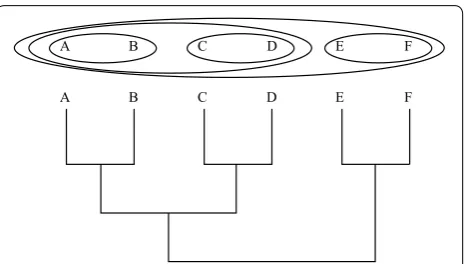
Another way of introducing tree-reading is by using cir-cle-in-circle-diagrams (see Fig. 4). These diagrams rely on depicting evolutionary relatedness using nested circles, representing different levels of relationship (Baum and Smith 2013; Jördens et al. 2012). Thus, students can easily get an understanding of the concept that a tree is a nested
hierarchy and that a branching event always results in sister groups, which are equally related to each other. Using this type of diagram allows students to easily grasp how taxonomic groups are organized (Catley et al. 2005; Jördens et al. 2012; Meisel 2010).
Circle-in-circle diagrams can be used to organize familiar groups intuitively and give students an easy introduction to constructing phylogenetic hypotheses. Card-sorting tasks (e.g., Gibson and Cooper 2017), where students organize species based on morphological or genetic data, may be used to structure relative relation-ships of the sorted species by nesting them in circles prior to constructing tree diagrams.
Convert topologies
In order to understand that different tree styles bear the same information and that the branching pattern, or topology, of a tree is the most important informational aspect, it can be advisable to get students to convert trees from one style into another (Baum and Smith 2013). By converting an evolutionary tree from, for example, the diagonal to a rectangular style, learners can better under-stand the aspects of both designs and get acquainted with the basic procedures in tree construction. Furthermore, they can understand the parts of the tree that correspond with each other and therefore contain the most mean-ing (Baum and Smith 2013). A better understanding of the tree styles being equivalent may reduce the risk of superficial or teleological interpretations, especially in the context of styles or orientations, which are prone to misinterpretations (see above).
Consider the wording
Students might not be aware of the problem teleological metaphors can pose in learning about evolution, espe-cially because professional biologists and textbooks reg-ularly use teleological wording. In order to address the issue in evolutionary education directly, students need
A B C D E F
A B C D E F
to be made aware of their thinking processes (González Galli and Meinardi 2011; Trommler et al. 2018). The dif-ficulty is that these thought processes typically occur implicitly, and they need to be made explicit by explain-ing one’s own way of thinkexplain-ing. By engagexplain-ing students to explain their rationale, teleological formulations will most likely arise. By picking these formulations up and using them in a constructive way of discussing how they con-flict with biological models, rather than simply mark them as wrong, students should be made aware of the problem of teleology directly. For example, discussions can engage with the question of whether the statement was intended figuratively or literally and point out the limitations of everyday language in scientific contexts (González Galli and Meinardi 2011). In advanced classes, teleology could be picked up as a topic by analyzing different statements, both scientific and teleological, about evolution, working out the differences and potential problems and rephras-ing teleological explanations or by makrephras-ing students aware of the metaphorical nature of many teleological wordings (González Galli and Meinardi 2011; Zohar and Ginossar 1998). This way teleological statements can be used to gain a deeper understanding of how to think about evo-lutionary processes (González Galli and Meinardi 2011; Zohar and Ginossar 1998; Kattmann 2008).
An issue with reacting to teleological statements is that students might not actually think teleologically, despite phrasing their statements this way. This can be because teleological statements are perceived as being less com-plicated and easier than scientifically valid statements (Talanquer 2013). As students might choose teleologi-cal wording although they do not hold the teleologiteleologi-cal idea, diagnosing teleological thinking cannot solely rely on finding teleological wordings, and it requires explicit questions regarding the underlying believes; the mere use of teleological language does not seem to be sufficient to actually account for teleological thinking (Coley and Tan-ner 2015). Therefore banning teleological language from biology education is not purposeful, as this ban does not necessarily lead to students changing their mindset (Zohar and Ginossar 1998). A difficulty in this regard is that the evolutionary discourse is characterized by the use of many ambiguous terms. Many students use terms like pressure or adapt in a non-scientific way, especially when showing a weaker overall academic performance (Rector et al. 2013).
Address teleology
A possible way of how to provide students with an oppor-tunity to show their teleological mindset is to ask them to explain how evolutionary processes occur and what information evolutionary trees contain. Using informa-tion like a fossil record or evoluinforma-tionary tree as a basis,
asking students questions like “How and why did Species X develop?” or “How and why did trait Y develop?” can lay open students’ potential teleological biases and thus stimulate a discussion about how to interpret evolution-ary processes and representations (González Galli and Meinardi 2011; Werth 2012).
In the later part of a learning period, the educator could test in how far students changed their interpreta-tions of evolutionary processes and representainterpreta-tions from teleological to scientific reasoning by not asking simple questions of how a certain species or trait developed, but by posing questions that challenge the students’ reason-ing (González Galli and Meinardi 2011). These challeng-ing questions could be about concepts such as the loss of function, lateral gene-transfer, or polytomies in an evolu-tionary tree, or a context, which is likely to conflict with the students’ prior knowledge, such as the closer relative relationship of crocodiles to birds, rather than lizards (Baum and Offner 2008).
By making learners aware of the conceptual difficul-ties of teleology, especially in the context of evolution, they can be sensitized to problematic wording or repre-sentations, especially in a non-scientific or pop-cultural context. Misconceptions directly linked to teleological reasoning, such as misinterpreting the age of groups or the position of focal taxa might be reduced if students are familiar with the conceptual difficulties of teleological interpretations.
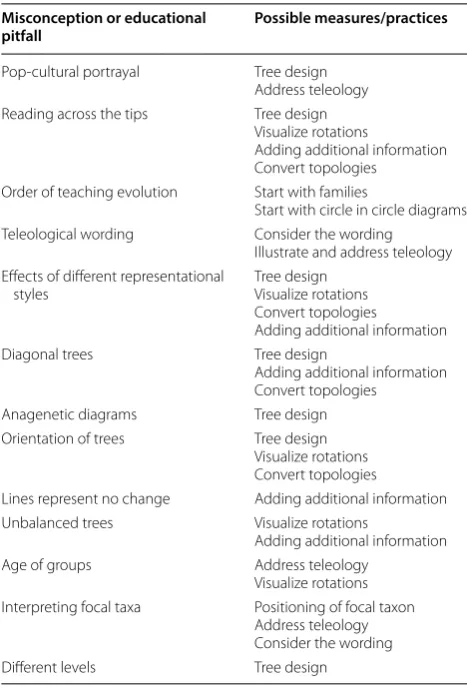
Educators can choose many practices to counter tele-ological reasoning in their learning environments (see Table 1). By critically reflecting and possibly altering the representations used, typical pitfalls and misconceptions will be less common. Furthermore, different instructional practices can affect teleological tendencies, ranging from the way the unit about phylogenetics commences, to con-crete practices with evolutionary trees, or general aspects relating to language use.
Conclusion and implications
Given widespread misunderstandings and low levels of acceptance, educators need to be aware about the ways in which they are teaching evolution. Many factors influ-ence the ways in which students perceive evolution; two very important ones are teleological thinking and the use of evolutionary trees.
interpreting evolutionary trees as the central diagram-matic depiction of macro-evolutionary processes is far from being immune to these teleological pitfalls. Tree-reading is of major importance to understanding evolu-tionary biology; however, students from high-school to the post-secondary education face great difficulties and have a high number of persistent misconceptions about reading evolutionary trees. Thus, educators need to be aware of approaches that they can employ to minimize student use of teleological reasoning.
This work lays out several known and documented pit-falls in working with evolutionary trees in order to inform educators about the parts of teaching tree-reading that are susceptible to being influenced by and for promoting teleological misconceptions. The major teleological mis-conception in the field of reading evolutionary trees is the notion that different species can be classified as “higher” or “lower” (more or less “advanced”). Different teaching practices and various properties of evolutionary trees can promote this problematic idea in learners.
Besides presenting known teleological pitfalls, we provided educators with several approaches for how to confront and address teleological reasoning and think-ing in their learnthink-ing environments when workthink-ing with evolutionary trees. Here, the approaches can be split into practices regarding the construction and design of tree diagrams and instructional approaches regarding general teaching practices.
This work contributes to the field of evolution education by helping educators identify teaching practices and prop-erties of evolutionary trees that can unintentionally pro-mote teleological thinking and reasoning. By countering teleological reasoning and making students aware of the difference between teleological and causal explanations, a deeper understanding of evolution can be achieved. If an increasing number of students attain a deeper understand-ing of evolution, its general acceptance might increase, and this may simultaneously result in less creationist views.
Limitations
The issue of teleological reasoning in the context of evo-lutionary education has often been addressed in recent years and, as in this work, has typically been seen as a hurdle in learning processes. Just as in many other cir-cumstances, one should adopt a more nuanced per-spective. Teleological interpretations are typically basal, non-scientific explanations for processes in the natural world, and they can be used as a gateway to more elabo-rate explanations. By making students aware of the meta-phorical nature of their teleological statements, they can learn to critically reflect the metaphorical nature and possibly attain a deeper understanding of the evolution-ary concepts (Kattmann 2008).
Few studies have explored the connections among tele-ological mindsets, evolution in general, and tree-reading. There seem to be some aspects, like different design ele-ments of evolutionary trees, that encourage students to make teleological interpretations. Then again, a general teleological mindset might lead to faulty interpretations of evolutionary trees. Teleological mindsets, tree design and fragmentary knowledge about evolution could interact and lead to the emergence of teleological inter-pretations in different contexts of evolution. So, further research—especially experimental research approaches— is needed to clarify these relations.
In the context of this work, we presented several pitfalls in teaching how to read evolutionary trees and subsequently, the different ways of avoiding them. Although several con-nections between pitfalls and teaching practices have been conducted, several implications presented are based on the-oretical conclusions, and they have not been tested empiri-cally. Further work testing these claims is needed.
Table 1 Overview of the reported misconceptions linked to teleological thinking and potential ways of confronting them
Misconception or educational
pitfall Possible measures/practices
Pop-cultural portrayal Tree design
Address teleology
Reading across the tips Tree design
Visualize rotations
Adding additional information Convert topologies
Order of teaching evolution Start with families
Start with circle in circle diagrams
Teleological wording Consider the wording
Illustrate and address teleology Effects of different representational
styles Tree designVisualize rotations
Convert topologies
Adding additional information
Diagonal trees Tree design
Adding additional information Convert topologies
Anagenetic diagrams Tree design
Orientation of trees Tree design
Visualize rotations Convert topologies
Lines represent no change Adding additional information
Unbalanced trees Visualize rotations
Adding additional information
Age of groups Address teleology
Visualize rotations
Interpreting focal taxa Positioning of focal taxon
Address teleology Consider the wording
Authors’ contributions
TS reviewed the literature, devised the line of thought and wrote the manu-script with support from PS. PS supervised the project and contributed to the manuscript. Both authors read and approved the final manuscript.
Funding
This project is funded by the German Federal Ministry of Education and Research under Grant Number 01PL16075.
Additional funding was provided by the Interdisciplinary Centre for Edu-cational Research (IZfB) of the University Duisburg-Essen for professional language editing services and by the Open Access Publication Fund of the University of Duisburg-Essen for publication fees.
The responsibilities for the content of this publication lie with the authors.
Availability of data and materials
The datasets supporting the conclusions of this article are included within the article.
Competing interests
The authors declare that they have no competing interests.
Received: 24 September 2019 Accepted: 13 November 2019
References
Abrams E, Southerland S. The how’s and why’s of biological change: how learners neglect physical mechanisms in their search for meaning. Int J Sci Educ. 2001;23(12):1271–81. https ://doi.org/10.1080/09500 69011 00385 58. Ariew A. Ernst Mayr’s ‘ultimate/proximate’ distinction reconsidered and
recon-structed. Biol Philos. 2003;18(4):553–65.
Barnes ME, Evans EM, Hazel A, Brownell SE, Nesse RM. Teleological reasoning, not acceptance of evolution, impacts students’ ability to learn natural selection. Evol Edu Outreach. 2017;10(1):152. https ://doi.org/10.1186/ s1205 2-017-0070-6.
Baum DA, Offner S. Phylogenics and tree-thinking. Am Biol Teach. 2008;70(4):222–9.
Baum DA, Smith SD. Tree thinking: an introduction to phylogenetic biology. Greenwood Village Col.: Roberts; 2013.
Baum DA, Smith SD, Donovan SSS. Evolution. The tree-thinking challenge. Sci-ence. 2005;310(5750):979–80. https ://doi.org/10.1126/scien ce.11177 27. Blacquiere LD, Hoese WJ. A valid assessment of students’ skill in determining relationships on evolutionary trees. Evol Edu Outreach. 2016;9(1):979. https ://doi.org/10.1186/s1205 2-016-0056-9.
Bokor JR, Landis JB, Crippen KJ. High school students’ learning and perceptions of phylogenetics of flowering plants. CBE Life Sci Educ. 2014;13(4):653– 65. https ://doi.org/10.1187/cbe.14-04-0074.
Borgerding LA, Deniz H. Evolution education around the globe: conclusions and future directions. In: Deniz H, Borgerding LA, editors. Evolution education around the globe. Cham: Springer; 2018. p. 449–64. https :// doi.org/10.1007/978-3-319-90939 -4_24.
Campbell A. Evolution education in New Zealand. In: Deniz H, Borgerding LA, editors. Evolution education around the globe. Cham: Springer; 2018. p. 431–46. https ://doi.org/10.1007/978-3-319-90939 -4_23.
Catley KM, Lehrer R, Reiser B. Tracing a prospective learning progression for developing understanding of evolution. In: Paper commissioned by the national academics committee on test design for K-12 science achieve-ment. Washington, DC: National Academy of Sciences; 2005.
Catley KM, Novick LR. Seeing the wood for the trees: an analysis of evolution-ary diagrams in biology textbooks. Bioscience. 2008;58(10):976. https :// doi.org/10.1641/B5810 11.
Catley KM, Novick LR, Shade CK. Interpreting evolutionary diagrams: when topology and process conflict. J Res Sci Teach. 2010;47(7):861–82. https :// doi.org/10.1002/tea.20384 .
Catley KM, Novick LR, Funk D. The promise and challenges of introducing tree thinking into evolution education. In: Rosengren KS, Brem SK, Evans EM, edi-tors. Evolution challenges: integrating research and practice in teaching and learning about evolution. Oxford: Oxford University Press; 2012. p. 93–101. Clark CA. “You are here”: missing links, chains of being, and the language of
cartoons. Isis. 2009;100(3):571–89.
Coley JD, Tanner K. Relations between intuitive biological thinking and biologi-cal misconceptions in biology majors and nonmajors. CBE Life Sci Educ. 2015;14(1):ar8. https ://doi.org/10.1187/cbe.14-06-0094.
Crisp MD, Cook LG. Do early branching lineages signify ancestral traits? Trends Ecol Evol. 2005;20(3):122–8. https ://doi.org/10.1016/j.tree.2004.11.010. Cunningham DL, Wescott DJ. Still more “Fancy” and “Myth” than “Fact” in
Students’ conceptions of evolution. Evo Edu Outreach. 2009;2(3):505–17. https ://doi.org/10.1007/s1205 2-009-0123-6.
Darwin C. On the origin of species by means of natural selection, or the pres-ervation of favoured races in the struggle for life. London: Murray; 1859. Dees J, Momsen JL, Niemi J, Montplaisir L. Student interpretations of
phy-logenetic trees in an introductory biology course. CBE Life Sci Educ. 2014;13(4):666–76. https ://doi.org/10.1187/cbe.14-01-0003.
Deniz H, Borgerding LA. Evolutionary theory as a controversial topic in science curriculum around the globe. In: Deniz H, Borgerding LA, editors. Evolu-tion educaEvolu-tion around the globe. Cham: Springer; 2018. p. 3–11. https :// doi.org/10.1007/978-3-319-90939 -4_1.
Dobzhansky T. Nothing in biology makes sense except in the light of evolu-tion. Am Biol Teach. 1973;35(3):125–9.
Evans EM. Cognitive and contextual factors in the emergence of diverse belief systems: creation versus evolution. Cogn Psychol. 2001;42(3):217–66. https ://doi.org/10.1006/cogp.2001.0749.
Friedrichsen PJ, Brown LG, Schul J. Project teach evolution: preparing biology pre-service teachers to teach evolution in Missouri, USA. In: Deniz H, Borgerding LA, editors. Evolution education around the globe. Cham: Springer; 2018. p. 41–58. https ://doi.org/10.1007/978-3-319-90939 -4_3. Futuyma DJ. Evolution. 3rd ed. Sunderland: Sinauer Associates; 2013. Gibson JP, Cooper JT. Botanical phylo-cards: a tree-thinking game to teach
plant evolution. Am Biol Teach. 2017;79(3):241–4. https ://doi.org/10.1525/ abt.2017.79.3.241.
Goldsmith DW. The great clade race. Am Biol Teach. 2003;65(9):679–82. González Galli LM, Meinardi EN. The role of teleological thinking in learning
the Darwinian model of evolution. Evo Edu Outreach. 2011;4(1):145–52. https ://doi.org/10.1007/s1205 2-010-0272-7.
Gould SJ. Ladders and cones: constraining evolution by canonical icons. In: Silvers RB, editor. Hidden histories of science. 1st ed. New York: Review of Books; 1995. p. 37–68.
Gould SJ. Full house: the spread of excellence from Plato to Darwin. New York: Harmony; 1996.
Gregory TR. Understanding evolutionary trees. Evo Edu Outreach. 2008;1(2):121–37. https ://doi.org/10.1007/s1205 2-008-0035-x. Gregory TR. Understanding natural selection: essential concepts and
com-mon misconceptions. Evo Edu Outreach. 2009;2(2):156–75. https ://doi. org/10.1007/s1205 2-009-0128-1.
Gregory TR, Ellis CAJ. Conceptions of evolution among science gradu-ate students. Bioscience. 2009;59(9):792–9. https ://doi.org/10.1525/ bio.2009.59.9.10.
Halverson KL. Using pipe cleaners to bring the tree of life to life. Am Biol Teach. 2010;72(4):223–4. https ://doi.org/10.1525/abt.2010.72.4.4.
Halverson KL. Improving tree-thinking one learnable skill at a time. Evo Edu Outreach. 2011;4(1):95–106. https ://doi.org/10.1007/s1205 2-010-0307-0. Halverson KL, Friedrichsen P. Learning tree thinking: developing a new frame-work of representational competence. In: Treagust DF, Tsui C-Y, editors. Multiple representations in biological education. Dordrecht: Springer; 2013. p. 185–201. https ://doi.org/10.1007/978-94-007-4192-8_11. Hanke D. Teleology: the explanation that bedevils biology. In: Cornwell J,
editor. Explanations: styles of explanation in science. Oxford: OUP Oxford; 2004. p. 143–55.
Jördens J, Asshoff R, Kullmann H. Stammbäume lesen und verstehen. In: Dreesmann DC, Graf D, Witte K, editors. Evolutionsbiologie: moderne Themen für den Unterricht. Heidelberg: Springer; 2012. p. 377–403. Kampourakis K. Understanding evolution. Cambridge: Cambridge University
Press; 2014.
Kampourakis K, Zogza V. Students’ preconceptions about evolution: how accurate is the characterization as “Lamarckian” when considering the history of evolutionary thought? Sci Educ. 2007;16(3–5):393–422. https :// doi.org/10.1007/s1119 1-006-9019-9.
Keil FC. The growth of causal understandings of natural kinds. In: Sperber D, editor. Causal cognition: a multidisciplinary debate; a Fyssen Foundation symposium. 1st ed. Oxford: Clarendon Press; 2002. p. 234–62. https ://doi. org/10.1093/acpro f:oso/97801 98524 021.003.0009.
Kelemen D. Function, goals and intention: children’s teleological reasoning about objects. Trends Cogn Sci. 1999a;3(12):461–8. https ://doi.org/10.1016/S1364 -6613(99)01402 -3.
Kelemen D. The scope of teleological thinking in preschool children. Cognition. 1999b;70(3):241–72. https ://doi.org/10.1016/S0010 -0277(99)00010 -4. Kelemen D. Why are rocks pointy? Children’s preference for teleological
explana-tions of the natural world. Dev Psychol. 1999c;35(6):1440–52. https ://doi. org/10.1037/0012-1649.35.6.1440.
Kelemen D. Teleological minds: how natural intuitions about agency and purpose influence learning about evolution. In: Rosengren KS, Brem SK, Evans EM, editors. Evolution challenges: integrating research and practice in teaching and learning about evolution. Oxford: Oxford University Press; 2012. p. 66–92.
Kelemen D, Rosset E. The human function compunction: teleological explanation in adults. Cognition. 2009;111(1):138–43. https ://doi.org/10.1016/j.cogni tion.2009.01.001.
Kummer TA, Whipple CJ, Jensen JL. Prevalence and persistence of misconcep-tions in tree thinking. J Microbiol Biol Educ. 2016;17(3):389–98. https ://doi. org/10.1128/jmbe.v17i3 .1156.
Lay YF, Ong ET, Han CGK, Chan SH. A glimpse of evolution education in the Malaysian context. In: Deniz H, Borgerding LA, editors. Evolution educa-tion around the globe. Cham: Springer; 2018. p. 357–74. https ://doi. org/10.1007/978-3-319-90939 -4_19.
MacDonald T, Wiley EO. Communicating phylogeny: evolutionary tree diagrams in museums. Evo Edu Outreach. 2012;5(1):14–28. https ://doi.org/10.1007/ s1205 2-012-0387-0.
Matuk C. Images of evolution. J Biocommun. 2007;33(3):E54–61.
Mead LS. Transforming our thinking about transitional forms. Evo Edu Outreach. 2009;2(2):310–4. https ://doi.org/10.1007/s1205 2-009-0126-3.
Mead LS, Scott EC. Problem concepts in evolution part I: purpose and design. Evo Edu Outreach. 2010a;3(1):78–81. https ://doi.org/10.1007/s1205 2-010-0210-8.
Mead LS, Scott EC. Problem concepts in evolution part II: cause and chance. Evo Edu Outreach. 2010b;3(2):261–4. https ://doi.org/10.1007/s1205 2-010-0231-3.
Meir E, Perry J, Herron JC, Kingsolver J. College students’ misconceptions about evolutionary trees. Am Biol Teach. 2007;69(7):e71–6.
Meisel RP. Teaching tree-thinking to undergraduate biology students. Evolution. 2010;3(4):621–8. https ://doi.org/10.1007/s1205 2-010-0254-9.
Mogie M. Historical baggage in biology: the case of ‘higher’ and ‘lower’ species. BioEssays. 2000;22(9):868–9.
Nee S. The great chain of being. Nature. 2005;435(7041):429. https ://doi. org/10.1038/43542 9a.
Nehm RH, Kampourakis K. History and philosophy of science and the teaching of macroevolution. In: Matthews MR, editor. International handbook of research in history, philosophy and science teaching. Dordrecht: Springer; 2014. p. 401–21. https ://doi.org/10.1007/978-94-007-7654-8_14.
Nehm RH, Schonfeld IS. Does increasing biology teacher knowledge of evolution and the nature of science lead to greater preference for the teaching of evolution in schools? J Sci Teach Educ. 2007;18(5):699–723. https ://doi. org/10.1007/s1097 2-007-9062-7.
Nehm RH, Schonfeld IS. Measuring knowledge of natural selection: a comparison of the CINS, an open-response instrument, and an oral interview. J Res Sci Teach. 2008;45(10):1131–60. https ://doi.org/10.1002/tea.20251 . Novick LR, Catley KM. Understanding phylogenies in biology: the influence of a
Gestalt Perceptual Principle. J Exp Psychol Appl. 2007;13(4):197–223. https :// doi.org/10.1037/1076-898X.13.4.197.
Novick LR, Catley KM. When relationships depicted diagrammatically conflict with prior knowledge: an investigation of students’ interpretations of evolutionary trees. Sci Educ. 2014;98(2):269–304. https ://doi.org/10.1002/ sce.21097 .
Novick LR, Catley KM. Fostering 21st-century evolutionary reasoning: teaching tree thinking to introductory biology students. CBE Life Sci Educ. 2016. https ://doi.org/10.1187/cbe.15-06-0127.
Novick LR, Catley KM, Funk D. Characters are key: the effect of synapomorphies on cladogram comprehension. Evo Edu Outreach. 2010;3(4):539–47. https ://doi.org/10.1007/s1205 2-010-0243-z.
Novick LR, Pickering J, MacDonald T, Diamond J, Ainsworth S, Aquino AE, et al. Depicting the tree of life in museums: guiding principles from psychological research. Evo Edu Outreach. 2014;7(1):669. https ://doi. org/10.1186/s1205 2-014-0025-0.
O’Hara RJ. Population thinking and tree thinking in systematics. Zool Scripta. 1997;26(4):323–9. https ://doi.org/10.1111/j.1463-6409.1997.tb004 22.x. Omland KE. Interpretation of phylogenetic trees. In: Losos JB, editor. The
Prince-ton guide to evolution. PrincePrince-ton: PrincePrince-ton University Press; 2014. p. 51–9. Omland KE, Cook LG, Crisp MD. Tree thinking for all biology: the problem with
reading phylogenies as ladders of progress. BioEssays. 2008;30(9):854–67. https ://doi.org/10.1002/bies.20794 .
Padian K. Trickle-down evolution: an approach to getting major evolution-ary adaptive changes into textbooks and curricula. Integr Comp Biol. 2008;48(2):175–88. https ://doi.org/10.1093/icb/icn02 3.
Philips BC, Novick LR, Catley KM, Funk D. Interactive effects of Diagrammatic Format and Teleological Beliefs on Tree Thinking. In: Ohlsson S, Catram-bone R, eds. 32nd Annual Meeting of the Cognitive Science Society 2010, Portland, Oregon, USA, 11-14 August 2010. Red Hook, NY: Curran Associ-ates Inc; 2011. p. 2656–2661.
Pietsch TW. Trees of life: a visual history of evolution. Baltimore: Johns Hopkins University Press; 2012.
Quessada M-P, Clément P. Evolution education in france: evolution is widely taught and accepted. In: Deniz H, Borgerding LA, editors. Evolution education around the globe. Cham: Springer; 2018. p. 213–33. https ://doi. org/10.1007/978-3-319-90939 -4_12.
Rector MA, Nehm RH, Pearl D. Learning the language of evolution: lexical ambiguity and word meaning in student explanations. Res Sci Educ. 2013;43(3):1107–33. https ://doi.org/10.1007/s1116 5-012-9296-z. Reiss MJ. Creationism and intelligent design. In: Smeyers P, editor. International
handbook of philosophy of education. Cham: Springer; 2018. p. 1247–59. https ://doi.org/10.1007/978-3-319-72761 -5_86.
Rosenberg A, McShea DW. Philosophy of biology: a contemporary introduc-tion. New York: Routledge; 2008.
Ruse M. Evolutionary biology and teleological thinking. In: Ariew A, Cummins R, Perlman M, editors. Functions: new essays in the philosophy of psychol-ogy and biolpsychol-ogy. Oxford: Oxford University Press; 2009. p. 33–60. Sandvik H. Anthropocentricisms in cladograms. Biol Philos. 2009;24(4):425–40.
https ://doi.org/10.1007/s1053 9-007-9102-x.
Schramm T, Schachtschneider Y, Schmiemann P. Understanding the tree of life: an overview of tree-reading skill frameworks. Evo Edu Outreach. 2019;12(1):1538. https ://doi.org/10.1186/s1205 2-019-0104-3.
Scott M. The pleasures and pitfalls of teaching human evolution in the museum. Evo Edu Outreach. 2010;3(3):403–9. https ://doi.org/10.1007/s1205 2-010-0252-y.
Southerland SA, Abrams E, Cummins CL, Anzelmo J. Understanding students’ explanations of biological phenomena: conceptual frameworks or p-prims? Sci Educ. 2001;85(4):328–48. https ://doi.org/10.1002/sce.1013.
Talanquer V. When atoms want. J Chem Educ. 2013;90(11):1419–24. https ://doi. org/10.1021/ed400 311x.
Tamir P, Zohar A. Anthropomorphism and teleology in reasoning about biological phenomena. Sci Educ. 1991;75(1):57–67. https ://doi.org/10.1002/sce.37307 50106 .
Taylor MR, Simon EJ, Dickey JL, Hogan KA, Reece JB, Campbell NA. Campbell biol-ogy: concepts AND connections. New York: Pearson Education, Inc; 2018. Trommler F, Gresch H, Hammann M. Students’ reasons for preferring
teleological explanations. Int J Sci Educ. 2018;40(2):159–87. https ://doi. org/10.1080/09500 693.2017.14046 58.
Werth A. Avoiding the pitfall of progress and associated perils of evolutionary education. Evo Edu Outreach. 2012;5(2):249–65. https ://doi.org/10.1007/ s1205 2-012-0417-y.
Wiley J, Sarmento D, Griffin TD, Hinze SR. Biology textbook graphics and their impact on expectations of understanding. Discourse Process. 2017;12:1–16. https ://doi.org/10.1080/01638 53X.2017.13196 55.
Zohar A, Ginossar S. Lifting the taboo regarding teleology and anthro-pomorphism in biology education?Heretical suggestions. Sci Educ. 1998;82(6):679–97.
Publisher’s Note