PhD Dissertation
International Doctorate School in Information and Communication Technologies
DIT - University of Trento
A
COLLABORATIVE
PLATFORM FOR MULTILINGUAL
ONTOLOGY DEVELOPMENT
Ahmed Maher Ahmed Tawfik Moustafa
Advisor:
Abstract
The world is extremely diverse and its diversity is obvious in the cultural differences and the large number of spoken languages being used all over the world. In this sense, we need to collect and organize a huge amount of knowledge obtained from multiple resources differing from one another in many aspects. A possible approach for doing that is to think of designing effective tools for construction and maintenance of linguistic resources and localized domain ontologies based on well-defined knowledge representation methodologies capable of dealing with diversity and the continuous evolvement of human knowledge. In this thesis, we present a collaborative platform which allows for knowledge organization in a language-independent manner and provides the appropriate mapping from a language independent concept to one specific lexicalization per language. This representation ensures a smooth multilingual enrichment process for linguistic resources and a robust construction of ontologies using language-independent concepts. The collaborative platform is designed following a workflow-based development methodology that models linguistic resources as a set of collaborative objects and assigns a customizable workflow to build and maintain each collaborative object in a community driven manner, with extensive support of modern web 2.0 social and collaborative features.
Keywords
Acknowledgments
Contents
PART I – INTRODUCTION ... 1
INTRODUCTION... 2
THE CONTEXT ... 2
THE PROBLEM ... 3
THE SOLUTION ... 5
INNOVATIVE ASPECTS ... 6
STRUCTURE OF THE THESIS ... 7
STATE OF THE ART ... 9
LEXICAL DATABASES ... 9
LEXICAL DATABASES ON THE WEB ... 10
ONTOLOGIES ... 12
ONTOLOGY DEVELOPMENT TOOLS ON THE WEB ... 16
Semantic Wiki based tools ... 16
Interactive web based tools ... 18
PART II – METHODOLOGICAL CONTRIBUTIONS ... 20
UNIVERSAL KNOWLEDGE CORE (UKC) ... 21
NATURAL LANGUAGE CORE (NLC) ... 22
CONCEPT CORE (CC) ... 25
UKCUSAGE SCENARIOS ... 27
1- Lexical Resource Enrichment ... 27
2- Lexical Resource Translation ... 28
3- Ontology Design and Development ... 28
4- Ontology Localization ... 29
COLLABORATIVE DEVELOPMENT METHODOLOGY ... 30
COLLABORATIVE OBJECT ... 30
COLLABORATIVE WORKFLOW ... 31
STEPS IN THE METHODOLOGY ... 35
PART III – TECHNOLOGICAL CONTRIBUTIONS ... 41
UKC WORDNET APPLICATION ... 42
REQUIREMENT SPECIFICATIONS ... 44
USER INTERFACE DESIGN ... 47
UKC INTERACTIVE PLATFORM ... 48
USER STUDIES ... 48
REQUIREMENT SPECIFICATIONS ... 49
OVERALL ARCHITECTURE ... 62
USER INTERFACE DESIGN ... 64
COMPARATIVE EVALUATION (WORDNET VS. UKC) ... 69
QUANTITATIVE WORK ... 69
EVALUATION RESULTS ... 70
UKC COLLABORATIVE PLATFORM ... 73
USER STUDIES ... 73
REQUIREMENT SPECIFICATIONS ... 75
OVERALL ARCHITECTURE ... 81
USER INTERFACE DESIGN ... 83
COLLABORATIVE DEVELOPMENT EXPERIMENT ... 87
ONTOLOGY DEVELOPMENT METHODOLOGY:DERAFRAMEWORK ... 87
EARLY EXPERIMENT ... 90
Experimental Setting ... 91
Results of the experiment ... 91
FINAL EXPERIMENT ... 93
Experimental Setting ... 93
Results of the experiment ... 95
CONCLUSION AND FUTURE WORK ... 99
COLLABORATIVE DEVELOPMENT OF ENTITY TYPES ... 99
COLLABORATIVE DEVELOPMENT OF DOMAINS ... 100
BIBLIOGRAPHY ... 102
Part I – Introduction
1. Introduction
Context
Problem
Solution
2. State of the Art
Lexical Databases
Chapter 1
I
NTRODUCTION
T
HEC
ONTEXTRecently, there have been great advances in semantic-aware and context-aware applications. Semantic-aware applications are mainly intended to assist with information retrieval. They are designed to return more accurate search results by trying to extract the embedded meaning of the search keywords. On the other hand, context-aware applications are smart applications capable of detecting the user’s social and physical surroundings (i.e. physical location, weather forecast) and provide in-site recommendations and short answers to user’s queries submitted in natural language. Both semantic-aware and context-aware applications rely on knowledge based approaches, i.e. approaches which exploit the semantics of information in order to deliver the necessary and sufficient information to the user and avoid delivering irrelevant and extra information. Examples of knowledge based approaches include: automatic classifications (Giunchiglia, F. et el. 2007 b), abstract reasoning (Giunchiglia, F. et el. 1997), ontology matching (Giunchiglia, F. et el. 2007 a), ontology mapping (Giunchiglia, F. et el. 2010a), common sense reasoning (Bouquet, P. et el. 1995) and natural language data and metadata understanding (Zaihrayeu, I. et el. 2007).
into useful domain specific knowledge. In addition, it must allow for extensibility as knowledge is continuously evolving.
Therefore, this challenge reflects two main research directions that we need to go through: (1) Defining methodologies for capturing and organizing multilingual linguistic information in a formal way; and (2) Designing and implementing usable tools for gathering diverse linguistic terminologies and cross-culture knowledge.
Capturing and organizing multilingual linguistic information in a formal way can be achieved by working at idiom level, i.e. by defining a piece of knowledge, or a semantic entry and its mapping to a set of lexical definitions in multiple languages forming semantic multilingual linguistic resource. Enriching this linguistic resource requires interactive and user-friendly web application that allows geographically distributed linguistic and domain experts to contribute in a collaborative manner. Their collaboration should take place based on a well-defined collaborative methodology which states clearly the development processes, user roles, and access rights. In addition, the collaborative methodology needs to remove the communication barrier between the participants and allow them to discuss various domain-related topics, share ideas and reach to common agreements.
T
HEP
ROBLEMKnowledge is continuously evolving in a diversified world. Diversity is a world fact that we have to address and deal with; it appears in more than one dimension:
Diversity in formal language representations: any representations may differ according to the scope of the domain, purpose of the representation or the conceptual point of view of the domain expert. For example, one domain expert may classify cars as economic, luxury, and sports cars while another domain expert may classify them based on car models and brands. Another approach is to allow the two experts to collaborate and come up with a classification that capture both point of views.
Diversity in human knowledge: knowledge may differ based on cultural differences or personal opinions. For example, Arab countries bring up horses only for riding and racing purposes while other countries may bring them up as a food.
As a result, a complete digital formal linguistic resource which acts as source of knowledge for knowledge seekers and as a background database for semantic applications is very hard to construct and maintain. This is mainly for the following specific reasons: (1) it should be very large and capture most if not all of the real life concepts, (2) it should be accurate which requires huge manual intervention in order to deal with problems like natural languages ambiguity and defining appropriate context for words usages, (3) it should be diversity aware and capable of capturing the regional and cultural differences, (4) it should be well organized and semantic aware in order to be reused in building efficient end-user software applications, (5) it should be extensible since knowledge is continually evolving with time and provide feasible extensible mechanisms without the need to reconstruct any part of the knowledge base, and (6) it should be easily accessible anywhere with friendly user-interface and don’t require complicated installation process.
T
HES
OLUTIONThis thesis aims to provide a methodological and technological approach for designing and implementing a collaborative platform for enriching linguistic resources and developing multilingual ontologies. The platform facilitates the management of diversity across cultures and development of localized domain ontologies.
The platform uses the Universal Knowledge Core as the background methodology for knowledge representation, also referred to as UKC, a framework designed and implemented by knowdive1 group. The UKC framework defines a comprehensive
methodology for organizing knowledge obtained from multiple languages into three main levels: (1) Natural language level, (2) Formal Language Level, and (3) knowledge level (Giunchiglia, F. et el. 2012a and Giunchiglia, F. et el. 2012b). Therefore, the UKC framework provides the necessary background semantic representation we need to rely on.
After deciding on the background semantic representation, we defined a collaborative development methodology based on the notions of collaborative objects and collaborative workflows. The methodology models the project under development into a set of collaborative objects and assigns a customizable collaborative workflow for each object. The collaborative workflows could model the process required for the development of a specific linguistic object and specify the roles of domain experts who will participate in the process, other constraints like time constraints could also be managed by setting timers and due dates to the workflow process. The workflow is customizable since workflows differ from project to project according to the structure and nature of the project. For example, the development of specific domain ontology for banking systems may require development of several classes of objects related to the financial transactions (i.e. withdraw, transfers, and the rest of financial transaction types) and other classes of objects related to banking card types (credit, debit, and the rest of banking card types). The objects related to financial transactions contain a fair amount of sensitive domain specific attributes, therefore the collaborative methodology
could be adopted to model these objects as collaborative objects and assign to them a workflow process that requires approval from at least four banking domain experts. On the other hand, Objects related to banking cards types are simpler and well known to domain experts, thus these collaborative objects could be assigned a workflow process that requires approval from only one banking domain expert. This fine grained development methodology may results in more accurate development of domain ontologies and within managed time ranges.
The collaborative methodology has been applied on UKC content and a collaborative interactive web platform has been designed, implemented and evaluated. The web platform was designed and implemented by following an iterative approach started by implementing a multilingual version of WordNet application accessing UKC content as a read-only linguistic resource. In parallel, an initial version of the UKC web platform was designed and implemented to provide an interactive environment for manipulating UKC content as an editable linguistic resource. A comparative evaluation was conducted between the UKC web platform and WordNet application in order to come up with a final refined version. Finally, the UKC web platform was further evolved to support collaborative development of UKC content according to the proposed collaborative methodology. The final collaborative platform allows participants to collaborate together in a social media and build a virtual community by leveraging a group of web 2.0 social features like message boards, online discussions, and interactive polls.
INNOVATIVE ASPECTS
However, there have been few trials to develop specific workflow-based approaches. (Palma, R. et el. 2008) and (Sebastian, A. et el. 2008) proposed an editorial workflow approach for ontology development using specific workflow ontology for defining workflows. Both approaches define domain specific workflows by making use of predefined workflow ontology. Our approach differs as it defines a set of domain non-specific collaborative workflows and makes use of them on the level of collaborative objects under development instead of one custom workflow for the development of the whole domain.
S
TRUCTURE OF THET
HESISThe thesis is divided into three parts. Part I introduces the problem statement, the proposed solution and the state of the art. The state of the art explains briefly the notions of lexical databases and ontologies then points out to the common web-based lexical databases and ontology development tools.
Part II introduces the methodological contributions of the thesis. Chapter 3 presents the UKC methodology for knowledge organization and describes how the methodology provides a clear distinction between formal and natural language representations. Chapter 4 presents a novel methodology for collaborative development. The methodology is based on the notions of collaborative objects and collaborative workflows. In this chapter, we explain the methodology and how it could be applied in collaborative development in step-by-step basis.
Part III introduces the technological contributions of the thesis. Chapter 5 presents the UKC WordNet application, a multilingual version of the famous WordNet application that has been designed to access the UKC linguistic resource. Chapter 6 presents the UKC Interactive Platform, a rich client web application for analyzing and enriching the UKC linguistic resource. Chapter 7 presents a comparative evaluation between UKC WordNet application and UKC interactive platform.
Chapter 2
S
TATE OF THE
A
RT
In this chapter, we explain briefly the notions of lexical databases and ontologies and point out to the major contributions and related work in these two areas.
We first start by defining the notion of lexical database and explain the requirements of a complete and well defined lexical database. Then we list the available lexical databases currently existing on the web and their main characteristics.
Then we define the notion of ontology and list the available ontology development tools. Our main focus is on ontology development tools that are characterized by being collaborative and web-based.
L
EXICALD
ATABASESThe word lexical is defined in the word reference dictionary2 as:
Adjective: “… related to words or the vocabulary of a language as distinguished from its grammar and construction….”
Starting from this definition, we can provide a more formal definition for a lexical database as an organized resource of the vocabulary of a language. It stores information about morphemes, the smallest possible unit of a language such as words, and meanings.
A lexical database could be designed in many different ways but however a complete lexical database should capture the knowledge that a native speaker has about the language. It should store at least the following information:
Words, word forms, and phrases.
Meaning of words with usage examples.
The word part of speech (noun, verb, adjective, or adverb)
Relations between words and phrases.
Another important distinction should be made when designing a lexical database is regarding its users, human users vs. natural language processing engines. For human users, it might be sufficient to capture and store the least amount of linguistic details that could be used in designing effective end-user applications. For natural language processing engines, the lexical database must be machine readable which requires defining means of organizing linguistic information in semantic ways and preserve the semantic relations between them.
Lexical databases could be multilingual and store the vocabulary of multiple languages; designing such a database introduces a couple of additional requirements:
Provide means for matching lexical entries of any two languages. For example, matching synonym lexical entries might be used in building applications like online dictionaries.
Allow for extensibility and adding more languages in a straightforward manner.
L
EXICALD
ATABASES ON THE WEBThere are small number of lexical databases and linguistic resources that exist today and have web platforms for linguistic analysis and enrichment. In the following paragraphs we review them briefly:
was the main reason for its accuracy. The latest version of WordNet released in November 2012 contains 155,287 words organized in 117,659 synsets.
MultiWordNet3 and EuroWordNet4 are multilingual lexical databases aligned with
WordNet and structured in the same way as WordNet. They are considered as an extension to WordNet which resolve its multilingual drawback. Both of these multilingual resources provide synsets which are strictly aligned with WordNet English synsets and their semantic relations were imported from WordNet and preserved for the translated synsets.
BabelNet (Navigli, R. and Ponzetto, SP. 2010) is a multilingual semantic network constructed automatically following a methodology that integrates lexicographic and encyclopedic knowledge from WordNet and Wikipedia. Its multilingual support was automatically constructed using machine translations in order to enrich their lexical representations. BabelNet wasn’t constructed based on a formal representation. BabelNet provides a graphical user interface, known as BabelNetXplorer (Navigli, R. and Ponzetto, SP. 2012). BabelNetXplorer allows the users to visually explore the knowledge repository but maintaining and enriching the linguistic resource is not supported.
FrameNet (Baker, Collin F. et el. 1998 and Baker, Collin F. 2003) is lexical database of English has more than 10,000 word senses. It’s machine-readable database, based on providing annotated examples of how words are used in actual texts. FrameNet is constructed based on a theory called Frame Semantics which assigns a semantic frame to each concept, i.e. a description explains the usage of the concept and its relations with other concepts. FrameNet has been constructed manually by defining language independent frames and annotated examples. The multilingual lexicalization was done as separate projects.
3http://multiwordnet.fbk.eu
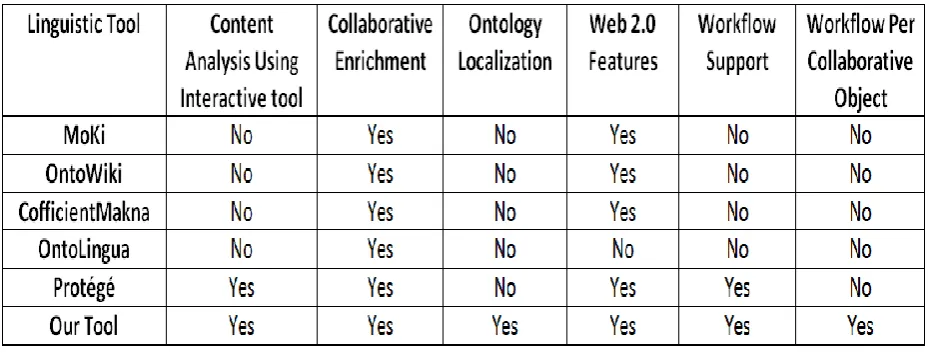
To the best of our knowledge, none of these tools has been built on a methodology for organizing knowledge obtained from multiple languages into natural language level and formal language level in order to facilitate extensibility and multicultural environment support. We could not also find a tool that provides collaborative extensibility based on a novel collaborative methodology. Table 2.1 provides a comparison between our collaborative platform and the commonly used linguistic tools, our platform supports all the listed distinctive features that none of them supports all of them.
Table-2.1: Comparison between our tool and the commonly used linguistic tools.
O
NTOLOGIESOntology is a hybrid term used in philosophy and information sciences. The origin of the word comes from the Latin word Ontologia (ont- + -logia), which means the science of existence.
The word ontology is defined in the word reference dictionary as:
(1) Noun: “… the branch of metaphysics that studies the question of what it means to exist…”
Starting from this definition, we can simply state that an ontology aims to define theories and models about reality and relations between existing objects. There have been several definitions for the notion of ontology in philosophy and information sciences. In order to stay in line within the context of this thesis, we focus only on the definitions proposed by information scientists.
In 1993, Gruber defined the notion of ontology as an “explicit specification of a conceptualization” (Gruber, T. 1993). In other words it means a clear well-defined representation of an abstract view of the world. A conceptualization is merely an abstraction of the world, or part of the world, in the form objects and relationships between objects.
In 1997, Borst proposed another definition and defined ontology as a “formal specification of a shared conceptualization” (Borst, W. N. 1997). Borst has added the word “shared” to describe the conceptualization which means that the abstract representation should be based on a common agreement instead of a personal point of view. Borst also replaced the word “explicit” with another word “formal” which means that the abstract representation should be free from ambiguity.
In 1998, Studer merged these two definitions in one definition: “ontology is a formal, explicit specification of a shared conceptualization.” (Studer et al 1998).
Figure-2.1: Simplified Computer Science Ontology
There have been also several trials to classify ontologies into different types. (Meersman et el 1999) classified ontologies into two main categories:
Thesaurus: domain specific ontology that models object, facts, and relations of a certain domain such as computer science, economics, or law.
Lexicon: a language specific ontology that models object vocabularies of specific language. Lexical databases defined earlier are examples of lexicon ontologies.
Lightweight ontologies are classified into two categories:
Descriptive lightweight ontologies: define the meaning of terms as well as the nature and structure of a domain.
Classification lightweight ontologies: describe and classify large collection of data items.
After defining and classifying ontologies, it’s essential to understand the benefits of developing new ontologies. Since ontologies provide a shared conceptualization and common understanding of a specific domain of interest, they may play a major role in supporting information exchange in various application areas.
(Fensel, D. 2001) identified three main application areas where ontologies may be used as the background schema for information exchange:
1. Information Search and knowledge management: these application areas include end-user applications and organization-wide applications.
2. Web Commerce: these application areas include online shopping applications.
3. Electronic business: these application areas include enterprise and e-government
applications.
O
NTOLOGY DEVELOPMENT TOOLS ON THE WEBOntology development tools that are web based and allow for collaborative development are few. Our main focus is on web based tools that support collaborative ontology editing through the web. Tools like OntoStudio (Weiten, M. 2009) and TopBraid Composer (COMPOSER, T. 2007) are mature tools for ontology development and offer wide range of functionalities such as ontology modeling, importing ontologies in standard formats, and ontology matching. Both of them offer collaborative development extension to the main tool which doesn’t go beyond internal shared access of a locally controlled ontology. Therefore, it would be hard to adopt them as collaborative tools for building diversity aware ontologies and require participation from a geographically distributed domain experts while web based tools could be easily adopted for this purpose. Web based ontology development tool used these days could be classified into two main categories: (1) Semantic Wiki based tools; and (2) Interactive web based tools.
SEMANTIC WIKI BASED TOOLS
Semantic Wiki aims to combine traditional wiki systems with Semantic Web by introducing semantic web technologies like RDF and OWL to the traditional Wiki. Ontology development tools that are based on Semantic Wiki based systems have gained popularity during the past few years with the increase of active contributors to the traditional encyclopedia5 as they could be easily extended and become familiar to
many domain experts. Semantic Wiki based tools are capable of providing a development approach similar to the one provided by the traditional wiki. Although the development process is straight forward but it is not customizable based on the contents and the nature of domain under development. On the following paragraphs we go through the main and the most promising Semantic Wiki based ontology development tools.
OntoWiki (Auer, S. et el. 2006) is a knowledge base which provides visual representation of domain ontologies as information maps. Information map entries are represented as web accessible pages and interlinked to related digital resources. Ontowiki also provides contextual views for entities, i.e. map views for locations and calendar views for instance data. The tool supports collaborative content enrichment by enabling users to rapidly editing or adding contents through an inline editing mode analogous to the WYSIWYG (What You See Is What You Get) editing strategy for text editing, since information can be edited in the same environment as it is presented to users. Social collaboration features are supported by OntoWiki: (1) commenting on contents, (2) tracking all changes performed by contributors such as: contributions to the ontology schema, additions of entities or comments, and information about the contributor; and (3) entities rating
CofficientMakna (Tempich, C. et el. 2007) is a Semantic Wiki tool for collaborative ontology engineering that allows participants to create ontologies from scratch or import existing ontologies to the wiki, imported ontologies are mapped to the wiki hypertext model according to a predefined schema. The collaborative development is augmented with the use of an argumentation ontology that formalizes the arguments exchanged between participants (issues, ideas and discussions) and provides a reasoning mechanism can alert users if they agree and disagree on the introduction of the same ontology entity.
MoKi (Ghidini, C. et el. 2010) is a tool for modeling ontologies and enterprise process models in a collaborative MediaWiki6 based approach. The tool associates a wiki page
containing both unstructured and structured information to each entity of the ontology. The unstructured information contains the MediaWiki markup format (text, images, drawings, or any markup format) while the structured information contains description knowledge stored according to the modeling language adopted (RDF or XML) where each entity is described by means of triple having the form (subject, relation, object). Moki supports multi-mode access to the page contents and exchange of comments to provide ease of use for different categories of users such as domain experts and knowledge engineers.
INTERACTIVE WEB BASED TOOLS
Ontology development tools that are designed and implemented as interactive web based tools are sort of challenging. They require more facilities in addition to exposing the ontology development functionalities. They should provide means for ontology visualization and manipulation in interactive way, management of concurrency control, mechanisms for data storage and alignment. On the following paragraphs we go through the main and the most promising interactive web based development tools.
OntoLingua (Farquhar, A. et el. 1997) was one of the earliest trials to provide collaborative ontology development on the web. It supports collaborative ontology construction by providing simultaneous work tasks through group sessions, i.e. a user opens a session and then may assign another group of people ownership to it. This enables any other member of that group to join the session and work simultaneously on the same set of ontologies. One of the main drawbacks stands in the fact that it was built using outdated web standards, for instance the server cannot notify users that a change has occurred until they revisit the page again. This tool also has no social collaboration features.
voting on content. Collaborative Protégé has an extension for supporting project specific workflows that could be defined using a generic ontology for modelling workflows (Sebastian, A. et el 2008a and Sebastian, A. 2008b). A workflow execution engine is required to interact with Protégé to run the modelled workflow for a specific project. This approach differs from our approach, as the workflow is modelled for a specific project and our approach offers a customized workflow for each collaborative object in the project.
Table 2.2 provides a comparison between our collaborative platform and the commonly used ontology development tools, our platform supports all the listed distinctive features that none of them supports all of them.
Part II – Methodological Contributions
1. Universal Knowledge Core
Natural Language Core (NLC)
Concept Core (CC)
2. Collaborative Development Methodology
Collaborative Object
Collaborative Workflow
Chapter 3
U
NIVERSAL
K
NOWLEDGE
C
ORE
(UKC)
The Universal Knowledge Core (UKC) is a comprehensive and extensible multilingual knowledge base. One of our main goals is to build the UKC as a high quality cross-culture and diversity aware knowledge base. In order to achieve this goal, UKC has been designed based on a knowledge organization methodology which keeps it unique from existing linguistic resources. For instance, WordNet is among the most widespread and commonly used lexical resources. However, it has several limitations. In particular, it’s only in British English, and the glosses given for the terms reflect the British society and culture. For example, the term “primary school” is defined as “a school for young children; usually the first 6 or 8 grades” which is clearly biased towards the British educational system. Thus, as it is, WordNet in a multilingual and multicultural environment, it does not bring a real competitive advantage. On the other hand, UKC provides a mapping from word forms (coming from different languages) to language independent concepts in order to represent and analyze how a language independent concept is expressed in different languages, or which synonymous sets are used to express that meaning in each language, or a lexical gap in case a lexicalization for the concept doesn’t exist in the language. A part from this lexical mapping, the UKC manages also semantic relations between concepts which allows for developing domain specific ontologies in a language independent manner.
N
ATURALL
ANGUAGEC
ORE(NLC)
Words are the basic linguistic units of languages. Each word in a natural language may have one or more meanings, known as word senses. One word may have over than 20 meanings based on the context of the word usage in the sentence. For instance, the word play has a different meaning in each of the following sentences:
- “We went to see the play Romeo and Juliet at the theatre”
- “The coach devised a great play that put the visiting team on the defensive” - “The children went out to play in the park”
- “Can you play on this old recorder?”
The Natural Language Core (NLC) models a language as a huge container of synsets and lexical gaps. A synset is a set of words having the same word sense. A synset, in addition to being a set of synonym words, is also characterized by having a natural language gloss and a part of speech (POS). The gloss is a brief description of the meaning of the words, it provides a brief explanation of the words with one or more usage examples. The part of speech (POS) is the category to which a word belongs in accordance to its syntactic functions, it indicates whether a word is either noun, adjective, verb, or adverb.
Every synset is associated with one language-independent concept. It may happen that a language-independent concept has a corresponding synset in one language and a gap in another language, formally known as a lexical gap. This model is similar to WordNet as it groups words with same meaning into synsets but it extends WordNet as it deals with multiple languages and accounts for lexical gaps.
Figure-3.1: The relation between the English word “kind”, its senses, and synsets and the Italian word “Gentile”, its sense and synset.
Synsets and their word senses relate to other Synsets through lexical relations. Natural language core defined 17 different types of lexical relations, here we explain them briefly:
1. Synonymy: a symmetric relation connecting two senses having the same Part of Speech and sharing the same meaning, i.e. early synonym soon.
2. Antonym: a symmetric relation connecting two senses having the same Part of Speech but having an opposite meaning, i.e. early antonym late.
4. Pertains-to: a relation between an adjective and an adjective or a noun, i.e. fraternal pertains to brother.
5. Pertainym-of: a relation between an adverb and the corresponding relational adjective; chemically pertains to chemical.
6. Participle-of-verb: relation between an adjective - the participle - and a verb; i.e. breaking is the participle of the verb break.
7. Also-see: a relation between two adjectives or between two verbs similar in meanings; i.e. unaware and unconscious is similar in meanings.
8. Similar-to: a relation between two similar adjectives but not equivalent; i.e. ponderous similar to heavy.
9. Related-form or derivationally related form: a relation between two words where one of them is a lexical variation of the other; i.e. personhood is related to person.
10.Hyponymy or subordination: a relation between two words indicating subordination or belonging to a lower ranks or classes; i.e. chicken is hyponymy of bird.
11. Hypernym or insubordination: a relation between two words indicating insubordination or belonging to a higher rank or class; i.e. bird is a superordinate class of chicken.
12. Meronymy: a relation between a part and the whole; i.e. finger is part of hand. 13. Holonymy: a relation between a whole and its parts; i.e. hand has finger.
14. Substance meronymy: a relation between a constituent and a compound; i.e. hydrogen is a substance of water.
15. Member meronymy: a relation between a member and the belonging group or set; i.e. a football player is a member of a football team.
16. Lexical entailment: a relation between two verbs denoting activities which are in temporal inclusion; i.e. snoring entails sleeping.
C
ONCEPTC
ORE(CC)
The Concept Core (CC) is the codifying information about language-independent concepts and relations between them. Every synset in a natural language is associated with exactly one language-independent concept. Each concept is having a concept Id as a unique identifier and a concept label as a descriptive word obtained from the first language-dependent synset associated with the concept. Figure-3.2 associates two language-independent concepts to the language-dependent synsets of (fail and go wrong) and (fail and breakdown) in English and Italian, together with the corresponding semantic relations between those concepts. Given that, the English synset for (fail and breakdown) corresponds to a lexical gap in Italian.
Concepts are related to other concepts through semantic relations. Concept Core has divided semantic relations into two different types of relations: hierarchical relations and associative relations. Hierarchical relations are transitive, asymmetric, and form coherent hierarchies in the form of parent-child relations, while associative relations connect concepts in different hierarchies in the Concept Core
The Concept Core defined four different types of hierarchical semantic relations. Here we explain them briefly:
1. Is-a: a specialization relation between two concepts that indicates the necessity of
specialization, i.e. minivan is-a car.
2. Has-aspect: a relation indicating the possibility of specialization into a subordinate
class in a given context; i.e. chicken is food when cooked.
3. Part-of: a relation that holds between a part and the whole; i.e. finger is part of hand.
4. Value-of: a relation that holds between a value and its attribute name; i.e. red is a
value of color.
The Concept Core defined three different types of associative semantic relations. Here we
explain them briefly:
1. Substance-of: a relation that holds between a constituent and a compound; i.e.
hydrogen is a substance of water.
2. Member-of: a relation that holds between a member and the belonging group or set;
i.e. football player is a member of a football team.
3. Metaphor-of: a relation that holds between the metaphoric meaning and its literal
UKC
U
SAGE SCENARIOSIn this section, we define the possible scenarios that could be accomplished using UKC. There are mainly four possible scenarios for enriching UKC:
1. Enriching UCK as a multilingual linguistic resource.
2. Translating a linguistic item exists in UKC from one language to a new language. 3. Designing language-independent formal ontologies using language-independent
concepts.
4. Localizing existing formal ontologies to a new language.
2-LEXICAL RESOURCE TRANSLATION
Chapter 4
C
OLLABORATIVE
D
EVELOPMENT
M
ETHODOLOGY
Recently with technology advances such as web 2.0 and the widespread of social networks and online communities, Ontology development has been transformed from a process performed by a single domain expert in isolation into a collaborative process performed by a group of domain experts distributed all over the world.
In this chapter, we explain our methodological approach for collaborative enrichment of multilingual linguistic resources and development of ontologies. The methodology incorporates web 2.0 features to the development process through the use of collaborative objects and collaborative workflows.
The chapter starts by defining the notions of collaborative objects and collaborative workflows, highlighting on the differences between collaborative and non-collaborative objects and between collaborative workflows and standard process management workflows. The chapter then proceeds by explaining the proposed collaborative methodology in step by step basis and applying the methodology for UKC development as a practical case study.
C
OLLABORATIVEO
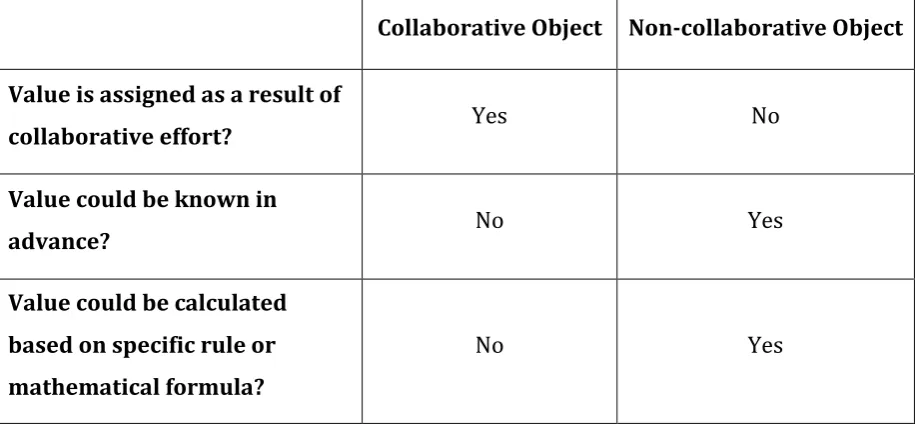
BJECTCollaborative Object Non-collaborative Object Value is assigned as a result of
collaborative effort? Yes No
Value could be known in
advance? No Yes
Value could be calculated based on specific rule or mathematical formula?
No Yes
Table 4.1- Collaborative Object vs. Non-collaborative Object
C
OLLABORATIVEW
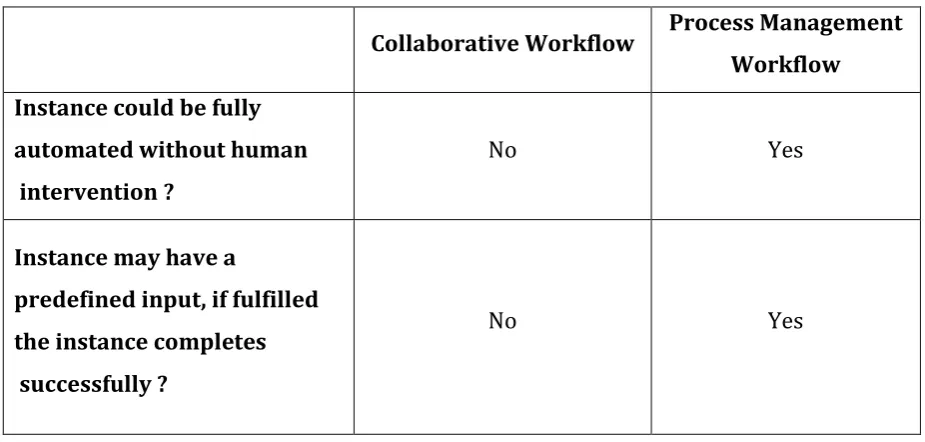
ORKFLOWCollaborative Workflow Process Management Workflow Instance could be fully
automated without human intervention ?
No Yes
Instance may have a
predefined input, if fulfilled the instance completes successfully ?
No Yes
Table 4.2- Collaborative Workflow vs Process Management Workflow
The main requirement for supporting a collaborative workflow is to provide social collaboration facilities and a work breakdown structure of an automated process. The work breakdown structure is provided in the form of different types of process nodes and user roles that are meant to constitute the main structure and sequence of workflow process steps. In our collaborative methodology definition, we are going to define and use six different types of nodes. A node can be a state, a human task, a condition, a fork, a join, a timer, and a notification. Each node has a unique set of properties; we explain them briefly as follow:
1. A state: represents a step in the workflow process that executes immediately and requires no user intervention. Any workflow process starts with an initial state and terminates with a final state.
Initial State
Intermediate State(s)
2. A task: represents a step in the workflow process that requires human intervention or input from a user. The task is blocked until user input completes. Tasks should be linked with defined user roles or user groups sharing a common role, i.e. a user who can complete a task review must be holding the reviewer role.
3. A condition: represents a decision making step and based on the condition the workflow takes a specific route.
4. Fork and Join: are used together to model parallel processing in a workflow process. The fork node splits the flow into two parallel sub-flows in order to perform parallel processing tasks. The join node merges them back and retains the original workflow only in case of successful completion of the two parallel sub-flows.
Approve a Task
condition
Save Task and mark as approved.
5. A timer: assigns a specific duration for tasks in order ensure that important tasks in a workflow aren’t forgotten or left undone for a long period of time due to absence of users.
6. A notification: is a message sent to one of the participants to communicate a piece of information.
Technical Review Theoretical Review
Review a Task
Final Review
Approve a Task
Assign the Task to another reviewer if not approved within 2 days.
S
TEPS IN THEM
ETHODOLOGYIn this section, we propose the collaborative methodology in step-by-step basis. The methodology is not limited to UKC ontology development and localization, it is generic enough to be applied to any collaborative development project. In fact, we are considering UKC as a practical case study in order to explain and verify the methodology. The methodology is composed of three steps, here we explain them:
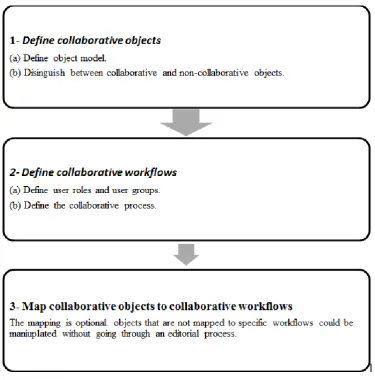
1- Definition of the collaborative objects: this step requires modeling the project as collection of collaborative and non-collaborative objects.
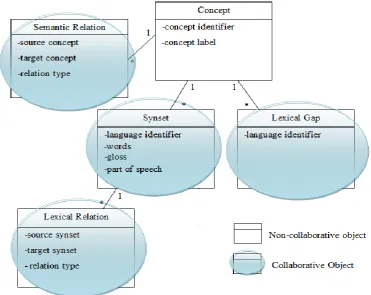
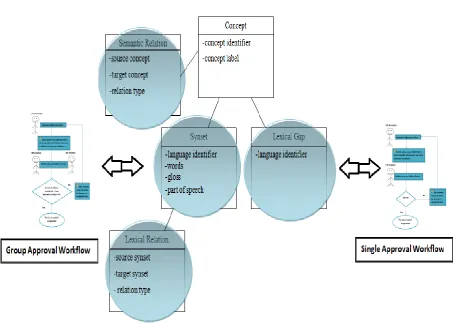
In UKC (Figure 4.1), four collaborative objects were defined: Synset, Lexical Gap, Semantic Relation, and Lexical Relation. The Concept object is the only non-collaborative object as it is auto-generated with the creation of a new synset which has not yet associated with already defined concept. In other words, the first language defining a new notion triggers the generation of the language-independent concept.
2- Definition of the collaborative workflows: this step requires defining the user roles and the collaborative processes needed to manipulate the collaborative objects. We may define one or more collaborative workflows based on the structure and nature of the project under development. The complexity of the defined workflows may vary based on the nature of domain under development and the number of participants required.
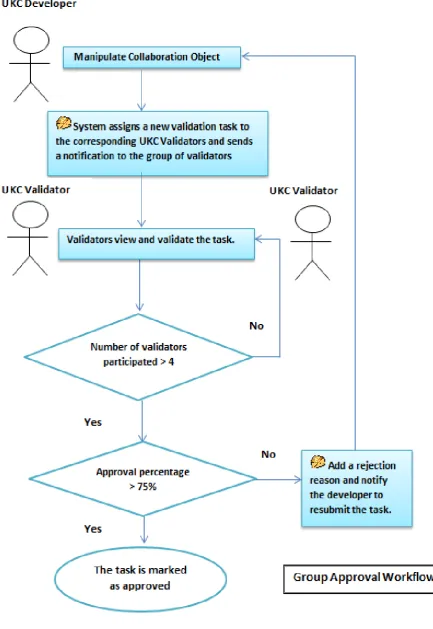
In UKC, the collaborative process is a two-phase process (development phase and validation phase) which required two main user roles: UKC Developer and UKC Validator. We then define and explain briefly two types of workflows containing two human tasks involving UKC Developers and Validators: (1) The single approval workflow, and (2) The group approval workflow.
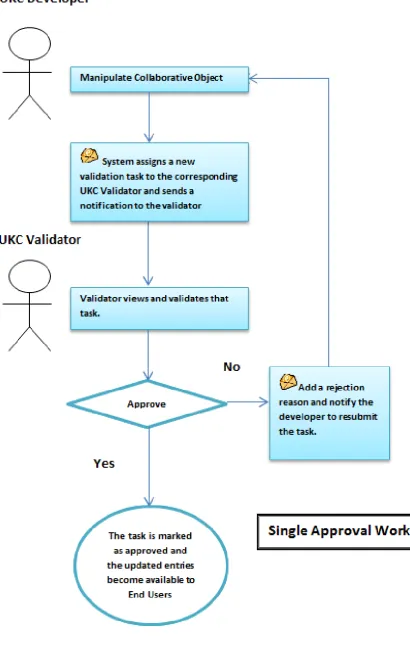
The single approval workflow process (Figure 4.2) is instantiated when a participant holding UKC Developer role manipulates a collaborative object via CUD operation (Create, Update, or Delete). The workflow process then assigns a validation task to a participant holding UKC validator role. The validator decides whether to accept or reject the developer’s recent manipulation. In case of rejection, the task is sent back to the same developer for reviewing and resubmission. While taking into consideration that the whole process augmented with social collaboration features (comments, discussions boards, and other features) and the final decision is taken as a result of common agreement between the participants.
3- Mapping objects to collaborative workflows: this step requires specifying which collaborative workflow needs to be employed for each collaborative object. However, such mapping can be partial and it is not mandatory to map all the collaborative objects to collaborative workflows. In fact, unmapped collaborative objects are directly manipulated without going through any process management procedure.
In UKC (Figure 4.4), we mapped the development of synsets to the group approval workflow while the development of lexical gaps is mapped to the single approval workflow and the rest of collaborative objects are not mapped to any collaborative workflows
Figure 4.5 summarizes the main phases of the collaborative methodology. We argue that the proposed methodology is fine grained and highly customizable which is expected to provide a high level of accuracy and time saving as well. A practical example for applying this methodology in translating synsets from English to French may reflect the expected advantages. The French language is characterized by being content rich and its synsets may involve a high degree of ambiguity. Therefore, it would be desirable when translating synsets from English to French to confirm the translated synsets using the group approval workflow and after getting at least three approvals from French linguistic experts. On the other hand, a lexical gap in French could be simpler and easy to spot by a French native speaker. Therefore, using the single approval workflow which requires participation of one French linguistic expert could be sufficient to confirm the existence of the lexical gap.
Part III – Technological Contributions
1. UKC WordNet Application
User Studies
Requirement Specifications
User Interface Design
2. UKC Interactive Platform
User Studies
Requirement Specifications
Overall Architecture
User Interface Design
3. UKC Collaborative Platform
User Studies
Requirement Specifications
Overall Architecture
Chapter 5
UKC
W
ORD
N
ET
A
PPLICATION
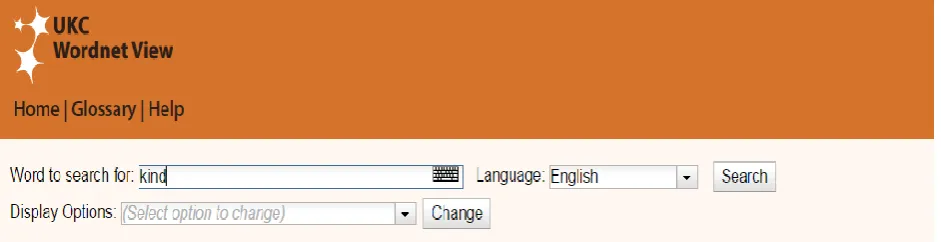
UKC WordNet is a web application providing access to the linguistic data stored in the UKC framework.
An online demo is available at: http://uk.disi.unitn.it:8089/ukcui/wordnetview.htm
The application has been designed to resemble the original user interface of WordNet
(http://wordnetweb.princeton.edu/perl/webwn) after taking permission from the WordNet team; we sincerely thank them for that. However, the UKC WordNet View differs from the original WordNet in being a multilingual linguistic resource.
The main idea behind designing an application that resembles the original WordNet is to fulfil the following goals: (1) Allow users who are familiar with WordNet to start accessing the UKC and rapidly get to know about its contents and main features, and (2) Conduct a comparative evaluation between our UKC interactive platform and WordNet application while both accessing the same linguistic data source, the comparative evaluation is documented in the next chapter.
USER STUDIES
At the start of any project, it's highly desirable to start by doing: (1) user studies, and (2) requirement specifications. Those are essential steps needed to guide during the design and implementation process.
User studies define the categories of users who are going to access and use the application. Also define the user roles as well as the application views that each user is allowed to access. There are several research methods used to conduct user studies7.
Here, we explain the most common and relevant ones:
1- Personas: define reliable and realistic representations of the application main users and audiences. Personas should describe users briefly together with their backgrounds, goals and values. They also should try to express and focus on the major needs and expectations of the users.
2- Scenarios: describe the context behind why a specific user or a user group comes to use the application. They explain briefly the user goals and define the possibilities of how the user(s) can achieve them. Scenarios can be represented in several ways; elaborated story-telling scenarios and use case scenarios are the most common ways.
3- Task Analysis: is a process of learning about ordinary users by observing them in action to understand in detail how they perform their tasks and achieve their intended goals. Task analysis helps identify the main tasks that your application must support and also helps application designers refine or re-define specific application features such as navigation or search types by determining the appropriate content needed by actual users.
4- Interviews: are conversations with a purpose between an interviewer and an interviewee. The main purpose of this type of interviews is to gain deeper understanding of the users or user groups who come to use the application. Interviews might take place in individual bases where the interviewer asks the interviewee a predefined set of questions or in groups, known as focus groups, similar to a moderated discussion between at least five or more participants.
5- Online Surveys: are a form of structured questionnaire that targets the application users over the internet generally through filling out a web form. Online surveys can vary in length and format. The collected data can be analyzed to gain insights about users, their goals, and what sort of information users are looking for from using the application.
able to navigate the application, read UKC synsets in a specific language and perform linguistic analysis. In the next section, we present the gathered requirement specifications for UKC WordNet view Application.
REQUIREMENT SPECIFICATIONS
Requirement specifications capture the main system requirements and describe the different forms of interaction modalities between the system and the users.
We define the system requirements for the UKC WordNet application in the form of use case scenarios following the standard specification of the unified modeling language (UML)8. Use case scenarios are considered as one of the standard techniques for capturing the system functional requirements in the form of a narrative interactive scenario between the user and the system. The scenarios explain the sequence of interactions, user roles, and the system responsibilities. There are mainly three different types of scenario:
Main Scenario: a basic scenario represents a single unit of meaningful work that terminates by achieving a user goal, such as read synset, create synset, or any other possible scenario.
Extension Scenario: an optional scenario that may happen as an extension to the main scenario. For example, analyzing synsets after retrieving them from the system database is an extension scenario.
Sub-Scenario: an internal or included scenario that takes place as a part of the main scenario. For example, reading words is a sub-scenario of reading synsets.
UKC WordNet application has only one scenario, reading synsets using textual search by a word lemma.
1- Read Synsets
Main Scenario: Read Synsets
1- User chooses the source language and types any word aiming to retrieve the word synsets.
2- System auto-suggests words based on what the user has typed.
3- User selects one of the auto-suggested words or presses the Search button. 4- System retrieves and displays the synsets having a sense for the entered word.
Extension Scenario-1: Read Relations
5- User chooses to read the synset relations (semantic, lexical, or semantic-lexical relation)
6-System retrieves the synset relations and visualizes them in the vicinity of the original synset.
Extension Scenario-2: Analyze Synsets
5- User may decide to analyze the displayed synsets by updating how synsets are displayed (show/hide the gloss or the example sentences).
6- System applies the performed visual changes on the displayed synsets
U
SERI
NTERFACE DESIGNFigure 5.1 shows the application user interface. The user can start a new search by typing a word and choosing the desired language. The application then retrieves the set of synsets organized by their part of speech (Noun, Adjective, Verb, and Adverb) and sorted by their synset rank.
The user may interact with the retrieved synsets by clicking on the letter “S” next to the synset to show either semantic relations with the language-independent concept or the lexical relations with language dependent synset. On the other hand, clicking on the letter “W” shows lexical relations with words.
The user can modify the visual display for the displayed synsets by updating the display options. For each synset, it’s possible to show or hide the: gloss, example sentences, synset provenance details, or the language-independent concept identifier for the concept associated with the synset.
Chapter 6
UKC
I
NTERACTIVE
P
LATFORM
UKC interactive platform is a web application for accessing and manipulating the linguistic data stored in the UKC.
An online demo is available at: http://uk.disi.unitn.it:8089/ukcui/ukc.htm
The application was designed and implemented as a rich client internet application having the same instant responsive behavior, look and feel of desktop applications.
In this chapter, we explain the user studies, requirement specifications together with the application overall architecture and user interface design of the UKC interactive platform.
U
SERS
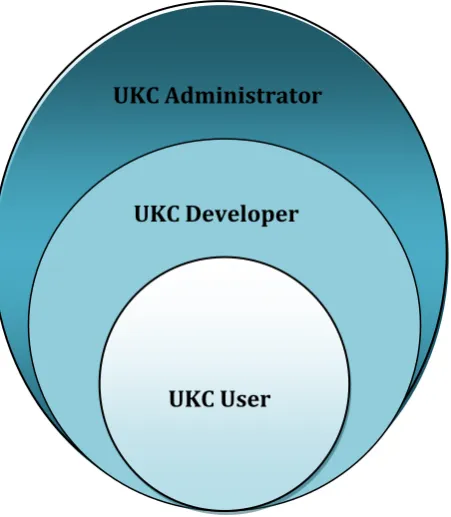
TUDIESUser Studies was the first step in designing UKC application as an interactive platform for navigating and enriching UKC linguistic resource. we performed the user studies by conducting interviews with knowledge experts who are fully aware and familiar with linguistic resources. The user studies revealed that that UKC interactive platform has three main categories of users (Figure 6.1):
UKC Users: are those who are allowed to view the UKC knowledge base for the navigation and linguistic analysis without performing any updates to the linguistic resource.
UKC Administrator
UKC Developer
UKC Administrators: have full access to system features and they can perform administrative tasks such as creating users, creating groups and assigning user roles to users.
Figure 6.1- Access rights for different categories of users; End Users have read only privileges, UKC Developers have read/write privileges; and UKC Administrators have full access.
R
EQUIREMENT SPECIFICATIONSThe Natural Language Core (NLC) and Concept Core (CC) scenarios presented in this section explain the core functional scenarios for the management of UKC linguistic resource items: synsets, lexical gaps and concepts as well as lexical relations between senses and semantic relations between concepts. Knowing that, words and their exceptional word forms are not managed explicitly through their corresponding synset. For each synset, it is allowed to define any number of synonym words and manage the order of these words.
The UKC linguistic resource is a multilingual one, therefore the user is dealing with two languages:
Working language: the default language, when the user performs any linguistic read/write operation, system applies the changes on the selected working language.
Reference language: the alternative language, it’s mainly used for multilingual support. For example, it is useful in understanding the meaning of a concept when no lexicalization is available in the working language yet by displaying its corresponding synset in the reference language.
The interactive system should allow the user to switch between the two languages (or change them to other languages) at any moment, or swap the roles of the two language. For examples, a user can start by selecting English as a working language and Italian as a reference language. In this case, the user will navigate the system in English and perform linguistic operations such as creating new synset for a concept in English. The user may view the corresponding synset associated with the same concept in Italian by selecting to view the lexicalization in the reference language. In case the user would like to create a new synset for the same concept in Italian, the user has to update the working language to beItalianand selects another language as a reference language.
In the following subsections, we explain the development scenarios for UKC linguistic items; synstes, lexical gaps, concepts, lexical and semantic relations. The UML use case scenarios present the requirements and the constraints arise while performing Create-Read-Update-Delete (CRUD) operations and how the system provides interactive features to facilitate these operations and also how the system should prevent the user from performing any pitfall.
1- Read Synsets in the Working Language
Main Scenario: Read synsets in the Working Language
1- User types any word in the working language aiming to retrieve the word synsets. 2- System auto-suggests words based on what the user has typed.
3- User selects one of the auto-suggested words or presses Enter as soon as he/she finishes typing.
4- System retrieves and displays the synsets having a word sense for the entered word. For every synset, the system displays the words having the same sense sorted by sense rank, Part of Speech (POS), Gloss, and Examples.
Sub Scenario-1: Read synsets in the Reference Language
5- For each synset retrieved in the main scenario, system retrieves the corresponding lexicalization in the reference language, System retrieves one of the following items depending on the content of the linguistic resource:
a- The corresponding synset in the reference language. b- Lexical gap.
c- No information, in-case the lexicalization is not yet defined.
Extension Scenario-1: Read lexical relations
6- User selects to retrieve the related synsets for any of the retrieved synsets in the main scenario.
7- System retrieves the lexically related synsets sorted by relation type.
Extension Scenario-2: Analyze Synsets
2- Read the Concept of a Synset
Main Scenario: Read the Concept of a Synset
1- User retrieves the synsets of any natural language word by following the scenario of use case: Read Synsets in the Working Language.
2- User selects to view the concept associated with one of its synsets.
3- System retrieves and visualizes the concept. For each concept, the system retrieves its concept identifier and concept label.
Extension Scenario-1: Read Semantic Relations
4- User selects to retrieve the related concepts for the retrieved concept or one of its child concepts.
Extension Scenario-2: Analyze Concepts
6- User may decide to analyze the displayed concepts by filtering displayed concepts by semantic relation type.
3- Read the Lexicalization of a Concept
Main Scenario: Read the Lexicalization of a Concept
1- User retrieves any language-independent concept by following the scenario of use case: Read the Concept of a Synset.
2- User selects to view the lexicalization of the retrieved concept in the working language.
3- System retrieves one of the following items depending on the content of the linguistic resource:
a- The corresponding synset in the working language. b- Lexical gap.
Sub Scenario-1: Read synsets in the Reference Language
4- For the retrieved synset in the main scenario, System retrieves the corresponding lexicalization in the reference language, System retrieves one of the following items de-pending on the content of the linguistic resource:
a- The corresponding synset in the reference language. b- Lexical gap.
c- No information, in-case the lexicalization is not yet defined.
4- Create New Synset with a new Concept
Main Scenario: Create New Synset together with new a Concept
1- User selects to create a notion as a new synset in the working language together with its new language-independent concept.
2- System displays an interactive editable form for defining the new synset and highlights the mandatory fields.
3- User fills the interactive form with the new synset details. The form requires the following mandatory fields:
Set of word senses.
Gloss
Example(s)
4- User saves the changes.
5- System checks if the new synset includes new word senses. If it contains any new word sense, system creates the new word sense and stores the word in the linguistic resource.
6- System creates a new synset and automatically creates a new concept and generates the corresponding concept identifier. The concept label is the first word sense defined for the newly created synset.
7- The system associates the newly created concept with the newly created synset.
5- Create New Synset for an existing Concept
Main Scenario: Create New Synset for an existing Concept
1- User selects to create a new synset in the working language together with a new Concept.
2- System displays an interactive editable form for defining the new synset and highlights the mandatory fields.
Set of word senses.
Part of Speech (POS).
Gloss
Example(s)
4- User saves the changes.
5- System checks if the new synset includes new word senses. . If it contains any new word sense, system creates the new word sense and stores the word in the linguistic resource.
6- System creates a new synset and associates it with the language-independent concept
6- Update Synset
Main Scenario: Update synset
1- User retrieves the synsets of any natural language word by following the scenario of use case: Read Synsets in the Working Language or by reading the lexicalization of a language-independent concept by following the scenario of use case:
Read the Lexicalization of a Concept.
2- User selects to update the retrieved synset
3- System displays an interactive editable form for editing the synset. The same interactive form defined for creating a new synset.
Sub Scenario-1.1 : Create new Word Sense
5- User selects to create a new word sense. user can create a new sense by creating a new word with its exceptional forms if any.
Sub Scenario-1.2 : Delete Word Sense
5- User selects to delete one of the defined word senses for the synset. 6- User saves the changes.
7- System validates the updates and save the changes.
7- Delete Synset
Main Scenario: Delete Synset
1- User retrieves the synsets of any natural language word by following the scenario of use case Read Synsets in the Working Language. or by reading the lexicalization of a language-independent concept by following the scenario of use case Read the Lexicalization of a Concept.
2- User selects to delete the retrieved synset.
Sub Scenario-1: Delete Word Senses
5- System checks each word sense, if the word sense is not part of any other synset, system deletes the word sense.
Sub Scenario-2: Delete Lexical Relations
6- System checks if the synset has lexical or semantic lexical relations with other synsets, if relations exist, system deletes them.
Extension Scenario-1: Delete Concept
7- System checks if there is any other lexical gaps still associated with the same concept. If the system finds a lexical gap associated with the same concept, the delete operation will be refused and the system will show an error message informing the user that the existing lexical gap must be deleted first. Knowing that, concepts can’t be associated with only lexical gaps, it must be associated with at least one language-dependent synset.