University of Trento
School of Social Sciences
PhD program in Economics and Management
Doctoral Thesis
Peer Influence and
Knowledge Management in
Communities
of Users and Practices
dissertation submitted to the doctoral school
in partial fulfillment of the requirements
for the degree of doctor of philosophy
in Economics and Management
Author:
Gianna Giudicati
Supervisor:
Prof. Massimo Riccaboni
Co-Supervisor:
Prof. Enrico Zaninotto
Supervisor:
Prof. Massimo Riccaboni
IMT Lucca
Co-Supervisor:
Prof. Enrico Zaninotto
University of Trento
Evaluation Committee
Prof. Keld Laursen
Copenhagen Business School
Prof. Stefano Schiavo
University of Trento
Prof. Gianmario Verona
Bocconi University
Final Examination Committee
Prof.ssa Laura Magazzini
University of Verona
Prof. Federico Munari
University of Bologna
Prof. Marco Zamarian
Acknowledgements
My first thanks go to my supervisor, Prof. Massimo Riccaboni, for his
continual and unconditional help and patience, and for having transmitted to
me his love for research. I also express my gratitude to my co-supervisor, Prof.
Enrico Zaninotto, for his support, advice and encouragement during these
three years. Special thanks go to Profs. Lee Fleming, Francesca Gino and
John Padgett for their valuable suggestions and comments, which improved
the quality of my work. I would also like to thank the examiners Prof.s Keld
Laursen, Stefano Schiavo and Gianmario Verona for their very useful feedback.
I also have a debt of gratitude to the “Rockers” for their useful suggestions
and advice.
Warm thanks to all my friends in Cifrem, especially Ivana Catturani,
Si-mone Cerroni, Kiryl Haiduk and Lorenza Lorenzetti. Special thanks also to
my second family in Boston, especially Italia and Elaine, and my friends Sam,
Andrea, Aurora and especially Roberto for their smiles and help overcoming
difficult moments.
I am forever grateful to my mom, my grandparents, my godmother
An-tonella, my best friend Silvia, my sweet flatmates Jessica, Chiara and Nadia,
and all my friends for their support and especially their patience.
Lastly, a very special thank you goes to Nicola, for his unconditional
To
Sabina
,
Contents
Abstract 1
1 Introduction 3
2 Co-experience Network Dynamics and Customer Retention:
Lessons from the Dance Floor 9
2.1 Introduction . . . 10
2.2 Conceptual framework . . . 12
2.3 Data and methodology . . . 16
2.4 Descriptive statistics . . . 20
2.5 Results . . . 24
2.6 Concluding discussion . . . 30
3 Homophily and Peer Influence in Customer Co-presence Net-works 33 3.1 Introduction . . . 33
3.2 Literature review and research propositions . . . 36
3.3 Contextual framework and methodological approach . . . 40
3.3.1 Data sources . . . 40
3.3.2 The co-presence network . . . 41
3.3.3 Influence in co-presence networks . . . 42
3.4.1 Preliminary findings . . . 47
3.4.2 The effect of peer-influence on renewal decisions . . . 50
3.4.3 Confounding effects: customer profile and product features 55 3.4.4 Timely peer-influence . . . 55
3.4.5 Observational learning attenuates overestimation of at-tendance . . . 57
3.5 Concluding Remarks . . . 61
4 Drilling Wells and Killing Wells through Knowledge Networks 65 4.1 Introduction . . . 65
4.2 Literature review . . . 69
4.3 Research questions and contextual framework . . . 74
4.4 Empirical framework . . . 79
4.5 Results . . . 83
4.5.1 Representativeness in the domain of experts . . . 83
4.5.2 Proactivity in the domain of information exchange . . . . 87
4.5.3 Presence and individual overlap . . . 90
4.5.4 Activation of experts . . . 92
4.5.5 Retrieval . . . 95
4.5.6 Structure: small worlds and structural holes . . . 98
4.6 Discussion and conclusions . . . 104
5 Conclusions 107
A Propensity Score and Coarsened Exact Matching 111
Abstract
Knowledge is highly dispersed in companies, customer networks and, more
generally, in markets. Various forms of knowledge influence collective results:
experiential knowledge derived from shared socialization, practical knowledge,
and scientific knowledge. This work aims at better understanding of how these
types of knowledge affect collective results in communities of customers and
of practice. In particular, collective results are interpreted on one hand as
individual commitments in communities of customers, and, on the other,
com-panies’ success in rapidly solving problematic urgencies through communities
of practice. First, the effect of both experience and socialization is examined in
the service sector, in order to investigate how the social structures of
commu-nities of customers influence commitment and retention. Second, commucommu-nities
of practice operating in high-risk sectors are analyzed to look for
improve-ments in their structure by aiding the recombination of dispersed knowledge
and more rapid access to those skills and competences required to solve urgent
problem-solving processes.
Various methods and tools are used to deal with these issues. In particular,
cross network analyses and new methodological approaches, originally applied
in the field of social ethology, are applied to study reality-mined data collected
by radio-frequency identification (RFID) tags. In addition, a set of recently
developed non-parametric methods is devised to deal with new
the marketing literature have emphasized methodological criticalities in
dis-criminating between peer influence, homophily, and other confounding factors
in real-world social settings. A whole chapter is devoted to a methodological
Chapter 1
Introduction
Knowledge is highly dispersed in companies, customer networks and, more
generally, in markets. The fast recombination of dispersed knowledge is
cru-cial in decision-making and problem-solving processes. The idea that all things
(not just novelties) are the result of recombinations can be traced back to the
pre-Socratic philosopher Empedocles (ca. 490-430 BC) (Kirk et al. 1983), who
proposed that the components of recombination were air, fire, earth, and water;
similar ideas have been identified in Aristotelian thought and in other ancient
societies (Russell and Mari´c 1945, Burnyeat 1981, Taylor 1990). The concept
has continued to influence Western thought and can be recognized in the works
of John Locke, Adam Smith, and Henri Poincar´e: new ideas are formed by a
combination of old ideas, which may be either empirical (that is, experienced)
or theoretical. In particular, the “growth of knowledge” principle proposed by
Smith is based on the connections of existing elements: the generative process
of recombinant search exploits the connections between elements rather than
the elements per se (Smith 1982, Loasby 2002). The importance of
recombi-nation has often resurfaced often in the last century of management literature.
Schumpeter (1939) proposed three steps for the recombinant search process:
them to form single independent entities and substantially recombining them
in a new manner (Schumpeter 1939, pages 84-86). Innovation, at both broader
economic and technical levels and firm level, may be seen as the output of a
recombinant search process of existing physical and non-physical materials
(Nelson and Winter 1982).
There are various forms of knowledge which need to be recombined and
which affect collective results: experiential knowledge derived from shared
so-cialization, practical knowledge, and scientific knowledge. This work aims at
better understanding of how the various types of knowledge affect collective
results in community settings. Two types of communities are analyzed to cover
the two main sides of innovation management dealing with knowledge creation
and its spread: communities of consumers and users, and communities of
prac-tice and experts. In particular, collective results are interpreted on one hand
as individual commitment in communities of customers, and, on the other, as
companies’ success in rapidly solving problematic urgencies through
commu-nities of practice. First, the combined effect of experience and socialization is
investigated in the service sector, in order to examine how the social structures
of communities of customers influence individual commitments and customer
retention. Second, communities of practice operating in a high-risk sector are
analyzed to identify improvements in their structure, aiding the recombination
of dispersed knowledge and more rapid access to those skills and competences
required to solve urgent problem-solving processes.
In addition, not all recombinable knowledge is coded, and difficulties arise
in merging universal and reciprocal (open science, i.e. scientific publishing),
or private and trust-based (private science, i.e. patenting) knowledge. In
addition, individual decision processes are strongly influenced by information
and knowledge acquired from past experience (Fazio and Zanna 1981, Smith
behav-CHAPTER 1. INTRODUCTION
ior (Goffman and Newill 1964, Coleman et al. 1966, Valente 1996b, Geroski
2000, Stoneman 2002). On one hand, individuals sharing experiences are
sub-ject to “chameleon effects” (Ramanathan and McGill 2007). On the other,
individual decisions are influenced by other people’s choices. Psychologists
and sociologists have introduced models of “social proof” to analyze how
peo-ple’s behavior influences others’ choices, in both experimental laboratories and
real-world settings (Hornstein et al. 1968, Cialdini 2001, Bandura et al. 2006).
Two main epidemic models have also been used in economics, sociology and
managerial studies to represent the transmission of new ideas, products and
information: contagion and cascades (Chan and Misra 1990, Bikhchandani
et al. 1992, Banerjee 1992, Valente 1996b, Bikhchandani et al. 1998, Valente
2005, Oh and Jeon 2007). Since the 1960s, the literature on marketing has
amply recognized that customers are influenced by other customers in a
va-riety of decision-making situations. In this framework, the model of Bass
(1969) predicts an S-shaped diffusion curve of new products triggered by a
small number of subjects, called innovators or influentials. Starting from the
mid-1990s, Valentes’s (1995) “influential hypothesis” has become central in
literature on the diffusion of innovation, communication research, and viral
marketing (Tucker 2008) Recent research in marketing also reveals the role of
network positioning and influence dynamics in customers’ adoption decisions
(Van den Bulte and Lilien 2001, Hill et al. 2006, Bell and Song 2007,
Man-chanda et al. 2008, Grinblatt et al. 2008, Iyengar et al. 2011) and definition of
marketing policies (Aral and Walker 2010). In addition, the increased interest
in on-line social networks has reinvigorated the idea of “leveraging” customer
networks to accelerate the diffusion of new products.
Various methods and tools are used to deal with these issues. Social
net-work analysis has been used to study both the analytical and descriptive
according to questionnaire data and web-based social networking tools. More
recently, thanks to the widespread diffusion of ICT, data on co-presence
net-works and dynamic weak social relationships have been collected and analyzed
both on-line and in real-world settings (Ebel et al. 2002, Eagle and Pentland
2006, Guimer¯a et al. 2006, Eagle et al. 2009). For example, urban planning
and transportation engineering are increasingly taking into consideration data
on real-world social dynamics collected through reality-mining solutions to
in-teractive design products and solutions (Graham 1997, Townsend 2000, Ratti
et al. 2006, Rojas et al. 2008). The analysis of reality-mined network data,
both within and between organizational boundaries, can radically improve our
knowledge about the effects of social ties on human decision-making. In
partic-ular, the diffusion of radio frequency identification (RFID) devices and wireless
networks has recently been improved, thanks to their usefulness in allowing
re-searchers to collect real time data on social networks (Barrat et al. 2008, Lee
et al. 2008).
In this thesis, multiple-network analyses and new methodological approaches,
originally applied in the field of social ethology, are applied to study
reality-mined data collected by RFID tags. In addition, a set of recently developed
non-parametric methods is devised to deal with new methodological problems
arising in studying socialization in networks. Recent debates in the marketing
literature have emphasized methodological criticalities in discriminating
be-tween peer influence, homophily, and other confounding factors in real-world
social settings. Indeed, the role of peer influence may be overestimated when
other effects, such as homophily (Aral et al. 2009) and other contextual and
cor-related effects (Manski 1993), are wrongly considered as real social effects, such
as peer influences. People may behave similarly because of similar individual
characteristics and common exposure to the same institutional environment,
CHAPTER 1. INTRODUCTION
people, the higher the probability of attraction between them and alignment in
their behavior (McPherson et al. 2003, Christakis and Fowler 2007, Christakis
and Fowler 2008, Christakis and Fowler 2011). Social identity and group
iden-tification also affect the degree to which people are influenced by other people’s
behavior, especially through weak ties, even in moral and unethical decisions
(Tajfel 1982, Tajfel and Turner 2004, Gino, Ayal and Ariely 2009, Gino and
Galinsky 2010) and in group settings (Cialdini and Goldstein 2004, Cialdini
et al. 2004, Gino, Gu and Zhong 2009, Gino, Ayal and Ariely 2009). Therefore,
despite the amount of literature in social psychology and diffusion dynamics
dealing with social influence, confusion still emerges in isolating contagion
mechanisms and methodological issues arise in analyzing decision-making
pro-cesses because of correlated effects impacting social proof (Manski 1993). A
whole chapter is devoted to a methodological contribution to these debates.
This thesis is composed of three core papers, the main contributions and
results of which are summarized as follows:
1. Co-experience Network Dynamics and Customer Retention: Lessons from
the Dance Floor.
Experience and socialization are key factors in determining customer
commitment and renewal decisions in the service sector. To analyze the
combined effect of experience and socialization, in this paper we
intro-duce the concept of co-experience networks, and a new methodological
approach is devised to study reality-mined co-experience networks.
An-alyzing a network of health club members over a period of four years,
we find that clients with long experience have lower probability of
re-newing their membership. Conversely, members who are central in the
co-experience network are stable and tend to renew their membership.
levels of commitment, renewal decisions are clustered in a small-world
network. These findings contribute to our understanding of social
dy-namics and localized conformity in customer decision-making which can
be used to plan marketing strategies to improve customer retention.
2. Homophily and Peer Influence in Customer Co-presence Networks.
The role of peer influence and observational learning in customer
deci-sion making is highly debated. On empirical grounds, methodological
problems arise in discriminating confounding effects from peer influence.
In this paper, the impact of customer co-presence networks upon
con-tractual renewal decisions is analyzed by controlling for homophily and
environmental effects. By applying a set of non-parametric methods to a
longitudinal dataset of health club members, we find that observational
learning attenuates overestimation of attendance and improves customer
retention.
3. Drilling Wells and Killing Wells through Knowledge Networks.
The rapid recombination of dispersed knowledge in multinational
com-panies operating in risk sectors is crucial in responding to unexpected
and urgent crises. The communities of practice (CoPs) introduced by a
company operating in the energy sector are analyzed, to examine how
their structure and the roles and positions of their members improve a
rapid access to dispersed knowledge. By overlapping multiple networks
of co-authorships, e-mail exchange and communities of practice, we find
structural holes among the phases of research and practice in the
inno-vation process. There are still inefficiencies in the introduction of on-line
communities of practice as tools to facilitate access to critical knowledge
and to speed problem-solving procedures, especially for multinational
Chapter 2
Co-experience Network
Dynamics and Customer
Retention: Lessons from the
Dance Floor
Abstract
Experience and socialization are key factors in determining customer commitment and re-newal decisions in the service sector. To analyse the combined effect of experience and socialization, in this paper we introduce the concept of co-experience networks. A new methodological approach, originally applied in the field of social ethology, is devised to study reality-mined co-experience networks. By analysing a network of health club mem-bers over a period of four years, we find that clients with long experience have a lower chance of renewing their membership. Conversely, central members in the co-experience network are stable and tend to renew their membership. In addition, since the members of the same reference group align their levels of commitment, renewal decisions are clustered in a small-world network. These findings contribute to our understanding of social dynamics and localized conformity in customer decision-making that can be used to plan marketing strategies to improve customer retention.
2.1
Introduction
Understanding the role of experience in individual and collective
decision-making is crucial in a wide range of disciplines. Research on customer
be-havior reveals that individual choices are strongly influenced by information
acquired from past experience (Smith and Swinyard 1982, Fredrickson and
Kahneman 1993, Branigan et al. 1997, Bolton et al. 2006) and through social
ties (Valente 1995, Valente 1996b, Valente 1996a, Valente 2005, Watts and
Dodds 2007b, Aral et al. 2008, Iyengar et al. 2010), although the relationship
between the satisfaction of prior experience and customer retention is difficult
to measure, since both experience and information are socially mediated.
Sub-jective experience is created in a dynamic social environment and is shared
with other people of the same community. Individuals who share experiences
are subject to a “chameleon effect”, according to which the longer subjects
share the same environment, the higher the probability that they will make
aligned decisions (Ramanathan and McGill 2007). Therefore, co-experience
leads consumers to take similar decisions, since they tend to align their
opin-ions.
This paper contributes to the literature by investigating co-experience
dy-namics (Zajonc 1965, Ramanathan and McGill 2007, Tokarchuk et al. 2009,
Cattuto et al. 2010). We define a co-experience network as a social network
in which individuals repeatedly share the experience of specific situations in
a given context. Co-worker networks of shared job activities, commuters
us-ing the same urban transport system, and on-line communities of software
developers are examples of co-experience networks. In such a network, two
in-dividuals are linked if they share some experiences. In addition, the greater the
number of experiences and the longer they are shared, the stronger the link
2.1. INTRODUCTION
and Koskinen 2005, Bolton and Saxena-Iyer 2009). We develop an innovative
methodology to study the relationship between co-experience and retention
based on co-presence1data. We take advantage of a methodology originally
de-veloped by ethologists (Hinde 1976, Krause and Ruxton 2002, Whitehead 2008)
to study the dynamics of social networks based on weak patterns of social
in-teraction. Co-presence data were collected by radio-frequency identification
(RFID) tags. Thanks to the spread of information and communication
tech-nologies (ICT), data on co-presence networks and weak social relationships
have been collected and analysed both on-line and in real world settings (Ebel
et al. 2002, Eagle and Pentland 2006, Eagle et al. 2009).
Our approach has important implications for customer relationship
man-agement (CRM) and strategy formation in the service sector. By
character-izing the real-time dynamics of customer networks, our methodological
ap-proach may be further exploited to re-design co-experience networks for
cus-tomer retention and improve the existing literature applying data mining and
RFID solutions to CRM (Schloter and Aghajan 2005, Lee et al. 2008, Ngai
et al. 2008, Heim et al. 2009).
The paper is organized as follows. Section 2.2 describes the conceptual
framework. Section 2.3 illustrates the methodology of co-presence network
analysis and the empirical settings of our research. Sections 2.4 and 2.5
dis-cuss the descriptive statistics and our main empirical findings. A concluding
discussion summarizes the results and explores future developments and the
potential applications of our methodology.
1In this study, we consider co-presence as a mode which refers to all the circumstances,
2.2
Conceptual framework
The members of any community M ={1,2, ..., i, ..., m} are connected by a network of shared experiences which we call co-experience network,N. In a given time frame, each community member can be active or inactive within the
network. Members of a health club are active when they exercise at the gym.
Similarly, members of an on-line forum are active when they chat on-line. The
more the active spells of two community members overlap, the more intense
is their relationship in the co-experience network. Since previous research
indicates that decisions are based on previous experiences, we were interested
in finding out whether and how individuals decide to continue being members
of the community and how much time they want to spend as active members.
We focus on the decision of individuali to belong to the community M . The
decision may be either positive (renewal, R) or negative (exit, E). We define
Gi ⊂ M as the reference group of subject i. Gi is the group of community
members with whom subject i has co-experience ties.
Decision-making models in networks typically assume that decisions are
functions of the status of customer neighborhood (Watts 2002). As argued
by Grabisch and Rusinowska (2008), each subject has an original inclination
either to put into effect an action, such as to renew a contract. This individual
inclination may differ from the final decision partly because of other subjects’
influences. We define si as a measure of the status or inclination of customer
i. In its simplest form, the status of an individual may be either positive
(si = 1) or negative (si = 0). In our case, each individual decides whether to be or not to be an active member of the community. By being active,
an individual establishes new relationships in the co-experience network and
influences other members’ choices. When subject i enters the community at
2.2. CONCEPTUAL FRAMEWORK
duration of the contract. After the expiry date, si becomes negative: in this case,s−i specifies the time elapsing from the expiry ofi ’s contract. In general, a high value of s+i is a sign of strong commitment, and a negative value ofs−i
corresponds to the decision to leave the network (negative commitment). We
can define s(Gi) as the state or inclination of the reference group of i in the co-experience network, that is of all the nodes linked to i in the co-experience
network. Thus, the inclination of the neighborhood is defined as the sum of
the states of the reference group of customer i in the co-experience network.
If the status of the reference group is above a given threshold, there is a higher
probability that the individual decision is positive. This variable measures the
level of commitment of each subject’s neighborhood. To ensure that the status
is between 0 and 1, we normalize the positive status by dividing the duration
of the contract by the maximum possible duration (a year).
By assuming that individuals have leisure-time constraints and preference
for variety, we expect that long experience in the community reduces the
chances of membership renewal. Thus, there is a negative drift in the
re-newal probability. Workers should have lower rere-newal probability since their
leisure-time constraints are more stringent (Becker 1965).
Proposition 2.1 The longer the presence in a co-experience network and the more stringent the leisure-time constraint, the
higher the probability of leaving the network:
P r(Rti)> P r(Rti+∆) (2.1)
or equivalently
P r(Eit)≤P r(Eit+∆)∀i∈N (2.2)
where P r(Rt
The second aspect of interest is the relationship between duration and
expe-rience. By controlling for the duration of membership, human interactions lead
to a more positive evaluation of both the experience and the service (Moore
et al. 2005, Ramanathan and McGill 2007). A service environment which
im-proves arousal and pleasure is also likely to be more interesting for customers,
who may stay longer in a store and renew service contracts (Baker 1987, Baker
et al. 1992, Oliver 1999). In the literature on network dynamics, preferential
attachments and the “popularity is attractive” effect imply that the
stabil-ity and centralstabil-ity of nodes are positively related (Barabasi et al. 2002, Jeong
et al. 2003, Wagner and Leydesdorff 2005). Thus, we expect that central nodes
in the co-experience network have a higher probability of contract renewal.
Proposition 2.2 Central agents in the network have a higher persis-tence:
if ci > cj then P r(Ri)> P r(Rj),∀i, j ∈M with i6=j (2.3)
where ci is the centrality ofi and cj is the centrality ofj, respectively.
Lastly, we were interested in verifying whether the strength of ties among
individuals influence the alignment of renewal decisions. Since individual
com-mitment and individual experiences are socially mediated, co-experience
en-hances alignment in decision-making processes. A “chameleon effect” takes
2.2. CONCEPTUAL FRAMEWORK
Proposition 2.3 The level of commitment of subject i is positively re-lated to the status of the reference group. More
specif-ically, the stronger the ties between two subjects, the
higher the probability that their decision to renew
con-tracts or to leave the club will be aligned:
P rRi|s(Gi) +
≥P rRi|s(Gi)
−
,∀i∈M. (2.4)
In cases in which i and j are neighbors, we expect that the link between
subjects enhances their propensity of taking common action. In other words,
we claim that co-experiences tend to align the level of commitment of
individ-uals to that of their reference group.
Different factors can be used as an explanation for alignment in individual
choices in co-experience network: ambient cues, such as common shared
envi-ronments (Mehrabian and Russell 1974, Donovan and Rossiter 1982, Baker
1987, Battarbee 2003b), and also social cues, such as observational
learn-ing, homophily (Manski 1993, McPherson et al. 2003, Christakis and Fowler
2007, Christakis and Fowler 2008), and peer-effects (Bikhchandani et al. 1992,
Banerjee 1992, Manski 1993, Sacerdote 2001, Glaeser and Scheinkman 2003,
Soetevent 2006, Oh and Jeon 2007, Watts and Dodds 2007b). Therefore, within
a social context, co-experience leads to alignment in decisions made by various
subjects because of three main factors: contagion and peer-effects, homophily,
and environmental effects.
In sum, by including the duration of membership in the analyses
(Propo-sition 2.1), we study the impact of both sociality and experience on future
commitment decisions (Propositions 2.2 - 2.3) (Aral et al. 2009, La Fond and
2.3
Data and methodology
We test our model in the context of the health club service sector, a
is rapidly growing industry in high-income countries. In 2008, there were
122,473 clubs worldwide, with more than 117 million members and a total
revenue of USD 68.2 billion (IHRSA 2009). The European market ranks first
in the world, with 46,736 clubs and 33.2 USD billion of revenues, followed by
North America and Asia. Italy, with 5.5 million members, is the fourth largest
national market after the US, the UK and Spain, in terms of industry revenues
(USD 4.4 billion). In this study, we analyse data provided by a health club
in Tuscany, Italy. Our database includes comprehensive customer data and
contract information for each member of the club from December 2004 to July
2008. Overall, the data consist of 4,649 coded individual members, 133,945
entry registrations, 103 types of contract2, and 4,892 subscriptions3.
Data on entries were collected through RFID tags on the personal badges
used to access the club and they show that among the 4,649 coded individual
members, only 4,378 were observed in the health club at least once during the
analysed period of 1,145 days (see Table 2.1).
2004 2005 2006 2007 2008 2004-2008
Number of days 12 315 312 316 190 1,145
Number of active individuals 370 1,157 866 1,090 895 4,378
Number of entries 915 33,295 26,503 38,199 35,033 133,945
Table 2.1: Summary statistics of the complete dataset
Figure 2.1 highlights the evident seasonality of club attendance: entries
are concentrated at the beginning of the week, remain stable from Monday
2After grouping contracts according to type of activity, we carried out analyses on sixteen
contract categories. The rationale for grouping the contracts and the courses was that all participants in the same room had similar relationships.
3The number of subscriptions was greater than the number of individual members,
2.3. DATA AND METHODOLOGY
Figure 2.1: Daily number of entries in 2005
to Friday, and fall during weekends and summer holidays. A similar trend
is observed in all years. Based upon an interview with the club owner, the
maximum numbers of members are always well below the total capacity of the
club. In addition, the RFID system to monitor entries was put in place when
the club opened in 2004 and constantly used until 2008. In spite of this, in order
to avoid any potential problem of initialization and finite period truncation,
we decided to limit our analysis to the three central years (2005-2007). The
number of club members varies over time. Table 2.1 shows that the number
of identified individuals was about 1,100 in 2005 and 2007, whereas there was
a sharp decrease in both total entries and active members in 2006. Thus, the
total turnover of club members was negative in 2006 and positive in 2005 and
2007. Again according to the owner, the downturn of active membership in
2006 was due to the opening of a new gym in the same area and the exit of
one of the club shareholders.
The club offers both traditional fitness programs and dance courses. In
more detail, sixteen types of activities are available, including classical dance,
American dances. We classified contracts in terms of type, duration and cost.
In addition to standard contracts, the club uses other promotional tools which
may influence both subscription renewal and recruitment of new customers
(e.g., holiday-free offers, social dinners, Facebook groups). Unlike Della Vigna
and Malmendier (2006), our dataset does not contain renewal default - that
is, there are no clauses for automatic renewal of contracts.
The majority of club members (60%) choose monthly subscriptions, and
about 25% subscribe to yearly contracts. Subscription fees are paid in
ad-vance, and data show that, for all contract types, the nominal price equals
the effective price paid. The health club applies discounts, which are linearly
related to contract length. On average, a 3.6% discount is applied for each
month of contract duration (11% for 3 months). Thus, the same discount
policy was consistently applied to all members throughout the study period.
Information on course attendance and renewals showed that most customers’
renewal decisions are taken immediately after contract expiry, and that 90%
of new contracts are subscribed within 40 days of the expiry of the old ones.
Therefore, a decision to leave the club is considered to be effective 40 days
after the expiry of the contract in question.
To test our propositions, we mapped a network of spontaneous social ties
(experience network) among club members, in which two subjects have a
co-experience tie if they are co-present in the club. We define two individuals as
entering together if the time-gap between their entries, recorded through RFID
tags, is below a given threshold. Two subjects who frequently go to the club
together are strongly associated in the co-experience network: the less they go
together and the longer the time elapsing between two consecutive entries, the
weaker the link between two individuals in the co-experience network. Since
the time cut-off is discretionary, we apply different thresholds (from 5 to 30
2.3. DATA AND METHODOLOGY
The co-experience network is computed by applying a methodology
cur-rently used in social ethology (Whitehead 2008, Whitehead 2009, Sih et al.
2009). Two individuals are associated in a sampling period if the difference
between the time of observation of co-presence is within a given time range.
The association between two subjects is summarized by an association index,
which is an estimate of the proportion of time which two individuals spend
to-gether. Among several measures of co-experience, we selected the half-weight
association index defined as:
aij =
x
x+yij + 1/2 (yi+yj)
(2.5)
where x represents the number of sampling periods in which individuals i
and j are jointly observed; yi is the number of sampling periods when only
i is identified; yj the number of sampling periods in which only j has been
observed, and yij the number of times both i and j are identified but not
together. This ratio is unbiased, because each group has the same probability
of being identified. In addition, since each individual is recorded as a member
of the health club for only a small fraction of the sampling period, the
half-weight index must be applied in order to avoid biases in the computation ofyi ,yj and x (Whitehead 2008)4. Co-presence is not used to infer stronger social relationships (such as friendship) but rather to investigate the structure of
weak ties, to measure co-experience, and to verify how stability and experience
influence renewal decision.
4We replicated our analysis with various association indices and found that the results
2.4
Descriptive statistics
Although all the following analyses and results focus on the co-experience
network, the descriptive statistics are enriched by matching other two types
of social relationships. First, exogenous social ties have been analyzed: two
individuals are linked by an exogenous social tie if they cohabitate or go to the
club the first time together. The data show that 1,649 subjects live together,
while 2,493 subjects have no other club’s member reporting the same address.
Secondly, two subjects are linked by an induced social tie if they attend the
same course, that is to say the club management encourages socialization by
scheduling group activities. In these two networks a link is identified whenever
two individuals live together or attend the same course. By comparing the
networks of cohabitants and shared activities in the club, we found that only
10.86% of the cohabitants attend the same courses. This result can be easily
explained by the different tastes of cohabitants: mothers and sons, fathers and
daughters, wives and husbands presumably attend different courses. Moreover,
the networks of cohabitants and common entries in 5 minutes are largely
in-dependent: only 9.34%5 of the cohabitants go to the club together. Therefore,
almost all the cohabitants attending the same courses enter together, but they
are only a minority of total co-entrants.
We now focus the attention on the co-experience network of spontaneous
social ties. Figure 2.2 shows the co-experience network in 2008. To improve
the legibility of the network, we applied a .10 cut-off to the association index
and set the size of each node proportional to its centrality (number of links).
Nodes represent the members for whom data about contractual renewals were
available in 2008: green nodes stand for members who renewed contracts in
the same year, and red nodes represent those who did not renew.
5This proportion remains stable and increases to 10.61% if we consider, respectively, 10
2.4. DESCRIPTIVE STATISTICS
The network displays an heterogenous small-world structure: clusters of
highly connected nodes linked by few ties (Watts and Strogatz 1998a). The
majority of the large central nodes are green. At first glance, this seems to
confirm Proposition 2.2, according to which the central position of subjects in
the network is positively related to the decision to renew contracts. The
align-ment in decision-making described in Proposition 2.3 is also visually confirmed
by the fact that green and red nodes tend to fall into the same cluster. When
we applied higher cut-offs, we found that the resulting communities were even
more homogeneous and formed of either green or red nodes. Lastly, squares
represent the nodes of people attending the dance courses (at the bottom of
the figure). They are the more central nodes and most of them form a
sep-arate, dense group. We therefore conclude that renewal decisions tend to be
shared at the level of local co-experience communities.
Figure 2.3: Connectivity distribution in 2007
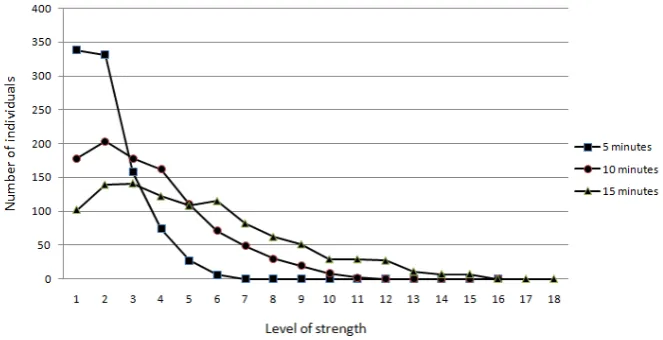
Figure 2.3 reports the strength connectivity distribution at the three
dif-ferent frequencies of entry in 2007. To measure centrality we use the strength
index also in the following analyses6 : in our network, the strength centrality
is a measure of the number of times an individual goes to the club (experience)
6We checked other measures of centrality (Wasserman and Faust 1994), which are strongly
2.4. DESCRIPTIVE STATISTICS
Figure 2.4: Entry and exit probability distribution by node strength (5 min)
weighted by the number of co-present members (co-experience). The
connec-tivity distribution is relatively flat, and its skewness is negatively related to
the length of the co-entrance time window (10-15 minutes): the longer the
time window in question, the flatter the distribution of the number of subjects
according to their strength. The same trend characterizes all the other
anal-ysed years. Since the variance of the strength is limited, we expect a more
prominent role of central subjects (Watts 2002).
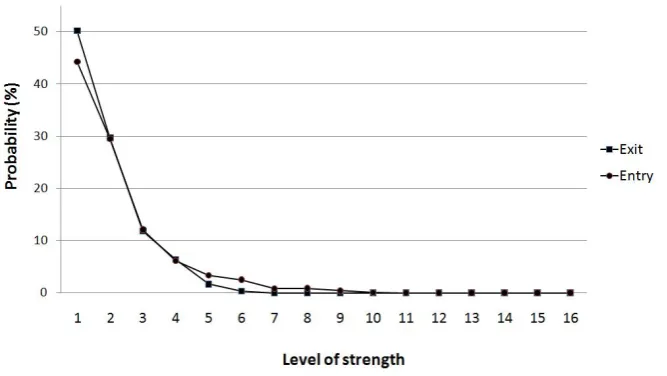
Figure 2.4 shows the probability distribution of entry and exit by node
strength (co-entrance in a 5-minute time frame) and reveals that the
major-ity of subjects entering or leaving the network have a lower level of strength
centrality, although there are cases in which subjects enter the network at the
maximum level of strength, and others in which central members have left
the network (in 2007, for instance, ten members with the highest levels of
strength left the network). These preliminary findings confirm the existence of
a positive relationship between centrality and renewal decisions (Proposition
2.5
Results
In this section, we test how renewal decisions are influenced by the position
of club members in the co-experience network. We run a set of regressions to
identify the variables affecting renewal decisions (R) and, conditional upon
renewal, the duration of the renewed contract (D). R is a dummy variable (1
renewal, otherwise 0), andD is the duration of the new subscription (in number
of days). As discussed in the previous sections, customers usually need time
to decide whether or not to renew their contracts. Since the decision to exit is
implicit, members cannot be classified simply by subdividing them into those
who renew and those who do not. Since our dataset does not contain renewal
default, there are no clauses for automatic contract renewal, and we consider
a non-renewal decision as effective only 40 days after contract expiry.
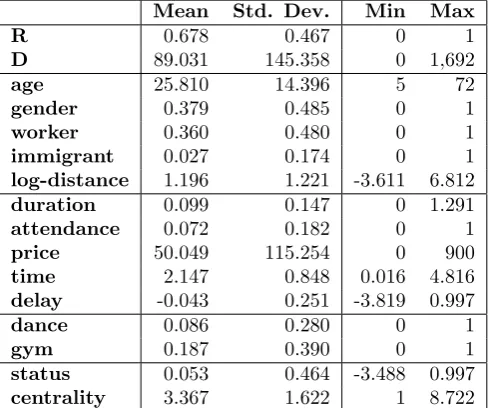
The regressions aim at analysing how the probability of renewal is
influ-enced by four groups of variables: an individual’s characteristics; learning and
experience; the list of activities offered by the health club; and co-experience
network variables (see Table 2.2).
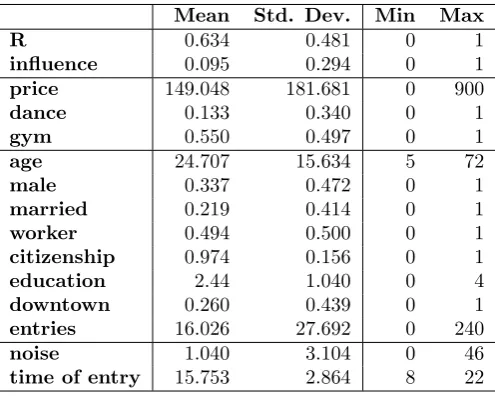
Mean Std. Dev. Min Max
R 0.678 0.467 0 1
D 89.031 145.358 0 1,692
age 25.810 14.396 5 72
gender 0.379 0.485 0 1
worker 0.360 0.480 0 1
immigrant 0.027 0.174 0 1
log-distance 1.196 1.221 -3.611 6.812
duration 0.099 0.147 0 1.291
attendance 0.072 0.182 0 1
price 50.049 115.254 0 900
time 2.147 0.848 0.016 4.816
delay -0.043 0.251 -3.819 0.997
dance 0.086 0.280 0 1
gym 0.187 0.390 0 1
status 0.053 0.464 -3.488 0.997
centrality 3.367 1.622 1 8.722
2.5. RESULTS
The following variables are used to characterize individuals: age (in years),
a dummy for gender (1, male; 0, female), and a dummy for employment status,
worker (1, employed; 0, otherwise). The dummy variableimmigrant indicates
whether subjects are Italian citizens (1, immigrant; 0, otherwise), and
log-distance is the logarithm of the distance between the home address of each
subject and the health club. Two variables are used to describe members’
par-ticipation in the club: duration is the time in years of the club membership,
andattendance is the frequency of attendance, computed as the ratio between
the number of effective entries of each subject in the club and the number
of total possible entries. In addition, price represents the price of the last
contract subscription by each member before the renewal decision, and it also
serves as a proxy for the willingness to pay. The variable time is the moment
at which the renewal decision was taken, anddelay indicates the time elapsing
from contract expiry. The two variables regarding the list of activities
pro-posed by the club are the dummiesdance (participation in dance courses) and
gym (individual use of exercise machines and gym equipment). We use only
dance and gym dummies because these are the two most frequently attended
activities, with 55% and 13% of total subscriptions, respectively. Lastly, the
network variables include both network indexes and neighbors’ inclinations:
centrality indicates the strength index of each individual, a measure of
cen-trality in the co-experience network. Thestatus s(Gi) specifies the inclination of the neighbors of each subject and their level of commitment. As noted
above, status indicates if, at the moment of contract renewal, the reference
group of the decision-maker in the co-experience network is mainly composed
of people who have a long-term commitment to go to the gym (positive values)
or includes a majority of people who decided to leave (negative values).
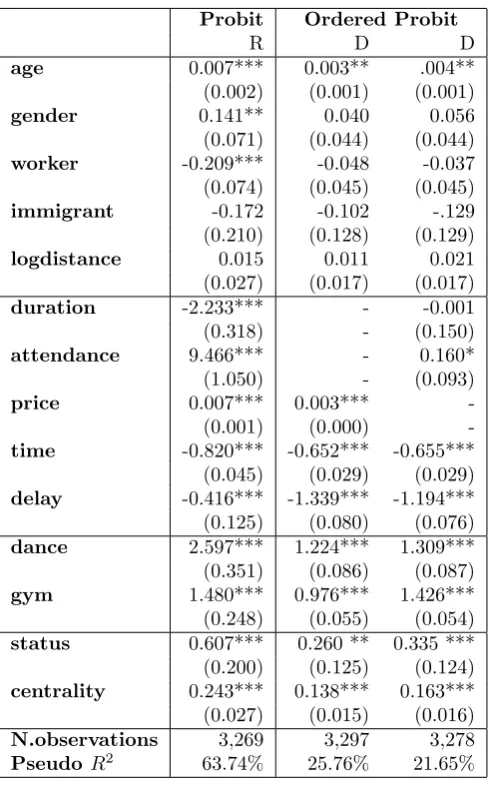
Probit Ordered Probit
R D D
age 0.007*** 0.003** .004** (0.002) (0.001) (0.001)
gender 0.141** 0.040 0.056 (0.071) (0.044) (0.044)
worker -0.209*** -0.048 -0.037 (0.074) (0.045) (0.045)
immigrant -0.172 -0.102 -.129 (0.210) (0.128) (0.129)
logdistance 0.015 0.011 0.021 (0.027) (0.017) (0.017)
duration -2.233*** - -0.001 (0.318) - (0.150)
attendance 9.466*** - 0.160* (1.050) - (0.093)
price 0.007*** 0.003*** -(0.001) (0.000)
-time -0.820*** -0.652*** -0.655*** (0.045) (0.029) (0.029)
delay -0.416*** -1.339*** -1.194*** (0.125) (0.080) (0.076)
dance 2.597*** 1.224*** 1.309*** (0.351) (0.086) (0.087)
gym 1.480*** 0.976*** 1.426*** (0.248) (0.055) (0.054)
status 0.607*** 0.260 ** 0.335 *** (0.200) (0.125) (0.124)
centrality 0.243*** 0.138*** 0.163*** (0.027) (0.015) (0.016)
N.observations 3,269 3,297 3,278
Pseudo R2 63.74% 25.76% 21.65%
Notes: Standard errors in parentheses. *Significant at the 10-per cent level. **Significant at the 5-per cent level. ***Significant at the 1-percent level.
2.5. RESULTS
column lists probit regression results with dummy R as dependent variable7.
Individual characteristics do not play a prominent role in renewal decisions,
but the probability of renewal is influenced by socialization, experience,
at-tendance, and kind of activities offered by the health club. More specifically,
members’ age has a positive and significant influence on the probability of
renewal, whereas workers and women have a lower probability of renewing.
Indeed, the constraint of being a worker and, especially, a young one reduces
the flexibility, stability and propensity of renewing a contract. In contrast,
distance from the health club and the nationality of members are not
signifi-cant8.
The duration of membership (duration) has a negative effect on renewal
decisions: the longer the membership in the club, the lower the probability of
renewing. Therefore, long affiliation to the club decreases the positive influence
of experience on renewal decisions. This result, together with the negative sign
of the worker dummy, confirms Proposition 2.1. Instead, attendance exerts a
positive effect on R: the higher the attendance frequency of each subject, the
higher the probability of renewing the contract. This positive influence of
in-dividual experience on renewal decision confirms the first hypothesis of Bolton
et al. (2006), according to which favorable (unfavorable) outcomes experienced
over prior time periods positively (or negatively) influence renewal decisions
for service contracts. The price of the previous contract also has a positive
influence on the probability of renewing: subjects having higher willingness to
pay are more willing to renew contracts. Conversely, the time dummy
cap-tures a decreasing probability of renewal, partially due to greater competition.
The time elapsing from contract expiry (delay) also has a negative effect: the
7As a robustness check, we also ran a set of logit regressions, without noting any
signifi-cant changes in the results.
8The result regarding the significance of distance may be biased by the fact that we do
later a subject decides to renew a contract, the lower the propensity to renew
it. The core activities organized by the club have a positive and significant
influence on the probability of renewal: both dance and gym are effective in
inducing participants to renew their contracts.
Lastly, all the co-experience network variables significantly influence the
probability of renewal: both centrality and status have a positive and
signifi-cant effect on the decision to renew. Thus, the more central a customer in the
co-experience network, the lower the probability of leaving the network. In
ad-dition, since we control for the frequency of attendance, this variable controls
for socialization at the gym: the larger the group of people with whom a client
co-experience a service, the higher the probability of renewal. The state of the
reference group in the co-experience network is also very important. A positive
commitment of the reference group consistently has a positive and significant
effect on the decision to renew the contract. This finding provides support for
the statement in Proposition 2.2 and 2.3.
When the renewal decision is taken, members must decide on the duration
of the new contract. The last column in Table 2.3 shows the results of ordered
probit regressions9 . For the ordered probit, we identify four thresholds, in
order to examine decisions on contractual duration: one month, three months,
a year, or longer. This choice is due to the fact that the demand is higher
for these types of contracts. Also in this case, the decision regarding the
duration of the renewed contract is not significantly influenced by individual
characteristics: only the variable age has a positive and significant effect on
the contractual duration.
In addition to the fact thatstatus andcentrality positively influence renewal
decisions, these two variables also have a positive effect on the duration of
9The different number of observations between the two cases in Table 2.3 depends on the
2.5. RESULTS
the new contract. Members who are central in the co-experience network
tend to subscribe long-term contracts, and tend to align the duration of the
contract with the reference group in the co-experience network. The length
of membership has a negative effect on contract duration (although it is not
significant at the 10% level): therefore, members who have been in the club
longer are more likely either not to renew the contract or, if they decide to
renew it, to subscribe short-term. Attendance has a positive effect, although
this effect on the duration of the new contract is less significant: therefore,
the higher the attendance rate, the higher the propensity both to renew the
contract and, in particular, to renew longer contracts.
The price of the previous contract, when included, has a positive influence
on the probability of choosing long contracts, whereas time and delay
nega-tively influence this probability: the later a subject decides to renew a contract,
the lower the propensity to renew a long-term contract. The longer a member
waits after contract expiry, the less likely that person will renew a long-term
contract. The variables of activitiesdance andgym have a positive and
signif-icant influence on the decision to subscribe to longer contracts. Therefore, the
decision to renew contracts and, more specifically, to renew long-term ones,
does not depend simply on the socializing features of the activities, but rather
on the type of activity and on how these activities are structured and
orga-nized. The successful organization of activities by the club is crucial toward
creating, developing and improving socialization, experience and retention. All
in all our results confirm that experience and socialization are both important
2.6
Concluding discussion
In this paper we introduce the concept of co-experience network and
de-velop a method to analyse data on customer interactions collected by means
of RFID tags or other reality-mining devices. On-line communities have been
increasingly studied, but so far little attention has been devoted to the analysis
of the dynamics of customer networks in real-world settings. To our knowledge,
this is the first attempt to study the influence of co-experience networks on
cus-tomer retention in the service sector. More in general, this paper contributes
to analysis of customer behavior in co-experience networks. By analysing a
network of health club members over a period of almost four years, we find that
retention decreases with the duration of membership. Leisure-time constraints
and preference for variety induce long-experienced subjects to leave the
com-munity. However, active club members and especially the central clients in
the co-experience network are more likely to renew their membership and to
subscribe long-term contracts. The longer a customer waits after contract
ex-piry, the less likely that person will be to renew it. In addition, by controlling
for individual characteristics and contractual options, we find that the
com-mitment to go to the club is socially mediated. Health club members tend to
align their commitment to the socially related group of co-members.
The innovative method used in this study may be further applied to
cus-tomer and human resource management, to design co-experience networks.
Our preliminary results may be used to improve the allocation of marketing
ef-forts, for example, or to better allocate instructors in the co-experience network
of the health club. Secondly, our results may be used to develop more efficient
discount policies, which take into account not only contract characteristics,
but also the interpersonal influence regarding renewal decisions. Customer
re-2.6. CONCLUDING DISCUSSION
lationship strategies such as fidelity cards, “bring a friend” promotions, and
special discounts on the subscription price. However, these strategies are not
based on real time analyses of customer experience: the proposed results and
methodology described in the paper may be applied toward improving
mar-keting policies by developing and implementing personalized marmar-keting actions
based on customer roles and positions in the co-experience network.
Although we show that individual commitment is highly related to the
de-cisions of their neighbors, this is not sufficient to infer that individual choices
are influenced by their reference group. The next paper aimes at
differentiat-ing peer influence from other confounddifferentiat-ing effects in aligned decision-makdifferentiat-ing
Chapter 3
Homophily and Peer Influence
in Customer Co-presence
Networks
Abstract
The role of peer influence and observational learning in customer decision making is highly debated. On the empirical ground, methodological problems arise in discriminating confounding effects from peer influence. In this paper the impact of customer co-presence networks upon contractual renewal decision is analysed controlling for homophily and envi-ronmental effects. By applying a set of non-parametric methods to a longitudinal dataset of health club members we find that observational learning attenuates overestimation of attendance and improves customer retention.
Keywords: peer influence, homophily, social networks, observational learning, service mar-keting
3.1
Introduction
In everyday life, social networks emerge from interactive experiences
in our roles as consumers, workers, friends, or members of online and
real-world social groups. Peer influence (Katz and Lazarsfeld 1955, Bass 1969,
Valente 1995) and observational learning (Bikhchandani et al. 1992, Banerjee
1992, Cai et al. 2007, Zhang 2010, Moretti 2011) in social networks are relevant
in many purchasing and non-purchasing decisions. While peer influence is a
more generic concept based on various mechanisms through which subjects
learn from others (Granovetter 1978, Valente 1996a, Stoneman 2002, Watts
and Dodds 2007a), observational learning is a weak form of peer influence.
Observational learning allows to gain informations from others by observing
their behavior, without a direct contact or speech (Bikhchandani et al. 1998).
Various approaches have been implemented so far to study the co-evolution
of influence dynamics and social networks, both theoretically and empirically
(Manski 1993, Valente 2005, Watts and Dodds 2007a, Iyengar et al. 2011).
The relation between individual behavior and position in social networks has
already been demonstrated in customers’ adoption decision studies (Van den
Bulte and Lilien 2001, Hill et al. 2006, Bell and Song 2007, Manchanda et al.
2008, Grinblatt et al. 2008, Iyengar et al. 2011, Narayan et al. 2011) and
marketing policies has been designed accordingly (Aral and Walker 2010).
Despite the crucial role of observational learning, this literature is still
hampered by several difficulties in measuring the role of influence in
net-work diffusion dynamics and customer behavior. Indeed, the role of peer
influence may be overestimated when other effects, such as homophily (Aral
et al. 2009) and other contextual and correlated effects (Manski 1993, Manski
2000, Sacerdote 2001, Soetevent 2006) are not considered. On the empirical
ground, recent debates in the literature on diffusion and peer influence focus
on new methodological approaches to disentangle among confounding factors
3.1. INTRODUCTION
Fowler 2011, Iyengar et al. 2011). By analysing a global instant messaging
network, Aral et al. (2009) show that more than half of behavioral contagion
is due to homophily rather than to peer influence. Subjects may behave
simi-larly, not because of social stimuli but due to common individual inclinations
and tastes, or because they are exposed to the same environment as well. The
quality of the available data and the robustness of the applied econometric
methods are the two main concerns in the literature (Aral 2011, Iyengar and
Van den Bulte 2011).
The goal of this paper is to empirically model observational learning on
long-term commitment, its impact on customer decision making, and
over-estimation of attendance. We contribute to the recent debates on diffusion
dynamics by studying a group-level setting (Christakis and Fowler 2011), and
exploiting the advantages of a unique dynamic dataset (Iyengar and Van den
Bulte 2011, Aral 2011). As in Della Vigna and Malmendier (2006), we selected
a long-time perspective but our data allow to disentagle confounding effects
from observational learning by excluding authomatic renewals. We improve
the previous literature on customer behavior and observational learning by
adding a dynamic perspective in the long run and using a rich observational
dataset over a four year-period. Radio frequency identification (RFID)
tech-nology, customer relationship management, and questionnaire data has been
exploited to discriminate between influence and confounding effects and to
demonstrate the importance of peer influence on the decisions of members to
renew or not renew their contracts. Innovative methodologies frequently used
in social ethology have also been implemented to measure co-presence in a
dynamic setting. In addition, we improve the efficiency in the discrimination
analysis among confounding effects by implementing a set of matching
non-parametric methods. In particular, we improve the previous studies based on
approach called Coarsened Exact Matching (Iacus et al. 2011) allowing us to
control for confounding effects in observational data.
The rest of the paper is organized as follows. Section 3.2 overviews the
rele-vant literature and identifies the four research questions. Section 3.3 describes
our research setting and methodological approach. Next, Section 3.4 specifies
the variables created for the analysis and present the results. Section 3.5
con-cludes the paper with a discussion of implications for marketing practice and
directions for future research.
3.2
Literature review and research propositions
Social influence is a key factor in human decision-making processes, and
helps to explain the diffusion of behavior and beliefs. Literature in innovation
diffusion and individual behavior specifies theoretical explanations of how peer
influence affects both individual choices and the diffusion of knowledge, ideas
and products. However numerous difficulties have emerged in measuring and
testing the presence and role of influence in individual decision-making.
We are interested in analysing the adoption and purchasing decisions of
cus-tomers in real work settings. In the theoretical literature, behavioral models,
at both social (Bass 1969, Chan and Misra 1990, Valente 1996a, Valente 1996b,
Watts and Dodds 2007a, Valente 2005) and individual levels (Cialdini 2001,
Goldstein et al. 2008), have been developed to describe peer influence in social
contexts by focusing on the relational aspects of network dynamics. Increased
interest in on-line social networks has also invigorated the idea of leveraging
customer networks to accelerate the diffusion of innovation and new products
(Watts and Dodds 2007b, Watts and Dodds 2007a, Iyengar et al. 2011, Narayan
et al. 2011). The power of social proof has also been widely confirmed in
3.2. LITERATURE REVIEW AND RESEARCH PROPOSITIONS
et al. 1963, Bandura 1965, Bandura et al. 2006).
Despite the amount of literature in social psychology and diffusion
dynam-ics dealing with social influence, confusion about the evaluation of consumer
network dynamics emerge in the marketing field when scholars try to isolate
contagion and influence (Aral et al. 2009, Aral 2011). Behavioral alignment
caused by social proof may indeed be evidence of various elements: peer
in-fluence, homophily and other confounding factors. Alignment in individual
choices may be due to the similarity of tastes and attributes among subjects
(homophily), rather than to endogenous peer effects (Manski 1993, McPherson
et al. 2003, Christakis and Fowler 2007, Christakis and Fowler 2008, Fowler
and Christakis 2008). In addition, one stream of literature focuses on
envi-ronmental effects - that is, on the effects of the physical environment of a
store on individual attitudes, emotions and choices as one of the most
rele-vant confounding effects (Donovan and Rossiter 1982, Baker 1987). As we also
demonstrated in Chapter 2, homogeneity in the behavior of group members
may in fact be determined not only by social cues, but also by atmospheric
fac-tors or ambient cues, such as a common shared environment and co-experience
(Mehrabian and Russell 1974).
This paper aims to prove that, despite the presence of both homophily
and environmental effects, customer decision-making is conditioned by
obser-vational learning1.
Proposition 3.1 After controlling for homophily and environmental ef-fects, peer influence in co-presence networks has a
pos-itive effect on individual decisions.
1In this paper we measure observational learning as the most likely form of emerging
By focusing the attention on homophily characteristics, we also specify the
types of homophily that can affect individual decision-making processes. In
particular, psychological closeness and physical proximity (Goldstein et al.
2008) are main causes of alignment in decision-making processes. Moreover,
individual characteristics, product features and price have been defined by the
recent literature to be important determinants of individual decisions and
in-fluential mechanisms (Aral 2011, Christakis and Fowler 2011). Differentiations
based on individual characteristics, such as socio-demographic characteristics
and willingness to pay, and product features, such as quantity, have been
highlighted by the economic literature on price discrimination as well. By
supporting Aral (2011)’s comments about the elements causing influence and
recovering price discrimination sources, we characterize homophily according
to four elements. More specifically, we expect that:
Proposition 3.2 Among homophily effects (socio-demograhic character-istics, physical proximity, product usage, and product
type), the type of products or activities chosen and the
individual characteristics of customers play a
predom-inant role in determining individual choices.
In addition, the marketing literature contains an increasing amount of
cus-tomer network data but, to our knowledge, there is a lack of literature
describ-ing influential factors in dynamic marketdescrib-ing settdescrib-ings (Iyengar et al. 2011,
Iyen-gar and Van den Bulte 2011). In the last decade, data on co-presence
net-works and dynamic weak social relationships have been collected and
anal-ysed both on-line and in real world settings2 (Ebel et al. 2002, Eagle and
Pentland 2006, Guimer¯a et al. 2006, Eagle et al. 2009) but previous studies on
2An application of dynamic co-presence data in a real world setting has been proposed
3.2. LITERATURE REVIEW AND RESEARCH PROPOSITIONS
contagion did not either consider social network data and the connectivity of
nodes or control for time-varying shocks (Iyengar et al. 2011). Following Aral
et al. (2009), who introduced an intertemporal factor in analysing the
discrim-ination between homophily and peer influence, we use our dynamic dataset
to examine the relation between influence and temporal distance in individual
choices. In particular, we expect that:
Proposition 3.3 Influential effects on renewal decisions decay with the time between customers’ renewal decisions.
Lastly, we prove that level of attendance is influenced by the reference
group of peers with whom customers frequently overlap. Since Della Vigna
and Malmendier (2006) found that club members are overconfident about their
time capacity to go to the club, we test how attendance is amplified or reduced
when influence occurs. We find that individual attendance is influenced by the
reference group of peers in the co-presence network. Our results are in line with
those of Mas and Moretti (2009) and suggest that customer overconfidence is
socially mediated (Della Vigna and Malmendier 2006). Following Della Vigna
and Malmendier (2006)’s approach, focused on detailed analysis of contractual
prices, we test how attendance is amplified or reduced when influence occurs.
Proposition 3.4 Among renewers, observational learning reduces over-estimation of future attendance.
However, methodological difficulties arise when we want to discriminate
between peer influence and confounding factors, such as homophily and
en-vironmental cues. As discussed in Aral (2011), in order to limit the
eval-uation bias, various methodological instruments have been used in the past
to deal with this issue, e.g., actor-oriented models (Snijders et al. 2007), ad
(Sacerdote 2001, Tucker 2008). More recently, random field experiments (Aral
and Walker 2010, Aral 2011), peer effect models (Bramoull´e et al. 2009),
dy-namic matching models (Aral et al. 2009) and structural models (Ghose and
Han 2009) have also been introduced to analyse the topic more rigorously.
This paper proposes two methods to discriminate between these three
fac-tors determining alignment in individual decisions. The first is based on the
Propensity Score Matching approach developed by Aral et al. (2009), to
distin-guish influence-based contagion from homophily-driven diffusion in dynamic
networks through matched sample estimations. They compared influence
es-timates in matched sample estimation and random matching by applying the
package developed by Becker and Ichino (2002). We improve on this by adding
a Monotonic Imbalance Bounding (MIB) matching method, called Coarsened
Exact Matching (CEM), recently developed by Iacus et al. (2009). The
pro-posed analyses test whether an individual’s position in a social network of
dance club members influences attendance and renewal decisions.
3.3
Contextual framework and
methodologi-cal approach
This section describes our setup. It includes our data sources, notation,
definitions of the co-presence network and our target quantities of interest, as
well as a brief summary of matching methods to control for confounding effects
(see also the appendix).
3.3.1
Data sources
In this paper we study influence and contagion effects in a health club and
3.3. CONTEXTUAL FRAMEWORK AND METHODOLOGICAL APPROACH
We test our model in the health club service sector.
In this study we use analyse data provided by a health club in Tuscany,
Italy. The dataset contains 4,645 contracts subscribed by the members of a
dance club in the period Decemb