R E S E A R C H
Open Access
Characterization of a novel
Helitron
family
in insect genomes: insights into
classification, evolution and horizontal
transfer
Guangjie Han
1,2, Nan Zhang
1, Jian Xu
2, Heng Jiang
1, Caihong Ji
1, Ze Zhang
3, Qisheng Song
4, David Stanley
5,
Jichao Fang
6*and Jianjun Wang
1*Abstract
Background:Helitronsplay an important role in shaping eukaryotic genomes due to their ability to transfer horizontally between distantly related species and capture gene fragments during the transposition. However, the mechanisms of horizontal transfer (HT) and the process of gene fragment capturing ofHelitronsstill remain to be further clarified. Results:Here, we characterized a novelHelitronfamily discontinuously distributed in 27 out of 256 insect genomes. The most prominent characteristic ofHel1family is its high sequence similarity among species of different insect orders. Related elements were also identified in two spiders, representing the first report of spiderHelitrons. All these elements were classified into 2 families, 9 subfamilies and 35 exemplars based on our new classification criteria. Autonomous partners ofHelitronwere reconstructed in the genomes of three insects and one spider.Integration pattern analysis showed that majority ofHel1Aelements inPapilio xuthusandPieris rapaeinserted into introns. Consistent with filler DNA model, stepwise sequence acquisition was observed inSfru_Hel1Aa,Sfru_Hel1AbandSfru_Hel1AcinSpodoptera frugiperda. Remarkably, the evidence thatPrap_Hel1Aain a Lepdidoptera insect,Pieris rapae, was derived fromCves_Hel1Aain a parasitoid wasp,Cotesia vestalis, suggested the role of nonregular host-parasite interactions in HT ofHelitrons. Conclusions:We proposed a modified classification criteria ofHelitronsbased on the important role of the 5′-end of Helitronsin transposition, and provided evidence for stepwise sequence acquisition and recurrent HT of a novelHelitron family. Our findings of the nonregular host-parasite interactions may be more conducive to the HT of transposons.
Keywords:Helitron, Transposable elements, Horizontal transfer, Insects, Genome evolution
Introduction
As the single largest component of the genetic material of most eukaryotic and proeukaryotic species, transpos-able elements (TEs) play key roles in the epigenetic regulation of the genome and generation of genomic
novelty [1, 2]. Depending on the mode of transposition,
TEs are traditionally categorized as class-I elements or retrotransposons and class-II elements or DNA
transpo-sons [1, 3]. Copy and paste retrotransposons replicate
via reverse transcription of an RNA intermediate of a source element, and can be further divided into long ter-minal repeat (LTR) and non-LTR retrotransposons. DNA transposons move through a single or double-stranded DNA intermediate, and are classified into three major sub-classes, including the classic “cut-and-paste” transposons, rolling-circle (RC) transposons called Helitrons, and
self-synthesizing transposons called Mavericks/Polintons.
Both retrotransposons and DNA transposons exist as self-mobilizing autonomous elements or non-autonomous elements relying on trans-mobilization by the enzymatic machinery of their autonomous counterparts [4].
Helitrons, a novel superfamily of transposons, were
ori-ginally discovered by in silico genome-sequence analysis
© The Author(s). 2019Open AccessThis article is distributed under the terms of the Creative Commons Attribution 4.0 International License (http://creativecommons.org/licenses/by/4.0/), which permits unrestricted use, distribution, and reproduction in any medium, provided you give appropriate credit to the original author(s) and the source, provide a link to the Creative Commons license, and indicate if changes were made. The Creative Commons Public Domain Dedication waiver (http://creativecommons.org/publicdomain/zero/1.0/) applies to the data made available in this article, unless otherwise stated.
* Correspondence:[email protected];[email protected]
6
Institute of Plant Protection, Jiangsu Academy of Agricultural Sciences, Nanjing 210014, China
1College of Horticulture and Plant Protection, Yangzhou University, Yangzhou 225009, China
[5], and later identified in a wide range of organisms, from
protists to mammals [6, 7]. Helitrons are fundamentally
different from classical transposons in terms of enzymatic
activity and structure. Helitrons encode a RepHel protein
homologous to RCR prokaryotic transposases, which comprises the replication initiator (Rep) and helicase (Hel) domains and is predicted to have both HUH
(His-hydro-phobe-His) endonuclease activity and 5′ to 3′ helicase
activity [8].Helitrons do not create target site duplications or contain terminal inverted repeats, and recent studies show that they transpose via copy-and-paste rather than cut-and-paste mechanism [9]. The characteristic features of Helitronsinclude a‘TC’motif on the 5′-end and a‘CTRR’ motif on the 3′-end, and a palindromic sequence of 16–20 bp near the 3′-end, which can form a hairpin structure. Be-cause of the minimal sequence feature and high sequence heterogeneity amongHelitroncopies, a classification system for family and subfamily definition has been proposed
based on genome-wide analysis of Helitrons in the maize,
Zea mays[10].
Helitrons have attracted widespread attention because their remarkable ability to capture gene fragments at the DNA level makes them play an important role in the host genome evolution. This process appears to have been par-ticularly remarkable in the maize genome, where it is esti-mated that at least 20,000 gene fragments have been
picked up and shuffled by Helitrons [10–12]. High
fre-quency ofHelitron-mediated gene capture is also reported
in bats [13]. A recent study revealed thatHelitronshave captured 3724 fragments from 268 genes in the silkworm, Bombyx mori[14].Several models have been proposed to explain the mechanism of gene capture at the DNA level including end bypass and filler DNA model [8,15].
Horizontal transfer (HT) is the non-vertical exchange of genetic material between reproductively isolated spe-cies. The inherent mobility and replication abilities of TEs facilitate them to undergo vector-mediated HT between organisms to avoid co-evolved host suppression mecha-nisms leading to vertical inactivation [1,16–18]. The first evidence for the repeated HT of four different families of Helitrons including Heligloria, Helisimi, Heliminu, and Helianu,was described in an unprecedented array of or-ganisms, including mammals, reptiles, fish, invertebrates, and polydnaviruses [19]. Subsequent identification of
hori-zontally transferred Helitrons, such as Hel-2 [20], Lep1
[21], suggesting thatHelitronsrely heavily on HT for their
propagation and maintenance throughout evolution [21].
However, the physiological or ecological factors favoring the high frequency of HT still remains elusive.
Here, we have conducted a thorough search for the
distribution of a novel Helitron family by analyzing the
sequenced genomes of 256 insects and 22 spiders. We
found that Hel1 elements distributed in 27 investigated
insect genomes as well as the genome of a distantly related
spider,Nephila clavipes, which were classified into 9 sub-families and 34 exemplars. A relatedHel2family was
identi-fied in the genome of a spider,Parasteatoda tepidariorum.
Furthermore, we provided evidence for stepwise sequence acquisition and recurrent HT of this novelHelitronfamily. Our results provided new insights into the classification and evolution ofHelitrons, and suggested that theHelitrons can undergo horizontal transfer by diverse means.
Results
Identification and distribution of a novelHelitron transposon
A novel Helitronelement was occasionally found during
the analysis of flanking sequence of one short interspersed
nuclear element (SINE) in Chilo suppressalis (Additional
file 1: Figure S1). Subsequent database search detected a
total of 884 similar sequences in C. suppressalis genome
(Additional file2: Table S1). Sequence analysis showed that these sequences present the typical structural features of theHelitrontransposons: almost all copies have character-istic 5′-TC and 3′-CTRY nucleotide termini. The integra-tion occurs precisely between the host A and T nucleotides, without duplications or deletions of the target sites, consistent with the RC mechanism (Additional file
1: Figure S2a). Further analysis showed that theseHelitron sequences could be divided into three exemplars of two
subfamilies, Csup_Hel1Aa, Csup_Hel1Ab and
Csup_He-l1Ea. Their consensus sequences are of 162, 257 and 195 bp long, respectively. The conserved 3′-stem-loops (hair-pins) were also predicted upstream of the 3′-CTRR termini ofCsup_Hel1Aexemplar (Additional file1: Figure S2b).
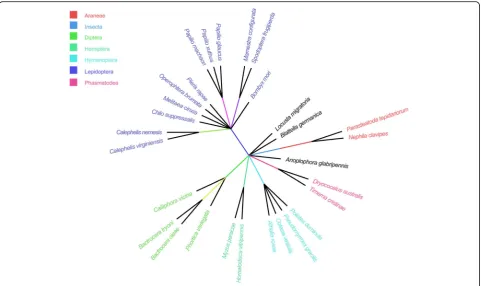
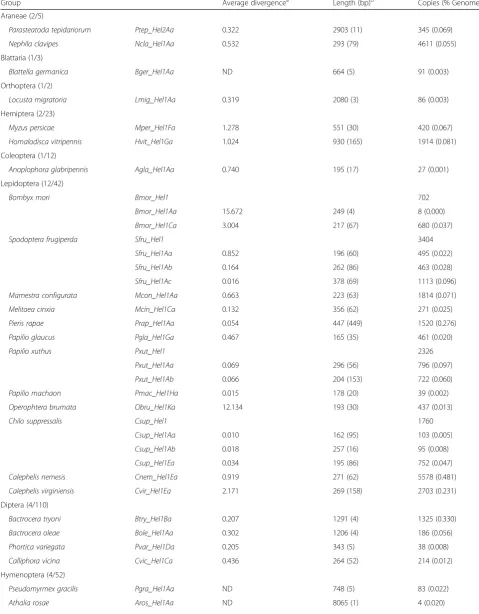
A broad homology-based search of contemporary whole genome shotgun (WGS) databases of 256 insects identi-fied similar elements in 27 species, including 12 out of 42 Lepidoptera, 4 out of 110 Diptera, 4 out of 52 Hymenop-tera, 1 out of 2 OrthopHymenop-tera, 2 out of 2 Phasmatodea, 1 out of 12 Coleoptera, 2 out of 23 Hemiptera, 1 out of 3 Blatto-dea. Among 22 spider WGS genome database, similar
ele-ments were only found inP. tepidariorumandN. clavipes
(Additional file 1: Figure S3 and Fig. 1). These elements vary in size from 162 bp to 8065 bp. The number of copies
also varies from exemplar to exemplar. Cvir_Hel1Ea in
Calephelis virginiensis showed the highest copy numbers of 5578, occupies 0.479% of genome, while only 4 copies
were found inAros_Hel1AainAthalia rosae.The average
percentage divergence varied from 0.01 to 15.672, indicat-ing different invasion time (Table1).
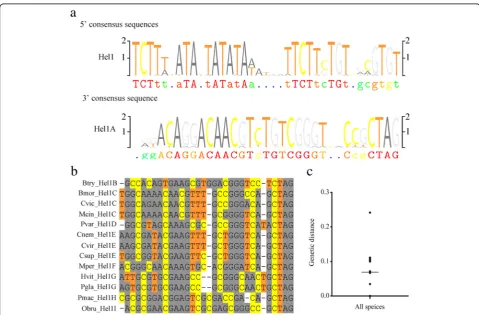
Multiple alignment of the consensus sequences showed that the 30 bp fragments at the 5′-end showed as high as 93.1% average identity, however, the 30 bp fragments at
the 3′-end showed somewhat sequence divergence.
Among 35 exemplars, 22 showed above 80% pairwise identities, the rest 13 exemplars showed less than 80%
sequence identity of 5′-end extended to 126 bp (89%
iden-tity) except Ptep_Hel2Ca(Additional file2: Table S2 and
Additional file1: Figure S4). According to our novel classi-fication method, these elements were divided into 2
fam-ilies, Hel1 and Hel2, and 9 subfamilies, Hel1A-Hel1I.
While the 30 bp fragment at the 3′-end of Ptep_Hel2Ca
showed over 80% identity with Hel1C, as low as 73.3%
identity was found between 30 bp fragment at the 5′-end of Ptep_Hel2Ca and Csup_Hel1A (Additional file 1: Fig-ure S5). Different exemplars were found in the same
species. For example, in the genome of C. suppressalis,
three exemplars of two subfamilies, Csup_Hel1Aa,
Csu-p_Hel1Ab, and Csup_Hel1Eb, were detected, which showed average percentage divergence of 0.01, 0.018 and 0.034, respectively (Table 1). The classification was sup-ported by evolutionary analysis, which showed that these three exemplars are polyphyletic in origin and separated into three distinct clades. Similarly, two exemplars of
Heli-tron subfamily, Pxut_Hel1Aa and Pxut_Hel1Ab were
found in the genome of Papilio xuthus with the average
percentage divergence of 0.064 and 0.066, respectively, and cluster into two distinct clades (Fig.3).
Characterization of reconstructed potential autonomous DNAHelitrons
A total of 7 Helitrons with degenerated remnants of
Helitron coding sequences were initially detected in the
genome ofN. clavipes,P. tepidariorum,Papilio machaon,
Cotesia vestalis, Homalodisca vitripennis, A. rosae and Timema cristinae(Additional file3: Data S1).The longest Helitronwas found inA. rosa, with the length of 8065 bp, and at position 785–1860, there was an insertion of 1076 bp fragment putatively encoding C-terminal catalytic do-main of Cre recombinase (INT_Cre_C). Due to the short sequencing length of WGS sequence, the characteristic
5′-TC nucleotide termini was not found in P. machaon,
however, 2 copies of 247 bp tandem repetitive sequences (TRS) were detected at 5′-end of this contig (Additional file1: Figure S6).
Further blast searches were executed and 4 potential
au-tonomous Helitrons with an uninterrupted ORF coding
for Rep/helicase of 1495, 1467, 1495 and 1496 amino acids
were reconstructed inC. vestalis (Cves_Hel1),P.
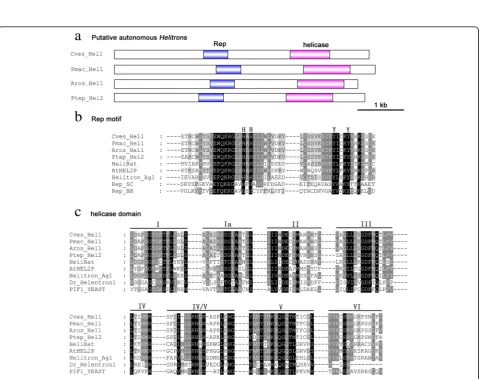
tepidar-iorum(Ptep_Hel2), P. machaon(Pmac_Hel1) andA. rosae (Aros_Hel1), respectively (Additional file3: Data S2). Mul-tiple alignment showed that the predicted Rep/helicase
proteins are composed of a Rep domain containing“
two-His” replication initiator motifs and two conserved
tyrosine residues, and a helicase domain containing eight conserved motifs of the SF1 superfamily of DNA helicases
[22] (Fig. 4). More than 86% amino acid identities were
observed among these 4 Rep/helicase proteins. Specially,
the amino acid identity of Helitronsin P. machcaon and
Table 1Characteristics of 35Helitronexemplars from 29 species
Group Average divergencea Length (bp)b Copies (% Genome)
Araneae (2/5)
Parasteatoda tepidariorum Ptep_Hel2Aa 0.322 2903 (11) 345 (0.069)
Nephila clavipes Ncla_Hel1Aa 0.532 293 (79) 4611 (0.055)
Blattaria (1/3)
Blattella germanica Bger_Hel1Aa ND 664 (5) 91 (0.003)
Orthoptera (1/2)
Locusta migratoria Lmig_Hel1Aa 0.319 2080 (3) 86 (0.003)
Hemiptera (2/23)
Myzus persicae Mper_Hel1Fa 1.278 551 (30) 420 (0.067)
Homalodisca vitripennis Hvit_Hel1Ga 1.024 930 (165) 1914 (0.081)
Coleoptera (1/12)
Anoplophora glabripennis Agla_Hel1Aa 0.740 195 (17) 27 (0.001)
Lepidoptera (12/42)
Bombyx mori Bmor_Hel1 702
Bmor_Hel1Aa 15.672 249 (4) 8 (0.000)
Bmor_Hel1Ca 3.004 217 (67) 680 (0.037)
Spodoptera frugiperda Sfru_Hel1 3404
Sfru_Hel1Aa 0.852 196 (60) 495 (0.022)
Sfru_Hel1Ab 0.164 262 (86) 463 (0.028)
Sfru_Hel1Ac 0.016 378 (69) 1113 (0.096)
Mamestra configurata Mcon_Hel1Aa 0.663 223 (63) 1814 (0.071)
Melitaea cinxia Mcin_Hel1Ca 0.132 356 (62) 271 (0.025)
Pieris rapae Prap_Hel1Aa 0.054 447 (449) 1520 (0.276)
Papilio glaucus Pgla_Hel1Ga 0.467 165 (35) 461 (0.020)
Papilio xuthus Pxut_Hel1 2326
Pxut_Hel1Aa 0.069 296 (56) 796 (0.097)
Pxut_Hel1Ab 0.066 204 (153) 722 (0.060)
Papilio machaon Pmac_Hel1Ha 0.015 178 (20) 39 (0.002)
Operophtera brumata Obru_Hel1Ka 12.134 193 (30) 437 (0.013)
Chilo suppressalis Csup_Hel1 1760
Csup_Hel1Aa 0.010 162 (95) 103 (0.005)
Csup_Hel1Ab 0.018 257 (16) 95 (0.008)
Csup_Hel1Ea 0.034 195 (86) 752 (0.047)
Calephelis nemesis Cnem_Hel1Ea 0.919 271 (62) 5578 (0.481)
Calephelis virginiensis Cvir_Hel1Ea 2.171 269 (158) 2703 (0.231)
Diptera (4/110)
Bactrocera tryoni Btry_Hel1Ba 0.207 1291 (4) 1325 (0.330)
Bactrocera oleae Bole_Hel1Aa 0.302 1206 (4) 186 (0.056)
Phortica variegata Pvar_Hel1Da 0.205 343 (5) 38 (0.008)
Calliphora vicina Cvic_Hel1Ca 0.436 264 (52) 214 (0.012)
Hymenoptera (4/52)
Pseudomyrmex gracilis Pgra_Hel1Aa ND 748 (5) 83 (0.022)
Contribution ofHel1to gene and genome evolution We further analyzed the integration pattern relative to
the annotated genes in two representative genomes, P.
xuthus and Pieris rapae. Out of the 796, 722 and 1520
copies of Pxut_Hel1Aa, Pxut_Hel1Aband Prap_Hel1Aa,
463 (58%) of Pxut_Hel1Aa Helitrons, 413 (57%) of
Pxut_Hel1Ab Helitrons, and 740 (52%) of Prap_Hel1Aa Helitronswere found in introns. Only 4, 7 and 3 copies
of Pxut_Hel1Aa, Pxut_Hel1Ab and Prap_Hel1Aa
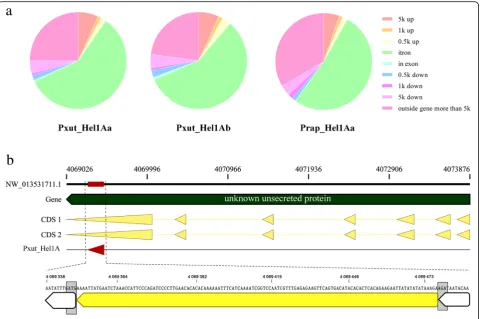
were found to insert into exons, respectively (Fig. 5a).
Further analysis revealed the insertion of multiple
copies of Hel1 into introns of the same gene. For
example, as many as 4 copies of Prap_Hel1Aa
inserted into introns of LOC110995424 gene, and the fifth copy inserted into 3′-end of coding
se-quence (CDS) (Additional file 1: Figure S8).
How-ever, in most cases, only one copy was detected in intron regions of a specific gene. Notably, a 127 bp
copy of Pxut_Hel1A (NW_013531711.1: 4069476–
4,069,349) inserted into CDS of a gene encoding an
unclassified protein (Fig. 5b). Thus, the P. xuthus
and P. rapae Hel1 Helitrons mainly contribute to structural variation in introns, which might influence the regulation of gene expression.
Table 1Characteristics of 35Helitronexemplars from 29 species(Continued)
Group Average divergencea Length (bp)b Copies (% Genome)
Cotesia vestalis Cves_Hel1Aa 0.372 278 (76) 137 (0.020)
Polistes dominula Pdom_Hel1Ia 0.968 395 (3) 165 (0.031)
Phasmatodea (2/2)
Dryococelus australis Daus_Hel1Aa 0.077 667 (27) 1326 (0.026)
Timema cristinae Tcri_Hel1Aa 0.099 3435 (5) 105 (0.035)
ND, not determined a
Average divergence is calculated between copies within a species b
The number in bracket is the number of copies used to reconstruct the consensus sequences
Fig. 4Gene structure (a), predicted Rep motif (b) and helicase domain (c) of reconstructed putative autonomousHel1andHel2Helitrons fromC. vestalis, P. machaon,A. rosaeandP. tepidariorum. In the alignment of the Rep motif, representative structure was fromMyotis lucifugus(HeliBat1), Arabidopsis thaliana(AtHEL2P),Anopheles gambiae(Helitron_Ag1), Streptomyces cyaneusplasmid (Rep_SC) andBacillus borstelensisplasmid (Re_BB). In the alignment of helicase domain, representative structure was fromMyotis lucifugus(HeliBat1),Arabidopsis thaliana(AtHEL2P), Anopheles gambiae(Helitron_Ag1),Danio rerio(Dr_Helentron1) andSaccharomyces cerevisiae(PIF1_YEAST)
Sequence acquisition and newHel1creation
Among all Helitrons identified in this study, Hel1 in
Spodoptera frugiperda attracted our attention. In
addition to Sfru_Hel1Aa、Sfru_Hel1Ab and
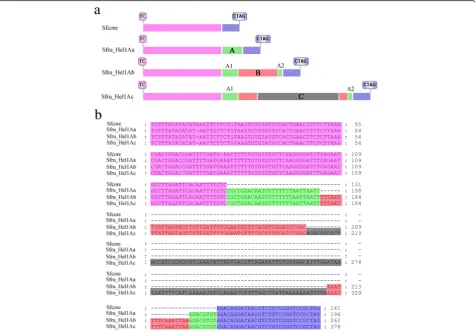
Sfru_He-l1Ac, a 161 bp copy (FJUZ01003913.1: 464817–464,657)
was detected (Fig.6). Sequence analysis showed that the
consensus sequences of these three exemplars shared almost 99% identity with this short sequence excluding insertions, thus this short copy was designated as core
sequence (Sfcore) (Fig. 6). Further analysis showed that
compared with the core sequence, a 35 bp fragment
named “A” region inserted into core sequence 130 bp
downstream of the 5′-end in Sfru_Hel1Aa, and a 66 bp
fragment named “B” region inserted into “A” region in
Sfru_Hel1Ab, while a 108 bp fragment named“C”region
inserted into “B” region in Sfru_Hel1Ac (Fig. 6a).
Alignment of the consensus sequences showed that the insertion sites were consistent with the overlapping re-gion (Fig.6b). The search of putative source loci of these
insertions revealed that“A”region consisted of“A1”and
“A2” regions, among which “A1” region was derived
from sequence NJHR01000652 (137291–137,357) and
“A2” region from NJHR01000244 (961324–961,247)
(Additional file 1: Figure S9). While sequence
NJHR01000585 (153969–153,870) showed high identity
with“B” region, we did not find source locus of“C”
re-gion, putative due to the incomplete genome sequen-cing. Additionally, 2-13 bp end junctions were identified in each source locus, supporting the filler DNA
model [23] (Additional file 1: Figure S9). Furthermore,
the average percentage divergence was 0.852, 0.164 and 0.016, respectively, indicating a clear evolutionary order (Table 1).
The sequence acquisition ofP. xuthus Hel1is different
from that ofS. frugiperda. Two exemplars ofHel1A
sub-family,Pxut_Hel1AaandPxut_Hel1Ab, were found inP.
xuthus, with the length of 296 bp and 204 bp, respect-ively, and only 172 bp region was shared by these two
exemplars (Additional file 1: Figure S10a). The average
percentage divergence ofPxut_Hel1AaandPxut_Hel1Ab
was 0.069 and 0.066, respectively (Table1). It seems
un-likely that Pxut_Hel1Ab was formed by the sequence
acquisition ofPxut_Hel1Aa. Furthermore, we also found
a core sequence (BBJE01004687.1: 58267–58,430) highly
similar to that of S. frugiperda (Additional file 1:
Fig-ure S10b). We speculated that Pxut_Hel1Aa and
Pxut_Hel1Ab were independently derived from the core sequence by sequence acquisition during transposition.
In case of C. suppressalis, the 162 bp consensus
se-quence of Csup_Hel1Aa was over 96% identical to the
above core sequences of P. xuthus and S. frugiperda
(Additional file 1: Figure S10b). Compared with
Csu-p_Hel1Ab, a 7 bp fragment (AGACGTG) was unique to Csup_Hel1Aa (Additional file 1: Figure S10b). Given similar average percentage divergence in these two
ex-emplars, it seems that Csup_Hel1Ab was not derived
from Csup_Hel1Aa. On the other hand, 5 core
se-quences with high similarity to Csup_Hel1Ea were also
found in the genome of C. suppressalis (Additional file
1: Figure S10c). Considering that the average percentage
divergence of Csup_Hel1Ea was 0.034, we inferred that
Csup_Hel1Ea was evolutionarily earlier than Csu-p_Hel1A, and had different origin withCsup_Hel1Aa.
Evolution and horizontal transfer ofHel1
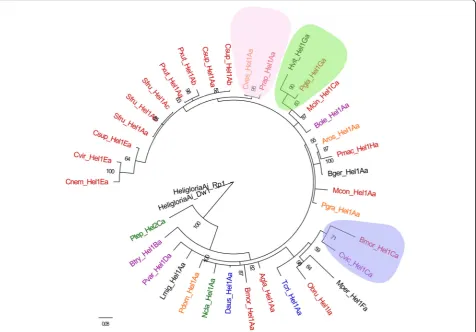
Using HeligloriaAi_DW1 and HeligloriaAi_Rp1 as out
group [19], the phylogenetic tree of the 35 Helitron
consensus sequences showed thatPtep_Hel2Cawas
evo-lutionarily different from other Hel1 elements, and
in-sects of the same order were not clustered together. The
incongruence of Hel1 elements and host phylogeny as
well as the patchy distribution and high sequence
simi-larity of Hel1 elements among distantly related lineages
suggest the recurrence of HT and that multiple
mecha-nisms may underlie the horizontal spread of Hel1.
Not-ably, Lepidopteran Prap_Hel1Aa and Hymenopteran
Cves_Hel1Aa, Dipteran Cvic_Hel1Ca and Lepidopteran Bmor_Hel1Ca, Hemipteran Hvit_Hel1Ga and
Lepidop-teran Pgla_Hel1Ga were clustered into distinct clades,
which diverged 325, 272 and 358 million years ago, re-spectively (http://www.timetree.org/) [24] (Fig. 7). Fur-thermore, several paralogous and orthologous empty sites were also detected in these insect genomes (Add-itional file 1: Figure S11). It is also noteworthy that the genetic distance between species of the same cluster was less than 0.1, indicating that these elements have spread horizontally among these species within a relatively nar-row timeframe.
The clustering of Prap_Hel1Aa from P. rapae
(Lepi-doptera: Pieridae) and Cves_Hel1Aa from C. vestalis
(Hymenoptera: Braconidae) into the same clade is of particular interest. While the calculated genetic distances
of orthologous genes calreticulin, Hsc70 and opsin
be-tween P. rapae and C. vestalis were 0.325, 0.229 and
0.312, respectively (Additional file 1: Figure S12a, b, c), sequence comparison showed that the consensus
se-quences of Prap_Hel1Aa and Cves_Hel1Aa shared over
98% identity excluding a 169 bp insertion in
Prap_He-l1Aa (Additional file 1: Figure S12d). Considering the
average percentage divergence ofPrap_Hel1Aaand
Cve-s_Hel1Aa were 0.054 and 0.372, respectively, we
specu-lated that Prap_Hel1Aa was derived from C. vestalis
through HT, followed by the capture of 169 bp fragment and a rapid burst in transposition. This hypothesis was partly supported by the reconstructed phylogeny in
which the Cves_Hel1Aa copies are generally nested
within clades made of Prap_Hel1Aa copies, and the
closely relatedCsup_Hel1Aacopies fromC. suppressalis
were phylogenetically separated from bothPrap_Hel1Aa
and Cves_Hel1Aa (Additional file 1: Figure S13).
Additionally, the 169 bp insertion fragment was almost
entirely absent in a short copy of Prap_Hel1Aa
(Prap0202, LWME01000202.1: 138955–138,682), which
was over 94% identical to eight copies of Cves_Hel1Aa,
and specifically over 97% identity was observed at the
30 bp 3′-ends of Prap0202 and these Cves_Hel1Aa
cop-ies (Additional file 1: Figure S12e). Interestingly, PCR
amplification and sequencing revealed orthologous
empty site of Prap0202 in a local population ofP. rapae,
suggesting Prap_Hel1Aa elements mobilized recently
(Additional file 1: Figure S14). Furthermore, as many as
11 elements inP. rapaegenome were found to be
com-pletely same as the consensus sequence ofPrap_Hel1Aa,
indicating recent invasion of the P. rapae genome by
Prap_Hel1Aaelements (Additional file1: Figure S15). There are few reports on the occurrence of HT
be-tween Lepidoptera and Diptera [19]. In this study, we
found that Cvic_Hel1Ca and Bmor_Hel1Ca, Pgla_
Hel1Ga and Hvit_Hel1Ga were clustered into same clade, respectively, and the corresponding consensus
se-quences were highly similar (Additional file 1:
Fig-ure S16a and FigFig-ure S17), suggesting the occurrence of Fig. 7Phylogenetic relationships among 35 exemplars from 29 species. Taxa showingHel1andHel2are colored taxonomically, with
HT between these insects. Furthermore, orthologous empty sites were detected in both Lepidoptera and Dip-tera insects (Additional file1: Figure S11). Notably, a
pu-tative Hel1 sequence (GEND01024785.1: 446–129) was
found in the transcriptome shotgun assembly (TSA)
database of Entomophthora muscae, which shared 90%
identity with two copies of Cvic_Hel1Caand 74%
iden-tity with Bmor_Hel1Ca (Additional file 1: Figure S16b),
suggesting a possible role of E. muscae in the HT
be-tween Lepidoptera and Diptera insects.
Discussion
The classification of Helitron has always been
ambigu-ous. The classical classification system was proposed
based on genome-wide analysis of maize Helitrons, in
which the sequences with the most similar 3′-ends (30 bp with at least 80% identity) were classified as members of the same family and sequences with the most similar 5′-ends (30 bp with at least 80% identity) were classified
as members of the same subfamily [25]. This criteria has
been followed by several other studies [19]. In addition, the unique internal sequence that was > 20% different at
the nucleotide level from any otherHelitron internal
re-gions was defined “exemplars” [10]. However, based on
genome-wide analysis of silkworm Helitrons, Han et al.
(2013) suggested that sequences with identities > 80% in the 30 bp of both their 5′- and 3′-ends were classified as members of the same family, and full-length sequences with identity > 80% were classified in the same
subfam-ily. Due to the lack of knowledge regardingHelitron
cis-or trans- activation of Helitron, these classification cri-teria are exploratory. According to the end bypass model, which was proposed to explain the mechanism of
gene capture of Helitron, transposition initiates at the
5′-end and gene capture occurs if the 3′-end signal is
missed. A random cryptic sequence located downstream would then act as the termination signal and all
inter-vening sequences would be captured [8,26]. This model
was supported by the fact that the xanA gene fragment
was captured by a Helitron in Aspergilus nidulans
gen-ome [27]. Recent study showed that the modification or
deletion of the hairpin loop or palindrome sequence had little effect on the transposon colony-forming activity of
the reconstructed active bat Helitron, Helraiser.
How-ever, the deletion of 5′-end of Heliraiser resulted in
complete loss of activity [9]. Given the importance role
of the 5′-end of Helitrons in transposition, we think it
seems more reasonable to classify the family with 5′-end
of Helitron. Thus, we proposed a new classification standard, as described in methods. This new criteria was
supported by our phylogenetic analysis of P. xuthis and
C. suppressalis Helitrons, in which the copies of different
subfamilies or exemplars of Helitron are well separated
phylogenetically (Fig.3).
The distinct copy and paste transposition process of Helitrons ensures them the capability of reaching high genomic copy numbers. For example, maize and silk-worm Helitrons constitute 6.6% and 4.23% of the gen-ome, respectively [11,14]. In this study, as many as 5578
copies of Cvir_Hel1Ea were found in C. virginiensis,
which account for 0.479% of genome. Besides their dir-ect effdir-ect on genome size, evidence has accumulated in
recent years that Helitrons can also impact the gene
structure and expression as well as genome organization
[28, 29]. For example, the insertion of two
non-autonomousHelitronelements,AtREP3andAtREP1,
into upstream ofETTandARF4genes intebichi(teb)
mu-tantArabidopsis thaliana resulted in the upregulation of these two genes [30]. In the tetraploid sour cherry,Prunus cerasus, the insertion of a small non-autonomousHelitron
element into 38 bp downstream of the stop codon ofSFB
gene is proposed to interfere with the polyadenylation process, resulting in a loss of function of theSFBgene in-volved in gametophytic self-incompatibility [31]. In this study, we found that, similar to silkwormHelitrons [14],
majority copies of Pxut_Hel1A and Prap_Hel1Aa insert
into introns of host genome, suggesting thatHel1
duplica-tion and transposiduplica-tion led to structural variaduplica-tion in in-trons, which might influence the regulation of gene
expression. Notably, a copy with 3′-end deletion of
Pxut_Hel1Ainserted into coding region of an unclassified
gene (Gene accession: LOC110995424) in P. xuthus
gen-ome, while the impact of the insertion on gene function is unknown at present.
A predominant characteristic ofHelitronsis their
abil-ity to capture and amplify host genome sequences.
Among 1649Helitron-liketransposons identified in
gen-ome of maize inbred line B73, over 90% of maizeHelitrons
have captured gene fragments [32]. While end bypass and
filler DNA models [8, 15] have been proposed to explain
Helitrongene capture and transposition, the exact mecha-nisms is far from clear. It has been proposed that gene
capture duringHelitrontransposition occurs in a stepwise
or sequential way [33]. In this study, three exemplars of Helitron, Sfru_Hel1Aa, Sfru_Hel1Ab and Sfru_Hel1Ac,
were identified in S. frugiperda together with a shorter
core sequence sharing high identity with these three ex-emplars. Multiple sequence alignment showed that these
three exemplar Helitrons have high sequence identity in
shared sequences, but differ due to additional captured re-gions internal to the elements. The gene fragment trapped
withinHelitronsexcluded the end bypass model.
Alterna-tively, filler DNA model suggests that Helitrons acquire
DNA from the host during the repair of double-strand breaks (DSBs) internal to the element, and predicts that short regions flanking the DSB in the acceptor transposon should be homologous to DNA sequences flanking the
The identification of end junctions in the putative source
loci suggested thatHel1 Helitronsacquire DNA from the
host putatively by filler DNA insertion during the repair of DSBs. Notably, the average percentage divergence of these three exemplars were 0.852, 0.164 and 0.016, respectively, strongly supporting the occurrence of stepwise transpos-ition and amplification putatively using the core sequence as the source element. However, while shorter core se-quences were also identified in respective host genomes,
exemplars of the Pxut_Hel1A and Csup_Hel1 seems to
capture host gene fragment during independent transpos-ition events.
No less than 2836 horizontal transposon transfer (HTT) events have been recorded so far in multicellular
eukaryotes [34], however, the mechanisms underlying
HTT remain largely mysterious. The role of a host-parasite relationship has been proposed recently as a major mech-anism of horizontal DNA transfer [21,35,36]. In this study,
we provide evidence thatPrap_Hel1Aamight derive from
Cves_Hel1Aa. While C. vestali is larval parasitoid of the
diamondback moth, Plutella xylostella (Lepidoptera:
Plutellidae), we did not find any Cves_Hel1-like
se-quences in the genome database of P. xylostella
(http://iae.fafu.edu.cn/DBM/), putatively due to the evolutionary dead-end of parasitized caterprillars. On the other hand, parasitoids are likely to oviposit within mar-ginal (or even completely unsuitable) hosts in the labora-tory or field, even if suitable hosts are present [37], andC. vestalishas been reared from several species belonging to different Lepidopteran families [38], thus we propose that C. vestalismight be a nonregular parasite ofP. rapae, and this nonregular host-parasite interactions contribute to
the HT ofHel1 between these two species. The origin of
Cves_Hel1AainC. vestalisseems to be a mystery. A num-ber of core sequences were found in Lepidoptera genome includingS. frugiperda,P. xuthusandC. suppressalis, thus
as a vector for HT in Lepidoptera insects, C. vestalis is
more likely to acquire and transfer Cves_Hel1Aa to P.
rapefrom other Lepidoptera insects.
While our results indicate the role of nonregular
host-parasite interactions in HT of Prap_Hel1Aa and
Cves_Hel1Aa, the evidence of 2 additional cases of HTT
(Cvic_Hel1Ca and Bmor_Hel1Ca, Pgla_Hel1Ga and
Hvit_Hel1Ga) based on their patchy distribution and
in-congruence ofHel1and host phylogeny is somewhat
in-triguing due to the absence of host-parasite relationship among these species. It has been proposed that mecha-nisms of HT include insect-associated facultative
symbi-onts [39–45]. In addition, the Lep1-like elements
identified in the genome ofNosema bombycis suggested
that the intracellular microsporidia parasite is also a po-tential vector for HT [21]. Recent studies have also sug-gested that both baculovirus and polydnaviruses might
be important vectors of HTT [46–48]. While Lep1-like
and Hel-2 Helitrons had been identified in C. vestalis and Cotesia sesamiae bracovirus and AcNPV,
respect-ively [20, 21], we did not find Hel1 in the genomes of
bracovirus and NPV. However, the discovery ofHel1-like
sequence in TSA database of E. muscae suggests that
pathogen may also serve as a vector mediating HT of in-sect TEs. More widespread sequencing would be re-quired to find exact vectors that would facilitate the HT ofHel1 Helitronsin these species.
Conclusion
In the current report, we conducted a thorough search
for a novel Helitron family by analyzing the sequenced
genomes of 256 insects and 22 spiders. We modified the classical classification system for family and subfamily
definition ofHelitrons, and classified Hel1 family into 9
subfamilies and 34 exemplars, among which three
exem-plars inS. frugiperdaexhibited stepwise sequence
acqui-sition, supporting the filler DNA model. We proposed that nonregular host-parasite interactions plays an
im-portant role in HT ofHelitrons. Our data may have
im-plications for understanding the evolution and HT
mechanisms ofHelitrons.
Materials and methods
Data resources
The publicly available 256 Insecta and 22 Arachnida WGS from National Center for Biotechnology Informa-tion (NCBI) (last accessed September 30, 2017) were
used in this study. P. rapae and P. xuthus WGS were
downloaded from NCBI. A list of the analyzed species and corresponding amount of sequence data is provided
in Additional file 4: Data S3 online. As corresponding
gene annotation files, we used the GFF files GCF_
001856805.1 for P. rapae and GCF_000836235.1 for P.
xuthus, respectively.
Database searches and copy number estimation of Helitrons
Database searches were performed and comprise three
steps. Firstly, the novelHelitronsequence located
down-stream of aSINEin C. suppressaliswas used as a query
in BLASTN searches against the NCBI C. suppressalis
WGS database. Sequences of high homology as well as 200 bp upstream and downstream flanking regions were
extracted and analyzed for hallmarks of Helitrons such
as characteristic 5′-TC and 3′-CTRY nucleotide termini,
and the consensus sequences of three Helitron
exem-plars of Hel1 families in C. suppressalis, Csup_Hel1Aa,
Csup_Hel1Ab and Csup_Hel1Ea, were determined. Secondly, a total of 255 insect WGS collections were
searched using 161 bp common sequence of
Csup_Hel1Aa and Csup_Hel1Abin other insect species,
and 9 subfamilies, Hel1A-Hel1I were identified. Finally,
WGS collections of other invertebrates were searched
using 161 bp common sequence of Csup_Hel1Aa and
Csup_Hel1Abas query to detect Hel1-like sequences in
other species, and the second family Hel2 was
identi-fied. In total, 2 families, 9 subfamilies, and 35
Heli-tron exemplars were identified, and consensus
sequences for each Helitron exemplars were
recon-structed based on a multiple alignment of at least 10
individual copies [36]. Specially, the copies of
Aros_Hel1Aa and Bmor_Hel1Aa were less than 10, thus all copies were used for multiple alignment to determine consensus sequence. All consensus
se-quences are provided in Additional file 5: Data S4.
To estimate copy number and average percentage
divergence of Helitrons, we used respective consensus
sequences to search against related genomes where these Helitron elements were found using BLASTN. All con-tiguous fragments with at least 80% identity at the nu-cleotide level to the consensus over 100 bp were used to estimate copy number in all species [36,49]. Given that
3′-ends deletion occurred in several copies of different
subfamilies/exemplas in the same organism species, all those undistinguishable copies were counted as
mem-bers of families. For example, twoHelitron exemplars in
P. xuthus, Pxut_Hel1Aa and Pxut_Hel1Ab shared high identity of 128 bp sequence at 5′-ends, thus all copies aligned only with part or full of this 128 bp region in the consensus sequence were estimate as members of family
(Additional file 1: Figure S19). Furthermore, all
frag-ments sharing at least 80% identity over at least 80% of the length of the consensus sequence were aligned and used for average percentage divergence calculation with
Kimura-2 parameter model [50] in all species except A.
rosae, Blattella germanica, Locusta migratoria, P. tepi-dariorum, Pseudomyrmex gracilis, T. cristinaeand Phor-tica variegata, in which a high level of fragmentation
was observed in multipleHelitroncopies.
Reconstruction of potential autonomousHelitron
The reconstruction of autonomous Helitron comprise
three steps. Firstly, large DNA fragments ranging from 1000 bp to 10 kb that shared similar terminal sequences to the above families were retrieved from WGS databases, and their potential transposase were predicted using getorf
in EMBOSS-6.3.1 package [51]. Secondly, these candidates
with degenerated remnants of Helitroncoding sequences
were used as queries in BLAST searches against both WGS databases, TSA and non-redundant protein data-bases. Finally, the query sequence and hit sequences were aligned to reconstruct the uninterrupted coding sequences
with complete Rep/helicase gene ORF of Helitron by
re-moving frameshifts and insertions.
Nomenclature
To distinguishHelitronelements from 29 species, we
as-sume a set of concept names that consist of short Latin of single species, the type of TEs, the family, subfamily
and exemplars ofHelitron, just likeCsup_Hel1Aa. Given
that the 3′-end sequences of Helitrons were more
vari-able than the 5′-end sequences [12], and the 5′-end
se-quence was strictly necessary for Helitron transposition
[9], we modified Yang and Bennetzen′s method to
re-classify HelitronTEs [25]. Generally, the sequences with the most similar 5′-ends (30 bp with at least 80% iden-tity) were classified as members of the same family and sequences with the most similar 3′-ends (30 bp with at least 80% identity) were classified as members of the same subfamily. Due to the internal sequence divergence
of copies in the same Helitronsubfamily, the unique
in-ternal sequences with more than 80% identity were clas-sified as members of exemplars.
Gene association and genomic show cases
The site of the Helitron integration relative to annotated
genes was analyzed with a custom Perl script [29]. All
copies of Prap_Hel1Aa, Pxut_Hel1Aa and Pxut_Hel1Ab,
were determined for their positions in the genome through BLAST analysis with respective genome database
and the GFF annotation files. TheHelitronsin coding and
untranslated gene regions as well as the distances of inter-genic copies to the closest neighboring gene were
deter-mined and the numbers were counted [29]. All the genic
and genomic loci harboring Helitrons were refined
and visualized with the respective annotations using Perl script. All the figures used CorelDRAW to be-atify the fine tune.
Sequence analysis and phylogeny
RNAstructure (http://rna.urmc.rochester.edu/RNAstruc
tureWeb) was used to predict and analyze DNA
second-ary structure [52]. Multiple alignment of Helitronswere
created by MUSCLE [53], and subsequently visualized
with GENEDOC (www.psc.edu/biomed/genedoc) and
TeXshade [54].
The phylogeny of Helitron elements was built using
MrBayes 3.2 [55] after removing ambiguously aligned
re-gions using BMGE [56] (Additional file5: Data S5).
Nu-cleotide substitution models were chosen using the AIC
criterion in Modeltest [57] (HKY + G). The robustness
of the nodes was evaluated for all phylogenies by per-forming a bootstrap analysis involving 1000 pseudo rep-licates of the original matrix [36].
Specifically, in the evolutionary analysis of
subfam-ilies from P. xuthus and C. suppressalis, we
the consensus sequences. Finally, we extracted these
sequences from each genome using TBtools [58]. A
Neighbor-Joining (NJ) phylogenetic tree of these
se-quences in C. suppressalis and P. xuthus were
con-structed using MEGA 7.0.
Detection of insertion polymorphism ofPrap_Hel1Aa InP. rapae, using one pair of primers flanking the insertion
site (Forward primer: 5′-ACGAGAGATGGCTACAA
CAG-3′; Reverse primer: 5′- AACACACCCACACCC TAAAC -3′), the insertion polymorphism of one short copy of Prap_Hel1Aa (Prap0202, LWME01000202.1: 138955– 138,682) was assessed by performing a PCR survey. The PCR products were cloned into the pMD18-T vector (TaKaRa, Dalian, China) and sequenced.
Additional files
Additional file 1:Figure S1.Insertion of a novelHelitronelement into downstream region of aSINEelement inC. suppressalisgenome. TheSINE
andHelitronsequences are highlighted in blue and pink, respectively. The nucleotides highlighted in purple are the target site duplication (TSD) of
SINE.Figure S2.Characteristic ofCsup_Hel1A. (a), Multiple alignment of
30-bp end sequences as well as the flanking host nucleotides at the 5′
-and 3′-end fromCsup_Hel1Aelements. The alignment was graphically
edited using TeXshade package. (b), Predicted secondary structure of 30-bp region at the 3′-end ofCsup_Hel1Aconsensus sequence.Figure S3.
The distribution ofCsup_Hel1A-like Helitrons in insect and spider
ge-nomes. Taxa showingHel1A-likeHelitronsare colored taxonomically, with
Lepidopteran insects in red, Diptera insects in purple, Hymenoptera
wasps in yellow, Araneae species in green.Figure S4.Multiple alignment
of 126 bp region at the 5′-end consensus sequence ofHel1Helitrons.
Figure S5.Multiple alignment (a) and genetic distance analysis (b) of
30-bp region at the 5′-end of consensus sequences ofPtep_Hel2Caand
Csup_Hel1Ab.Figure S6.Structural analysis of degenerated remnants
potential autonomousHelitronsfound inN. clavipes,P. tepidariorus, P.
machaon, C. vestalis, H. vitripennis, A. rosaeandT. cristinae.Figure S7.
Multiple alignment (a) and genetic distance analysis (b) of Rep/helicase
protein sequences of reconstructed potential autonomousHelitrons.
Figure S8.The typical integration pattern ofHel1Awithin genomes of
P. xuthusandP. rapae. (a), A copy ofPxut_Hel1Aainserted into the coding sequence (CDS) of a gene. (b), A copy ofPxut_Hel1Abinserted
into intron. (c), Several copies ofPrap_Hel1Aainserted into introns and
exons of the same gene.Figure S9. Identification of source loci and
end junctions of insertions inSfru_Hel1A. The end junction sequences are shaded.Figure S10.Multiple alignment ofPxut_Hel1Abconsensus sequence and core sequence inP. xuthus(a),Csup_Hel1Aaand Csu-p_Hel1Abconsensus sequences inC. suppressalisas well as core sequence in genome ofP. xuthus(BBJE) andS. frugiperda(FJUZ) (b) and Csup_Hel1Eaconsensus sequence and four short core sequences inC. suppressalis(c).Figure S11.Paralogous or orthologous empty sites of Prap_Hel1AainP. rapae,Cves_Hel1AainC. vestalis, Csup_Hel1AainC. suppressalis, andMcin_Hel1CainMelitaea cinxia. The 4-letter project ID of WGS accession number and corresponding species are listed as following: LWME forP. rapae, JZSA forC. vestalis, ANCD forC. suppressalis, APLT forMelitaea cinxia,JXPT forBactrocera oleaeand
AZMT forMicroplitis demolitor.Figure S12. Multiple alignment of orthologous gene of calreticulin fromP. rapae(EU826537.1) andC. vestalis(KX384605.1) (a), heat shock protein 70 fromP. rapae (KJ573767.1) andC. vestalis(JX088378.1) (b), opsin fromP. rapae (AB177984.1) andC. vestalis(KY368220.1) (c), consensus sequences ofPrap_Hel1AaandCves_Hel1Aaas well as a short copy of Pra-p_Hel1Aa(Prap0202, LWME01000202.1: 138955–138,682) (d) and Prap0202 and eight individual sequences ofCves_Hel1Aaincluding Cves_Hel1Aa.1(JZSA01006637.1: 22335–22,612), Cves_Hel1Aa.2 (JZSA01007293.1: 718–441), Cves_Hel1Aa.3 (JZSA01002845.1: 21212–21,486), Cves_Hel1Aa.4 (JZSA01005118.1: 18777–18,500), Cves_Hel1Aa.5
(JZSA01002791.1: 17198–17,475), Cves_Hel1Aa.6 (JZSA01001525.1: 718–441), Cves_Hel1Aa.7 (JZSA01000595.1: 12281–12,558) and Cves_Hel1Aa.8 (JZSA01006408.1: 3165–2888) (e).Figure S13.Phylogenetic analysis of all copies ofHel1Helitrons inC. vestalis,P. rapaeandC. suppressalis. The phylogenetic tree was constructed by the neighbor-joining method using MEGA 7.0 software.Figure S14.Detection of orthologous empty site of a short copy ofPrap_Hel1Aa(Prap0202, LWME01000202.1: 138955–138,682) inP. rapaelarvae collected from Yangzhou, China.Figure S15.Multiple alignment of sequences completely same as the consensus sequence ofPrap_Hel1AainP. rapae.Figure S16.Multiple alignment of Emus_Hel1Caand the consensus sequences ofBmor_Hel1Ca,Cvic_Hel1Ca (a) as well asEmus_Hel1Caand the individual sequences ofBmor_Hel1Ca (Bmor_Hel1Ca.1, AADK01000158.1: 43487–43,268) andCvic_Hel1Ca (Cvi-c_Hel1Ca.1, JXOT01107662.1: 1253–1516; Cvic_Hel1Ca.2, JXOT01181287.1: 382–645) (b).Figure S17.Multiple alignment (a) and genetic distance ananlysis (b) ofPgla_Hel1GaandHvit_Hel1Ga.Figure S18.Multiple alignment ofCsup_Hel1AaandCsup_Hel1Ab.Figure S19.Multiple alignment ofPxut_Hel1AaandPxut_Hel1AbfromP. xuthus. (PDF 3085 kb)
Additional file 2:Table S1.List of copies of theHelitronbased on searches of WGS database inC. suppressalis.Table S2.Estimates of evolutionary divergence betweenHel1transposon of 28 speices . The number of base differences per site from between sequences are shown. The analysis involved 34 nucleotide sequences. Codon positions included were 1st + 2nd + 3rd + Noncoding. All ambiguous positions were removed for each sequence pair. There were a total of 131 positions in the final dataset. Evolutionary analyses were conducted in MEGA7.0. (XLSX 66 kb)
Additional file 3:Data S1.TheHel1elements with degenerated remnants ofHelitroncoding sequences identified in insect and spider genome databases.Data S2.The reconstructed potential autonomous Hel1 Helitrons. (PDF 67 kb)
Additional file 4:Data S3.The list of the analyzed species and corresponding amount of sequence data. (XLSX 2613 kb)
Additional file 5:Data S4.The consensus sequences of 35Helitron exemplars.Data S5.The sequences used for evolutionary analysis. (PDF 101 kb)
Acknowledgements
The authors would like to thank anonymous referees for their helpful comments on the manuscript.
Funding
This work was supported by the National Natural Science Foundation of China (Grant No. 30871642 and 31701792), National Rice Industry Technology System Project (Grant No. Cars-001-25), Jiangsu Agricultural Science and Technology Innovation Fund (Grant No. ZX (17)2002) and Jiangsu Science Project of China (Grant No. BK20181215).
Availability of data and materials
Authors′contributions
GH did most of the experimental work and wrote the manuscript; NZ analysed the genome database; JX designed the experiments; HJ reconstructed the autonomousHelitrons; CJ performed genomic DNA extraction and PCR; ZZ analysed the data and revised the manuscript; QS and DS revised the manuscript; JF designed the experiments and wrote the manuscript; JW designed the experiments, supervised all of the experimental work and wrote the manuscript. All authors read and approved the final manuscript.
Ethics approval and consent to participate
Not applicable.
Consent for publication
Not applicable.
Competing interests
The authors declare that they have no competing interests.
Publisher’s Note
Springer Nature remains neutral with regard to jurisdictional claims in published maps and institutional affiliations.
Author details
1
College of Horticulture and Plant Protection, Yangzhou University, Yangzhou 225009, China.2Jiangsu Lixiahe Institute of Agricultural Sciences, Yangzhou 225007, China.3School of Life Sciences, Chongqing University, Chongqing 400044, China.4Division of Plant Sciences, University of Missouri, Columbia, MO, USA.5USDA/Agricultural Research Service, Biological Control of Insects Research Laboratory, Columbia, MO, USA.6Institute of Plant Protection, Jiangsu Academy of Agricultural Sciences, Nanjing 210014, China.
Received: 11 February 2019 Accepted: 30 April 2019
References
1. Barron MG, Fiston-Lavier AS, Petrov DA, Gonzalez J. Population genomics of transposable elements inDrosophila. Annu Rev Genet. 2014;48:561–81. 2. Jangam D, Feschotte C, Betrán E. Transposable element domestication as an
adaptation to evolutionary conflicts. Trends Genet. 2017;33(11):817–31. 3. Wicker T, Sabot F, Hua-Van A, Bennetzen JL, Capy P, Chalhoub B, Flavell A,
Leroy P, Morgante M, Panaud O. A unified classification system for eukaryotic transposbale elments. Nat Rev Genet. 2007;8(12):973–82. 4. Slotkin RK, Martienssen R. Transposable elements and the epigenetic
regulation of the genome. Nat Rev Genet. 2007;8(4):272–85.
5. Kapitonov VV, Jurka J. Rolling-circle transposons in eukaryotes. Proc Natl Acad Sci U S A. 2001;98(15):8714–9.
6. Kapitonov VV, Jurka J.Helitronson a roll: eukaryotic rolling-circle transposons. Trends Genet. 2007;23(10):521–9.
7. Rossato DO, Ludwig A, Depra M, Loreto EL, Ruiz A, Valente VL.BuT2is a member of the third major group ofhATtransposons and is involved in horizontal transfer events in the genusDrosophila. Genome Biol Evol. 2014;6(2):352–65.
8. Thomas J, Pritham EJ.Helitrons, the eukaryotic rolling-circle transposable elements. Microbiology Spectrum. 2015;3(4):MDNA3–0049-2014. 9. Grabundzija I, Messing SA, Thomas J, Cosby RL, Bilic I, Miskey C, et al. A
Helitrontransposon reconstructed from bats reveals a novel mechanism of genome shuffling in eukaryotes. Nat Commun. 2016;7:10716.
10. Yang L, Bennetzen JL. Distribution, diversity, evolution, and survival of Helitronsin the maize genome. Proc Natl Acad Sci U S A. 2009;106(47): 19922–7.
11. Xiong W, He L, Lai J, Dooner HK, Du C. HelitronScanner uncovers a large overlooked cache ofHelitrontransposons in many plant genomes. Proc Natl Acad Sci U S A. 2014;111(28):10263–8.
12. Du C, Fefelova N, Caronna J, He L, Dooner HK. The polychromaticHelitron landscape of the maize genome. Proc Natl Acad Sci U S A. 2009;106(47):19916. 13. Thomas J, Phillips CD, Baker RJ, Pritham EJ. Rolling-circle transposons
catalyze genomic innovation in a mammalian lineage. Genome Biol Evol. 2014;6(10):2595–610.
14. Han MJ, Shen YH, Xu MS, Liang HY, Zhang HH, Zhang Z. Identification and evolution of the silkwormHelitronsand their contribution to transcripts. DNA Res. 2013;20(5):471–84.
15. Feschotte C, Pritham EJ. DNA transposons and the evolution of eukaryotic genomes. Annu Rev Genet. 2007;41(41):331.
16. Hartl DL, Lohe AR, Lozovskaya ER. Modern thoughts on an ancyent marinere: function, evolution, regulation. Annu Rev Genet. 1997;31(31):337–58. 17. Peccoud J, Loiseau V, Cordaux R, Gilbert C.Massivehorizontal transfer of
transposable elements in insects. Proc Natl Acad Sci U S A. 2017;114(18):4721–6. 18. Sormacheva I, Smyshlyaev G, Mayorov V, Blinov A, Novikov A, Novikova O. Vertical evolution and horizontal transfer of CR1 non-LTR retrotransposons and Tc1/mariner DNA transposons in Lepidoptera species. Mol Biol Evol. 2012;29(12):3685–702.
19. Thomas J, Schaack S, Pritham EJ. Pervasive horizontal transfer of rolling-circle transposons among animals. Genome Biol Evol. 2010;2:656–64. 20. Coates BS. Horizontal transfer of a non-autonomousHelitronamong insect
and viral genomes. BMC Genomics. 2015;16:137.
21. Guo X, Gao J, Li F, Wang J. Evidence of horizontal transfer of non-autonomous Lep1Helitronsfacilitated by host-parasite interactions. Sci Rep. 2014;4:5119. 22. Pritham EJ, Feschotte C. Massive amplification of rolling-circle transposons
in the lineage of the batMyotis lucifugus. Proc Natl Acad Sci U S A. 2007; 104(6):1895–900.
23. Gorbunova V, Levy AA. Non-homologous DNA end joining in plant cells is associated with deletions and filler DNA insertions. Nucleic Acids Res. 1997; 25(22):4650.
24. Hedges SB, Dudley J, Kumar S. TimeTree: a public knowledge-base of divergence times among organisms. Bioinformatics. 2006;22(23):2971–2. 25. Yang L, Bennetzen JL. Structure-based discovery and description of plant
and animalHelitrons. Proc Natl Acad Sci U S A. 2009;106(31):12832–7. 26. Mendiola MV, Bernales I, Cruz FDL. Differential roles of the transposon
termini in IS91transposition. Proc Natl Acad Sci U S A. 1994;91(5): 1922–6.
27. Cultrone A, Domínguez YR, Drevet C, Scazzocchio C, Fernández-Martín R. The tightly regulated promoter of thexanAgene ofAspergillus nidulansis included in a helitron. Mol Microbiol. 2007;63(6):1577–87.
28. Stuart T, Eichten SR, Cahn J, Karpievitch YV, Borevitz JO, Lister R. Population scale mapping of transposable element diversity reveals links to gene regulation and epigenomic variation. Elife. 2016;5:e20777.
29. Seibt KM, Wenke T, Muders K, Truberg B, Schmidt T. Short interspersed nuclear elements (SINEs) are abundant in Solanaceae and have a family-specific impact on gene structure and genome organization. Plant J. 2016; 86(3):268–85.
30. Soichi I, Kenzo N, Atsushi M. A link among DNA replication, recombination, and gene expression revealed by genetic and genomic analysis ofTEBICHI gene ofArabidopsis thaliana. PLoS Genet. 2009;5(8):e1000613.
31. Tsukamoto T, Hauck NR, Tao R, Ning J, Iezzoni AF. Molecular and genetic analyses of four nonfunctionalShaplotype variants derived from a common ancestralShaplotype identified in sour cherry (Prunus cerasusL.). Genetics. 2010;184(2):411.
32. Dong Y, Lu X, Song W, Shi L, Zhang M, Zhao H, et al. Structural
characterization ofhelitronsand their stepwise capturing of gene fragments in the maize genome. BMC Genomics. 2011;12:609.
33. Lal SK, Hannah LC. Plant genomes: massive changes of the maize genome are caused byHelitrons. Heredity. 2005;95(6):421–2.
34. Dotto BR, Carvalho EL, da Silva AF, Dezordi FZ, Pinto PM, TdL C, et al. HTT-DB: new features and updates. Database. 2018;2018.
35. Schaack S, Gilbert C, Feschotte C. Promiscuous DNA: horizontal transfer of transposable elements and why it matters for eukaryotic evolution. Trends Ecol Evol. 2010;25(9):537–46.
36. Gilbert C, Schaack S, Pace JK II, Brindley PJ, Feschotte C. A role for host-parasite interactions in the horizontal transfer of transposons across phyla. Nature. 2010;464(7293):1347–50.
37. Heimpel GE, Neuhauser C, Hoogendoorn M. Effects of parasitoid fecundity and host resistance on indirect interactions among hosts sharing a parasitoid. Ecol Lett. 2003;6(6):556–66.
38. Cameron PJ, Walker GP. Host specificity ofCotesia rubeculaandCotesia plutellae, parasitoids of white butterfly and diamondback moth. New Zealand Plant Protection. 1997;50(50):236–41.
39. Oliver K, Degnan P, Burke G, Moran N. Facultative symbionts in aphids and the horizontal transfer of ecologically important traits. Annu Rev Entomol. 2010;55(55):247–66.
41. Sloan DB, Nakabachi A, Richards S, Qu J, Murali SC, Gibbs RA, et al. Parallel histories of horizontal gene transfer facilitated extreme reduction of
endosymbiont genomes in sap-feeding insects. Mol Biol Evol. 2014;31(4):857–71. 42. Dunning Hotopp JC, Clark ME, Oliveira DC, Foster JM, Fischer P, Muñoz
Torres MC, et al. Widespread lateral gene transfer from intracellular bacteria to multicellular eukaryotes. Science. 2007;317(5845):1753–6.
43. Venner S, Miele V, Terzian C, Biemont C, Daubin V, Feschotte C, et al. Ecological networks to unravel the routes to horizontal transposon transfers. PLoS Biol. 2017;15(2):e2001536.
44. Werren JH. Biology ofWolbachia. Annu Rev Entomol. 1997;42(1):587. 45. Nikoh N, Tanaka K, Shibata F, Kondo N, Hizume M, Shimada M, et al.Wolbachia
genome integrated in an insect chromosome: evolution and fate of laterally transferred endosymbiont genes. Genome Res. 2008;18(2):272–80. 46. Gilbert C, Feschotte C. Horizontal acquisition of transposable elements and viral
sequences: patterns and consequences. Curr Opin Genet Dev. 2018;49:15–24. 47. Gilbert C, Chateigner A, Ernenwein L, Barbe V, Bezier A, Herniou EA, et al.
Population genomics supports baculoviruses as vectors of horizontal transfer of insect transposons. Nat Commun. 2014;5:3348.
48. Herniou EA, Olszewski JA, O'Reilly DR, Cory JS. Ancient coevolution of baculoviruses and their insect hosts. J Virol. 2004;78(7):3244–51. 49. Zhang HH, Xu HE, Shen YH, Han MJ, Zhang Z. The origin and evolution of
six miniature inverted-repeat transposable elements inBombyx moriand Rhodnius prolixus. Genome Biol Evol. 2013;5(11):2020.
50. Lerat E, Rizzon C, Biémont C. Sequence divergence within transposable element families in theDrosophila melanogastergenome. Genome Res. 2003;13(8):1889–96.
51. Rice P, Longden I, Bleasby A. EMBOSS: the European molecular biology open software suite. Trends in Genetics Tig. 2000;16(6):276–7.
52. Mathews JSR, David H. RNAstructure: software for RNA secondary structure prediction and analysis. BMC Bioinformatics. 2010;11(1):129.
53. Edgar RC. MUSCLE: multiple sequence alignment with high accuracy and high throughput. Nucleic Acids Res. 2004;32(5):1792–7.
54. Beitz E. TEXshade: shading and labeling of multiple sequence alignments using LATEX2 epsilon. Bioinformatics. 2000;16(2):135–9.
55. Ronquist F, Teslenko M, DMP V, Ayres DL, Darling A, Höhna S, et al. MrBayes 3.2: efficient Bayesian phylogenetic inference and model choice across a large model space. Syst Biol. 2012;61(3):539–42.
56. Criscuolo A, Gribaldo S. BMGE (block mapping and gathering with entropy): a new software for selection of phylogenetic informative regions from multiple sequence alignments. BMC Evol Biol. 2010;10(1):210.
57. Posada D, Crandall KA. MODELTEST: testing the model of DNA substitution. Bioinformatics. 1998;14(9):817–8.