AP
®Physics C: Mechanics
2012 Free-Response Questions
About the College Board
The College Board is a mission-driven not-for-profit organization that connects students to college success and opportunity. Founded in 1900, the College Board was created to expand access to higher education. Today, the membership association is made up of more than 5,900 of the world’s leading educational institutions and is dedicated to promoting excellence and equity in education. Each year, the College Board helps more than seven million students prepare for a successful transition to college through programs and services in college readiness and college success — including the SAT® and the Advanced
Placement Program®. The organization also serves the education community through research and advocacy on behalf of students, educators, and schools.
© 2012 The College Board. College Board, Advanced Placement Program, AP, AP Central, SAT, and the acorn logo are registered trademarks of the College Board. Admitted Class Evaluation Service and inspiring minds are trademarks owned by the College Board. All other products and services may be trademarks of their respective owners. Visit the College Board on the Web: www.collegeboard.org. Permission to use copyrighted College Board materials may be requested online at:
www.collegeboard.org/inquiry/cbpermit.html.
Visit the College Board on the Web: www.collegeboard.org.
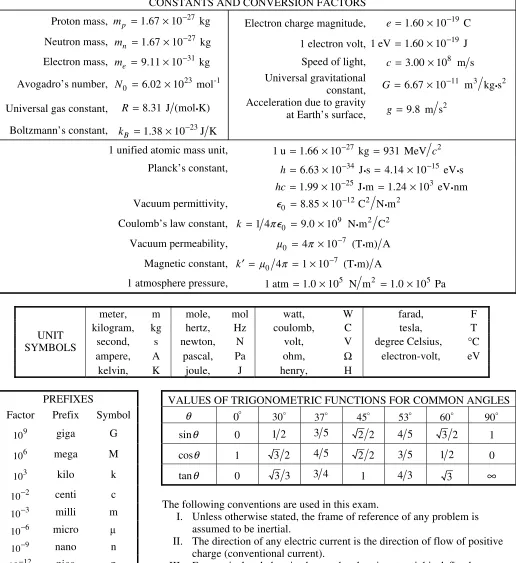
TABLE OF INFORMATION DEVELOPED FOR 2012
CONSTANTS AND CONVERSION FACTORS
Proton mass, mp 1.671027 kg Electron charge magnitude, e 1.601019 C
Neutron mass, mn 1.671027 kg 1 electron volt, 1 eV 1.601019 J
Electron mass, me 9.111031 kg Speed of light, c 3.0010 m s8
Avogadro’s number, N0 6.0210 mol23 -1 Universal gravitational
constant,
11 3 2
6.67 10 m kg s
G <
Universal gas constant, R 8.31 J (mol K)< Acceleration due to gravity
at Earth’s surface,
2 9.8 m s g
Boltzmann’s constant, kB 1.381023J K
1 unified atomic mass unit, 1 u 1.661027 kg 931 MeV c2
Planck’s constant, h 6.631034 J s< 4.141015 eV s<
25 3
1.99 10 J m 1.24 10 eV nm
hc < <
Vacuum permittivity, ⑀0 8.851012C2 N m< 2
Coulomb’s law constant, k 1 4p⑀0 9.010 N m9 < 2 C2
Vacuum permeability, m0 4p 107 (T m) A<
Magnetic constant, k m0 4p 1 107 (T m) A<
1 atmosphere pressure, 1 atm 1.010 N m5 2 1.010 Pa5
meter, m mole, mol watt, W farad, F
kilogram, kg hertz, Hz coulomb, C tesla, T
second, s newton, N volt, V degree Celsius, C
ampere, A pascal, Pa ohm, W electron-volt, eV
UNIT SYMBOLS
kelvin, K joule, J henry, H
PREFIXES VALUES OF TRIGONOMETRIC FUNCTIONS FOR COMMON ANGLES
Factor Prefix Symbol q 0D 30D 37D 45D 53D 60D 90D
9
10 giga G sinq 0 1 2 3 5 2 2 4 5 3 2 1
6
10 mega M cosq 1 3 2 4 5 2 2 3 5 1 2 0
3
10 kilo k tanq 0 3 3 3 4 1 4 3 3
2
10 centi c
3
10 milli m
6
10 micro m
9
10 nano n
12
10 pico p
The following conventions are used in this exam.
I. Unless otherwise stated, the frame of reference of any problem is assumed to be inertial.
II. The direction of any electric current is the direction of flow of positive charge (conventional current).
ADVANCED PLACEMENT PHYSICS C EQUATIONS DEVELOPED FOR 2012
MECHANICS ELECTRICITY AND MAGNETISM
0 at u u 2 0 0 1 2
x x u t at
2 2
0 2a x x0
u u
net m
Ç F F a
d dt p F dt D
Ô
J F p
m
p v
fric
F mN
Ô
F< rW d
2
1 2
K mu
dW P
dt
F v< P g U mgh D 2 2 c a r r u w
r F
t
net I
Ç t t a
2 2
I
Ô
r dm Çmrcm Çm Çm
r r
r
u w
I
L r p w
2
1 2
K Iw
t
w w a
a = acceleration
F = force
f = frequency
h = height
I = rotational inertia
J = impulse
K = kinetic energy
k = spring constant
A = length
L = angular momentum
m = mass
N = normal force
P = power
p = momentum
r = radius or distance
r = position vector
T = period
t = time
U = potential energy
u = velocity or speed W = work done on a system
x = position
m = coefficient of friction
q = angle
t = torque
w= angular speed
a = angular acceleration
f = phase angle
s k
F x 2 1 2 s U kx maxcos(
x x wt f
2 1 T f p w 2 s m T k p 2 p T g p A 1 2 2 ˆ G Gm m r F r 2 1 2 0 1 4 q q F r p⑀ q F E 0
Ô
E< Av
d Q⑀ dV E dr 0 1 4 i i i q V r
p⑀
Ç
1 2 0 1 4 E q q U qV r p⑀ Q C V 0A C d k⑀ p i i
C
Ç
C1 1
s i i
C
Ç
CdQ I dt 2 1 1 2 2 c
U QV CV
R A rA r E J d
I Ne Au
V IR
i i
s
R
Ç
R1 1
i i
p
R
Ç
RA = area
B = magnetic field
C = capacitance
d = distance
E = electric field
e
= emfF = force
I = current
J = current density
L = inductance
A = length
n = number of loops of wire
per unit length
N = number of charge carriers
per unit volume
P = power
Q = charge
q = point charge
R = resistance
r = distance
t = time
U = potential or stored energy
V = electric potential
u = velocity or speed
r = resistivity
m
f = magnetic flux
k = dielectric constant
0 m
Ô
B<v
dᐉ I I d d r 0 3 4 m p r B ᐉI d
Ô
F ᐉ B
0
s
B m nI
fm
Ô
B<dAf
e
v
Ô
E<d d mADVANCED PLACEMENT PHYSICS C EQUATIONS DEVELOPED FOR 2012
GEOMETRY AND TRIGONOMETRY CALCULUS
Rectangle
A bh
Triangle
1
2
A bh
Circle
A pr2
C 2pr
Rectangular Solid
V Awh
Cylinder
V pr2A
S 2prA2pr2
Sphere
4 3
3
V pr
S 4pr2
Right Triangle
a2 b2 c2
sin a
c
q
cos b
c
q
tan a
b
q
A = area
C = circumference V = volume
S = surface area
b = base
h = height
A = length w = width
r = radius
c a
b
90q
q
d f d f du
dx du dx
1
n n
d x nx
dx
x x
d e e
dx
1 ln
d x
dx x
sin cosd x x
dx
cos sind x x
dx
1 1
, 1
1
n n
x dx x n
n
Ô
x x
e dx e
Ô
ln
dx x
x
Ô
cosx dx sinx
Ô
sinx dx cosx
2012 AP
®PHYSICS C: MECHANICS FREE-RESPONSE QUESTIONS
PHYSICS C: MECHANICS SECTION II
Time — 45 minutes 3 Questions
Directions: Answer all three questions. The suggested time is about 15 minutes for answering each of the questions, which are worth 15 points each. The parts within a question may not have equal weight. Show all your work in this booklet in the spaces provided after each part.
Mech. 1.
Experiment 1. A block of mass 0.30 kg is placed on a frictionless table and is attached to one end of a horizontal
spring of spring constant k, as shown above. The other end of the spring is attached to a fixed wall. The block is set into oscillatory motion by stretching the spring and releasing the block from rest at time t = 0. A motion
detector is used to record the position of the block as it oscillates. The resulting graph of velocity u versus time t
is shown below. The positive direction for all quantities is to the right.
(a) Determine the equation for u( )t , including numerical values for all constants.
(b) Given that the equilibrium position is at x 0, determine the equation for x(t), including numerical values
for all constants.
2012 AP
®PHYSICS C: MECHANICS FREE-RESPONSE QUESTIONS
© 2012 The College Board.
Visit the College Board on the Web: www.collegeboard.org.
GO ON TO THE NEXT PAGE.
Experiment 2. The block and spring arrangement is now placed on a rough surface, as shown below. The block
is displaced so that the spring is compressed a distance d and released from rest.
(d) On the dots below that represent the block, draw and label the forces (not components) that act on the block
when the spring is compressed a distance x d 2 and the block is moving in the direction indicated below
each dot.
Toward Away from
the equilibrium position the equilibrium position
(e) Draw a sketch of u versus t in this case. Assume that there is a negligible change in the period and that the
2012 AP
®PHYSICS C: MECHANICS FREE-RESPONSE QUESTIONS
Mech. 2.
You are to perform an experiment investigating the conservation of mechanical energy involving a transformation from initial gravitational potential energy to translational kinetic energy.
(a) You are given the equipment listed below, all the supports required to hold the equipment, and a lab table. On the list below, indicate each piece of equipment you would use by checking the line next to each item.
____ Track ____ Meterstick ____ Set of objects of different masses
____ Cart ____ Electronic balance ____ Lightweight low-friction pulley
____ String ____ Stopwatch
(b) Outline a procedure for performing the experiment. Include a diagram of your experimental setup. Label the equipment in your diagram. Also include a description of the measurements you would make and a symbol for each measurement.
(c) Give a detailed account of the calculations of gravitational potential energy and translational kinetic energy both before and after the transformation, in terms of the quantities measured in part (b).
(d) After your first trial, your calculations show that the energy increased during the experiment. Assuming you made no mathematical errors, give a reasonable explanation for this result.
2012 AP
®PHYSICS C: MECHANICS FREE-RESPONSE QUESTIONS
© 2012 The College Board.
Visit the College Board on the Web: www.collegeboard.org.
Mech. 3.
A ring of mass M, radius R, and rotational inertia MR2 is initially sliding on a frictionless surface at constant
velocity u0 to the right, as shown above. At time t = 0 it encounters a surface with coefficient of friction m and begins sliding and rotating. After traveling a distance L, the ring begins rolling without sliding. Express all
answers to the following in terms of M, R, u0, m, and fundamental constants, as appropriate.
(a) Starting from Newton’s second law in either translational or rotational form, as appropriate, derive a differential equation that can be used to solve for the magnitude of the following as the ring is sliding and rotating.
i. The linear velocity u of the ring as a function of time t
ii. The angular velocity w of the ring as a function of time t
(b) Derive an expression for the magnitude of the following as the ring is sliding and rotating.
i. The linear velocity u of the ring as a function of time t
ii. The angular velocity w of the ring as a function of time t
(c) Derive an expression for the time it takes the ring to travel the distance L.
(d) Derive an expression for the magnitude of the velocity of the ring immediately after it has traveled the distance L.
(e) Derive an expression for the distance L.
STOP