The Thirty-Third AAAI Conference on Artificial Intelligence (AAAI-19)
Dynamic Capsule Attention for Visual Question Answering
Yiyi Zhou,
1Rongrong Ji,
1∗Jinsong Su,
2Xiaoshuai Sun,
1Weiqiu Chen
11Fujian Key Laboratory of Sensing and Computing for Smart City, Department of Cognitive Science, School of Information Science and Engineering, Xiamen University, China
2School of Software Engineering, Xiamen University, China Peng Cheng Laboratory, China
Abstract
In visual question answering (VQA), recent advances have well advocated the use of attention mechanism to precisely link the question to the potential answer areas. As the diffi-culty of the question increases, more VQA models adopt mul-tiple attention layers to capture the deeper visual-linguistic correlation. But a negative consequence is the explosion of parameters, which makes the model vulnerable to over-fitting, especially when limited training examples are given. In this paper, we propose an extremely compact alternative to this static multi-layer architecture towards accurate yet efficient
attention modeling, termed as Dynamic Capsule Attention
(CapsAtt). Inspired by the recent work ofCapsule Network,
CapsAtt treats visual features as capsules and obtains the
attention output viadynamic routing, which updates the
at-tention weights by calculating coupling coefficients between the underlying and output capsules. Meanwhile, CapsAtt also discards redundant projection matrices to make the model much more compact. We quantify CapsAtt on three
bench-mark VQA datasets,i.e., COCO-QA, VQA1.0 and VQA2.0.
Compared to the traditional multi-layer attention model, Cap-sAtt achieves significant improvements of up to 4.1%, 5.2% and 2.2% on three datasets, respectively. Moreover, with much fewer parameters, our approach also yields competi-tive results compared to the latest VQA models. To further verify the generalization ability of CapsAtt, we also deploy it
on another challenging multi-modal task ofimage captioning,
where state-of-the-art performance is achieved with a simple network structure.
Introduction
Visual question answering (VQA) has received extensive research attention in computer vision and artificial intel-ligence (Antol et al. 2015; Yang et al. 2016). Similar to other joint learning tasks of vision and language such as image captioning (IC), the typical setting of VQA involves the acquisition of correlated visual entities about the tex-tual information. To this end, the attention mechanism (Bah-danau, Cho, and Bengio 2014) has been widely explored in VQA (Yang et al. 2016; Lu et al. 2016; Yu et al. 2017; Teney et al. 2018).
∗
Corresponding Author. E-mail:[email protected]
Copyright c2019, Association for the Advancement of Artificial
Intelligence (www.aaai.org). All rights reserved.
Questions: What is
the man holding? LSTM
CNN
1st
Attention Layer
2nd
Attention Layer
3rdAttention
Layer
Dynamic Attention Layer
...
...
The Traditional...
Multi-step Attentions
The Dynamic Capsule Framework
F
F
F
Fv
fq
fq Fv Step 1
Step 2
Step 3
Step 1
Step 2
Step 3
Fv fq
Feature Extraction
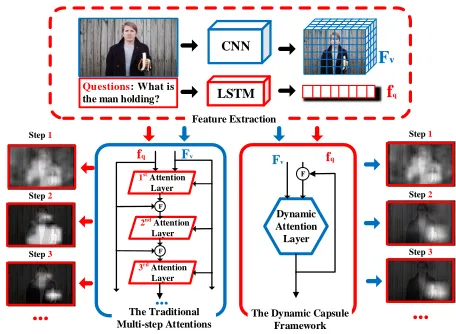
Figure 1: Comparison between the traditional multi-step at-tention and the proposed Dynamic Capsule Atat-tention (Cap-sAtt) in Visual Question Answering. The “F” in cycles de-notes feature fusions. The left part describes the procedure of the traditional multi-step attentions, while the right one depicts the framework of CapsAtt. Visualized attention re-sults are given on two sides.
The principle behind attention mechanism is to mimic the process of human cognition, assigning limited attention re-sources to the most relevant information for a given task (Xu et al. 2015). In VQA, given a question feature, this mecha-nism forces the model to attend to the visual feature matrix and generates a probability distribution to denote the impor-tance of each regional feature, based on which a weighted-sum vector is output for the answer prediction. As another appealing property, it requires no additional label informa-tion, and its gradient can be derived from the designed ob-jective function (Xu et al. 2015). These advancements have pushed attention mechanism to various tasks such as neu-ral machine translation (Bahdanau, Cho, and Bengio 2014; Vaswani et al. 2017), machine comprehension (Xiong and Socher 2016), and image captioning (Xu et al. 2015) etc.
al. 2016; Lu et al. 2016; Vaswani et al. 2017). Fig.1 shows a representative structure of the multi-step attention (Yang et al. 2016) in VQA. Along with the accuracy improvement, a consequent deficiency is the explosion of parameters, which also leads to a huge cost of computation. The main reason is that the fusion process in the attention layer typically con-tains large-scale parameters. For instance, the compact bi-linear pooling used in MCB (Fukui et al. 2016), a bench-mark model in VQA, has about 48 million parameters. In this case, the training deficiency as well as the model’s ro-bustness have become urgent issues.
We argue that, the key to solving these issues is to replace such a multi-layer attention with a more flexible structure. In particular, as a static stack of information refinements, this multi-layer attention should be replaced with a dynamic alternative. Meanwhile, inspired by the Dynamic Routing
in the recent work ofCapsNet (Sabour, Frosst, and Hinton 2017), in this paper we reveal the possibility of performing multi-step attentions in a dynamic one-component setting. In CapsNet, the routing algorithm updates the coupling co-efficients between capsules in lower and upper layers via it-erations, which further determine the contributions of input capsules. We have found that such an intention is similar to the attention mechanism for evaluating the importances of input visual signals.
To this end, we propose a dynamic algorithm towards ro-bust and highly efficient attention, namelyDynamic Capsule Attention(CapsAtt)1, as shown in Fig.1(right) and Fig.2.a. CapsAtt draws on the idea of CapsNet and treats vectors in the feature matrix as underlying capsules. The attention output is regarded as an overlying capsule obtained through dynamic interactions with these underlying capsules. In con-trast to the traditional prediction-based calculation of atten-tion weights, CapsAtt directly uses the coupling coefficients between modalities to determine the importances of input features. It also discards redundant projection matrices to make the model much more compact. Conclusively, CapsAtt has three major advantages:
• It performs the multi-step attentions by using only one attention layer and avoids the vanishing gradient problem of the traditional stacked attention layers.
• It greatly reduces the number of parameters, making mod-els more compact and robust.
• It is general and applicable to most of the existing attention-driven models.
To validate the merits of the proposed CapsAtt, we first conduct extensive experiments on three VQA datasets,i.e., COCO-QA (Ren, Kiros, and Zemel 2015), VQA1.0 (An-tol et al. 2015) and VQA2.0 (Goyal et al. 2017). The ex-perimental results show that, CapsAtt can obtain significant improvements on all three datasets compared with the clas-sic multi-step attention model. With a much smaller num-ber of parameters and a simple fusion strategy, our approach also achieves near or better performances compared with other benchmark models, like MCB (Fukui et al. 2016) or
1
https://github.com/XMUVQA/CapsAtt
BUA (Teney et al. 2018). To further validate the general-ization ability of CapsAtt, we also conducts experiments on COCO-Caption (Chen et al. 2015), where competitive per-formance is also obtained for the task of image captioning.
Related Work
Attention mechanism is a process of mimicking human cog-nition that focuses on most related information to a vision and/or language modeling task. The concept of attention mechanism has been studied in many works (Tang, Srivas-tava, and Salakhutdinov 2014; Ba, Mnih, and Kavukcuoglu 2014; Mnih et al. 2014), among which the most widely-used structure might resort to that in (Bahdanau, Cho, and Ben-gio 2014). In the task of neural machine translation (NMT), (Bahdanau, Cho, and Bengio 2014) uses the hidden state of the decoder to attend to the collection of hidden states generated by the encoder, and then outputs a weighted-sum vector for word prediction. The attention mechanism was further introduced to the task of visual question answer-ing (VQA) by (Xu and Saenko 2016; Yang et al. 2016). In VQA, the visual regional feature matrix becomes the collection of features to attend, and the reference vector is the question feature. However, the increasing difficulty of questions in VQA often exceeds the ability of a single-step attention. In this case, multiple-glimpse based atten-tions were further proposed to refine the visual/textual infor-mation, such as the multi-step attentions in (Yang et al. 2016; Vaswani et al. 2017) and the co-attentions in (Lu et al. 2016). Attention mechanism is also applied to many other tasks in-cluding image captioning (Xu et al. 2015; Lu et al. 2017), vi-sual grounding (Fukui et al. 2016), video captioning (Song et al. 2017) and text comprehension (Xiong and Socher 2016).
Dynamic Capsule Attention
The Attention Mechanism
Since there are various attention mechanisms proposed in the literature, we do not intend to explore all potential de-signs of attention models in this paper, e.g., the selection of fusion approaches or input features. Instead, we aim at showing how to use a single attention layer to perform multi-step attentions. Therefore, we take the most commonly used attention framework (Ba, Mnih, and Kavukcuoglu 2014; Xu et al. 2015; Yang et al. 2016) as baseline. Before intro-duction, definitions of feature matrix andreference vector
are given first:
• Feature matrix refers to a collection of feature vectors to attend. In different tasks, its representation varies. In VQA (Yang et al. 2016) or image captioning (IC) (Xu et al. 2015), it is the feature maps of an image generated by a convolutional neural network. And in NMT (Bahdanau, Cho, and Bengio 2014), it is a collection of hidden states of the encoder.
• Reference vector is used to determine the attention
Σ
f1 f2 f3 ...fk-2 fk-1 fk
fp
1 fp2 fp3 fp k-2 fpk-1 fpk wf wf wf wf wf wf
c1 c2 c3 ck-2ck-1ck
st
h
s0 wh
Initialize Update ci
Weighted Sum
CNN/
F-RCNN Bi-GRU
CapsAtt
FC
Prediction
(b) The structure of the VQA model FC
Image Question
(a) Illustration of Dynamic Capsule Attention
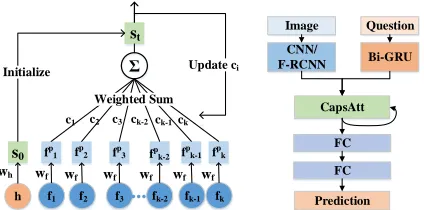
Figure 2: Illustrations of the proposed Dynamic Capsule At-tention (a) and the corresponding VQA model (b). In (a),sis the output capsule which is initialized by the reference vec-torh.fiis the vector in the feature matrixF.WhandWf are projection matrices.ciis the coupling coefficient which can be regarded as the attention weight. In (b), “FC” refers to the fully-connected layer.
Problem Setup. Given a feature matrix F ∈ Rn×K, whereKdenotes the number of feature vectors andh∈Rm is the reference vector, the attention based prediction aims at maximizing the following conditional probability:
P(y|h,F) =g(h, fa), (1)
wherefa ∈Rnis the attention feature which is a weighted-sum vector ofF.
Based onh, an attention model first generates a probabil-ity distribution on vectorsfi ∈ Rn ofF, and then obtains
fa. This process is formulated as:
fa =
K
X
i
αifi, (2)
whereαi is the attention weight of the i-th feature vector
fiinFv. It is often based on the joint representation of two modalities, and is computed by:
αi=
exp (ei)
PK
j exp (ej)
,
where ei=ss· F(h, fi).
(3)
Here, ei is the log prior,ss ∈ Rm is the weight vector, andF(·)is any fusion methods, which often includes two weight matrices,Wh∈Rm×dandWf∈Rn×d, to project
handfionto the same semantic space.
The Multi-Step Attention. In the traditional setting of multi-step attentions (Yang et al. 2016), the model usesfa in the previous step to refine the reference vectorh, and then performs attention again. Thet-step attention result for the
i-th feature inFis calculated by:
αti = exp (e
t i)
PK
j exp e t j
,
where eti=Wts· F(ht, fi),
ht=F ht−1, fat−1
.
(4)
Algorithm 1Dynamic Capsule Attention
Input: feature matrixFand reference vectorh
Output: coupling coefficientscand the output capsules 1: Initialize projection matrices,WfandWh
2: ProjectFandh, and obtainfi
p∈Fpandhp
3: Initializes0withhp
4: for tinN iterationsdo
5: Obtain coupling coefficients:ci ←sof tmax(bi)
6: Obtain weighted-sum feature:fp a ←
PK
i cifpi
7: Update output capsule:st←st−1+fap
8: Update agreements:bi←fpi
>
·st+bi
9: end for
10: returnc, sN.
After that, the attention feature ft
a is computed again by Eq.2. Notably, weight matrices used in each layer are sep-arated.
Capsule Attention
To achieve the multi-step reasoning withoneattention layer, we propose an iterative attention algorithm, termed as
Dy-namic Capsule Attention (CapsAtt). Inspired by the
Cap-sNet, CapsAtt treats each vector in the feature matrixFas an underlying capsules. The attention output is the only upper capsule that contains information related to the prediction.
Concretely, the output capsule s is initialized with the projected reference vector hp, which is denoted as s0 =
σ(Whh). In the t-th iteration, the output capsule is calcu-lated by the following:
st=st−1+
K
X
i
cifpi, f i
p=σ(Wffi), (5)
whereci is the coupling coefficients indicating the contri-butions of the underlying capsules to the overlying one . Note that, the sum of coupling coefficients between capsules in the feature matrix and the output capsule adds up to 1. Therefore, we treat them as the attention weights overF.
The coupling coefficient ci is determined by a “routing softmax” whose initial logit is denoted as bi.bi is the log prior probability that the capsuleishould be coupled to the output capsules. Then, the coefficients is calculated by:
ci=
exp (bi)
PK
j exp (bj)
. (6)
The log prior is initialized with zero and then updated by adding agreements between the underlying capsules and the output capsule, which is calculated by:
bi=bi+fpi
>
·st−1. (7)
These agreements are added to log priors after each routing. The detailed process is presented in Alg.1.
contrast, we usesdirectly as the capsule output in CapsAtt, which is the main difference between these two works. To explain,CapsNetuses the length ofvto represent the prob-ability that the entity represented by the capsule is presented in the current input (Sabour, Frosst, and Hinton 2017). In CapsAtt, the output vector is to represent both the feature matrix and the reference vector. Therefore, the informa-tion contained in this vector is highly correlated with the final prediction task. Accordingly, we discard the “squash-ing” function that may introduce information loss. The out-put capsulesis further used for model predictions, and the gradients of CapsAtt can be calculated by using a standard back-propagation.
CapsAtt for VQA
We first apply the proposed CapsAtt to the task of visual
question answering (VQA), the structure of which is
de-picted in Fig.2.b. In VQA, the training example is a triplet
(I, Q, a) , whereI denotes the image, Q is the question
andais the corresponding answer. The imageIis first pro-cessed by a convolution neural network (CNN) or a Faster R-CNN network (Ren et al. 2017) to obtain the regional vi-sual feature matrix, denoted asF ∈ Rn×K. Then we use a bi-directional GRU network to process the input question and obtain the question featureh∈ Rm, which is the con-catenation of the last hidden states of forward and backward GRUs.
The visual and textual features are fed to CapsAtt to per-form attentions. The output capsule from CapsAtt is used as the joint representation of two modalities, and two fully-connected layers are followed before the final prediction.
On datasets like COCO-QA where each question has only one answer, we use the softmax cross-entropy as the loss function. When a question is associated with a list of an-swers, such as that in VQA1.0 and VQA2.0, we treat the pre-diction as a multi-label classification by following the setting in (Teney et al. 2018). The loss function is then defined as:
L=
N
X
i
yilog (pi)−(1−yi) log (pi), (8)
wherepi is the predicted probability of thei-th candidate andyi= 1if thei-th candidate is in the answer set .
Applying CapsAtt for Image Captioning. To examine the generation ability of CapsAtt, we further apply it to the task ofimage captioning(IC). The input image is also pro-cessed by CNN/Faster R-CNN to obtain the visual feature matrix. The language decoder is an LSTM unit, and we use its hidden state of the current step,ht, as the reference vec-tor. Based onht, CapsAtt attends to the visual feature matrix to produce the output capsules, which is followed by a FC layer and then is used to predict the wordytof the current step. Following the setting in (Xu et al. 2015), the loss func-tion is the averaged softmax cross entropy of all steps.
Experiments
The main purpose of our experiments is to prove that the pro-posed CapsAtt can achieve multi-step attentions with only
Table 1: Evaluation results on COCO-QA.
Method Objects Number Color Location
( 70%) (7%) (17%) (6%)
SAN-1layer(LSTM) 62.5 49.0 54.8 51.6
SAN-2layer(LSTM) 63.6 49.8 57.9 52.8
SAN-1layer(CNN) 63.6 48.7 56.7 52.8
SAN-2layer(CNN) 64.5 48.6 57.9 54.0
CapAtt-Iter1 64.4 49.2 57.0 54.2
CapAtt-Iter2 64.7 49.5 59.5 55.8
CapAtt-Iter3 65.0 50.2 61.3 56.3
CapAtt-Iter4 64.8 50.0 62.0 56.0
*The number under the question type indicates the percentage of this type in the dataset.
one attention layer, and obtain better performance than the traditional multi-step attention models, such as the stacked attention network (SAN) in (Yang et al. 2016). Besides, we also compare CapsAtt with the state-of-the-arts.
Datasets
COCO-QA (Ren, Kiros, and Zemel 2015) is a VQA dataset which is automatically generated by image captions of MS COCO images. It contains 123,287 images with 78,736 training questions and 38,948 test questions. All questions can be divided into four types, namely object, quantity,
color andlocation. Each answer contains only one word.
The metric we used is the classification accuracy. VQA1.0 dataset contains 200,000 natural images from MS-COCO with 614,153 human annotated questions in total. Each ques-tion has 10 free-response answers. The whole dataset is di-vided into three splits, in which there are 248,349 examples for training, 121,512 for validation, and 244,302 for test-ing. VQA2.0 is developed based on VQA1.0, and its images are also from MS-COCO. It has about 1,105,904 image-question pairs, in which 443,757 examples are for training, 214,254 are for validation, and 447,793 are for testing. On these two datasets, we evaluate all methods under the mode
of Open-ended which means no answer options are given
during training and testing. The metric we used is theVQA accuracyproposed in (Antol et al. 2015).
Baselines
We mainly compare our CapsAtt model with the classic multi-step attention model proposed in (Yang et al. 2016), denoted as SAN. Besides, on VQA1.0 and VQA2.0 datasets, we also compare CapsAtt with a set of the sate-of-the-art models including HiCoAtt (Lu et al. 2016), ASK (Wu et al. 2016), VQA Machine (VQA-M) (Wang et al. 2017), MCB (Fukui et al. 2016), MLB (Kim et al. 2017), MFB (Yu et al. 2017) and BUA (Teney et al. 2018) etc. HiCoAtt is a model that performs co-attentions on both visual and text features. ASK and VQA-M are methods that apply external knowledge or techniques to the VQA learning. MCB, MLB and MFB are two-glimpse attention models using bilinear pooling based fusion approaches for capturing interactions between two modalities, and they all show most advanced
6$1/6$1/ %8$ 0)% 0/% 0&% &DSV$WW 0
0 0 0 0
0 0 0
0 0
0
0
Figure 3: Comparisons of the parameter sizes of differ-ent models. “SAN-1L” and “SAN-3L” dnotes SAN models with one attention layer and three attention layers, respec-tively. CapsAtt achieve the state-of-art performances with only 10.8 million parameters.
Challenge, which is equipped with various tricks for the per-formance improvement, and uses the F-RCNN features from (Anderson et al. 2018) as the visual input.
Model Configurations
On COCO-QA, the visual feature used is the convolution feature map before the first fully-connected layer of VGG-16 (Simonyan and Zisserman 2014) with a size of14×14× 512. The dimensions of forward and backward GRU units are set to 256. So the whole dimension of the output ques-tion feature is 512. The attenques-tion dimension in CapsAtt is set to 512, and the ones of the two FC layers are both 512 as well. The number of answer category is set to 434. The initial learning rate is 7e-4, which is half decayed after each 10,000 training steps. On VQA1.0 and VQA2.0, the visual feature input is the feature map before the last pooling layer of ResNet-152 (He et al. 2016) with a size of14×14×2,048. We also use the Faster RCNN features from (Anderson et al. 2018) with a size of36×2,048, which is labeled as “FR-CNN” to distinguish. The dimensions of GRU units, Cap-sAtt and FC layers are set to 512, 1,024, 2,048 respectively. The answer dimensions on these two datasets are both set to 3,000. The initial learning rate is set to 7e-4 with a decay step of 25,000 and a decay rate of 0.5, while the batch size is 124. The maximum training step is set to 200,000 and the validation step is 5,000 steps. Early stop is applied when the performance does not increase after 5 validations.
Quantitative Analysis
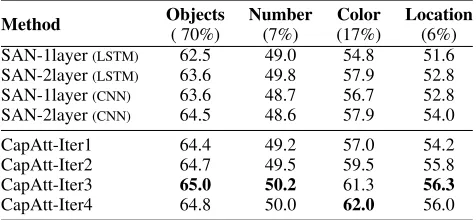
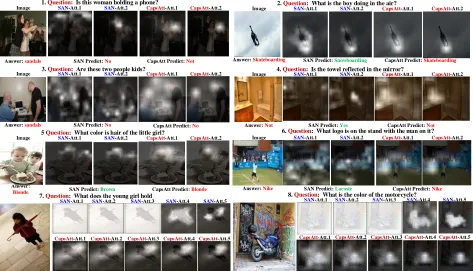
We first compare CapsAtt with SAN on three VQA datasets. Tab.1 shows the comparison results on the COCO-QA dataset. From Tab.1 we can see that under the similar ex-perimental setup, the proposed CapsAtt has made significant improvements in all four tasks, especially the “color” and the “location” with improvements up to 4.1% and 2.3%, respec-tively. Notably, the training examples of these two tasks take account for only a small proportions of the entire dataset, which suggests the robustness of CapsAtt. Tab.2 displays the comparisons on VQA1.0 and VQA2.0 dataset, and the im-provements are more significant. The overall imim-provements
Table 2: Comparisons with the state-of-the-arts on the
Open-Endedtask of VQA1.0 and VQA2.0. Tested on thetest-dev
split.
VQA1.0 Others Num. Yes/No All
SMem(Xu and Saenko 2016) 46.1 36.6 80.9 58.0 NMN(Andreas et al. 2016) 44.0 38.0 81.2 58.6
SAN-2layer(Yang et al. 2016) 46.1 36.6 79.3 58.7
ASK(Wu et al. 2016) 45.2 38.4 81.0 59.2 DMN(Xiong and Socher 2016) 48.3 38.3 80.5 60.3
HiCoAtt(Lu et al. 2016) 51.7 38.9 79.4 61.8
VQA-M (Wang et al. 2017) 53.0 38.4 81.5 63.1
MCB+att(Fukui et al. 2016) 54.8 37.7 82.2 64.2
MLB(Kim et al. 2017) 54.7 37.9 84.0 65.0
MFB+Att(Yu et al. 2017) 55.2 38.3 82.5 64.6
CapsAtt-Iter2 53.5 39.5 81.7 63.7
CapsAtt-Iter3 53.3 39.7 82.8 63.9
CapsAtt-Iter3+FRCNN* 56.4 42.4 83.7 66.1
VQA2.0 Others Num. Yes/No All
LSTM-Q(Goyal et al. 2017) 41.8 35.2 41.8 54.2
SAN-2layer (LSTM) 50.1 37.5 78.34 58.9
MCB(Fukui et al. 2016) 53.3 38.2 78.8 62.3
BuA+VG(Teney et al. 2018) 52.6 39.5 79.2 62.1
BuA+VG+FRCNN* 56.1 44.2 81.8 65.3
CapsAtt-Iter2 51.4 40.7 79.37 61.7
CapsAtt-Iter3 51.7 41.1 79.7 62.1
CapsAtt-Iter3+FRCNN* 55.5 45.1 82.6 65.5
* -FRCNN denotes that the use of regional features from (Anderson et al. 2018).
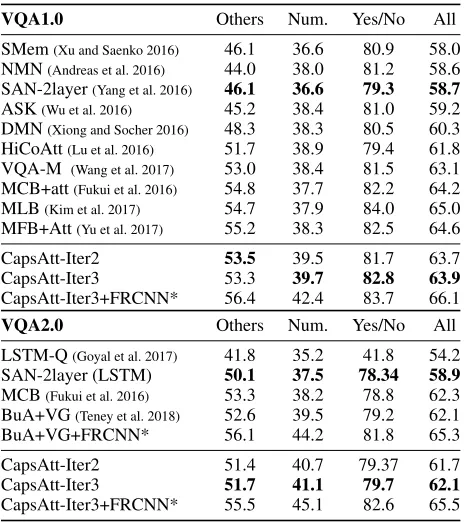
on these two datasets are up to 5.2% and 2.2%, respectively. Under a similar setting, these results are quite significant.
We explain these obvious improvements in two aspects. The first is that the traditional attention method uses a linear layer to predict the importance of each region based on the fused features, and then obtain the attention weights via a Softmax layer. However, in CapsAtt, the importance of each region is directly determined by the coefficient between its feature and the reference vector, rather than by predictions. So when the multi-modal space is well learned, the mea-surement of attention weights will be more accurate by na-ture. The other reason is that CapsAtt only uses one atten-tion layer with only two projecatten-tion matrices for multi-step reasoning. Such a design not only reduces the number of pa-rameters, but also avoids the semantic inconsistency among multi-modal spaces of different layers.
Next, we compare CapsAtt with the state-of-the-art mod-els on VQA1.0 and VQA2.0. As shown in Tab.2, Cap-sAtt achieves state-of-the-art performances with a simple structure and much fewer parameters on both two datasets. For models that use external knowledge or incorporating
advance CV or NLP techniques, e.g., AKS and VQA-M,
1. Question: Is this woman holding a phone?
Image SAN-Att.1 SAN-Att.2
Answer: sandals SAN Predict: No
CapsAtt-Att.1 CapsAtt-Att.2
CapsAtt Predict: Not
3. Question: Are these two people kids?
Image SAN-Att.1 SAN-Att.2
Answer: sandals SAN Predict: No
CapsAtt-Att.1 CapsAtt-Att.2
CapsAtt Predict: No
2. Question: What is the boy doing in the air?
Image SAN-Att.1 SAN-Att.2
Answer: Skateboarding SAN Predict: Snowboarding
CapsAtt-Att.1 CapsAtt-Att.2
CapsAtt Predict: Skateboarding
5 Question: What color is hair of the little girl?
Image SAN-Att.1 SAN-Att.2
Answer:
Blonde SAN Predict: Brown
CapsAtt-Att.1 CapsAtt-Att.2
CapsAtt Predict: Blonde
4. Question: Is the towel reflected in the mirror?
Image SAN-Att.1 SAN-Att.2
Answer: Not SAN Predict: Yes
CapsAtt-Att.1 CapsAtt-Att.2
CapsAtt Predict: Not
6. Question: What logo is on the stand with the man on it?
Image SAN-Att.1 SAN-Att.2
Answer: Nike SAN Predict: Lacoste
CapsAtt-Att.1 CapsAtt-Att.2
CapsAtt Predict: Nike
7. Question: What does the young girl hold
SAN-Att.1 SAN-Att.2 SAN-Att.3 SAN-Att.4 SAN-Att.5
CapsAtt-Att.1 CapsAtt-Att.2 CapsAtt-Att.3 CapsAtt-Att.4 CapsAtt-Att.5
8. Question: What is the color of the motorcycle?
SAN-Att.1 SAN-Att.2 SAN-Att.3 SAN-Att.4 SAN-Att.5
CapsAtt-Att.1 CapsAtt-Att.2 CapsAtt-Att.3CapsAtt-Att.4CapsAtt-Att.5
Figure 4: The visualized attentions of SAN and the proposed CapsAtt. Comprared to SAN, our CapsAtt can locate the potential answer area more quickly (1-3) and precisely (4-6), and avoid the vanishing gradient problem (7-8).
Table 3: Evaluations of Caps-Iter3 with different dimension settings on VQA1.0 test-devset. Trained on the train+val
split with theFRCNNfeatures.a,f andgare dimensions of attention, fully-connected layers and the GRU unit.
Setting Acc. Para.Size Model Size
a= 1024, f= 1024, g= 512 66.10 10.8M 183mb
a= 2048, f= 2048, g= 1024 66.18 25.6M 403mb
a= 1024, f= 2048, g= 512 65.94 18.1M 305mb
a= 512, f= 512, g= 256 65.22 4.2M 113mb
a= 256, f= 512, g= 256 64.28 3.4M 104mb
“M” is the unit of the parameter size which is one million, and “mb” denotes the saved model size which is one mega byte2.
attention methods, but their main advantage is their bilinear-pooling based fusions, which have been shown to effectively capture interactions between two type of features (Gao et al. 2016). Even so, with the same visual input, their advan-tages are still margin. Notably, the parameter size of Cap-sAtt is much smaller than theirs, as shown in Fig.3. Tak-ing the benchmark model MCB for example, the param-eter amount of CapsAtt is only about 15% of its amount. When equipped with the Faster R-CNN features from (An-derson et al. 2018), CapsAtt achieves the best performances on both two datasets. On VQA2.0, the performance and the parameter size of BUA (Teney et al. 2018),i.e., the winner
ofVQA challenge 2017is close to those of CapsAtt.
Com-Table 4: Performances on the test portion of Karpathy et al. (Karpathy and Feifei 2015)’s splits on COCO dataset. V,RandFdenote using features of VGG, ResNet and FR-CNN, respectively.
Method BLEU-1 BLEU-4 METEOR CIDEr
Karpathy et.al. 2015V 62.5 23.0 19.5 66
Xu et.al. 2015V 70.9 24.3 23.9
-Lu et.al. 2017 (Spatial)R 73.4 32.5 25.1 99
Lu et.al. 2017 (Adapt)V 74.2 33.2 26.6 108
Lu et.al. 2018F 75.5 34.7 27.1 107
CapsAtt-Iter2V 71.3 30.5 24.6 94
CapsAtt-Iter3V 71.7 29.4 24.5 95
CapsAtt-Iter2F 75.6 34.0 26.8 108
pared with BUA, CapsAtt merits in requiring no complex pre-processing,e.g., pretraining the classifier, and additional training examples. Overall, with a simple structure and a small parameter size, CapsAtt still achieves advanced per-formances in VQA.
(1) Image
Ground Truth:
a tabby cat is laying on a white keyboard
ShowAttendTell
Generated Caption:
a cat is sitting on a laptop computer
ShowAttendTell
Generated Caption:
a cat is sitting on a
laptop computer
CapsAtt-Iter2
Generated Caption: a cat is laying on a keyboard on a desk
CapsAtt-Iter2
Generated Caption: a cat is laying on a
keyboard on a desk
(2) Image
Ground Truth:
a stop sign with some graffiti on it at night
ShowAttendTell
Generated Caption:
a stop sign with a stop sign on it
ShowAttendTell
Generated Caption:
a stop sign with a stop
sign on it
CapsAtt-Iter2
Generated Caption: a red sign with a stop sign on it
CapsAtt-Iter2
Generated Caption: a red sign with a stop
sign on it
(3) Image
Ground Truth:
a black bear is walking through tall green grass
ShowAttendTell
Generated Caption:
a bear is standing in a field of flowers
ShowAttendTell
Generated Caption:
a bear is standing in a field of flowers
CapsAtt-Iter2
Generated Caption: a black bear is standing in the grass
CapsAtt-Iter2
Generated Caption: a black bear is standing in the grass
(4) Image
Ground Truth:
a man stands with his surfboard at the beach
ShowAttendTell
Generated Caption:
a man standing on a beach holding a surfboard
ShowAttendTell
Generated Caption:
a man standing on a beach
holding a surfboard
CapsAtt-Iter2
Generated Caption: a person on a beach with a surfboard
CapsAtt-Iter2
Generated Caption: a person on a beach
with a surfboard
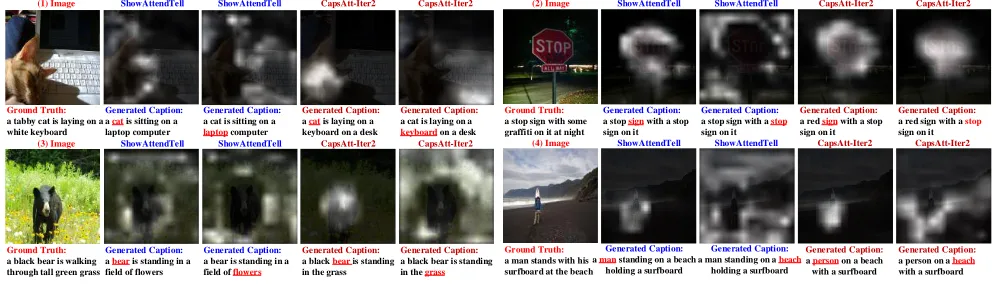
Figure 5: Visualizations of the attention results of CapsAtt andShowAttendTellwhen predicting the underlined words. Com-pared with ShowAttendTell, CapsAtt focus on the described objects more precisely and generates more accurate descriptions.
amount of parameters (3.3 millions), CapsAtt still has a good accuracy, while its model size is only about 100mb. Such a result not only proves the efficiency and robustness of our al-gorithm, but also provides good evidence in applying VQA into resource (memory)-limited scenarios.
Qualitative Analysis
We visualize the attention results of the proposed CapsAtt and the traditional multi-step attention model SAN, which are given in Fig.4. Eg.(1)-(6) shows the comparisons of two-step attentions generated by CapsAtt and SAN. From these examples, we first observe that both two approaches shows a step-by-step reasoning during attentions. A slightly differ-ence is that, when the question is easy or the answer entity in image is certain, CapsAtt can locate the potential answer areas more quickly compared to SAN,e.g., Eg.(1)-Eg.(3). The other observation is that, compared with SAN, Cap-sAtt shows a better ability of modeling the correlation be-tween the question content and visual information. Taking the Eg.(4)-(5) for examples, CapsAtt understands the recog-nition conditions in questions well and finds the correspond-ing visual entities for answers, accurately. In contrast, the fo-cus of SAN is obviously not in line the purpose of the given questions. Eg.(7)-(8) displays the 5-step attentions of Cap-sAtt and SAN. Unexpectedly, the first three steps of atten-tions of SAN are basically inactive. To explain, SAN is built with attention layers and has a structure similar to the for-ward network. When the number of attention layers grows, the gradients become more difficult to be back-propagated. Meanwhile, this does not happen in SAN that uses three or fewer attention layers. This indicates that CapsAtt can help models to be free from the vanishing gradient problem.
Extending CapAtt to Image Captioning
Dataset.COCO-captions (Ren, Kiros, and Zemel 2015) is the largest image captioning dataset at present. It has 82,783, 40,504 and 40,775 images for training, validation and test, respectively. Each image has 5 human annotated captions.
Model Configurations.VGG-16 and ResNet-152 are both used as the visual backbone. We also test the Faster-RCNN features from (Anderson et al. 2018) which is labeled as
“FRCNN”. When using VGG-16, the dimensions of LSTM and CapsAtt is set to 512. For ResNet and FRCNN features, we set the dimensions of LSTM and CapsAtt to both 1,024. During training, the learning rate is 4e-4 for the language model and 1e-4 for the visual backbones. The batch size is 80 while the max number of training epoch is 40. The op-timizer is Adam, while gradient clip is set to 5.0. For CNN backbones, their parameters are fixed in the first 20 epochs, and after that they will be trained together with the language model. Early stop is also applied. We test the model with beam sizes of 1,2,3 and 7, and chose the best results.
Analysis.We further evaluate the proposed CapsAtt on the COCO-Caption dataset. The results are shown in Tab.4. We first observe that CapsAtt surpasses the classic at-tention model (Xu et al. 2015) that uses one atat-tention layer, which confirms the generalization of our algorithms. When equipped with the FRCNN features, CapsAtt is able to achieve superior performances than the most recent works that have a similar structure. Fig.5 shows the visu-alized attention results of CapsAtt and the classic atten-tion model (Xu et al. 2015) in IC, denoted as ShowAtt-Tell. As can be seen from these visualizations, compared with ShowAttTell, CapsAtt can locate the corresponding vi-sual entity more accurately when predicting the next word. Meanwhile, the qualities of generated by CapsAtt is better than those of ShowAttTell. Conclusively, these experimen-tal results confirm the generalization fo CapsAtt.
Conclusion
com-pare CapsAtt with the classic multi-step attention model as well as a set of the state-of-the-arts. Experimental results not only shows the obvious improvements of CapsAtt over the traditional attention methods, but also proves that CapsAtt can achieve the most advanced performances with a simple network structure and a small number of parameters. To ex-amine its generalization ability, we apply CapsAtt to image captioning and also obtain competitive performances.
Acknowledgments.
This work is supported by the National Key R&D Program (No.2017YFC0113000, and No.2016YFB1001503), Nature Science Foundation of China (No.U1705262, No.61772443, and No.61572410), Post Doctoral Innovative Talent Support Program under Grant BX201600094, China Post-Doctoral Science Foundation under Grant 2017M612134, Scien-tific Research Project of National Language Committee of China (Grant No. YB135-49), and Nature Science Founda-tion of Fujian Province, China (No. 2017J01125 and No. 2018J01106).
References
Anderson, P.; He, X.; Buehler, C.; Teney, D.; Johnson, M.; Gould, S.; and Zhang, L. 2018. Bottom-up and top-down attention for
im-age captioning and visual question answering. InCVPR, volume 3,
6.
Andreas, J.; Rohrbach, M.; Darrell, T.; and Klein, D. 2016. Neural
module networks.computer vision and pattern recognition39–48.
Antol, S.; Agrawal, A.; Lu, J.; Mitchell, M.; Batra, D.; Lawrence Zitnick, C.; and Parikh, D. 2015. Vqa: Visual question
answering. InProceedings of the IEEE International Conference
on Computer Vision, 2425–2433.
Ba, J.; Mnih, V.; and Kavukcuoglu, K. 2014. Multiple object
recog-nition with visual attention.arXiv preprint arXiv:1412.7755.
Bahdanau, D.; Cho, K.; and Bengio, Y. 2014. Neural machine
translation by jointly learning to align and translate.arXiv preprint
arXiv:1409.0473.
Chen, X.; Fang, H.; Lin, T.-Y.; Vedantam, R.; Gupta, S.; Doll´ar, P.; and Zitnick, C. L. 2015. Microsoft coco captions: Data collection
and evaluation server.arXiv preprint arXiv:1504.00325.
Fukui, A.; Park, D. H.; Yang, D.; Rohrbach, A.; Darrell, T.; and Rohrbach, M. 2016. Multimodal compact bilinear pooling for
vi-sual question answering and vivi-sual grounding. empirical methods
in natural language processing457–468.
Gao, Y.; Beijbom, O.; Zhang, N.; and Darrell, T. 2016. Compact
bilinear pooling. InProceedings of the IEEE Conference on
Com-puter Vision and Pattern Recognition, 317–326.
Goyal, Y.; Khot, T.; Summers-Stay, D.; Batra, D.; and Parikh, D. 2017. Making the v in vqa matter: Elevating the role of image
understanding in visual question answering. InCVPR, volume 1,
3.
He, K.; Zhang, X.; Ren, S.; and Sun, J. 2016. Deep residual
learn-ing for image recognition. InProceedings of the IEEE Conference
on Computer Vision and Pattern Recognition, 770–778.
Karpathy, A., and Feifei, L. 2015. Deep visual-semantic
align-ments for generating image descriptions.computer vision and
pat-tern recognition3128–3137.
Kim, J.; On, K. W.; Lim, W.; Kim, J.; Ha, J.; and Zhang, B. 2017.
Hadamard product for low-rank bilinear pooling. international
conference on learning representations.
Lu, J.; Yang, J.; Batra, D.; and Parikh, D. 2016. Hierarchical
question-image co-attention for visual question answering. In
Ad-vances In Neural Information Processing Systems, 289–297. Lu, J.; Xiong, C.; Parikh, D.; and Socher, R. 2017. Knowing when to look: Adaptive attention via a visual sentinel for image
caption-ing.computer vision and pattern recognition3242–3250.
Mnih, V.; Heess, N.; Graves, A.; et al. 2014. Recurrent models
of visual attention. InAdvances in neural information processing
systems, 2204–2212.
Ren, S.; He, K.; Girshick, R. B.; and Sun, J. 2017. Faster r-cnn: Towards real-time object detection with region proposal networks. IEEE Transactions on Pattern Analysis and Machine Intelligence 39(6):1137–1149.
Ren, M.; Kiros, R.; and Zemel, R. 2015. Exploring models and data
for image question answering. InAdvances in Neural Information
Processing Systems, 2953–2961.
Sabour, S.; Frosst, N.; and Hinton, G. E. 2017. Dynamic routing
between capsules. InAdvances in Neural Information Processing
Systems, 3859–3869.
Simonyan, K., and Zisserman, A. 2014. Very deep
convolu-tional networks for large-scale image recognition. arXiv preprint
arXiv:1409.1556.
Song, J.; Guo, Z.; Gao, L.; Liu, W.; Zhang, D.; and Shen, H. T. 2017. Hierarchical lstm with adjusted temporal attention for video
captioning.arXiv preprint arXiv:1706.01231.
Tang, Y.; Srivastava, N.; and Salakhutdinov, R. R. 2014. Learning
generative models with visual attention. In Advances in Neural
Information Processing Systems, 1808–1816.
Teney, D.; Anderson, P.; He, X.; and Den Hengel, A. V. 2018. Tips and tricks for visual question answering: Learnings from the 2017
challenge.computer vision and pattern recognition.
Vaswani, A.; Shazeer, N.; Parmar, N.; Uszkoreit, J.; Jones, L.; Gomez, A. N.; Kaiser, L.; and Polosukhin, I. 2017. Attention is
all you need.arXiv preprint arXiv:1706.03762.
Wang, P.; Wu, Q.; Shen, C.; and Den Hengel, A. V. 2017. The vqa-machine: Learning how to use existing vision algorithms to
answer new questions. computer vision and pattern recognition
3909–3918.
Wu, Q.; Wang, P.; Shen, C.; Dick, A.; and van den Hengel, A. 2016. Ask me anything: Free-form visual question answering based on
knowledge from external sources. InProceedings of the IEEE
Con-ference on Computer Vision and Pattern Recognition, 4622–4630. Xiong, Caiming, M. S., and Socher, R. 2016. Dynamic memory
networks for visual and textual question answering.arXiv1603.
Xu, H., and Saenko, K. 2016. Ask, attend and answer: Exploring
question-guided spatial attention for visual question answering.
eu-ropean conference on computer vision451–466.
Xu, K.; Ba, J.; Kiros, R.; Cho, K.; Courville, A. C.; Salakhutdinov, R.; Zemel, R. S.; and Bengio, Y. 2015. Show, attend and tell:
Neural image caption generation with visual attention. InICML,
volume 14, 77–81.
Yang, Z.; He, X.; Gao, J.; Deng, L.; and Smola, A. 2016. Stacked
attention networks for image question answering. InProceedings
of the IEEE Conference on Computer Vision and Pattern Recogni-tion, 21–29.
Yu, Z.; Yu, J.; Fan, J.; and Tao, D. 2017. Multi-modal factorized bilinear pooling with co-attention learning for visual question