International Journal of Advanced Research in Education & Technology (IJARET)
192
Vol. 3, Issue 3 (July - Sept. 2016) ISSN : 2394-2975 (Online) ISSN : 2394-6814 (Print)
www.ijaret.com © IJARET All Rights Reserved
Performance Evaluation of Different Equalization Techniques
for 2x2 MIMO Wireless Communication Systems
I
Chandani Dewangan,
IIPankaj M Gulhane
IResearch Scholar, Electronics& Telecommunication Department, DIMAT, Raipur(C.G.) IIAsst. Prof., Electronics & TeleCommunication Department, DIMAT, Raipur (C.G.)
I. Introduction
Introduction of the internet and mobile technology in the world has made it possible to share and exchange the text, voice, video and other vital information among each other at very fast rate. Emergence of wireless communication and 3G/4G mobile technology has enabled us to transfer the data at very high speed while keeping the quality of the data intact. Keeping the quality of the data high when data rate is high, is very difficult and challenging task. Using orthogonal frequency division multiplexing can minimize this problem to some extent. Unlike the wired media, wireless media suffers the phenomenon called multi path phenomenon which causes the inter symbol interference (ISI). Due to this bit error rate also increases[1]. Reaching the signal from different path to the receiver antenna is called the multipath phenomenon.
Generally, during the designing of the communication system, AWGN channel and non- dispersive channels effect are ignored i.e. it is assumed that AWGN and non dispersive channel passes all frequency which is not possible in practical case. For using the frequency spectrum wosely, generally, transmitted signal is filtered which limits the bandwidth. Apart from this most of the channels are dispersive in nature and behave like band pass filter and hence responds differently to different frequency which also degrades the performance of the communication. It is therefore very essential to make some changes in the non-dispersive channel model so that it represent the practical channel accurately. This modification is given by
r(t)= u(t) ⊗hc (t) +n(t)
here u(t) is the transmitted signal, hc (t) is the response of the channel, and n(t) is AWGN(additive white Gaussian noise) whose PSD (Power spectral density) is given by N0/2.
From the above discussion it is clear that linear filter can be used to model the dispersive characteristics of the channel.
It is found that impulse response of the dispersive or band limited channel reseble the impulse response of the ideal low pass filter. This causes the transmitted signal to be seared in time which spread the symbol length which overlapped the adjacent symbol. This is very undesirable and known as the inter symbol interference (ISI). This effect increases the bit error rate(BER) and therefore need to be corrected efficiently.
There are two solution of this problem, first approach is to design the band limited pulses also known as the nyquist pulses for transmission, second approach rely on suppressing the ISI
effect by filtering method.
Mitigating the effect of the inter symbol interference (ISI) by applying appropriate filtering operation is known as the equalization technique[2].
In this paper, an attempt has been made to evaluate the performance of various equalization techniques like zero forcing, zero forcing with successive interference cancelling(SIC), MMSE, ZF-SIC with optimal ordering, Maximum likelihood(ML) equalizer, MMSE-SIC with optimal ordering 2x2 MIMO system. The performance of the above mentioned equalization techniques has been conducted under Rayleigh fading and noisy channel. II. Channel Model
In this paper, AWGN(Additive white Gaussian noise) noise channel model is taken for producing the white Gaussian noise i.e noise which follow the Gaussian distribution and has constant spectral density.
Phenomenon like fading dispersion, frequency selectivity, and intereference is not the characteristics of this channel model. This channel model is designed to analyze the effect of Gaussian noise produced by the various natural resources [3] on the wireless communication. This model is designed mathematically. Introduction of distortion in a carrier modulated signal transmitted wirelessly is called “fading” phenomenon. Multipath propagation in wireless media is the main reason behind the fading phenomenon. Due to multipath propagation, transmitted signal reach the receiver by two or more path. These signal from the different path creates constructive and destructive interference in the received signal which causes the phase shifting of the signal. Rayleigh fading is one such type of fading phenomenon which occurs due to the multipath propagation. This type of fading can be modeled with the help of statistical characteristics. This model can be used for analyzing the propagation environment effect on the signal[3]. A. Channel Model
In this work, channel model with multipath phenomenon is simulated for studying the effect of multipath on the signal. Abstract
Inter symbol interference in wireless communication is the phenomenon which occur when the high bit data rate transmission causes the channel response to extend more than one symbol period. Inter-symbol interference in the wireless channel is very undesirable
which causes the recovery of the signal difficult. Equalization in the techniques which is used to fight and overcome the ISI(inter symbol interference ) problem. This paper present the performance analysis of different equalization techniques for 2x2 MIMO configuration.
Keywords
International Journal of Advanced Research in Education & Technology (IJARET)
193 Vol. 3, Issue 3 (July - Sept. 2016) ISSN : 2394-2975 (Online)
ISSN : 2394-6814 (Print)
www.ijaret.com © IJARET All Rights Reserved
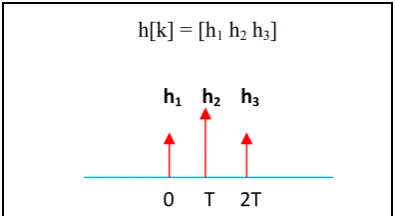
Fig. 1: Impulse Response of simulated multipath Channel In this work, 3-tap multipath channel model is designed in which impulse response with spacing T is given in figure 1.1.
Other than suffering from multipath effect, the transmitted signal also suffered AWGN(additive white Gaussian noise) which is represented by the gaussian function as shown below
In this formula µ is defined as the mean of the distribution while the σ is variance.
If the known channel response is h(k) and noise is n, the signal received at the receiver side of the communication systemis given by
y(k)= x(k)⊗h(k)+n
here the ⊗ sign is used as the convolution operation[5]. III. Equalizer [6]
Equalization is the technique which is used to mitigate the effect of the ISI(inter symbol interference) by minimizing the error probability occur in the communication system without ISI suppression method.
Since, suppression of ISI causes the noise power to enhanced therefore it is essential to create optimum balance between enhancement of noise power and suppression of ISI[4]
A. Adaptive equalization [7, 8]
An adaptive equalizer is a kind of digital filter or equalization filter which is designed to automatically adapts itself to the time varying characteristics of communication channel. This technique is most often used to mitigate the distortion caused by multipath effect. B. Zero Forcing Equalizer [9, 10]
Proposed by Robert lucky, zero forcing method of equalization is a linear equalization method in which restoration of the transmitted signal is carried by inverting the frequency response of the channel. The name zero forcing comes from the fact that it is able to decrease the ISI level to zero value under the noise free environment. This technique of equalization is useful for the channel where the ISI is more significant than the noise. let for a 2x2 MIMO channel, If transmitted symbol is given by x1 and x2, h11 is the channel response of the channel from first transmitter to first receiver,h12 is the channel response from second transmitter to first receiver, h21 represent the channel response from first transmitter to second receiver and h22 is the channel response from second transmitter to second receiver and n1,n2 are the noise on first and second receiver then the received symbol on the first receiver antenna is given by
From this matrix it is clear that the off diagonal terms of this matrix are non zero which signifies that zero forcing equalizer cancel out the interference signal. It is reasonably simple and easy to implement technique of equalization but its main drawback is that it always amplifies the noise and hence gives noisy output. C. MMSE Equalizer[11]
This type of equalizer applies the squared error for performance measurement[11]. The receiver filter is designed and develop to satisfy the minimum mean square error criterion. Main objective of this technique is to minimize the error produced between target signal and output obtained by filter. The computation procedure for this method is as