The Thirty-Third AAAI Conference on Artificial Intelligence (AAAI-19)
Depthwise Convolution Is All You Need for Learning Multiple Visual Domains
Yunhui Guo,
∗1Yandong Li,
∗2Liqiang Wang,
2Tajana Rosing
11University of California, San Diego, CA,2University of Central Florida, Orlando, FL
[email protected], [email protected], [email protected], [email protected]
Abstract
There is a growing interest in designing models that can deal with images from different visual domains. If there exists a universal structure in different visual domains that can be captured via a common parameterization, then we can use a single model for all domains rather than one model per do-main. A model aware of the relationships between different domains can also be trained to work on new domains with less resources. However, to identify the reusable structure in a model is not easy. In this paper, we propose a multi-domain learning architecture based on depthwise separable convolu-tion. The proposed approach is based on the assumption that images from different domains share cross-channel correla-tions but have domain-specific spatial correlacorrela-tions. The pro-posed model is compact and has minimal overhead when be-ing applied to new domains. Additionally, we introduce a gat-ing mechanism to promote soft shargat-ing between different do-mains. We evaluate our approach on Visual Decathlon Chal-lenge, a benchmark for testing the ability of multi-domain models. The experiments show that our approach can achieve the highest score while only requiring 50% of the parameters compared with the state-of-the-art approaches.
Introduction
Deep convolutional neural networks (CNN) (Krizhevsky, Sutskever, and Hinton 2012; He et al. 2016) have been the state-of-the-art methods for tackling vision tasks. The exist-ing CNN models are powerful but mostly designed for deal-ing with images from a specific visual domain (e.g.digits, animals, or flowers) (Gan et al. 2017; Li et al. 2018). This limits the applications of current approaches, as each time the network needs to be retrained when new tasks arrive. In sharp contrast to such CNN models, humans can easily generalize to new domains based on the acquired knowl-edge (Cichon and Gan 2015; Kirkpatrick et al. 2017). Pre-viou (Bilen and Vedaldi 2017; Rebuffi, Bilen, and Vedaldi 2018) show that images from different domains may have a universal structure that can be captured via a common pa-rameterization. A natural question then arises:
Copyright c2019, Association for the Advancement of Artificial Intelligence (www.aaai.org). All rights reserved.
∗
Equal contribution. Work done during internship at IBM Re-search mentored by Rogerio Feris.‡The authors’ work was sup-ported in part by NSF-1741431.
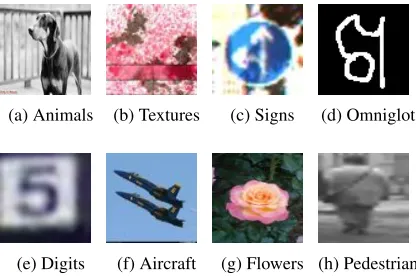
(a) Animals (b) Textures (c) Signs (d) Omniglot
(e) Digits (f) Aircraft (g) Flowers (h) Pedestrian
Figure 1: Image examples from different domains.
Can we build a single neural network that can deal with images across different domains?
The question motivates the field called multi-domain learning, where we target designing a common feature ex-tractor that can capture the universal structure in different domains and reducing the overhead of adding new tasks to the model. With multi-domain learning, the visual models are vested with the ability to work well on different domains with minimal or no domain-specific parameters.
There are two challenges in multi-domain learning. The first one is to identify a common structure among differ-ent domains. As shown in Fig 1, images from differdiffer-ent domains are visually different, it is challenging to design a single feature extractor for all domains. Another chal-lenge is to add new tasks to the model without introduc-ing additional parameters. Existintroduc-ing neural network based multi-domain learning approaches (Bilen and Vedaldi 2017; Rebuffi, Bilen, and Vedaldi 2017; 2018) mostly focus on the architecture design while ignoring the structural regularity hidden in different domains which leads to sub-optimal so-lutions.
best of our knowledge, this is the first work that explores depthwise separable convolution for multi-domain learning. The proposed multi-domain learning model is compact and easily extensible. To promote knowledge transfer between different domains we further introduce a softmax gating mechanism. We evaluate our method on Visual Decathlon Challenge (Rebuffi, Bilen, and Vedaldi 2017), a benchmark for testing multi-domain learning models. Our method can beat the state-of-the-art models with only 50% of the parameters.
Summary and contributions: The contributions of this pa-per are summarized below:
• We propose a novel multi-domain learning approach by exploiting the structure regularity hidden in different do-mains. The proposed approach greatly reduces the num-ber of parameters and can be easily adapted to work on new domains.
• The proposed approach is based on the assumption that images in different domains share cross-channel corre-lations while having domain-specific spatial correcorre-lations. We validate the assumption by analyzing the visual con-cepts captured by depthwise separable convolution using
network dissection(Bau et al. 2017).
• Our approach outperforms the state-of-the-art results on Visual Decathlon Challenge with only 50% of the param-eters.
Related Work
Multi-Domain Learning Multi-domain learning aims at creating a single neural network to perform image classifica-tion tasks in a variety of domains. (Bilen and Vedaldi 2017) showed that a single neural network can learn simultane-ously several different visual domains by using an instance normalization layer. (Rebuffi, Bilen, and Vedaldi 2017; 2018) proposed universal parametric families of neural networks that contain specialized problem-specific mod-els which differ only by a small number of parameters. (Rosenfeld and Tsotsos 2018) proposed a method called Deep Adaptation Networks (DAN) that constrains newly learned filters for new domains to be linear combinations of existing ones. Multi-domain learning can promote the application of deep learning based vision models since it reduces engineers’ effort to train new models for new images.
Multi-Task Learning The goal of multi-task learning (Doersch and Zisserman 2017; Kokkinos 2017) is to extract different features from a single input to simultaneously perform classification, object recog-nition, edge detection, etc. Various applications can be ben-efited from a multi-task learning approach since the training signals can be reused among related tasks (Caruana 1997; Zamir et al. 2018).
Transfer Learning The goal of transfer learning is to improve the performance of a model on a target domain by leveraging the information from a related source
domain (Pan, Yang, and others 2010; Bengio 2012; Hu, Lu, and Tan 2015). Transfer learning has wide ap-plications in a variety of areas, such as computer vision (Raina et al. 2007), sentiment analysis (Glorot, Bordes, and Bengio 2011) and recommender systems (Pan et al. 2010; Guo, Wang, and Xu 2015). Different from transfer learning, multi-domain learning aims at maximizing the performance of the model across multiple domains rather than focusing on a specific target domain.
Preliminary
Problem Definition and NotationsConsider a set of image domains {D1, D2, ..., DT}, each
domain Di consists of a triplet {Xi, Yi, Pi}. Xi ∈ RCi×Hi×Wiis the input image space andY
i∈ {1,2, ..., Li}
is the output label space. Letx∈ Xi andy ∈ Yi be a pair
of objects. The joint probabilistic distributionPi(x, y)
de-scribes the frequency of encountering(x, y)in domainDi.
For a neural networkgi(x):RCi×Hi×Wi → {1,2, ..., L i}
and a given loss functionl, the risk of gi(x)can be
mea-sured as below,
Ri=E[l(y, gi(x)] =
Z
l(y, gi(x))dPi(x, y) (1)
In multi-domain learning, our goal is to design neural net-work architectures that can net-work well on all the domains si-multaneously. LetE(Di)be the domain-specific parameters
for domainDi andC be the sharable portion of the neural
network. Forx∈Xi, the output of the network can be
cal-culated as,
ˆ
y= (E(Di)◦ C)(x) (2)
The average risk of the neural network across all the do-mains can be expressed as,
R= 1
T T
X
i=1
E[l(y,(E(Di)◦ C)(x)] (3)
The goals of multi-domain learning include: (1) minimize the average risk across different domains; (2) maximize the size of sharing partC; (3) minimize the size of the domain-specific partE(Di).
Depthwise Separable Convolution
Our proposed approach is based on depthwise separable convolution that factorizes a standard3×3convolution into a3×3depthwise convolution and a1×1 pointwise con-volution. While standard convolution performs the channel-wise and spatial-channel-wise computation in one step, depthchannel-wise separable convolution splits the computation into two steps: depthwise convolution applies a single convolutional filter per each input channel and pointwise convolution is used to create a linear combination of the output of the depthwise convolution. The comparison of standard convolution and depthwise separable convolution is shown in Fig. 3.
Figure 2: ResNet-26 with depthwise separable convolution.
Depthwise Pointwise
Figure 3: Standard convolution and depthwise separable convolution.
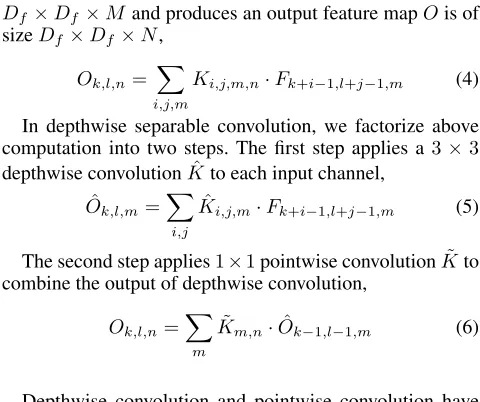
Df ×Df×M and produces an output feature mapOis of
sizeDf×Df×N,
Ok,l,n=
X
i,j,m
Ki,j,m,n·Fk+i−1,l+j−1,m (4)
In depthwise separable convolution, we factorize above computation into two steps. The first step applies a3×3
depthwise convolutionKˆ to each input channel,
ˆ Ok,l,m=
X
i,j
ˆ
Ki,j,m·Fk+i−1,l+j−1,m (5)
The second step applies1×1pointwise convolutionK˜ to combine the output of depthwise convolution,
Ok,l,n=
X
m
˜
Km,n·Oˆk−1,l−1,m (6)
Depthwise convolution and pointwise convolution have different roles in generating new features: the former is used for capturing spatial correlations while the latter is used for capturing channel-wise correlations.
Most the previous works (Chollet 2017; Howard et al. 2017; Sandler et al. 2018) focus on the computational as-pect of depthwise separable convolution since it requires less parameters than standard convolution and is more com-putationally effective. In (Chollet 2017), the authors pro-posed the “Inception hypothesis” stating that mapping cross-channel correlations and spatial correlations separately is more efficient than mapping them at once. In this paper, we provide further evidence to support this hypothesis in the setting of multi-domain learning. We validate the as-sumption that images from different domains share cross-channel correlations but have domain-specific spatial cor-relations. Based on this idea, we develop a highly efficient
multi-domain learning method. We further analyze the vi-sual concepts captured by depthwise convolution and point-wise convolution based on network dissection (Bau et al. 2017). The visualization results show that while having less parameters depthwise convolution captures more concepts than pointwise convolution.
Proposed Approach
Network Architecture
For the experiments, we use the same ResNet-26 architec-ture as in (Rebuffi, Bilen, and Vedaldi 2018). This allows us to fairly compare the performance of the proposed ap-proach with previous ones. This original architecture has three macro residual blocks, each outputting 64, 128, 256 feature channels. Each macro block consists of 4 residual blocks. Each residual block has two convolutional layers consisting of 3×3 convolutional filters. The network ends with a global average pooling layer and a softmax layer for classification.
Different from (Rebuffi, Bilen, and Vedaldi 2018), we replace each standard convolution in the ResNet-26 with depthwise separable convolution and increase the channel size. The modified network architecture is shown in Fig. 2. This choice leads to a more compact model while still maintaining enough network capacity. The original ResNet-26 has over 6M parameters while our modified architecture has only half the amount of parameters. In the experiments we found that the reduction of parameters does no harm to the performance of the model. The use of depthwise sepa-rable convolution allows us to model cross-channel corre-lations and spatial correcorre-lations separately. The idea behind our multi-domain learning method is to leverage the differ-ent roles of cross-channel correlations and spatial correla-tions in generating image features by sharing the pointwise convolution across different domains.
Learning Multiple Domains
Figure 4: The proposed soft-sharing approach for sharing spatial correlations.
images from different domains are different, we also allow domaspecific batch normalization parameters. During in-ference, we stack the trained depthwise convolutional filters for all domains as a 4D tensor and the output of domaind
can be calculated as,
ˆ
Ok,l,m,d=
X
i,j
ˆ
Ki,j,m,d·Fk+i−1,l+j−1,m,d (7)
The adoption of depthwise separable convolution pro-vides a natural separation for modeling cross-channel correlations and spatial correlations. Experimental evidence (Chollet 2017) suggests the decouple of cross-channel correlations and spatial correlations would result in more useful features. We take one step further to develop a multi-domain domain method based on the assumption that different domains share cross-channel correlations but have domain-specific spatial correlations. Our method is based on two observations: model efficiency and interpretability of hidden units in a deep neural network.
Model efficiencyTable 1 shows the comparison of standard
3 ×3 convolution, 3 ×3 depthwise convolution (Dwise) and1×1pointwise convolution (Pwise). Clearly, standard convolution has far more parameters than both depthwise convolution (×c2) and pointwise convolution (×9).
Typ-ically, pointwise convolution has more parameters than depthwise convolution. In the architecture shown in Fig 2, pointwise convolution accounts for 80% of the parameters in the convolutional layers. The choice of sharing pointwise convolution and adding depthwise convolution induces minimal additional parameters when dealing with new domains. In the experiments we found that only by adding depthwise convolution leads to a network with limited number of free parameters which cannot handle some large datasets. To increase the network capacity, we allow the last convolutional layer to be specific for each domain. Based on this modification, each new domain averagely introduces 0.3M additional parameters which is 10% of the modified ResNet-26.
Interpretability While depthwise convolution typical has less paramaters, by using the technique ofnetwork
dissec-Input Operator Output Parameters c1×h×w 3×3Conv2d c2×h×w 3×3×c1×c2
c1×h×w 3×3Dwise c1×h×w 3×3×c1
c1×h×w 1×1Pwise c2×h×w 1×1×c1×c2
Table 1: Comparison of standard3×3convolution,3×3
depthwise convolution (Dwise) and1×1pointwise convo-lution (Pwise).
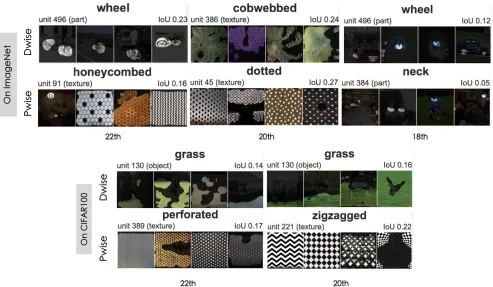
tion(Bau et al. 2017), we found it captures more visual con-cepts than pointwise convolution. Meanwhile, the results in the same convolutional layer show that depthwise convolu-tion captures higher level concepts such as wheel and grass while pointwise convolution can only detect dots or honey-combed. This observation suggests that pointwise convolu-tion can be generally shared between different image do-mains since it is typically used for dealing with lower level features.
Soft Sharing of Trained Depthwise Filters
In addition to the proposed sharing pointwise filters (cross-channel correlations) for multi-domain learning, we also in-vestigate whether the depthwise filters (spatial correlations) learned from other domains can be transferred to the tar-get domain. We introduce a novel soft sharing approach in the multi-domain setting to allow the sharing of depthwise convolution. We first train domain-specific depthwise filters. Then we stack all the domain-specific filters as in Fig 4. During soft-sharing, we train each domain one by one. All the domain-specific depthwise filters and pointwise filters (trained on ImageNet) are fixed during soft sharing. We only train the feedforward network that controls the softmax gate. For a specific target domain, the softmax gate allows a soft sharing of trained depthwise filters with other domains. It can be denoted as follows: for each domain Dj, consider
a network withLdepthwise separable convolutional layers
S1, ..., SL, the input to the pointwise convolution in layerl
ˆ Ol=
T
X
i=1
sliOˆil, with
T
X
i=1
sli= 1 (8)
whereOˆl
i is the output of the depthwise convolution of
do-mainiin the layerlif we use images in domainDj as
in-put.sl
i denotes a learned scale for the depthwise
convolu-tion of domainiin the layerl. The scaless1, ..., sT are the
output of a softmax gate. The input to the softmax gate is the convolutional feature mapXl−1∈RC×H×W produced
by the previous layer. Similar to (Veit and Belongie 2017), we only consider global channel-wise features. In particular, we perform global average pooling to compute channel-wise means,
Mc =
1
H×W
H
X
i=1
W
X
j=1
Xc,i,j (9)
The output is a 3-dimensional tensor of sizeC×1×1. To achieve a lightweight design, we adopt a simple feedfor-ward network consisting of two linear layers with ReLU ac-tivations to apply a nonlinear transformation on the channel-wise means and feed the output to the softmax gate. All the convolutional filters are freezed during soft sharing. The scaless1, ..., sT and the parameters of the feedforward
net-works are learnt jointly via backpropagation.
It is widely believed that early layers in a convolutional neural network are used for detecting lower level features such as textures while later layers are used for detecting parts or objects. Based on this observation, we partition the net-work into three regions (early, middle, late) as shown in Fig-ure 2 and consider different placement of the softmax gate which allows us to compare a variety of sharing strategies.
Experiment
Datasets and evaluation metrics We evaluate our ap-proach on Visual Domain Decathlon Challenge (Rebuffi, Bilen, and Vedaldi 2017). It is a challenge to test the ability of visual recognition algorithms to cope with images from different visual domains. There are a total of 10 datasets: (1) ImageNet(2)CIFAR-100(3)Aircraft(4)Daimler pedes-trian classification(5)Describable textures(6) German traffic signs (7) Omniglot (8) SVHN (9) UCF101 Dy-namic Images (10)VGG-Flowers. The detailed statistics of the datasets can be found at http://www.robots.ox.ac.uk/
∼vgg/decathlon/.
The performance is measured in terms of a single scalar score S = P10
i=1αimax{0, Eimax −Ei}γi,where Ei =
1
Dtesti
P
(x,y)∈Ditest1{y 6= (E(Di)◦ C)(x)}.Eiis the
aver-age test error of domainDi.Eimaxis the error of a
reason-able baseline algorithm. The exponentγiis set to be 2 for all
domains. The coefficientαi is1000(Eimax)
−γi then a
per-fect classifier receives 1000. The maximum score achieved across 10 domains is 10000.
Baselines We consider the following baselines in the ex-periments,
(a) Individual Network: The simplest baseline we consider is Individual Network. We finetune the pretrained modi-fied ResNet-26 on each domain which leads to 10 mod-els altogether. This approach results in the largest model size since there is no sharing between different domains.
(b) Classifier Only: We freeze the feature extractor part of the pretrained modified ResNet-26 on ImageNet and train domain-specific classifier layer for each domain.
(c) Depthwise Sharing: Rather than sharing pointwise con-volution, we consider an alternative approach of multi-domain extension of depthwise separable convolution which shares the depthwise convolution between differ-ent domains.
(d) Residual Adapters: Residual Adapters (Rebuffi, Bilen, and Vedaldi 2017; 2018) are the state-of-the-art ap-proaches for multi-domain learning which include Serial Residual Adapter (Rebuffi, Bilen, and Vedaldi 2017) and Parallel Residual Adapter (Rebuffi, Bilen, and Vedaldi 2018).
(e) Deep Adaptation Networks (DAN): In (Rosenfeld and Tsotsos 2018) the authors propose Deep Adaptation Networks (DAN) that constrains newly learned filters for new domains to be linear combinations of existing ones viacontroller modules.
(f) PiggyBack: In (Mallya and Lazebnik 2018) the authors present PiggyBack for adding multiple tasks to a single network by learning domain-specific binary masks. The main idea is derived from network quantization (Cour-bariaux et al. 2016; Guo 2018) and pruning.
Implementation details All networks were implemented using Pytorch and trained on 2 NVIDIA V100 GPUs. For the base network trained on ImageNet we use SGD with mo-mentum as the optimizer. We set the momo-mentum rate to be 0.9, the initial learning rate to be 0.1 and use a batch size of 256. We train the network with a total of 120 epochs and the learning rate decays twice at 80th and 100th epoch with a factor of 10. To prevent overfitting, we use a weight decay (L2 regularization) rate of 0.0001.
For the multi-domain extension of depthwise separable convolution, we keep the same optimization settings as train-ing the base network. We train the network with a total of 100 epochs and the learning rate decays twice at 60th and 80th epoch by a factor of 10. We apply weight decay (L2 regularization) to prevent overfitting. Since the size of the datasets are highly unbalanced, we use different weight de-cay parameters for different domains. Similar to (Rebuffi, Bilen, and Vedaldi 2018), higher weight decay parameters are used for smaller datasets. In particular, 0.002 for DTD, 0.0005 for Aircraft, CIFAR100, Daimler pedestrain, Om-niglot and UCF101, and 0.0003 for GTSTB, SVHN and VGG-Flowers.
Model #par ImNet Airc. C100 DPed DTD GTSR Flwr OGlt SVHN UCF mean S
# images 1.3m 7k 50k 30k 4k 40k 2k 26k 70k 9k
Serial Res. Adapt. 2× 59.67 61.87 81.20 93.88 57.13 97.57 81.67 89.62 96.13 50.12 76.89 2621 Parallel Res. Adapt. 2× 60.32 64.21 81.91 94.73 58.83 99.38 84.68 89.21 96.54 50.94 78.07 3412 DAN 2.17× 57.74 64.12 80.07 91.30 56.64 98.46 86.05 89.67 96.77 49.38 77.01 2851 Piggyback 1.28× 57.69 65.29 79.87 96.99 57.45 97.27 79.09 87.63 97.24 47.48 76.60 2838 Individual Network 5× 63.99 65.71 78.26 88.29 52.19 98.76 83.17 90.04 96.84 48.35 76.56 2756 Classifier Only 0.6× 63.99 51.04 75.32 94.49 54.21 98.48 84.47 86.66 95.14 43.75 74.76 2446 Depthwise Sharing 4× 63.99 67.42 74.46 95.60 54.85 98.52 87.34 89.88 96.62 50.39 77.91 3234 Proposed Approach 1× 63.99 61.06 81.20 97.00 55.48 99.27 85.67 89.12 96.16 49.33 77.82 3507
Table 2: Top-1 classification accuracy and the Visual Decathlon Challenge score (S) of the proposed approach and baselines. #par is the number of parameters w.r.t. the proposed approach.
Model ImNet Airc. C100 DPed DTD GTSR Flwr OGlt SVHN UCF mean S # images 1.3m 7k 50k 30k 4k 40k 2k 26k 70k 9k
early 63.99 58.69 81.01 95.44 55.75 98.75 84.90 88.80 96.18 48.86 77.23 3102 middle 63.99 59.11 80.93 95.33 54.74 98.71 85.42 88.93 96.09 48.91 77.21 3086 late 63.99 58.81 80.93 96.63 54.74 98.91 84.79 89.35 96.30 49.01 77.88 3303
Table 3: Top-1 classification accuracy and the Visual Decathlon Challenge score (S) of different soft sharing strategies.
Results and Analysis
Quantitative Results
The results of the proposed approach and the baselines on Visual Decathlon Challenge are shown in Table 2. Our ap-proach achieves the highest score among all the methods while requiring the least amount of parameters. In partic-ular, the proposed approach improves the current state-of-the-art approaches by 100 points with only 50% of the pa-rameters. The ResNet-26 with depthwise separable convo-lution surpasses the performance of the original ResNet-26 by a large margin on ImageNet (63.99 vs 60.32). On other smaller datasets, our approach still achieves better or com-parable performance to the baselines. The improvement can be attributed to the sharing of pointwise convolution that has a regularization effect and allows the training signals in Im-ageNet to be reused when training new domains.
Compared with other variations of the modified ResNet-26, our approach still achieves the highest score. Our ap-proach obtains a remarkable improvement (3507 vs 2756) with only 20% of the parameters compared with Individual Network. One reason for the improvement is that the pro-posed approach is more robust to overfitting, especially for some small datasets. While only training domain-specific classifier layers leads to the smallest model, the score is about 1000 points lower than the proposed approach. Com-pared with Depthwise Sharing, the assumption of sharing pointwise convolution leads to a more compact and efficient model (3507 vs 3234). This validates our assumption that it is preferable to share pointwise convolution rather than depthwise convolution in the setting of mutli-domain learn-ing. We provide more qualitative results in the next section to support this claim.
Qualitative Results
This section presents our visualization results of deptwise convolution and pointwise convolution based on network
dissection (Bau et al. 2017). Network dissectionis a
gen-eral framework for quantifying the interpretability of deep neural networks by evaluating the alignment between indi-vidual hidden units and a set of semantic concepts. The ac-curacy of unitkin detecting conceptcis denoted asIoUk,c.
If the value ofIoUk,c exceeds a threshold then we consider
the unitkas a detector for the conceptc. The details of cal-culatingIoUk,cis omited due to space limitation.
In the experiments, we use the individual networks trained on ImageNet and CIFAR100 as examples. We visualize the hidden units in the 18th, 20th, 22th convolutional layers. Fig 5 shows the interpretability of units of the depthwise convolution and pointwise convolution in the correspond-ing layer. The highest-IoU matches among hidden units of each layer are shown. We observe that the hidden units in depthwise convolution detect higher level concepts than the units in pointwise convolution. The units in the depthwise convolution can capture part or object while the units in pointwise convolution can only detect textures. Moreover, Fig 6 shows the number of attributes captured by the units in depth convolution and pointwise convolution. The results demonstrate that depthwise convolution consistently detects more attributes than pointwise convolution. These observa-tions imply that pointwise convolution are mostly used for capturing low level features which can be generally shared across different domains.
Figure 5: A comparison of visual concepts identified by network dissection in ResNet-26 with depthwise separable convolution trained on ImageNet and CIFAR100. The first two rows demonstrate the results on ImageNet and the last two rows demonstrate the results on CIFAR100. The columns show the results in different layers. The highest-IoU matches among hidden units of each layer are shown. The hidden units of the pointwise convolution in the 18th layer detect no visual concepts.
0 10 20 30 40 50 60
Dwise _18
Pwise _18
Dwise _20
Pwise _20
Dwise _22
Pwise _22 Number of Attributes
Objects Scenes Parts Textures Colors
(a) On ImageNet
0 10 20 30 40 50 60
Dwise _18
Pwise _18
Dwise _20
Pwise _20
Dwise _22
Pwise _22 Number of Attributes
Objects Scenes Parts Textures Colors
(b) On CIFAR100
Figure 6: Number of attributes captured by the hidden units of depthwise convolution and pointwise convolution in the 18th, 20th and 22th convolutional layer.
sharing still achieves the highest score on Visual Decathlon Challenge. One possible reason is that the datasets are from very different domains, sharing information between them may not generally improve the performance. However, for some specific datasets, we still observe some improvement. In particular, by sharing early layers we can obtain a slightly higher accuracy on DTD and SVHN. Another observation
is that sharing later layers leads to a higher score than other alternatives. This implies that although images in different domain may not share similar low level features, they can still be benefited from each other by transfering information in later layers.
Conclusion
In this paper, we present a multi-domain learning approach based on depthwise separable convolution. The proposed ap-proach is based on the assumption that images from dif-ferent domains share the same channel-wise correlation but have domain-specific spatial-wise correlation. We evaluate our approach on Visual Decathlon Challenge and achieve the highest score among the current approaches. We further visualize the concepts detected by the hidden units in depth-wise convolution and pointdepth-wise convolution. The results re-veal that depthwise convolution captures more attributes and higher level concepts than pointwise convolution.
Acknowledgment
References
Bau, D.; Zhou, B.; Khosla, A.; Oliva, A.; and Tor-ralba, A. 2017. Network dissection: Quantifying inter-pretability of deep visual representations. arXiv preprint
arXiv:1704.05796.
Bengio, Y. 2012. Deep learning of representations for un-supervised and transfer learning. InProceedings of ICML
Workshop on Unsupervised and Transfer Learning, 17–36.
Bilen, H., and Vedaldi, A. 2017. Universal representa-tions: The missing link between faces, text, planktons, and cat breeds.arXiv preprint arXiv:1701.07275.
Caruana, R. 1997. Multitask learning. Machine learning
28(1):41–75.
Chollet, F. 2017. Xception: Deep learning with depthwise separable convolutions. In2017 IEEE Conference on
Com-puter Vision and Pattern Recognition (CVPR), 1800–1807.
IEEE.
Cichon, J., and Gan, W.-B. 2015. Branch-specific den-dritic ca2+ spikes cause persistent synaptic plasticity.Nature
520(7546):180–185.
Courbariaux, M.; Hubara, I.; Soudry, D.; El-Yaniv, R.; and Bengio, Y. 2016. Binarized neural networks: Training deep neural networks with weights and activations constrained to+ 1 or-1. arXiv preprint arXiv:1602.02830.
Doersch, C., and Zisserman, A. 2017. Multi-task self-supervised visual learning. InThe IEEE International
Con-ference on Computer Vision (ICCV).
Gan, C.; Li, Y.; Li, H.; Sun, C.; and Gong, B. 2017. Vqs: Linking segmentations to questions and answers for super-vised attention in vqa and question-focused semantic seg-mentation. InProceedings of the IEEE International
Con-ference on Computer Vision, 1811–1820.
Glorot, X.; Bordes, A.; and Bengio, Y. 2011. Domain adap-tation for large-scale sentiment classification: A deep learn-ing approach. InProceedings of the 28th international
con-ference on machine learning (ICML-11), 513–520.
Guo, Y.; Wang, X.; and Xu, C. 2015. Crorank: cs domain personalized transfer ranking for collaborative filtering. In
Data Mining Workshop (ICDMW), 2015 IEEE International
Conference on Data Mining, 1204–1212. IEEE.
Guo, Y. 2018. A survey on methods and theories of quan-tized neural networks. arXiv preprint arXiv:1808.04752. He, K.; Zhang, X.; Ren, S.; and Sun, J. 2016. Deep resid-ual learning for image recognition. InProceedings of the IEEE conference on computer vision and pattern recogni-tion, 770–778.
Howard, A. G.; Zhu, M.; Chen, B.; Kalenichenko, D.; Wang, W.; Weyand, T.; Andreetto, M.; and Adam, H. 2017. Mo-bilenets: Efficient convolutional neural networks for mobile vision applications. arXiv preprint arXiv:1704.04861. Hu, J.; Lu, J.; and Tan, Y.-P. 2015. Deep transfer metric learning. InProceedings of the IEEE Conference on
Com-puter Vision and Pattern Recognition, 325–333.
Kaiser, L.; Gomez, A. N.; and Chollet, F. 2017. Depthwise
separable convolutions for neural machine translation.arXiv
preprint arXiv:1706.03059.
Kirkpatrick, J.; Pascanu, R.; Rabinowitz, N.; Veness, J.; Des-jardins, G.; Rusu, A. A.; Milan, K.; Quan, J.; Ramalho, T.; Grabska-Barwinska, A.; et al. 2017. Overcoming catas-trophic forgetting in neural networks. Proceedings of the
national academy of sciences201611835.
Kokkinos, I. 2017. Ubernet: Training a universal convo-lutional neural network for low-, mid-, and high-level vi-sion using diverse datasets and limited memory. In 2017 IEEE Conference on Computer Vision and Pattern
Recogni-tion (CVPR), 5454–5463. IEEE.
Krizhevsky, A.; Sutskever, I.; and Hinton, G. E. 2012. Imagenet classification with deep convolutional neural net-works. InAdvances in neural information processing sys-tems, 1097–1105.
Li, Y.; Wang, L.; Yang, T.; and Gong, B. 2018. How lo-cal is the lolo-cal diversity? reinforcing sequential determinan-tal point processes with dynamic ground sets for supervised video summarization. InProceedings of the European
Con-ference on Computer Vision (ECCV), 151–167.
Mallya, A., and Lazebnik, S. 2018. Piggyback: Adding multiple tasks to a single, fixed network by learning to mask.
arXiv preprint arXiv:1801.06519.
Pan, W.; Xiang, E. W.; Liu, N. N.; and Yang, Q. 2010. Trans-fer learning in collaborative filtering for sparsity reduction. Pan, S. J.; Yang, Q.; et al. 2010. A survey on transfer
learn-ing.IEEE Transactions on knowledge and data engineering
22(10):1345–1359.
Raina, R.; Battle, A.; Lee, H.; Packer, B.; and Ng, A. Y. 2007. Self-taught learning: transfer learning from unlabeled data. InProceedings of the 24th international conference on
Machine learning, 759–766. ACM.
Rebuffi, S.-A.; Bilen, H.; and Vedaldi, A. 2017. Learning multiple visual domains with residual adapters. InAdvances
in Neural Information Processing Systems, 506–516.
Rebuffi, S.-A.; Bilen, H.; and Vedaldi, A. 2018. Efficient parametrization of multi-domain deep neural networks. In
IEEE Conference on Computer Vision and Pattern
Recogni-tion (CVPR).
Rosenfeld, A., and Tsotsos, J. K. 2018. Incremental learn-ing through deep adaptation. IEEE transactions on pattern
analysis and machine intelligence.
Sandler, M.; Howard, A.; Zhu, M.; Zhmoginov, A.; and Chen, L.-C. 2018. Inverted residuals and linear bottlenecks: Mobile networks for classification, detection and segmenta-tion. arXiv preprint arXiv:1801.04381.
Veit, A., and Belongie, S. 2017. Convolutional net-works with adaptive computation graphs. arXiv preprint
arXiv:1711.11503.
Zamir, A. R.; Sax, A.; Shen, W.; Guibas, L.; Malik, J.; and Savarese, S. 2018. Taskonomy: Disentangling task transfer learning. InProceedings of the IEEE Conference on