The Thirty-Third AAAI Conference on Artificial Intelligence (AAAI-19)
LiveBot: Generating Live Video Comments Based on Visual and Textual Contexts
Shuming Ma,
1,∗Lei Cui,
2Damai Dai,
1Furu Wei,
2Xu Sun
1 1MOE Key Lab of Computational Linguistics, School of EECS, Peking University2Microsoft Research Asia
{shumingma,daidamai,xusun}@pku.edu.cn {lecu,fuwei}@microsoft.com
Abstract
We introduce the task of automatic live commenting. Live commenting, which is also called “video barrage”, is an emerging feature on online video sites that allows real-time comments from viewers to fly across the screen like bullets or roll at the right side of the screen. The live comments are a mixture of opinions for the video and the chit chats with other comments. Automatic live commenting requires AI agents to comprehend the videos and interact with human viewers who also make the comments, so it is a good testbed of an AI agent’s ability to deal with both dynamic vision and language. In this work, we construct a large-scale live comment dataset with 2,361 videos and 895,929 live com-ments. Then, we introduce two neural models to generate live comments based on the visual and textual contexts, which achieve better performance than previous neural baselines such as the sequence-to-sequence model. Finally, we provide a retrieval-based evaluation protocol for automatic live com-menting where the model is asked to sort a set of candidate comments based on the log-likelihood score, and evaluated on metrics such as mean-reciprocal-rank. Putting it all together, we demonstrate the first “LiveBot”. The datasets and the codes can be found at https://github.com/lancopku/livebot.
Introduction
The comments of videos bring many viewers fun and new ideas. Unfortunately, on many occasions, the videos and the comments are separated, forcing viewers to make a trade-off between the two key elements. To address this problem, some video sites provide a new feature: viewers can put down the comments during watching videos, and the com-ments will fly across the screen like bullets or roll at the right side of the screen. We show an example of live comments in Figure 2. The video is about drawing a girl, and the view-ers share their watching experience and opinions with the live comments, such as “simply hauntingly beautiful”. The live comments make the video more interesting and appeal-ing. Besides, live comments can also better engage viewers and create a direct link among viewers, making their opin-ions and responses more visible than the average comments in the comment section. These features have a tremendously
∗Joint work between Microsoft Research Asia and Peking
Uni-versity
Copyright c2019, Association for the Advancement of Artificial Intelligence (www.aaai.org). All rights reserved.
Vision
Language
Vision Language
Language
Language
Language
Vision Language
Language
Image captioning Visual question answering
Machine translation Live commenting
Figure 1: The relationship between vision and language in different tasks.
positive effect on the number of users, video clicks, and us-age duration.
Motivated by the advantages of live comments for the videos, we propose a novel task: automatic live comment-ing. The live comments are a mixture of the opinions for the video and the chit chats with other comments, so the task of living commenting requires AI agents to comprehend the videos and interact with human viewers who also make the comments. Therefore, it is a good testbed of an AI agent’s ability to deal with both dynamic vision and language.
Figure 2: An example of live comments from a video streaming website ViKi.
understand the videos and share the opinions or watching experiences, which is a more challenging task.
A unique challenge of automatic live commenting is the complex dependency between the comments and the videos. First, the live comments are related to both the videos and the surrounding comments, and the surrounding comments also depend on the videos. We summarize the comparison of the dependency between live commenting and other tasks in Figure 1. Second, the live comments are not only condi-tioned on the corresponding frames that they appear on but also the surrounding frames, because the viewers may com-ment on either the upcoming video streaming1or the past. More specifically, we formulate the live commenting task as: given a videoV, one frame in the videof, the time-stampt
of the frame, and the surrounding commentsC(if any) and
framesIat around the time-stamp, the machine should make
a comment relevant to the clips or the other comments near the framef.
In this work, we build a “LiveBot” to make live ments for the videos. We construct a large-scale live com-ment dataset with 2,361 videos and 895,929 comcom-ments from a popular Chinese video streaming website called Bilibili. In order to model the complex dependency described above, we introduce two neural approaches to generate comments. We also provide a retrieval-based evaluation protocol for live commenting where the model is asked to sort a set of can-didate answers based on the log-likelihood score, and evalu-ated on metrics such as mean-reciprocal-rank. Experimental results show that our model can achieve better performance than the previous neural baselines in both automatic evalua-tion and human evaluaevalua-tion.
The contributions of the paper are as follow:
• To the best of our knowledge, we are the first to propose
the task of automatic live commenting for videos.
• We construct a large-scale live comment dataset with 2,361 videos and 895,929 comments, so that the data-driven approaches are possible for this task.
• We introduce two neural models to jointly encode the vi-sual content and the textual content, which achieve better
1For example, some viewers will turn back the videos and put
down the warning of upcoming surprising scenes.
performance than the previous neural baselines such as the sequence-to-sequence model.
• We provide a retrieval-based evaluation protocol for live
commenting where the model is asked to sort a set of can-didate answers and evaluated on metrics such as mean-reciprocal-rank.
The Live Comment Dataset
In this section, we introduce our proposed Live Comment Dataset. We first describe how we collect the data and split the dataset. Then we analyze the properties of live com-ments.
Collection of Videos and Live Comments
Here, we describe the Live Comment Dataset. The videos are collected from a popular Chinese video streaming web-site called Bilibili. In order to collect the representative videos, we obtain the top representative queries from the search engine, and crawl the top 10 pages of the video search results. The queries cover 19 categories, including pets, sports, animation, food, entertainment, technology and more. We remove the duplicate and short videos, and filter the videos with low quality or few live comments to main-tain the data quality. As a result, we have 2,361 videos of high quality in total.
On the video website, the live comments are naturally paired with the videos. For each video, we collect all the live comments appeared in the videos. We also crawl the time-stamps when the comments appear, so that we can determine the background (surrounding frames and comments) of the given comments. We tokenize all comments with the popu-lar python package Jieba. As a result, we have 895,929 live comments paired with the videos and the time-stamps. We also download the audio channels of the videos. We find it intractable to align the segment of audio with the comments. Therefore, we do not segment the audio, and reserve the en-tire audio for the videos.
(a) 0:48(a) 0:48 (b) 1:52(b) 1:52 (c) 3:41(c) 3:41
Time Stamp Comments
0:48 橙猫是短腿吗(Is the orange cat short leg?)
1:06 根本停不下来(Simply can’t stop) 1:09 哎呀好可爱啊(Oh so cute)
1:52 天哪这么多,天堂啊(OMG, so many kittens, what a paradise!)
1:56 这么多只猫(So many kittens!)
2:39 我在想猫薄荷对老虎也有用吗(I am wondering whether the catmint works for the tiger.) 2:41 猫薄荷对老虎也有用(Catmint also works for the tiger.)
3:41 活得不如猫(The cat lives even better than me)
3:43 两个猫头挤在一起超可爱(It’s so cute that two heads are together)
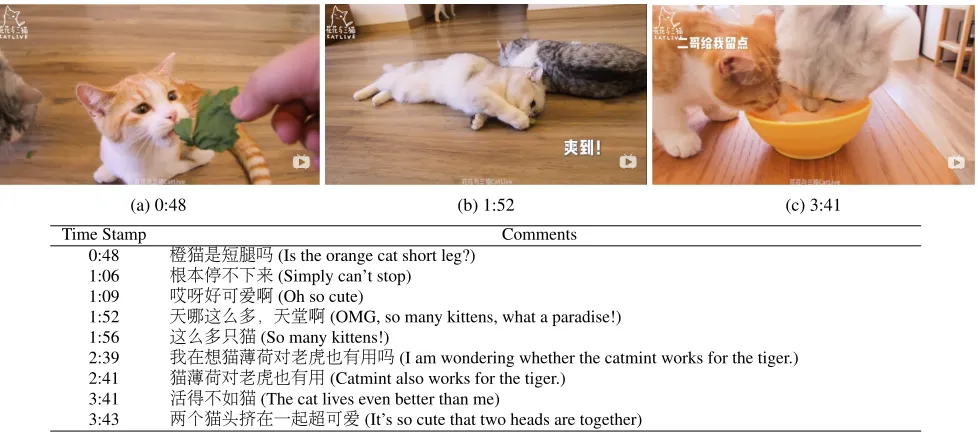
Figure 3: A data example of a video paired with selected live comments in the Live Comment Dataset. Above is three selected frames from the videos to demonstrate the content. Below is several selected live comments paired with the time stamps when the comments appears on the screen.
ing cats. The table below includes several selected live com-ments with the corresponding time-stamps. It shows that the live comments are related to the frames where the comments appear. For example, the video describes an orange cat fed with the catmint at 0:48, while the live comment at the same frame is asking “is the orange cat short leg?”. The com-ment is also related to the surrounding frames. For example, the video introduces three cats playing on the floor at 1:52, while the live comment at 1:56 is saying “So many kittens!”. Moreover, the comment is related to the surrounding com-ments. For example, the comment at 2:39 asks “whether the catmint works for the tiger”, and the comment at 2:41 re-sponds that “catmint also works for the tiger”.
Dataset Split
To split the dataset into training, development and testing sets, we separate the live comments according to the corre-sponding videos. The comments from the same videos will not appear solely in the training or testing set to avoid over-fitting. We split the data into 2,161, 100 and 100 videos in the training, testing and development sets, respectively. Fi-nally, the numbers of live comments are 818,905, 42,405, and 34,609 in the training, testing, development sets. Table 1 presents some statistics for each part of the dataset.
Data Statistics
Table 2 lists the statistics and comparison among dif-ferent datasets and tasks. We will release more data in the future. Our Bilibili dataset is among the large-scale dataset in terms of videos (2,361) and sentences (895,929). YouCook (Das et al. 2013), TACos-M-L (Rohrbach et al. 2014) are two popular action description datasets, which fo-cus on the cooking domain. M-VAD (Torabi et al. 2015) and
Statistic Train Test Dev Total #Video 2,161 100 100 2,361 #Comment 818,905 42,405 34,609 895,929
#Word 4,418,601 248,399 193,246 4,860,246 Avg. Words 5.39 5.85 5.58 5.42 Duration (hrs) 103.81 5.02 5.01 113.84
Table 1: Statistics information of the training, testing, and development sets.
MPII-MD (Rohrbach et al. 2015) are the movie description datasets, while MovieQA (Tapaswi et al. 2016) is a popular movie question answering dataset. MSVD (Chen and Dolan 2011) is a dataset for the task of paraphrasing, and MSR-VTT (Xu et al. 2016) is for video captioning. A major limi-tation for these datasets is limited domains (i.e. cooking and movie) and small size of data (in terms of videos and sen-tences). Compared with these datasets, our Bilibili dataset is derived from a wide variety of video categories (19 cate-gories), which can benefit the generalization capability of model learning. In addition, the previous datasets are de-signed for the tasks of description, question answering, para-phrasing, and captioning, where the patterns between the videos and the language are clear and obvious. Our dataset is for the task of commenting, where the patterns and re-lationship between the videos and the language are latent and difficult to learn. In summary, our BiliBili dataset repre-sents one of the most comprehensive, diverse, and complex datasets for video-to-text learning.
Analysis of Live Comments
Here, we analyze the live comments in our dataset. We demonstrate some properties of the live comments.
Figure 3: A data example of a video paired with selected live comments in the Live Comment Dataset. Above are three selected frames from the videos to demonstrate the content. Below is several selected live comments paired with the time stamps when the comments appear on the screen.
appear. For example, the video describes an orange cat fed with the catmint at 0:48, while the live comment at the same frame is asking “is the orange cat short leg?”. The com-ment is also related to the surrounding frames. For example, the video introduces three cats playing on the floor at 1:52, while the live comment at 1:56 is saying “So many kittens!”. Moreover, the comment is related to the surrounding com-ments. For example, the comment at 2:39 asks “whether the catmint works for the tiger”, and the comment at 2:41 re-sponds that “catmint also works for the tiger”.
Dataset Split
To split the dataset into training, development and testing sets, we separate the live comments according to the corre-sponding videos. The comments from the same videos will not appear solely in the training or testing set to avoid over-fitting. We split the data into 2,161, 100 and 100 videos in the training, testing and development sets, respectively. Fi-nally, the numbers of live comments are 818,905, 42,405, and 34,609 in the training, testing, development sets. Table 1 presents some statistics for each part of the dataset.
Data Statistics
Table 2 lists the statistics and comparison among dif-ferent datasets and tasks. We will release more data in the future. Our Bilibili dataset is among the large-scale dataset in terms of videos (2,361) and sentences (895,929). YouCook (Das et al. 2013), TACos-M-L (Rohrbach et al. 2014) are two popular action description datasets, which fo-cus on the cooking domain. M-VAD (Torabi et al. 2015) and MPII-MD (Rohrbach et al. 2015) are the movie description datasets, while MovieQA (Tapaswi et al. 2016) is a popular movie question answering dataset. MSVD (Chen and Dolan
Statistic Train Test Dev Total #Video 2,161 100 100 2,361 #Comment 818,905 42,405 34,609 895,929
#Word 4,418,601 248,399 193,246 4,860,246 Avg. Words 5.39 5.85 5.58 5.42 Duration (hrs) 103.81 5.02 5.01 113.84
Table 1: Statistics information on the training, testing, and development sets.
2011) is a dataset for the task of paraphrasing, and MSR-VTT (Xu et al. 2016) is for video captioning. A major limi-tation for these datasets is limited domains (i.e. cooking and movie) and small size of data (in terms of videos and sen-tences). Compared with these datasets, our Bilibili dataset is derived from a wide variety of video categories (19 cate-gories), which can benefit the generalization capability of model learning. In addition, the previous datasets are de-signed for the tasks of description, question answering, para-phrasing, and captioning, where the patterns between the videos and the language are clear and obvious. Our dataset is for the task of commenting, where the patterns and re-lationship between the videos and the language are latent and difficult to learn. In summary, our BiliBili dataset repre-sents one of the most comprehensive, diverse, and complex datasets for video-to-text learning.
Analysis of Live Comments
Here, we analyze the live comments in our dataset. We demonstrate some properties of the live comments.
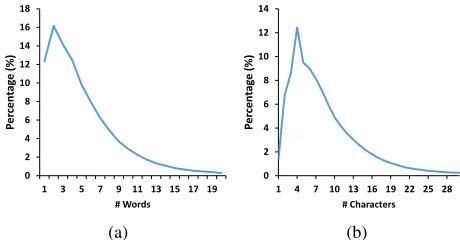
Distribution of Lengths Figure 4 shows the distribution
Dataset Task #Video #Sentence YouCook Action Description 88 2,668 TACos-M-L Action Description 185 52,593
M-VAD Movie Description 92 52,593 MPII-MD Movie Description 94 68,375 MovieQA Question Answering 140 150,000
MSVD Paraphrasing 1,970 70,028 MSR-VTT Captioning 7,180 200,000
Bilibili Commenting 2,361 895,929
Table 2: Comparison of different video-to-text datasets.
Interval Edit Distance TF-IDF Human
0-1s 11.74 0.048 4.3 1-3s 11.79 0.033 4.1 3-5s 12.05 0.028 3.9 5-10s 12.42 0.025 3.1
>10s 12.26 0.015 2.2
Table 3: The average similarity between two comments at different intervals (Edit distance: lower is more similar; Tf-idf: higher is more similar; Human: higher is more similar).
can see that most live comments consist of no more than 5 words or 10 characters. One reason is that 5 Chinese words or 10 Chinese characters have contained enough informa-tion to communicate with others. The other reason is that the viewers often make the live comments during watching the videos, so they prefer to make short and quick comments rather than spend much time making long and detailed com-ments.
Correlation between Neighboring Comments We also
validate the correlation between the neighboring comments. For each comment, we select its 20 neighboring comments to form 20 comment pairs. Then, we calculate the sentence similarities of these pairs in terms of three metrics, which are edit distance, tf-idf, and human scoring. For human scoring, we ask three annotators to score the semantic relevance be-tween two comments, and the score ranges from 1 to 5. We group the comment pairs according to their time intervals: 0-1s, 1-3s, 3-5s, 5-10s, and more than 10s. We take the av-erage of the scores of all comment pairs, and the results are summarized in Table 3. It shows that the comments with a larger interval are less similar both literally and semantically. Therefore, it concludes that the neighboring comments have higher correlation than the non-neighboring ones.
Approaches to Live Commenting
A challenge of making live comments is the complex depen-dency between the comments and the videos. The comments are related to the surrounding comments and video clips, and the surrounding comments also rely on the videos. To model this dependency, we introduce two approaches to generate the comments based on the visual contexts (surrounding frames) and the textual contexts (surrounding comments). The two approaches are based on two popular architectures for text generation: recurrent neural network (RNN) and transformer. We denote two approaches as Fusional RNN
0 2 4 6 8 10 12 14 16 18
1 3 5 7 9 11 13 15 17 19
P
er
cen
tag
e
(%
)
# Words (a)
0 2 4 6 8 10 12 14
1 4 7 10 13 16 19 22 25 28
P
er
cen
tag
e
(%
)
# Characters (b)
Figure 4: Distribution of lengths for comments in terms of both word-level and character-level.
Model and Unified Transformer Model, respectively.
Problem Formulation
Here, we provide the problem formulation and some nota-tions. Given a videoV, a time-stampt, and the surrounding
commentsCnear the time-stamp (if any), the model should
generate a commentyrelevant to the clips or the other
com-ments near the time-stamp. Since the video is often long and there are sometimes many comments, it is impossible to take the whole videos and all the comments as input. Therefore, we reserve the nearest m frames2 andn
com-ments from the time-stampt. We denote themframes as I ={I1, I2,· · · , Im}, and we concatenate thencomments
asC={C1, C2,· · ·, Cn}. The model aims at generating a
commenty = {y1, y2,· · ·, yk}, wherekis the number of
words in the sentence.
Model I: Fusional RNN Model
Figure 5 shows the architecture of the Fusional RNN model. The model is composed of three parts: a video encoder, a text encoder, and a comment decoder. The video encoder en-codesmconsecutive frames with an LSTM layer on the top
of the CNN layer, and the text encoder encodesm
surround-ing live comments into the vectors with an LSTM layer. Fi-nally, the comment decoder generates the live comment.
Video Encoder In the video encoding part, each frameIi
is first encoded into a vectorvi by a convolution layer. We
then use an LSTM layer to encode all the frame vectors into their hidden stateshi:
vi=CN N(Ii) (1)
hi=LST M(vi, hi−1) (2)
Text Encoder In the comment encoding part, each
sur-rounding commentCiis first encoded into a series of
word-level representations, using a word-word-level LSTM layer:
rji =LST M(Cij, rij−1) (3)
We use the last hidden staterL(i)
i as the representation for Cidenoted asxi. Then we use a sentence-level LSTM layer
𝐼1
𝐼2
𝐼𝑚 …
ℎ1
ℎ2
…
ℎ𝑚
𝑔1 𝑔2 … 𝑔𝑛
𝑠1 𝑠2 … 𝑠𝑘
Video Encoder
𝑦1 𝑦2 … 𝑦𝑘
Comment Decoder
A
tten
ti
on
Attention
𝑥1 𝑥2 … 𝑥𝑛
Text Encoder
Figure 5: An illustration of Fusional RNN Model.
with the attention mechanism to encode all the comments into sentence-level representationgi:
ˆ
gi=LST M(xi, gi−1) (4)
gi =Attention(ˆgi,h) (5)
With the help of attention, the comment representation con-tains the information from videos.
Comment Decoder The model generates the comment
based on both the surrounding comments and frames. There-fore, the probability of generating a sentence is defined as:
p(y0, ..., yT|h,g) = T Y
t=1
p(yt|y0, ..., yt−1,h,g) (6)
More specifically, the probability distribution of wordwiis
calculated as follows,
ˆ
si=LST M(yi−1, si−1) (7)
si=Attention(ˆsi,h,g) (8) p(wi|w0, ..., wi−1, h) =Sof tmax(W si) (9)
Model II: Unified Transformer Model
Different from the hierarchical structure of Fusional RNN model, the unified transformer model uses a linear structure to capture the dependency between the comments and the videos. Similar to Fusional RNN model, the unified trans-former model consists of three parts: the video encoder, the text encoder, and the comment decoder. Figure 6 shows the architecture of the unified transformer model. In this part, we omit the details of the inner computation of the transformer block, and refer the readers to the related work (Vaswani et al. 2017).
Video Encoder Similar to Fusional RNN model, the video
encoder first encodes each frameIiinto a vectorvi with a
convolution layer. Then, it uses a transformer layer to encode all the frame vectors into the final representationhi:
vi=CN N(Ii) (10)
hi=T ransf ormer(vi,v) (11)
Inside the transformer, each frame’s representation vi
at-tends to a collection of the other representations v = {v1, v2,· · ·, vm}.
CNN Multi-head
Attention Feed Forward
Embedding
Multi-head Attention
Feed Forward
Multi-head Attention
Embedding
Masked Multi-head
Feed Forward
Multi-head Attention Multi-head
Attention
Image Text Comment
Softmax
Outputs
Video Encoder
Text Encoder
Comment Decoder
Figure 6: An illustration of Unified Transformer Model.
Text Encoder Different from Fusion RNN model, we
concatenate the comments into a word sequence e = {e1, e2,· · · , eL} as the input of text encoder, so that each
words can contribute to the self-attention component di-rectly. The representation of each words in the comments can be written as:
gi =T ransf ormer(ei,e,h) (12)
Inside the text encoder, there are two multi-head attention components, where the first one attends to the text inpute
and the second attends to the outputshof video encoder.
Comment Decoder We use a transformer layer to
gener-ate the live comment. The probability of generating a sen-tence is defined as:
p(y0, ..., yT|h,g) = T Y
t=1
p(wt|w0, ..., wt−1,h,g) (13)
More specifically, the probability distribution of wordyi is
calculated as:
si=T ransf ormer(yi,y,h,g) (14)
p(yi|y0, ..., yi−1,h,g) =Sof tmax(W si) (15)
Inside the comment decoder, there are three multi-head at-tention components, where the first one attends to the com-ment inputyand the last two attend to the outputs of video
encoderhand text encoderg, respectively.
Evaluation Metrics
Model #I #C Recall@1 Recall@5 Recall@10 MR MRR
Video Only
S2S-I 5 0 4.69 19.93 36.46 21.60 0.1451
S2S-IC 5 0 5.49 20.71 38.35 20.15 0.1556
Fusional RNN 5 0 10.05 31.15 48.12 19.53 0.2217 Unified Transformer 5 0 11.40 32.62 50.47 18.12 0.2311
Comment Only
S2S-C 0 5 9.12 28.05 44.26 19.76 0.2013
S2S-IC 0 5 10.45 30.91 46.84 18.06 0.2194
Fusional RNN 0 5 13.15 34.71 52.10 17.51 0.2487 Unified Transformer 0 5 13.95 34.57 51.57 17.01 0.2513
Both S2S-ICFusional RNN 55 55 12.8917.25 33.7837.96 50.2956.10 16.1417.05 0.24540.2710 Unified Transformer 5 5 18.01 38.12 55.78 16.01 0.2753
Table 4: The performance of the baseline models and the proposed models. (#I: the number of input frames used at the testing stage; #C: the number of input comments used at the testing stage; Recall@k, MRR: higher is better; MR: lower is better)
Model Fluency Relevance Correctness
S2S-IC 4.07 2.23 2.91
Fusion 4.45 2.95 3.34
Transformer 4.31 3.07 3.45
Human 4.82 3.31 4.11
Table 5: Results of human evaluation metrics on the test set (higher is better). All these models are trained and tested give both videos and surrounding comments.
Inspired by the evaluation methods of dialogue mod-els (Das et al. 2017), we formulate the evaluation as a rank-ing problem. The model is asked to sort a set of candi-date comments based on the log-likelihood score. Since the model generates the comments with the highest scores, it is reasonable to discriminate a good model according to its ability to rank the correct comments on the top of the candi-dates. The candidate comment set consists of the following parts:
• Correct:The ground-truth comments of the
correspond-ing videos provided by the human.
• Plausible: The 50 most similar comments to the title of
the video. We use the title of the video as the query to re-trieval the comments that appear in the training set based on the cosine similarity of their tf-idf values. We select the top 30 comments that are not the correct comments as the plausible comments.
• Popular: The 20 most popular comments from the
dataset. We count the frequency of each comment in the training set, and select the 20 most frequent ments to form the popular comment set. The popular com-ments are the general and meaningless comcom-ments, such as “2333”, “Great”, “hahahaha”, and “Leave a comment”. These comments are dull and do not carry any informa-tion, so they are regarded as incorrect comments.
• Random:After selecting the correct, plausible, and
pop-ular comments, we fill the candidate set with randomly selected comments from the training set so that there are 100 unique comments in the candidate set.
Following the previous work (Das et al. 2017), We mea-sure the rank in terms of the following metrics:Recall@k
(the proportion of human comments found in the top-k rec-ommendations),Mean Rank(the mean rank of the human comments), Mean Reciprocal Rank(the mean reciprocal rank of the human comments).
Experiments
Settings
For both models, the vocabulary is limited to the 30,000 most common words in the training dataset. We use a shared embedding between encoder and decoder and set the word embedding size to 512. For the encoding CNN, we use a pretrained resnet with 18 layers provided by the Pytorch package. For both models, the batch size is 64, and the hidden dimension is 512. We use the Adam (Kingma and Ba 2014) optimization method to train our models. For the hyper-parameters of Adam optimizer, we set the learning rateα= 0.0003, two momentum parametersβ1= 0.9and β2= 0.999respectively, and= 1×10⁻⁸.
Baselines
• S2S-I(Vinyals et al. 2015) applies the CNN to encode the
frames, based on which the decoder generates the target live comment. This model only uses the video as the input.
• S2S-C (Sutskever, Vinyals, and Le 2014) applies an
LSTM to make use of the surrounding comments, based on which the decoder generates the comments. This model can be regarded as the traditional sequence-to-sequence model, which only uses the surrounding com-ments as input.
• S2S-ICis similar to (Venugopalan et al. 2015a) which
makes use of both the visual and textual information. In our implementation, the model has two encoders to en-code the images and the comments respectively. Then, we concatenate the outputs of two encoders to decode the out-put comments with an LSTM decoder.
Results
video and comment. Video only means that the model only uses the images as inputs (5 nearest frames), which simu-lates the case when no surrounding comment is available. Comment only means that the model only takes input of the surrounding comments (5 nearest comments), which simu-lates the case when the video is of low quality. Both de-notes the case when both the videos and the surrounding comments are available for the models (5 nearest frames and comments).
Table 4 summarizes the results of the baseline models and the proposed models under three settings. It shows that our proposed models outperform the baseline models in terms of all evaluation metrics under all settings, which demon-strates the effectiveness of our proposed models. Moreover, it concludes that given both videos and comments the same models can achieve better performance than those with only videos or comments. Finally, the models with only com-ments as input outperform the models with only videos as input, mainly because the surrounding comments can pro-vide more direct information for making the next comments.
Human Evaluation
The retrieval evaluation protocol evaluates the ability to dis-criminate the good comments and the bad comments. We also would like to evaluate the ability to generate human-like comments. However, the existing generative evaluation metrics, such as BLEU and ROUGE, are not reliable, be-cause the reference comments can be various. Therefore, we conduct human evaluation to evaluate the outputs.
We evaluate the generated comments in three aspects:
Fluencyis designed to measure whether the generated live
comments are fluent setting aside the relevance to videos.
Relevanceis designed to measure the relevance between the
generated live comments and the videos.Correctnessis de-signed to synthetically measure the confidence that the gen-erated live comments are made by humans in the context of the video. For all of the above three aspects, we stipulate the score to be an integer in{1,2,3,4,5}. The higher the
bet-ter. The scores are evaluated by three human annotators and finally we take the average of three raters as the final result.
We compare our Fusional RNN model and Unified Trans-former model with the strong baseline model S2S-IC. All these models are trained and tested give both videos and surrounding comments. As shown in Table 5, our models achieve higher scores over the baseline model in all three degrees, which demonstrates the effectiveness of the pro-posed models. We also evaluate the reference comments in the test set, which are generated by the human. It shows that the comments from human achieve high fluency and cor-rectness scores. However, the relevance score is lower than the fluency and correctness, mainly because the comments are not always relevant to the videos, but with the surround-ing comments. Accordsurround-ing to the table, it also concludes that the comments from unified transformer are almost near to those of real-world live comments. We use Spearman’s Rank correlation coefficients to evaluate the agreement among the raters. The coefficients between any two raters are all near 0.6 and at an average of 0.63. These high coefficients show that our human evaluation scores are consistent and credible.
Related Work
Inspired by the great success achieved by the sequence-to-sequence learning framework in machine translation (Sutskever, Vinyals, and Le 2014; Cho et al. 2014; Bah-danau, Cho, and Bengio 2014), Vinyals et al. (2015) and Mao et al. (2014) proposed to use a deep convolutional neu-ral network to encode the image and a recurrent neuneu-ral net-work to generate the image captions. Xu et al. (2015) further proposed to apply attention mechanism to focus on certain parts of the image when decoding. Using CNN to encode the image while using RNN to decode the description is natural and effective when generating textual descriptions.
One task that is similar to live comment generation is im-age caption generation, which is an area that has been stud-ied for a long time. Farhadi et al. (2010) trstud-ied to generate descriptions of an image by retrieving from a big sentence pool. Kulkarni et al. (2011) proposed to generate descrip-tions based on the parsing result of the image with a sim-ple language model. These systems are often applied in a pipeline fashion, and the generated description is not cre-ative. More recent work is to use stepwise merging network to improve the performance (Liu et al. 2018).
Another task which is similar to this work is video cap-tion generacap-tion. Venugopalan et al. (2015a) proposed to use CNN to extract image features, and use LSTM to encode them and decode a sentence. Similar models(Shetty and Laaksonen 2016; Jin et al. 2016; Ramanishka et al. 2016; Dong et al. 2016; Pasunuru and Bansal 2017; Shen et al. 2017) are also proposed to handle the task of video caption generation. Das et al. (2017) introduce the task of Visual Dialog, which requires an AI agent to answer a question about an image when given the image and a dialogue history. Moreover, we are also inspired by the recent related work of natural language generation models with the text inputs (Ma et al. 2018; Xu et al. 2018).
Conclusions
We propose the tasks of automatic live commenting, and construct a large-scale live comment dataset. We also in-troduce two neural models to generate the comments which jointly encode the visual contexts and textual contexts. Ex-perimental results show that our models can achieve better performance than the previous neural baselines.
Acknowledgement
We thank the anonymous reviewers for their thoughtful com-ments. This work was supported in part by National Natural Science Foundation of China (No. 61673028). Xu Sun is the corresponding author of this paper.
References
Agrawal, A.; Batra, D.; and Parikh, D. 2016. Analyzing the behavior of visual question answering models. InEMNLP 2016, 1955–1960.
Bahdanau, D.; Cho, K.; and Bengio, Y. 2014. Neural ma-chine translation by jointly learning to align and translate.
arXiv preprint arXiv:1409.0473.
Chen, D., and Dolan, W. B. 2011. Collecting highly parallel data for paraphrase evaluation. InACL 2011, 190–200.
Cho, K.; Van Merri¨enboer, B.; Gulcehre, C.; Bahdanau, D.; Bougares, F.; Schwenk, H.; and Bengio, Y. 2014. Learning phrase representations using rnn encoder-decoder for statis-tical machine translation.arXiv preprint arXiv:1406.1078.
Das, P.; Xu, C.; Doell, R. F.; and Corso, J. J. 2013. A thousand frames in just a few words: Lingual description of videos through latent topics and sparse object stitching. In
CVPR 2013, 2634–2641.
Das, A.; Kottur, S.; Gupta, K.; Singh, A.; Yadav, D.; Moura, J. M.; Parikh, D.; and Batra, D. 2017. Visual dialog. In
CVPR 2017, 1080–1089.
Donahue, J.; Hendricks, L. A.; Rohrbach, M.; Venugopalan, S.; Guadarrama, S.; Saenko, K.; and Darrell, T. 2017. Long-term recurrent convolutional networks for visual recognition and description. IEEE Trans. Pattern Anal. Mach. Intell.
39(4):677–691.
Dong, J.; Li, X.; Lan, W.; Huo, Y.; and Snoek, C. G. 2016. Early embedding and late reranking for video captioning. In
Proceedings of the 2016 ACM on Multimedia Conference,
1082–1086. ACM.
Fang, H.; Gupta, S.; Iandola, F. N.; Srivastava, R. K.; Deng, L.; Doll´ar, P.; Gao, J.; He, X.; Mitchell, M.; Platt, J. C.; Zit-nick, C. L.; and Zweig, G. 2015. From captions to visual concepts and back. InCVPR 2015, 1473–1482.
Farhadi, A.; Hejrati, M.; Sadeghi, M. A.; Young, P.; Rashtchian, C.; Hockenmaier, J.; and Forsyth, D. A. 2010. Every picture tells a story: generating sentences from im-ages. 15–29.
Jin, Q.; Chen, J.; Chen, S.; Xiong, Y.; and Hauptmann, A. 2016. Describing videos using multi-modal fusion. In
Proceedings of the 2016 ACM on Multimedia Conference,
1087–1091. ACM.
Karpathy, A., and Fei-Fei, L. 2017. Deep visual-semantic alignments for generating image descriptions. IEEE Trans. Pattern Anal. Mach. Intell.39(4):664–676.
Kingma, D. P., and Ba, J. 2014. Adam: A method for stochastic optimization.CoRRabs/1412.6980.
Kulkarni, G.; Premraj, V.; Dhar, S.; Li, S.; Choi, Y.; Berg, A. C.; and Berg, T. L. 2011. Baby talk: Understanding and generating simple image descriptions. 1601–1608.
Liu, F.; Ren, X.; Liu, Y.; Wang, H.; and Sun, X. 2018. Step-wise image-topic merging network for generating detailed and comprehensive image captions. InEMNLP 2018.
Ma, S.; Sun, X.; Li, W.; Li, S.; Li, W.; and Ren, X. 2018. Query and output: Generating words by querying distributed word representations for paraphrase generation. In NAACL-HLT 2018, 196–206.
Mao, J.; Xu, W.; Yang, Y.; Wang, J.; and Yuille, A. L. 2014. Explain images with multimodal recurrent neural networks.
arXiv: Computer Vision and Pattern Recognition.
Pasunuru, R., and Bansal, M. 2017. Multi-task video cap-tioning with video and entailment generation.arXiv preprint arXiv:1704.07489.
Ramanishka, V.; Das, A.; Park, D. H.; Venugopalan, S.; Hen-dricks, L. A.; Rohrbach, M.; and Saenko, K. 2016. Multi-modal video description. InProceedings of the 2016 ACM on Multimedia Conference, 1092–1096. ACM.
Rohrbach, A.; Rohrbach, M.; Qiu, W.; Friedrich, A.; Pinkal, M.; and Schiele, B. 2014. Coherent multi-sentence video description with variable level of detail. In GCPR 2014,
184–195.
Rohrbach, A.; Rohrbach, M.; Tandon, N.; and Schiele, B. 2015. A dataset for movie description. In CVPR 2015,
3202–3212.
Shen, Z.; Li, J.; Su, Z.; Li, M.; Chen, Y.; Jiang, Y.-G.; and Xue, X. 2017. Weakly supervised dense video captioning. InCVPR 2017, volume 2, 10.
Shetty, R., and Laaksonen, J. 2016. Frame-and segment-level features and candidate pool evaluation for video cap-tion generacap-tion. InProceedings of the 2016 ACM on Multi-media Conference, 1073–1076. ACM.
Sutskever, I.; Vinyals, O.; and Le, Q. V. 2014. Sequence to sequence learning with neural networks. InAdvances in neural information processing systems, 3104–3112.
Tapaswi, M.; Zhu, Y.; Stiefelhagen, R.; Torralba, A.; Urta-sun, R.; and Fidler, S. 2016. Movieqa: Understanding sto-ries in movies through question-answering. InCVPR 2016,
4631–4640.
Torabi, A.; Pal, C. J.; Larochelle, H.; and Courville, A. C. 2015. Using descriptive video services to create a large data source for video annotation research. CoRR
abs/1503.01070.
Vaswani, A.; Shazeer, N.; Parmar, N.; Uszkoreit, J.; Jones, L.; Gomez, A. N.; Kaiser, L.; and Polosukhin, I. 2017. At-tention is all you need. InNIPS 2017, 6000–6010.
Venugopalan, S.; Rohrbach, M.; Donahue, J.; Mooney, R. J.; Darrell, T.; and Saenko, K. 2015a. Sequence to sequence -video to text. InICCV 2015, 4534–4542.
Venugopalan, S.; Xu, H.; Donahue, J.; Rohrbach, M.; Mooney, R. J.; and Saenko, K. 2015b. Translating videos to natural language using deep recurrent neural networks. In
NAACL HLT 2015, 1494–1504.
Vinyals, O.; Toshev, A.; Bengio, S.; and Erhan, D. 2015. Show and tell: A neural image caption generator. InCVPR 2015, 3156–3164.
Xu, K.; Ba, J.; Kiros, R.; Cho, K.; Courville, A.; Salakhudi-nov, R.; Zemel, R.; and Bengio, Y. 2015. Show, attend and tell: Neural image caption generation with visual attention. InICML 2015, 2048–2057.
Xu, J.; Mei, T.; Yao, T.; and Rui, Y. 2016. MSR-VTT: A large video description dataset for bridging video and lan-guage. InCVPR 2016, 5288–5296.
Xu, J.; Sun, X.; Zeng, Q.; Ren, X.; Zhang, X.; Wang, H.; and Li, W. 2018. Unpaired sentiment-to-sentiment translation: A cycled reinforcement learning approach. In ACL 2018,