Volume 1, Issue 4, December 2012
Page 57
ABSTRACT
In this paper of Rectangular Microstrip line feed patch Antenna is designed for various wireless Applications. The Antenna is fed by coaxial probe feeding technique. The proposed patch antenna is Designed and Simulated on IE3D simulation software. Using the configuration of ring slotted microstrip line feed patch Antenna, The Return Loss Bandwidth achieved is 55.68% at operating frequency range of 1.415 to 2.507 GHz with a Return loss -21.69 dB at resonant frequency 1.526 GHz. The Antenna parameters such as VSWR, Smith chart, Antenna and Radiation Efficiencies, 3 D Radiation pattern has been analyzed by IE3D simulation based on mom.
Keywords: Broadband Antenna, Line feed, Radiation pattern, Radiation efficiency, VSWR & IE3D.
1.
INTRODUCTION
Generally a Conventional microstrip antenna has a radiating patch of any planar geometry (e.g. square, rectangular, Circular, Ellipse and ring) on one side of a dielectric material substrate printed on a grounded microwave substrate, and have the attractive features of low profile, light weight, low volume, ease of fabrication, and low profile planar configuration which can be easily made conformal to host surface [1-2].
However Microstrip Antenna has a drawback of narrow bandwidth and low gain. The Bandwidth can be increased byvarious technique like cutting slots, stacking, microstrip line and inset feeding, ground slotting and recently by shortpinning between conducting patch and ground plane.
Now a days Compact microstrip antenna are getting much more attention due to the increase in demands ofsmall size antennas used in personal and commercial purposes communicational accessories. In order todesign a compact microstrip antenna at a fixed operating frequency higher dielectric constant of substratemust be used [3].
The achievement of high gain of an antenna is the most desirable aspect. To enhance the gain of an antenna one may arrange the different patch element in an array configuration and receives the maximum radiation characteristics. In this design of Ring slotted line feed Microstrip antenna a conducting patch is formed on a dielectric sheet of glass epoxy having dielectric constant of 4.2 and ground plane is formed on the back side of the sheet. In this Antenna design the Return loss bandwidth achieved 55.68% and maximum radiation and Antenna efficiencies are obtained 97% and 94% at 1.36 GHz and 1.54 GHz.
2.
DESIGN OF RECTANGULAR PATCH
To design a rectangularmicrostrip patch antenna following parameters such as dielectric constant of substrate ( r), the
resonant frequency (fr) and height of the substrate (h) should be considered for calculating the length and the width of
the rectangular microstrip patch.
1: Width (W) Calculation:
The width of the mictrostrip patch antenna can be calculated by the given equation as follows;
2: Calculation of effective dielectric constant (Ereff);
The following equation gives the effective dielectric constant is given by
3: Calculation of length extension (Δl) ;
The following equation gives the length extension in terms of (W/h) ratio and effective dielectric constant.
Design of a Compact Ring Slotted Line Feed
Microstrip Patch Antenna
Mayank Dwivedi1, Ms.Pallavi Nayyer2
1
M.Tech student, IITT College of engineering, Nawanshar (Punjab), India
2
Volume 1, Issue 4, December 2012
Page 58
4: Calculation of actual length of patch (L);
The following equation gives thelengthof patch as,
5: calculation of the length and width of ground plane:
Ideally the ground plane is assumed of infinite size in length and width but it is practically impossible to make a such infinite size ground plane, so to calculate the length and width of a ground plane following equations are given as,
6: Determination of feed point location (Xf,Yf):
The center of the patch is taken as the origin and feed point location is given by the coordinates (Xf,Yf) from the origin. The
feed point must be located at that point on the patch, where the input impedance is 50 ohms for the resonant frequency. Hence a trial and error method is used to locate the feed point. The resonant frequency is taken at the return loss which is the most negative point of S11 parameter.
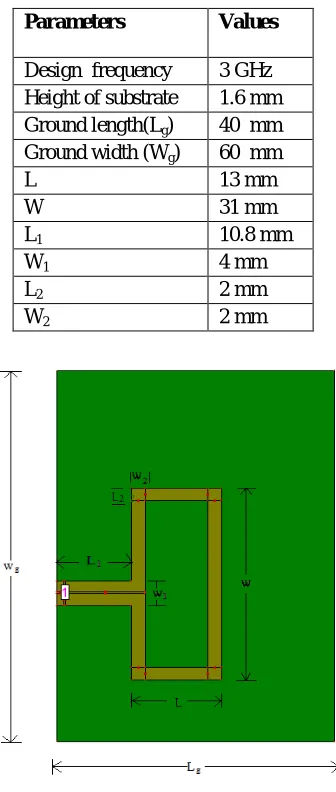
Table 1: Proposed antenna design parameters
Parameters Values
Design frequency 3 GHz Height of substrate 1.6 mm Ground length(Lg) 40 mm
Ground width (Wg) 60 mm
L 13 mm
W 31 mm
L1 10.8 mm
W1 4 mm
L2 2 mm
W2 2 mm
Volume 1, Issue 4, December 2012
Page 59
3.
IE3D RESULTS AND DISCUSSION
Various graphs result from the analysis of the patch by giving the feed point location x = 1.125 mm and y = 24.1 mm are shown in figures.
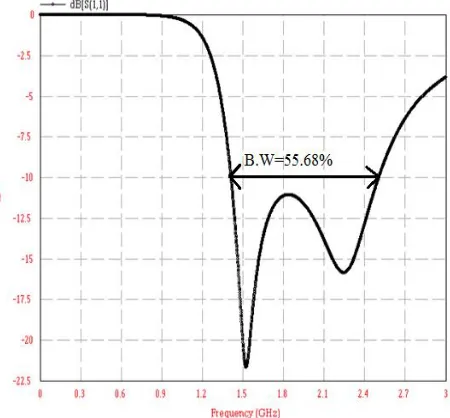
Fig 2 shows the graph of return loss verses frequency. The total bandwidth is calculated 55.68% at operating range 1.415 to 2.507 GHz. Fig 3 shows the antenna and radiation efficiency. The maximum radiation efficiency is occurred 97% at 1.36 GHz and maximum antenna efficiency is obtained 94% at 1.54 GHz. Fig 4 shows the Smith chart verses frequency plot shows the input impedance which should be ideally 50Ω used for impedance matching. Fig 5 shows the graph of VSWR. The minimum value of VSWR is about 1.18 at 1.522 GHz. The value of VSWR should be less than 2 for desirable communication. Fig 6 & 7 shows the 3D radiation pattern and 3D view of proposed antenna.
Figure 2 Return loss graph of proposed antenna
Volume 1, Issue 4, December 2012
Page 60
Figure 4 Smith chart of proposed antenna Figure 5 VSWR plot of proposed antenna
Figure 6 3D Radiation pattern of proposed antenna Figure 7 3D view of proposed antenna
4.
CONCLUSIONS
Volume 1, Issue 4, December 2012
Page 61
REFERENCES
[1]K. L. Wong, Design of Nonplanar Microstrip Antennas and Transmission Lines, Wiley,New York, 1999. [2] A. Balanis, “Antenna Theory analysis and design”, Microstrip Antenna, Chapter 14, pp.720-784.
[3] Zakir Ali, Vinod Kumar Singh, Ashutosh Kumar, AyubShahanaz, “E shaped Microstrip Antenna on RogersSubstrate for WLAN applications” Proc. IEEE, pp.342-345,Oct. 2011.
[4]A. M. Hadian, H.R. Hassani, “Wideband RectangularMicrostrip Patch Antenna with U-Slot”, IEEE, Electronics letters,vol. 33, No. 25, April. 2009.
[5] Amit A. Deshmukh and K. P. Ray, “Compact Broadband Slotted Rectangular Microstrip Antenna ”, IEEE antennas and wireless propagation letters, vol. 8, No. 3, March 2009, PP.377-382.
[6] B.K. Ang& B.K. Chung “A wideband E shapedMicrostrip patch antenna for 5-6 GHz Wireless communications
“PIER,75, pp. 397-407, 2007.
[7] Shivnarayan and Babau R. Vishvakarma, “Microstrip Patch Antenna with Inclined Slot for Dual-Band Operation”, Electronic letters, Vol. 33, No. 22, February 2006, PP.1833-1834.
[8] C.Y. Chiu, C.H. Chan and K.M. Luke, “Study of slotted microstrip patch antennas with folded patch fee”, Microwave Antennas propagation., vol. 152, No. 5, October 2005.
[9] C.Y. Chiu, C.H. Chan and K.M. Luke, “Study of slotted microstrip patch antennas with folded patch feed ”, Microwave Antennas propagation., vol. 152, No. 5, october 2005.
[10]Z. L. Dafalla, W. T. Y. Kuan, A. M. Abdel Rahman, and S. C.Shudakar, “Design of a Rectangular Microstrip Patch Antenna at 1 GHz”, Rf And Microwave Conference, October 5 - 6- 2004,Subang, Selangor, Malaysia. [11] Gh. Z. Rafi and L. Shafai,“V-slotted rectangular microstrip antenna witha stacked patch”,IEEEProc-Microw.
AntennasPropag. Vol. 146, No.1.January 2001, PP.13-16.
[12] Mohammad A.A.,Subhi H., Ahmad A. K. and Juma S.M, “Bandwidthenhancement of stacked rectangular microstrip patch antenna”,IEEE Trans.Antennas Propagation , vol. 49, No. 1, 2001 pp. 45-47.