Particle Swarm Optimization Based Composite
Power System Reliability Analysis Using FACTS
Venkata Padmavathi S
EEE Dept., GITAM University, Hyderabad, A.P., India Email:[email protected]
Sarat Kumar Sahu
EEE Dept., M.V.G.R Engg. Col., Vizianagaram, A.P., India Email: [email protected]
A. Jayalaxmi
EEE Dept., JNTU University, Hyderabad, A.P., India Email: [email protected]
Abstract—With the introduction of competition in the existing electrical market, it becomes necessary to enhance the transmission capacity of the power system through the existing transmission lines. The utilization of FACTS technologies can have significant impact on power system reliability. Low cost and feasibly better improvement can be achieved by using power electronics based devices in the system. Such devices are called Flexible Alternating Current Transmission system (FACTS) devices. This work deals with the reliability evaluation of generation system, transmission system, and load system by probabilistic technique. The composite system reliability can be enhanced by adjusting the settings of the FACTS device (such as reactance, phase angles, reactive power injection) with respect to the system. This is based on DC and AC load flow model. In this paper, the settings of Thyristor Controlled Series Capacitor or Compensator (TCSC) and Unified Power Flow Controller (UPFC) are found out using PSO technique for enhancing the transmission power capability to improve composite power system reliability. Now by finding Loss of Load Probability(LOLP) by inserting TCSC and UPFC in the line and compare the reliability after connecting TCSC and UPFC separately.
Index Terms—flexible AC transmission system (FACTS), thyristor controlled series capacitors (TCSC), particle swarm optimization technique (PSO), loss of load probability (LOLP), unified power flow controller (UPFC)
I. INTRODUCTION
The function of power system is to supply electrical energy on demand, economically and within acceptable levels of reliability and service quality. The basic element in power system planning is the determination of how much generation capacity required giving a reasonable assurance of satisfying the load requirements. There are wide range of probabilistic techniques have been developed for the evaluation of system behavior. These
Manuscript received February 11, 2014; revised May 20, 2014.
include techniques for reliability evaluation, and probabilistic load flow [1].
All the techniques are concerned with future behavior of the component or system. In all cases the problem cannot be defined as deterministic [2] but as stochastic in nature (i.e.) it varies randomly with time.
FACTS [3] devices are well known for their voltage control, reactive power compensation and power flow control applications. FACTS technologies are proven solutions to rapidly enhancing reliability and upgrading transmission capacity on long term and cost effective basis. These are effective where new transmission line construction is not feasible. FACTS are high speed, reliable, power electronic controllers that offer,
(a) Greater control of power so that it flows on the prescribed transmission routes
(b) Secure loading of transmission lines to levels nearer their thermal limits
(c) Greater ability to transfer between controlled areas (d) Prevention of cascading outages and in damping of power system oscillation.
II. COMPOSITE POWER SYSTEM RELIABILITY EVALUATION
The total problem of assessing the adequacy of the generation and bulk power transmission systems in regard to provide suitable supply at the terminal stations can be designed as composite power system reliability evaluation[1], [4], [5].
2.1 Generation system reliability 2.2 Transmission system reliability 2.3 Composite power system reliability
A. Generation System Reliability
load points is ignored. The only concern is in estimating the necessary generation capacity to satisfy the system demand and to have sufficient capacity to satisfy to perform corrective and preventive maintenance on the generation facilities.
B. Generation System Model
The generating units are divided into two groups: the conventional units, which may be controlled and scheduled, and the non-conventional units, which generally can be scheduled. For the generation system model the generation outages are treated individually and the model is evaluated.
The generation system model failure probability computed with the known data by
Probability (Pg) = ncrp r
qn-r (1)
where n is number of units, p is availability of each unit, and q is unavailability of each unit.
Using the above said formulas the generation system model is computed.
C. Transmission System Reliability
Transmission system deals with the transfer of electric power to the consumers in a reliable manner.
The electric power produced at the power station is transmitted over large distances to the load center by transmission lines. The transmission system associates with itself the substation, switching station and their associated components such as current transformers, potential transformers, breakers, relays, bus bars, reactors, capacitor banks, transmission lines. The bus scheme or the configuration of components along with bus bars is to be effectively planned for reliable supply of power to consumers. The system under study usually end at secondary buses, low voltage-switching devices may not be considered. The components of almost consideration are circuit breakers power transformers. This in contrast to the generating systems the variety of components are involved and the modeling of such a diversity of devices can make the transmission system reliability evaluation quiet formidable.
D. Transmission System Model
Transmission system model failure probability is computed by using
Probability (Pt) = ncrprqn-r (2)
where n is number of lines, r is number of available lines, p is availability of each line, and q is unavailability of each line.
E. Composite System Reliability
Composite system reliability evaluation refers to assessments that consider both generation and transmission contingencies. Some of the existing network-based programs do have limited capability to model generating unit outages. However there are several concerns in the industry regarding the limitations of the existing programs for composite system reliability evaluation. For example, generation contingencies are not
considered accurately and efficiently on terms of reliability programs could be defined to (1) multi area reliability programs (generating unit outages, no transmission outages, no load flows); (2) transmission system reliability programs (load flow analysis transmission outages, no generating unit outages); (3) composite system reliability programs (load flow analysis, generation and transmission outages).
In the network, based programs failure is defined in terms line overloads and unacceptable bus voltage levels, and load curtailment needed to alleviate these conditions. Using the probability (or frequency) of contingencies that could cause this condition, probability (or frequency) different unacceptable conditions are computed as indices of reliability. A major difficulty in developing these programs has been to analyze a sufficient number of contingencies a reasonable computation time in order to have confidence in the calculated reliability indices. This is particularly true when generation outages are included.
Composite Probability, Pc = Pg*Pt (3)
where,
Pg=probability of generating unit Pt=probability of transmitting unit
III. THYRISTOR CONTROLLED SERIES CAPACITORS
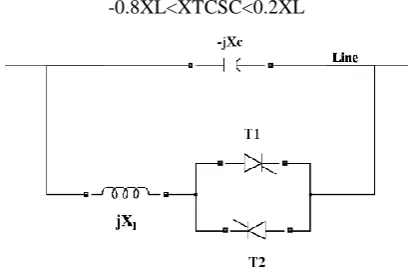
TCSC [3] is a capacitive reactance compensator which consists of a series capacitor banks shunted by a thyristor controlled reactor in order to provide a smoothly variable series capacitive reactance. The TCSC model shown in Fig. 1 has a variable reactor such as a thyristor controlled reactor (TCR) is connected across a series capacitor. When the TCR firing angle is 1800 the reactor becomes non-conducting and series capacitor has its normal reactance. As the firing angle reduces to less than 1800 the capacitive reactance increasing. When TCR firing angle is 900 the reactor becomes fully conducting and the total reactance becomes inductive because the reactor impedance is designed to be much lower than the series capacitor impedance with 900 to limit the fault current.
The TCSC may have one of the two possible characteristics: capacitive or inductive, respectively to decrease or increase the impedance of the branch. It is modeled with variable series reactance. Its value is function of the reactance of the line XL where the device is located [6]. It is in the range:
-0.8XL<XTCSC<0.2XL
IV. UNIFIED POWER FLOW CONTROLLER
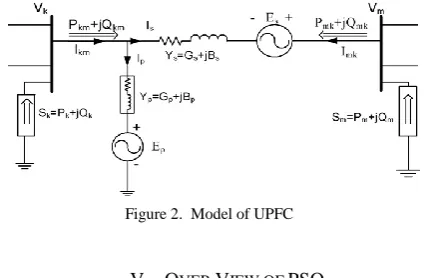
This could be a combination of separate shunt and series controllers, which are controlled in a coordinated manner, or a unified power flow controller with series and shunt elements as shown in Fig. 2. In principle, combined shunt and series controllers inject current into the system with the shunt part of the controller and voltage in series in the line with the series part of the controller. However, when the shunt and series controllers are unified, there can be a real power exchange between the series and shunt controllers via the power link.
UPFC consists of two voltage sourced converters are operated from a common DC link provided by a DC storage capacitor. The real power can flow in either direction and each converter can independently generate or absorb reactive power at its terminals.
The converter 2 provides the main function of UPFC [3] by injecting a voltage in series with the line via an insertion transformer. This injected voltage will act as synchronous AC voltage source. The transmission line current flows through this voltage source resulting in reactive and real power exchange between it and the ac system.
The reactive power exchanged at the AC terminal i.e. at the terminal of the series insertion transformer is generated internally by the converter. The real power exchanged at the AC terminal is converted into DC at the DC link. Converter 1 can also generate or absorb reactive power and provide independent shunt reactive compensation for the line. There is a closed direct path for the real power by the series voltage injection through converters 1 and 2 back to the line, the corresponding reactive power exchanged is supplied or absorbed locally by converter two. Alternatively it can independently control both the real and reactive power flow in the line.
Figure 2. Model of UPFC
V. OVER VIEW OF PSO
Particle swarm optimization (PSO) [7] is an evolutionary computation technique developed by Dr. Eberhart and Dr. Kennedy in 1995, inspired by social behavior of bird flocking or fish schooling. Similar to genetic algorithms (GA), PSO is a population based optimization tool. The system is initialized with a population of random solutions and searches for optima by updating generations. However, unlike GA, PSO has no evolution operators such as crossover and mutation. In PSO, the potential solutions, called particles are “flown”
through the problem space by following the current optimum particles. The detailed information will be given in the following sections.
Compared to GA, the advantages of PSO are that PSO is easy to implement and there are few parameters to adjust. PSO has been successfully applied in many areas: function optimization, artificial neural network training, fuzzy system control, and other areas where genetic algorithm can be applied.
VI. METHODOLOGY
A. Probabilistic Elements Models
The forced outage rates for generating units, which described the outage capacity density function for units when two state models were used. The same type of probabilistic description will be used for other transmission elements in transmission system reliability. Each transmission element can be described adequately by two state models and associated FORs.
For simplicity two state models will be used throughout.
B. Basic Philosophy
Given that each element, Vm, m=1, 2……….., E, in the system under study [8] can reside in either the “0” state, with probability qm, in which it has no capacity and is out of service, or the “1” state, with probability pm, in which it has capacity Cm and is in service, the system will have 2E distinct capacity states Xi, i=1, 2, 3…………..2E. Take the 6bus RBTS system it has 11 elements: 2 generators and 9 lines so the system can reside in any one of 211 different capacity states Xi. Obviously the upper and lower limiting states denoted by X=(1,1,1,1,1,1,1,1,1,1,1), and the state X
=(0,0,0,0,0,0,0,0,0,0,0).
The Associated state probabilities with each of the 2E states is a probability f(Xi) that it will occur; for example the probability, f(x), that the 6 bus system will reside in upper limiting state is
f X
= 1
m m
E
p
=p1p2p3p4p5 p6p7p8p9p10p11 (4)The probability for lower limiting states is
f X
=
1
m
E
m
q
=q1q2q3q4q5q6 q7q8q9q10q11(5)
The probability for that system will reside in any state
f(xi) = Π f(Vm) (6)
where f(Vm) = pm if Vm=1, f(Vm) = qm if Vm=0.
Decompose the system states into acceptable and unacceptable states, for those unacceptable states calculate the LOLP [6].
LOLP = Σf(xi) (7)
C. Problem Formulation
A simple test system [8], [9] is considered in which the DC load flow was run and the Loss of load probability calculation was done using the probabilistic method. For studying the effect of FACTS controllers, TCSC a series controller is incorporated in the lines on a random selection and the effect on LOLP was observed. The analysis was done on the Roy Billinton test system (RBTS). The study was done by installing a single TCSC at a line and running the DC load flow for testing the effect of the variation in the system impedance through TCSC. Here for calculation of LOLP single and double line contingencies are considered [10].
For installing UPFC in the line run the AC load flow for to know the behavior of the system. PSO is used in estimating the optimal setting of the TCSC to be installed in the lines. Several possible combinations with the use of TCSC in the system were tried and the variations in the LOLP for system are observed. The choice for PSO is that it is a very efficient algorithm in converging towards the global solution that optimizes the function. Choice of TCSC among various FACTS device for this problem is that, it can be easily modeled as a reactance to be in series with that of the line reactance in the equivalent circuit.
Based on the power flow model, get the base case powers calculations typically assumes a lossless system, where changes in the line real power flows are linearly related to changes in the net real power injections. The LOLP can be determined as by doing single line outages and double line outages and get the unacceptable states and 3, 4 etc. line contingencies are eliminated because the probability is less than 10-6 so those are neglected. So for the unacceptable states calculate the LOLP by using subset decomposition theorem. The line power flow can be calculated by using
Pij=
1 X
/
ij
*(θi-θj) (8)where Pij is the power flow between the bus i and bus j, Xij is line reactance, and θi,θj are the angles at buses i and j.
For a given positive line flow limit Pijmax, which is assumed to be equal to the line MVA rating.
The objective of the problem is to maximize the power flow using TCSC, UPFC.
The problem is solved as a minimization problem with the objective of maximizing the power flow as given below,
Max{Pij} = min{1/(1+Pij)} (10)
VII. RESULTS AND COMPARISON
The simulation for the RBTS is studied with single TCSC, UPFC located to enhance the power flow and simultaneously adjust the line parameters with in the line limit. The simulation is carried out in MATLAB version 7.0 for Windows environment. By observing the Table I that the failure probability is decreasing with increased number of generator outages, Table II shows each line probability of availability and it was clear from Table III
that by using the TCSC the LOLP is reduced from 0.0093 to 0.007 and by using UPFC it was reduced to 0.065.So it was clear that the loss of load probability was reduced using FACTS. So the reliability of the composite power system is improved by using FACTS. From Table III it was clear that the LOLP of the system using UPFC is lesser than that of TCSC. So it was clear that using UPFC the reliability of the system increased highly compared to TCSC. The TCSC is having only series controller. But the UPFC is having series and shunt controllers, which are controlled in coordinated manner. This is a complete controller for controlling active and reactive power control through the line. DC load flow is used to study the effect of TCSC. AC load flow is used to study the effect of UPFC. The analysis of TCSC is simpler than the UPFC, because in TCSC we are varying the line reactance and neglected the line resistance and shunt reactance, so we used DC load flow, it will take less time compare to AC load flow but AC load flow will give the accurate result.
TABLEI. GENERATION SYSTEM RELIABILITY
State Capacity Outage(MW)
Probability
1 0 0.81271400
2 10 0.01658600
3 20 0.07081400
4 25 0.00100000
5 30 0.00144520
6 35 0.00002040
7 40 0.06924200
8 45 0.00038320
9 50 0.00104930
10 55 0.00000000
11 60 0.00355235
12 65 0.00009160
13 70 0.00010096
14 80 0.00221280
15 85 0.00002160
16 90 0.00004462
17 100 0.00014819
TABLEII. TRANSMISSION SYSTEM RELIABILITY
Line no. Probability
1 0.99829000
2 0.99432460
3 0.99432460
4 0.99885975
5 0.99885975
6 0.99829060
7 0.99885900
8 0.99885900
9 0.99885900
TABLEIII. LOLPRESULTS
LOLP without FACTS
LOLP with TCSC at line 1 or 6
LOLP with UPFC at line 1 or 6
0.0093 0.007 0.065
Parameter Values for PSO C1 and C2:1.5
VIII. CONCLUSION
The composite power system reliability was improved by employing the FACTS in the transmission line. In this paper PSO was used to set the TCSC and UPFC parameter values. By increasing transmission line capacity using FACTS the failure probability reduced. So the composite power system Reliability was increased. And by using UPFC the reliability of the system increased highly compared to TCSC.
REFERENCES
[1] Roy Billinton and R. N. Allan, Reliability Evaluation of Power
Systems, New York: Plenum Press, 1984.
[2] C. Grigg, P. Wong, et al., “IEEE Reliability test system-1996. A report prepared by the reliability test system task force of the application of probability methods subcommittee,” IEEE Transactionson Power Systems, vol. 14, no. 3, pp. 1010-1020, 1999.
[3] N. G. Hingorani and L. Gyugyi, Understanding FACTS, Concepts
and Technology of Flexible AC Transmission Systems, New York:
IEEE Press, 2000.
[4] Roy Billinton, Power system Reliability Evaluation, New York: Gordon & Breach Science Publishers, 1970.
[5] R. N. Allan, R. Billinton, and N. M. K. Abdel-Gawad, “The IEEE reliability test system – Extensions to and evaluation of the generating system, IEEE Transactions on Power Systems, vol. 1, no. 4, pp. 1-7, 1986.
[6] S. Gerberi, R. Chercaoui, and A. J. Germond, “Optimal location of FACTS devices to enhance power system security,” in Proc. IEEE
Bologna Power Tech Conference Proceedings, 2003.
[7] J. Kennedy and R. Eberhart, “Particle swarm optimization”, in
Proc. IEEE International Conference on Neural Networks, 1995,
pp. 1942-1948.
[8] R. Billinton and Y. Cui, “Reliability evaluation of composite electric power systems incorporating FACTS,” in Proc. IEEE
Canadian Conference on Electrical and Computer Engineering,
2002, pp. 1-6.
[9] R. Billinton, S. Kumar, et al., “A reliability test system for educational purposes-Basic data,” IEEE Transactions on Power
Systems, vol. 4, no. 3, pp. 1238-1244, 1989.
[10] A. J. Wood and B. F. Woolenberg, Power Generation, Operation and Control, editorial John Wiley & Sons, 1996.
Dr. Sarat Kumar Sahu completed his B.Tech. (EEE) from Acharya Nagarjuna University, in 1999 and M.Tech. (Power Electronics) from Jawaharlal Nehru Technological University, Hyderabad in 2003 and completed Ph.D from Jawaharlal Nehru Technological University, Hyderabad in 2010. His research area is FACTS. He is currently working as Professor, Electrical & Electronics Eng, MVGR College of Engineering, Vizianagaram.
Dr. A. Jayalaxmi completed her B.Tech. (EEE) from Osmania University College of Engineering, Hyderabad in 1991, M. Tech.(Power Systems) from REC Warangal, Andhra Pradesh in 1996 and completed Ph.D. (Power Quality) from Jawaharlal Nehru Technological University, Hyderabad in 2007. She has five years of Industrial experience and 14 years of teaching experience. Presently, working as Professor, Electrical & Electronics Engg., and Coordinator, Centre for Energy Studies, JNTUH College of Engineering, Jawaharlal Nehru Technological University Hyderabad, Kukatpally, Hyderabad. Her research interests are Neural Networks, Power Systems & Power Quality.