Dynamic Modelling and Analysis of a Cane
under Cane Gait
Hao Wang, Baiqing Sun, Dechun Li, and Linlin Song
Shenyang University of Technology, Shenyang, ChinaEmail: {wanghao7797, dc_li, Song_Linlin}@hotmail.com, [email protected]
Abstract—In order to develop a cane robot to be compliant with the motion habits of an elder during his walking assisted by a general cane, the motion state of an ordinary cane was analysed in this paper. Two different cane-assisted gaits were introduced and the motion state of the cane was divided by two motion phases. The relationship of the human-cane interaction force for each phase was analysed, and the dynamic model of the cane was founded individually. An experimental setup was constructed and validity of the proposed dynamic models were verified.
Index Terms—dynamic model, cane gait, walking habit
I. INTRODUCTION
Due to the aging society, disabled and semi-disabled elderly increase rapidly [1]. In 2015, the population over the age of 60 will grow from 11% to 12% to more than 25% in Asia [2]. How to solve the daily care of the elderly with a modern way is a work for researchers in the field of robots always working on. Currently, there are three kinds of robots assisting walker’s function, namely the exoskeleton robot, the walking frame robot and the cane robot.
Currently, a lot of research focusing on the exoskeleton robot have been done by many scholars [3]-[6]. For example, Yoshiyuki Sankai developed an exoskeleton robot called HAL-5. The robot can help the elderly complete some action, such as walking and stairs up and down [7]-[9]. However, exoskeleton robots still have some drawbacks, such as the robot was connected with user by bundling. It causes the user’s body will produce poor blood circulation and it is too unachievable for an elderly to wear the equipment independently. For the research on walking aid robot, a walking robot JARoW [10], [11] was proposed, in which a laser sensor was employed to locate the relative position of legs and the center of the walker. The robot was controlled to coincide COGs of users and the robot frame. Walk frame robots are usually with large size and restrict human motion, and it is not suitable for indoor environment.
Generally, certain motion abilities were survived for most of elderly people, the most effective walking assist equipment for them is something with smaller size and easy to use and unrestricted moving just like a general cane. Cane robots just meet the requirements mentioned above. In 2013, Toshio Fukuda developed an
Manuscript received March 30, 2017; revised June 28, 2017.
omnidirectional cane robot based on human walking intention. The robot recognized the intention of the direction by analyzing the interaction between man and the robot was realized to assist users walking effectively [12]-[16]. However, there are still some problems with this kind of robots. For example, the supporting stick and the moving platform are always integrated and there is no any joint connecting them together. The stick is perpendicular with floor and there is no effective support comparing with that of a general cane. Moreover, it is incompliant with the motion habits of an elder walking assisted with a cane.
In this paper, In order to develop a cane robot to be compliant with the motion habits of an elderly people during his walking assisted by a general cane, the motion state of an ordinary cane was analyzed firstly, and then two different cane-assisted gaits were introduced and the motion state of the cane was divided by two motion phases. The relationship of the human-cane interaction force for each phase was analyzed, and the dynamic model of the cane was founded individually. An experimental setup was constructed and validity of the proposed dynamic models was verified.
II. ANALYSIS OF CANE’S MOTION STATE
There are two kinds of cane gait, one is Two-point gait and the other is the Three-point gait. The Two-point gait is shown in Fig. 1(a). In this situation, a cane is on the same side with the unaffected extremity. On first step, the cane and affected extremity are stepped out simultaneously, and then the user holds the cane and supports body weight with arm power and step out the unaffected extremity after the body is stable. In the Three-point gait, as shown in Fig. 1(b), a cane is also required on the same side with an unaffected extremity before walking. At first, the user steps out the cane and then holds the cane tightly supporting his body with the arm power, then the affected extremity is stepped out when his body is stable. After that, the unaffected extremity is stepped out.
Figure 1. Cane gait classification
III. DYNAMICS MODELS OF CANE
A. Establishment of Coordinate System
In order to accurately explain the movement state of cane under cane gait, defining the earth coordinate system and the cane coordinates as follows:
Figure 2. The definition of cane coordinate system
As shown in Fig. 2, 𝑂0− 𝑥0𝑦0𝑧0is the earth coordinate system, 𝑦0is point toward the Geographic North Pole; 𝑥0 is perpendicular to 𝑦0 and point to the East; 𝑧0 is perpendicular to the plane 𝑥0𝑦0𝑧0.
𝑂1− 𝑥1𝑦1𝑧1 is the cane coordinate system, 𝑥1 is perpendicular to 𝑦1and point to right; 𝑦1is the forward direction of cane along the handle.
Figure 3. Cane’s motion classification
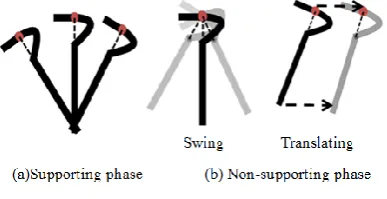
Under these two coordinate systems, according to the analysis of Section II, we also divide the motion state of the cane into two phases, namely the Support phase and the Non-support phase. The support phase is defined as the cane’s terminal remains stationary and cane provide support force, as shown in Fig. 3(a).
The Non-support phase was defined as the cane’s terminal was hung up and moved from one point to another point as shown in Fig. 3(b).
The state cane does not provide support force. During Non-support phase, the cane motion is combined rotation around the handle and translation together. In support phase, the human force, the gravity and the supporting force from floor are simultaneously acted to determine the cane motion. In non-support phase, only the human force and the gravity are acted simultaneously to determine the cane motion. The acceleration in the direction of 𝑦1 axis was defined as 𝑎𝑦,
𝑎𝑦= 𝑆 ∗ 𝑎𝑦1+ 𝐶 ∗ 𝑎𝑦2
𝑆 = {1 𝐹𝑧 ≥ 0
0 𝐹𝑧 < 0 𝐶 = {0 𝐹𝑧 ≥ 01 𝐹𝑧 < 0 (1) where 𝑎𝑦1 and 𝑎𝑦2 represent acceleration of support phase and the non-support phase respectively.
B. Dynamic Model in Support Phase
In this section, the acceleration of the cane on Y axis is analysed in 𝑂1− 𝑥1𝑦1𝑧1 coordinate system during supporting phase. Illustration of the acceleration decomposition of the cane is shown in Fig. 4.
Figure 4. Decomposition of acceleration
In support phase, the cane rotates around the other end of the cane. This movement causes the cane’s terminal to be almost static. Therefore, the acceleration in y1 axis is
mainly the component of the gravity acceleration without gravity compensation. The acceleration produced by other forces at y1 axis is approximately zero, so
𝑎𝑆𝑢𝑝= 𝑚𝑔𝑠𝑖𝑛𝜃 = 𝑎𝑦1 (2)
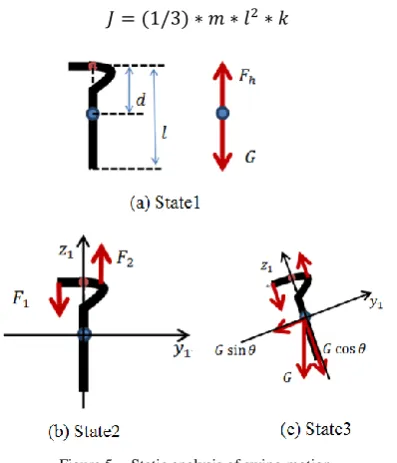
C. Dynamic Model of Swing in Non-support Phase In this section we analysed acceleration of the cane on Y axis caused by swing motion. In 𝑂1− 𝑥1𝑦1𝑧1 coordinate system, the torque exerted on cane by human and the gravity act simultaneously to determine the swing motion of the cane. The movement of cane is divided into three stages.
gravity cause the rotate motion of cane together, we record the status as state3 as shown in Fig. 5(c). The movement of cane change between the three states. We get the formula for swing motion
𝑇 − 𝑚𝑔 𝑠𝑖𝑛𝜃 ∗ 𝑑 = 𝐽𝜃̈ (3)
where m represents quality of lower part, which consists of F/T senor and the lower part of cane. d represents the distance from the rotation point to COG of the lower part. 𝜃 represents the angle between 𝑧0 and 𝑧1. 𝐽 represents the moment of inertia of cane, get the formula
𝜃̈ = 𝑎𝑅𝑜𝑡𝑎/𝑙 (4)
where 𝑎𝑅𝑜𝑡𝑎 represents the linear acceleration of the cane’s terminal, 𝑙 represents length of cane. We see the cane as a uniform thin rod and add a coefficient k to make up the error of the moment of inertia.
𝐽 = (1/3) ∗ 𝑚 ∗ 𝑙2∗ 𝑘 (5)
Figure 5. Static analysis of swing motion
The coefficients k are empirical values. We get a formula for calculating moment of inertia of a cane as formula(5), the linear acceleration of the cane’s terminal can be obtained, get the formula
𝑎𝑅𝑜𝑡𝑎 =3(𝑇−𝑚𝑔𝑠𝑖𝑛𝜃∗𝑑)𝑚𝑙𝑘 (6)
D.
In this section we analysed acceleration of the cane on Y axis caused by translation motion as shown in Fig. 6.
Figure 6. Static analysis of translational motion
When the translation speed of lower part and upper part of the cane is synchronized on the 𝑧1𝑜1𝑦1 surface, Interaction force between them don’t appear. When the speed is not synchronized, interaction force between them will appear. Horizontal force called 𝐹𝐻𝑜𝑟𝑧, the vertical force 𝐹𝑉𝑒𝑟𝑡. The acceleration produced by the translation on the Y axis is 𝑎𝑇𝑟𝑎𝑛𝑠.
𝑎𝑇𝑟𝑎𝑛𝑠= (𝐹𝐻𝑜𝑟𝑧∗ 𝑐𝑜𝑠𝜃 + 𝐹𝑣𝑒𝑟𝑡∗ 𝑠𝑖𝑛𝜃)/𝑚 (7)
In the Non-Support Phase, the acceleration on the y1 is
caused by the swing and the translation, so the final acceleration should be the synthesis of the two kinds of motion called 𝑎𝑐,
𝑎𝑐 = 𝑎𝑅𝑜𝑡𝑎+ 𝑎𝑇𝑟𝑎𝑛𝑠 = 𝑎𝑦2 (8)
IV. EXPERIMENT
A. Experiment Setup
In order to verify validity of the proposed model, a cane motion monitor system was designed. A F/T sensor and a gyro sensor were mounted on the cane as shown in Fig. 7.
Figure 7. Cane motion monitor system
The experimental platform parameters are as follows: the quality of the lower part is 0.75kg and the length of cane is 0.87m, the distance from rotation point to COG of lower part is 0.5m. In earth coordinate system 𝑂0− 𝑥0𝑦0𝑧0 we choose a path called 𝑅𝑜𝑢𝑡𝑒, as shown in Fig. 5. 𝛼 is the plane containing the Route and the 𝑧0. The plane 𝑧1𝑂1𝑦1 coincides with the plane 𝛼.
The cane is pitched in the plane 𝛼. An user walked with Three-point gait use cane motion monitor system along the 𝑅𝑜𝑢𝑡𝑒 with 0.16m/s. Recording the force data from the F/T sensor and the posture and acceleration
F/T senor
Gyro senor Net Box
information from the gyro. The force of the cane includes the force along the 𝑧1 axis, denoted as 𝐹𝑧, and the torque around the 𝑥1 axis, denoted as 𝑇𝑥. These two parameters reflect force situation of cane. The cane posture is reflected by the pitch angle of the cane in α plane, denoted as Pitch. The cane’s terminal acceleration on the 𝑦1 axis is denoted as Acc, the parameter reflect the movement of the cane.
Figure 8. Experimental method description
B. Data Analysis
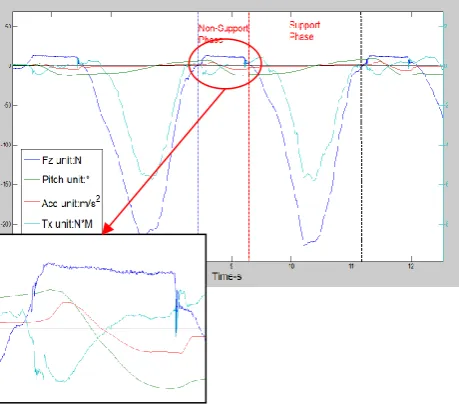
In Fig. 9, the blue line represents 𝐹𝑧 (N) , the green curve represents Pitch (unit: degree); the red curve represents Acc (unit: 𝑚/𝑠2 ); the light blue curve represents 𝑇𝑥 (unit: N·M). The black curve is zero reference line
Figure 9. Variation of force, moment, angle and acceleration
It can be seen from the curve that the four parameters 𝐹𝑧, Pitch,𝑇𝑥 and Acc are cyclically changed. This characteristic is consistent with the characteristics of gait changes when a person uses a cane.
Inputting real measurements of 𝐹𝑧, Pitch and 𝑇𝑥 into formulas and setting k as 1.3, then the acceleration of cane’s terminal on 𝑦1 axis is shown in Fig. 10. The blue and the green curves represent the acceleration measured by gyro and calculated based on the dynamic model respectively. It can be seen that the two curves match very well. The results verified the dynamic model of a cane under cane gait is correct.
Figure 10. Variation of acceleration in Y axis
V. CONCLUSION
In this paper, two different cane-assisted gaits were introduced and the motion state of a general cane was divided by two motion phases. The dynamic models of the cane were founded individually and an experimental setup was constructed and validity of the proposed dynamic models were verified. The results of this paper are good for developing a cane robot to be compliant with the motion habits of an elder during assisted by a general cane.
REFERENCES
[1] World Population Ageing 1950-2050 [R] DESA, United Nations, 2000.
[2] 2015 Revision of World Population Prospects [R] DESA, United Nations, 2015.
[3] M. Suzukawa, H. Shimada, and H. Makizako, “Incidence of falls and fractures indisabled elderly people utilizing long-term care insurance,” Ronen Biyou, vol. 46, no. 4, pp. 334-340, July 2009. [4] H. Kazerooni, R. Steger, and H. H. Li, “Hybrid control of the
Berkeley Lower Extremity Exoskeleton (BLEEX),” The International Journal of Robotics Research, vol. 25, pp. 561-573, May 2006,
[5] A. B. Zoss and A. Chu, “Design of the Berkeley Lower Extremity Exoskeleton (BLE-EX),” IEEE/ASME Transactions on Mechatronics, vol. 11, pp. 128–138, May 2006.
[6] K. Kazuo and K. Kiguhi, “Mechanical designs of activeupper-limb exoskeleton robots state-of-the-art and design diffi-culties,” presented at IEEE 11th International Conference on Rehailitation Robotics, Kyoto, Japan, 2009.
[7] T. Sakurai, et al., “Development of motion instruction system with interactive robot suit HAL,” presented at IEEE International Conference on Robotics and Biomimetics, Japan, 2009.
[8] Y. Sankai, “Wearing type behavior help device calibration device and control progarm,” USA, Patent 2011000432Al, Jan. 6, 2011. [9] Y. Sankai, “Centroid position detector device and wearing type
action assistance device including centroid positon detector device,” USA Patent 20100271051A, Oct. 28, 2010.
[10] G. Lee and T. Ohnuma, “Design and control of JAIST active robotic walker,” Journal of Intelligent Service Robotics, vol. 3, pp. 125-135, 2010.
[11] G. Lee and E. J. Jung, “JAIST robotic walker control based on a two-layered Kalman filter,” presented at IEEE International Conference on Roboticsand Automation, 2011
[12] K. Wakita and J. Huang, “Human-Walking-Intention-Based motion controlof an omnidirectional-type cane robot,” IEEE/ASME Transactions on Mechatronics, vol. 18, pp. 285-296, 2013.
[13] Y. Hirata, “AsamiHara.motion control of passive-type walking support systembased on environment information,” presented at the IEEE International Conference on Robotics and Automation, Barcelona, Spain, April 2005.
[15] Y. Hirata and A. Hara, “Motion control of intelligent passive-type walkerfor fall-prevention functionbased on estimation of user state,” presented at IEEE International Conference on Robotics and Automation, Orlando, Florida, May 2006.
[16] K. Yamamoto, M. Ishii, H. Noborisaka, and K. Hyodo, “Standalone wearable power assisting suit-sensing and controlsystems,” in Proc. IEEE International Workshop Joyce AnsFarn Physician, 1999, pp. 535-542.
Hao Wang received the B.S degree from City institute, Dalian Univercity of Technology, China, in 2014. He is currently working toward the Master of Engineering degree in Shenyang unversity of technology
From 2014 to 2017, he worked in School of Electricial Engineering, Shenyang unversity of technology, Shenyang, China. His research include robotics, motion control, rehabilitation robots.
Baiqing Sun is an associate professor in Shenyang University of Technology (SUT), China. He received the B.S. and M.S. degrees in 1995 and 1998 in Shenyang University of Technology, China and the Ph.D. degree from Kochi University of technology, Japan, in 2006.
He joined Nagoya University as a postdoctoral researcher from 2009 to 2010. His research interests include rehabilitation robots, power electronics, and so on.
Dechun Li received the B.S degree from Daqing Normal University, China, in 2014. He is currently working toward the Master of Engineering degree in Shenyang unvercity of technology
From 2014 to 2017, he worked in School of Electricial Engineering, Shenyang unversity of technology, Shenyang, China. His research include robotics, intelligent wheelchair, rehabilitation robots.
Linlin Song received the B.S degree from Henan Polytechnic University, China, in 2016. He is currently working toward the Master of Engineering degree in Shenyang unvercity of technology