http://www.sciencepublishinggroup.com/j/ijvetr doi: 10.11648/j.ijvetr.20180402.11
ISSN: 2469-8180 (Print); ISSN: 2469-8199 (Online)
Competency Training Models and the Teaching of Apparel
Patternmaking in Ghana
Elizabeth Obinnim
1, Ninette Afi Pongo
2, *1
Department of Fashion Design and Textiles, Ho Technical University, Ho, Ghana 2
Department of Fashion Design and Textiles Education, University of Education, Winneba, Kumasi, Ghana
Email address:
*
Corresponding author
To cite this article:
Elizabeth Obinnim, Ninette Afi Pongo. Competency Training Models and the Teaching of Apparel Patternmaking in Ghana. International Journal of Vocational Education and Training Research. Vol. 4, No. 2, 2018, pp. 48-57. doi: 10.11648/j.ijvetr.20180402.11
Received: September 18, 2018; Accepted: October 8, 2018; Published: October 30, 2018
Abstract:
Competency-based instruction significantly increases the likelihood of adequately preparing students for the world of work. This is a major objective of TVET. Thus, the goal of this inquiry was to examine competency models and the teaching of apparel patternmaking in Ghana. It identifies the origins and introduction of competency-based training models in Ghana and examines the gaps that exist between the desired competencies needed for teaching the subject successfully and the challenges that are affecting instructors’ competencies. This study employs a descriptive survey design approach; thus, questionnaires were developed and utilised to collect data from the respondents. In order to enable the researchers to use their judgment to select cases that will best facilitate the answering of research questions and meet the objectives of the study, the most common type of non-probability sampling - purposive sampling was used. The sample comprised a total of 119 Participants - eight (8) instructors and one hundred and one (111) students from each of the four Polytechnics. The major empirical findings of the study demonstrate that in CBT, instructors focus their attention on what students have to do and not how they do it. The results also imply that regarding adoption of the different approaches to competency models, the Polytechnics implement competency-based models that are closely aligned with the vision, values and mission which provide broad, quick and consistent impacts. Concerning approaches to teaching apparel pattern making, the results indicate that Polytechnic students are able to transform three-dimensional (3D) fashion designs into two-dimensional (2D) constituent pattern pieces. On strategies to improve competencies, it was discovered that only a few Polytechnics surveyed have sufficient teaching and learning resources for effective academic work.Keywords:
Apparel, Patternmaking, CBT Models, TVET1. Introduction
According to Spöttll, international comparative research in the field of school education has shown that the quality of an institution, decisively depends on the leadership qualifications of the staff – teachers and school management. Spöttll emphasis that the school personnel must be able to: create a favourable learning environment and an attractive working atmosphere. They must also be able to shape the institution as a learning organisation, in partnership with the parents and the school environment. These according to him, are the decisive factors that constitute the success of an institution [1].
Teachers, especially TVET instructors, must consider the developments both within a national and international framework as it is their task to prepare students for living and working after completion. This reorientation is deemed to be a critical trigger for an improvement of an institution's performance. Also, the emerging change of paradigms is more tilted towards the orienting of students towards the tasks of offering them opportunities to qualify and gain experiences to either be self-employed or employable [1]. These, therefore, necessitates the implementation of competency models in TVET Instructors.
economic and social advancement without a skilled, productive labour force that can satisfy the changing requirements of its environment. The ongoing globalisation and resulting changes in the education of skilled workers require a unique model in TVET instructor training as well as a system of further training for teachers [3]. Such a model they argued, may be the basis of a TVET instructor training since the quality of TVET, especially in pattern making will be enhanced and strengthened.
According to the ILO, balancing the supply of skills with demand in the labour market constitutes one of the fundamental issues in skills development policy [4]. Historically, however, since economic and technological change worldwide accelerated in the 1980s the inability of most TVET systems to adequately respond to these challenges can mostly be seen as a critical skill mismatch due to an insufficient demand orientation in TVET.
This according to the ILO is even more troublesome, since the demand for skilled labour has increased significantly as a consequence of globalisation, transformations in technology, the organisation of work, new development policies, including the recent international financial crises and subsequent worldwide recession. In this present time, many observers contend that different individual skills sets are needed [4]. A complete skill mix incorporates many generic skills such as; the ability to think logically, plan precisely and anticipate difficulties. The capacity to be innovative and creative so as to develop and update the necessary capabilities and skills needed to enable the youth to be productively employed for their personal fulfilment and collective well-being is essential [5].
This skill mix, in turn, forms a critical component of a sustainable institutional and economic environment in which public and private enterprises enable growth, the generation of higher employment and income opportunities for all citizens, and whereby societies achieve their goals of economic development, excellent living standards, and social progress [6]. However, the question remains: what models can be established to encourage TVET instructors to organise training around this enhanced labour market and societal orientation?
The concept of competency models in TVET training tends to put more emphasis on the importance of the overall competence of individuals and particularly on their ability to solve problems, in addition to technical skills, all part of a skills package. In many countries including Ghana, nevertheless, most skills gained during TVET training are too narrow in scope and lack overall context [4].
Demand and supply perspectives are equally pertinent at the micro level of human resources and learning environments in TVET, notably instructor training, and the relevance of curricula, teaching and training materials and teaching methods [4]. Conceptually, TVET instructors' training in many countries is seen as something that people will learn on the job. Pre- and in-service programs of TVET instructors are often not in place, creating difficulties for personnel working in this sector, which depends heavily on
innovations and technology, to function effectively. Innovations also require very close contacts with enterprises and other stakeholders, including employment services, labour market institutions, and other social partners, with other vocational instructors as well as TVET students, for purposes of effective teaching/training [7].
Already in the 1960s, the international standards on teachers called for programs to include practical experience acquired in the industry [8]. These aspects of training of instructors too often remain a missing link in designing innovative schemes in TVET [9]. Vocational curricula represent another weak point in the learning chain. In countries like Ghana, government officials with little or no exposure to the world of work still tend to prepare and set curricula. Even worse, previously adopted curricula are extended by incorporating new content without scrapping outdated, irrelevant materials [10].
Thus, the gap between the TVET training system and employment needs and opportunities keeps widening [11]. Teaching/training materials are usually outdated and not relevant to what is required for specific skills development. Too often, teaching and training materials are of little relevance to what the students have to face in the world of work after they leave their refuge of government-run technical vocational schools and institutions [12]. More relevant labour market approaches would go beyond developing pure occupational standards but would rely on real work and business processes as the basis for TVET learning.
The problems associated with the TVET instructors especially in apparel pattern making processes in Ghana are multi-dimensional and interrelated [13]. It may be difficult to single out a problem which stands in isolation or that could be readily solvable. Thus, a systemic approach towards addressing these problems and looking for options to solve them is necessary. The current research particularly focuses on identifying issues regarding the Ghanaian TVET instructors' education and their professional development. Specifically, this study sought to identify the origins and introduction of competency-based training models in Ghana and examine the gaps that exist between the desired competencies needed for teaching the subject effectively and the challenges that are affecting instructor's competencies.
2. Literature Review
Despite significant recent attention on CBT, it is however not a new concept. CBT has evolved from early vocational education models to more robust and complex approaches to learning in institutions [14].
2.1. Definitions of Competency Based Training
emphasises primarily what a person can do [16]. This is as a result of the training outcome, and as such symbolises a shift away from a focus on the process involved in the training inputs. CBT is concerned with training to industry-specific standards rather than an individual’s achievement relative to others in the group.
More recently, NCVER’s Glossary of TVET terms defines CBT as ‘training which develops the knowledge, attitudes and skills required to achieve competency standards’ [17]. Various policies and detailed documents describe CBT based on competency standards and outcomes. It is not input or process focused; industry-led; flexibly delivered, involving self-paced approaches where appropriate; performance oriented and evaluated using benchmark reference rather than norm-referenced assessment techniques, and allowing for the recognition of prior learning [18-20].
Saluja defined competency-based TVET education as an instruction system emphasising the specifications, learning and demonstration of those competencies (knowledge, skills, behavioural) which are of prime importance for a given task, activity or career [21]. Earnest defined CBT as a statement which describes the integrated demonstration of a cluster of related skills and attitude that are observable and measurable and are also necessary to perform a job independently at a prescribed proficiency level [22]. Competency is a clear and quantifiable performance regarding quality, quantity, time, cost or a combination of any of these for action or performance-oriented verbs are to be used in writing competency statement [23]. Competency is a cluster of skills
consisting of cognitive (intellectual) skills and social skills/ attitudes skilfully woven together into a whole.
2.2. The Importance of Competency Based Training Models
TVET institutions, especially in developing countries, need to provide students with both specialised skills as professionals are highly demanded around the world. Besides the provision of specialised skills, Brown et al. argue that it must also afford the sort of education that promotes flexibility and innovation to support the constant renewal of economic and social structures relevant to the rapidly developing world [24].
In this era of creative and adaptable learning, most TVET institutions in developing countries adopt a passive approach to learning where the success of students’ in examinations is contingent on their ability to replicate credible portions of their notes from memory [19]. Though the curricula and teaching methods have remained mostly unchanged in developing countries over the past few decades, companies are increasingly demanding analytical thinking, communication and entrepreneurial skills [25].
2.3. The Variations Between CBT Models and Conventional Training
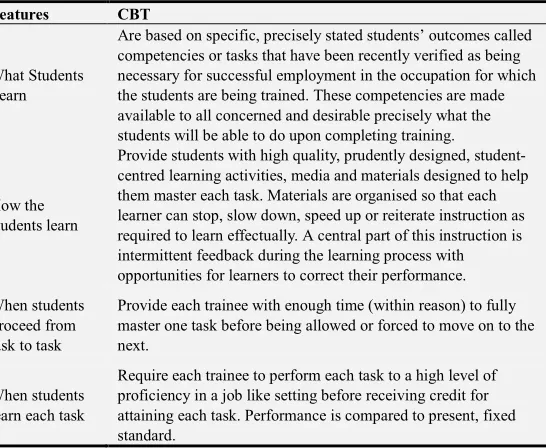
Brown explains the primary characteristics that distinguish between competency-based training and traditional training in Table 1 [26].
Table 1. Differences between CBT models and conventional Training.
Features CBT Traditional program
What Students Learn
Are based on specific, precisely stated students’ outcomes called competencies or tasks that have been recently verified as being necessary for successful employment in the occupation for which the students are being trained. These competencies are made available to all concerned and desirable precisely what the students will be able to do upon completing training.
Are usually based on textbooks, reference materials, course outlines or other sources removed from the occupation itself. Students rarely know what they will learn in each successive part of the program. The programs are usually built around chapters, units, blocks and other segments that have little meaning within the occupation. Instructors focus on covering material.
How the students learn
Provide students with high quality, prudently designed, student-centred learning activities, media and materials designed to help them master each task. Materials are organised so that each learner can stop, slow down, speed up or reiterate instruction as required to learn effectually. A central part of this instruction is intermittent feedback during the learning process with opportunities for learners to correct their performance.
Rely primarily on the instructors to personally deliver most of the instructions, lectures, discussions and other instructor centred learning activities. Learners have little or no control whatsoever over the pace of instruction, and usually, little periodic feedback on progress is given
When students Proceed from task to task
Provide each trainee with enough time (within reason) to fully master one task before being allowed or forced to move on to the next.
Usually, require a group of students to spend the same amount of time on each unit of instruction. The group then progress to the next unit after a fixed amount of time which may be too soon or not soon enough for many individual trainees.
When students learn each task
Require each trainee to perform each task to a high level of proficiency in a job like setting before receiving credit for attaining each task. Performance is compared to present, fixed standard.
Are highly reliant on paper and pencil tests and each student performance is usually compared to the group norm students are allowed (and usually forced) to move on to the next unit after only marginally mastering or even failing the current unit.
Source: Brown (1994)
2.4. The Practicality of Pattern Designing
Okabe et al., describe pattern designing as the creative process of all the stages of folding, cutting, copying, modifying and experimenting with the relevant basic blocks to obtain the first set of pattern pieces that reflect the fashion
the final design. Pattern making is thus a three-step process that covers fashion analysis, pattern design and pattern drafting [28].
In the analysis process, a new design is disintegrated into a basic style which closely resembles this new design and the new fashion features needed through appropriate classification of that garment type [30]. Pattern-making rules are then applied to subdivide this 3D garment design into
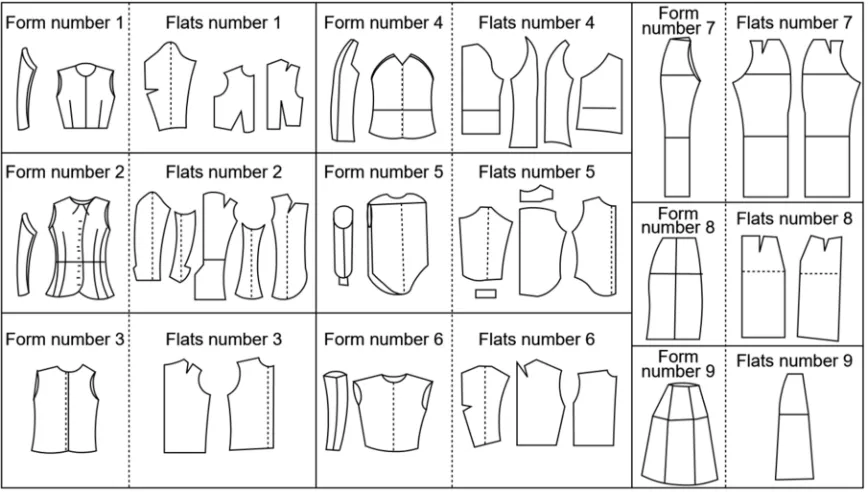
sections that are more easily spread into 2D pattern pieces. Subsequently, these pattern pieces are modified to take into account those new fashion features in the design. Only then are the pattern pieces drafted out. The basic style is made up of several sections of a garment that can easily be reduced to their secondary forms as illustrated in Figure 1. By implication, patternmaking requires a lot of applications and hands-on experiences.
Figure 1. Secondary forms Source: Willett 1990.
The pattern pieces of these secondary forms, known as secondary pattern pieces, usually have only the essential features of darts, pleats, flares and cuts added to the basic blocks to give the required shapes of those garment parts. As a result, they remain flexible enough to be used to generate slightly different fashion styles for that particular type of garment. Hence, to speed up the pattern-making process, some fashion designs can be better adapted from their secondary pattern pieces, instead of from their basic blocks. These are usually designs that have only minor variations in their fashion features from those of the corresponding secondary forms.
2.5. Conceptions of Competence
As Guthrie points out, on the surface, competence seems to be a simplistic concept [15]. However, it is conceptually far more complicated than people imagine. Much of the literature contends that competence is a comprehensive concept than the ability to execute workplace tasks. CBT often stresses work performance, and the outcomes of that which are observable, measurable and assessable. However, performance is founded on the constituents of competence: individually held abilities, knowledge and skills together underpin and facilitate performance [32]. Conceptually, therefore, the 'total' is better than the ‘sum of the parts’ [33].
Competence is, therefore, an ambiguous term, and the
ambiguousness reflects the conflation of distinct concepts and usages. If for nothing else, CBT attempts to close the gap between education and job expectations, but descriptions of competence may fail to reflect the complexities of 'competence' in work performance [34], [33]. As Lum explains, the assumption that human capabilities can be unequivocally described and accurately communicated using language is unfounded [35]. At best, written competency standards are ready and rough, though useful guides. Hence, one should be cautious in assuming that actual realities of what competence is are reflected in the words used to describe them.
Consequently, it is not the words that are important but what they denote, and the degree to which what they denote is commonly appreciated. These elusive characteristics of competence can present distinct challenges, one of the most notable is its assessment. As there is the tendency to concentrate more on tangible and the apparent and less on the underlying but possibly more critical attributes of competence [33].
3. Methodology
data from a sizeable population through the use of descriptive and/or inferential statistics [36]. They are popular and authoritative research strategy, affording researchers more control over the research process [37]. Again, since quantitative approaches support larger sample sizes, it translates into more generalizability over the population being studied [36]. Self-administered questionnaires were put together to gather data from the experiences of both students and their instructors on a host of issues relative to the origins and understanding of competency training models, approaches to competency models, processes involved in the making of apparels, as well as measures for the improvement of competencies. The purpose of the questionnaires was to garner quantitative data for further analysis. One benefit of
the quantitative approach is that the outcomes are valid, reliable and generalizable to a more significant population [37]. The quantitative approach was selected based on the nature of the study and its methodological foundation. This investigation attempts to assess competency training models and the teaching of apparel patternmaking in Ghana. The target study population was instructors and students of tertiary institutions in the country that offer higher fashion education. Consequently, the purposive sampling technique was used to select one hundred and nineteen respondents from four (4) institutions that offer higher fashion education. Purposive sampling is appropriate when the study aims to glean knowledge from targeted respondents deemed to have specific knowledge in the field of study [38-40].
4. Findings and Discussions
4.1. Identifying the Origins and Introduction of Competency-Based Training
Table 2. Identification of the origins and introduction of competency-based training.
Item Frequency (Percent)
1 2 3 4 5 µ ±SD
The training students receive, emphasises what they can do - - 9 (7.6) 31 (26.1) 79 (66.4) 4.59 .63 Instructors build students competence in what they learn - - - 27 (22.7) 92 (77.3) 4.77 .42 Instructors focus on what students have to do and not how they do it. - - 3 (2.5) 42 (35.3) 73 (61.3) 4.59 .54 Students learn at their pace and convenience 6 (5.0) 21 (17.6) 40 (33.6) 31 (26.1) 21 (17.6) 3.34 1.11
The focus is on performance - - 4 (3.4) 20 (16.8) 95 (79.8) 4.76 .50
Assessment is based on what students have done or achieved - - - 23 (19.3) 96 (80.7) 4.81 .40
1=strongly disagree 2=disagree 3=neutral 4= agree 5= strongly agree Source: Fieldwork (2018)
Table 2 presents a series of questions concerning the origins and introduction of competency-based training models into the tertiary education curriculum. Subject to the emphasis laid on training, the results show that more than half 79 (66.4%) of the respondents strongly agreed that the training they receive in their school places emphasis on what they can do. Additionally, 31 (26.1%) of the respondents supported this position by agreeing to that effect. However, the results on mean scores show that a mean score of m=4.59 with a standard deviation of.63 indicating the extent of dispersion away from the mean. From the above, the results give the impression that training in the Polytechnics emphasise more on what students can do.
Furthermore, the results on how instructors build students’ competencies in what they learn indicate that almost all the responses were towards the agreement end of the scale. The results demonstrate that about two-thirds 92 (77.3%) of the respondents strongly agreed whereas 27 (22.7%) of the respondents also agreed to that effect. Mean scores showed that the item obtained a mean value of 4.77 with a standard deviation of.42 indicating the extent of deviation away from the mean scores. By implication, the results prove that instructors at the various Polytechnics surveyed build students’ competencies in what they learn.
Results regarding instructors focusing on what students have to do and not how they do it demonstrates that the general trend of responses was towards the agreement end of
the scale. The results show that 73 (61.3%) of the respondents strongly agreed that instructors focus on what students have to do and not how they do it. Also, 42 (35.3%) of the respondents agreed in that regard. Mean and standard deviation scores (µ=4.59, ±SD=.54) shows that the majority of the responses were geared towards the agreement end of the rating scale. From the results, it can be concluded that instructors at the Polytechnics focus their attention on what students have to do and not how they do it.
With regards to students learning at their pace and convenience, again the results show a general trend of responses geared towards the agreement end of the scale. The majority 43 (36%) of the respondents agreed that students are allowed to learn at their pace and convenience. In support, 28 (23.5%) of the respondents strongly agreed to that effect. From the analysis, mean and standard deviation scores (µ=3.32, ±SD=1.41) showed that responses were centred on the midpoints of the rating scale. The results imply that the various Polytechnics practising competency-based training models allow their students to learn at their pace and convenience.
outcome of the results gives the impression that training in the respective Polytechnics implementing the competency-based training models focuses training on the performance of students.
That notwithstanding, concerning the student's assessment, the results show that more than two-thirds 96 (80.7%) of the respondents agreed strongly that in competency-based training, assessment of students is based on what they have
done or achieved. Likewise, 23 (19.3%) of the students also agreed. More so, the item obtained a mean score of (µ=4.81, ±SD=.40) indicating the trend of responses geared towards the agreement end of the scale. The results infer that institutions practising the competency-based training model assess their students based on what they have achieved.
4.2. Apparel Patternmaking Processes
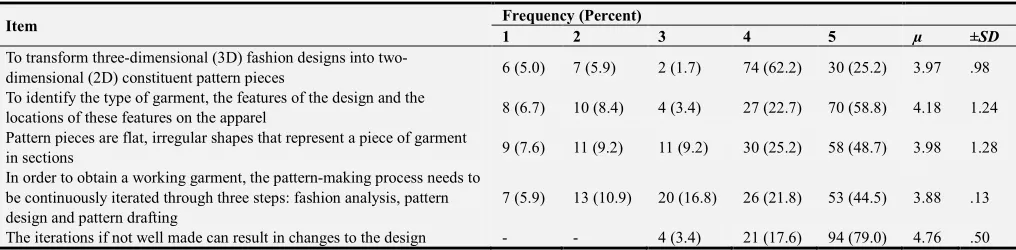
Table 3. Apparel patternmaking processes.
Item Frequency (Percent)
1 2 3 4 5 µ ±SD
To transform three-dimensional (3D) fashion designs into
two-dimensional (2D) constituent pattern pieces 6 (5.0) 7 (5.9) 2 (1.7) 74 (62.2) 30 (25.2) 3.97 .98 To identify the type of garment, the features of the design and the
locations of these features on the apparel 8 (6.7) 10 (8.4) 4 (3.4) 27 (22.7) 70 (58.8) 4.18 1.24 Pattern pieces are flat, irregular shapes that represent a piece of garment
in sections 9 (7.6) 11 (9.2) 11 (9.2) 30 (25.2) 58 (48.7) 3.98 1.28
In order to obtain a working garment, the pattern-making process needs to be continuously iterated through three steps: fashion analysis, pattern design and pattern drafting
7 (5.9) 13 (10.9) 20 (16.8) 26 (21.8) 53 (44.5) 3.88 .13
The iterations if not well made can result in changes to the design - - 4 (3.4) 21 (17.6) 94 (79.0) 4.76 .50
1=strongly disagree 2=disagree 3=neutral 4= agree 5= strongly agree Source: Fieldwork (2018)
Table 3 presents responses regarding a series of questions concerning how the various institutions surveyed organise their apparel pattern making processes. Respondents were asked whether they are able to transform three-dimensional (3D) fashion designs into two-dimensional (2D) constituent pattern pieces. Summary of the responses shows that more than half 74 (62.2%) of the respondents said they could transform three-dimensional (3D) fashion designs into two-dimensional (2D) constituent pattern pieces. Also, 30 (25.2%) of the respondents responded that to a very large extent they were able to transform 3D fashion designs into 2D constituent pattern pieces. Mean, and standard deviation scores (µ=3.97, ±SD=.98) shows that the majority of the respondents can a large extent transform three-dimensional (3D) fashion designs into two-dimensional (2D) constituent pattern piece. The results indicate that Polytechnic students are able to transform three-dimensional (3D) fashion designs into two-dimensional (2D) constituent pattern pieces.
Furthermore, on respondent’s ability to identify the type of garment, the features of the design and the locations of these features on the apparel; it could be observed from the results that more than half 70 (58.8%) of the respondents stated they are able to identify the garments, features of the design and also the locations of these features on the apparel. Also, 27 (22.7%) of the respondents responded they are to a large extent able to undertake the process. Mean and standard deviation scores (µ=4.18, ±SD=1.24) confirms that most of the respondents are to a large extent able to undertake the process. The results suggest that Polytechnic students can identify the type of garment, the feature of the design as well as the locations of these features on the apparel.
More so, the results demonstrate that nearly half 58 (48.7%) of the respondents agreed to a very large extent that
pattern pieces are flat, irregular shapes that represent a piece of garment in sections.
Likewise, 30 (25.2%) of the respondents agreed that to a large extent that pattern pieces are flat, irregular and come in shapes that represent a piece of garments in sections. Mean scores and standard deviation (µ=3.98, ±SD=1.28) confirms that the majority of the responses were around the ‘large extent’ side of the scale. The results imply that the students agreed that pattern pieces are flat, irregular and come in shapes that represent a piece of garments in sections.
Moreover, the majority 53 (44.5%) of respondents further agreed to a very large extent that to obtain a working garment; the pattern-making process needs to be continuously iterated through three steps: fashion analysis, pattern design and pattern drafting. Additionally, 26 (21.8%) of the respondents also agreed to a large extent in that regard. Mean, and standard deviation (µ=3.88, ±SD=.13) showed that the majority of the responses were geared towards the large extent end of the rating scale. This outcome suggests that students are aware of the fact that to obtain a working garment, the pattern-making process needs to be continuously iterated through three steps: fashion analysis, pattern design and pattern drafting.
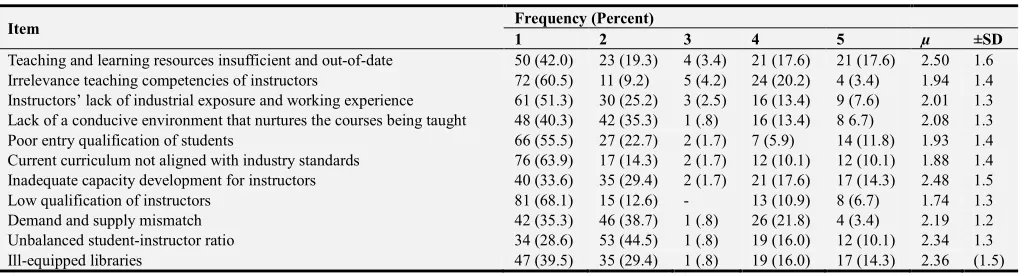
Table 4. Challenges hindering effective implementation of competency-based models.
Item Frequency (Percent)
1 2 3 4 5 µ ±SD
Teaching and learning resources insufficient and out-of-date 50 (42.0) 23 (19.3) 4 (3.4) 21 (17.6) 21 (17.6) 2.50 1.6 Irrelevance teaching competencies of instructors 72 (60.5) 11 (9.2) 5 (4.2) 24 (20.2) 4 (3.4) 1.94 1.4 Instructors’ lack of industrial exposure and working experience 61 (51.3) 30 (25.2) 3 (2.5) 16 (13.4) 9 (7.6) 2.01 1.3 Lack of a conducive environment that nurtures the courses being taught 48 (40.3) 42 (35.3) 1 (.8) 16 (13.4) 8 6.7) 2.08 1.3 Poor entry qualification of students 66 (55.5) 27 (22.7) 2 (1.7) 7 (5.9) 14 (11.8) 1.93 1.4 Current curriculum not aligned with industry standards 76 (63.9) 17 (14.3) 2 (1.7) 12 (10.1) 12 (10.1) 1.88 1.4 Inadequate capacity development for instructors 40 (33.6) 35 (29.4) 2 (1.7) 21 (17.6) 17 (14.3) 2.48 1.5
Low qualification of instructors 81 (68.1) 15 (12.6) - 13 (10.9) 8 (6.7) 1.74 1.3
Demand and supply mismatch 42 (35.3) 46 (38.7) 1 (.8) 26 (21.8) 4 (3.4) 2.19 1.2
Unbalanced student-instructor ratio 34 (28.6) 53 (44.5) 1 (.8) 19 (16.0) 12 (10.1) 2.34 1.3
Ill-equipped libraries 47 (39.5) 35 (29.4) 1 (.8) 19 (16.0) 17 (14.3) 2.36 (1.5)
1=strongly disagree, 2=disagree, 3=not sure, 4=agree, 5=strongly agree Source: Fieldwork (2018)
Table 4 presents the descriptive statistics of factors challenging the effective implementation of competency-based models in the Polytechnics. The respondents were requested to indicate whether they have challenges associated with teaching and learning resources. Responses to that effect indicate that 50 (42%) of the respondents strongly disagreed whereas 23 (19.3%) of the respondents disagreed that their institution has challenges as a result of insufficient and out-of-date teaching and learning resources. Also, mean and standard deviation scores (µ=2.50, ±SD=1.6) showed the general trend of the responses to the centre on the disagreement side of the rating scale. The outcome of the responses means that students do not think that their institution has sufficient teaching and learning resources for effective academic work.
Also, the respondents were asked whether their instructors demonstrate relevant teaching competencies. Summary of the responses depicts that more than half 72 (60.5%) of the respondents disagreed strongly whereas 11 (9.2%) of the respondents also disagreeing in that regard. However, 24 (20.2%) of the respondents agreed on the other hand that they regard their instructors to demonstrate irrelevant teaching competencies. From the mean and standard deviation scores (µ=1.94, ±SD=1.4) depicts that the responses were generally skewed towards the disagreement side of the rating scale. The outcome implies that fashion instructors at the Polytechnics do not demonstrate irrelevant teaching competencies in their respective lecture rooms.
Concerning responses to instructor’s lack of industrial exposure and working experience, it could be observed from Table 3 that just about half 61 (51.3%) of the respondents strongly disagreed whereas 30 (25.2%) of the respondents also agreed to that effect. The mean and standard deviation statistics of the responses establishes that generally, the responses were in favour of the disagreement side of the rating scale hence giving the impression that fashion instructors possess adequate industrial exposure as well as working experience.
Concerning poor entry qualification of students into the various fashion related programs at the Polytechnic, the responses suggest that about half 66 (55.5%) of the respondents strongly disagreed whereas 27 (22.7%) of the
respondents also agreed that poor entry qualification of students is a challenge to the effective implementation of competency-based models. Also mean statistics (µ=1.74, ±SD=1.3) showed that the responses were skewed towards the disagreement end of the rating scale which implies that poor entry qualification of students does not affect the effective implementation of competency-based models.
Regarding the notion of unbalanced student-instructor ratio in the polytechnics as a challenge, the responses to the item point out that the majority 53 (44.5%) of the respondents agreed. This position was supported by 34 (28.6%) of the respondents when they also disagreed strongly. The mean and standard deviation scores (µ=2.34, ±SD=1.3) of the items shows that the responses were clustered around the agreement point of the rating scale.
5. Discussion
5.1. Origins, Introduction and Understanding of Competency-Based Training Models in Ghana
Despite significant recent media and public policy attention, competency-based education and training is not a new concept [14]. It has evolved from early vocational training models to more robust and sophisticated approaches to learning in higher education. Modern competency-based education and training movements began with efforts to reform teacher education and training in the 1960s [41].
Findings from the literature indicate that the performance of Polytechnic graduates in the Ghanaian labour market is woefully inadequate [42]. There were skills deficiencies in most study programmes. It is in the light of these that the COTVET was established in 2006 among other things to ensure the introduction of an industry-driven TVET system in Ghana.
Production of Fashion and Textiles’ was commenced in 2004/2005 and was successfully piloted and appraised in October 2009. A preliminary investigation revealed that the new HND CBT Fashion and Textiles curricular had insufficiencies in practical expertise. Stakeholders identified this deficiency during the last assessment of three years of piloting the curricular at Accra Polytechnic.
These findings are in line with COTVET’s (2010) assertion that TVET reforms (CBT) propose a broad-based set of activities aimed at creating effective linkages between industry and the TVET system so that it can afford access to lifelong learning for all Ghanaians. The reform intends to utilise Competency-Based Training as the principal means of obtaining adequate linkage between institutions and the industry.
Also, findings from the study indicate that students understood competency-based training models in the Polytechnic as teaching that focuses on what students have to do and not how they do it. The results also imply that the various Polytechnics practising competency-based training models allow their students to learn at their pace and convenience. Also, Polytechnics implementing the competency-based training models focused training on the performance of students. The results again infer that institutions practising the competency-based training model assess their students based on what they have achieved.
5.2. The Gaps That Exist Between Desired Competencies Needed for Teaching the Subject Efficiently and the Challenges Affecting Instructor’s Competencies
One of the biggest challenges confronting the higher education system in Ghana is the competencies required for teaching efficiently. Therefore, the skills of graduates are most of the time misaligned with the changing needs of students, industry and society. The findings of the study indicate that regarding competencies desired for effective teaching and learning, instructors in the Polytechnics design and implement developmentally appropriate and challenging learning experiences for students. Instructors also implement multiple methods of assessments to engage and monitor the progress of their students.
Fashion instructors again ensure that there is inclusive learning in which the environment is created in such a way that each learner is enabled to meet high standards of achievements. What is more, the fashion instructors do well to find connections in concepts they teach while implementing differing perspectives to engage learners in critical thinking, creativity and collaborative problem-solving. It was further discovered that fashion instructors at the Polytechnics plan instruction to effectively enable students to meet the demands of achieving learning goals. That notwithstanding, instructors at the various Polytechnics surveyed made an effort to work with others to create the enabling environment to support individual student learning and collaboratively as well.
The findings indicate that there is a significant relationship between pattern development techniques and instructors’ competences. Concerning approaches to teaching apparel
pattern making, it was discovered that Polytechnic students are able to transform three-dimensional (3D) fashion designs into two-dimensional (2D) constituent pattern pieces. Also, students are able to identify the type of garment, the feature of the design as well as the locations of these features on the apparel. The findings again suggest that students agreed that pattern pieces are flat, irregular and come in shapes that represent a piece of garments in sections.
Nonetheless, students are aware of the fact that to obtain a working garment; the pattern-making process needs to be continuously iterated through three steps: fashion analysis, pattern design and pattern drafting. The outcomes coincide with the observations of Pierce that pattern making techniques are critical to a fashion designer’s concept being made into a garment [44]. Pierce further notes that the techniques serve the purpose of creating a style pattern that can be used to construct the designer’s concept [44]. It is imperative to point out that without the utilisation of these techniques, it is almost impossible for a new fashion design concept to be made into a wearable garment.
Stanley buttresses the points that, the one fervent wish of students of apparel design and pattern making is to translate their designs into finished garments as speedily as possible [4]. Pierce notes that apparel pattern making techniques are critical to the fashion designer’s concept that is being made into a garment [44]. The outcome of the study indicates that instructors’ competencies in apparel pattern making are considered important as they define students’ disposition towards the subject.
Also, it was discovered that majority of the instructors of apparel pattern making in the Polytechnics do not have training in the area of pattern making specifically. Hence, the shortfall in their teaching methods which subsequently leads to the inadequacy of students’ skills in the course. These discoveries agree with the findings of Boateng & Ofori-Sarpong in their study of ‘An analytical study of the labour market for graduates in Ghana’ [46]. They observed from employers that most of the graduates lacked core competencies to complete a simple routine assignment. As a result, some employers take prospective employees through more extended orientation and probation schemes after which the best performing candidates are selected.
Like other professional institutions, Polytechnic education in Ghana was established to provide career-focused education, skill training and opportunities for conducting practical research in collaboration with business and industry. However, a report by the JICA on the TVET in Ghana revealed that the curricula and modes of teaching in the Polytechnics are more theory-oriented with theory-based [43]. Given these realities, innovation in instruction in the polytechnics is needed to bring out new teaching methods that will lead to better outcomes and performance of learners. Such outcomes include relevant knowledge and skills and competencies of instructors.
pattern making has duly changed to accommodate the unique competency requirements necessary for effective teaching and learning of pattern making in the various Polytechnics. Pattern making is a distinct concept in fashion which demands carefully mastery of the various aspects in order to perfect competencies.
On students’ assessment under CBT, it was discovered that appraisal is based on learning outcomes specified in the learning unit specifications developed for each course. Consequently, in competency-based, training assessment refers to collecting evidence of a learner’s performance on which an assessor determines whether or not or the extent to which a learner has met the performance requirements of the learning outcome laid in a particular unit. A decision is then made based on this judgement as to whether a learner has achieved a learning outcome as a whole or not. From the findings, it can be concluded that generally, TVET education in the various Polytechnics is facing various challenges that are preventing it from making the desired impacts as expected. Mostly, the Polytechnics are challenged by infrastructural inefficiencies to facilitate the implementation of the competency models.
6. Conclusions
There is an urgent need to enhance pedagogical training to the distinctive nature of TVET by recognizing authentic teaching and learning whereby real industry working environment can be replicated in a school setting or by affording more opportunities to collaborate and utilize the workplace as a learning station. Using competency models and incorporating project and problem-based training are timely momentarily as the demand from industry for specialized skills and employable skills are becoming more apparent and stringent. The adoption of vocational pedagogy copulated with the use of technology is worth exploring.
Furthermore, a model of pedagogical competence of pattern making instructors will provide an instrument to reflect the quality of professional performance of these instructors and the quality of their education. It will also contribute to shaping the initial and in-service fashion design instructor’s education, particularly in setting the objectives of their education and training. It will again promote the establishment and improvement of policies regarding TVET, in particular, the policies facilitating the initial establishment and development of TVET educational systems in Ghana. Finally, it will help in suggesting a tool to pattern making instructors to self-evaluate, control and improve their competencies and set their professional objectives to meet the needs of their learners.
References
[1] Spöttll, G., (2009). Teacher education for TVET in Europe and Asia: The comprehensive requirements. Journal of Technical Education and Training, 1 (1), p. 1-16.
[2] Atchoarena, D., & Delluc, A. (2002). Revisiting Technical and Vocational Education in SubSaharan Africa: An Update on Trends, Innovations and Challenges. New Trends in Technical and Vocational Education. Paris: UNESCO-IIEP.
[3] Bünning, F., Gleißner, K. Jing, M. & Yang, S. (2011). Initiatives to foster Chinese TVET and TVET Teacher Training. Magdeburg, Germany: UNVEOC Centre.
[4] International Labour Office (ILO). (2010). Teachers and trainers for the future–Technical and vocational education and training in a changing world. Report for discussion at the Global Dialogue Forum on Vocational Education and Training Geneva: ILO.
[5] International Labour Office (ILO) (2008). Conclusions on skills for improved productivity, employment growth and development. International Labour Conference, 97th Session, Geneva: ILO.
[6] Bunning, F. (2007). Approaches to Action Learning in Technical and Vocational Education and Training (TVET)
Journal of Sociology, 53 (1), 18–31.
[7] Pongo N. A. & Obinnim, E. (2015). Changing Landscape of Industry Practice: The Role of Quality Technical Vocational Education and Training in Ghana. Arts and Design Studies, Vol. 33, pp. 1–8.
[8] UNESCO (2001). Revised Recommendation concerning Technical and Vocational Education. UNESCO General
Conference Paris: Available at
http://portal.unesco.org/en/ev.php-URL_ID=13145&URL_DO=DO_TOPIC&URL_SECTION= 201.html.
[9] Grootings, P. & Nielsen, S. (Eds). (2005). ETF Yearbook 2005-Teachers and trainers: Professionals and stakeholders in the reform of vocational education and training. Turin: European Training Foundation.
[10] Adotey, J. A., Obinnim, E. & Pongo, N. A (2016). Quality Assurance and Higher Fashion Education in Ghana: Examining the Contemporary Quandary. International Journal of Vocational Education and Training Research. 2 (6), pp. 39-48. [11] Axmann, M. (2004). Facilitating labour market entry for youth
through enterprise-based schemes in vocational education and training and skills development, InFocus Programme on Boosting Employment through Small Enterprise Development Working Paper No. 48, Geneva; ILO.
[12] Johanson, R. K. & van Adams, A. (2004). Skills Development in Sub-Saharan Africa. Washington, DC: World Bank. http://publications.worldbank.org/ecommerce/catalog/product ?item_id.
[13] Obinnim, E. & Pongo, N. A. (2015). The Significance of Flat Pattern Making in Fashion Designing. International Journal of Innovative Research in Science, Engineering and Technology. 4 (4), pp. 1850–1857.
[14] Ford, K. (2014). Competency-Based Education: History, Opportunities, and Challenges. Turin: UNESCO.
[15] Guthrie, H. (2009). Competence and competency-based training: What the literature says. National Centre for Vocational Education Research.
[17] NCVER (National Centre for Vocational Education Research (2004). Profiling the national vocational education and training workforce, Adelaide: NCVER.
[18] Keating, J. (2008). Current Vocational Education and Training Strategies and Responsiveness to Emerging Skills Shortages, A Well-skilled Future–Tailoring VET to the Emerging Labour Market, Adelaide. NCVER.
[19] UNESCO-UNEVOC. (2012). Strengthening TVET teachers’ education. UNESCO-UNEVOC International Centre for Technical and Vocational Education and Training. http://www.unevoc.unesco.org/fileadmin/userupload/docs/Syn thesisreport_eForum TVETTeachers.pdf.
[20] The World Bank (1991) Vocational Education and Training: A World Bank Policy Paper. (Washington DC, the World Bank. [21] Saluja, S. (1993). Workshop on curriculum development in
technical and vocational education.
[22] Earnest, J. (2001). Competency-based Engineering Curricula.
An Innovation approaches. From:
www.inner.org/welcome.htm/icee-2001.
[23] Perry, J. & William, G. (1998). How to Develop Competency-based vocational education. Florida: Praken publication. [24] Brown, P., Lauder, H. & Ashton, D. (2008). Education,
Globalisation and the Future of the Knowledge Economy.
Europeans Educational Research Journal, 7 (2), 131-156. [25] World Bank. World Development Report, 2007.
[26] Brown, M., (1994). A Collection of Readings Related to Competency Based Training. Victoria: Deakam University. [27] Okabe, H., Imaoka, H., Tomika, T. & Niwaya, H. (1992).
Three-dimensional apparel CAD system. Computer Graphics, 26 (2), pp. 105-10.
[28] Kopp E., Rolfo, V., Zelin, B. & Gross, L., (1984). How to Draft Basic Patterns. New York: Fairchild Publications. [29] Joseph Armstrong, H. (2010). Patternmaking for Fashion
Design. New Jersey: Pearson Education Inc.
[30] MacDonald, N. M. (2010). Principles of Flat-Pattern Design (4th edn.) New York: Fairchild Books.
[31] Willett, S., (1990). Syntax and semantics of an image communications language for design management. Design Theory and Methodology, DTM 1990, presented at the 1990 ASME design technical conferences–2nd International Conference on Design Theory and Methodology, Chicago, IL, 16-19 September, pp. 27-32.
[32] Schofield, K & McDonald, R. (2004). Moving on: Report of the high-level review of training packages, Melbourne: Australian National Training Authority.
[33] Harris, R. Guthrie, H. Hobart, B. & Lundberg, D. (1995). Competency-based education and training: Between a rock and a whirlpool. Melbourne: Macmillan.
[34] Le Diest, F. & Winterton, J. (2005). What is competence?
Human Resource Development International, 8 (1), pp. 27-46. [35] Lum, G. (1999). Where’s the competence in competency-based education and training? Journal of Philosophy of Education, 33 (3), pp. 403–18.
[36] Leavy, P. (2017). Research Design: Quantitative, Qualitative, Mixed Methods, Arts-Based, and Community-Based Participatory Research Approaches. Guilford Press.
[37] Creswell, R. (2014). Research design: qualitative, quantitative, and mixed methods approaches. USA: Sage Publications. [38] Zhi., H. L. (2014). A comparison of convenience sampling
and purposive sampling. PubMed, 105-11.
[39] Battaglia, M. P. (2008). Non-Probability Sampling. Encyclopedia of Survey Research Methods. 2008. SAGE Publications, 1-4.
[40] Oppong, S. H. (2013). The problem of sampling in qualitative research. Asian journal of management sciences and education, 1-9.
[41] Hodge, S. & Harris, R. (2012). Discipline, governmentality and 25 years of competency-based training. Studies in the Education of Adults, 44 (2), pp. 155-170.
[42] Boahin, P., Kamphorst, J. C. & Hofman. W. H. A. (2010). Tracer study on the performance of polytechnic graduates in Ghanaian labour market. Accra, Ghana.
[43] Japan International Cooperation Agency (JICA) (2001). Report of the Study for Development of a Master Plan to Strengthen Technical Education in the Republic of Ghana. Accra: National Council for Tertiary Education.
[44] Pierce, S. (2010). Fashion designing techniques (Online). http://www.ehow.com/way_5505420_fashion-designing-techniques.html#ixzz1ALnOrZoE.
[45] Stanley, H. (1999). Flat pattern cutting and modelling for fashion (3rd ed.). United Kingdom: Stanley Thornes (Publishers) Ltd.