Vol.9 (2019) No. 3
ISSN: 2088-5334
The Influence of Type of Solvent and Extraction Temperature
of Corn Silk Extracts
Haslina
#, Novizar Nazir
*, Sri Budi Wahjuningsih
#, Dewi Larasati
# #Faculty of Agriculture Technology, Semarang University, Semarang 50196,Central Java, Indonesia. Email:[email protected], [email protected], [email protected]
*
Faculty of Agricultural Technology, Universitas Andalas, Padang, West Sumatra 25163, Indonesia. Email:[email protected]
Abstract— Corn silk has not been well-utilized. Actually it has the capacity to develop into functional food because it contains bioactive compounds and high natural antioxidant such as flavonoids and phenolics and positive effects on human health. There are several factors that influence the quality of corn silks extracts, including ratio (raw:solvents) and extraction temperature. This research was couducted to determine the influence of ratio (raw:solvent) and extration temperature of corn silk extracts. The experimental design used Randomized Block Design (RBD) which consisted of two factors and 3 replications. The first factor was type of solvent. All treatment use (raw:solvents) ratio at (1:4). The first factor consists P1=raw:ethanol (1:4)(w/v), P2=raw:methanol (1:4)(w/v), P3=raw:ethyl acetate (1:4)(w/v), and P4=raw:acetone (1:4)(w/v). and the second factor was extraction temperature that consists S1=60°C, S2=70°C, and S3=80°C. Data were analyzed with analysis of variance, followed by Duncan Multiple Range Test (DMRT) test at 5% significant level. Parameters of chemical analysis were included (water, ash, protein, fat, and carbohyrate), and phytochemical analysis were included (total phenol, total flavonoid, activity antioxidant, beta carotene, and vitamin C). The results showed that the type of solvent and extraction temperature of corn silk extracts have significantly effect on water, ash, protein, fat, and, total phenol, total flavonoid, activity antioxidant, beta carotene, and vitamin C. Methanol solvent and extraction temperature at 60°C is the best treatment which have the highest protein and the lowest fat content at 18.22%±1.13 and 0.17%±0.02 respectively, and the highest total phenol, total flavonoid, activity antioxidant, beta carotene, and vitamin C at 8216.89±132.39 μgGAE/g; 234.29±3.98
μgGAE/g; 215.27ppm±3.87; 80.80%±1.84; and 8.84%±0.45 respectively. Keywords— local corn silk; extract; type of solvents); extraction temperature.
I. INTRODUCTION
As a global staple food, more than half of the world's population considers rice as a staple food. Main rice consumption in Asia, South America, and Sub-Saharan Corn silk is a parts of corn which has not been used effectively, because it has not been well-utilized. It contains antioxidant compounds that are beneficial to the human health. In addition to containing antioxidant compounds, it has potential as traditional medicine. Based on research, it contains sitosterol and stigmasterol, alkaloids, saponins,
tannins, flavonoids, steroids, protein, carbohydrates,
vitamins, salts, calcium potassium, magnesium, sodium, and essential oils [1]. Different from previous researcher, Bisma local variety of Indonesia have corn silk approximately at 80-90 days (mature), contain water at 11.58%; fat at 0.30%; ash at 3.29%; protein at 17.70%; and carbohydrate at 67.13%; total phenol at 8262.93 µgGAE/g; total flavonoids
at 236.03 μgGAE/g; beta sitosterol at 1343.93 ppm; and 75% activity antioxidant [2].
Bioactive compound of corn silk can be obtained by extraction. There are several factors that influence the extraction method namely type solvent, ratio yield weight to volume solvent, temperature, speed stirring, time, tangent to solids, frequency, concentration, particle size, and pH [3;4,5]. One method that is often used to extract bioactive components is maceration method which has advantages such as workmanship and types of tools used are simple, operational cost are relatively low, and can avoid damage to compounds that are thermo-labile [6].
Antioxidant components extracted from corn silk using methanol and water with the amount of polyphenol content in methanol and water extracts each being at 272.81 mgGAE/100g and 256.36 mgGAE/100mg (dry) [9].
Acetone is the most effective solvent for extracting antioxidants from foxtail millet (a type of cereal) compared to water, ethanol, propanol, and methanol [10]. Combination of ethyl acetate (EtO-Ac):water (85:15) solvent produced total flavonoids four times greater than acetone solvents in extracting organic compounds from grape seeds [11]. 50% (v/v) ethanol solvent as the most effective for polyphenols seed grape extraction compared to acetone and water for all concentrations [12], methanol 70% (v/v) chose, with a ratio at 10:1 (v/w) for materials for the same purpose and material [13]. In extracting seeds papaya recruitsusing ethanol, acetone, and ethyl acetate. The best treatment was obtained from the type of solvent which produced the highest total phenol obtained in ethanol solvents [14]. This research was conducted to determine the influence of type of solvent and extraction temperature of corn silk extracts to produce the best characteristics of corn silk extracts.
II. MATERIAL AND METHODS
A. Materials
Fresh corn silk age 70 days were collected from local farmers in Pati, Central Java, Indonesia. Chemicals Folin-Ciocalteu reagent (Merck), sodium carbonate (≥ 99%,
Merck), aluminum chloride (99%, Ferak) were purchased and used without further purification. 2,2-Diphenyl-1-picrylhdrazyl (DPPH, Aldrich), ethanol, methanol, ethyl acetate, and acetone (≥80%, Merck), gallic acid (≥99%,
Sigma®), rutin (≥ 94%, Sigma®).
B. Equipments
Some equipment used are becker glass, blender, waterbath, spectrophotometer, pH meter, oven, Whatman filter paper 1, rotary flash evaporator, Folin-Ciocalteu colorimetric, and some glassware for analysis.
C. Preparation
Fresh corn silk weighing 3g, was washed with distilled water, dried in an oven at 60°C for 24h [9] until the final moisture content was 10-11%, ground into a powder using a grinder, and then it dissolved with the proportion of raw and solvent is 1:4 (w/v) at room temperature for 24 hours by maceration. The extraction is done at 70°C with water bath shaker. 1.5 hours later filtered off the dregs. Separation of solvent with rotary flash evaporator at 60°C [15]. Dissolve residue with 5 ml methanol, store temperature at 0-4oC.
D. The Experimental Design
The experimental design used Randomized Block Design (RBD) which consisted of two factors and 3 replications. The first factor was the type of solvent that consists P1=raw:ethanol (1:4)(w/v), P2=raw:methanol (1:4)(w/v), P3=raw:ethyl acetate (1:4)(w/v), and P4=raw:acetone (1:4)(w/v). and the second factor was the temperature of extraction that consists S1=60°C, S2=70°C, and S3=80°C. Data were analyzed with analysis of variance, followed by Duncan Multiple Range Test (DMRT) test at 5% level.
E. Analysis
Chemical analysis was performed on water and ash content using oven method [16], protein content using Micro Kjeldahl method [16], fat content using Soxhlet [16], carbohydrate using carbohydrate by difference [16], and phytochemicals of corn silk (total phenol) [17], flavonoids [18], vitamin C [16], beta carotene [19], and activity antioxidant [18].
III. RESULT AND DISCUSSIONS
A. Chemical Content of Corn Silk
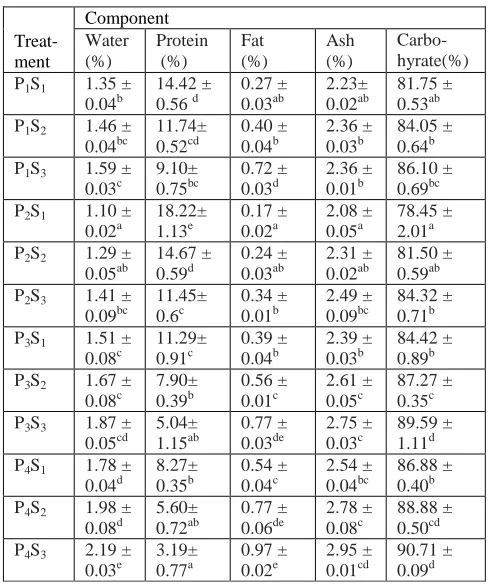
Different in ratio (raw:solvent) and extraction temperature to chemical content of corn silk extracts as shown in Table 1. Table 1 shows that the methanol solvent and extraction temperature at 60°C showed the highest protein and the lowest fat content at 18.22%±1.13 and at 0.17% 0.02 respectively. Methanol solvent and extraction temperature at 60°C (P2S1) produced the highest protein content that is equal to 18.22% and the lowest ratio (raw:acetone) and extraction temperature at 80°C (P4S3) of 3.19%. The increasing extraction temperature decreases the protein content of corn silk extracts. The protein solubility generally increases when the temperature rises from 0 to 40°C, and the longer of time dissolution, the contact between the solute and solvent is longer, so that many solutes are taken [20].
TABLEI
CHEMICAL ANALYSIS OF CORN SILK EXTRACT
Treat- ment Component Water (%) Protein (%) Fat (%) Ash (%) Carbo-hyrate(%) P1S1 1.35 ±
0.04b
14.42 ± 0.56 d
0.27 ± 0.03ab 2.23± 0.02ab 81.75 ± 0.53ab P1S2 1.46 ±
0.04bc 11.74± 0.52cd 0.40 ± 0.04b 2.36 ± 0.03b 84.05 ± 0.64b P1S3 1.59 ±
0.03c 9.10± 0.75bc 0.72 ± 0.03d 2.36 ± 0.01b 86.10 ± 0.69bc P2S1 1.10 ±
0.02a 18.22± 1.13e 0.17 ± 0.02a 2.08 ± 0.05a 78.45 ± 2.01a P2S2 1.29 ±
0.05ab 14.67 ± 0.59d 0.24 ± 0.03ab 2.31 ± 0.02ab 81.50 ± 0.59ab P2S3 1.41 ±
0.09bc 11.45± 0.6c 0.34 ± 0.01b 2.49 ± 0.09bc 84.32 ± 0.71b P3S1 1.51 ±
0.08c 11.29± 0.91c 0.39 ± 0.04b 2.39 ± 0.03b 84.42 ± 0.89b P3S2 1.67 ±
0.08c 7.90± 0.39b 0.56 ± 0.01c 2.61 ± 0.05c 87.27 ± 0.35c P3S3 1.87 ±
0.05cd 5.04± 1.15ab 0.77 ± 0.03de 2.75 ± 0.03c 89.59 ± 1.11d P4S1 1.78 ±
0.04d 8.27± 0.35b 0.54 ± 0.04c 2.54 ± 0.04bc 86.88 ± 0.40b P4S2 1.98 ±
0.08d 5.60± 0.72ab 0.77 ± 0.06de 2.78 ± 0.08c 88.88 ± 0.50cd P4S3 2.19 ±
0.03e 3.19± 0.77a 0.97 ± 0.02e 2.95 ± 0.01cd 90.71 ± 0.09d Description: Ratio (raw:solvent):P1=raw:ethanol (1:4) (w/v), P2= raw:methanol (1: 4) (w /v), P3= raw:ethyl acetate (1: 4) (w/v), and P4= raw:acetone (1: 4) (w/v). Extraction temperature: S1=60°C, S2=70°C, and S3=80°C
temperature used, the fat damage will increase. Essential fatty acids are isomerized when heated in alkaline solutions and sensitive to light, temperature and oxygen. The process of fat oxidation can cause inactivation of its biological functions and can even be toxic. Apart from fat being damaged by oxidation, fat can also be damaged by hydrolysis [21].
B. Phytochemical Content of Corn Silk Extract
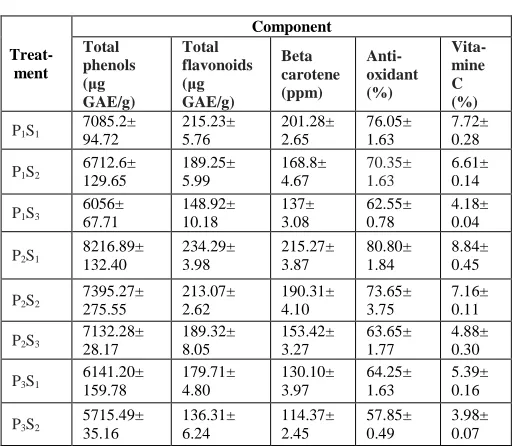
The type of solvent and extraction temperature affect significantly phytochemical content of corn silk extracts as shown in Table 2.
1) Total Phenol
Methanol solvent and extraction temperature at 60°C affect (p<0.05) the content of total phenol of corn silk extracts. Table 2 and Figure 1, it can be seen that methanol solvent and extraction temperature at 60°C (P2S1) results in the highest total phenol and acetone solvent and extraction temperature at 90°C (P4S1) resulted in the lowest total phenol. The results of this study are different from those reported by Ref. [5], that to extract soursop leaves using the best ultrasonic treatment at ratio of material and solvent at 1:10 and extraction time at 20 minutes. Empirically, methanol is the most efficient solvent for the extraction of simple phenolic compounds. For phenolic compounds that are more complex (larger molecular weight) acetone-water (aqueous acetone) is used [22]. The solubility of a substance into a solvent is largely determined by the suitability of the properties between the solute and the solvent which is the nature of like dissolve like which is caused by its polarity [23]. The higher ratio of ingredients and solvents, the level higher of phenolic avocado seed extracts will be the higher. [24]. Methanol is used as a solvent, because it is able to dissolve almost all organic compounds both polar, semi-polar and non-semi-polar. Phenol or phenyl alcohol is still one group of compounds with methanol, so its solubility is very suitable, and this compound is not resistant to hot temperatures because it has a low vapor point.
TABLEII
PHYTOCHEMICAL ANALYSIS OF CORN SILK EXTRACT
Treat-ment
Component Total
phenols (μg GAE/g)
Total flavonoids (μg GAE/g)
Beta carotene (ppm)
Anti- oxidant (%)
Vita-mine C (%)
P1S1 7085.2±
94.72
215.23± 5.76
201.28± 2.65
76.05± 1.63
7.72± 0.28
P1S2 6712.6±
129.65
189.25± 5.99
168.8± 4.67
70.35± 1.63
6.61± 0.14
P1S3 6056±
67.71
148.92± 10.18
137± 3.08
62.55± 0.78
4.18± 0.04
P2S1 8216.89±
132.40
234.29± 3.98
215.27± 3.87
80.80± 1.84
8.84± 0.45
P2S2
7395.27± 275.55
213.07± 2.62
190.31± 4.10
73.65± 3.75
7.16± 0.11
P2S3 7132.28± 28.17 189.32± 8.05 153.42± 3.27 63.65± 1.77 4.88± 0.30
P3S1 6141.20±
159.78
179.71± 4.80
130.10± 3.97
64.25± 1.63
5.39± 0.16
P3S2
5715.49± 35.16
136.31± 6.24
114.37± 2.45
57.85± 0.49
3.98± 0.07
P3S3
4827.26± 148.85
121.10± 4.35
90.96± 4.82
43.95± 1.20
1.68± 0.19
P4S1
4717.52± 146.08
116.31± 5.83
97.33± 1.14
41.99± 3.22
3.29± 0.15
P4S2 3368.35± 83.17 100.57± 2.91 73.66± 2.05 32.37± 1.17 2.31± 0.20
P4S3 2645.73±
1785.40
69.21± 5.49
49.12± 1.15
20.71± 3.27
1.63± 0.16 Description: Ratio (raw:solvent): of P1=raw:ethanol (1:4) (w/v), P2= raw:methanol (1: 4) (w /v), P3= raw:ethyl acetate (1: 4) (w/v), and P4= raw:acetone (1: 4) (w/v). Extraction temperature: S1=60°C, S2=70°C, and S3=80°C
Fig 1. Total fenol
The increase in extraction temperature needs to be considered properly. The higher extraction temperatures and longer extraction time exceed the time limit can cause removal of compounds in the solution due to the evaporation, in addition bioactive components such as flavonoids do not hold high temperatures, thus undergoing structural changes and producing low extracts [25].
2) .Total Flavonoid
Type of solvent and extraction temperature at 60°C affect (p<0.05) the content of total flavonoid corn silk extract. The biggest corn silk of flavonoid contents was produced by methanol solvent and extraction temperature at 60°C (P2S1). Flavonoids are included in phenolic compounds, the solvents whose polarity is the same as flavonoids are methanol, resulting in high flavonoids. Flavonoids are heat resistant and easily oxidized at high temperatures. Flavonoids will be degraded at temperatures above 100°C [26]. Flavonoids are sensitive to heat, because groups hydroxyl and ketone, and unsaturated double bonds [27].
3) Activity of antioxidant
Methanol solvent and extraction temperature at 60°C affect (p<0.05) the antioxidant activity corn silk extracts. Table 2 and Figure 3 shows that, methanol and extraction temperature at 60°C results in higher antioxidant activity than others. The high total phenol and total flavonoids in corn silk extracts showed high activity of antioxidant. There is a relationship between the ability of phenol compounds as antioxidants and their chemical structure [28]. The configuration and total group hydroxyl is the basis that influences greatly the mechanism of its activity as an antioxidant activity. There is a good correlation between total flavonoids and activity antioxidant, where the higher the total flavonoids and the stronger antioxidant activity [29]. There is a positive correlation between antioxidant activity and the content of polyphenol compounds [30
4) Beta Carotene
Type of solvent and extraction temperature at 60°C affect (p<0.05) the content of beta carotene of corn silk extracts. This occurs because the soluble phenol compounds are affected by the polarity of solvent, while the power antioxidant of the solvent is affected by compounds which are soluble in the mixture.
Fig 3. Antioxidant Activity
Fig 4. Beta carotene
Antioxidant compounds besides phenolic include
alkaloids, vitamin C, vitamin E, and beta carotene etc. [31]. Carotenoids are yellow, red and orange pigments in plants. Carotenoids can function as precursors of vitamin A and antioxidants. Carotene has properties that are very susceptible to oxygen, heat, light, and are not stable under conditions acidic [32]. Table 2 and Figure 4 shows that type of solvent and extraction temperature at 60°C produces the highest levels of beta carotene. This is because beta carotene is a group of antioxidants, it is directly proportional to
activity antioxidant. High temperatures are a factor that causes thermal degradation which will damage carotene resulting in carotene decomposition.
5) Vitamin C
Methanol solvent and extraction temperature at 60°C affect (p<0.05) the content of vitamin C corn silk extracts. This is directly proportional to the level of antioxidants, because vitamin C is part of antioxidant compounds. Vitamin C is an electron donor and reducing agent. Antioxidants are called, because by donating electrons, this vitamin prevents other compounds from being oxidized. However, vitamin C itself will be oxidized in the antioxidant process, resulting in dehydroascorbic acid [33]. Vitamin C is included in antioxidants so it can not stand at high temperatures. This is because low temperatures can inhibit respiration, enzyme activity, and metabolic reactions.
Fig 5. Vitamin C
IV. CONCLUSIONS
The type of solvent and extraction temperature will affect the extraction process of corn silk. Methanol solvent and extraction temperature at 60°C is the best treatment which contain the highest protein and the lowest fat content at 18.22%±1.13 and 0.17% 0.02 respectively. It also have the highest total phenol, total flavonoid, activity antioxidant, beta carotene, and vitamin C at 8216.89 ±132.39μgGAE/g;
234.29±3.98 μgGAE/g; 215.27ppm±3.87; 80.80%±1.84, and
8.84%±0.45 respectively.
REFERENCES
[1] J. Guo, T. Liu, L. Han, and Y. Liu. The effect of corn silk on glycaemic metabolism. Journal of Nutrition and Metabolism Biomed Central, vol. 6, p.47. 2009.
[2] Haslina, D.Praseptiangga D, V.P. Bintoro, B.Pujiasmanto. Chemical and phytochemical characteristics of local corn silk powder of three different varieties. International Journal of Advanced Science Engineering Information Technology 7 (5) p: 1957-1963. 2017. [3] Distantina. Larutan perendaman terhadap kecepatan ekstraksi dan
sifat gel agar-agar dari rumput laut Gracilana verrulosa. Jurnal Rekayasa Proses 2:11-16. 2008.
[4] K.K. Chew, S.Y. Ng, Y.Y Thoo, M.Z.. Khoo, W.M Wan Aida, and C.W Ho. Effect of ethanol concentration, extraction time, and extraction temperature on the recovery of phenolic compounds and antioxidant capacity of Centella asiatica extracts. International Food Research Journal 18:571-578. 2011.
[6] Y.Mukraini. Ekstraksi, pemisahan senyawa identifikasi senyawa bioaktif. Jurnal Kesehatan 7(2) p:361-367. 2014.
[7] D.T. Wahyuni dan S.B. Widjanarko. The effect of different solvent and extraction time of carotenoids extract from pumpkin with ultrasonic Jurnal Pangan dan Agroindustri 3(2) p:390-401. 2014. [8] J. Tong-Wei, X Jian, W. Xiao-Meng, C. Xue-Song, and Q Zhi-Dong.
Screening of active ingredient of stigmata maydis inhibitor xanthine oxidase and its effect. Journal of Jilin University Medicine Edition 37(3):433-436. 2011.
[9] A.R. Nurhanan, W.I.W. Rosli, and S.S.J. Mohsin. Total polyphenol content and free radical scavenging activity of corn silk (Zea mays hairs). Sain Malysiana 40 (2) p:155-161. 2012.
[10] M.L. Bangora, J. Nsor-Atindana, and Z.H. Ming. Solvent optimization extraction of antioxidants from foxtail millet species’ insoluble fibers and their free radical scavenging properties. Food Chem 141 p:736-744. 2013.
[11] G..K Jayaprakasha, R.P. Singh, and K.K. Sakariah. Activity antioxidant of grape seed (Vitis vinera) extracts on peroxidantion models in vitro. Food Chem 73 (3) p:285-290. 2001.
[12] B. Vayupharp and V. Laksanalamai. Rocovery of antioxidants from grape seeds and its application in fried. J.Food Processing & Technology. 2012.
[13] A. Selcuk, O. Ozden, and N. Erkan. Effect of frying, grilling, and steaming on amino acid composition of marine fishes. J. Med. Food 13(6) p:1524-1531. 2010.
[14] Y.G. Purwaningdyah, T.D.Widyaningsih, and N.Wijayanti. Efektivitas ekstrak biji pepaya sebagai antidiare pada mencit. Jurnal Pangan dan Agroindustri 3(4) p:1283-1293. 2015.
[15] Q. L. Hu, L. Zhang, J. Li, Y. N. Ding, and F. L. Li. Purification and antifatigue activity of flavonoids from corn silk, International Journal of Physical Sciences, vol 5 p:321-326. 2011.
[16] Association of Official Analytical Chemist (AOAC). Official method 980.17 preservatives in ground beef spectrophotometric method. USA:AOAC International. 2007.
[17] E. Candesa and L. Parker. Handbook of Antioxidant. 2nd ed., New York, NY: Marcell Dekker Inc. 2002.
[18] J. Liu, C. Wang, Z. Wang, C. Zhang, S. Lu, and J. Liu. The antioxidant and free-radical scavenging activities of extract and fractions from corn silk (Zea mays L) and related flavone glycosides, Food Chemistry vol. 126 p:261-269. 2011.
[19] N.Yinusa, I. George, R.G. Ayo, and Y. Rufai. Vacuum liquid chromatographic isolation and characterization of beta-sitosterol from the bark of Sarcocephalus latifolius (Smith Bruce), Journal of Chemistry and Chemical Sciences 5 (9) p:480-488. 2015.
[20] E.Kurniati. Pembuatan konsentrat protein dari biji kecipir dengan penambahan HCl. Jurnal Penelitian Ilmu Teknik 9(2) p:115-122. 2009.
[21] N.S.Palupi, F.R. Zakaria, dan E. Prangdimurti. The effect of processing on the nutritional value of food. Topic 8. ENBP e-learning module. Department of Food Science and Technology Fateta-IPB. Bogor. 2007.
[22] D.Wazir, A.Syahida, M.Radzali, M.Maziah, and M.Y.Shukor. Antioxidant activities of different parts of Gnetum gnemon L. Journal Plant Biochemistry and Biotechnology. 2011.
[23] B. Sultana, F. Anwar, and Przybylski. Activity antioxidant of phenolic components in bark of Azadirachta indica, Terminalia arjuna, Acacia nilotica dan Eugenia jambolana Lam trees. Food Chemistry 104 p:1106-1114. 2007.
[24] Rivai, I. W.R.Widarta, dan K.A. Nosianitri. Pengaruh jenis fenolik dan aktivitas antioksidan ekstrak biji alpukat (Persia americano Mill). Jurnal ITEPA 7(2) p:22-32. 2018.
[25] A.M. Ibrahim, Yunita, dan H.S. Feronika.Pengaruh suhu dan lama waktuekstraksi terhadap sifat kimia dan fisik pada pembuatan minuman sari jahe merah dengan kombinasi penambahan madu sebagai pemanis. Jurnal Pangan dan Agroindustri. 3 (2) p:530-541.2015.
[26] S.Lenny. Senyawa flavonoid, fenilpropanoida dan alkaloida. Fakultas MIPA, USU. 2006.
[27] L.Y.Qiao, R.Sun, Chen, Y.Fu, W.Zhang, X.Li, J.Chen, Y.X.Shen, and Ye. Sonochemical effects on 14 flavonoids common in citrus. Relation to stability. Plos ONE 9 (2):e87766. 2014.
[28] A.Miryati, L.Sapei, K.Budiono, dan S.Indra. Ekstraksi antioksidan dari kulit buah manggis (Garcinia mangostana L). Universitas Katolik Parahyangan, Bandung. 2011.
[29] C. Perwiratami, M.Suzery, and B.Cahyono.Korelasi total fenolat dan total flavonoid dengan antioksidan dari beberapa sediaan ekstrak buah tanjung (Mimusoup elengi) 7(1) p:34-38. 2014.
[30] S.Ogawa. Studies on Activity antioxidant in Japanese Edible Seaweeds. Tesis. Tokyo University of Fisheries, Tokyo. 2003. [31] H. Rivai, E.Widiya, and Rusdi. The effect of comparison of
ethanol-water treatment areas of total phenolate compounds and power antioxidants of extract of sirsak leaf (Annona muricata L.). Fakultas Farmasi Universitas Andalas, Padang, Jurnal Sains dan Teknologi Farmasi 18(1) p:35-42. 2013.
[32] A.M. Legowo, Nurwantoro, dan Sutaryo. Analisis Pangan. Fakultas Peternakan Universitas Diponegoro, Semarang p:22-24. 2005. [33] S.J. Padayatty, A.Katz, Y.Wang, and M. Levine. Review vitamin C