PREDICTION OF LEARNING DIFFICULTIES
WITH THE TEST OF COMPLEX IMITATION OF MOVEMENT
Tjaša Filipčič, Martina Ozbič
Faculty of Education, University of Ljubljana, Ljubljana, Slovenia
Submitted in December, 2008
Developmental Coordination Disorder (DCD) is one of all of the heterogeneous range of developmental disor-ders aff ecting the initiation, organization and performance of actions. It is often being overlooked in school practice and in everyday work with children. Therefore, the aim of this article is to draw attention to this problem and prove how children with DCD can be easily recognized by teachers of diff erent subjects. Especially PE teachers are those who can recognize pupils with learning diffi culties, in informal tasks, and later on organize appropriate intervention. A quicker prognosis can lead to faster intervention resulting in the progress of children with DCD in their movement abilities. This research has shown that on the basis of twenty tasks of the Bergès-Lézine’s test of the complex imitation of movement/gestures, we can predict which children have some learning diffi culties and which do not. Particularly we wish to emphasize three tasks (12, 17 and 20) where children had to cross the vertical midline of their bodies. These three tasks involve bilateral coordination. Children with DCD signs face problems in spatial orientation and in complex imitation of movement/gestures. On the basis of great diff erences, found in tasks where pupils had to cross the vertical midline of their bodies and rotate their palms, children can be classifi ed into two groups (with and without motor and learning diffi culties).
Keywords: DCD, learning diffi culties, manual constructional dyspraxia.
INTRODUCTION
Movement is very important during a child’s devel-opment. It shapes their bodies’ scheme, their sense of time and space, their planning ability and adaptability. It is based on self esteem, acquirement of self confi dence and personal motor skills, as well as progressive knowl-edge in motor learning and knowlknowl-edge of cooperation, mutual and self respect and consideration of diversity. Sometimes a child’s motor development is not in pro-portion with his/her general development. This can be recognized by parents and/or by teachers, especially those of physical education, or by other school experts. These children can have Developmental Coordination Disorder (DCD), also known as Developmental Dyspraxia (Kirby, 2005). It can be recognized in chil-dren who experience movement diffi culties and who are without any known medical condition or identifi able neurological disease (American Psychiatric Association, 2000). The specifi c manifestations of the disorder are varied and pervasive including both gross and fi ne mo-tor skills (Visser, 2003). These problems make a child’s day to day activities (such as dressing/undressing, tying shoe laces, doing up a button and writing), as well as sports activities (such as skipping and ball dribbling), extremely diffi cult. Therefore, in comparison with older children, the lack of diff erent movement abilities can
be observed. In a way these characteristics may be rec-ognized as motor immaturity. Often the problems de-scribed are associated with yet other diffi culties (such as dropping objects, frequent falls, fi ne motor skills prob-lems, sensor integration, visual perception, reading and writing diffi culties). Gross motor skills problems occur in an overfl ow of energy spent for the practice of even such a basic skill as standing upright (Williams, Fisher, & Tritscher, 1983). In addition to that, problems occur in jumping, roller-skating, accurate throwing of diff erent objects; and especially in the simultaneous coordination of hands with diff erent or identical motor patterns. Even more problems appear with the timing of movement/ gestures. Children experience lack of balance, rhythm and spatial orientation, as well as fear of heights and climbing. The realization of the complex movement/ gesture is not problematic, however the problem is in its planning.
them were presented in the introduction (body scheme problems, lack of balance and coordination, diffi culties with time and spatial orientation, problems with timing, and so on). All these skills infl uence a child’s ability to master reading, writing and mathematical reasoning. They are also an important factor which determines school success. Therefore, PE and other teachers can be the fi rst ones who recognize diff erent learning diffi cul-ties and other problems at school. Previous researchers (Henderson & Hall, 1982; Sugden & Wright, 1998) did not answer the following question: Can manual practise tests help to predict learning diffi culties?
In some cases there are no major problems with the simple movements/gestures observed. Diffi culties in reading and writing, in complex motor tasks or in diffi -cult motor coordination are observed much later during the school period. Deconinck et al. (2006) divided the underlying causes of the motor impairment into two main lines. The fi rst line focuses on the sensory infor-mation process prior to and during the motor response, while the second focuses on the motor component itself. Visuospatial processing (Wilson & McKenzie, 1998) and kinesthetic perception (Smyth & Mason, 1997) as well as cross modal perception were found to contrib-ute to motor coordination impairment in children with DCD. Children with DCD are by defi nition delayed in the results of norm referenced motor tests (BOTMP – Bruininks, 1987; Movement ABC – Henderson & Sugden, 1992). It is to be mentioned that these tests measure the outcome of the movement rather than how the movement was performed. Motor problems are usu-ally associated with lack of satisfaction in movement. It is not surprising, therefore, that children with DCD tend to participate less in social activities than do other children (Chen & Cohn, 2003), especially when the task is of a motor practical nature. Here the environment plays an important role.
The fi rst persons who can recognize a child with DCD at his/her school are teachers and in particular, teachers of PE class. They can observe a child in his/ her complex motion involving diffi cult coordination as well as time and space oriented tasks. A dance/rhyth-mic gymnastics/aerobics teacher can observe a child’s sense for rhythm and a music teacher can observe his/ her coordination when playing diff erent instruments. Teachers can encourage children to participate in vari-ous sports activities. However, unlike other conditions such as muscular dystrophy or cerebral paralysis, DCD is often not recognized by parents or primary school teachers as a condition requiring intervention or special assessment. Children with DCD are often observed to be clumsy, unmotivated and lazy. Their problems are often assumed to be the result of other conditions such as ADD or a learning disability. Cairney, Hay, Faught, Corna and Flouris (2006) named children with DCD
as “hidden cohorts” and at risk of social exclusion. By experience the condition of DCD is often overlooked in the school fi eld and it could be very effi cient and useful to screen pupils during their PE lessons in the fi rst or second class of elementary school.
The purpose of this research was to present a rela-tively simple way for predicting DCD in the children ob-served. These asks, based on the Bergès-Lézine’s test of the complex imitation of movement, can be used by pri-mary school teachers (as well as PE teachers) in order to recognize pupils with learning diffi culties. Based on simple imitation, the tasks can help to expose the ones with specifi c problems, such as dyslexia, dyscalculia, dysortographia etc. as well as those without. A quicker prognosis can lead to faster intervention and progress in the development of children with DCD.
The aim of this research was also to fi nd prediction variables. The following hypothesis was exposed: Based on some variables of the complex movement/gestures imitation of the Bergès-Lézine’s test (1972) it is possible to predict the classifi cation of children into two groups: those with learning diffi culties and those without.
METHOD SUBJECTS
Children from the fi rst triad of the Slovenian pri-mary school in Italy participated in this research. In total, 46 children were tested (52.2% boys and 47.8% girls). Their average was 9 years (SD = 1.572). Chil-dren with intellectual disabilities were excluded from the research.
The control group presented 35 children (48.57% boys and 52.94% girls) aged 9.6 years on the average (SD = 1.46). No coordination problems nor learning difficulties were observed beforehand in this group. The experimental group presented 11 children (72.73% boys and 27.27% girls) aged 8.1 years on the average (SD = 1.49). These children were chosen by their teach-ers who observed and reported coordination problems and learning diffi culties. The two groups present inde-pendent variables in our research.
PROCEDURES
The second part of the Bergès-Lézine’s test (1972 in Išpanović-Radojković, 1986) was used. The 20 diff erent tasks are suitable for children aged 6 to 10 years of age. These 20 tasks examine:
b) coordination of directions in space, control of par-ticular body parts, and the ability to asymmetrically use their hands (tasks number 5, 8, 10, 12, 14, 17, 19, 20),
c) recognition of the fi ngers as a base of a global model where cognitive presentation is needed (tasks num-ber 11, 13, 15, 16, 18).
Each child’s execution was numerically evaluated with a zero (failed) or 1 point (passed). Thus 20 depend-ent variables were exposed (berg1–berg 20). Children were assessed during PE classes.
METHODS OF DATA ANALYSIS
Descriptive statistics, the K–S normal distribution test and regression analysis with step wise methods were used. Data were processed with the statistical pro-grammed package SPSS for Windows (release 13.0).
RESULTS
Cronbach’s Alpha coeffi cient shows a relatively reli-able internal consistency of the test (0.756). The regres-sion analysis (step wise method) was used. Of complex hand gesture imitation possibilities, 20 variables were
included. Three variables entered the discriminant anal-ysis: bergb 12, bergb 17 and bergb 20 (Sig. 0.000) (TA-BLE 1). The value of R and R2 increases from the fi rst
to the third model whereas standard error decreases. All three tasks represent hand coordination where cross-ing the vertical midline of the body is involved. They examine coordination of directions in space, control of particular body parts/limbs, and the ability to asym-metrically use their hands.
In addition, TABLE 1 shows that 46.3% of variance is explained by prediction variables. This means that almost 50% of the explained variance is conditioned by practical variables. The unexplained part of the vari-ance can be attributed to the following factors: verbal memory, phonological awareness, attentional disorders, dysortographia, etc.
TABLE 1
Summary of regression analysis
Model R R square Adjusted R square of the estimateStd. error
1 .550 .302 .286 .364
2 .670 .449 .423 .328
3 .706 .499 .463 .316
TABLE 2
Diff erences between experimental and control group
Model Sum of squares df Mean square F Sig.
1 Regression 1.210 1 1.210 7.440 .009
Residual 7.159 44 .163
Total 8.370 45
2 Regression 1.858 2 .929 6.135 .005
Residual 6.512 43 .151
Total 8.370 45
3 Regression 4.173 3 1.391 13.923 .000
Residual 4.196 42 .100
Total 8.370 45
TABLE 3
Prediction of classifi cation into experimental or control group
Model Unstandardized coeffi cients Standardized coeffi cients
B Std. error Beta t Sig.
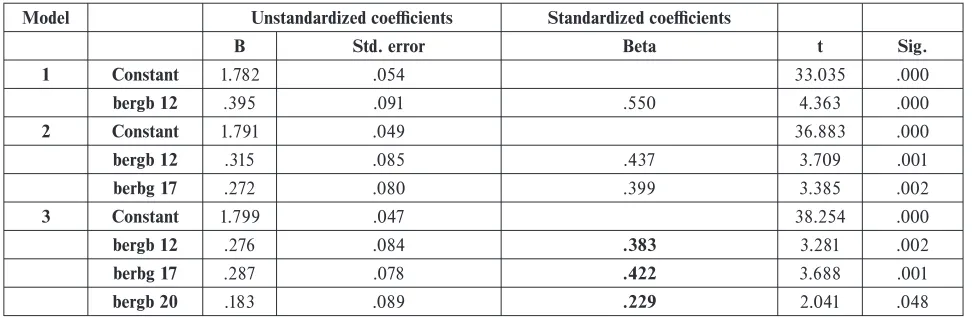
1 Constant 1.782 .054 33.035 .000
bergb 12 .395 .091 .550 4.363 .000
2 Constant 1.791 .049 36.883 .000
bergb 12 .315 .085 .437 3.709 .001
berbg 17 .272 .080 .399 3.385 .002
3 Constant 1.799 .047 38.254 .000
bergb 12 .276 .084 .383 3.281 .002
berbg 17 .287 .078 .422 3.688 .001
The third model (TABLE 2) at sig. = 0.000 shows that the dependent variable classifi es pupils into two groups; the F value increases from model 1 to model 3 up to the value of 13.923. ANOVA shows that there are signifi cant diff erences between the groups.
The equation constant + 0.383 bergb 12 + 0.422 bergb 17 + 0.229 bergb 20 (TABLE 3) predicts clas-sifi cation into the experimental or control group. Tasks 12 and 17 (sig. < 0.005) show the highest statistical signifi cance, whereas task 20 has the lowest statistical signifi cance (sig. < 0.05).
DISCUSSION AND CONCLUSIONS
For suffi cient and quality prediction three variables used in the regression analysis (step wise method) of the second part of the Bergès-Lézine’s test, are important: bergb 12, bergb 17 and bergb 20 (Fig. 1). All of the three variables represent tasks where hands needed to be crossed; in tasks 12 and 17 intertwining of fi ngers was demanded, while in task 20, palm rotation was needed. All of the three tasks represent a complex structure where crossing the vertical midline of the body is in-volved. The above tasks are in connection with bilateral coordination (i.e. coordinated activities of the left and right side of the brain).
Good coordination of the two body sides is an im-portant foundation for writing with pencils and cutting with scissors. Children learn to coordinate their body sides when they play with toys (for example threading beads, assembling Lego cubes, skipping rope and play-ing rhythmic games over a rope) or ridplay-ing a bicycle as suggested in Chen and Cohn (2003).
The ability to coordinate the right and left side of the body and to cross the midline of the body is an in-dication that both sides of the brain are working well to-gether and sharing information effi ciently. Coordination of the two body sides is an important foundation for the development of many gross and fi ne motor skills. It is essential for the development of cerebral specialization for the skilled use of a dominant hand. A child with poor coordination of the two body sides may adjust his/ her body to avoid crossing the midline. He/she may not
be able to coordinate one hand’s movement while the other is acting as an assistant to ease the eff ort. A child may switch hands when performing a fi ne motor task because he/she is experiencing frustration. Namely, in this case, skilful use of both hands is simultaneously needed.
Based upon the results of the complex imitation of the movement/gestures of the Bergès-Lézine’s test,the classifi cation of pupils with and without DCD is pos-sible. We can adopt the following hypothesis: the vari-ables of the imitation of the movement/gestures of the Bergès-Lézine’s test are good prediction variables for classifi cation into groups.
The results of this research have practical value. The biggest problem was observed in pupils’ mental involvement and consequently in their motor perform-ance. Therefore, pupils faced problems with their body scheme and coordination, as well as in spatial percep-tion. As a result of these problems, learning diffi culties can occur. With the systematic testing of pupils with the Bergès-Lézine’s test, problems in visual perception and in cognitive reasoning can be detected.
Children with DCD signs face problems in spatial orientation and in the complex imitation of movements/ gestures. On the basis of differences found in tasks where pupils had to cross the vertical midline of the body and rotate their palms, children can be distributed into two groups (with and without motor and learning diffi culties). School teachers, especially PE teachers, are those who can predict learning diffi culties in pupils, in informal tasks, and later on organize appropriate physi-cal activities.
REFERENCES
American Psychiatric Association. (2000). Diagnostic and statistical manual of mental health disorders (6th
ed.). Washington, DC: Author.
Bergès, J., & Lézine, I. (1972). Test d’imitation de gestes. Paris: Masson.
Bruininks, R. H. (1987). Bruininks–Oseretsky test of mo-tor profi ciency: Examiner’s manual. Circle Pines, MN: American Guidance Service.
Fig. 1
Cairney, J., Hay, J., Faught, B. E., Corna, L. M., & Flouris, A. D. (2006). Developmental coordination disorder, age and play: A test of divergence in ac-tivity defi cit with age hypothesis. Adapted Physical Activity Quarterly, 23, 261–276.
Chen, H., & Cohn, E. S. (2003). Social participation for children with developmental coordination disorder: Conceptual evaluation and intervention considera-tions. Physical and Occupational Therapy in Pediat-rics, 23, 61–78.
Deconinck, F. J. A., Savelsbergh, G. J. P., Van Coster, R., Oostra, A., Dewitte, G., & Lenoir, M. (2006). Adaptations to task constraints in catching by boys with DCD. Adapted Physical Activity Quarterly, 23, 14–30.
Henderson, S. E., & Hall, D. (1982). Concomitants of clumsiness in young schoolchildren. Developmental Medicine and Child Neurology, 24, 448–460.
Henderson, S. E., & Sugden, D. A. (1992). Movement assessment battery for children. London: The Psycho-logical Corporation.
Išpanović-Radojković, V. (1986). Nespretno dete: Poremečaji praksije v detinjstvu. Beograd: Zavod za udžbenike i nastavna sredstva.
Kirby, A. (2005). Dyspraxia: Developmental coordination disorder (6th ed.). A Condor Book, Souvenir press
(E & A) Ltd.
Smyth, M. M., & Mason, U. C. (1997). Planning and execution of action in children with and without de-velopmental coordination disorder. Journal of Child Psychology Psychiatry, 38, 1023–1037.
Sugden, D. A., & Wright, H. C. (1998). Motor coordi-nation disorders in children. London: Sage Publica-tions.
Visser, J. (2003). Developmental coordination disorder: A review of research on subtypes and comorbidities. Human Movement Science, 22, 479–493.
Williams, H. G., Fisher, J., & Tritschler, M. (1983). De-scriptive analysis of static postural control in 4–6 and 8 year old motorically awkward children. Ameri-can Journal of Physical Medicine, 62, 12–26.
Wilson, P. H., & McKenzie, B. E. (1998). Information processing defi cits associated with developmental coordination disorder: A meta analysis of research fi ndings. Journal of Child Psychology Psychiatry, 39, 829–840.
PREDIKCE PORUCH UČENÍ POMOCÍ TESTU KOMPLEXNÍ IMITACE POHYBU
(Souhrn anglického textu)
Vývojová porucha motorické koordinace (DCD) je součástí heterogenní skupiny vývojových poruch a postihuje iniciaci, organizaci a provádění činností. Ve školské praxi i v každodenním životě s dětmi je často přehlížena. Proto si tento článek klade za cíl upozornit na tento problém a ukázat, jak mohou vyučující v růz-ných předmětech děti s DCD snadno rozpoznat. Žáky s poruchami učení mohou rozpoznat zejména vyučující tělesné výchovy při neformálních úkolech a tito mohou později iniciovat příslušnou intervenci. Rychlá prognóza může vést k rychlejší intervenci, což vede ke zlepšení pohybových dovedností u dětí s DCD. Tento výzkum prokázal, že na základě dvaceti úkolů testu Bergès-Lé-zine pro komplexní imitaci pohybu/gest můžeme určit, které z dětí mají určité poruchy učení a které ne. Chce-me zejména vyzdvihnout tři úkoly (12, 17 a 20), při kterých děti musejí protnout vertikální osu svých těl. Tyto tři úkoly zahrnují oboustrannou koordinaci. Děti s příznaky DCD mají problémy s prostorovou orientací a komplexní imitací pohybu/gest. Na základě velkých rozdílů, nalezených při úkolech, kdy žáci musí protnout vertikální osu svých těl a otáčet dlaně, lze děti rozdělit do dvou skupin (s motorickými poruchami a poruchami učení a bez nich).
Tjaša Filipčič, Ph.D.
University of Ljubljana Faculty of Education Kardaljeva ploščad 16 1000 Ljubljana Slovenia
Education and previous work experience
She is an assistant at the Faculty of Education in Ljublja-na (Slovenia) at Department of Special Education. In 1996 she started to work in diff erent areas of adapted sport, such as recreation, elite sport and also research work. She is a promoter of wheelchair tennis and also a fi rst coach of this sport in Slovenia. She published one book and several scientifi c articles. Her research activi-ties are focused on adapted physical activity and tennis. She fi nished Faculty of Sport and EMDAPA study in Leuven (Belgium). In 2008 she had fi nished Doctoral study at the Faculty for Sport in Ljubljana, Slovenia.
First-line publications
Filipčič, A., Filipčič, T., Leskošek, B. (2004). The infl uence of tennis motor abilities and basic anthro-pometric characteristics on the competition success-fulness of young tennis players. Kinesiol. slov., 10(1), 16–26.
Filipčič, A., Filipčič, T. (2005). The infl uence of tennis motor abilities and anthropometric measures on the competition successfulness of 11 and 12 year old female tennis players. Acta Universitatis Palackianae Olomucensis. Gymnica, 35(2), 35–41.
Pinter, S., Filipčič, T., Šolar, A., Smrdu, M. (2005). Integrating children with physical impairments into sports activities: A “golden sun” for all children? J. Philos. Sport, 32(2), 147–154.
Filipčič, A., Filipčič, T. (2005). The relationship of tennis specifi c motor abilities and the competition effi ciency of young female tennis players. Kinesiology, 37(2), 164–170.