VOLUME NO. 7 (2017), ISSUE NO. 08 (AUGUST)
ISSN 2231-5756
A Monthly Double-Blind Peer Reviewed (Refereed/Juried) Open Access International e-Journal - Included in the International Serial Directories
Indexed & Listed at:
Ulrich's Periodicals Directory ©, ProQuest, U.S.A., EBSCO Publishing, U.S.A., Cabell’s Directories of Publishing Opportunities, U.S.A., Google Scholar, Open J-Gage, India [link of the same is duly available at Inflibnet of University Grants Commission (U.G.C.)],
VOLUME NO. 7 (2017), ISSUE NO. 08 (AUGUST)
ISSN 2231-5756
INTERNATIONAL JOURNAL OF RESEARCH IN COMMERCE, IT & MANAGEMENT
CONTENTS
Sr.
No.
TITLE & NAME OF THE AUTHOR (S)
Page
No.
1.
ADAPTATION LEVEL OF GREEN SUPPLY CHAIN PRACTICES: AN EMPIRICAL STUDY OF INDIAN
AUTOMOBILE SECTOR
DR. SHIVANI SHARMA & DR. V. K. JAIN
1
2.
LEASING: A SOLUTION TO CREDIT RATIONING
MANDEEP KAUR & DR. POOJA MISHRA
5
3.
A STUDY ON THE RELATIONSHIP BETWEEN FOREIGN DIRECT INVESTMENT AND ECONOMIC GROWTH
WITH SPECIAL EMPHASIS TO FOREIGN TRADE AND GROSS DOMESTIC PRODUCT
MANINDER KAUR & RITU PRIYA
10
4.
PERFORMANCE MANAGEMENT: IMPLICATIONS FOR POTENTIAL WAGE CAPPING AT RAKSHITH
HOSPITAL, CHENNAI
V.CHANDIRAVATHANAN & DR. S. POUGAJENDY
15
5.
EMPOWERMENT OF WOMEN THROUGH CREATING AWARENESS TRAINING ON VALUE ADDITION OF
NUTRICEREALS FOODS
DR. S. GANAPATHI & A.THANAGM
19
6.
MERGER & ACQUISITION IN THE INDIAN CONTEXT: THE IMPACT ON SHAREHOLDER VALUE
S. GOWRI & DR. S. POUGAJENDY
22
7.
CHALLENGES OF CHANGE MANAGEMENT ON SERVICE DELIVERY IN THE ADMINISTRATION POLICE
SERVICE IN MURANGA COUNTY
DR. JOHN WEKESA WANJALA, CLIFFORD G. MACHOGU, DR. RICHARD JUMA OTIENO & NELLY AYABEI
25
8.
A STUDY ON ELECTRONIC-HUMAN RESOURCE MANAGEMENT AND ITS STRATEGIES: LITERATURE
REVIEW
MONALISHA PATEL & SUNIL DHAL
31
9.
AN EMPIRICAL STUDY ON ROLL AND PERFORMANCE OF MSMEs IN INDIA
B R MURTHY, G MANJULA & G NARAYANA SWAMY
37
10.
UNDERSTANDING CUSTOMER SATISFACTION OF INTERNET BANKING: A CASE STUDY IN UTTRAKHAND
DR. PRIYANKA AGARWAL
39
11.
A STATISTICAL STUDY ON ADVERTISING EFFECTIVENESS OF COLD DRINKS IN CHINNATHIRUPATHY,
SALEM DISTRICT
M.VALAVAN
44
12.
PRIVATE LIFE INSURANCE INDUSTRY: AN OVERVIEW
MONA JINDAL
46
13.
IMPACT OF INSTITUTIONAL FINANCE ON BORROWERS CONCERNED WITH PRIORITY SECTOR
DR. POONAM NAGPAL, PRACHI GUPTA & SHACHI GUPTA
51
14.
RURAL MARKETING IN INDIA
DR. MIRDULESH SINGH & ANKIT KUMAR KATIYAR
55
15.
GREEN BANKING: AN APPROACH TOWARDS ENVIRONMENT CONSERVATION
VANDANA SONI & DR. B. B. PANDEY
59
16.
OPPORTUNITIES AND CHALLENGES OF E-ADVERTISING: THE CONSUMERS’ PERSPECTIVE
DR. SEEMA SINGH & SARIKA AHLLUWALIA
63
17.
A STUDY ON EMPLOYEES SATISFACTION TOWARDS E-HRM IN PRIVATE SECTOR BANKS
DR. P. KANNAN & D. MOHANA PRIYA
72
18.
PERFORMANCE ESCALATION THROUGH SUPPLIER RELATIONSHIP PRACTICES (SRP)
RAJEEV KUMAR
76
19.
WORKING OF NEURONS IN ARTIFICIAL NEURAL NETWORKS
MAMTA SHARMA
82
20.
STUDY ON INDIAN BANKS USING GREEN BANKING
NEHA CHOUDHARY
86
VOLUME NO. 7 (2017), ISSUE NO. 08 (AUGUST)
ISSN 2231-5756
CHIEF PATRON
Prof. (Dr.) K. K. AGGARWAL
Chairman, Malaviya National Institute of Technology, Jaipur
(An institute of National Importance & fully funded by Ministry of Human Resource Development, Government of India)
Chancellor, K. R. Mangalam University, Gurgaon
Chancellor, Lingaya’s University, Faridabad
Founder Vice-Chancellor (1998-2008), Guru Gobind Singh Indraprastha University, Delhi
Ex. Pro Vice-Chancellor, Guru Jambheshwar University, Hisar
FOUNDER PATRON
Late Sh. RAM BHAJAN AGGARWAL
Former State Minister for Home & Tourism, Government of Haryana
Former Vice-President, Dadri Education Society, Charkhi Dadri
Former President, Chinar Syntex Ltd. (Textile Mills), Bhiwani
FORMER CO-ORDINATOR
Dr. S. GARG
Faculty, Shree Ram Institute of Business & Management, Urjani
ADVISOR
Prof. S. L. MAHANDRU
Principal (Retd.), Maharaja Agrasen College, Jagadhri
EDITOR
Dr. R. K. SHARMA
Professor & Dean, Bharti Vidyapeeth University Institute of Management & Research, New Delhi
CO-EDITOR
Dr. BHAVET
Faculty, Shree Ram Institute of Engineering & Technology, Urjani
EDITORIAL ADVISORY BOARD
Dr. S. P. TIWARI
Head, Department of Economics & Rural Development, Dr. Ram Manohar Lohia Avadh University, Faizabad
Dr. CHRISTIAN EHIOBUCHE
Professor of Global Business/Management, Larry L Luing School of Business, Berkeley College, USA
Dr. SIKANDER KUMAR
Chairman, Department of Economics, Himachal Pradesh University, Shimla, Himachal Pradesh
Dr. JOSÉ G. VARGAS-HERNÁNDEZ
Research Professor, University Center for Economic & Managerial Sciences, University of Guadalajara,
Gua-dalajara, Mexico
Dr. M. N. SHARMA
Chairman, M.B.A., Haryana College of Technology & Management, Kaithal
Dr. TEGUH WIDODO
Dean, Faculty of Applied Science, Telkom University, Bandung Technoplex, Jl. Telekomunikasi, Indonesia
Dr. M. S. SENAM RAJU
Professor, School of Management Studies, I.G.N.O.U., New Delhi
Dr. CLIFFORD OBIYO OFURUM
Professor of Accounting & Finance, Faculty of Management Sciences, University of Port Harcourt, Nigeria
Dr. KAUP MOHAMED
VOLUME NO. 7 (2017), ISSUE NO. 08 (AUGUST)
ISSN 2231-5756
INTERNATIONAL JOURNAL OF RESEARCH IN COMMERCE, IT & MANAGEMENT
SUNIL KUMAR KARWASRA
Principal, Aakash College of Education, ChanderKalan, Tohana, Fatehabad
Dr. MIKE AMUHAYA IRAVO
Principal, Jomo Kenyatta University of Agriculture & Tech., Westlands Campus, Nairobi-Kenya
Dr. SYED TABASSUM SULTANA
Principal, Matrusri Institute of Post Graduate Studies, Hyderabad
Dr. NEPOMUCENO TIU
Chief Librarian & Professor, Lyceum of the Philippines University, Laguna, Philippines
Dr. SANJIV MITTAL
Professor & Dean, University School of Management Studies, GGS Indraprastha University, Delhi
Dr. ANA ŠTAMBUK
Head of Department of Statistics, Faculty of Economics, University of Rijeka, Rijeka, Croatia
Dr. RAJENDER GUPTA
Convener, Board of Studies in Economics, University of Jammu, Jammu
Dr. SHIB SHANKAR ROY
Professor, Department of Marketing, University of Rajshahi, Rajshahi, Bangladesh
Dr. ANIL K. SAINI
Professor, Guru Gobind Singh Indraprastha University, Delhi
Dr. SRINIVAS MADISHETTI
Professor, School of Business, Mzumbe University, Tanzania
Dr. NAWAB ALI KHAN
Professor & Dean, Faculty of Commerce, Aligarh Muslim University, Aligarh, U.P.
MUDENDA COLLINS
Head, Operations & Supply Chain, School of Business, The Copperbelt University, Zambia
Dr. EGWAKHE A. JOHNSON
Professor & Director, Babcock Centre for Executive Development, Babcock University, Nigeria
Dr. A. SURYANARAYANA
Professor, Department of Business Management, Osmania University, Hyderabad
Dr. MURAT DARÇIN
Associate Dean, Gendarmerie and Coast Guard Academy, Ankara, Turkey
Dr. ABHAY BANSAL
Head, Department of Information Technology, Amity School of Engg. & Tech., Amity University, Noida
Dr. YOUNOS VAKIL ALROAIA
Head of International Center, DOS in Management, Semnan Branch, Islamic Azad University, Semnan, Iran
WILLIAM NKOMO
Asst. Head of the Department, Faculty of Computing, Botho University, Francistown, Botswana
Dr. JAYASHREE SHANTARAM PATIL (DAKE)
Faculty in Economics, KPB Hinduja College of Commerce, Mumbai
SHASHI KHURANA
Associate Professor, S. M. S. Khalsa Lubana Girls College, Barara, Ambala
Dr. SEOW TA WEEA
Associate Professor, Universiti Tun Hussein Onn Malaysia, Parit Raja, Malaysia
Dr. OKAN VELI ŞAFAKLI
Associate Professor, European University of Lefke, Lefke, Cyprus
Dr. MOHENDER KUMAR GUPTA
Associate Professor, Government College, Hodal
Dr. BORIS MILOVIC
VOLUME NO. 7 (2017), ISSUE NO. 08 (AUGUST)
ISSN 2231-5756
Dr. MOHAMMAD TALHA
Associate Professor, Department of Accounting & MIS, College of Industrial Management, King Fahd
Uni-versity of Petroleum & Minerals, Dhahran, Saudi Arabia
Dr. V. SELVAM
Associate Professor, SSL, VIT University, Vellore
Dr. IQBAL THONSE HAWALDAR
Associate Professor, College of Business Administration, Kingdom University, Bahrain
Dr. PARDEEP AHLAWAT
Associate Professor, Institute of Management Studies & Research, Maharshi Dayanand University, Rohtak
Dr. ALEXANDER MOSESOV
Associate Professor, Kazakh-British Technical University (KBTU), Almaty, Kazakhstan
Dr. ASHOK KUMAR CHAUHAN
Reader, Department of Economics, Kurukshetra University, Kurukshetra
YU-BING WANG
Faculty, department of Marketing, Feng Chia University, Taichung, Taiwan
SURJEET SINGH
Faculty, Department of Computer Science, G. M. N. (P.G.) College, Ambala Cantt.
Dr. MELAKE TEWOLDE TECLEGHIORGIS
Faculty, College of Business & Economics, Department of Economics, Asmara, Eritrea
Dr. RAJESH MODI
Faculty, Yanbu Industrial College, Kingdom of Saudi Arabia
Dr. SAMBHAVNA
Faculty, I.I.T.M., Delhi
Dr. THAMPOE MANAGALESWARAN
Faculty, Vavuniya Campus, University of Jaffna, Sri Lanka
Dr. SHIVAKUMAR DEENE
Faculty, Dept. of Commerce, School of Business Studies, Central University of Karnataka, Gulbarga
SURAJ GAUDEL
BBA Program Coordinator, LA GRANDEE International College, Simalchaur - 8, Pokhara, Nepal
FORMER TECHNICAL ADVISOR
AMITA
FINANCIAL ADVISORS
DICKEN GOYAL
Advocate & Tax Adviser, Panchkula
NEENA
Investment Consultant, Chambaghat, Solan, Himachal Pradesh
LEGAL ADVISORS
JITENDER S. CHAHAL
Advocate, Punjab & Haryana High Court, Chandigarh U.T.
CHANDER BHUSHAN SHARMA
Advocate & Consultant, District Courts, Yamunanagar at Jagadhri
SUPERINTENDENT
VOLUME NO. 7 (2017), ISSUE NO. 08 (AUGUST)
ISSN 2231-5756
INTERNATIONAL JOURNAL OF RESEARCH IN COMMERCE, IT & MANAGEMENT
CALL FOR MANUSCRIPTS
We invite unpublished novel, original, empirical and high quality research work pertaining to the recent developments & practices in the areas of Com-puter Science & Applications; Commerce; Business; Finance; Marketing; Human Resource Management; General Management; Banking; Economics; Tourism Administration & Management; Education; Law; Library & Information Science; Defence & Strategic Studies; Electronic Science; Corporate Gov-ernance; Industrial Relations; and emerging paradigms in allied subjects like Accounting; Accounting Information Systems; Accounting Theory & Practice; Auditing; Behavioral Accounting; Behavioral Economics; Corporate Finance; Cost Accounting; Econometrics; Economic Development; Economic History; Financial Institutions & Markets; Financial Services; Fiscal Policy; Government & Non Profit Accounting; Industrial Organization; International Economics & Trade; International Finance; Macro Economics; Micro Economics; Rural Economics; Co-operation; Demography: Development Planning; Development Studies; Applied Economics; Development Economics; Business Economics; Monetary Policy; Public Policy Economics; Real Estate; Regional Economics; Political Science; Continuing Education; Labour Welfare; Philosophy; Psychology; Sociology; Tax Accounting; Advertising & Promotion Management; Management Information Systems (MIS); Business Law; Public Responsibility & Ethics; Communication; Direct Marketing; E-Commerce; Global Business; Health Care Administration; Labour Relations & Human Resource Management; Marketing Research; Marketing Theory & Applications; Non-Profit Or-ganizations; Office Administration/Management; Operations Research/Statistics; Organizational Behavior & Theory; Organizational Development; Pro-duction/Operations; International Relations; Human Rights & Duties; Public Administration; Population Studies; Purchasing/Materials Management; Re-tailing; Sales/Selling; Services; Small Business Entrepreneurship; Strategic Management Policy; Technology/Innovation; Tourism & Hospitality; Transpor-tation Distribution; Algorithms; Artificial Intelligence; Compilers & Translation; Computer Aided Design (CAD); Computer Aided Manufacturing; Computer Graphics; Computer Organization & Architecture; Database Structures & Systems; Discrete Structures; Internet; Management Information Systems; Mod-eling & Simulation; Neural Systems/Neural Networks; Numerical Analysis/Scientific Computing; Object Oriented Programming; Operating Systems; Pro-gramming Languages; Robotics; Symbolic & Formal Logic; Web Design and emerging paradigms in allied subjects.
Anybody can submit the soft copy of unpublished novel; original; empirical and high quality research work/manuscript anytime in M.S. Word format after preparing the same as per our GUIDELINES FOR SUBMISSION; at our email address i.e. [email protected] or online by clicking the link online
submission as given on our website (FOR ONLINE SUBMISSION, CLICK HERE).
GUIDELINES FOR SUBMISSION OF MANUSCRIPT
1. COVERING LETTER FOR SUBMISSION:
DATED: _____________
THE EDITOR
IJRCM
Subject: SUBMISSION OF MANUSCRIPT IN THE AREA OF______________________________________________________________.
(e.g. Finance/Mkt./HRM/General Mgt./Engineering/Economics/Computer/IT/ Education/Psychology/Law/Math/other, please specify)
DEAR SIR/MADAM
Please find my submission of manuscript titled ‘___________________________________________’ for likely publication in one of your journals.
I hereby affirm that the contents of this manuscript are original. Furthermore, it has neither been published anywhere in any language fully or partly, nor it is under review for publication elsewhere.
I affirm that all the co-authors of this manuscript have seen the submitted version of the manuscript and have agreed to inclusion of their names as co-authors.
Also, if my/our manuscript is accepted, I agree to comply with the formalities as given on the website of the journal. The Journal has discretion to publish our contribution in any of its journals.
NAME OF CORRESPONDING AUTHOR :
Designation/Post* :
Institution/College/University with full address & Pin Code :
Residential address with Pin Code :
Mobile Number (s) with country ISD code :
Is WhatsApp or Viber active on your above noted Mobile Number (Yes/No) :
Landline Number (s) with country ISD code :
E-mail Address :
Alternate E-mail Address :
Nationality :
* i.e. Alumnus (Male Alumni), Alumna (Female Alumni), Student, Research Scholar (M. Phil), Research Scholar (Ph. D.), JRF, Research Assistant, Assistant Lecturer, Lecturer, Senior Lecturer, Junior Assistant Professor, Assistant Professor, Senior Assistant Professor, Co-ordinator, Reader, Associate Profes-sor, ProfesProfes-sor, Head, Vice-Principal, Dy. Director, Principal, Director, Dean, President, Vice Chancellor, Industry Designation etc. The qualification of
VOLUME NO. 7 (2017), ISSUE NO. 08 (AUGUST)
ISSN 2231-5756
NOTES:
a) The whole manuscript has to be in ONE MS WORD FILE only, which will start from the covering letter, inside the manuscript. pdf. version is liable to be rejected without any consideration.
b) The sender is required to mention the following in the SUBJECT COLUMN of the mail:
New Manuscript for Review in the area of (e.g. Finance/Marketing/HRM/General Mgt./Engineering/Economics/Computer/IT/
Education/Psychology/Law/Math/other, please specify)
c) There is no need to give any text in the body of the mail, except the cases where the author wishes to give any specific message w.r.t. to the manuscript.
d) The total size of the file containing the manuscript is expected to be below 1000 KB.
e) Only the Abstract will not be considered for review and the author is required to submit the complete manuscript in the first instance.
f) The journal gives acknowledgement w.r.t. the receipt of every email within twenty-four hours and in case of non-receipt of acknowledgment from the journal, w.r.t. the submission of the manuscript, within two days of its submission, the corresponding author is required to demand for the same by sending a separate mail to the journal.
g) The author (s) name or details should not appear anywhere on the body of the manuscript, except on the covering letter and the cover page of the manuscript, in the manner as mentioned in the guidelines.
2. MANUSCRIPT TITLE: The title of the paper should be typed in bold letters, centeredand fully capitalised.
3. AUTHOR NAME (S) & AFFILIATIONS: Author (s) name, designation, affiliation (s), address, mobile/landline number (s), and email/al-ternate email address should be given underneath the title.
4. ACKNOWLEDGMENTS: Acknowledgements can be given to reviewers, guides, funding institutions, etc., if any.
5. ABSTRACT: Abstract should be in fully Italic printing, ranging between 150 to 300 words. The abstract must be informative and
eluci-dating the background, aims, methods, results & conclusion in a SINGLE PARA. Abbreviations must be mentioned in full.
6. KEYWORDS: Abstract must be followed by a list of keywords, subject to the maximum of five. These should be arranged in alphabetic
order separated by commas and full stop at the end. All words of the keywords, including the first one should be in small letters, except special words e.g. name of the Countries, abbreviations etc.
7. JEL CODE: Provide the appropriate Journal of Economic Literature Classification System code (s). JEL codes are available at
www.aea-web.org/econlit/jelCodes.php. However, mentioning of JEL Code is not mandatory.
8. MANUSCRIPT: Manuscript must be in BRITISH ENGLISH prepared on a standard A4 size PORTRAIT SETTING PAPER. It should be free
from any errors i.e. grammatical, spelling or punctuation. It must be thoroughly edited at your end.
9. HEADINGS: All the headings must be bold-faced, aligned left and fully capitalised. Leave a blank line before each heading.
10. SUB-HEADINGS: All the sub-headings must be bold-faced, aligned left and fully capitalised.
11. MAIN TEXT:
THE MAIN TEXT SHOULD FOLLOW THE FOLLOWING SEQUENCE:
INTRODUCTION REVIEW OF LITERATURE
NEED/IMPORTANCE OF THE STUDY STATEMENT OF THE PROBLEM OBJECTIVES
HYPOTHESIS (ES)
RESEARCH METHODOLOGY RESULTS & DISCUSSION FINDINGS
RECOMMENDATIONS/SUGGESTIONS CONCLUSIONS
LIMITATIONS
SCOPE FOR FURTHER RESEARCH REFERENCES
APPENDIX/ANNEXURE
VOLUME NO. 7 (2017), ISSUE NO. 08 (AUGUST)
ISSN 2231-5756
INTERNATIONAL JOURNAL OF RESEARCH IN COMMERCE, IT & MANAGEMENT
12. FIGURES & TABLES: These should be simple, crystal CLEAR, centered, separately numbered & self-explained, and the titles must be above the table/figure. Sources of data should be mentioned below the table/figure. It should be ensured that the tables/figures are
referred to from the main text.
13. EQUATIONS/FORMULAE: These should be consecutively numbered in parenthesis, left aligned with equation/formulae number placed
at the right. The equation editor provided with standard versions of Microsoft Word may be utilised. If any other equation editor is utilised, author must confirm that these equations may be viewed and edited in versions of Microsoft Office that does not have the editor.
14. ACRONYMS: These should not be used in the abstract. The use of acronyms is elsewhere is acceptable. Acronyms should be defined
on its first use in each section e.g. Reserve Bank of India (RBI). Acronyms should be redefined on first use in subsequent sections. 15. REFERENCES: The list of all references should be alphabetically arranged. The author (s) should mention only the actually utilised
references in the preparation of manuscript and they may follow Harvard Style of Referencing. Also check to ensure that everything
that you are including in the reference section is duly cited in the paper. The author (s) are supposed to follow the references as per
the following:
All works cited in the text (including sources for tables and figures) should be listed alphabetically.
Use (ed.) for one editor, and (ed.s) for multiple editors.
When listing two or more works by one author, use --- (20xx), such as after Kohl (1997), use --- (2001), etc., in chronologically ascending order.
Indicate (opening and closing) page numbers for articles in journals and for chapters in books.
The title of books and journals should be in italic printing. Double quotation marks are used for titles of journal articles, book chapters, dissertations, reports, working papers, unpublished material, etc.
For titles in a language other than English, provide an English translation in parenthesis.
Headers, footers, endnotes and footnotes should not be used in the document. However, you can mention short notes to elucidate
some specific point, which may be placed in number orders before the references.
PLEASE USE THE FOLLOWING FOR STYLE AND PUNCTUATION IN REFERENCES: BOOKS
Bowersox, Donald J., Closs, David J., (1996), "Logistical Management." Tata McGraw, Hill, New Delhi.
Hunker, H.L. and A.J. Wright (1963), "Factors of Industrial Location in Ohio" Ohio State University, Nigeria.
CONTRIBUTIONS TO BOOKS
Sharma T., Kwatra, G. (2008) Effectiveness of Social Advertising: A Study of Selected Campaigns, Corporate Social Responsibility, Edited by David Crowther & Nicholas Capaldi, Ashgate Research Companion to Corporate Social Responsibility, Chapter 15, pp 287-303.
JOURNAL AND OTHER ARTICLES
Schemenner, R.W., Huber, J.C. and Cook, R.L. (1987), "Geographic Differences and the Location of New Manufacturing Facilities," Jour-nal of Urban Economics, Vol. 21, No. 1, pp. 83-104.
CONFERENCE PAPERS
Garg, Sambhav (2011): "Business Ethics" Paper presented at the Annual International Conference for the All India Management Asso-ciation, New Delhi, India, 19–23
UNPUBLISHED DISSERTATIONS
Kumar S. (2011): "Customer Value: A Comparative Study of Rural and Urban Customers," Thesis, Kurukshetra University, Kurukshetra.
ONLINE RESOURCES
Always indicate the date that the source was accessed, as online resources are frequently updated or removed.
WEBSITES
VOLUME NO. 7 (2017), ISSUE NO. 08 (AUGUST)
ISSN 2231-5756
ADAPTATION LEVEL OF GREEN SUPPLY CHAIN PRACTICES: AN EMPIRICAL STUDY OF INDIAN
AUTOMOBILE SECTOR
DR. SHIVANI SHARMA
ASST. PROFESSOR
INDORE INSTITUTE OF MANAGEMENT & RESEARCH
INDORE
DR. V. K. JAIN
DEAN
COLLEGE OF ENGINEERING & TECHNOLOGY
MODI UNIVERSITY
LAXMANGARH
ABSTRACT
Green initiatives in supply chain operations of manufacturing organizations have emerged as indispensable approach, which not only reduces the environmental issues but also yields economic benefits to manufacturers. This paper aims to present, current state of Green Supply Chain Management (GSCM) practices’ adap-tation level in Indian automobile industry. Primary data was collected through questionnaire survey from Pithampur (Madhya Pradesh) and descriptive statistics is being used to analyze data. The research findings show that, in general, Indian Automobile manufacturers have initiated adaptation of environmental friendly practices into their supply chain operations.
KEYWORDS
Indian automobile sector, green supply chain management (GSCM), GSCM practices.
INTRODUCTION
he environmental management has now become a vital issue across the world. Tremendous growth in the production, consumption and transportation has caused the environmental issues such as global warming, climate change and air and water pollution. Besides, manufacturing supply chain is one of the major sources of environmental pollution by release of unnecessary waste and emissions throughout the operations. As a result, environmental issues have become a threat for supply chain activities of manufacturing organizations. Hence, an attempt has been made through this research to investigate adaptation level of GSCM practices in Indian Automobile Sector.
According to the Council of Logistics Management, Supply Chain Management (SCM) is defined as the process of planning, implementing controlling efficient and cost effective flow of material, and related information from point of order to point of consumption for fulfilling customers’ requirements as efficiently as possible. Karchu (2009) defined SCM as conscious effort to maximize customer value and sustainable competitive advantage. In addition, SCM involves extraction and exploitation of the natural resources (Srivastava, 2007).
Consequently, it causes environmental degradation. Besides, conflict between natural environment and manufacturing supply chain has become more complex and need of environmental friendly initiatives has raised across full SCM activities; from extraction of resources to disposal of end life of product. GSCM has emerged as add-on to traditional SCM concept. It is the process of incorporating environmental consciousness in the SCM activities. Jung (2011) defined GSCM as fast moving, multidisciplinary field and an effort of organization to integrate environmental requirements with SCM systems.
Green et al. (2012) defined green supply as referred to the way in which innovations in SCM and industrial purchasing may be considered in the context of the environment. Godfrey (1998) addressed GSCM as the practice of monitoring and improving environmental performance in the supply chain.
LITERATURE REVIEW
The choice of GSCM practices depends up on some external and internal factors of organization like type of operations, nature of product, management policies and support and stage of organization in the supply chain of industry (i.e., supplier, OEMs, distributor). There are numerous studies conducted on GSCM practices. Zhu & Sarkis (2007a) found significant positive relationship between organizational leaning and management support and the adoption of GSCM practices in Chinese manufacturing firms.
In another study Zhu et al. (2008b) performed cross-sectional analysis with four Chinese manufacturing industries: power generating, chemical/petroleum, elec-trical/ electronic and automobile, to evaluate their GSCM and closing the supply chain loop (reverse logistics). They found the insights capabilities of manufacturers in implementation of GSCM practices and concluded that these practices are not considered equally across the four industries. Hence, GSCM practices implemen-tation level and choice of practice varies as per the industry operations and requirements.
Hsu et al. (2008) developed a model to prioritize practices while implementing GSCM practices in electronic industry. Their findings indicate that supplier manage-ment and organizational involvemanage-ment are the two most important decisions for implemanage-menting GSCM practices followed by product life cycle managemanage-ment and product recycling. Zhu et al. (2008a) applied confirmatory factor analysis to construct both first and second order GSCM practices model. They developed standard constructs and scale to implement GSCM practices in manufacturing organizations.
Few studies addressed common practices among manufacturing organizations. Eitayeb & Zailani (2009) empirically investigated the adoption of green supply chain initiatives namely, green purchasing, eco- design, and reverse logistics among ISO 14001 certified manufacturing firms in Malaysia. Eco- design was found to be the most adopted practice followed by green purchasing whereas reverse logistics adoption level found very low. Moreover, they found that manufactures with more number of suppliers are practicing more green purchasing initiatives than lower. They also found that green adoption level is no significantly varied between firm age and type of product.
Zhu et al. (2010) compared implementation of internal environment management, eco - design, customer cooperation, green purchasing and investment recovery in Japanese and China large manufacturing firms. They found that internal environmental management practices as most adopted practice in Japanese turers than Chinese manufacturers. Luthra et al. (2013) identified and ranked strategies for the successful implementation of GSCM practices in Indian manufac-turing sector with the help of experts view and Analytic Hierarchy Process (AHP). They divide strategies into four categories namely, non members of supply chain, downstream supply chain members, organizational members and upward stream supply chain members. Lo (2014) investigated the relationship in supply chain position of an organization in the industry and type of GSCM practices adoption. According to literature review, GSCM Practices mainly includes the followings: a. Green Design,
b. Green Procurement, c. Green Manufacturing, d. Green Packaging,
VOLUME NO. 7 (2017), ISSUE NO. 08 (AUGUST)
ISSN 2231-5756
INTERNATIONAL JOURNAL OF RESEARCH IN COMMERCE, IT & MANAGEMENT
e. Green Warehousing & Building,f. Green Distribution & Transportation, and g. Green Reverse Logistics.
NEED AND OBJECTIVE OF STUDY
Automobile sector is one of the major contributors in critical environmental issues. Meanwhile, Indian Automobile Sector is also tackling a range of environmental issues in their supply chain. Thus, greening the supply chain has become essential for Indian automobile manufacturers to take global competitive edge. Therefore, this research paper is aimed towards to describe adaptation level of green supply chain practices in Indian Automobile Sector.
RESEARCH METHODOLOGY
This research is descriptive in nature. Based on available literature, a questionnaire was developed of fifty two identified parameters of GSCM practices and grouped into main seven GSCM practices, which include; green design, green purchasing, green manufacturing, green packaging, green warehousing and building, green distribution and transportation and green reverse logistics.
Data was collected through survey questionnaire on 5 - point Likert scale of 1= not considering it, 2 = planning consider it, 3 = considering it currently, 4 = initiating implementation, 5 = implementing successfully (scale adopted from Zhu et al. 2007b).
The non-probability, convenient sampling, was used to opt for the data from original equipment manufacturers (OEMs) and auto component manufactures situ-ated in Pithampur (Indore) Mandhya Pradesh, India. Pithampur is one of the big auto clusters of India. The questionnaires were emailed to Automobile organiza-tional managers according to their area of expertise in Supply Chain Management/ Production/Logistics. Out of 50 questionnaires, 31 complete questionnaires were received.
RESULTS AND DISCUSSION
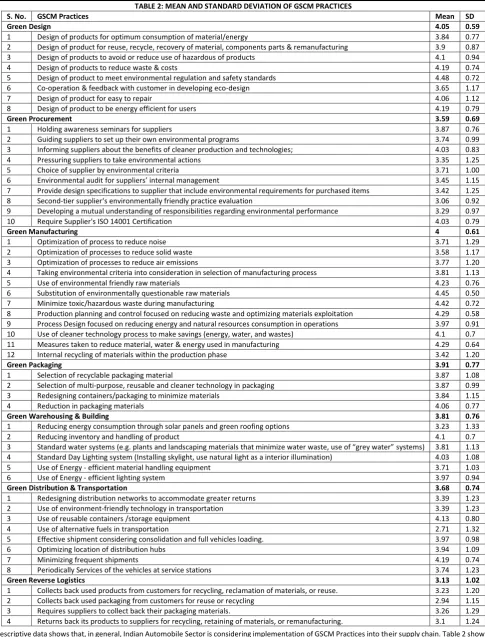
This research aimed to find out the adaptation level of GSCM practices in Indian Automobile Sector. The reliability (Refer Table 1) and descriptive test (Mean and Standard Deviation) of GSCM practices was computed. Out of fifty two practices, only two GSCM practices mean scores were found less than the threshold of 3, which are; use of alternative fuels in transportation (2.71) and collect back used packaging from customers for reuse or recycle (2.94) (Refer Table 2). Therefore, these two GSCM practices are not practicing by selected sample of Indian automobile manufacturers. Table 1 shows that research data is reliable and scored value of more than .70.
TABLE 1: RELIABILITY TEST OF GSCM PRACTICES
Factor Reliability Test Value (α)
Green Design .807
Green Procurement .878
Green Manufacturing .872
Green Packaging .754
Green Warehousing and Building .818 Green Distribution and Transportation .826
Green Reverse Logistics .851
VOLUME NO. 7 (2017), ISSUE NO. 08 (AUGUST)
ISSN 2231-5756
TABLE 2: MEAN AND STANDARD DEVIATION OF GSCM PRACTICESS. No. GSCM Practices Mean SD
Green Design 4.05 0.59
1 Design of products for optimum consumption of material/energy 3.84 0.77
2 Design of product for reuse, recycle, recovery of material, components parts & remanufacturing 3.9 0.87
3 Design of products to avoid or reduce use of hazardous of products 4.1 0.94
4 Design of products to reduce waste & costs 4.19 0.74
5 Design of product to meet environmental regulation and safety standards 4.48 0.72
6 Co-operation & feedback with customer in developing eco-design 3.65 1.17
7 Design of product for easy to repair 4.06 1.12
8 Design of product to be energy efficient for users 4.19 0.79
Green Procurement 3.59 0.69
1 Holding awareness seminars for suppliers 3.87 0.76
2 Guiding suppliers to set up their own environmental programs 3.74 0.99
3 Informing suppliers about the benefits of cleaner production and technologies; 4.03 0.83
4 Pressuring suppliers to take environmental actions 3.35 1.25
5 Choice of supplier by environmental criteria 3.71 1.00
6 Environmental audit for suppliers’ internal management 3.45 1.15
7 Provide design specifications to supplier that include environmental requirements for purchased items 3.42 1.25
8 Second-tier supplier‘s environmentally friendly practice evaluation 3.06 0.92
9 Developing a mutual understanding of responsibilities regarding environmental performance 3.29 0.97
10 Require Supplier's ISO 14001 Certification 4.03 0.79
Green Manufacturing 4 0.61
1 Optimization of process to reduce noise 3.71 1.29
2 Optimization of processes to reduce solid waste 3.58 1.17
3 Optimization of processes to reduce air emissions 3.77 1.20
4 Taking environmental criteria into consideration in selection of manufacturing process 3.81 1.13
5 Use of environmental friendly raw materials 4.23 0.76
6 Substitution of environmentally questionable raw materials 4.45 0.50
7 Minimize toxic/hazardous waste during manufacturing 4.42 0.72
8 Production planning and control focused on reducing waste and optimizing materials exploitation 4.29 0.58
9 Process Design focused on reducing energy and natural resources consumption in operations 3.97 0.91
10 Use of cleaner technology process to make savings (energy, water, and wastes) 4.1 0.7
11 Measures taken to reduce material, water & energy used in manufacturing 4.29 0.64
12 Internal recycling of materials within the production phase 3.42 1.20
Green Packaging 3.91 0.77
1 Selection of recyclable packaging material 3.87 1.08
2 Selection of multi-purpose, reusable and cleaner technology in packaging 3.87 0.99
3 Redesigning containers/packaging to minimize materials 3.84 1.15
4 Reduction in packaging materials 4.06 0.77
Green Warehousing & Building 3.81 0.76
1 Reducing energy consumption through solar panels and green roofing options 3.23 1.33
2 Reducing inventory and handling of product 4.1 0.7
3 Standard water systems (e.g. plants and landscaping materials that minimize water waste, use of “grey water” systems) 3.81 1.13
4 Standard Day Lighting system (Installing skylight, use natural light as a interior illumination) 4.03 1.08
5 Use of Energy - efficient material handling equipment 3.71 1.03
6 Use of Energy - efficient lighting system 3.97 0.94
Green Distribution & Transportation 3.68 0.74
1 Redesigning distribution networks to accommodate greater returns 3.39 1.23
2 Use of environment-friendly technology in transportation 3.39 1.23
3 Use of reusable containers /storage equipment 4.13 0.80
4 Use of alternative fuels in transportation 2.71 1.32
5 Effective shipment considering consolidation and full vehicles loading. 3.97 0.98
6 Optimizing location of distribution hubs 3.94 1.09
7 Minimizing frequent shipments 4.19 0.74
8 Periodically Services of the vehicles at service stations 3.74 1.23
Green Reverse Logistics 3.13 1.02
1 Collects back used products from customers for recycling, reclamation of materials, or reuse. 3.23 1.20
2 Collects back used packaging from customers for reuse or recycling 2.94 1.15
3 Requires suppliers to collect back their packaging materials. 3.26 1.29
4 Returns back its products to suppliers for recycling, retaining of materials, or remanufacturing. 3.1 1.24
The descriptive data shows that, in general, Indian Automobile Sector is considering implementation of GSCM Practices into their supply chain. Table 2 shows that, the Indian Automobile Sector (selected sample) has initiated implementation of Green Design (Mean = 4.05) and Green Manufacturing (Mean = 4) practices in their supply chain management activities. On the other hand, Green Purchasing (Mean = 3.60), Green Packaging (Mean = 3.91), Green Warehousing & Building (Mean = 3.81), Green Distribution & Transportation (Mean = 3.68), and Green Reverse Logistics (Mean = 3.13) are at the initial level of consideration. Whereas, green reverse logistic is found to be the lowest considered practice in sampled organizations. In addition, the research findings are in similar direction of past research as discussed in literature review.
CONCLUSION
VOLUME NO. 7 (2017), ISSUE NO. 08 (AUGUST)
ISSN 2231-5756
INTERNATIONAL JOURNAL OF RESEARCH IN COMMERCE, IT & MANAGEMENT
The study found that green design and manufacturing practices has adopted by selected sample and remaining practices are at the initial stage of consideration. Therefore, it can be concluded that Indian Automobile Sector is at the initial stage of implementing GSCM Practices in majority of supply chain functions.RECOMMENDATIONS
The results show that Indian Automobile Sector is considering implementation of GSCM practices in their supply chain activities. The Indian Automobile Sector may increase the implementation of green procurement practices like ISO14001 certification and environment audit of suppliers to improve the upward supply chain. Additionally, customer cooperation should be increase to make green design of products. Measurement of carbon footprints during manufacturing should also be increased to improve the environmental and operational performance. It is also suggested that recycling and reuse of used vehicles or components should be also increased to minimize wastage in the environment.
LIMITATIONS AND SCOPE FOR FUTURE RESEARCH
Research sample is the limitation of this study. Future research can be conducted with large sample. Some other methods, like, case study will be also useful for this area of research.
REFERENCES
1. Eltayeb, T. K., & Zailani, S. (2009). "Going Green through Green Supply Chain Initiatives towards Environmental Sustainability". Operations and Supply Chain Management, 2 (2), pp. 93-110.
2. Godfrey, R. (1998). "Eithical Purchasing: Developing the Supply Chain beyond the Environment". Greener Purchasing: Opportunities and Innovations, pp. 244-251.
3. Green, K. W., Zelbst, P. J., Meacham, J., & Bhadauria, V. S. (2012). "Green supply chain management practices". Supply Chain Management: An International Journal, pp. 290–305.
4. Hsu, C. W., & Hu, A. H. (2008). 'Green Supply Chain Management in Electronic Industry". International Journal of Science Technology, 5 (2), pp. 205-216. 5. Jung, J. J. (2011). "A Bibliometric Analysis on Green Supply Chain Management: A Preliminary Result". Commerce and Enterprise Computing (CEC) pp.
418-420. Luxembourg: IEEE.
6. Kachru, U. (2009). "Exploring the Supply Chain Theory and Practices". New Delhi: Excel Books.
7. Lo, S. M. (2014). "Effects of Supply Chain Position on the Motivation and Practices of Firms Going Green. International Journal of Operations & Production Management, 34 (1), pp. 93-114.
8. Luthra, S., Garg, D., & Haleem, A. (2013). "Identifying and Ranking of Strategies to Implement Green Supply Chain Management in Indian Manufacturing Industry using Analytical Hierarchy Process". Journal of Industrial Engineering and Management, 6 (4), pp. 930-962.
9. Srivastava, S. K. (2007). "Green Supply - Chain Management: A State -of- the-Art of Literature Review". International Journal of Management Review, 9 (1), pp.53-80.
10. Zhu, Q., & Sarkis, J. (2007a). "The Moderating Effects of Institutional Pressures on Emergent Green Supply Chain Practices and Performance". International Journal of Production Research, 45 (18-19), pp. 4333-4355.
11. Zhu, Q., Crotty, J., & Sarkis, J. (2008b). "A Cross-Country Empirical Comparison of Environmental Supply Chain Management Practices in the Automobile Industry". Asian Business and Management, 7, pp. 467-488.
12. Zhu, Q., Gwng, Y., Fujita, T., & Hashimoto, S. (2010). "Green Supply Chain Management in Leading Manufacturers: Case Studies in Japanese Large Companies. Management Research Review, pp. 380-392.
13. Zhu, Q., Sarkis, J., & Lai, K. (2007b). "Green Supply Chain Management: Pressures, Practices and Performance within the Chinese Automobile Industry." Journal of Cleaner Production, 15 (11-12), 1041-1052.
VOLUME NO. 7 (2017), ISSUE NO. 08 (AUGUST)
ISSN 2231-5756
LEASING: A SOLUTION TO CREDIT RATIONING
MANDEEP KAUR
RESEARCH SCHOLAR
I. K. GUJRAL PUNJAB TECHNICAL UNIVERSITY
JALANDHAR
DR. POOJA MISHRA
DIRECTOR
A & M INSTITUTE OF MANAGEMENT AND TECHNOLOGY
PATHANKOT
ABSTRACT
“Leasing is one of the last financial resorts”. Finance forms the most important resources for any organization. There are va rious methods through which such finance is being raised. It is still not resolved in financial literature that leasing could act as a substitute or not. A leasing is a contract by which one party coveys land, property, service etc. to another for a specified time, usually in return for a periodic payment whereas banks used credit-rationing mechanism in order to mitigate the losses that arise due to asymmetric information. The question still arises about the relationship between leasing and credit rationing. Over the years, lease finance has been consented as one of the cornerstone of modern economy. In this paper, we are going to discuss two things: first, what are the factors that influence credit rationing and secondly, to study relationship between them. We compare the lease rentals with the monthly payments of loan. The results shows that we pay less in leasing as compare to banking loan.
KEYWORDS
asymmetric information, century, credit rationing, leasing, mechanism.
INTRODUCTION
inance forms the most important resource for any organization. The main objective of any organization is to maximize their profits. According to E. Chandraiah (2004)1 when leasing business grew and met with initial success, and then there was a mushroom growth of institutions offering leasing services
in India. Globally leasing is the second most powerful source of financing next to the banks. Leasing in India started in 1973 with the first leasing company named “First Leasing Company Of India Ltd”. Since, a number of medium to large sized companies, financial institutions like IRCI, ICICI AND GIC have also entered the field of leasing. Leasing is an attractive form of financing because of its flexibility that’s why approximately one-third of all equipment acquisitions are now financed by leases. Another significant phase in the development of Indian leasing was the Dahotre Committee's recommendations based on which the RBI formed guidelines on commercial bank funding to leasing companies. The growth of leasing in India has distinctively been assisted by funding from banks and financial institutions. Apart from these, there are Sale & lease back and direct lease, Single investor lease & leveraged lease and Domestic & international lease. Though in foreign countries people are getting more advantage of the leasing but in India it is not popular as compared to other countries. The lack of regulatory supervision, particularly with regard to lease accounting practices where lease transactions were used as a means for deferring tax liability, finally brought the industry under scrutiny from the RBI in the mid-1990s. In fact, the number of lessors and the total volume of leased assets continued to fall until around 2008/2009. In Global Competitiveness Report 2012-2013 produced by the World Economic Forum (WEF), India is ranked at 59th position out of 144 in the Global Competitiveness Index (GCI). Leasing started quite late in India and the penetration level is not that high. Currently, only a limited number of players operate in this business. (T.T. Srinivasaraghavan, Managing Director of Sundaram Finance). The market is segmented with clear asset focus. Hence, the impact of the current economic situation on the leasing market is quite marginal (White Clarke Group India Asset and Auto Finance Country Survey 2013). Credit Rationing is referring to the situation where lenders limit the supply of additional credit to borrowers who demand funds, even if the later are willing to pay higher interest rates. There are two working definitions of credit rationing in the literature. The first focuses on situations in which increase in the interest rate cannot clear excess demand in the loan market, whether this excess demand reflects a single borrower (who would like a larger loan amount) or many. Under this definition, rationing would exist if every potential borrower received a loan but smaller one than that desired at the equilibrium interest rate. The second definition restricts its attention to situations in which some borrowers are completely rationed out of the market, even though they would be willing to pay an interest rate higher than the prevailing in the market. Both of these definitions focus on the supply side of the market.
CONCEPT OF LEASING
There are various methods through which finance is being raised. Leasing is unique commercial activity in this century. A Lease may be defined as a contractual arrangement in which a party owing an asset (lessor) provides the asset and transfer the right to use the equipment to the user (lessee) over a certain agreed period of time, for consideration in the form of return for periodic payment (rentals) with or without a further payment. Andrea Eisfeldt, Adriano Rampini (2007)
2study that benefit of leasing is that repossession of a leased asset is easier than foreclosure on the collateral of a secured loan, which implies that leasing has
higher debt capacity than secured lending. Marie Christine and Eric Severin (16june2008)3 conduct a study to better understand the relationship between leasing
and credit rationing. Kampumure Joseph (2009)4 reviews that leasing is an attractive form of financing because of its flexibility. There are two types of leasing:
Financial lease and Operating lease. A financial lease is that lease in which all the risks and rewards transferred incidental to the lessee except the title of ownership. An operating lease is a lease whose term is short compared to the useful life of the asset or the equipment being leased.
CONCEPT OF CREDIT RATIONING
Credit rationing is a situation where lenders limit the supply of additional credit to borrowers who demand funds even if the latter are willing to pay higher interest rates. It’s an example of market imperfection or market failure. Hodgman (1960)5 was the first to try and explain how credit rationing can persist in a rational
equilibrium framework. Miller (1962)6 argued that Hodgman’s analysis could be made consistent with rational expectations between the borrowers and lenders
by incorporating bankruptcy costs that would be incurred by the lender upon the borrowers default. There is a situation where the interest rate is deemed too high. It means at the prevailing market interest rates, demand exceeds supply but lenders are not willing to either loan more funds or raise the interest rate charged, as they are already maximizing profits. Manfred Zeller (1994)7 study that formal groups obtain and use information about the creditworthiness of the
credit applicant in a similar way than informal lenders do. In the SME’s sector storyin 1993 includes another four factors that are related with the rationing of credit.
1. The high fixed cost of information research.
2. The variety in credit conditions (interest and terms and conditions) used by banks to compete. 3. The variety of attitudes, skills and motivations that entrepreneurs presents.
VOLUME NO. 7 (2017), ISSUE NO. 08 (AUGUST)
ISSN 2231-5756
INTERNATIONAL JOURNAL OF RESEARCH IN COMMERCE, IT & MANAGEMENT
RESEARCH OBJECTIVES
The research paper addresses the philosophical as well as practical approach to explain the concept of leasing and credit rationing. The main objectives are: 1. To render a better understanding of the concept of leasing and credit rationing.
2. To compare both options of sources of finance.
REVIEW OF LITERATURE
With the help of these literatures, we can understand the concepts of leasing and credit rationing more briefly.
Andrada-maria georgescu (2010)8 examine that if leasing is a solution to credit rationing, considering that the limiting of the bank credit supply will determine the
orientation of enterprises towards leasing. Slotty.F(July 2009)9 conclude that the principal agency problems in joint ventures between lessors and banks that can
arise if banks – on the basis of commission or on their own account also offer leasing to their customers. Eisfeldt Andera, Rampini Andriano (2007)2 study that
repossession of a leased asset is easier than foreclosure on the collateral of a secured loan, which implies that leasing has higher debt capacity than secured lending. Dowla Ud Asif (1998)10 revealed in his study that Grameen bank has plans to introduce leasing to rehabilitate problem centers. Christine Marie, Severin
Eric (16 June 2008)11 conduct a study to better understand the relationship between leasing and credit rationing. They suggest that SME use leasing so when they
are young, leveraged and less solvent and that they present an small size and an important failure probability. Grenadier R. Steven (1996)12 found a model that
was flexible enough to be applied to a wide variety of real –world leasing structures, including security deposits, required up- front prepayments, embedded lease options, leases indexed to use and lease credit insurance contracts. Callimaci Antonello, Fortin Anne, Landry Suzanne (2011)13 examine the relationship between
a firm’s propensity to lease and several firm characteristics: tax position, financial constraint, ownership structure, growth and size. Cosci Stefania, Guide Roberto, Meliciane Valentine (March 2015)14this paper investigate the relationship between financial constraints and leasing decision for a sample of Italian firm. It
inves-tigates the determinants of firm leasing decision, the degree of substitutability between leasing and debt and the impact of leasing on the profitability of the firms feeing credit rationed. The results support the hypothesis that leasing preserves capital, thus helping to relieve credit constraints. De Sankar, Singh Manpreet (Sep. 2010)15 conclude that creditors ration credit at high rates of interest. They also observed that creditors ration credit at lower rate of interest and ration a larger
proportion of the pool of borrowers. Choudhary Ali M, Jain Anil (Dec. 2016)16 they conclude that well-functioning of credit market is crucial for the effective
allocation of resources and in turn, economic growth. However, shocks to financial intermediaries can hide their effectiveness.
CREDIT RATIONING: FOCUSING ON ASYMMETRIC INFORMATION
One of the most accepted problem in credit rationing is the asymmetric information. Credit rationing explained on the basis of asymmetric information. One of the reasons for this considerable attention is the implication that credit rationing has the transmission mechanism of monetary policy. The incidence of every factor is affected by the lack of information or by the quality of available one:
1. High fixed cost of information: This cost is independent from the amount of the loan to grant. The small projects will be more affected, thus this difficulty to reach economies of scale in the assignment of loan. Loan Portfolio will be discriminate a prior to the smaller firms.
2. Incentive effect: It has the direct relation with the information available. The less the monitoring of the project, higher the probability that borrower would deviate from the original objectives agreed.
3. Variety of credit condition: The diversity of business is not a problem but to manage the information in effective way is difficult. So banks will be forced to make more efforts and increase cost of evaluation and monitoring.
STRENGTH AND WEAKNESS OF LEASING
STRENGTHa) Shifting the risk of technological obsolescence: In business sector where there is a high risk of technology obsolesce, leasing yields great returns and save the business from the risk of investing in a technology that might become outdated soon.
b) Easy source of finance: It is a very easy source of finance. c) Enhances liquidity.
d) Conserves borrowing capacity through OFF-THE-BALANCE-SHEET financing: As lease expenses get same treatment as that of interest expense, leasing is classified as an off-balance sheet debt and does not appear on company balance sheet.
e) Tax-benefit
f) Hedge against inflation g) Low monthly payments
The leasing pros list may not be very long however, the list carries a lot of weight. The low monthly payments can be up to 60% lower than your monthly payments purchasing the same vehicle. The warranty is also a huge plus point. E.g. it can be extremely frustrating when the newly purchased vehicle has a major mechanical problem shortly after the warranty run out; but with a lease there is no need to worry about that.
WEAKNESS
a) Risk of being deprived of the use of equipment b) Alteration in the asset
c) Terminal value of the asset
d) Problem of evaluating credibility of lease-customers e) Consistent maintenance of the asset/equipment properly.
Paying a constant payment does not require a stable predictable lifestyle. Any mis-happening or a major medical expense can really upset the finances. When we go for lease, it is hard to get out of the contact as compare to selling your purchased equipment.
RELATIONSHIP BETWEEN LEASING AND CREDIT RATIONING
When there is large flow of money in the market, RBI always takes action to control it. To control the money flow in the market, Monetary policy is the process by which the monetary authorities of a country controls the supply of money, often targeting an inflation rate or interest rates to ensure price stability and general trust in the currency. The limiting of the bank credit supply will determine the orientation of enterprises towards leasing.
EXAMPLE
LEASE Vs. LOAN (PAYMENT OF MONTHLY INSTALLMENTS) FOR LEASE
For example, let's say the negotiated selling price of the car is Rs. 26,00,000. Subtract a down payment of Rs. 1,00,000 and a trade-in value of Rs. 3,00,000 = Rs.22,00,000. The dealer then agrees to pay off the balance of the loan on your existing car at Rs. 5,00,000. So that equals a Rs. 27,00,000 net capitalized costs.
Calculating the depreciation portion of the lease payment
Net capitalized cost = Negotiable selling price + down payment and other credits +loan B/s = 2600000 - (100000 + 300000) + 500000
= 2600000 – 400000 + 500000 = 2700000
VOLUME NO. 7 (2017), ISSUE NO. 08 (AUGUST)
ISSN 2231-5756
= sticker price * residual price = 300000* 55%
= 300000*0.55 = 165000
Calculate the monthly payments on the lease
= Net capitalized cost- residual value Number of monthly payments
= 2600000-(300000+100000)-3000000*55%
3 years * 12 months
= 2200000-1650000
36 months
= 550000
36
= 15277.7 (Monthly payment on lease)
FOR BANK LOAN
Same example on the loan from bank. We take 2600000 loan from the bank at 11% rate of interest for 10 years. Payment= Principal* i(1+i)n
(1+i)n -1
For example, imagine a person took out a loan at 11 percent, and the loan required making payments on a monthly basis. Since the payments are monthly, we need to divide the interest rate by 12.11 percent (0.11) divided by 12 equals 0.00916.
CALCULATE THE MONTHLY PAYMENT WITH EXCEL
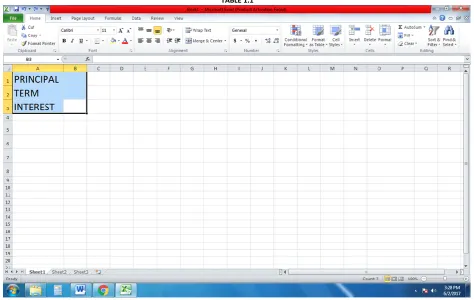
TABLE 1.1
1. Write the principal, term and interest from the loan in one column. Fill separate boxes with the amount of the loan, the length in which you have to pay and the interest and excel can calculate the monthly payments.
Like a person take home loan of Rs. 2600000 and have 10 years to pay it off at 11% annual interest rate.
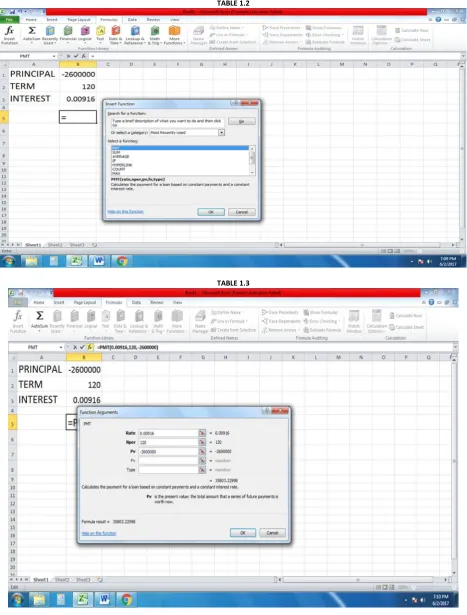
Write the principal in as negative number, determine the number of payments and convert the interest rate to fit the number of payments. In excel we have to write the principal amount in negative to tell excel that we are paying a debt.
Principal= -2600000
Most of the payments are paid monthly, so simply multiply the number of years by 12 to get total number of payments 10 years x12 =120 no. of payments
We are paying monthly interest; so we need to know what is monthly rate of interest? So 11% is for 12 months, simply divide by 12 to get one month interest. 11% = 11 = 0.00916 monthly interest
VOLUME NO. 7 (2017), ISSUE NO. 08 (AUGUST)
ISSN 2231-5756
INTERNATIONAL JOURNAL OF RESEARCH IN COMMERCE, IT & MANAGEMENT
TABLE 1.2
VOLUME NO. 7 (2017), ISSUE NO. 08 (AUGUST)
ISSN 2231-5756
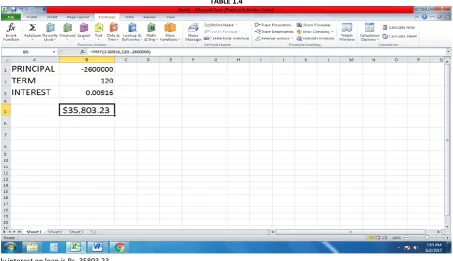
TABLE 1.4The monthly interest on loan is Rs. 35803.23
Monthly payment on loan is 35803.23.
The difference between the monthly payments of lease is 15277.7 and loan is 35803.23. So it is clear from the example that a person opting for lease has to pay less as compared to loan.
BANKS RUNS AS CREDIT RATIONING
The theoretical literature on credit rationing in the deposit market (bank runs) has some features that distinguish it from the literature on credit rationing in the loan market. The ultimate causes of deposit market rationing can be similar to, or very different from, the causes of loan market rationing. Loan market rationing can reflect either information or incentive problems in the loan market or exogenous regulations. In the case of the deposit market, rationing can result either from incentive and information problems relating to the depositor-bank relationship or from exogenous liquidity needs of depositors. An alternative cause of credit rationing in the deposit market is a shock to the liquidity needs of depositors, which forces depositors to demand their funds from their banks irrespective of the portfolio performance of the banks. Diamond and Dybvig (1983)17 is an example of a model of this phenomenon. Bank depositor runs are but one specific
example of how financial intermediaries may be credit rationed due to creditor risk intolerance and/or liquidity shocks.
CONCLUSION
This study has revealed that both leasing and credit rationing are two sides of a coin. Both have their own advantages and disadvantages which we had discussed in paper. When we talk about financing, banks generally lend a portion (60-80%) of the equipment or vehicle cost exclusive of soft costs such as shipping, installa-tion etc. On the other hand, in leasing 100% financing is available including all extra costs. From the above example we also conclude that on lease we have to pay less as compare to bank loan. There are numbers of factors that affect the choice between lease and debt such as size, taxes, nature of assets and financial constraints. Lease end to be more prevalent in some industries than in others and companies tend to lease assets that are less specific, of more general usage and more liquid.
REFERENCES
1. Chandraiah, E.,(2004), “Evaluation of lease financing”. Published by Concept Publishing Company Ltd,” ISB10:8180690350
2. Eisfeldt, L. Andrea, Rampini, A. Andriano,(2007) “Leasing : Ability to Responsiveness and Debt Capacity” AFA2007, Chicago meeting paper
3. Christine, Marie., Filareto,Deghaye., Severin, Eric.,(16 June 2008)., “Determinants of the Choice Leasing vs Bank Loan: Evidence from the French SME by KACM”. http://hal.archives-ouvertes.fr/hal-00204911
4. Joseph. Kampumure.,(2006), “Leasing Competence, Lease Structure and Perceived Performance of SME in UGANDA” 2006 /HD10/75710 5. D.R.Hodgman.,(1960), “Credit Risk And Credit Rationing” Quarterly Journal Of Economics 74, 258-78
6. M.H, Miller.,(1962) “Credit Risk And Credit Rationing : Further comments.” Quarterly Journal of Economics 76, 480-8.
7. Zeller, Manfred.,(1994), “Deteminants of Credit Rationing : A Study of Informal Lenders and Formal Credit Groups in Madagascar” Wahington, D.C. 20036-3006 U.S.A.
8. Andrada, Georgesc, Maria.,(2010) “Leasing : A Solution to Credit Rationing” http://stec.univ-ovidius.vo/html/anale/Ro/cuprins%20rezumatemai2010.Pdf.Is-sue-1mayVol.x(2010) page-1602-1607
9. Slotty, F, Constaintin., (July, 2009) “Financial Constraints and The Decision to Lease Evidence From German SME”. Goethe University Frankfurt, House of Finance, Germany.
10. Dowla,Ud,Asif.,(1998) “The Grameen Bank Experience”
11. Marie,Christine.,Eric, Severin.,(16 June 2008) “Determinants of the choice leasing VS Bank loan: Evidence from the French SME by KACM”.https://hal.arch ives-ouvertes.fr/hal-00204911
12. Grenadier,Steven,R.,(1996)., “ Leasing and Credit Risk”. Journal of Financial Economics. Vol.42,PP.333-364
13. Callimaci, Antonello., Fortin, Anne.,and Landry., Suzanne.,(2011) “ Determinants of leasing propensity in Canadian listed companies”. International Journal of Managerial Finance. Vol.7, Issue.3,PP 259-310
14. Cosci, Stefania., Guide, Roberyo., Meliciani, Valentine.,(2015) “Leasing Decisions And Credit Constraints: Empirical Analysis On A Sample of Italian Firms”. European Financial Management, Vol.21, Issue 2, PP.377-398