Denture Tagging: An Overview of
Simple And Complex Methods
Mohammad Arif Lone1, Ramanpreet Ranauta2,Syed Mohammad Noorani3, Manu Rana4, Nuzhat Ara5
ABSTRACT:
Dentures are used to restore the functions of the oral cavity
and naming or tagging make it very easy to identify the denture,
maintain record and create a more personal and ambient
atmosphere for the patient and the technician to whom the
prosthetic work is relegated. Denture tagging can be helpful in
identification of human bodies with prosthesis during natural
disasters and calamities. After Second World War nearly 3000
unidentified soldiers were identified by denture prosthesis.
Identification is important in medico legal cases, disposal of
diseased property dispute cases, insurance policies or claim for
compensation. A denture labeling method should maintain all
the basic requirements of American Dental Association, but till
date no methods fulfills all the requirements. This review
articles will come up with all the methods that can be done for
labeling, their benefits and limitations.
Key words: Denture Tagging Methods, Forensic odontology,
Denture Identification doi: 10.5866/2015.7.10147
1Registrar
Department of Dentistry Sher-i-Kashmir Institute of Medical Sciences Bemina Srinagar Jammu & Kashmir 2Post Graduate Student
Department Of Prosthodontics Swami Devi Dyal Hospital and Dental College Barwala Panchkula, Haryana
3Registrar
Department of Prosthodontics Mansarovar Dental College, Bhopal, M.P
4Registrar
Department of Endodontics M.B.Kedia Dental College, Birgunj, Nepal
5P.G student
Oral Medicine and Radiology Jaipur Dental College, Jaipur, Rajasthan
Article Info:
Received: April 13, 2015
Review Completed: May 13, 2015 Accepted: June 10, 2015
Available Online: April, 2015 (www.nacd.in) © NAD, 2015 - All rights reserved
Email for correspondence: [email protected]
Quick Response Code
INTRODUCTION
Humans live in a civilised society and have the right of recognition which makes identification and communication easy within the system. Every person is unique and has some typical feature
I
NDIANJ
OURNALOFD
ENTALA
DVANCEMENTS J o u r n a l h o m e p a g e : w w w. n a c d . i nCard, Birth Certificate, Death Certificate but when the identity is at threat from natural calamities like fire, trauma, road traffic accident, floods like Tsunami, hurricane like (Katrina, Hud-Hud) fall from height, landslides, aviation disaster, cataclysmic holocausts or unconscious person, medico-legal, Health issues like Alzheimer’s disease, war crimes etc, identity of human body can be a challenging task.
In the present world every individual has the right to recognition “article 6 of united nations declaration of human rights”.1 Forensic odontology
is of tremendous help in settling those cases with lost identity like it helped in mass disaster cases like Tsunami in Thailand. In some serious disaster cases denture can be the only source of identification.2
The American Dental Associations has prescribed some basic requirements for denture labeling, that the strength of the material must not be jeopardised, should be easy to achieve, should be efficient and durable, markings should be visible, should be inert and inexpensive, and possible to retrieve, withstand temperature, humidity and disinfection.3 Dental tagging can be done in the form
of patients name, age, sex, address, job profile, state address, phone number. The various methods of Tagging are as under.4, 5
1) SURFACE METHOD6-8
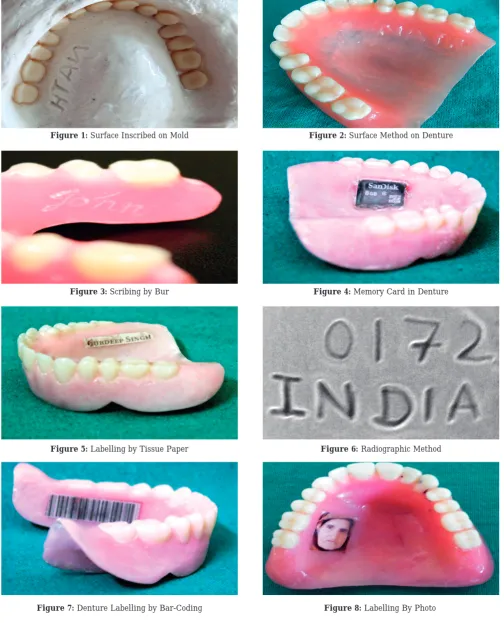
In surface method the marks are located on one of the denture’s surface and can be made by “scribing or engraving” the denture. “Embossing” comprises of initials of the name that are scratched with a bur on the master cast (Figure 1). This technique produces embossed lettering on the surface of the denture (Figure 2). Denture labelling can be done by blade of laboratory knife exposing only the tip, Cut the patients name or social security number on the buccal surface of Distolingual flange, Rub with no. 2 lead pencil or ink pen over fine grooves.
In surface technique, letters or numbers are engraved with a small round dental bur on the fitting surface of the complete denture (Figure 3). Alternate method is to dry the tissue surface of the
denture and write the name with a number 2 pencil. This method requires frequent remarking possibly every 3-4 weeks. Denture can be engraved with Electropen introduced by Wecker with an invisible ink that gets illuminated by UV radiations.
Both these surface methods are very simple and cost effective but the main limitation of this methods is that it can lead to roughening of the denture surface, food entrapment, bacterial colonisation & tissue irritation.9, 10
2) MEMORY CARD 11
Memory Card is a data storage device used for storing files like audio, video clips, pictures, voice messages or text documents. The data of the card can be read with the help of card reader in any computer. The memory card can be embedded in the acrylic and can be easily retrieved from it without distortion (Figure 4). It does not interfere with the oral function or strength of the material and no special training is needed for the procedure.
The cost of the memory card is also very economical. The limitations with the card are that in case of extensive impact the card may get damaged. During thermal tests, memory card can withstand temperature between -25 to 85°c and
cannot be durable in fire or aviation disasters when temperature may rise up to 600°c.12
3) STAINLESS STEEL TAPE METHOD13
Denture labelling can be done with the help of a stainless steel tape of the dimensions 9.5×.125mm this is an easy methods of labelling denture and can be done by a small round bur that can engrave the patient’s name, identification number (for example, social security number). The limitation with this method is that markings are not readily visible and it is difficult to write on a thin metal strip with a bur. Steel tape will also not compliment the denture instead it acts as a contrast to the denture base and will lead to an unesthetic appearance.
4) ABSORBENT TISSUE PAPER14
Figure 1: Surface Inscribed on Mold Figure 2: Surface Method on Denture
Figure 3: Scribing by Bur Figure 4: Memory Card in Denture
Figure 5: Labelling by Tissue Paper Figure 6: Radiographic Method
placed within the resin dough but the limitation with this method is that information is very limited and it is not fire or chemical resistant.
The absorption of lot of monomer may weaken the tissue paper and lead to dispersion of the ink used for writing on the paper, so it cannot maintain the information over a prolonged period of time.
5) RADIOGRAPHIC FILMS15
In this method the lead foil is incorporated within the denture after dewaxing the denture as required. Place a Layer of acrylic in the mold space and within this resin, place the lead foil (2.5×.6mm) on which all the details that are to be incorporated are written with a 0.5mm ball point pen tip. The lead foil should contain all the details that are to be incorporated within the denture. After denture processing the patient’s denture can be identified by taking an IOPAR (Figure 6) of the processed denture to see the details.
Moreover this method has proved to be simple, easy, quick, durable and cosmetically acceptable, fulfilling all requirements of A.D.A
6) DENTURE BAR-CODING12, 16
This machine readable technique involves printing a number code on paper, photographing the paper and making a negative of the photo. After this the negative image is transferred to the piece of silk. The silk is fixed over the rim of the device worn to pattern ceramic faience, and a plain piece of white faience is placed underneath the rim. Then faience paint containing black ceramic is applied to the negative barcode region on the silk, and a device forces the paint all the way through the silk, creating an image on the white faience .Finally the faience is heated at 860 for 30 minutes, after which we ensure that the barcode can be read.
The main advantage with this system is that a lot of information can be stored within the bar code and it is fire resistant up to 6000c. But to read the
information within the barcode (Figure 7) a scanner and a computer is needed and during placement of the bar code it may get distorted due to the curvature of the palate.
7) PHOTOGRAPHS17
One of the easiest methods of denture tagging is by using patients photograph (Figure 8). It is easy to recognise, this methods can be beneficial for uneducated people also who cannot be familiar with other methods of denture labelling. Patient feels more attached with the denture as it distinguished itself from the rest of complete or removable prosthesis. However thermal tests have revealed that the photographic marker were only resistant to temperature around 200-300°C.
8) LENTICULAR CARD18
Lenticular card is a newer method of denture tagging in which a lens is used with an illusion of depth, morph or the ability to change as viewed from different angles e.g. it is like Rupees 500 Indian currency notes that changes color from green to blue when viewed under different directions. Lenticular card is a polyethylene tetra phthalate card having patient’s details that is processed by the manufacturer and the same can be put in the denture after processing and can be covered with clear acrylic. The Lenticular card showed no signs of deterioration of fading for months together.
9) LASER ETCHING19
Copper vapour laser (CVL) can etch patient’s identification into the non impression surface of the metal partial denture. It can label the cobalt-chromium components of dentures easily, legibly and reduce the font size of the data. The CVL beam is focused and delivered to the material surface by the two-axis scanner mounted with mirrors. Computer is used to controls the movement of the scanner and the firing of the CVL. The limitation with this method is that it is expensive and also requires specialized equipment and technician’s to perform the procedure and this method cannot be used to etch on acrylic resin.
CONCLUSION
three factors i.e. Dentists who don’t pay attention to such procedures, Patients who are not educated enough to understand the importance of labelling and the laboratory personals who are not interested in doing so. Denture labelling should also match the standards of labelling as set by American Dental Association. Though there are many methods of denture labelling but none fill all the requirements of American Dental Association.
Dentists should raise awareness and motivate the patients about the benefits and uses of denture labelling. The reassurance and education on behalf of the dentist can help the patent in understanding the fact that labelling will add features to the denture. Also during processing of the denture in the laboratory the lab personal should be well trained and should take due care to maintain the strength and esthetics of the denture.
References:
1. Harvey W. Identity by teeth and marking of denture. Br
Dent J 1996; 121:334-340
2. Berry FA, Logan GI, Plata R, Riegel R. A post fabrication
technique for identification of prosthetic devices. J Prosthet
Dent 1995; 73(4):341-343.
3. Clark DH, Cainio P. Practical forensic dentistry.
Butterworth -Heinemann, Boston 1992.
4. Wolfardt CP. Denture identification system. J Prosthet Dent
1995; 74:551-554.
5. MatsmuraH, Shimoe S. (2002) Incorporation of a cast,
embossed identification plate into a partial denture
framework. J Prosthet Dent 2002; 88:215-216.
6. Stimson PG, Meltz CA. Forensic dentistry .CRC Press, Boco
Raton. 1997.
7. Shepherd M. Automatic identification of dental appliances.
Br Dent J 1997; 182:171-174.
8. Takahashi F, Koji T, Morita O. Durable method of denture
identification. J Prosthet Dent 1998; 28.
9. Stevenson RB. Marking dentures for identification. J
Prosthet Dent 1987; 58:255-256.
10. Heath JR, Zoitopoulos L, Griffiths C. Simple method for
denture identification: a simple approach. J Oral Rehabil
1987; 14:147-163.
11. Luthra R, Arora S, Meshram S. Denture marking for
forensic identification using memory card: An innovative
technique. J Indian Prosthodontic Soc 2012; 12(4): 231-235.
12. Anglo S, Zortuk M, Beydemir K. Denture Bar-coding. New
horiz Br Dent J 2009; 206:589-590
13. Padmanabhan TV, Gupta RK. Denture marking: an
introduction and review. J Forensic Dent Sci 2009; 1(1):
11-16
14. Thomas CJ: The role of the denture in identification: A
review. J Forensic Odontostomatol 1984; 2:13-16
15. Mohan J, Kumar CD, Simon P: Denture Marking as an aid
to forensic identification. J Indian Prosthodont Soc 2012;
12(3):131-136.
16. Rajendran V, Karthigeyan S, Manoharam S. Denture
marker using a two dimensional bar code. J Prosthet Dent
2012; 107:207-208
17. Anehosar GV, Acharya AB, Nadiger RK. Usefulness of
patient photograph as a marker for identifying denture
wearers in India. Gerodontology 2010; 27:272-277.
18. Colvenkar SS. Lenticular Card: A new method for denture
identification Indian J Dental Res 2010; 21:112-114
19. Ling BC, Nambiar P, Low KS, Lee CK. Copper vapour laser
ID Labelling on metal dentures and restorations. J Forensic
Odontostomatol. 2003; 21:17-22.