ISSN 0975-928X
Research Article
Association and path analysis for seed yield and component characters in
sunflower (
Helianthus annuus
L
.)
* Neelima1 .S., K.G.Parameshwarappa2 and Y.Praveen Kumar3
1
Scientist (Br), RARS, Nandyal, Kurnool 2
Associate Director of Research (HQ), UAS, Dharwad 3
Agricultural Officer, Kurnool (Dt.), A.P
Email:[email protected]
(Received: 12 Sep 2011; Accepted: 26 June 2012)
Abstract
Genotypic and phenotypic correlation among seed yield and eleven component characters were studied in 11 genotypes of sunflower. Association analysis of parents revealed that number of seeds/head, 100-seed weight, head diameter and per cent seed filling had high significant positive correlation with seed yield. Number of seeds/head, 100 seed weight, head diameter and per cent seed filling also had significant positive intercorrelation among themselves. Number of seeds/head, per cent seed filling, hull content and plant height influence the seed yield directly whereas 100-seed weight influenced indirectly through no.of seeds/head and per cent seed filling. Very high indirect contribution for most of the traits is through number of seeds/head. Hence, this trait should be given priority in sunflower seed yield improvement programme.
Key words
Sunflower, correlation, path analysis
Introduction
India is among the largest vegetable oil economies in the world after USA and China and enjoys a distinct position in terms of diversity in annual oilseed crops. Oilseeds form the second largest agricultural commodity after cereals in India accounting for 14 per cent of the country’s gross cropped area. It contribute for nearly five per cent of the gross national product and 10 per cent of the value of all agricultural products. Yield is a complex character and influenced by several yield component characters. The knowledge on the association of several characters with yield and interrelationship among these characters is essential for planning a successful plant breeding program. Path coefficient analysis has an advantage over estimation of simple correlation coefficients because it allows partitioning of the correlation coefficients into its components. These components are 1) the path coefficient that measures the direct effect of a predictor variable upon its response variable 2) the indirect effect(s) of a predictor variable on the response variable through other predictor variables (Dewey and Lu, 1959). The purpose of this study was to estimate phenotypic and genotypic correlations and path coefficients of
important agronomic traits on seed yield in sunflower to formulate efficient selection strategy.
Material and Methods
Eleven entries comprising five maintainer lines of corresponding CMS lines and six restorer lines were evaluated during kharif 2006 at MARS, Dharwad. All the genotypes were sown in a randomized complete block design with three replications, wherein each replication was represented by three rows of 3 m length for each entry. A spacing of 60 cm between rows and 30 cm within a row was provided. All other recommended agronomic
practices were followed to raise successful
ISSN 0975-928X
according to the method given by Dewey and Lu (1959).
Results and Discussion
In general, genotypic correlation coefficients (rg)
were higher in magnitude than phenotypic correlation coefficients (rp) indicating less influence of
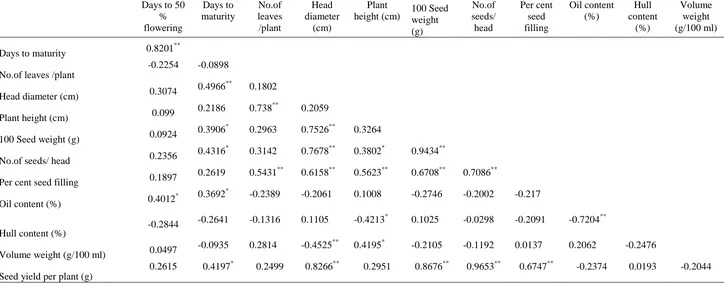
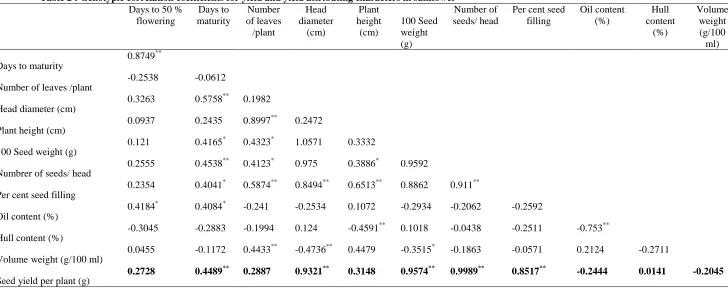
environment. The nature and magnitude of correlation among 12 traits in the present study revealed that number of seeds/head exhibited a strong positive association with seed yield (rg=0.9989,
rp=0.9653) followed by 100 seed weight (rg=0.9574,
rp=0.8676), head diameter (rg=0.9321, rp=0.8266) and
per cent seed filling (rg=0.8517, rp=0.6747) both at
genotypic and phenotypic level (Table 1 and 2). This indicates simultaneous selection for these traits might bring an improvement in seed yield. The earlier studies of Joksimovic et al., (1999), Teklewold et al. (2000), Dagustu (2002), Khokhar et al. (2006), Yasin and Singh (2010) and Sowmya et al. (2010) were in agreement with the present finding. The association between hull and oil content was found to be strongly negative (rg= - 0.753, rp= - 0.7204) which was
confirmed from the past studies of Chikkadevaiah et al. (2002). Among yield component characters, per cent seed filling has strong association with number of seeds/head (rg=0.911, rp=0.7086) followed by
100-seed weight (rg=0.6708, rp=0.6513) and head
diameter (rg=0.8494, rp=0.6158). Likewise, number
of seeds/head is highly associated with head diameter (rg=0.975, rp=0.7678) and test weight (rg=0.9592,
rp=0.9434). Further, plant height and number of
leaves/plant were highly correlated (rg=0.8997,
rp=0.738).
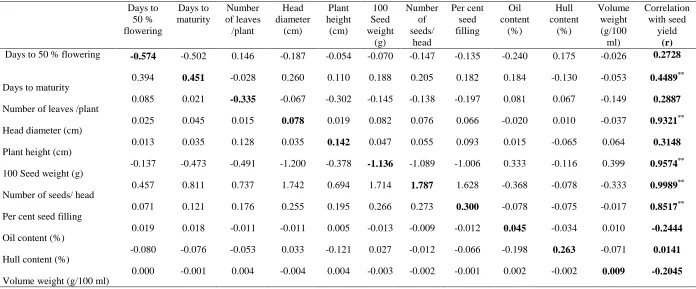
The path analysis (Table 3) showed that the direct effect of number of seeds/head on seed yield was very high and positive (1.787). Thus, the character number of seeds/head which showed high positive correlation and high direct effect with seed yield had a high influence on seed yield. Lawrence and Shaik
Mohammad (1993) had also stressed the importance of number of seeds/head for selection. The direct effect of head diameter on seed yield/plant was found to be low in magnitude (0.078) and its indirect effect through number of seeds/head (1.742), per cent seed filling (0.255) and days to maturity (0.260) proved to be chief cause of high positive genotypic correlation with seed yield (0.9321). Hundred seed weight has significant positive correlation with seed yield (0.9574) but the path coefficient analysis revealed a negative direct contribution (-1.136). The significant positive association with seed yield was owing to its indirect contribution mainly through number of seeds/head (1.714) and per cent seed filling (0.266). This is in confirmation with the findings of Vanisree et al. (1988) and Velkov (1976). Oil content has negative correlation on seed yield (-0.2444) but its direct effect with seed yield (0.045) was found to be positive due to its indirect contribution through number of seeds/head (-0.368), days to 50 % flowering (-0.240) and hull content (-0.198). Maximum indirect contribution to seed yield was found to be number of seeds/head via head diameter (1.742) and 100-seed weight (1.714). The low residual effect indicates most of the important yield components which are responsible for yield were included in the present analysis.
From the above study it can be concluded that number of seeds/head, 100-seed weight, head diameter, per cent seed filling and days to maturity are the important selection indices for seed yield improvement in sunflower as they had significant positive correlation with seed yield. But 100-seed weight recorded negative direct effect on seed yield
hence indirect selection through number of
seeds/head and per cent seed filling will be effective for seed yield improvement. Therefore, priority should be given for the number of seeds/head in the selection programme for improvement of seed yield in sunflower.
References
Al-Jibouri, H.A., Miller, P.A. and Robinson, H.F. 1958. Genotype and environmental variances in an upland cotton cross of inter specific origin.
Agron. J. 50: 633-637.
Chikkadevaiah, Sujatha H.L. and Nandini. 2002. Correlation and path analysis in sunflower. Helia.
Joksimovic, J., Atlagic, J. and Skoric, D. 1999. Path coefficient analysis of some oil yield components in sunflower (Helianthus annuus L.). Helia. 22 (31) : 35-42.
Khokhar, M. I., Sadaqat, H.A. and Tahir, M.H.N. 2006. Association and effect of yield related traits on achene yield in sunflower. Int.J. of Agri .Biol. 8 (4) : 450-451.
ISSN 0975-928X
Teklewold. A., Jayaramaiah, H. and Jagadesh, D.N. 2000. Correlations and path analysis of physiomorphological characterstics of sunflower (Helianthus annuus L.) as related to breeding method. Helia. 23 (32) : 105-114.
Vanisree, G., Anathasayana, K., Nagabhushanam, G.V.S. and Jagadish, C.A. 1988. Correaltion and path coefficient analysis in sunflower (Helianthus annuus L.). J.
Oilseeds Res .5 : 46-51.
Yasin A.B. and Singh, S. 2010. Correlation and path coefficient analyses in sunflower. J.of Pl. Breed. and Crop Sci. 2 (5) : 129-133.
Velkov, V.N.1976. The path coefficients and correlation between some traits and sunflower productivity.
ISSN 0975-928X
Table 1 : Phenotypic correlation coefficients for yield and yield attributing characters in sunflower
Days to 50 % flowering
Days to maturity
No.of leaves /plant
Head diameter
(cm)
Plant
height (cm) 100 Seed weight
(g)
No.of seeds/ head
Per cent seed filling
Oil content (%)
Hull content
(%)
Volume weight (g/100 ml)
Days to maturity 0.8201
**
No.of leaves /plant
-0.2254 -0.0898
Head diameter (cm) 0.3074
0.4966** 0.1802
Plant height (cm) 0.099
0.2186 0.738** 0.2059
100 Seed weight (g) 0.0924
0.3906* 0.2963 0.7526** 0.3264
No.of seeds/ head 0.2356
0.4316* 0.3142 0.7678** 0.3802* 0.9434**
Per cent seed filling 0.1897
0.2619 0.5431** 0.6158** 0.5623** 0.6708** 0.7086**
Oil content (%) 0.4012
* 0.3692* -0.2389 -0.2061 0.1008 -0.2746 -0.2002 -0.217
Hull content (%)
-0.2844 -0.2641 -0.1316 0.1105 -0.4213
*
0.1025 -0.0298 -0.2091 -0.7204**
Volume weight (g/100 ml) 0.0497
-0.0935 0.2814 -0.4525** 0.4195* -0.2105 -0.1192 0.0137 0.2062 -0.2476
Seed yield per plant (g)
0.2615 0.4197* 0.2499 0.8266** 0.2951 0.8676** 0.9653** 0.6747** -0.2374 0.0193 -0.2044
ISSN 0975-928X
Table 2 : Genotypic correlation coefficients for yield and yield attributing characters in sunflower
Days to 50 % flowering
Days to maturity
Number of leaves /plant
Head diameter
(cm)
Plant height
(cm)
100 Seed weight (g)
Number of seeds/ head
Per cent seed filling
Oil content (%)
Hull content
(%)
Volume weight (g/100 ml)
Days to maturity
0.8749**
Number of leaves /plant
-0.2538 -0.0612
Head diameter (cm)
0.3263 0.5758** 0.1982
Plant height (cm)
0.0937 0.2435 0.8997** 0.2472
100 Seed weight (g)
0.121 0.4165* 0.4323* 1.0571 0.3332
Numbrer of seeds/ head
0.2555 0.4538** 0.4123* 0.975 0.3886* 0.9592
Per cent seed filling
0.2354 0.4041* 0.5874** 0.8494** 0.6513** 0.8862 0.911**
Oil content (%)
0.4184* 0.4084* -0.241 -0.2534 0.1072 -0.2934 -0.2062 -0.2592
Hull content (%)
-0.3045 -0.2883 -0.1994 0.124 -0.4591** 0.1018 -0.0438 -0.2511 -0.753**
Volume weight (g/100 ml)
0.0455 -0.1172 0.4433** -0.4736** 0.4479 -0.3515* -0.1863 -0.0571 0.2124 -0.2711
Seed yield per plant (g)
ISSN 0975-928X
Table 3: Direct and indirect effects for seed yield and yield attributing characters in sunflower at genotypic level
Days to 50 % flowering
Days to maturity
Number of leaves /plant
Head diameter
(cm)
Plant height
(cm)
100 Seed weight
(g)
Number of seeds/
head
Per cent seed filling
Oil content
(%)
Hull content
(%)
Volume weight (g/100 ml)
Correlation with seed
yield
(r)
Days to 50 % flowering -0.574 -0.502 0.146 -0.187 -0.054 -0.070 -0.147 -0.135 -0.240 0.175 -0.026 0.2728
Days to maturity
0.394 0.451 -0.028 0.260 0.110 0.188 0.205 0.182 0.184 -0.130 -0.053 0.4489**
Number of leaves /plant
0.085 0.021 -0.335 -0.067 -0.302 -0.145 -0.138 -0.197 0.081 0.067 -0.149 0.2887
Head diameter (cm)
0.025 0.045 0.015 0.078 0.019 0.082 0.076 0.066 -0.020 0.010 -0.037 0.9321**
Plant height (cm)
0.013 0.035 0.128 0.035 0.142 0.047 0.055 0.093 0.015 -0.065 0.064 0.3148
100 Seed weight (g)
-0.137 -0.473 -0.491 -1.200 -0.378 -1.136 -1.089 -1.006 0.333 -0.116 0.399 0.9574**
Number of seeds/ head
0.457 0.811 0.737 1.742 0.694 1.714 1.787 1.628 -0.368 -0.078 -0.333 0.9989**
Per cent seed filling
0.071 0.121 0.176 0.255 0.195 0.266 0.273 0.300 -0.078 -0.075 -0.017 0.8517**
Oil content (%)
0.019 0.018 -0.011 -0.011 0.005 -0.013 -0.009 -0.012 0.045 -0.034 0.010 -0.2444
Hull content (%)
-0.080 -0.076 -0.053 0.033 -0.121 0.027 -0.012 -0.066 -0.198 0.263 -0.071 0.0141
Volume weight (g/100 ml)