ISSN 1392-2785 ENGINEERING ECONOMICS. 2006. No 4 (49)
COMMERCEOFENGINEERINGDECISIONS
Study of Relationship Quality Dimensionality in the Parcel Delivery Services
Market
Tomas Palaima, Vilt
ė
Auruškevi
č
ien
ė
Kauno technologijos universitetas K. Donelaičio g. 73, LT-44029, Kaunas
The article is organized in five parts. First part is in-troduction. In this part the research problem, the aim of this work and objectives are formulated. The aim of this work is as follows: after having analyzed an integrative model of determinants of key relationship marketing out-comes, to perform confirmatory factor analysis of the scale in order to assess if the same dimensions structure exists for parcel delivery services. The objectives of this work are: 1) to analyze T. Hennig-Thurau et al. (2002) model of determinants of key relationship outcomes, 2) to do survey of Lithuanian parcel delivery services consum-ers and to measure relationship quality using this instru-ment, 3) to perform confirmatory factor analysis in order to determine if dimensions structure of the model is the same for Lithuanian parcel delivery services. The prob-lem solved in this paper is as follows: an integrative model of determinants of key relationship marketing out-comes was developed using a wide variety of services to expand the generalization therefore it is possible to ex-amine context-specific relationships of a single service type. Moreover, it is not known if the same relationship quality dimensions exist in other than North-American cultural context such as Lithuanian culture.
In the second part of this article relationship quality model suggested by T. Hennig-Thurau et al. (2002) is analyzed and research hypotheses are formulated. Hy-potheses are formulated in order to test relationships between dimensions and their discriminant validity.
In the third part of this work research methods are de-scribed. Confirmatory factor analysis process is analyzed.
In the fourth part of this article the results of study are analyzed. Various goodness of fit statistics such as degrees of freedom and chi-square test, RMSEA, NFI, NNFI, PNFI, CFI, IFI, RFI, standardized RMR, GFI, AGFI, PGFI, D2, Fornell-Larcker test is analyzed in
or-der to accept or reject hypotheses and to assess relation-ships between dimensions and discriminant validity of these dimensions. Nested models are compared with the original model and differences in goodness of fit statistics are examined. In the fifth part of this work final conclu-sions are formulated about model’s reliability and valid-ity in parcel delivery services setting.
Keywords: relationship quality, confirmatory factor analy-sis, relationship marketing.
Introduction
Relationship marketing concept first was mentioned by L. Berry (1983) and now this concept is in vogue, maybe more than ever (T. Hennig-Thurau et al., 2002).
Marketing transition from transactional marketing to relationship marketing lasted past two decades (M. Chris-topher, A. Payne, D. Ballantyne, 2002; I. Gordon, 1998; E. Gummesson, 2003; T.Hennig-Thurau, 2000; R. Varey, 2002; R. Virvilaitė et al., 2003). Ch. Grönroos (1997, 2001) explains the role and scope of relationship market-ing as identifymarket-ing and establishmarket-ing, maintainmarket-ing and en-hancing customer relationships and points out that the process of marketing includes the following:
• Market research to identify potentially interesting and profitable customers to contact.
• Establishing the first contact with a customer so that the relationship emerges.
• Maintaining an existing relationship so that the customer is satisfied with the quality and the value he or she judges to have received and is willing to continue business.
• Enhancement of ongoing relationship so that the customer decides to expand the content of the rela-tionship by purchasing larger quantities types ser-vice or goods.
• Sometimes terminating a relationship or coping when a customer decides to discontinue the rela-tionship, in such a manner that the relationship can be reestablished in the future under different cir-cumstances.
Finally Ch. Grönroos (2001) defines a relationship mar-keting “as a social process oriented to establish, maintain, enhance and when necessary also to terminate relationships with customers and other stakeholders, at a profit so that the objectives of all parties are met. This is achieved by a mu-tual exchange and fulfillment of promises”.
relationship quality dimensions.
In relation to marketing literature there are several methodologies and instruments to measure relationship quality. These models contributed very much to relation-ship marketing theory, but also every of these models have some limitations:
The relationship quality based student Loyalty model (T. Hennig-Thurau, F. Langer, U. Hansen, 2001). The main limitation of this model is that it is a service indus-try specific model. This model measures relationship quality of university services users. It’s impossible to use this model in the parcel delivery company.
An integrative model of determinants of key relation-ship marketing outcomes(T. Hennig-Thurau et al., 2002). The main limitations of this model are:
• Wide variety of services used does not allow test-ing context-specific relationships.
• Model was tested only in North American culture. It is not known if the same dimensions exist in other cultures.
• Cross sectional nature of data only allows for cor-relation, rather than causal, inferences to be made. Relationship quality model (R. Brodie et al., 2003). This model is based more on the SERVQUAL dimen-sions model with some additional relationship quality dimensions. Moreover the amount of loyalty variance explained by these relationship quality dimensions is not reported. So it is not known how this scale is effective in comparison with SERQUAL scale.
Literature analysis revealed that the first model is more promising for assessment of relationship quality and future development, but there is a scientific problem:
The research problem. Does the structure of an
in-tegrative model of determinants of key relationship mar-keting outcomes (T. Hennig-Thurau et al. 2002) exist in parcel delivery services market?
The aim of this work. After having analyzed an
in-tegrative model of determinants of key relationship mar-keting outcomes, to perform confirmatory factor analysis of the scale in order to assess if the same dimensions structure exists for parcel delivery services.
The objectives of this work are: 1) To analyze T.
Hennig-Thurau model of determinants of key relationship outcomes, 2) To do survey of Lithuanian parcel delivery services consumers and to measure relationship quality us-ing this instrument, 3) To perform confirmatory factor analysis in order to determine if dimensions structure of the model is the same for Lithuanian parcel delivery services.
The research object is relationship quality of
Lithuanian parcel delivery services customers.
Research methods used: web-based survey,
explora-tory factor analysis, confirmaexplora-tory factor analysis.
The analysis of an integrative model of the key relationship outcomes and hypotheses
formulation
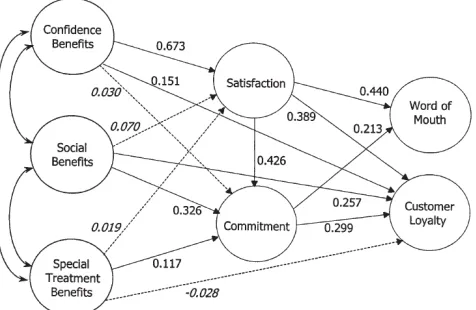
The model is presented in Figure. In the model there are seven dimensions of relationship quality: confidence benefits, social benefits, special treatment benefits,
satis-faction, commitment, word of mouth and loyalty.
Figure. An integrative model of determinants of key relationship outcomes (T. Hennig-Thurau et al., 2002).
Satisfaction in this model is dimension, which has strongest impact on customer loyalty and word of mouth. R. Rust et al. (1996) agrees with antecedent of loyalty.
R. Bennett et al. (2004) explains that the summary of satisfaction research is predominantly consumer oriented rather then taking place in business-to-business settings. Finally, the main three key issues are formulated regard-ing satisfaction and loyalty:
• Satisfaction and loyalty are related constructs.
• There are moderating factors for the relationship.
• The methodology influences outcome of the re-search.
R. Bennett et al. (2004) points out that that some studies concluded that both satisfaction and loyalty items are capturing the same construct. Furthermore, the au-thors explain that researchers achieving high levels of association and strong positive relationships should ex-amine both convergent and discriminant validity amongst all constructs in a study, rather than assuming that con-structs are distinct.
Based on these arguments the following hypotheses are formulated:
Hypothesis H1SA/WM: Satisfaction and word of mouth
are related constructs in business-to-business parcel de-livery services setting.
Hypothesis H1SA/LO: Satisfaction and loyalty are
re-lated constructs in a business-to-business parcel delivery services setting.
Hypothesis H2SA/WM: Satisfaction and word of mouth
are discriminant constructs in business-to-business parcel delivery services setting.
Hypothesis H2SA/LO: Satisfaction and loyalty are
dis-criminant constructs in a business-to-business parcel de-livery services setting.
Based on these arguments the following hypotheses are formulated:
Hypothesis H1CO/WM: Commitment and word of
mouth are related constructs in business-to-business par-cel delivery services setting.
Hypothesis H1CO/LO: Commitment and loyalty are
re-lated constructs in business-to-business parcel delivery services setting.
Hypothesis H2CO/WM: Commitment and word of
mouth are discriminant constructs in a business-to-business parcel delivery services setting.
Hypothesis H2CO/LO: Commitment and loyalty are
discriminant constructs in a business-to-business parcel delivery services setting.
According to T. Hennig-Thurau et al. (2002) and K. Gwinner et al. (1998) Social benefits focus on relation-ship itself rather than on the outcome. The authors sug-gest that social benefits are positively related to commit-ment to the relationship. Based on this argument and other arguments provided by R. Bennett et al. (2004) the following hypotheses are formulated:
Hypothesis H1SB/CO: Social benefits and commitment
are related constructs in business-to-business parcel de-livery services setting.
Hypothesis H2SB/CO: Social benefits and commitment
are discriminant constructs in business-to-business parcel delivery services setting.
According to T. Hennig-Thurau et al. (2002), trust and confidence benefits play a key role in the relationship quality and the relationship benefits approaches. In the model these two constructs are combined into one single construct. In order to determine convergent and discrimi-nant validity of these constructs the following hypotheses are formulated:
Hypothesis H1CB/CO: Confidence benefits and
com-mitment are related constructs in business-to-business parcel delivery services setting.
Hypothesis H2CB/CO: Confidence benefits and
com-mitment are discriminant constructs in business-to-business parcel delivery services setting.
From Figure we can see that there exists relationship between confidence benefits and customer loyalty. These constructs are related. Based on the arguments provided by R. Bennett et al. (2004) we will formulate the follow-ing hypotheses:
Hypotheses H1CB/LO: Confidence benefits and loyalty
are related constructs in business-to-business parcel de-livery services setting.
Hypotheses H1CB/WM: Confidence benefits and word
of mouth are related constructs in a business-to-business parcel delivery services setting.
Hypotheses H2CB/LO: Confidence benefits and loyalty
are discriminant constructs in business-to-business parcel delivery services setting.
Hypotheses H2CB/WM: Confidence benefits and word
of mouth are discriminant constructs in a business-to-business parcel delivery services setting.
Path loading connecting social benefits and loyalty (see Figure) shows that there exists relationship between
constructs. The following hypotheses are formulated:
Hypothesis H1SB/WM: Social benefits and word of
mouth are related constructs in business-to-business par-cel delivery services setting.
Hypothesis H2SB/WM: Social benefits and word of
mouth are discriminant constructs in business-to-business parcel delivery services setting.
From Figure it is not known if there exists the rela-tionship between social benefits and confidence benefits. In order to test relationship between two constructs and discriminant validity the following hypotheses were for-mulated:
Hypothesis H1SB/CB: Social benefits and confidence
benefits are related constructs in business-to-business parcel delivery services setting.
Hypothesis H2SB/CB: Social benefits and confidence
benefits are discriminant constructs in business-to-business parcel delivery services setting.
Finally, in order to determine if loyalty and word-of-mouth are related constructs and discriminant constructs we will test the following hypotheses:
Hypothesis H1LO/WM: Loyalty and word-of-mouth are
related constructs in business-to-business parcel delivery services setting.
Hypothesis H2LO/WM: Loyalty and word-of-mouth are
discriminant constructs in business-to-business parcel delivery services setting.
Description of research methods used
The primary objective of CFA is to determine the ability of a predefined factor model to fit an observed set of data.
Some common uses of CFA are to:
• Establish the validity of a single factor model.
• Compare the ability of two different models to ac-count for the same set of data.
• Test the significance of specific factor loadings.
• Test whether a set of factors are correlated or un-correlated.
• Assess the convergent and discriminant validity of a set of measures.
Confirmatory factor analysis was performed using six basic steps (T. Brown, 2006):
1. Definition of the factor model. This involves
se-lecting the number of factors, and defining the na-ture of the loadings between the factors and the measures. These loadings fixed at a zero, or at other constant values, allowed to vary freely, or be allowed to vary under specified constraints (such as being equal to another loading in the model). Factor model was defined based on the results of the research done by T. Hennig-Thurau et al.
(2002). The factor structure and indicators are identical to an integrative model of determinants of key relationship marketing outcomes (see Figure).
2. Collection of measurement. Respondents were
parcel delivery services customers, who were active services users in the past 6 months and bought ser-vices for more than 200 Lt. A total sample of 200 responses was collected. According to Kline (2005), sample size can be considered as small, medium and large when N values are less than 100, between 100 and 200, and more than 200, accordingly. Web-based interactive survey was used to collect responses. All questions in the questionnaire were set as required in order to avoid missing values and maximum likelihood estimation problems de-scribed by A. Diamantopoulos and A. Siguaw (2005). Firstly, respondents were selected from da-tabase. Secondly, e-mails were sent asking cus-tomers to participate in survey. Thirdly, the re-sponses collected to interned-based database. Fi-nally, in the end of survey the responses were ex-ported to SPSS to code and perform clearing. 3. Obtaining correlation matrix. From SPSS
data-base data was imported to LISREL software. Then correlation matrix was generated.
4. Fit the model to the data. Estimates of factor loading were obtained using maximum likelihood
estimation.
5. Evaluate model adequacy and fit. To evaluate
the model fit various fit indicators suggested by A. Diamantopoulos and A, Siguaw (2005), R. Kline (2005), E. Kelloway (1998) and B. Byrne (1998) were used. Namely, degrees of freedom and chi-square test, RMSEA, NFI, NNFI, PNFI, CFI, IFI, RFI, standardized RMR, GFI, AGFI, PGFI.
6. Comparison with other models. The discriminant
validity between all dimensions was checked by constraining pairing to 1 and examining the change in model fit. Different models and their fit indicators were examined.
Analysis of results
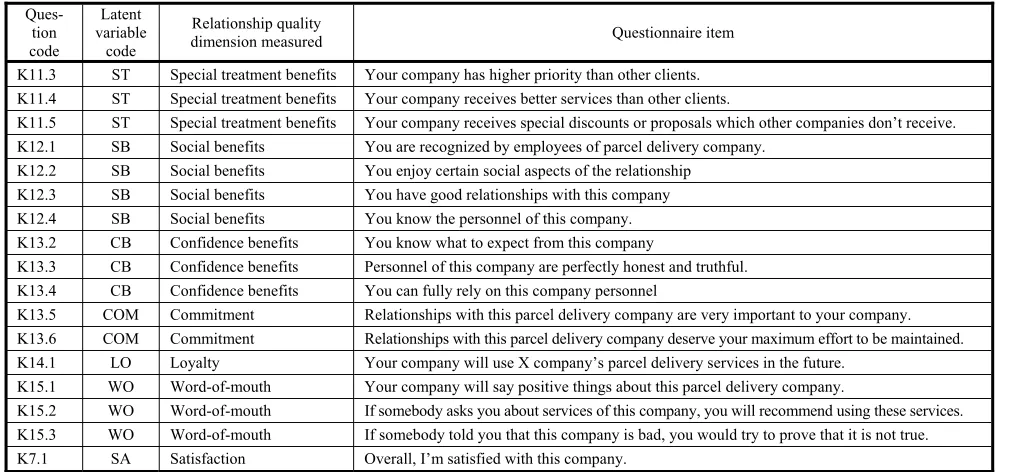
Confirmatory factor analysis model structure, latent variables and their indicators are provided in Table 1. Confirmatory factor model consists of seven latent vari-ables and seventeen indicators. Seven relationship quality dimensions are tested. Namely, special treatment bene-fits, social benebene-fits, confidence benebene-fits, commitment, loyalty and word-of-mouth.
Table 1 CFA model dimensions and questionnaire items
Ques-tion code
Latent variable
code
Relationship quality
dimension measured Questionnaire item
K11.3 ST Special treatment benefits Your company has higher priority than other clients. K11.4 ST Special treatment benefits Your company receives better services than other clients.
K11.5 ST Special treatment benefits Your company receives special discounts or proposals which other companies don’t receive. K12.1 SB Social benefits You are recognized by employees of parcel delivery company.
K12.2 SB Social benefits You enjoy certain social aspects of the relationship K12.3 SB Social benefits You have good relationships with this company K12.4 SB Social benefits You know the personnel of this company. K13.2 CB Confidence benefits You know what to expect from this company
K13.3 CB Confidence benefits Personnel of this company are perfectly honest and truthful. K13.4 CB Confidence benefits You can fully rely on this company personnel
K13.5 COM Commitment Relationships with this parcel delivery company are very important to your company. K13.6 COM Commitment Relationships with this parcel delivery company deserve your maximum effort to be maintained. K14.1 LO Loyalty Your company will use X company’s parcel delivery services in the future.
K15.1 WO Word-of-mouth Your company will say positive things about this parcel delivery company.
K15.2 WO Word-of-mouth If somebody asks you about services of this company, you will recommend using these services. K15.3 WO Word-of-mouth If somebody told you that this company is bad, you would try to prove that it is not true. K7.1 SA Satisfaction Overall, I’m satisfied with this company.
Model fit was evaluated using goodness of fit statis-tics calculated by LISREL (see Table 2). Firstly, model parameters are estimated in which all the parameters be-tween latent variables are allowed to vary freely. Then model’s fit was assessed. In Table 2 are provided nearly all fit statistics calculated by LISREL, but A. Diaman-topoulos and A. Siguaw (2005) explains that “Chi-square test used in conjunction with the RMSEA, ECVI, stan-dardized RMR, GFI and CFI indices should be more than sufficient to reach an informal decision concerning the model’s overall fit”. Discriminant validity of constructs was performed using Fornell and Larcker (1981) test and D2 test suggested by A. Diamantopoulos and A. Siguaw (2005). Composite reliability and average variance
ex-tracted are tested too to see if in literature suggested thresholds are exceeded (R. Bagozzi and Y. Yi, 1988).
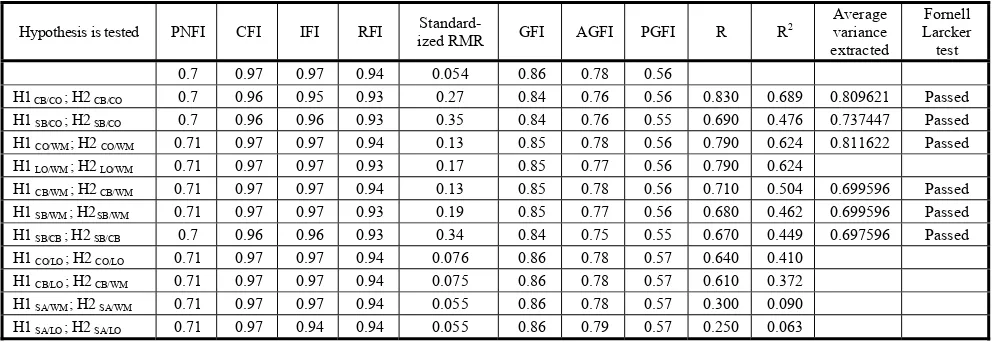
In the first row of Table 2 and Table 3 are provided goodness of fit statistics of original illustrative model, which later will be compared to nested models testing formulated hypotheses. The goodness of fit index GFI is reasonably good 0.86 and almost reaches the threshold suggested in literature (A. Diamantopoulos and A. Siguaw, 2005). RMSEA is 0.09 and indicates mediocre fit (K. Jöreskog and D. Sörbom, 1997). Standardized root mean square residual is 0.054 and indicates acceptable fit. AGFI is bellow suggested threshold but PGFI is above. PGFI index takes into account model’s complexity.
suggested threshold. NFI (0.95) and NNFI (0.96) demon-strate good relative fit.
Constructs reliability and average variance extracted were calculated using formula suggested by (A. Diaman-topoulos and A. Siguaw, 2005). The following results were obtained (first number in brackets is construct reli-ability and second is an average variance extracted): spe-cial treatment benefits (0.89; 074); sospe-cial benefits (0.86; 0.62), confidence benefits (0.90; 0.77), commitment (0.91; 0.84), word-of-mouth (0.91; 0.77). All the number exceeds minimum thresholds and demonstrates high reli-ability and high amount of variance extracted.
Now in order to test formulated hypotheses nested models will be compared to this original model and good-ness of fit changes will be examined.
In Table 3 standardized correlation coefficients be-tween different constructs are provided (R). Hypotheses
are sorted by correlation descending and will be tested in this order because dimensions with strong positive rela-tionships are more likely to be not discriminant and there-fore need to be tested first of all (R. Bennett et al., 2004; R. Kline, 2005).
H1CB/CO; H2CB/CO. The strongest relationship (0.8)
ex-ists between confidence benefits and commitment there-fore hypothesis H1CB/CO is accepted. To test if these
di-mensions are discriminant the relationship between these variables was constrained to 1.0 and then changes in model’s fit were examined. D2 test, RMSEA, NNFI, CFI, IFI, RFI, standardized RMR, GFI and PGFI indicates loss in model’s fit (see Table 2 and Table 3). Standardized RMR is very large and exceeds suggested thresholds. Fornell-Larcker test has been passed. Confidence benefits and commitment are discriminant constructs therefore hypotheses H2CB/CO are accepted.
Table 2 Goodness of fit statistics
Hypothesis is tested Degrees of freedom
Normal theory weighted Least Squares
Chi-Square
Minimum function Chi-Square D
2 test RMSEA 90% confiden-ce interval for
RMSEA NFI NNFI
100 246.71 279.84 0.091 0.077; 0.11 0.95 0.96
H1 CB/CO ; H2 CB/CO 101 265.51 313.91 18.8 0.096 0.082; 0.11 0.95 0.95
H1 SB/CO ; H2 SB/CO 101 269.39 333.42 22.68 0.097 0.083; 0.11 0.94 0.95
H1 CO/WM ; H2 CO/WM 101 249.89 287.08 3.18 0.092 0.077; 0.11 0.95 0.96
H1 LO/WM ; H2 LO/WM 101 274.85 296.11 28.14 0.099 0.085; 0.11 0.95 0.96
H1 CB/WM ; H2 CB/WM 101 252.98 288.29 6.27 0.092 0.078; 0.11 0.95 0.96
H1 SB/WM ; H2 SB/WM 101 253.25 296.22 6.54 0.093 0.078; 0.11 0.95 0.96
H1 SB/CB ; H2 SB/CB 101 273.12 330.69 26.41 0.098 0.084; 0.11 0.95 0.95
H1 CO/LO ; H2 CO/LO 101 247.39 282.09 0.68 0.091 0.076; 0.11 0.95 0.96
H1 CB/LO ; H2 CB/WM 101 247.94 282.13 1.23 0.091 0.077; 0.11 0.95 0.96
H1 SA/WM ; H2 SA/WM 101 247.32 280.31 0.61 0.091 0.076; 0.11 0.95 0.96
H1 SA/LO ; H2 SA/LO 101 246.7 279.84 -0.01 0.091 0.076; 0.10 0.95 0.96
Table 3 Goodness of fit statistics
Hypothesis is tested PNFI CFI IFI RFI ized RMR Standard- GFI AGFI PGFI R R2 Average variance
extracted
Fornell Larcker test
0.7 0.97 0.97 0.94 0.054 0.86 0.78 0.56
H1 CB/CO ; H2 CB/CO 0.7 0.96 0.95 0.93 0.27 0.84 0.76 0.56 0.830 0.689 0.809621 Passed
H1 SB/CO ; H2 SB/CO 0.7 0.96 0.96 0.93 0.35 0.84 0.76 0.55 0.690 0.476 0.737447 Passed
H1 CO/WM ; H2 CO/WM 0.71 0.97 0.97 0.94 0.13 0.85 0.78 0.56 0.790 0.624 0.811622 Passed
H1 LO/WM ; H2 LO/WM 0.71 0.97 0.97 0.93 0.17 0.85 0.77 0.56 0.790 0.624
H1 CB/WM ; H2 CB/WM 0.71 0.97 0.97 0.94 0.13 0.85 0.78 0.56 0.710 0.504 0.699596 Passed
H1 SB/WM ; H2 SB/WM 0.71 0.97 0.97 0.93 0.19 0.85 0.77 0.56 0.680 0.462 0.699596 Passed
H1 SB/CB ; H2 SB/CB 0.7 0.96 0.96 0.93 0.34 0.84 0.75 0.55 0.670 0.449 0.697596 Passed
H1 CO/LO ; H2 CO/LO 0.71 0.97 0.97 0.94 0.076 0.86 0.78 0.57 0.640 0.410
H1 CB/LO ; H2 CB/WM 0.71 0.97 0.97 0.94 0.075 0.86 0.78 0.57 0.610 0.372
H1 SA/WM ; H2 SA/WM 0.71 0.97 0.97 0.94 0.055 0.86 0.78 0.57 0.300 0.090
H1 SA/LO ; H2 SA/LO 0.71 0.97 0.94 0.94 0.055 0.86 0.79 0.57 0.250 0.063
H1SB/CO; H2SB/CO. Social benefits and commitment are
constructs which have a very strong correlation (0.69) therefore hypothesis H1SB/CO is accepted (see Table 2).
From test D2 we see that fit of this nested model is decreased. Other indicators suggest the same result (see Table 2 and Table 3). Standardized RMR is extremely large. Fornell-Larcek test has been passed. Hypotheses H2SB/CO are accepted.
H1CO/WM; H2CO/WM. Commitment and word-of-mouth
Correlation coefficient R shows (Table 3) that all other pairs of constructs hypothesized to be related con-structs are related. Relationship strength varies from so-cial benefits and commitment being the most related con-structs (0.83) to satisfaction and loyalty being the least related constructs (0.25) therefore, we can conclude that
H1LO/WM, H1CB/WM, H1SB/WM, H1SB/CB, H1CO/LO, H1CB/LO,
H1SA/WM, H1SA/LO are accepted. Goodness of fit statistics
of all other nested models indicates loss of fit therefore
H2LO/WM, H2CB/WM, H2SB/WM, H2SB/WM, H2SB/CB, H2CO/LO,
H2CB/LO, H2SA/WM, H2SA/LO are accepted.
Conclusions
1. Analysis of an integrative model of determinants of key relationship marketing outcomes suggested by T. Hennig-Thurau et al. (2002) revealed that it is the most promising model because it integrates nearly all the most important relationship quality dimensions suggested by different authors in scientific literature. Also some model’s limitations were identified. Analysis revealed that variety of services used does not allow identifying context specific relationships. Moreover, it is not known if the same dimensions ex-ist in different culture or in different service type. 2. The results of confirmatory factor analysis revealed
that there exist seven relationship quality dimen-sions in parcel delivery services setting: social benefits, confidence benefits, special treatment benefits, commitment, loyalty and word of mouth. While testing formulated hypotheses it is revealed that despite existence of constructs with strong posi-tive relationship, all the constructs are discriminant in parcel delivery services setting. Discriminant va-lidity of relationship quality dimensions was dou-ble-tested by chi-square and Fornell-Larcker test and both tests indicated that constructs are discrimi-nant. Moreover, construct reliability and average variance extracted are tested and results have shown that all the constructs are reliable and with a high average variance extracted. Finally, we can con-clude that relationship quality measurement scale suggested by T. Hennig-Thurau et al. (2002) is a valid and reliable scale suitable for relationship quality measurement in parcel delivery services.
References
1. Bagozzi, R. On the evaluation of structural equation models/R. Bagozzi, Y. Yi // Journal of the academy of marketing science, 1988, No 4, p. 74-94.
2. Bennett, R. Relative customer satisfaction should not be the only goal/ R. Bennett, S. Rundle-Thiele // Journal of services marketing, 2004, No 7, Vol. 18, p. 514-523.
3. Berry, L. Relationship marketing of services – growing interests, emerging perspectives: Handbook of relationship marketing. London: Sage publications, 1983, p. 149-170.
4. Byrne B. Structural Equation Modeling With Lisrel, Prelis, and Simplis: Basic Concepts, Applications, and Programming/ B. Byrne. LEA, 1998. 424 p. ISBN 0805829245.
5. Brodie, R. Measuring the quality of relationships in consumer ser-vices: an empirical study/ R. Brodie, K. Roberts, S. Varki // European Journal of Marketing, 2003, No 37, p. 196-196.
6. Brown, T. Confirmatory Factor Analysis for Applied Research/ T. Brown. The Guilford Press, 2006. 475 p. ISBN 1593852754.
7. Christopher, M. Marketing relationship: creating shareholder value/ M. Christopher, A. Payne, D. Ballantyne. Oxford, 2002. 242 p. ISBN 0-7506-4839-2.
8. Diamantopoulos, A. Introducing lisrel/ A. Diamantopoulos, A. Siguaw. London: 2005. 171 p. ISBN 0-7619-5170-9.
9. Fornell, C. Evaluating structural equation models with unobservable variables and measurement error / C. Fornell, D.F. Larcker // Journal of Marketing Research, 1981, Vol. 18, No 2, p. 186-189.
10. Gordon, I. H. Relationship marketing: new strategies, techniques, and technologies to win the customers you want and keep them for-ever.Toronto etc, 1998. 314 p. ISBN 0-471-64173-1.
11. Grönroos, Ch. From marketing mix to relationship marketing-towards a paradigm shift in marketing // Management Decision. 1997, No 3/4, p. 322. ISSN: 0025-1747.
12. Grönroos, Ch. Service management and marketing: a customer rela-tionship management approach. Chichester, 2001. 394 p. ISBN 0-471-72034-8.
13. Gummesson, E. Total relationship marketing : marketing strategy moving from the 4Ps – product, price, promotion, place – of tradi-tional marketing management to the 30Rs – the thirty relationships – of a new marketing paradigm. Amsterdam: Butterworth-Heinemann, 2003. 352 p. ISBN 0-7506-5407-4.
14. Gwinner, K. Relational Benefits in Services Industries: The Customer’s Perspective / K. Gwinner, D. Gremler, M. Bitner // Journal of the Academy of Marketing Science, 1998, 26 (Spring), p. 101-114. 15. Hennig-Thurau, T. Modeling and managing student loyalty: an
ap-proach based on the concept of relationship quality / T. Hennig-Thurau, M. Langer, U. Hansen // Journal of service research, 2001, Vol. 3, No 4, p. 331-344.
16. Hennig-Thurau, T. Relationship marketing: gaining competitive advantage through customer satisfaction and customer retention / T. Hennig-Thurau, U. Hansen, editors. Springer, 2000. ISBN 3-540-66942-6.
17. Hennig-Thurau, T. Understanding relationship marketing outcomes: an integration of relationship benefits and relationship quality / T. Hennig-Thurau, K. Gwinner, D. Gremler // Journal of Services Re-search, 2002, No 3, p. 230-247.
18. Jöreskog K. Lisrel 8: User's Reference Guide / K. Jöreskog, D. Sör-bom. Scientific Software, 1997. 378 p. ISBN 0894980408.
19. Kelloway E. Using lisrel for structural equation modeling/ E. Kello-way. London: 1998. 160 p. ISBN 0761906266.
20. Kline, R. Principles and practice of structural equation modeling/ Rex B. Kline. The Guilford Press, 2005. 366 p. ISBN 1572306904. 21. Liljander, V. The nature of customer relationships in services/V.
Liljander, T. Strandvik // Advances in services marketing and man-agement, 1995, London, No 4, p. 141-167.
22. Morgan R. The commitment – trust theory of relationship marketing / R. Morgan, S. Hunt // Journal of Marketing, 1994, Vol. 58, p. 1-38. 23. Palaima T. Marketing services relationships: the relative role of service
quality / Tomas Palaima, Juratė Banytė // Inžinerinė ekonomika = En-gineering Economics / Kauno technologijos universitetas. ISSN 1392-2785. Kaunas: Technologija, 2006, No 1 (46), p. 83-94.
24. Rust, R. Service marketing / R. Rust, A. Zahorik, T. Keiningham. New York: 1996. 508 p. ISBN 0-673-99145-8.
25. Varey, R. J. Relationship marketing: dialogue and networks in the e-commerce era. Chichester, 2002. 217 p. ISBN 0-470-84341-1. 26. Virvilaitė, R. Santykių marketingo konceptualioji esmė ir ištakos /
Aistė Dovalienė, Regina Virvilaitė // Inžinerinė ekonomika = Engi-neering Economics / Kauno technologijos universitetas. ISSN 1392-2785. Kaunas: Technologija, 2003, No 2(33), p. 100-105
Tomas Palaima, Viltė Auruškevičienė
Santykių kokybės dimensijų tyrimas greitųjų siuntų pristatymo rinkoje
Santrauka
Grönroos (2002), santykių marketingas apima tokius aspektus: mar-ketingo tyrimus, kontakto su vartotojais užmezgimą, santykių išlai-kymą per pasitenkinimą ir kokybę, santykių išplėtimą ir vartojimo didinimą ir netgi santykių nutraukimą.
T. Hennig-Thurau ir kt. (2002) aiškina, kad vienas iš pagrindinių santykių marketingo tikslų yra svarbių veiksnių, lemiančių lojalumą ir gyvąjį žodį, identifikavimas. R. Brodie ir kt. (2003) teigia, kad neapčiuo-piami konkurenciniai pranašumai, kuriami santykių marketingo priemo-nėmis, yra sunkiai imituojami konkurentų. Taigi įmonėms reikia instru-mentų, kurie leistų išmatuoti santykių kokybę tarp paslaugų teikėjo ir vartotojo. Paslaugų kokybės modeliai ir instrumentai turi rimtų trūkumų, nes matuoja tam tikrą paslaugos epizodą ir yra statiški ( Palaima ir kt., 2006; Grönroos, 2001; Liljander ir kt., 1995). Santykių marketingo para-digma reikalauja dinaminės perspektyvos, kuri leistų matuoti paslaugų kokybę kartu su kitomis santykių kokybės dimensijomis ilgalaikėje pe-rspektyvoje.
Santykių marketingo mokslinėje literatūroje yra keletas modelių ir instrumentų santykių kokybei matuoti. Šių modelių indėlis į santy-kių marketingo teoriją yra nemenkas, tačiau ir jie turi ribotumų ir trūkumų.
Pagrindinis T. Hennig-Thurau, F. Langer, U. Hansen (2001) san-tykių kokybe pagrįsto studentų lojamumo modelio (angl. The rela-tionship quality based student Loyalty model) trūkumas tas, kad jis matuoja santykių kokybę tik tarp universitetų ir jų paslaugų vartoto-jų-studentų.
T. Hennig-Thurau ir kt. (2002) Integruoto santykių marketingo pasekmių determinantų modelis (angl. An integrative model of deter-minants of key relationship marketing outcomes) buvo testuojamas tiriant įvairių tipų paslaugų vartotojus, siekiant sukurti universalią matavimo skalę. Tačiau modeliui testuoti naudota paslaugų įvairovė neleidžia patikrinti konkrečiam paslaugų tipui būdingų ryšių tarp modelio kintamųjų. Be to, neaišku, ar ta pati dimensijų struktūra yra būdinga konkrečiam paslaugų tipui. Kitas modelio trūkumas tas, kad modelis testuotas apklausiant tik Šiaurės Amerikos vartotojus, todėl neaišku, ar pastarosios dimensijos egzistuoja kitose kultūrose.
K. Roberts ir kt. (2003) santykių kokybės modelis yra SERVQUAL modelis, turintis papildomų santykių kokybės dimensi-jų. Modelis tik parodo, kad paslaugų kokybė lemia santykių kokybę, o ši lemia lojalumą, tačiau nėra žinoma, ar gerai šios dimensijos paaiškina viena kitą.
Mokslinės literatūros analizė parodė, kad perspektyviausias to-liau vystyti yra T. Hennig-Thurau ir kt. (2002) modelis.
Mokslinė problema: ar T. Hennig-Thurau ir kt. (2002) modelio santykių kokybės dimensijų struktūra yra būdinga greitųjų siuntų paslaugų rinkai?
Tyrimo tikslas – remiantis T. Hennig-Thurau ir kt. (2002) mo-deliu, ištirti santykių kokybės dimensijų struktūrą greitųjų siuntų paslaugų rinkoje.
Tyrimo uždaviniai: 1) atlikti T. Hennig-Thurau ir kt. (2002) modelio santykių kokybės dimensijų teorinę analizę, 2) pasitelkus T. Hennig-Thurau ir kt. (2002) tyrimo instrumentą, atlikti Lietuvos grei-tųjų siuntų paslaugų vartotojų empirinį tyrimą, 3) pritaikius patvirti-nančiąją faktorinę analizę, identifikuoti santykių kokybės dimensijų struktūrą greitųjų siuntų paslaugų rinkoje.
Tyrimo objektas yra santykių tarp paslaugos teikėjo ir vartotojų kokybė Lietuvos greitųjų siuntų paslaugų rinkoje.
Tyrimo metodai: internetinė greitųjų siuntų paslaugų vartotojų apklausa, patvirtinančioji faktorinė analizė.
Teorinis pagrindimas ir hipotezių formulavimas. T. Hennig-Thurau ir kt. (2002) modelį sudaro septynios dimensijos: pasitikėjimo nauda (angl. confidence benefits), socialinė nauda (nagl. social bene-fits), ypatingo požiūrio į paslaugos vartotoją nauda (angl. special treatment benefits), pasitenkinimas (angl. satisfaction), prisirišimas (angl. commitment), ketinimas rekomenduoti (angl. word-of-mouth) ir lojalumas. Pasak T. Hennig-Thurau ir kt. (2002), vartotojų pasitenki-nimas yra dimensija, turinti didžiausią poveikį vartotojų lojalumui ir ketinimui rekomenduoti. R. Bennet ir kt. (2004) atlikta empirinių tyrimų apžvalga parodė, kad pasitenkinimas ir lojalumas gali priklau-syti vienam faktoriui. Jeigu tarp šių konstruktų yra stiprus koreliaci-nis ryšys, būtina tikrinti, ar šie konstruktai nepriklauso vienam fakto-riui (angl. discriminant validity). Vartotojų prisirišimas yra antroji pagal stiprumą dimensija, lemianti vartotojų lojalumą ir gyvąjį žodį.
Remiantis šiuo teoriniu pagrindu, iškeltos šios hipotezės:
Hipotezė H1SA/WM: Vartotojų pasitenkinimas ir ketinimas
reko-menduoti koreliuoja.
Hipotezė H1SA/LO: Vartotojų pasitenkinimas ir lojalumas koreliuoja. Hipotezė H2SA/WM: Vartotojų pasitenkinimas ir noras rekomenduoti
yra skirtingi konstruktai ir nepriklauso vienam faktoriui.
Hipotezė H2SA/LO: Vartotojų pasitenkinimas ir lojalumas yra
skir-tingi konstruktai ir nepriklauso vienam faktoriui.
Hipotezė H1CO/WM: Prisirišimas ir noras rekomenduoti koreliuoja. Hipotezė H1CO/LO: Prisirišimas ir lojalumas koreliuoja.
Hipotezė H2CO/WM: Prisirišimas ir noras rekomenduoti yra
skir-tingi konstruktai ir nepriklauso vienam faktoriui.
Hipotezė H2CO/LO: Prisirišimas ir lojalumas yra skirtingi
konst-ruktai ir nepriklauso vienam faktoriui.
Hipotezė H1SB/CO: Socialinė nauda ir prisirišimas koreliuoja. Hipotezė H2SB/CO: Socialinė nauda ir prisirišimas yra skirtingi
konstruktai ir nepriklauso vienam faktoriui.
Hipotezė H1SB/CO: Egzistuoja koreliacija tarp socialinės naudos ir
prisirišimo.
Hipotezė H1CB/CO: Pasitikėjimo nauda ir prisirišimas koreliuoja. Hipotezė H2CB/CO: Pasitikėjimo nauda ir prisirišimas yra skirtingi
konstruktai ir nepriklauso vienam faktoriui.
Hipotezė H1CB/LO: Pasitikėjimo nauda ir lojalumas koreliuoja. Hipotezė H1CB/WM: Pasitikėjimo nauda ir noras rekomenduoti
kore-liuoja.
Hipotezė H2CB/LO: Pasitikėjimo nauda ir lojalumas yra skirtingi
konstruktai ir nepriklauso vienam faktoriui.
Hipotezė H2CB/LO: Pasitikėjimo nauda ir noras rekomenduoti yra
skirtingi konstruktai ir nepriklauso vienam faktoriui.
Hipotezė H1SB/WM: Socialinė nauda ir noras rekomenduoti koreliuoja. Hipotezė H2SB/WM: Socialinė nauda ir noras rekomenduoti yra
skirtingi konstruktai ir nepriklauso vienam faktoriui.
Hipotezė H1SB/CB: Socialinė nauda ir pasitikėjimo nauda koreliuoja. Hipotezė H2SB/CB: Socialinė nauda ir pasitikėjimo nauda yra
skir-tingi konstruktai ir nepriklauso vienam faktoriui.
Hipotezė H1LO/WM: Lojalumas ir noras rekomenduoti koreliuoja. HipotezėH2LO/WM: Lojalumas ir noras rekomenduoti yra skirtingi
konstruktai ir nepriklauso vienam faktoriui.
Tyrimo eiga ir imtis. Respondentai buvo atrinkti naudojant greitųjų siuntų paslaugų verslo klientų duomenų bazę. Tyrimo popu-liaciją sudarė klientai, per paskutiniuosius 6 mėnesius pirkę paslaugų ne mažiau kaip už 200 Lt. Tyrimo imtis – 200 respondentų. Tokio dydžio imtis patvirtinančiai faktorinei analizei yra laikoma vidutine (Kline, 2005).
Respondentams apklausti buvo pasitelktas internetinis klausimy-nas. Visi klausimai buvo privalomi, kad būtų išvengta trūkstamų reikšmių keliamų problemų (Diamantpoulos ir Siguaw, 2005). At-rinktiems respondentams buvo išsiųsti elektroniniai laiškai su kvieti-mais dalyvauti tyrime.
Statistinės analizės metodas. Surinkti duomenys buvo kaupia-mi internetinėje duomenų bazėje iš kurios vėliau buvo importuoti į statistinės analizės programą LISREL. Siekiant įvertinti modelio tinkamumą, buvo atlikta patvirtinančioji faktorinė analizė. Modelio tinkamumui ir hipotezėms patikrinti buvo naudojami rodikliai, reko-menduojami Diamantpoulos ir Siguaw (2005): RMSEA, NFI, NNFI, PNFI, CFI, IFI, RFI, standartizuotas RMR, GFI, AGFI, PGFI. Pir-miausia sudarytas pagrindinis modelis, kuris vėliau buvo lyginamas su lizdiniais modeliais, norint patvirtinti arba atmesti hipotezes.
Tyrimo rezultatai. Faktorinės analizės rezultatai parodė, kad visos iškeltos hipotezės pasitvirtino, t.y. greitųjų siuntų paslaugų rinkoje egzistuoja septynios santykių kokybės dimensijos, identiškos išskirtoms T. Hennig-Thurau ir kt. (2002) modelyje. Apibendrinant galima teigti, kad T. Hennig-Thurau ir kt. (2002) matavimo instru-mentas yra validus ir patikimas santykių kokybei tarp kliento ir grei-tųjų siuntų paslaugų teikėjo tirti.
Raktažodžiai: Santykių kokybė, patvirtinančioji faktorinė analizė, santykių marketingas.
The article has been reviewed.