Comparison of Regeneration Efficiency of
Three Different Genotypes of Basmati Rice
under in Vitro Condition
Ritu Mahajan* and Shilpi Sharma
School of Biotechnology, University of Jammu, Jammu, India
Abstract
Seeds of three basmati rice genotypes namely Pusa Sugandha, Pusa1 and Pusa 1121 were assessed for callus induction and plant regeneration on different concentrations and combinations of plant growth regulators in MS medium. A two stage sterilization treatment was found to be the most effective leading to maximum number of uncontaminated explants in three rice genotypes. The number of shoots was observed to be more in MS media supplemented with BAP and the shoot length was more in MS media supplemented with Kn. An optimum concentration of 1.0mg/l of 2,4-D was found to be effective for callus induction but Pusa Sugandha had more potential towards callus formation than Pusa 1 and Pusa 1121. However, highest percentage of shoot regeneration from callus was observed in Pusa Sugandha (90.0%) followed by Pusa 1 (80.0%) and Pusa 1121 (50.0%) in MS media supplemented with 0.5 mg/l of 2,4-D, 1.0 mg/l of Kn and 0.5 mg/l of BAP.
Key words: Oryza sativa, basmati, in vitro, callus, growth regulators, genotypes
INTRODUCTION
Rice (Oryza sativa L.) is the main staple food for more than half of the world population and has also become a model monocot system for genetic and functional genomics studies. The Asian cultivated rice provides 35% of calorie intake worldwide [1]. In recent years, considerable efforts are being directed toward the improvement of important agronomic traits of rice through biotechnological techniques. A number of factors such as the genotype of the donor plant, the physiological status of the explant, the composition and concentration of the culture medium play an important role for rice callus induction and regeneration [2]. Among these, auxins and cytokinins are mostly employed in plant tissue culture systems to regulate cell division and differentiation in the explants. Aromatic rice such as basmati is well known for its super grain quality. It is an important export commodity of India due to its aroma and excellent cooking qualities. Its production is limited by being susceptible to number of insects and pests. Thus there is a need to improve the existing
germplasm of Basmati cultivars by introducing variability into plants [3]. Thus callus production and its regeneration are the prime steps for the manipulation of a crop by biotechnological means and their regeneration ability highly depends upon genotypes, carbohydrate sources, plant growth regulators, culture medium and culture conditions [4]. Present study was, therefore, carried out to study the effect of growth regulators on developing a high frequency callus induction and regeneration system in three different genotypes of basmati rice i.e. Pusa 1, Pusa 1121 and Pusa Sugandha.
media with 3% sucrose and 0.8% agar for their initial establishment and to monitor the percentage of contamination.
Salt Stress:
Proliferation efficiency of different basmati genotypes was studied after a pre-treatment of seeds to a salt concentration of 100 mM, 200 mM, 300mM, 400mM and 500mM NaCl for 7 days and then inoculating the seeds on basal MS media.
MATERIALS AND METHODS:
Plant Material and establishment of cultures:
The plant material used in present study were the rice seeds of Pusa 1, Pusa 1121 and Pusa Sugandha which were brought from SKUAST Jammu and were used for all the experiments. The seeds of all three varieties: Pusa 1, Pusa 1121 and Pusa Sugandha were dehusked manually. The dehusked seeds were washed with detergent Tween 20, rinsed thrice with tap water and finally with distilled water. The seeds
then were treated aseptically in laminar flow with 70% alcohol for 30 sec and with mercuric chloride (0.1%, 0.2%, 0.4%, 0.7% and 1.0%) for 3-4 mins. The seeds were established on basal MS nutritive
Shoot Proliferation and Rooting:
(0.5mg/l, 1.0mg/l and 1.5mg/l) separately as well as in combinations. Data was recorded after 12 days of culturing. Every possible care was taken to prevent any further contamination. Rootable shoots were excised from lavishly multiplying shoot clusters of all three basmati varieties (Pusa 1, Pusa 1121 and Pusa Sugandha) and were then transferred singly to culture tubes. Rooting medium was MS supplemented with different concentrations of IAA (Indole-3-acetic acid) (0mg/l, 0.2mg/l, 0.4mg/l, 0.6mg/l and 1.0mg/l). The percentage of root induction was recorded after 12 days of culture. After the roots were well developed, the rooted plants were taken out of culture tubes, washed gently to remove agar and then transferred to the pots with a mixture of sand and soil in the ratio of 2:1. The plantlets in the pots were covered with jars
to maintain the humidity. After 2 weeks, the jars were removed and the established plants were then transferred to soil in the field conditions and their survival rate was observed.
piece originated from a single seed. After 15 days the callus formed was transferred to fresh MS media containing 2,4-D, kinetin and BAP. Regenerated plantlets were counted based on the number of callus-producing plantlets.
Data collection and analysis:
The average number and length of shoots per explants and the total number of shoots produced were calculated for the different treatments. To measure the number and length, the shoots and roots were removed from the cultures. The statistical analysis was based on mean values and standard error
Callus induction and Shoot regeneration:
Dehulled seeds of Pusa 1, Pusa 1121 and Pusa Sugandha were surface sterilized with 0.7% mercuric chloride for 3-4 mins and cultured on MS media supplemented with 0.5 mg/l and 1.0 mg/l concentrations of 2,4-D (2,4-dichlorophenoxy acetic acid). The cultures were kept at 25 ± 3°C in diffused light for initial 12 days and then were transferred to 2000 lux intensity for 16 hour photoperiod. Seeds were screened regularly for contamination and callus induction. Healthy callus (Granular, light yellow in color) was subcultured on fresh callus proliferating media for another two weeks. The callus induction frequency was recorded considering that each callus
RESULTS AND DISCUSSION
Shoot establishment:
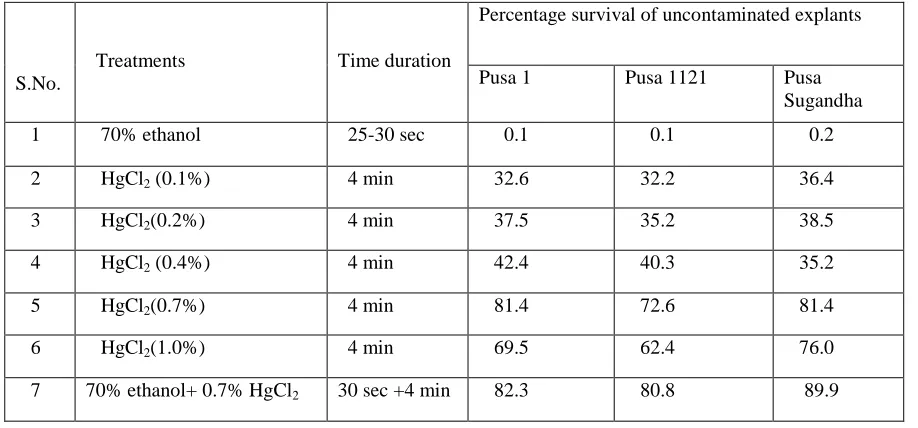
A single sterilant for different time periods was not applicable for the surface sterilization of seeds (explant) in Pusa 1, Pusa 1121 and Pusa Sugandha, as it could not control the contamination completely. A two stage sterilization treatment which included the combination of 70% alcohol (for 30 sec) and HgCl2
(0.7% for 3-4 minutes) was found to most effective leading to maximum uncontaminated explants (Table I).
Table I. Effect of different sterilants on surface sterilization of explants
Salt stress:
After 7 days of inoculation, it was observed that the all the explants were established in the MS medium
without any salt concentration and as the salt concentration was increased in the media there was a reduction in the survival rate of the explants, clearly
S.No.
Treatments Time duration
Percentage survival of uncontaminated explants
Pusa 1 Pusa 1121 Pusa Sugandha 1 70% ethanol 25-30 sec 0.1 0.1 0.2 2 HgCl2 (0.1%) 4 min 32.6 32.2 36.4
3 HgCl2(0.2%) 4 min 37.5 35.2 38.5
4 HgCl2 (0.4%) 4 min 42.4 40.3 35.2
5 HgCl2(0.7%) 4 min 81.4 72.6 81.4
6 HgCl2(1.0%) 4 min 69.5 62.4 76.0
stating that the increased salinity adversely affect the plant growth. However the number of explants survived in Pusa 1 and Pusa Sugandha were more as compared to Pusa 1121 at 100 mM salt concentration. None of the explants survived in all the three basmati genotypes when MS media was supplemented with 400mM and 500 mM salt concentration (Table II). Our results were at par with those obtained by Rajakumar in 2013.
Shoot multiplication:
The explants that survived in all the three basmati genotypes viz. Pusa 1, Pusa 1121 and Pusa Sugandha after salt stress were transferred to MS media supplemented with BAP and Kinetin. Their effect on shoot multiplication was studied as plant growth regulators are the most important factors for successful plant regeneration. Hill and schaller [6]
reported that cytokinins play a crucial role as promoters of cell division and act in the induction
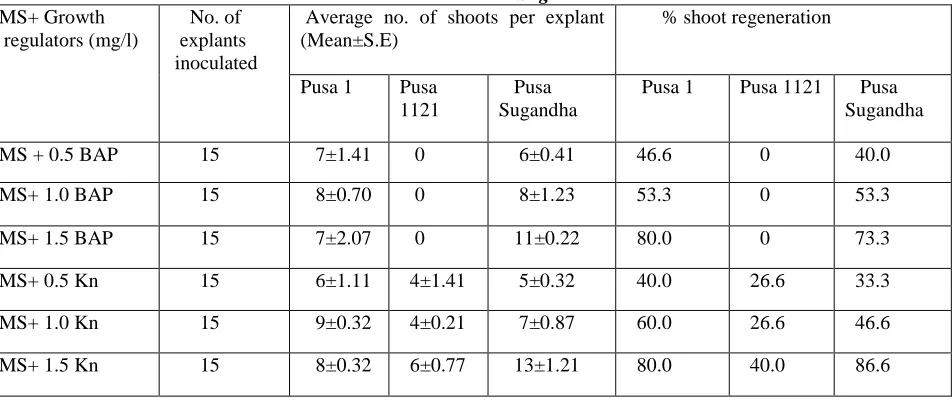
and development of meristematic centers leading to the formation of organs mainly shoots. The maximum number of shoots established in MS media supplemented with (1.0 mg/l) BAP and (1.0 mg/l) Kinetin were 93.33% in Pusa Sugandha, 80.0% in Pusa1, whereas it was only 66.6% in Pusa1121 (Table III, Fig I)). However when the MS media was supplemented with different concentrations (0.5mg/l, 1.0mg/l and 1.5mg/l) of either BAP or kinetin then the shoot length was longer in MS supplemented with 1.5mg/l Kn than in MS supplemented with 1.5mg/l BAP but the number of shoots obtained in MS supplemented with BAP (1.5mg/l) were more (multiple shoot regeneration) than in MS supplemented with Kn (1.5mg/l) (Table IV, Fig II). The results were at par with the earlier studies where cytokinins induced multiple shoot formation and in increased shoot length [7]. Verma et al. [8] obtained 95% of shoot regeneration in MS media supplemented with a combination with BAP and GA3 in cotyledonary node explants of gaur.
Table II: Effect of different salt concentrations on in vitro growth of explants
S.No. Salt concentration Time period
Percentage survival rate of explants Pusa 1 Pusa 1121 Pusa Sugandha 1 Control 7 days 100.0 100.0 100.0
2 100 mM 7 days 92.0 80.1 95.2 3 200 mM 7 days 60.8 42.4 72.8 4 300 mM 7 days 42.7 30.2 50.8 5 400 mM 7 days 0 0 0
6 500 mM 7 days 0 0 0
Table III: Effect of different concentrations of BAP and Kinetin on shoot regeneration in Basmati genotypes after 12 days of inoculation
MS Media +
growth regulators (mg/l)
Basmati genotypes
No. of explants inoculated
Percentage shoot
regeneration
Average No. of shoots per explant
Mean±S.E MS+BAP(1.0)+ Kn(1.0) Pusa Sugandha 15 93.3 3.11±0.43
Pusa 1 15 80.0 2.98±0.89 Pusa 1121 15 66.6 2.12±0.65 MS+BAP(1.0)+ Kn(0.5) Pusa Sugandha 15 80.0 2.98±0.89 Pusa 1 15 66.6 2.12±0.65 Pusa 1121 15 53.3 2.12±0.65 MS+BAP(0.5)+
Kn(0.5)
Pusa 1 15 46.6 1.56±0.34 Pusa 1121 15 33.3 1.78±0.447 MS+BAP(1.5)+ Kn(1.5) Pusa Sugandha 15 60.0 1.99±0.41
Pusa 1 15 60.0 1.99±0.32 Pusa 1121 15 46.6 1.98±0.89
Fig I: Effect of BAP and Kinetin on shoot multiplication (a) Pusa Sugandha (b) Pusa 1 (c) Pusa 1121
Table IV: Effect of different concentrations of BAP and Kinetin on shoot multiplication in Pusa 1, Pusa 1121 and Pusa Sugandha
MS+ Growth regulators (mg/l)
No. of explants inoculated
Average no. of shoots per explant (Mean±S.E)
% shoot regeneration
Pusa 1 Pusa 1121
Pusa Sugandha
Pusa 1 Pusa 1121 Pusa Sugandha MS + 0.5 BAP 15 7±1.41 0 6±0.41 46.6 0 40.0 MS+ 1.0 BAP 15 8±0.70 0 8±1.23 53.3 0 53.3 MS+ 1.5 BAP 15 7±2.07 0 11±0.22 80.0 0 73.3 MS+ 0.5 Kn 15 6±1.11 4±1.41 5±0.32 40.0 26.6 33.3 MS+ 1.0 Kn 15 9±0.32 4±0.21 7±0.87 60.0 26.6 46.6 MS+ 1.5 Kn 15 8±0.32 6±0.77 13±1.21 80.0 40.0 86.6
Fig II: Effect of (a) 1.5mg/l BAP and (b) 1.5mg/l Kn on shoot regeneration in Pusa Sugandha
In vitro Rooting and Hardening:
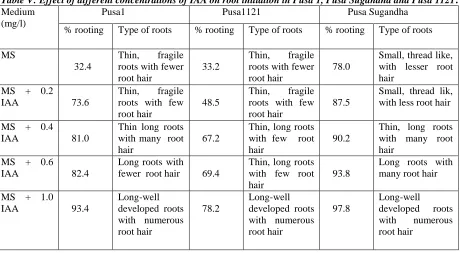
The shoots obtained in Pusa 1, Pusa 1121 and Pusa Sugandha were transferred to MS medium containing different concentrations of IAA. Root initiation occurred after 10-15 days of inoculation and well developed root system was attained in 3 weeks in all
the three genotypes. The maximum percentage of root regeneration was 97.83% in Pusa Sugandha, 93.48% in Pusa 1 and 78.23% in Pusa 1121 on MS medium containing 1.0 mg/l IAA whereas basal MS media has 78%, 32.40% and 33.24% roots in Pusa Sugandha, Pusa 1 and Pusa 1121 respectively (Table V).
Table V: Effect of different concentrations of IAA on root initiation in Pusa 1, Pusa Sugandha and Pusa 1121.
Medium (mg/l)
Pusa1 Pusa1121 Pusa Sugandha % rooting Type of roots % rooting Type of roots % rooting Type of roots MS
32.4
Thin, fragile roots with fewer root hair
33.2
Thin, fragile roots with fewer root hair
78.0
Small, thread like, with lesser root hair
MS + 0.2
IAA 73.6
Thin, fragile roots with few root hair
48.5
Thin, fragile roots with few root hair
87.5
Small, thread lik, with less root hair MS + 0.4
IAA 81.0
Thin long roots with many root hair
67.2
Thin, long roots with few root hair
90.2
Thin, long roots with many root hair
MS + 0.6
IAA 82.4
Long roots with
fewer root hair 69.4
Thin, long roots with few root hair
93.8
Long roots with many root hair MS + 1.0
IAA 93.4
Long-well developed roots with numerous root hair
78.2
Long-well developed roots with numerous root hair
97.8
Long-well developed roots with numerous root hair
Callus Induction:
Though 2, 4-D is the most suitable auxin for callus induction in rice tissue culture, yet it depends on the explant source and rice genotypes. In the present
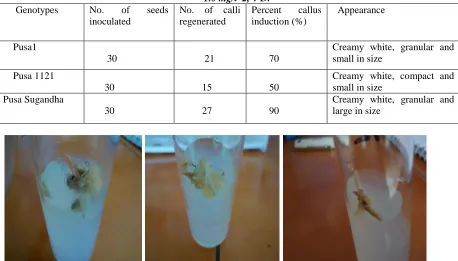
days of inoculation of dehusked seeds in all three genotypes of basmati rice viz. Pusa 1, Pusa 1121 and Pusa Sugandha (Table VI, Fig III). After three weeks of inoculation the MS medium supplemented with 1.0mg/l of 2, 4-D produced only 50% of the callus in Pusa 1121 whereas high frequency of callus induction occurred in Pusa Sugandha followed by Pusa 1. However, Mahajan et al. [9] reported an optimum concentration of 2.0mg/l of 2,4-D effective for callus induction in Ranbir basmati and Basmati 370. Though difference was found between callus of all three varieties but it was observed that the Pusa
Sugandha had more potential towards callus formation than Pusa 1 and Pusa 1121. The observed difference was not only in callus induction frequency but also in the quality of callus produced. Callus produced by Pusa Sugandha was more embryogenic. Significant difference between all three varieties for callogenesis under the same nutritional condition indicated that the callus induction quality is genotype dependent. The strong influence of genotypes on callus induction and plant regeneration was also observed in different plants [10, 11].
Table VI: Genotypic response of basmati rice to callus induction in MS media supplemented with 1.0 mg/l 2, 4-D.
Genotypes No. of seeds inoculated
No. of calli regenerated
Percent callus induction (%)
Appearance
Pusa1 30
21
70
Creamy white, granular and small in size
Pusa 1121 30
15
50
Creamy white, compact and small in size
Pusa Sugandha 30
27
90
Creamy white, granular and large in size
Fig III: Callus induction in (a) Pusa Sugandha (b) Pusa 1 (c) Pusa 1121 after 3 weeks of seed inoculation Shoot Regeneration and Multiplication:
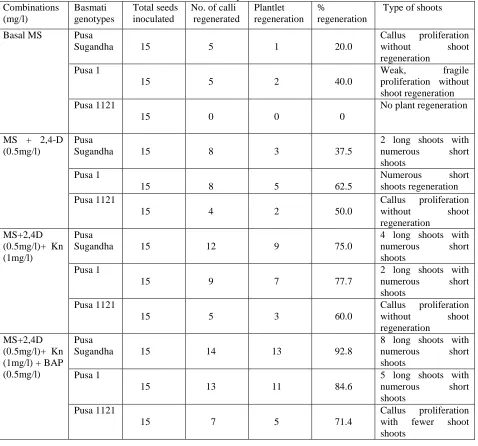
The differential application of growth regulators such as BAP and Kn in the culture medium results in the induction of callus and subsequent differentiation and organogenesis. The plant regeneration ability of plated calli generally depends on the variety and the callus inducing media. Pusa Sugandha regenerated maximum number of plants. The current study showed that the best combination of plant growth regulator that caused plant regeneration from callus was 2,4-D (0.5 mg/l), Kn (1.0 mg/l) and BAP (0.5 mg/l) in all three genotypes of basmati rice i.e Pusa 1, Pusa 1121 and Pusa Sugandha. However, highest percentage of shoot regeneration was observed in Pusa Sugandha (90.0%) followed by Pusa 1 (80.0%) and Pusa 1121 (50.0%) (Table VII, Fig IV). No shoot regeneration was observed in Pusa 1121 when the
MS media was supplemented with 2,4- D (0.5mg/l) and 1.0 mg/l Kn whereas shoot regeneration was observed in Pusa Sugandha and Pusa 1 (Table VII). Duangsee and Bunnag [12] observed the effect of nutrient composition and plant growth regulators on callus induction and plant regeneration in the glutinous rice cultivar Khunvang. They studied that the increasing casein hydrolysate and proline concentrations did not show a significant effect on callus growth but, proline concentration of 900 mg/ L yielded 85.67% of callus growth.
derived callus of rice is not influenced by physiological factors but also seems to be genetically controlled [13]. Same observations have also been reported earlier [14]. Though rice cultivars respond
differently to culture techniques and the genotype is a critical factor in tissue culture yet different histological processes leading to callus induction and organ differentiation, needs to be fully understood.
Table VII: Effect of different concentration of 2,4-D, BAP and Kn on plantlet regeneration from callus after 12 days
Combinations (mg/l)
Basmati genotypes
Total seeds inoculated
No. of calli regenerated
Plantlet regeneration
%
regeneration
Type of shoots Basal MS Pusa
Sugandha 15
5 1 20.0
Callus proliferation without shoot regeneration
Pusa 1
15 5 2 40.0
Weak, fragile proliferation without shoot regeneration Pusa 1121
15
0 0 0
No plant regeneration
MS + 2,4-D (0.5mg/l)
Pusa Sugandha
15 8 3 37.5
2 long shoots with numerous short shoots
Pusa 1
15 8 5 62.5
Numerous short shoots regeneration Pusa 1121
15 4 2 50.0
Callus proliferation without shoot regeneration
MS+2,4D (0.5mg/l)+ Kn (1mg/l)
Pusa Sugandha
15 12 9 75.0
4 long shoots with numerous short shoots
Pusa 1 15
9
7 77.7
2 long shoots with numerous short shoots
Pusa 1121
15 5 3 60.0
Callus proliferation without shoot regeneration
MS+2,4D (0.5mg/l)+ Kn (1mg/l) + BAP (0.5mg/l)
Pusa Sugandha
15 14 13 92.8
8 long shoots with numerous short shoots
Pusa 1
15 13 11 84.6
5 long shoots with numerous short shoots
Pusa 1121
15 7 5 71.4
Fig IV: Effect of BAP, Kn and 2,4 D on shoot regeneration from callus in (a) Pusa Sugandha (b) Pusa 1 (c) Pusa 1121
REFRENCES
1. Huang J, David CC and Duff B (1991). Rice in Asia: is it becoming an inferior good? Comment. Am J Agric Econ. 73: 515- 521
2. Lin YJ and Zhang Q (2005). Optimising the tissue culture conditions for high efficiency transformation of indica rice. Plant Cell Rep. 23: 540-547
3. Ge X,Chu Z, Lin Y et al. (2006) A tissue culture system for different germplasms of indica rice. Plant Cell Rep. 25: 392– 402
4. Rueb S, Leneman M, Schilperoort RA et al. (1994). Efficient plant regeneration through somatic embryogenesis from callus induced on mature rice embryos (Oryza sativa L.). Plant Cell Tissue Organ Cult. 36: 259-264
5. Murashige T and Skoog F (1962) A revised medium for rapid growth and bio-assays with tobacco tissue cultures. Physiol Plant 15: 473-497
6. Hill K and Schaller, G. E (2013). Enhancing plant regeneration in tissue culture: A molecular approach through manipulation of cytokinin sensitivity. Plant Signaling & Behavior. 8: e25709. doi:10.4161/psb.25709
7. Ibrahmin MA, Taha HA and Seheem AA (2013). Effect of cytokinin type and concentration, and source of explant on shoot multiplication of pineapple plant (Ananas comosus ‘Queen’) in vitro. Acta agriculturae Slovenica. 10: 15 -20 8. Verma D, Joshi R, Shukla A et al. (2011). Protocol for in
vitro somatic embryogenesis and regeneration of rice (Oryza
sativa L.). Indian J Experimental Biol.. 49: 958-963
9. Mahajan R, Aslam L and Kousar H (2013) Effect of growth regulators on in vitro cultures of two basmati rice genotypes: Ranbir basmati and Basmati 370. IJPCBS. 3: 1131-1138 10. Mohebodini M, Javaran MJ, Mahboudi F, Alizadeh H (2011).
Effects of genotype, explant age and growth regulators on callus induction and direct shoot regeneration of Lettuce
(Lactuca sativa L.). Aust J pl Sci. 5 : 92-95
11. Gandonou C, Errabii T, Abrini J et al. (2005). Effect of genotype on callus induction and plant regeneration from leaf explants of sugarcane (Saccharum sp.) Afr. J Biotechnol. 4: 1250- 1255
12. Duangsee K and Bunnag S (2014) Influence of nutrient composition and plant growth regulators on callus induction and plant regeneration in glutinous rice (Oryza sativa L.). Pak J Biol Sci.17: 98-103
13. Rajakumar R (2013).A study on effect of salt stress in the seed germination and biochemical parameters of rice (Oryza
sativa l.) under in vitro condition. Pelagai Res Lib. 3 : 20-25.
14. Rajendran RA, Bastian D, Oomman A et al. (2009). The role of growth hormones in rice (Oryza sativa L.) in vitro
cultures. Int J Pl Sci. 4 : 422-425