52
The Efficacy of Wellness Programmes as Work-Life Balance Strategies in the South African Public Service
Ethel N. Abe, Ziska Fields*, Isaac I. Abe University of KwaZulu-Natal, Durban South Africa
Abstract: This paper aimed to evaluate the wellness programs adopted by the South African Public Service to ascertain their efficacy at addressing work-family challenges and aiding employees to achieve work-life balance. Understanding the effectiveness of wellness programmes as work-life balance strategies is necessary especially when the cost of implementing such strategies is considered exorbitant. Many institutions have put in place work-life balance strategies, but discrepancies concerning definitions, formulation and implementation could make it impossible for them to fully reduce work-family challenges and assist employees in achieving the envisaged work-life balance. A sequential transformative mixed-methods study design was adopted. Data was collected using self-report questionnaire administered to 307 individual managers. Additionally, 11 top management members were interviewed. The major findings are as follows; (a) significant relationship exists between the wellness programmes and work-life balance strategies (b) wellness programmes qualified to be addressed only as life strategies because they did not address work challenges faced by employees. (c) work-life balance strategies predicted only 7.1% of the variations in wellness programmes in the South African Public Service. The peculiarity and value of this article lies in the discovery that work and life balance strategies adopted by organisations may not address employee work and life challenges and assist them in achieving work-life balance. Summarily, wellness programmes are not work-life balance strategies, and the South African Public Service should endeavour to adopt strategies that could assist employees in balancing work and family needs.
Keywords: Wellness Programmes, Work-Life Balance Strategies, Work-family challenges, Employee Assistance Programmes (EAPs)
1. Introduction
Contemporary organisations face the growing need to increase efficiency in product and service delivery globally. To achieve this, organisations must attract and retain the benefits of international, diverse and very technologically sound and high performing employees. Where these quality of employees are available, it is reported that they struggle to achieve balance between work and family challenges (Newaz & Zaman, 2012). Work-life balance (WLB) could be viewed as the simultaneous satisfaction that an individual employee has about his/her work and family situations; achieved through the use of work-life balance strategies (WLBS) implemented at a workplace. In this context, employment may no longer be satisfactory to an employee because it pays more or provides job security and prospects for rapid growth in the organisation. Rather, employments decisions could be made based on the ability of the present or potential employer to implement policies that are supportive in assisting employees achieve balance between work and family. Dunne (2007) reports that organisations that are unable to put in place work-life balance strategies such as flexible work arrangements have begun to lose very skilled and talented employees especially at the management level to the workplaces considered more family supportive and flexible. But in the public sector, WLBS are seen as arrangements made in order to conform to legislative requirements to provide for dual-earner families and address gender issues. However, the arrangements made by organisations towards employee wellbeing could possess WLB elements but may be unable to assist workers in achieving WLB regularly and consistently (Kossek, Lautsch & Eaton, 2006). The South African Public Service adopted the wellness programmes to assist her employees in managing work and family-related challenges. The key objective of this paper was to determine if the wellness programmes were able to assist employees to satisfactorily manage their work and family challenges and achieve WLB.
2. Literature Review
53
conducting a literature review was to assist in proffering appropriate examination, analysis and interpretation of the subject towards the conceptualisation of suitable strategies for assisting employees in addressing their work-life challenges. Hence, the expected result could be the achievement of meaningful WLB by the employees investigated. Research has revealed that family and work are interconnected, in the light of this, interest in the development of approaches to advance understanding into the interface among them has grown among scholars and practitioners (Voydanoff, 2005b).
Theoretical foundations: The segmentation theory (O'Driscoll, Ilgen, & Hildreth, 1992; Zedeck & Mosier, 1990; Zedeck, 1992), person-environment fit theory (Edwards, Caplan, & Harrison, 1998; Edwards & Cooper, 2013), conservation of resources (COR) theory (Hobfoll, 2001, 2011; Hobfoll & Lilly, 1993) and the demands, resources and strategies model (Voydanoff, 2005a, 2005b) helped in providing useful conceptualisations. Segmentation theory proposes that work and life are two mutual but exclusive spheres that do not influence each other (Guest, 2002; Sumer & Knight, 2001). Based on this theory, the strategies crafted to address each sphere’s challenges could be suitably designed to address the challenges existing in the domain. The person-environment fit theory is a double–barrel approach that focuses on the individual and person-environment in the study of stress to ascertain the features and influence of stress (Edwards et al., 1998; Endler & Magnusson, 1977; Pervin, 1989). It suggests that wellness, mannerisms and conduct are jointly influenced by the environment and the individual. The theory is core to studies in workplace behaviour, industrial psychology and management of human resources (Edwards, Cable, Williamson, Lambert, & Shipp, 2006; Edwards et al., 1998; Holland, 1997; Kristof, 1996; Walsh, Craik, & Price, 2000). It is useful to the present paper in providing clarity to the stress-environment interface and its implication on strategies.
COR theory predicts that the major determinant variable in stress development is the loss of resources (Hobfoll, 2001). Hobfoll (2001, p. 337) states that such resources ‘are those objects, personal characteristics, conditions, or energies that are valued in their own right, or that are valued because they act as conduits to the achievement or protection of valued resources’ The prediction of this theory is that stress is inevitable where resources are perceived to be vulnerable, lost, forfeited, and uneven; or if people as individuals or groups are unable to see the way of enhancing and securing their resources either by personal or collaborative efforts (Hobfoll, 2001). Since people try to receive, keep, enhance and secure everything that is maximally valuable (Hobfoll, 2001), the implication is that they will use important resources to manage themselves, their engagements in social relationships as well as the way in which they arrange themselves to behave and align with the larger society (Hobfoll, 2011). This paper engaged the COR theory in investigating how individual employees used the adopted strategies at the municipality in South Africa.
The demands, resources and strategies model considers the fact that employees nowadays face numerous unavoidable challenges regarding WLB (Campione, 2008; Delgado & Canabal, 2006; Mauno & Rantanen, 2013; Minnotte, 2012; Voydanoff, 2005a). Therefore, employees look for ways and means of managing the demands at work and at home. It was assumed in the study that resources present at work – such as wellness programmes – could assist employees in managing work and family demands and achieve WLB.
When people perceive that the challenges in the environment are more than the resources available to manage them, the situation is appraised as being stressful (Crawford, LePine, & Rich, 2010). Therefore, WLB could be derived from evaluating the relative challenges and resources pertaining to family and work responsibilities. Demands include those designed or mental claims that playing a particular role makes on an individual. Examples of demands are norms and expectations that a person is required to conform to in the course of performing a mental or physical task. Resources comprise those organised or mental assets which could be used in improving performance, reducing challenges or developing more resources (Voydanoff, 2004). The research on which this article is based aimed to ascertain if employees perceived that they achieved WLB by using the WLBS (in this case wellness programmes) in place at the municipality.
54
of these strategies, abundance of literary work done on work- and family-related matters (Pitt-Catsouphes, Kossek, & Sweet, 2006), as well as the publicity that the subject is receiving from the media, organisations do not know which strategies to adopt in order to assist employees in managing their work and family demands. WLBS can be classified into three groups: flexible working programmes (FWPs), family-friendly programmes, and health and wellness programmes. According to Caillier (2013), FWPs are those that offer workers the required flexibility to achieve WLB, for example, telecommuting, a compressed workweek and flexi start and finish. Flexitime is the most commonly FWP adopted by organisations for reasons ranging from job satisfaction to performance (Baltes, Briggs, Huff, Wright, & Neuman, 1999). Caillier (2013), reports that workplaces using FWPs could have their employees put in additional time at work including delivering services to citizens outside normal workday time. This suggests that flexitime would be appropriate to the needs of employees in the public service, especially municipalities. In a compressed workweek job schedules are compacted to permit employees to work fewer than 10 days every fortnight and particularly exceed eight hours per workday. It is different from flexible start and finish because time of work is aligned to the routine of starting and finishing times for all employees that participate in the arrangement (Caillier, 2013). Telecommuting refers to the arrangement where employees carry out some of their functions outside the contemporary office setting by using information and communication technology (ICT). This approach could result in work being done from home, at specific outposts in a region or any place where the employee has access to ICT (Baruch, 2001). Job sharing, part-time work, and maternal and paternal leave arrangements are other arrangements related to flexible time (Gunavathy, 2011).
The next group of WLBS, family-friendly benefits, include child and dependent-elderly relative care. In government organisations, child care in particular consists of assistance with on-site services, resource and referral services, and subsidies. The last group of WLBS is health and wellness programmes. Health and wellness programmes include health carnivals, bulletins, preventive programmes, gymnasium, weight loss facilities, counselling, and stress management programmes (SHRM, 2009). Fleetwood (2007), citing Gambles, Lewis, and Rapoport (2006), reaffirms that even though various adaptable work programmes seem to have the potential to assist individuals in achieving WLB, a number of these practices restrain the successful achievement of WLB. The South African public service adopted wellness programmes as WLBS to assist the employees in managing their work-life challenges and possibly achieve WLB. This article examines the efficacy of the wellness programmes among professional level employees at a municipality in the South African Public Service.
55
2004) or satisfaction with work (Shinn, Wong, Simko, & Ortiz-Torres, 1989). Thompson, Jahn, Kopelman, and Prottas (2004), found that aspects of WLBS associated positively with workers’ emotional obligation to the organisation, but had no effect on family-work challenges. The discussion of wellness programmes as WLBS is presented below.
The wellness programmes: There are fundamental assumptions underpinning the adoption of WLBS. Felstead, Jewson, Phizacklea, and Walters (2002) Concur on four theories that describe the elements underlying an organisation’s adoption of WLBS. These are institutional theory, organisational adaptation theory, high commitment theory and situational theory (Wood, 1999). Institutional theory postulates that organisations mirror and adapt to the influence of societal norms, though to differing levels (DiMaggio & Powell, 1983; Oliver, 1991; Powell & DiMaggio, 2012). The need to sustain compliance with societal norms fuels the differences in the levels of adaptations. Large corporate sector organisations and the public sector institutions usually easily conform to regulations due to their visibility resulting from size, and accountability to their constituencies. Situational theory is considered more practical in its method because it submits that workplaces merely respond and try to counter issues of stress as they emerge in their WLBS use. To Osterman (1995) this is known as the pragmatic reaction theory. This perspective views the adoption of WLBS by an organisation as emanating from neither variation in the national value structures as recommended in the institutional and organisational adaptation theories, nor the beginning of the ground-breaking human resources strategies as suggested by high commitment theory. Instead, it is founded on the establishment of defined challenges that threaten organisational performance and profit (Felstead et al., 2002).
The municipality under study adopted wellness programmes in line with the Employee Health and Wellness Strategic Framework for the public service which was based on the World Health Organisation (WHO) Global Plan of Action on Workers’ Health 2008-2017, the International Labour Organisation’s (I L O) Decent Work Agenda in Africa and the recommendations of the report of the WHO’s Commission on Social Determinants of Health (DPSA, 2008). The objective was to enable the formulation of strategies to manage HIV/AIDS, tuberculosis (TB), and wellness in the public service. The adoption of this programme as a WLB strategy may be attributed to the institutional and situational theories described above. Sieberhagen, Pienaar, and Els (2011) report that organisations are increasingly recognising the challenges relating to workers’ wellbeing (Hooper, 2004) and that there is heightened public interest in the integration of wellness events and the responsibilities of the employers (Hillier, Fewell, Cann, & Shephard, 2005). Consequently, programmes such as Employee Assistance Programmes (EAPs) and Employee Wellness programmes (EWPs) have been established to investigate matters regarding wellness of employees in the workplace (Frey, Osteen, Berglund, Jinnett, & Ko, 2015; Sieberhagen et al., 2011). These scholars confirm that both EAPs and EWPs address wellness issues.
Traditionally, the reason for establishing EAPs was to assist employees with their domestic problems that had the potential to undermine their work performance. The initial EAPs concentrated on addressing alcohol and substance misuse which negatively affected workers’ performance. For example, a number of the first EAPs focused on addressing issues emanating from abuses relating to alcohol and substance which undermine employees’ productivity. But in contemporary times, a number of EAPs integrated dependent-elderly relative care, domestic relationship counselling, stress management, legal advice, financial/debt counselling, HIV/AIDS counselling, and substance/alcohol abuse counselling (these are life strategies) to help workers address their personal life challenges (Benavides & David, 2010). The scholars are of the view that these interventions are formulated to detect, remedy and rehabilitate workers whose individual challenges are meddling with productivity at work. They further reported that employees perceived the programmes as having the objective of treating workers’ personal problems so that they do not degenerate to the point of permanently affecting the employees’ performance at work. EAPs are reactionary programmes intended to alleviate prevailing adverse situations by attending to core issues (subjective, psychological and medical) in the way they affect an employee’s performance at work (Benavides & David, 2010).
56
towards providing relief to employees from stress emanating from substance/alcohol abuse, finance/debt issues, medical and chronic diseases, career crises and job demands (Tuwai, Kamau, & Kuria, 2015). Basically, most of the strategies adopted by EWPs are counselling-based and their use is voluntary. By their formulation and design, EWPs are not structured to address work-related issues (Reynolds & Bennett, 2015) such as job stress, function vagueness or role clash, and/or absence of autonomy and their outcomes on employees’ stress levels. In addition, the services rendered through wellness programmes to employees are targeted towards personal and health-related matters rather than work-related issues. Participation in wellness programmes is limited by factors such as stigmatisation (Gerber, 1995; Naidoo, & Jano, 2003) as well as trust and confidentiality-related issues (Sieberhagen et al., 2011). Also, according to Gunavathy (2011), although corresponding interventions appear to be under the umbrella of WLBS, sound knowledge of the concept per se is still grey. The municipality (which, for the purpose of confidentiality, will not be named) in the South African Public Service investigated in this article adopted the wellness programmes as WLBS to assist employees in addressing their work- and family-related challenges.
Shamian and El-Jardali's (2007) examination of the implementation of wellness programmes in the healthcare sector showed that the work environment had improved significantly due to legislation and governmental policy which combined empirical information and inculcated information from literature. Edries, Jelsma, and Maart (2013) found wellness useful in enhancing health-related manners and employees’ perception of quality of life. Brown, Gilson, Burton, and Brown (2011) and Ho (1997) reported that employees who participated in the wellness events showed greater levels of satisfaction with their jobs than those that did not participate. Després, Alméras, and Gauvin (2014) suggested that a new breed of studies on the assessment and development in practices regarding employee health and wellness is needed. In the context sketched above, this paper was significant in assessing the work-life practices at the municipality and guiding the development of an effective WLB strategy that could address employees’ work-life challenges and assist in the achievement of WLB. To achieve this objective, individual benefits were assessed in order to ascertain their efficacy. According to Casper and Buffardi (2004), the examination of the various strategies may have distinctive results on workplace outcomes and possibly relate in predicting outcomes. The expected outcome of the paper is that the adoption of WLBS could lead to reduction in work and family stress and the achievement of WLB by employees.
57
assessing the strategies in place at a workplace. The research on which this article is based examined the efficacy of wellness programmes as WLBS at a municipality in South Africa.
3. Methodology
Being an exploratory study, a sequential transformative mixed methods study design was adopted. Both the quantitative and qualitative data collected concurrently (through the survey questionnaire) and sequentially (by in-depth interviews) were equally prioritised (Creswell & Garrett, 2008; Hanson, Creswell, Clark, Petska, & Creswell, 2005; Morgan, 2007). This is because the data collected from one-on-one interviews and open-ended questions were expected to disprove, validate or augment the data collected from the survey questionnaires. Therefore, the data collected and analysed in the paper are based on the assumptions of Hanson et al. (2005) sequential transformative mixed methods.
Sample selection and questionnaire administration: The target population for this study was 7 000 professional-level employees and the sample of participants in the study was 307 professional-level employees and 11 other members of the municipal top management that were interviewed. The sample respondents were drawn from the Safety and Social Services, Infrastructure, Human Settlement, HR, Governance, Finance and Procurement and Economic Development clusters of the municipality. Primary data were gathered from a survey of heads of units, senior managers, managers, co-ordinators, and supervisors. Data were collected over a six-month period and the study recorded a response rate of approximately 84%. A factor analysis method was engaged in classifying the WLBS while descriptive and inferential statistics were used in analysing the extent to which WLBS contributed to the wellness programmes. To establish the strategies that made up the wellness programmes, 10 different WLBS were described in the survey instrument. Respondents marked ‘yes’ to concur with the adoption of a strategy and ‘no’ to signify that it was not adopted by the municipality. Through exploratory factor analysis, the 10 selected strategies were classified into two, namely life strategies (for strategies addressing life challenges) and work strategies (for strategies addressing work demands). Descriptive statistics was employed in determining the frequencies of the responses to items relating to the WLBS scale that was adopted.
Measures: The variables in this paper were measured using responses from scales adapted to the study from validated measures that had been used previously. To measure WLBS, participants were asked to respond on a dual response ‘Yes’ and ‘No’ WLBS scale in order to establish the strategies in place at the municipality. A factor analysis was subsequently utilised to group the strategies according to their effectual patterns into two groups, namely life strategies and work strategies. The pattern that emerged categorically placed the WLBS into two distinct domains: work and life strategies. The wellness programmes were assessed by using the work-life wellness scale tested and adapted to the study. Respondents were asked to rank on a 5-point scale ranging from (1) strongly disagree to (5) strongly agree; the effect of the wellness programmes in assisting them to cope with various work and family-related challenges. Some of the items on this scale were ‘The work-life balance strategies in place at the municipality help me cope with work-related issues like function vagueness’ and ‘The work-life balance strategies in place at the municipality help me cope with my family related issues of parenting.’ The researcher appraised all aspects of work- and family-related challenges examined in this paper and included them as items in the scale so as to collect meaningful data.
58
4. ResultsExploratory factor analysis was conducted using the IBM SPSS version 22 to ascertain the validity of the instruments, correlation coefficient and regression analysis of the quantitative data. IBM NVivo was used in organising and analysing qualitative data. The results from the various variables are presented below.
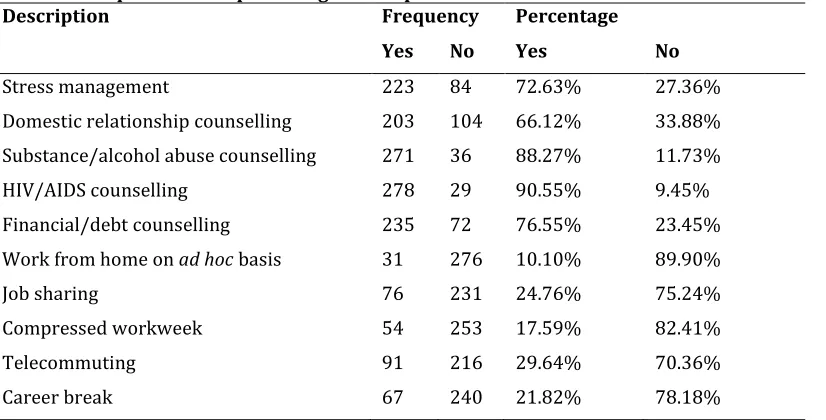
Work-life balance strategies at the municipality. Table 1 presents an assessment of WLBS in place at the municipality by highlighting 10 distinct strategies and respondents’ views on their availability at the municipality.
Table 1: Frequencies and percentages of responses to items on the work-life balance strategies
Description Frequency Percentage
Yes No Yes No
Stress management 223 84 72.63% 27.36%
Domestic relationship counselling 203 104 66.12% 33.88% Substance/alcohol abuse counselling 271 36 88.27% 11.73%
HIV/AIDS counselling 278 29 90.55% 9.45%
Financial/debt counselling 235 72 76.55% 23.45% Work from home on ad hoc basis 31 276 10.10% 89.90%
Job sharing 76 231 24.76% 75.24%
Compressed workweek 54 253 17.59% 82.41%
Telecommuting 91 216 29.64% 70.36%
Career break 67 240 21.82% 78.18%
The respondents that marked ‘Yes’ to the question eliciting information as to the availability of various strategies at the municipality, such as stress management, domestic relationship counselling, substance/alcohol abuse counselling, HIV/AIDS counselling and financial/debt counselling, were 72.6%, 66.1%, 88.3%, 90.6% and 76.5% respectively. These results confirm that most respondents were of the opinion that the municipality had adopted stress management, domestic relationship counselling, substance/alcohol abuse counselling, HIV/AIDS counselling and financial/debt counselling as WLBS. However, concerning work from home on an ad hoc basis, job share, compressed workweek, telecommuting and career break, the results indicate 89.9%, 75.2%, 82.4%, 70.4% and 78.2% respectively. These results show that most employees were of the opinion that these strategies were not adopted by the municipality. In summary, the municipality adopted stress management, domestic relationship counselling, substance/alcohol abuse counselling, HIV/AIDS counselling and financial/debt counselling. These strategies have been identified in the WLBS literature as health and wellness programmes (Caillier, 2013). Hence, the municipality’s wellness programmes particularly addressed health and wellness issues [issues relating to life (family)]. However, work from home on an ad hoc basis, job share, compressed workweek, telecommuting and career break (Caillier, 2013) had not been adopted by the municipality in the South African Public Service as strategies to assist employees in coping with their work and family-related challenges.
Table 2: Wellness programmes address work-related issues
Frequency Percent Valid Percent Cumulative Percent Valid Strongly disagree 67 21.82 21.82 21.82
Disagree 64 20.85 20.85 42.67
Neutral 99 32.25 32.25 74.92
Agree 66 21.50 21.50 96.42
Strongly agree 11 3.58 3.58 100.00
59
Use of wellness as a work-life balance strategy to address work-related challenges: From the results presented in Table 2 below, it is evident that the majority of the respondents represented by 32.2% (99 respondents) took a neutral stand with respect to the question, while 67 respondents representing 21.8% of the participants disagreed strongly and 64 others (20.8) also disagreed that the wellness programmes assisted them in managing their work-related challenges. Sixty-six participants (21.5%) agreed that the wellness programmes helped them in managing their work-related issues and the remaining 3.6% strongly agreed with the statement. The feedback on the item yielded a mean of 2.64 and a standard deviation of 1.147. The results indicate that over 42% of the participants expressed the view that the wellness programmes did not assist them in coping with their work-related challenges, while 37% others agreed with the statement.
Use of wellness programmes as a work-life balance strategy to address family-related issues: The outcome presented in Table 3 indicate that 23.8% of the respondents strongly disagreed that the wellness programmes helped them in coping with their relational issues and 20.5% others also disagreed with the statement. By taking a neutral stand a total of 104 respondents representing 33.9% did not express any view on the statement while 19.2% and 2.6% strongly agreed and agreed respectively that the wellness programmes helped them in coping with their relational challenges. The mean and standard deviation derived from this item were 2.56 and 1.125 respectively. This result shows that 44.3% of the total respondents disagreed with the statement while 21.8% agreed that the wellness programmes assisted them in managing their relational challenges. Table 3 presents the outcomes of the responses to this item.
Table 3: Wellness programmes address family-related issues
Frequency Percent Valid Percent Cumulative Percent Valid Strongly disagree 73 23.78 23.78 23.78
Disagree 63 20.52 20.52 44.30
Neutral 104 33.88 33.88 78.18
Agree 59 19.22 19.22 97.40
Strongly agree 8 2.60 2.60 100.00
Total 307 100.00 100.00
This is an unexpected result because the majority of the respondents were married and according to the literature, wellness programmes are designed to address family-related demands. The reason for this result could be linked to the findings of the qualitative data analysis. Some of the findings are unawareness of the programme, inaccessibility to the programme, stigmatisation, confidentiality and trust issues, as well as cultural beliefs. These findings of the qualitative data analysis are substantiated in the literature by various scholars (Gunavathy, 2011; Naidoo & Jano, 2003; Sieberhagen et al., 2011). This result could also be linked to the fact that the programme was an EAP, which the literature has shown to be a reactive strategy (Benavides & David, 2010). It is also corroborated by Kelly et al. (2008) supposition that workplaces that have adopted WLBS may be reacting to emerging viewpoints that suggest that good employers are those that adopt initiatives that are family-friendly.
60
tested in the study were integrated into it. This is supported by Voydanoff’s (2005a) border theory which postulates that work and family are inseparable spheres, therefore activities and resources need to be tailored to address them simultaneously.
Table 4: Work-life balance strategies as predictor of wellness programmes
Having established that there is a significant relationship between the wellness programmes and WLBS, it is necessary to ascertain if the WLBS assisted employees in achieving meaningful WLB.
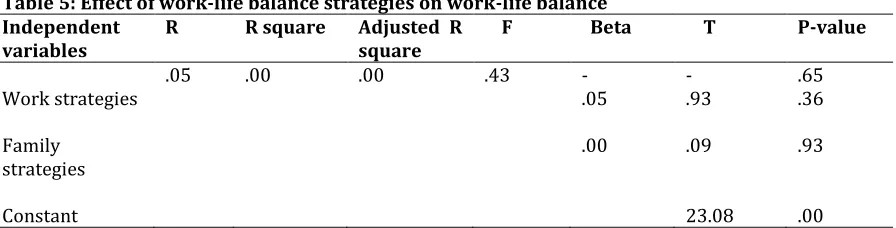
Work-life balance: The outcome variable in this paper is WLB indicated by satisfaction with work and family situations. The result of the effect of the WLBS on WLB is presented in the regression model below (Table 5). Consider the result of the R square at 0.003 and adjusted R square of 0.004. This shows that work and family strategies predict only 0.30% of the variations in WLB at a municipality in the South African Public Service. This is insignificant at p > 0.05 confirming that there is no significant relationship between WLBS and WLB. The standardised Beta and corresponding P values for work strategies and family strategies (β = 0.053, p > 0.05) and (β = 0.005, p > 0.05) respectively. Although none of the independent variables (family and work strategies) contributed significantly to the model, family strategies were most insignificant.
Table 5: Effect of work-life balance strategies on work-life balance Independent
variables R R square Adjusted R square F Beta T P-value
.05 .00 .00 .43 - - .65
Work strategies .05 .93 .36
Family
strategies .00 .09 .93
Constant 23.08 .00
Qualitative data analysis: The qualitative data was gathered from 11 selected interviewees among top management employees at the municipality and responses from open-ended questions included in the questionnaire. There were no restrictions as to choice of alternative answers in closed-ended form to participants. The qualitative responses highlighted participants’ perspective on the WLBS implemented by the municipality and ways of improving them. Most respondents were of the opinion that domestic relationship counselling, substance/alcohol abuse counselling, HIV/AIDS counselling, stress management and financial/debt counselling were implemented by the municipality. They further suggested the WLBS that were not in place at the municipality. Below in Figure 1 is the presentation of the responses from participants with respect to the WLBS including those adopted and not adopted by the municipality. The word “parent” in the figure below does not constitute any significant implication to the study but are NVivo generated labels for sources of data flow. Parent node is the main container of topics or themes in a particular factor. It aggregates the coding references from child nodes. Opening a parent node reveals the information coded directly to it and those coded at the first-level child nodes.
Independent
variable R R square Adjusted square R F Beta T P
.28 0.08 0.07 12.73
Life
strategies 150 2.73 .00
Work
strategies 235 4.27 .00
61
Figure 1: Work-life balance strategies (WLBS) at the municipality
Discussion of findings: The research reported in this article was designed to examine the efficacy of wellness programmes in addressing employee work-life challenges and achievement of WLB at a municipality in South Africa. The paper combined 10 major work-life balance strategies [(1) life strategies: domestic relationship counselling, stress management, substance/alcohol abuse counselling, HIV/AIDS counselling, financial/debt counselling and (2) work strategies: work from home on an ad hoc basis, job share, compressed workweek, telecommuting and career break)] by integrating the segmentation theory (Zedeck, 1992) and the demands, resources and strategies model (Voydanoff, 2005a, 2005b) in assessing the wellness programme as a WLBS. This result (categorisation) is supported in the literature by Zheng, Kashi, Fan, Molineux, and Ee (2015, p. 11). The outcome demonstrates that the wellness programme adopted as WLBS categorically addressed family-related demands; hence work strategies were not in place at the municipality in the South African Public Service. This result aligns to the segmentation theory’s (Guest, 2002; Lambert, 1990; O'Driscoll et al., 1992; Staines, 1980; Sumer & Knight, 2001; Zedeck, 1992) assumptions that work and the non-work domain are dissimilar and have no relationship with one another; therefore, strategies addressing both domains could be distinctly formulated and implemented.
62
Qualitative data provided more substantive information on the effect of the non-adoption of work strategies by the public service. The data confirmed that employees wished that strategies like telecommuting, job share, work from home on ad hoc basis and part-time work could be implemented at the municipal workplace. Additionally, the qualitative data supported the claim that wellness programmes at the municipality could not be addressed as holistic WLBS because they did not enhance employees’ experiences with work and family domains as supported in the literature (Felstead et al., 2002; McCarthy, Darcy, & Grady, 2010; Thompson, Beauvais, & Lyness, 1999). The findings of this paper also support the claims of Batt and Valcour (2003) that the challenges of work and life domains could not be solely tackled through initiatives that are crafted to give flexibility and restrict general work demands. This result is beneficial in predicting outcomes and this is supported in the literature (Arthur, 2003; Casper & Buffardi, 2004; Grover & Crooker, 1995; Kossek, Baltes, & Matthews, 2011). It also furthers knowledge in the study of wellness programmes by ascertaining that wellness programmes are life strategies. This highlights the need to formulate domain-based WLBS to address pertinent workplace and family-related challenges.
For the purpose of advising prospective practices to improve employees’ work-life experiences in the South African public sector, the following discussion provides the appraisal of the findings regarding wellness and WLBS. To find the extent to which work-life strategies (work strategies and life strategies in this paper) predicted wellness programmes at the municipality in the South African public service, the strategies (work and life strategies) were subjected to a regression model. The adjusted R square showed that the WLBS were responsible for 7.1% of the variations in wellness programme at the municipality. This is not surprising because, in line with Caillier (2013) categorisation of WLBS, wellness programme as one of the sub-categories of the construct is designed to assist employees with health and wellness issues. Incidentally, in this paper, work strategies made a more important contribution to the model than life (family) strategies, indicating that if work strategies were integrated into the wellness programmes, employees’ achievement of WLB could be influenced in a more meaningful way (Guest, 2002; Voydanoff, 2005b). Furthermore, Zheng, Kashi et al. (2015) submission in the literature was also corroborated by the findings of this paper.
5. Conclusion
The idea behind this paper is that the investment in the human capital of an organisation should not only be justifiable but must result in higher employee satisfaction, health and better services. This paper revealed that work strategies and family strategies jointly predicted wellness programmes at the municipality, therefore the finding is useful in bridging the gap in the literature, as suggested by Skinner and Chapman (2013), by evaluating the practice at the municipality in the South African Public Service. This result, therefore, has satisfied the second objective of this paper. The result confirms the novelty of this paper in classifying WLBS into two distinct and practical categories (work strategies and life strategies) and furthers knowledge on the efficacy of wellness programmes as WLBS.
63
drain, resource generation, and positive and negative spillover’ cause and effect rendition. Although there may be certain theoretical assumptions that support the supposed cause and effect relationship, experimental study (wherein resource drain and resource generation are manipulated) may be needed to make such strong inferences about causality.
The main aim of WLBS should be to reduce stressors that reduce employee satisfaction with work and family situations. Due to the significant effect that work and family –related challenges have on employees, work-life balance strategists need to be pragmatic in formulating and designing work-life balance strategies that address domain-specific needs. This could be achieved through proper investigation of the major work-related stressors and family-work-related stressors in order to match strategy to stressor. For instance, an employee facing absence of autonomy at work may be unable to overcome the stressor by using the wellness programmes. Therefore, it is recommended that management lead in championing the formulation, implementation (building WLBS portfolio) and promotion of WLBS at the municipality. This way, the strategies best suited to workplace stressors and employees’ work and family demands will be formulated and implemented. Effectively crafting a WLBS portfolio demands various skills, including aspects of management (change, project, communication), as well as strategic planning, implementation, monitoring and evaluation of the outcomes. Management need to be seen (not just heard) as being supportive of WLBS. When management endorsement is seen in the promotion of the policies (by way of campaigns, slogans, publicity and support), use by employees will be encouraged and possibly sustained.
References
Akanji, B. (2012). Realities of work life balance in Nigeria: Perceptions of role conflict and coping beliefs. Business, Management and Education, 2, 248–263.
Anderson, S. E., Coffey, B. S. & Byerly, R. T. (2002). Formal organizational initiatives and informal workplace practices: Links to work-family conflict and job-related outcomes. Journal of Management, 28(6), 787–810.
Arthur, M. M. (2003). Share price reactions to work-family initiatives: An institutional perspective. Academy of Management Journal, 46(4), 497–505.
Baltes, B. B., Briggs, T. E., Huff, J. W., Wright, J. A. & Neuman, G. A. (1999). Flexible and compressed workweek schedules: A meta-analysis of their effects on work-related criteria. Journal of Applied Psychology, 84(4), 496.
Baruch, Y. (2001). The status of research on teleworking and an agenda for future research. International Journal of Management Reviews, 3(2), 113–129.
Batt, R. & Valcour, P.M. (2003). Human resources practices as predictors of work‐family outcomes and employee turnover. Industrial Relations: A Journal of Economy and Society, 42(2), 189–220.
Benavides, A. D. & David, H. (2010). Local government wellness programs: A viable option to decrease healthcare costs and improve productivity. Public Personnel Management, 39(4), 291–306.
Brown, H. E., Gilson, N. D., Burton, N. W. & Brown, W. J. (2011). Does physical activity impact on presenteeism and other indicators of workplace well-being? Sports Medicine, 41(3), 249–262.
Burke, R. J. (2009). Working to live or living to work: Should individuals and organizations care? Journal of Business Ethics, 84(2), 167–172.
Caillier, J. G. (2013). Satisfaction with work-life benefits and organizational commitment/job involvement: Is there a connection? Review of Public Personnel Administration, 33(4), 340–364.
Cameron, R. (2005). Metropolitan restructuring (and more restructuring) in South Africa. Public Administration and Development, 25(4), 329–339.
Campione, W. (2008). Employed women’s well-being: The global and daily impact of work. Journal of Family and Economic Issues, 29(3), 346–361.
Carlson, D. S. & Kacmar, K. M. (2000). Work–family conflict in the organization: Do life role values make a difference? Journal of Management, 26(5), 1031–1054.
Casper, W. J. & Buffardi, L. C. (2004). Work-life benefits and job pursuit intentions: The role of anticipated organizational support. Journal of Vocational Behavior, 65(3), 391–410.
64
Crawford, E. R., LePine, J. A. & Rich, B. L. (2010). Linking job demands and resources to employee engagement and burnout: A theoretical extension and meta-analytic test. Journal of Applied Psychology, 95(5), 834-848.
Creswell, J. W. & Garrett, A. L. (2008). The movement of mixed methods research and the role of educators. South African Journal of Education, 28(3), 321–333.
Cushing, K. (2004). Concerns raised over UK long-hours culture. Caterer and Hotelkeeper, 193(4327), 14. Darcy, C., McCarthy, A., Hill, J. & Grady, G. (2012). Work–life balance: One size fits all? An exploratory analysis
of the differential effects of career stage. European Management Journal, 30(2), 111–120.
De Cieri, H., Holmes, B., Abbott, J. & Pettit, T. (2005). Achievements and challenges for work/life balance strategies in Australian organizations. The International Journal of Human Resource Management, 16(1), 90–103.
Delgado, E. A. & Canabal, M. E. (2006). Factors associated with negative spillover from job to home among Latinos in the United States. Journal of Family and Economic Issues, 27(1), 92–112.
Department of Public Service & Administration. (2008). Employee health and wellness strategic framework for the public service. Pretoria, South Africa: Author.
Després, J. P., Alméras, N. & Gauvin, L. (2014). Worksite health and wellness programs: Canadian achievements and prospects. Progress in Cardiovascular Diseases, 56(5), 484–492.
DiMaggio, P. J. & Powell, W. W. (1983). The iron cage revisited: Institutional isomorphism and collective rationality in organizational fields. American Sociological Review, 3, 147–160.
Dunne, H. (2007). Putting balance into business: Work/life balance as a business strategy for avoiding brain drain. Strategic HR Review, 6(6), 28-31.
Eagle, B. W., Icenogle, M. L., Maes, J. D. & Miles, E. W. (1998). The importance of employee demographic profiles for understanding experiences of work-family interrole conflicts. The Journal of Social Psychology, 138(6), 690–709.
Eagle, B. W., Miles, E. W. & Icenogle, M. L. (1997). Interrole conflicts and the permeability of work and family domains: Are there gender differences? Journal of Vocational Behavior, 50(2), 168–184.
Edries, N., Jelsma, J. & Maart, S. (2013). The impact of an employee wellness programme in clothing/textile manufacturing companies: A randomised controlled trial. BMC Public Health, 13(1), 13-25.
Edwards, J. R., Cable, D. M., Williamson, I. O., Lambert, L. S. & Shipp, A. J. (2006). The phenomenology of fit: Linking the person and environment to the subjective experience of person-environment fit. Journal of Applied Psychology, 91(4), 802-827.
Edwards, J. R., Caplan, R. D. & Van Harrison, R. (1998). Person-environment fit theory. Theories of Organizational Stress, 28, 1-71.
Edwards, J. R. & Cooper, C. L. (2013). The person-environment fit approach to stress: Recurring problems and some suggested solutions. In C.L. Cooper (Ed.). From stress to wellbeing, Volume 1: The theory and research on occupational stress and wellbeing. Palgrave Macmillan.
Edwards, J. R. & Rothbard, N. P. (2000). Mechanisms linking work and family: Clarifying the relationship between work and family constructs. Academy of management review, 25(1), 178-199
Endler, N. S. & Magnusson, D. (1977). The interaction model of anxiety: An empirical test in an examination situation. Canadian Journal of Behavioural Science/Revue canadienne des sciences du comportment, 9(2), 101-107.
Ezra, M. & Deckman, M. (1996). Balancing work and family responsibilities: Flextime and child care in the federal government. Public Administration Review, 2, 174–179.
Felstead, A., Jewson, N., Phizacklea, A. & Walters, S. (2002). Opportunities to work at home in the context of work‐life balance. Human Resource Management Journal, 12(1), 54–76.
Fleetwood, S. (2007). Why work–life balance now? The International Journal of Human Resource Management, 18(3), 387–400.
Frey, J. J., Osteen, P. J., Berglund, P. A., Jinnett, K. & Ko, J. (2015). Predicting the impact of chronic health conditions on workplace productivity and accidents: Results from two US Department of Energy national laboratories. Journal of Occupational and Environmental Medicine, 57(4), 436–444.
Gambles, R., Lewis, S. & Rapoport, R. (2006). The myth of work-life balance: The challenge of our time for men, women and societies. Sussex: Wiley.
65
Greenhaus, J. H., Ziegert, J. C. & Allen, T. D. (2012). When family-supportive supervision matters: Relations between multiple sources of support and work–family balance. Journal of Vocational Behavior, 80(2), 266–275.
Grover, S. L. & Crooker, K. J. (1995). Who appreciates family‐responsive human resource policies: The impact of family‐friendly policies on the organizational attachment of parents and non‐parents. Personnel Psychology, 48(2), 271–288.
Guest, D. E. (2002). Perspectives on the study of work-life balance. Social Science Information, 41(2), 255–279. Gunavathy, J. (2011). Work-life balance interventions prevalent in the Indian industry. South Asian Journal of
Management, 18(2), 108-127.
Haar, J. M. & Spell, C. S. (2004). Programme knowledge and value of work-family practices and organizational commitment. The International Journal of Human Resource Management, 15(6), 1040–1055.
Hanson, W. E., Creswell, J. W., Clark, V. L. P., Petska, K. S. & Creswell, J. D. (2005). Mixed methods research designs in counselling psychology. Journal of Counselling Psychology, 52(2), 224-235.
Hill, E. J. (2005). Work-family facilitation and conflict, working fathers and mothers, work-family stressors and support. Journal of Family Issues, 26(6), 793–819.
Hill, E. J., Ferris, M. & Märtinson, V. (2003). Does it matter where you work? A comparison of how three work venues (traditional office, virtual office, and home office) influence aspects of work and personal/family life. Journal of Vocational Behavior, 63(2), 220–241.
Hill, E. J., Märtinson, V. K., Ferris, M. & Baker, R. Z. (2004). Beyond the mommy track: The influence of new-concept part-time work for professional women on work and family. Journal of Family and Economic Issues, 25(1), 121–136.
Hillier, D., Fewell, F., Cann, W. & Shephard, V. (2005). Wellness at work: Enhancing the quality of our working lives. International Review of Psychiatry, 17(5), 419–431.
Hobfoll, S. E. (2001). The influence of culture, community, and the nested‐self in the stress process: Advancing conservation of resources theory. Applied Psychology, 50(3), 337–421.
Hobfoll, S. E. (2011). Conservation of resource caravans and engaged settings. Journal of Occupational and Organizational Psychology, 84(1), 116–122.
Hobfoll, S. E. & Lilly, R. S. (1993). Resource conservation as a strategy for community psychology. Journal of Community Psychology, 21(2), 128–148.
Hobson, B. (2011). The agency gap in work–life balance: Applying Sen’s capabilities framework within European contexts. Social Politics: International Studies in Gender, State & Society, 18(2), 147–167. Holland, J. L. (1997). Making vocational choices: A theory of vocational personalities and work environments:
Psychological Assessment Resources. Hooper, M. (2004). Employee well-being: A hard issue. People Dynamics, 22(3), 8–9.
Jones, F., Burke, R. J. & Westman, M. (2013). Work-life balance: A psychological perspective. New York: Psychology Press.
Judge, T. A., Locke, E. A., Durham, C. C. & Kluger, A. N. (1998). Dispositional effects on job and life satisfaction: The role of core evaluations. Journal of Applied Psychology, 83(1), 17-34.
Kalliath, T. & Brough, P. (2008). Work-life balance: A review of the meaning of the balance construct. Journal of Management & Organization, 14(3), 323–327.
Kelly, E. L., Kossek, E. E., Hammer, L. B., Durham, M., Bray, J. & Chermack, K. (2008). 7 Getting there from here: Research on the effects of work–family initiatives on work–family conflict and business outcomes. The Academy of Management Annals, 2(1), 305–349.
Kim, J. & Wiggins, M. E. (2011). Family‐friendly human resource policy: Is it still working in the public sector? Public Administration Review, 71(5), 728–739.
Kossek, E. E., Baltes, B. B. & Matthews, R. A. (2011). How work–family research can finally have an impact in organizations. Industrial and Organizational Psychology, 4(3), 352–369.
Kossek, E. E., Lautsch, B. A. & Eaton, S. C. (2006). Telecommuting, control, and boundary management: Correlates of policy use and practice, job control, and work–family effectiveness. Journal of Vocational Behavior, 68(2), 347–367.
Kossek, E. E. & Ozeki, C. (1999). Bridging the work-family policy and productivity gap: A literature review. Community, Work & Family, 2(1), 7–32.
66
Kristof, A. L. (1996). Person‐organization fit: An integrative review of its conceptualizations, measurement, and implications. Personnel Psychology, 49(1), 1–49.
Lambert, S. J. (1990). Processes linking work and family: A critical review and research agenda. Human Relations, 43(3), 239–257.
Leiter, M. P. & Durup, M. J. (1996). Work, home, and in-between: A longitudinal study of spillover. The Journal of Applied Behavioral Science, 32(1), 29–47.
Locke, E. A. (1976). The nature and causes of job satisfaction1. Hand book. Chicago: Rand McNally
MacInnes, J. (2005). Work–life balance and the demand for reduction in working hours: Evidence from the British Social Attitudes Survey 2002. British Journal of Industrial Relations, 43(2), 273–295.
Mauno, S. & Rantanen, M. (2013). Contextual and dispositional coping resources as predictors of work–family conflict and enrichment: Which of these resources or their combinations are the most beneficial? Journal of Family and Economic Issues, 34(1), 87–104.
May, J. & Govender, J. (1998). Poverty and inequality in South Africa. Indicator South Africa, 15, 53–58. McCarthy, A., Darcy, C. & Grady, G. (2010). Work-life balance policy and practice: Understanding line manager
attitudes and behaviors. Human Resource Management Review, 20(2), 158–167.
Minnotte, K. L. (2012). Family structure, gender, and the work–family interface: Work-to-family conflict among single and partnered parents. Journal of Family and Economic Issues, 33(1), 95–107.
Miraftab, F. (2004). Invited and invented spaces of participation: Neoliberal citizenship and feminists’ expanded notion of politics. Bloomington: Indiana University Press
Morgan, D. L. (2007). Paradigms lost and pragmatism regained methodological implications of combining qualitative and quantitative methods. Journal of Mixed Methods Research, 1(1), 48–76.
Naidoo, A. V. & Jano, R. (2003). The role of EAPs the SA context. The Social Work Practitioner-Researcher, 15(2), 113–127.
Netemeyer, R. G., Boles, J. S. & McMurrian, R. (1996). Development and validation of work–family conflict and family–work conflict scales. Journal of Applied Psychology, 81(4), 400-410.
Newaz, M. T. & Zaman, K. F. (2012). Work-life balance: Is it still a new concept in private commercial banking sector of Bangladesh? International Journal of Research Studies in Management, 1(2).
Ngo, H. Y., Foley, S. & Loi, R. (2009). Family friendly work practices, organizational climate, and firm performance: A study of multinational corporations in Hong Kong. Journal of Organizational Behavior, 30(5), 665–680.
O’Driscoll, M. P., Ilgen, D. R. & Hildreth, K. (1992). Time devoted to job and off-job activities, interrole conflict, and affective experiences. Journal of Applied Psychology, 77(3), 272-279.
Oliver, C. (1991). Strategic responses to institutional processes. Academy of Management Review, 16(1), 145– 179.
Osterman, P. (1995). Work/family programs and the employment relationship. Administrative Science Quarterly, 4, 681–700.
Özler, B. (2007). Not separate, not equal: Poverty and inequality in post‐apartheid South Africa. Economic Development and Cultural Change, 55(3), 487–529.
Pandey, S. K. & Wright, B. E. (2006). Connecting the dots in public management: Political environment, organizational goal ambiguity, and the public manager’s role ambiguity. Journal of Public Administration Research and Theory, 16(4), 511–532.
Pervin, L. A. (1989). Persons, situations, interactions: The history of a controversy and a discussion of theoretical models. Academy of Management Review, 14(3), 350–360.
Pitt-Catsouphes, M., Kossek, E. E. & Sweet, S. (2006). Charting new territory: Advancing multi-disciplinary perspectives, methods, and approaches in the study of work and family. In M. Pitt-Catsouphes, E.E. Kossek, & S. Sweet (eds.). The work and family handbook: Multidisciplinary perspectives, methods, and approaches. 1–16. Mahwah, NJ: Lawrence Erlbaum.
Powell, W. W. & DiMaggio, P. J. (2012). The new institutionalism in organizational analysis. Los Angeles: University of Chicago Press.
Reynolds, G. S. & Bennett, J. B. (2015). A cluster randomized trial of alcohol prevention in small businesses: A cascade model of help seeking and risk reduction. American Journal of Health Promotion, 29(3), 182– 191.
67
Shamian, J. & El-Jardali, F. (2007). Healthy workplaces for health workers in Canada: Knowledge transfer and uptake in policy and practice. Healthcare Papers, 7(I), 6 - 25.
Shinn, M., Wong, N. W., Simko, P. A. & Ortiz-Torres, B. (1989). Promoting the well-being of working parents: Coping, social support, and flexible job schedules. American Journal of Community Psychology, 17(1), 31–55.
Sieberhagen, C., Pienaar, J. & Els, C. (2011). Management of employee wellness in South Africa: Employer, service provider and union perspectives. SA Journal of Human Resource Management, 9(1), 1–14. Skinner, N. & Chapman, J. (2013). Work-life balance and family friendly policies. Evidence Base, 4(4), 1–25. Staines, G. L. (1980). Spillover versus compensation: A review of the literature on the relationship between
work and nonwork. Human Relations, 33(2), 111–129.
Sumer, H. C. & Knight, P. A. (2001). How do people with different attachment styles balance work and family? A personality perspective on work–family linkage. Journal of Applied Psychology, 86(4), 653 -663 Thompson, C. A., Beauvais, L. L. & Lyness, K. S. (1999). When work–family benefits are not enough: The
influence of work–family culture on benefit utilization, organizational attachment, and work–family conflict. Journal of Vocational Behavior, 54(3), 392–415.
Thompson, C. A., Jahn, E. W., Kopelman, R. E. & Prottas, D. J. (2004). Perceived organizational family support: A longitudinal and multilevel analysis. Journal of Managerial Issues, 3, 545–565.
Tuwai, B. B., Kamau, C. & Kuria, S. (2015). Effect of corporate wellbeing practices on employees’ performance among commercial banks in Kenya. International Journal of Scientific and Research Publications, 1, 1-16
Valcour, P. M. & Batt, R. (2003). Work-life integration: Challenges and organizational responses. Faculty publications –Human Resource Studies, 310–331. http://digitalcommons.ilr.cornell.edu/hrpubs Voydanoff, P. (2004). The effects of work demands and resources on work‐to‐family conflict and facilitation.
Journal of Marriage and Family, 66(2), 398–412.
Voydanoff, P. (2005a). Consequences of boundary-spanning demands and resources for work-to-family conflict and perceived stress. Journal of Occupational Health Psychology, 10(4), 491-503.
Voydanoff, P. (2005b). Toward a conceptualization of perceived work‐family fit and balance: A demands and resources approach. Journal of Marriage and Family, 67(4), 822–836.
Walsh, W. B., Craik, K. H. & Price, R. H. (2000). Person-environment psychology: New directions and perspectives. New York: Psychology Press.
Wong, S. C. K. & Ko, A. (2009). Exploratory study of understanding hotel employees’ perception on work–life balance issues. International Journal of Hospitality Management, 28(2), 195–203. doi:10.1016/j.ijhm.2008.07.001
Wood, S. (1999). Family-friendly management: Testing the various perspectives. National Institute Economic Review, 168(1), 99–116.
Zedeck, S. (1992). Introduction: Exploring the domain of work and family concerns. In S. Zedeck (ed.). Work, families, and organizations. 1-32. San Francisco CA: Jossey-Bass.
Zedeck, S. & Mosier, K. L. (1990). Work in the family and employing organization. American Psychologist, 45(2), 240-251.
Zheng, C., Kashi, K., Fan, D., Molineux, J. & Ee, M.S. (2015). Impact of individual coping strategies and organisational work–life balance programmes on Australian employee well-being. The International Journal of Human Resource Management (ahead-of-print), 1–26.