Vol. 10, No.1, 2015, 1-6
ISSN: 2279-087X (P), 2279-0888(online) Published on 8 April 2015
www.researchmathsci.org \
1
Annals of
Generalized Bernoulli Sub-ODE Method and its
Applications
Md. Abdus Salam1, Md. Sharif Uddin2 and Pinakee Dey3
1
Department of Mathematics, Mawlana Bhashani Science and Technology University, Tangail-1902, Bangladesh, E-mail: [email protected]
2
Department of Mathematics, Khulna University, Bangladesh, E-mail: [email protected]
3
Department of Mathematics, Mawlana Bhashani Science and Technology University, Tangail-1902, Bangladesh, E-mail: [email protected]
Received 20 March 2015; accepted 31 March 2015
Abstract. In this paper, by using the generalized Bernoulli sub-ODE method the Phi-four equation and Benney-Luke equation are solved analytically where some exact traveling wave solutions are established. This is the method which can be adapted to solve nonlinear partial differential equations. Solitary waves can be obtained from each traveling wave solution by setting particular values to its unknown parameters. By adjusting these parameters, one can get an internal localized mode.
Keywords: Generalized Bernoulli Sub-ODE method; Phi-four equation; Benney-Luke equation; traveling wave solutions.
AMS Mathematics Subject Classification (2010): 35Qxx
1. Introduction
Md. Abdus Salam, Md. Sharif Uddin and Pinakee Dey
2
[4], Enhanced (G'/G)-expansion Method [5], the modified simple equation method [6], the homogenous balance method [7] etc.
The objective of this article is to bring to bear the generalized Bernoulli sub-ODE method to extract new exact traveling wave solutions and then solitary wave solutions to the Phi-four equation [8-9] and Benney–Luke equation [10]. This application shows the simplicity, efficiency, and effectiveness of the generalized Bernoulli sub-ODE method. To the best of our knowledge the generalized Bernoulli sub-ODE method has not been applied to the above mentioned equation in the previous literature.
2. Description of generalized Bernoulli sub-ode method
Consider a nonlinear partial differential equation of the form
P
(
u
,
u
t,
u
x,
u
tt,
u
xt,
u
xx,
⋯
⋯
⋯
)
=
0
,
(2.1) where u=u(x,t)is a function of xand t , P is a polynomial in u=u( tx, )and its different partial derivatives, in which the highest order derivatives and nonlinear terms are present.The generalized Bernoulli sub-ODE method for solving the nonlinear partial differential equation (2.1) is demonstrated by the following steps:
Step 1: The traveling wave variable u(x,t)=u(
ξ
) whereξ
= x−ct, reduce the NPDE (2.1) to an NODE of the formP(u,−cu′,u′,c2u′′,−cu′′,u′′,⋯⋯⋯)=0, (2.2)
Step 2: Suppose that the solution of Eq. (2.2) can be expressed as a polynomial in Φ, i.e.
∑
= Φ = m
i i i
A u
0
)
(
ξ
, (2.3)where Am,Am−1,……. are constants to be determined later and Am ≠0. The positive integer m can be determined by considering the homogeneous balance between the highest order derivatives and nonlinear terms appearing in Eq.(2.2), and Φ=Φ
( )
ξ
satisfies the following equation:Φ′+
λ
Φ=µ
Φ2, (2.4) Whenµ
≠0, Eq. (2.4) is the type of Bernoulli equation, and we can obtain the solution as( )
−
− =
Φ 1
2 tanh
2 ξ
λ µ
λ
ξ . (2.5)
or,
( )
−
− =
Φ 1
2 coth
2
ξ
λ
µ
λ
ξ
. (2.6)3
Step 4: Setting the values of constants obtained in Step 3, and by using the solutions of Eq. (2.4), we can construct the traveling wave solutions of the nonlinear partial differential equation (2.1).
3. Application of the method
3.1. Generalized Bernoulli sub-ODE method for Phi-four equation
In this section, we will apply the generalized Bernoulli sub-ODE method to find the traveling wave solutions of Phi-four equation
utt −auxx−u+u3 =0, a>0 (3.1) Making the wave transformation
u
(
x
,
t
)
=
u
(
ξ
)
,ξ
=
x
−
c
t
, Eq.(3.1) becomes the following ODE:
(
c
2−
a
)
u
′′
−
u
+
u
3=
0
, (3.2) Balancing the order of u′′and u3appearing in Eq.(3.2), we have m=1 .So, according to the rule of sub-ODE method, the solution of Eq.(3.2) takes the following form
0 ,
)
( =A1Φ+A0 A1≠
u
ξ
(3.3)where A1, A0 are constants to be determined later.
Substituting Eq.(3.3) along with Eq.(2.4) into Eq.(3.2) and collecting all the terms with the same power of Φ together, equating each coefficient to zero, yields a set of simultaneous algebraic equations as follows:
3 1 0 2
1 2 2 1 1 2
0A −aA +c A −A =
A
λ
λ
3 3 3 1 0 2
1 0 1
2
λµ
+ +λµ
=aA A
A A
c
2 2 3 0
3 1 2 1 2 2
1 + + =
− aA
µ
c Aµ
A0 0 3
0 −A =
A
Solving the algebraic equations above, we obtain two sets of values for the constants:
Set A: 0 1 2
2 ,
2 ,
1
λ
λ
µ
= −− =
= A c a
A (3.4)
Set B: 0 1 2
2 ,
2 ,
1
λ
λ
µ
= −= −
= A c a
A
(3.5) Substituting Eq. (3.4) and Eq. (3.5) into Eq. (3.3) along with Eq. (2.5) and Eq. (2.6), we obtain the solution of Eq.(3.1) as:
−
=
−
=
2 2 a t -x coth ) , ( ,
2 2 a t -x tanh ) , (
2 1
2 1
λ
λ
λ
λ
t x u or
t x u
A A
Md. Abdus Salam, Md. Sharif Uddin and Pinakee Dey 4 − − = − − = 2 2 a t -x coth ) , ( , 2 2 a t -x tanh ) , ( 2 1 2 1
λ
λ
λ
λ
t x u or t x u and B B (3.7)3.2. Generalized Bernoulli sub-ODE method for Benney-Luke equation We know that the Beneey-Luke equation is
utt −uxx+auxxxx−buttxx+utuxx+2uxuxt =0, (3.8) The transformation
u
(
x
,
t
)
=
u
(
ξ
)
,ξ
=
x
−
c
t
, Eq.(3.8) becomes the following ODE:
(
c
2−
1
)
u
′′
+
(
a
−
bc
2)
+
u
′
′′′
−
3
c
u
′
u
′′
=
0
, (3.9) Here m=1 and the same procedure described above yields a set of algebraic equations of constants.0
4 1 2 2 1 4 1 2 12
λ
−
λ
−
λ
+
λ
=
A
bc
A
aA
A
c
3
3
15
15
3
0
3 2 1 3 1 2 3 1 2 1 1
2
λµ
+
λµ
−
λ
µ
+
λ
µ
+
λ
=
cA
A
ac
A
bc
A
A
c
2
2
50
12
50
0
2 2 1 2 2 1 2 2 1 2 2 1 2 2
1
+
+
−
−
=
−
A
µ
c
A
µ
bc
A
λ
µ
cA
λ
µ
aA
λ
µ
60
15
60
0
3 1 2 2 1 3 1
2
λµ
+
λµ
+
λµ
=
A
cA
A
bc
24
24
6
0
3 2 1 4 1 4 1
2
µ
−
µ
−
µ
=
cA
aA
A
bc
Solving, we get
2 2 2 2 1 0 0 1 1 , ) 1 )( 1 ( ,
λ
λ
λ
λ
b a c b a A A A + + = + + − == (3.10)
Substituting Eq. (3.10) into Eq. (3.3) along with Eq. (2.5) and Eq. (2.6), we obtain the solution of Eq.(3.8) as:
− + + − − = − + + − − = 1 . 1 1 2 coth 2 ) , ( , 1 . 1 1 2 tanh 2 ) , ( 2 2 0 2 2 2 0 2 t b a x A t x u or t b a x A t x u
λ
λ
λ
µ
λ
λ
λ
λ
µ
λ
(3.11)Remark: All the obtained results has been checked with Maple-13 by putting them back into the original equation and found correct.
4. Graphical representation
5
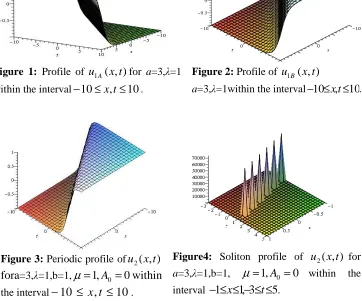
Eq. (3.11) represented in Fig. 3 shows kink type whereas the Fig.-4 shows the shape of singular kink type traveling wave solution.
Figure 1: Profile of u1A(x,t)for a=3,λ=1 within the interval−10≤x,t≤10.
Figure 2: Profile of u1B(x,t)
a=3,λ=1within the interval−10≤x,t≤10.
Figure 3: Periodic profile ofu2(x,t) fora=3,λ=1,b=1, 1, 0
0 =
= A
µ
withinthe interval
−
10
≤
x
,
t
≤
10
.Figure4: Soliton profile of u2(x,t) for a=3,λ=1,b=1, 1, 0
0 =
= A
µ
within theinterval −1≤x≤1,−3≤t≤5.
5. Conclusions
In this article, the generalized sub-ODE method method has been implemented to find the exact traveling wave solutions and then the solitary wave solutions of two very important nonlinear evolution equations, namely, the Phi-four equation and the Benney–Luke equation. It is important to observe that, the currently proposed method in comparing to other methods the generalized sub-ODE method is much simpler. Here, we achieved the value of the coefficients A1, A0 etc. with using any symbolic computation software such
as Maple-13 where the procedure is very easy, concise and straightforward. Also it is quite capable and almost well suited for finding exact solutions of other NLEEs in mathematical physics.
REFERENCES
Md. Abdus Salam, Md. Sharif Uddin and Pinakee Dey
6
2. J.H.He, Application of homotopy perturbation method to nonlinear wave equations, Chaos, Solitons and Fractals. 26 (3) (2005) 695–700.
3. J.H.He, Variational principles for some nonlinear partial differential equations with variable coefficients, Chaos, Solitons and Fractals, 19 (4), (2004).
4. A.Bekir and A.Boz, Exact solutions for nonlinear evolution equation using Exp-function method, Physics Letters A 372(2008), 1619–1625.
5. M.E.Islam, K.Khan, M.A.Akbar and R.Islam, Traveling wave solutions of nonlinear evolution equation via enhanced (G'/G)-expansion method, GANIT J. Bangladesh Math. Soc., 33 (2013) 83-92.
6. A.J.M.Jawad, M.D.Petkovi´c and A.Biswas, Modified simple equation method for nonlinear evolution equations, App. Math. and Compu., 217(2) (2010) 869–877. 7. J.Weiss, M.Tabor, G.Carnevale, The Painleve property for partial differential
equations, J Math Phys, 24 (1983) 522.
8. Ahmet Bekir, New exact travelling wave solutions for regularized long-wave, phi-four and Drinfeld-Sokolov equations, International Journal of Nonlinear Science, 6 (2008) 46-52.
9. X.Deng, M.Zhao, X.Li, Traveling wave solutions for a nonlinear variant of the PHI-four equation, Mathematical and Computer Modelling, 49(3–4) ( 2009) 617–622. 10. H.Triki, A.Yildirim, T.Hayat, O.M.Aldossary and A.Biswas, Shock wave solution of
the Benney–Luke equation, Rom J Phys, 57 (2012) 1029–34.