44 INTERNATIONAL JOURNAL OF ADVANCES IN ENGINEERING RESEARCH
REVIEW OF THE RISKS POSED TO DRINKING
WATER BY DISTILLATION PROCESS ON SHIPS
V.Thanikachalam
Department of Marine Engineering, HIMT College,Chennai.
ABSTRACT
The quality of drinking-water is a powerful environmental determinant of health. Assurance of drinking water safety is a foundation for the prevention and control of waterborne diseases.The quality of water, whether used for drinking, domestic purposes, food productionor recreational purposes has an important impact on health. Water of poor quality can causedisease outbreaks and it can contribute to background rates of disease manifestingthemselves on different time scales. Initiatives to manage the safety of water do not onlysupport health, but often promote socioeconomic development and well-being as well.
Contaminated water serves as a mechanism to transmit communicable diseasessuch as diarrhea, cholera, dysentery, typhoid and guinea worm infection. In addition, dangerously high concentrations ofchemical hazards, such as arsenic and fluoride, originating from natural sources affectmillions and cause conditions such as cancer and fluorosis. Inorganic arsenic is present athigh levels in the groundwater of a number of countries, including Argentina, Chile, China,India (West Bengal), Mexico, the United States of America, and Bangladesh.
Fresh water is of dire need on a ship. It is used for various purposes such as drinking, for preparing food, in laundry services and in many other day to day activities. In the past, people used to carry tons and tons of fresh water in barrels or in specially made tanks. This was because there were no other sources of fresh water once the ship was in sea, except rain, which was quite unpredictable.
Today in spite of means on board to generate fresh water, ships carry tons and tons of fresh water in segregated fresh water tanks. But there are many other processes in which fresh water is used and as generally the fresh water tanks provided are not sufficient, the need arises to generate fresh water onboard. Fresh water is always in dearth also because it is very difficult to keep a check on the water usage by the crew members and also the usage cannot be avoidable as water is continuously required onboard ship.Humans cannot drink saline water. But, saline water can be made into freshwater.The process is called desalination, and it is being used more and more around the world to provide people with needed freshwater.
In ancient times, many civilizations used this process on their ships to convert sea water into drinking water. Today, desalination plants are used to convert sea water to drinking water on ships. Distillation is perhaps the one water treatment technology that most completely reduces the widest range of drinking water contaminants.
45 INTERNATIONAL JOURNAL OF ADVANCES IN ENGINEERING RESEARCH
INTRODUCTION
Awareness of the importance of minerals and other beneficial constituents in drinking waterhas existed for thousands years, being mentioned in the Vedas of ancient India. In the book RigVeda, the properties of good drinking water were described as follows: ―Sheetham (cold totouch), Sushihi (clean), Sivam (should have nutritive value, requisite minerals and traceelements), Istham (transparent), VimalamlahuShadgunam (its acid base balance should be withinnormal limits)‖. That water may contain desirable substances has received less attention inguidelines and regulations, but an increased awareness of the biological value of water hasoccurred in the past several decades.
It was clear from the very beginning that desalinated or demineralised water without further enrichment with some minerals might not befully appropriate for consumption. There were three reasons for this:
Demineralised water is highly aggressive and if untreated, its distribution through pipes andstorage tanks would not be possible. The aggressive water attacks the water distribution pipingand leaches metals and other materials from the pipes and associated plumbing materials.
Distilled water has poor taste characteristics.
Preliminary evidence was available that some substances present in water could havebeneficial effects on human health as well as adverse effects. For example, experience withartificially fluoridated water showed a decrease in the incidence of tooth caries, and someepidemiological studies in the 1960’s reported lower morbidity and mortality from somecardiovascular diseases in areas with hard water.
Therefore, researchers focused on two issues:
1.) The possible adverse healtheffects of demineralised water,
46 INTERNATIONAL JOURNAL OF ADVANCES IN ENGINEERING RESEARCH
QUALITY OF DRINKING WATER
Although water has the simple formula H2O, it is a complex chemical solution. "Pure" water
essentially is nonexistent in the natural environment. Natural water, whether in the atmosphere, on the ground surface, or under the ground, always contains dissolved minerals and gases as a result of its interaction with the atmosphere, minerals in rocks, organic matter, and living organisms.
CHEMICAL CONTROLS OF WATER COMPOSITION
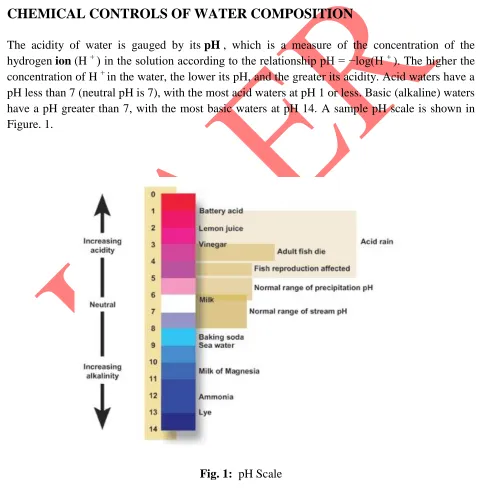
The acidity of water is gauged by its pH , which is a measure of the concentration of the hydrogen ion (H + ) in the solution according to the relationship pH = −log(H + ). The higher the concentration of H + in the water, the lower its pH, and the greater its acidity. Acid waters have a pH less than 7 (neutral pH is 7), with the most acid waters at pH 1 or less. Basic (alkaline) waters have a pH greater than 7, with the most basic waters at pH 14. A sample pH scale is shown in Figure. 1.
47 INTERNATIONAL JOURNAL OF ADVANCES IN ENGINEERING RESEARCH
The pH of water determines the solubility (amount that can be dissolved in the water) and biological availability (amount that can be utilized by aquatic life) of chemical constituents such as nutrients (phosphorus, nitrogen, and carbon) and heavy metals (lead, copper, cadmium, etc.). For example, in addition to affecting how much and what form of phosphorus is most abundant in the water, pH also determines whether aquatic life can use it. In the case of heavy metals, the degree to which they are soluble determines their toxicity. Metals tend to be more toxic at lower pH because they are more soluble.
NATURAL ACIDITY
Natural rainwater is slightly acidic because it interacts with carbon dioxide (CO2 ) in the
atmosphere, forming carbonic acid (H2CO3 ). Some of the carbonic acid in the rainwater then
breaks down (dissociates), producing more hydrogen ion and bicarbonate ion, both of which are dissolved in the rainwater.
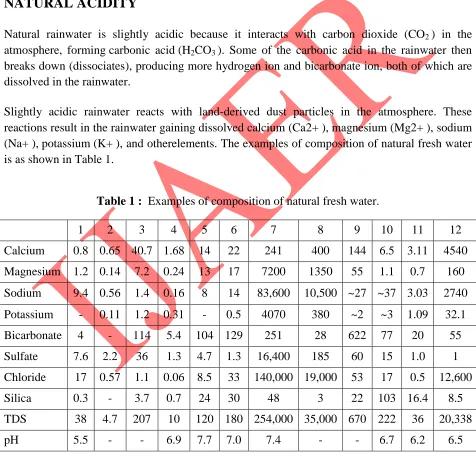
Slightly acidic rainwater reacts with land-derived dust particles in the atmosphere. These reactions result in the rainwater gaining dissolved calcium (Ca2+ ), magnesium (Mg2+ ), sodium (Na+ ), potassium (K+ ), and otherelements. The examples of composition of natural fresh water is as shown in Table 1.
Table 1 : Examples of composition of natural fresh water.
48 INTERNATIONAL JOURNAL OF ADVANCES IN ENGINEERING RESEARCH
All concentrations in milligrams/liter. TDS is total dissolved solids and pH is a measure of the acidity of the water. A pH less than 7 is acidic. A dash (-) indicates that the component was not detected or the water was not analyzed for this constituent. A tilde (~) means "approximately."Key to Analyses: (1) Rainwater from Menlo Park, California; (2) Average rainwater from sites in North Carolina and Virginia; (3) Composition of the Rhine River as it leaves the Alps; (4) Stream draining igneous rocks in the Washington Cascades; (5) Jump-Off Joe Creek, southwestern Oregon, wet season, November, 1990; (6) Jump-Off Joe Creek, southwestern Oregon, dry season, September, 1991; (7) Great Salt Lake, Utah; (8) Average seawater; (9) Groundwater from limestone of the Supai Formation, Grand Canyon; (10) Groundwater from volcanic rocks, New Mexico; (11) Groundwater from a spring, Sierra Nevada Mountains: short residence time; (12) Groundwater from metamorphic rocks in Canada: long
residence time.
FRESH WATER FROM SEA WATER ON SHIPS :
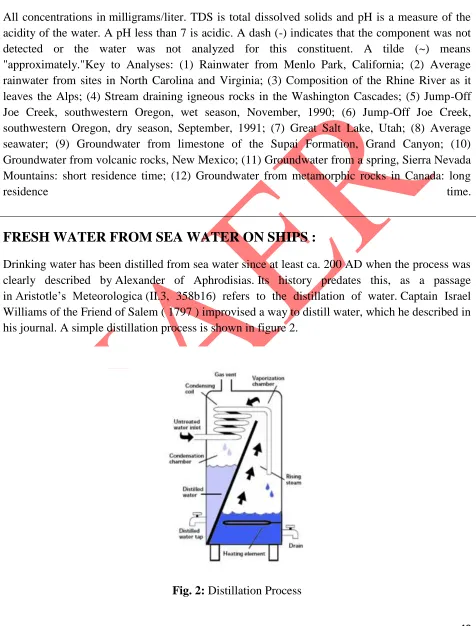
Drinking water has been distilled from sea water since at least ca. 200 AD when the process was clearly described by Alexander of Aphrodisias. Its history predates this, as a passage in Aristotle’s Meteorologica (II.3, 358b16) refers to the distillation of water. Captain Israel Williams of the Friend of Salem ( 1797 ) improvised a way to distill water, which he described in his journal. A simple distillation process is shown in figure 2.
49 INTERNATIONAL JOURNAL OF ADVANCES IN ENGINEERING RESEARCH
Up until World War II, distilling sea water to fresh water was time consuming and expensive in fuel. The saying was: "It takes one gallon of fuel to make one gallon of fresh water." Shortly before the war, Dr. R.V. Kleinschmidt developed the compression still, that became known as
the Kleinschmidt Still, for extracting fresh water from sea water or contaminated water. By
compressing the steam produced by boiling water, 175 gallons of fresh water could be extracted from sea water for every gallon of fuel used. During World War II this unit became standard on Allied ships and on trailer mounts for armies. This method was in widespread use for ships and portable water distilling units during the latter half of the century. Modern vessels now use Flash type Evaporatorsto boil sea water - heating the water to between 70-80 °C and evaporating the water in a vacuum - this is then collected as condensation before being stored.
Fresh water is of dire need on a ship. It is used for various purposes such as drinking, for preparing food, in laundry services and in many other day to day activities, like in motorships as an engine component cooling medium.
In the past, people used to carry tons and tons of fresh water in barrels or in specially made tanks. This was because there were no other sources of fresh water once the ship was in sea, except rain, which was quite unpredictable.
Today in spite of means on board to generate fresh water, still, ships carry fresh water in segregated fresh water tanks. But there are many other processes in which fresh water is used and as generally the fresh water tanks provided are not sufficient, the need arises to generate fresh water onboard. Fresh water is always in dearth also because it is very difficult to keep a check on the water usage by the crew members and also the usage cannot be avoidable as water is continuously required onboard ship.
Fresh water is generated on ship by a fresh water generator, also known as evaporator. The process by which fresh water is generated is known as distillation process. Sea water is converted into fresh water by evaporating and condensing the sea water. Evaporation of the sea water is either done by boiling or by flash process.
Nowadays, there are several very efficient types of evaporators still using the same heat sources, and of course now using osmosis as well.
TYPES OF FRESH WATER EVAPORATORS
There are numerous types of evaporators and osmosis equipment used to produce fresh water from seawater on the ships today.
Multi-stage Flash Evaporator
50 INTERNATIONAL JOURNAL OF ADVANCES IN ENGINEERING RESEARCH
MULTI-STAGE FLASH EVAPORATORS
This type of evaporator uses a multi-stage process which has two components, the seawater heater and the flash drum, with these being two separate units.
The seawater can be heated using steam or the main engine cooling water, depending on the main propulsion unit.
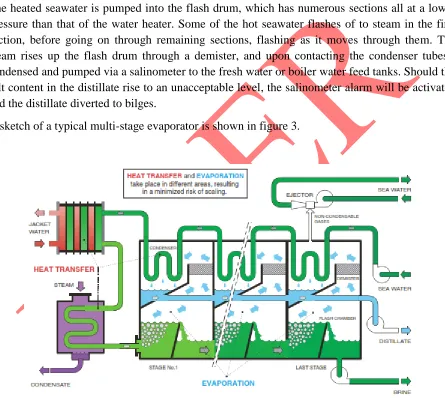
The heated seawater is pumped into the flash drum, which has numerous sections all at a lower pressure than that of the water heater. Some of the hot seawater flashes of to steam in the first section, before going on through remaining sections, flashing as it moves through them. The steam rises up the flash drum through a demister, and upon contacting the condenser tubesis condensed and pumped via a salinometer to the fresh water or boiler water feed tanks. Should the salt content in the distillate rise to an unacceptable level, the salinometer alarm will be activated and the distillate diverted to bilges.
A sketch of a typical multi-stage evaporator is shown in figure 3.
Fig. 3 : Multi stage Evaporator Flow Diagram.
TUBE OR COIL SEAWATER EVAPORATOR
51 INTERNATIONAL JOURNAL OF ADVANCES IN ENGINEERING RESEARCH
Today, there is an innovative device which uses a material that emits oscillations counteracting the natural seawater oscillations, thereby altering its properties and preventing calcium carbonate scale.
A tube and coil evaporator consists of a steel vessel which has a nest of heating pipes near the bottom of the vessel being fed by steam or hot water from the main engine.
There is a tube condenser cooled by seawater installed near the top of the vessel. A vacuum is drawn in the vessel by air ejectors operated by steam or pressurised seawater.
Seawater is fed into the evaporator just covering the heating pipes. Heat is supplied to the pipes and, this combined with the vacuum conditions begins to boil the seawater producing steam. The steam rises up through a demister into the tube condenser where it is evaporated to distilled water. This is collected and pumped via the salinometer to the storage tanks.
A typical tube condenser is shown in figure 4.
Fig.4 : Tube Condenser.
REVERSE OSMOSIS PROCESS
52 INTERNATIONAL JOURNAL OF ADVANCES IN ENGINEERING RESEARCH
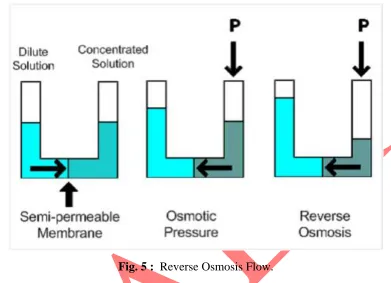
the higher concentrated solution, with the membrane blocking the solids. This is as shown in figure 5.
Fig. 5 : Reverse Osmosis Flow.
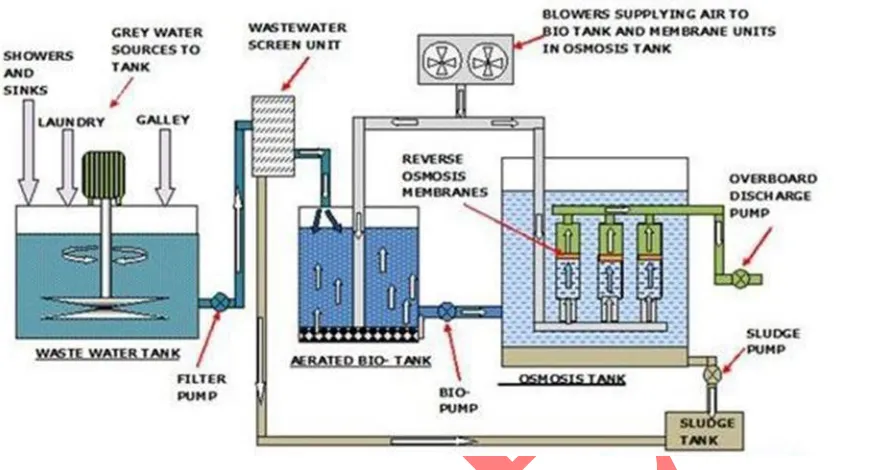
In an engine room, reverse osmosis takes place in a pressure vessel which contains a tank holding a quantity of seawater and freshwater separated by a semi-permeable membrane. In natural osmosis the freshwater would flow into the seawater, however when pressure is applied to the seawater side the process is reversed. This causes the seawater to flow into the freshwater side, the solids being stopped by the membrane.
53 INTERNATIONAL JOURNAL OF ADVANCES IN ENGINEERING RESEARCH
Fig. 6 : Flow Diagram of a Reverse Osmosis Evaporator.
DISTILLED WATER
54 INTERNATIONAL JOURNAL OF ADVANCES IN ENGINEERING RESEARCH
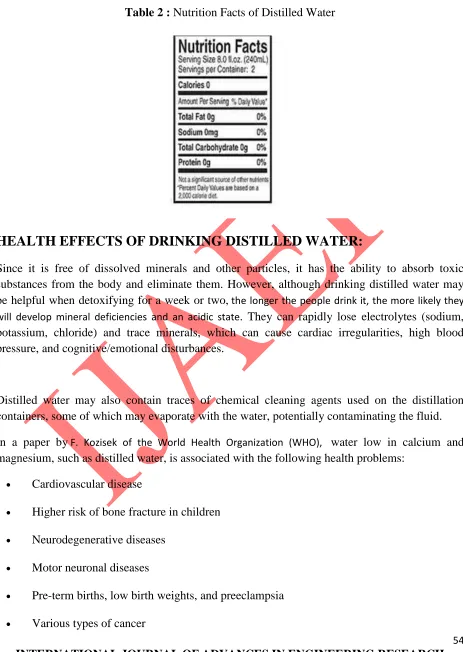
Table 2 : Nutrition Facts of Distilled Water
HEALTH EFFECTS OF DRINKING DISTILLED WATER:
Since it is free of dissolved minerals and other particles, it has the ability to absorb toxic substances from the body and eliminate them. However, although drinking distilled water may be helpful when detoxifying for a week or two, the longer the people drink it, the more likely they will develop mineral deficiencies and an acidic state. They can rapidly lose electrolytes (sodium, potassium, chloride) and trace minerals, which can cause cardiac irregularities, high blood pressure, and cognitive/emotional disturbances.
Distilled water may also contain traces of chemical cleaning agents used on the distillation containers, some of which may evaporate with the water, potentially contaminating the fluid.
In a paper by F. Kozisek of the World Health Organization (WHO), water low in calcium and magnesium, such as distilled water, is associated with the following health problems:
Cardiovascular disease
Higher risk of bone fracture in children
Neurodegenerative diseases
Motor neuronal diseases
Pre-term births, low birth weights, and preeclampsia
55 INTERNATIONAL JOURNAL OF ADVANCES IN ENGINEERING RESEARCH Increased risk of "sudden death"
Acute magnesium and calcium deficiency, weakness, fatigue and muscle cramping
A growing number of health care practitioners and scientists from around the world have been advocating the theory that aging and disease is the direct result of the accumulation of acid waste products in the body.
The longer one drinks distilled water, the more likely the development of mineral deficiencies and an acid state.Those who supplement their distilled water intake with trace minerals are not as deficient but still not as adequately nourished in minerals as their non-distilled water drinking counterparts even after several years of mineral supplementation.
The ideal water for the human body should be slightly alkaline and this requires the presence of minerals like
calcium
magnesium
Distilled water tends to be acidic and can only be recommended as a way of drawing poisons out of the body. Once this is accomplished, the continued drinking of distilled water is a bad idea.
Water filtered through reverse osmosis tends to be neutral and is acceptable for regular use provided minerals are supplemented.
Water filtered through a solid charcoal filter is slightly alkaline. Ozonation of this charcoal filtered water is ideal for daily drinking. Longevity is associated with the regular consumption of hard water (high in minerals). Disease and early death is more likely to be seen with the long term drinking of distilled water.
AN
ELABORATE
VIEW
ON
THE
CONSUMPTION
OF
DEMINERALISED OR LOW-MINERAL WATER
56 INTERNATIONAL JOURNAL OF ADVANCES IN ENGINEERING RESEARCH
these studies, we should also consider the results of epidemiological studies where health effects were compared for populations using low-mineral (soft) water and more mineral-rich waters.
Demineralised water that has not been remineralised is considered an extreme case of low-mineral or soft water because it contains only small amounts of dissolved low-minerals such as calcium and magnesium that are the major contributors to hardness.
The possible adverse consequences of low mineral content water consumption are discussed in the following categories:
Direct effects on the intestinal mucous membrane, metabolism and mineral homeostasis or other body functions.
Little or no intake of calcium and magnesium from low-mineral water.
Low intake of other essential elements and microelements.
Loss of calcium, magnesium and other essential elements in prepared food.
Possible increased dietary intake of toxic metals.
Possible bacterial contamination of low-mineral water.
DIRECT EFFECTS OF LOW MINERAL CONTENT WATER ON THE
INTESTINAL MUCOUS MEMBRANE, METABOLISM AND MINERAL
HOMEOSTASIS OR OTHER BODY FUNCTIONS:
Distilled and low mineral content water (TDS < 50 mg/L) can have negative taste characteristics to which the consumer may adapt with time. This water is also reported to be less thirst quenching. Although these are not considered to be health effects, they should be taken into account when considering the suitability of low mineral content water for human consumption. Poor organoleptic and thirst-quenching characteristics may affect the amount of water consumed or cause persons to seek other, possibly less satisfactory water sources.
57 INTERNATIONAL JOURNAL OF ADVANCES IN ENGINEERING RESEARCH
LITTLE OR NO INTAKE OF CALCIUM AND MAGNESIUM FROM
LOW-MINERAL WATER
Calcium and magnesium are both essential elements. Calcium is a substantial component of bones and teeth. In addition, it plays a role in neuromuscular excitability (i.e., decreases it), the proper function of the conducting myocardial system, heart and muscle contractility, intracellular information transmission and the coagulability of blood. Magnesium plays an important role as a cofactor and activator of more than 300 enzymatic reactions including glycolysis,
For about 50 years, epidemiological studies in many countries all over the world have reported that soft water (i.e., water low in calcium and magnesium) and water low in magnesium is associated with increased morbidity and mortality from cardiovascular disease (CVD) compared to hard water and water high in magnesium. Recent studies also suggest that the intake of soft water, i.e. water low in calcium, may be associated with higher risk of fracture in children, certain neurodegenerative diseases , pre-term birth and low weight at birth and some types of cancer . In addition to an increased risk of sudden death, the intake of water low in magnesium seems to be associated with a higher risk of motor neuronal disease, pregnancy disorders (so-called preeclampsia), and some cancers.
The complaints included cardiovascular disorders, tiredness, weakness or muscular cramps and were essentially the same symptoms listed in the warning of the German Society for Nutrition.
LOW
INTAKE
OF
SOME
ESSENTIAL
ELEMENTS
AND
MICROELEMENTS FROM LOW-MINERAL WATER
Recent epidemiological studies of an ecologic design among Russian populations supplied with water varying in TDS suggest that low-mineral drinking water may be a risk factor for hypertension and coronary heart disease, gastric and duodenal ulcers, chronic gastritis, goitre, pregnancy complications and several complications in newborns and infants, including jaundice, anemia, fractures and growth disorders.
HIGHLOSS OF CALCIUM, MAGNESIUM AND OTHER ESSENTIAL
ELEMENTS IN FOOD PREPARED IN LOW-MINERAL WATER
58 INTERNATIONAL JOURNAL OF ADVANCES IN ENGINEERING RESEARCH
Since most nutrients are ingested with food, the use of low-mineral water for cooking and processing food may cause a marked deficiency in total intake of some essential elements that was much higher than expected with the use of such water for drinking only. The current diet of many persons usually does not provide all necessary elements in sufficient quantities, and therefore, any factor that results in the loss of essential elements and nutrients during the processing and preparation of food could be detrimental for them.
POSSIBLE INCREASED DIETARY INTAKE OF TOXIC METALS
Low-mineralized water is unstable and therefore, highly aggressive to materials with which it comes into contact. Such water more readily dissolves metals and some organic substances from pipes, coatings, storage tanks and containers, hose lines and fittings, being incapable of forming low-absorbable complexes with some toxic substances and thus reducing their negative effects.
POSSIBLE
BACTERIAL
CONTAMINATION
OF
LOW-MINERAL
WATER
All water is prone to bacterial contamination in the absence of a disinfectant residual either at source or as a result of microbial re-growth in the pipe system after treatment. Re-growth may also occur in desalinated water. Bacterial re-growth within the pipe system is encouraged by higher initial temperatures, higher temperatures of water in the distribution system due to hot climates, lack of a residual disinfectant, and possibly greater availability of some nutrients due tothe aggressive nature of the water to materials in contact with it.
The Czech National Institute of Public Health in Prague has tested products intended for contact with drinking water and found, for example, that the pressure tanks of reverse osmosis units are prone to bacterial regrowth. They also contain a rubber bag whose surface appears to be favourable for bacterial growth.
FOR MAKING WATER POTABLE
As a method of disinfecting water, bringing it to its boiling point at 100 °C (212 °F), is the oldest and most effective way since it does not affect the taste, is effective despite contaminants or particles present in it, and is a single step process which eliminates most microbes responsible for causing intestine related diseases. In places having a proper water purificationsystem, it is only advocated as an emergency treatment method or for obtaining potable water in the wilderness or in rural areas, as it cannot remove chemical toxins or impurities.
59 INTERNATIONAL JOURNAL OF ADVANCES IN ENGINEERING RESEARCH complete inactivation, most intestine affecting microbes and E.Coli (Gastroentriritis) take less than a minute; at boiling point, Vibrio Cholerae (cholera) takes ten seconds and hepatitis A virus (causes the symptom of jaundice), one minute. Boiling does not ensure the elimination of all micro-organisms; the bacterial spores chlostridium can survive at 100 °C (212 °F) but are not water-borne or intestine affecting. Thus for human health, complete sterilization of water is not required.
DISTILLED WATER AND PURIFIED WATER
The difference between pure and distilled water is that, the former is prepared by filtering water while the later by boiling it. The process of filtration leads to removal of impurities up to a certain extent; it may contain naturally found minerals. Distilled water on the other hand doesn't contain solid materials. It is just pure hydrogen dioxide (H2O).
USE OF DISTILLED WATER
One cannot judge as to, what is distilled water best used for. This is because, it serves many other purposes apart from the usage in laboratories i.e. in research projects.
The distilled water is suitable for conducting experiments and also in cleaning purposes. As stated earlier, it is one of the most important applications of distilled water.
The domestic use of distilled water is made for cooking. It can especially be used in the preparation of diets containing low amount of sodium.
In the industrial areas, distilled water proves to be useful in developing photographic films. The reason behind using distilled water for this job is that photographic films have a layer of certain chemicals on them. These chemical are washed away and no other chemicals remain on the surface, if distilled water is used.
Distilled water is also required for the purpose of filling wet-car batteries. Intravenous solutions too are prepared with the help of distilled water.
REASONS FOR TREATING THE DISTILLATE
60 INTERNATIONAL JOURNAL OF ADVANCES IN ENGINEERING RESEARCH There are chances of the water becoming infested with the bacteria due to colonial
organisms. Sterilization by the addition of chlorine and electro-katadyn process is recommended in Merchant Shipping Notices M1214 and M1401 respectively.
The distilled water has none of the dissolved solids in common that is present in freshwater and also it has no taste (ie, it tastes flat).
Distilled water tends to be slightly acidic as it absorbs CO2 readily. This condition will
cause problems like corrosion, and the human digestive tract will be disturbed.
TREATMENT OF DRINKING WATER
Drinking water should contain minimum levels of certain essential minerals (and othercomponents such as carbonates). Unfortunately, over the two past decades, little research attentionhas been given to the beneficial or protective effects of drinking water substances. The main focushas been on the toxicological properties of contaminants. Nevertheless, some studies haveattempted to define the minimum content of essential elements or TDS in drinking water, andsome countries have included requirements or guidelines for selected substances in their drinkingwater regulations. The issue is relevant not only where drinking water is obtained by desalination(if not adequately re-mineralised) but also where home treatment or central water treatmentreduces the content of important minerals and low-mineral bottled water is consumed.
Drinking water manufactured by desalination is stabilized with some minerals, but this isusually not the case for water demineralised as a result of household treatment. Even whenstabilized, the final composition of some waters may not be adequate in terms of providing healthbenefits. Although desalinated waters are supplemented mainly with calcium (lime) or othercarbonates, they may be deficient in magnesium and other microelements such as fluorides andpotassium.
Furthermore, the quantity of calcium that is supplemented is based on technicalconsiderations (i.e., reducing the aggressiveness) rather than on health concerns. Possibly none ofthe commonly used ways of re-mineralization could be considered optimum, since the water doesnot contain all of its beneficial components. Current methods of stabilization are primarilyintended to decrease the corrosive effects of demineralised water.
61 INTERNATIONAL JOURNAL OF ADVANCES IN ENGINEERING RESEARCH
In recent years we've learned a lot about the dangers of disinfection byproducts (DBPs) found in most treated water supplies, such as trihalomethanes (THMs) and haloacetic acids (HAAs). These DBPs form when water treatment disinfectants such as chlorine, chloramines, and chlorine dioxide react with natural organic matter in the source water.
Researchers have now discovered that DBPs are over 1,000 times more toxic than chlorine, and out of all the other toxins and contaminations present in the water, such as fluoride and miscellaneous pharmaceutical drugs, DBPs may be the absolute worst.
Trihalomethanes (THMs), for example, are Cancer Group B carcinogens, meaning they've been shown to cause cancer in laboratory animals. They've also been linked to reproductive problems in both animals and humans, and human studies suggest that lifetime consumption of chlorine-treated water can more than double the risk of bladder and rectal cancers in certain individuals.
CONCLUSION
The most effective means of ensuring the safety of the fresh water supply is through the use of arisk assessment and management approach that covers the whole process from loading todelivery at the tap and includes a planned maintenance system. All of the information gatheredshould be used to develop a Fresh Water Safety Plan (FWSP), particularly for ships with acomplex system, which could be incorporated into the ship’s planned maintenance system.
AnFWSP should be based on the following format.
• System assessment and hazard analysis (including an assessment of source waterloaded on to the ship)
• Management plan and control measures, (the selection and operation of appropriatetreatment processes)
• Monitoring and corrective action system in accordance with the Plan (the prevention ofcontamination/re-contamination during storage and distribution).
Control measures (treatments) will be influenced by the quality of the source water. In the eventof the potable water becoming unfit for human consumption then the tank(s) and distributionsystem should be drained, super-chlorinated and flushed.
62 INTERNATIONAL JOURNAL OF ADVANCES IN ENGINEERING RESEARCH
remarkable job of filtering out some of the absolute worst water contaminants. It does, however, also create water that is both slightly acidic and demineralized.
Most recently, the UN General Assembly declared the period from 2005 to 2015 as the International Decade for Action, ―Water for Life.‖
In the end, what the human being want is pure, clean, well-balanced water that is neither too alkaline nor too acidic.
REFERENCES
[1] Anne Marie Helmenstine, ― Can You Drink Distilled Water?‖
[2] ArikAzoulay, et al., ―Comparison of the Mineral Content of Tap Water and Bottled Waters‖.
[3] ChanieKirschner, ―What's the difference between distilled water, spring water and purified water?‖
[4] FrantisekKozisek, ― Health Risks From Drinking Demineralised Water‖.
[5] Mohd. HanifDewan, ― Fresh Water Generator‖.
[6] Dr. Mercola, ‖ Distilled Water : Avoid This Type of Water Purification‖.
[7] NikolayVoutchkov, ― Re-mineralization of Desalinated Water‖.
[8] Raunekk, ― Generating Drinking Water on Ship – The Magic Machine‖.
[9] Rick Curtis, ―OA Guide to Water Purification‖
[10]Shmueli, Deborah F, ―Water quality in international river basins"
[11] Solomon Branch, ―Which Minerals Should You Add to Distilled Water Before Drinking?‖ [12] Willie Scott, ―Fresh Water from Sea Water on Ships‖
[13] Zoltar. P. Rona, ―Early Death Comes From Drinking Distilled Water‖
[14] Australian Drinking Water Guidelines (2011)
[15] Drinking water for New Zealand
63 INTERNATIONAL JOURNAL OF ADVANCES IN ENGINEERING RESEARCH
[17] Health Canada (2006).
[18] Maritime and Coastguard Agency - MGN 397(M+F) , ―Guidelines for the Provision of Food and
Fresh Water on Merchant Ships and Fishing Vessels‖
[19] The USGS Water Science School, 2014, ― Saline Water : Desalination‖.
[20] USGS, 2014, ― Water Properties and Measurements‖ [21] Wikipedia,‖ Properties of Water‖.
[22] World Health Organisation, Fourth Edition, 2011, ―Guidelines for Drinking-water Quality‖