Isolation of Bacteria Producing Cellulase from
Tilapia Fish Gut and Media Optimization for
Celluase Production using Plackett Burman
Design
Sandeep Chovatiya#1; Snehal Ingle#2, Dipika Patel#3 and Bhoomi Thakkar#
#
Ashok & Rita Patel Institute of Integrated Studies in Biotechnology & Allied Sciences (ARIBAS), New Vallabh Vidhya Nagar-388121 (Gujarat) India
Abstract
Cellulase production from bacteria can be an advantage as the enzyme production rate is normally higher due to the higher bacterial growth rate as compared to fungi. Screening of bacteria, optimisation of fermentation conditions and selection of substrates are important for the successful production of cellulase. This study is conducted to produce cellulase from tilapia fish gut bacteria, using Plackett Burman design and carboxymethyl cellulose (CMC) as substrate. The highest cellulase producing ability of isolate from this study was found to be 0.323 IU/ml with 24 hours of incubation. With the help of Plackett-Burman design, maximum cellulolytic activities was observed in high levels of CMC, Urea, Peptone, Calcium chloride, magnesium sulphate and Trace elements and Low levels of Ammonium sulphate, and Di Potassium Hydrogen phosphate, at 37 °C and pH 7.0 which is found to be optimized levels of components.
Keywords:Celluase, fish gut, tilapia, Plackett Burman design.
I. INTRODUCTION
Cellulases are a group of hydrolytic enzymes capable of hydrolyzing the most abundant organic polymer i.e. cellulose to smaller sugar components including glucose subunits. Cellulases are inducible enzyme complex involving synergistic action of endoglucanase, exoglucanase and cellobiase [1]. Cellulases gained a huge economic importance due to their wide range of application in industries like starch processing, animal food production, grain alcohol fermentation, malting and brewing, extraction of fruits and vegetable juices, pulp and paper industry and textiles industry [2].
The high cost of cellulase production owing to use of pure chemicals in production coupled with low enzyme activities limits its industrial use[3]. Major impediments to exploiting the commercial potential of cellulases are the yield stability and the cost of cellulase production. Research should therefore be aimed at taking advantage of the commercial potential of existing and new cellulases in nature. Cellulase enzymes account for approximately 20 percent of the world enzymes market and are mostly produced by Aspergillus, Trichoderma and Penicillium species [4]. Cellulase is widely produced by submerged fermentation, but the relatively high cost of production and recovery has hindered its industrial application. Cellulase of Paenibacillus spp was found to have maximum CMC activity at 600C, pH 6.5. Due to the promising thermostability and slight acidic tolerance of this enzyme, it has good potential for industrial use in the hydrolysis of soluble cellulose as well as activity on microcrystalline sources of cellulose [2]. Paenibacillus campinasensis BLII is a thermophilic spore-forming bacterium which was found to grow between 25 and 600C over a wide range of pH. Optimal growth is around neutral pH at 550C. The physiological properties of this strain and the vast number of free glycosyl hydrolases produced, give this strain potential for use in bio-refining industry [5].
As a result of the high cost of cellulase production with its low enzyme activities owing to the use of chemicals in its industrial production, efforts were needed to economize cellulase production through media (cultural) optimization and use of supplements and/or additives [3]. Researches have been carried out and are still ongoing all aimed at isolating potential cellulase producing microorganisms from diverse habitats [11]. This study was therefore aimed at investigating the cultural conditions necessary for optimal cellulase yield by cellulolytic bacterial organisms from gastrointestinal tract of Tilapia fish.
II. MATERIALS&METHODS
A. Sample-Collection:
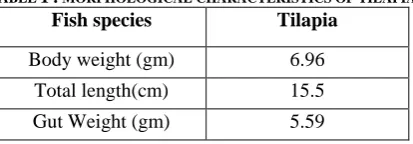
Carnivore, column feeder tilapia were sampled from Anand fish market for study. The average weight and length are studied & presented in Table 1.
TABLE 1: MORPHOLOGICAL CHARACTERISTICS OF TILAPIA
Fish species Tilapia
Body weight (gm) 6.96
Total length(cm) 15.5
Gut Weight (gm) 5.59
B. Homogenate Preparation
The gut of healthy fish was dissected out in cold and aseptic condition in phosphate buffer. Then it is rinsed in N-Saline and intestine was mechanically homogenized in sterile phosphate buffer (0.2 M) to give 10-1 diluted sample. Homogenates thus obtained were centrifuged for 15 min at 6000 rpm and supernatant was stored in refrigerator at 4ºC for further processing.
C. Isolation of Cellulase Producing Microorganism on Nutrient Agar Media
Isolation of cellulase producing bacteria by spread plate technique is carried out by serially diluting the homogenates obtained in sterilized phosphate buffer using Normal saline as diluents. 0.1ml of aliquots from each dilution is used to spread inoculated onto Nutrient agar plates. (10-1 to 10-6). Plates were incubated for 24 hours 37⁰C and after incubation the isolates obtained were screened for cellulase production.
D. Screening of Isolates Obtained on Nutrient Agar Plates for Cellulase Activity:
A plate assay method with 1% (w⁄v) CMC in Nutrient Agar medium with 1.5 % (w/v) agar was used for screening of cellulase positive bacterial isolates. The plates were incubated at 37 ºC for 24 h and the cellulase activity was indicated as clear orange halos around the inoculated wells after staining with 1 % Congo red solution for 30 min and washing several times with 1 M NaCl [12]. The magnitude of the activity was calculated by measuring the diameter of the zones.
E. Fermentation Process of Cellulase Production
To 100 ml of the optimized culture medium, a loopful of cell culture from respective species was inoculated under controlled conditions. Then it was kept in incubator at 37°C for a 3days and after every 24 hours of incubation 5ml of broth from the flask was withdrawn aseptically and centrifuged at 5000rpm at 40C and the supernatant used for cellulase activity estimation. The composition of fermentation medium used for cellulase production at high level (+) contained (g / 100ml): Carboxymethyl cellulose,2.5; Urea,0.05; Proteose Peptone, 0.5; (NH4)2SO4,0.5; KH2PO4, 0.5; CaCl2, 0.5; MgSO4, 0.05; FeSO4, 0.5mg; MnSO4, 0.16mg; ZnSO4,0.14mg; CoCl2, 0.2mg; pH – 7.0.
A ten times lower concentration of each component is maintained at low level (-) for cellulase production.
F. Fermentation Media Optimization for Cellulase Production using Plackett Burman Design:
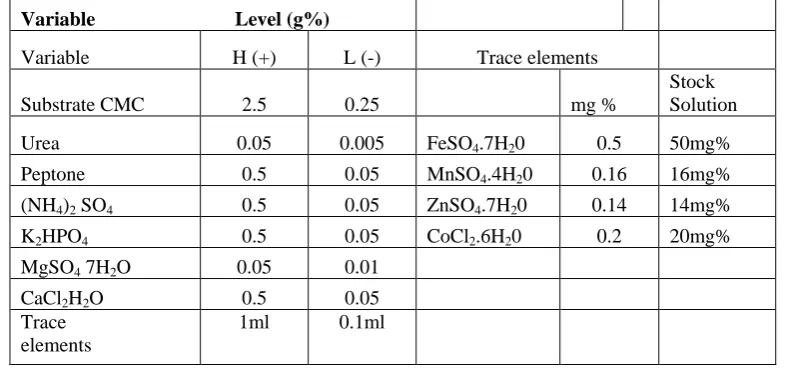
low level (−) and high level (+) of each factor are listed in (Table 2). The statistical software package Design-Expert software (version 6.1.5, Stat-Ease, Inc., Minneapolis, USA) is used for analyzing the experimental data. Once the critical factors are identified through the screening, the central composite design can be used to obtain a quadratic model.
Table 1 : Experimental Range and Levels of Independent Variables in the Plackett-Burman Experiment Variable Level (g%)
Variable H (+) L (-) Trace elements
Substrate CMC 2.5 0.25 mg %
Stock Solution
Urea 0.05 0.005 FeSO4.7H20 0.5 50mg%
Peptone 0.5 0.05 MnSO4.4H20 0.16 16mg%
(NH4)2 SO4 0.5 0.05 ZnSO4.7H20 0.14 14mg%
K2HPO4 0.5 0.05 CoCl2.6H20 0.2 20mg%
MgSO4 7H2O 0.05 0.01
CaCl2H2O 0.5 0.05
Trace elements
1ml 0.1ml
Table 2 : The Plackett-Burman Design For 11 Parameters. Trial Substrat
e CMC
Urea Peptone (NH4)2
SO4
K2HP
O4
MgS O4.7
H2O
CaC l2.2H 2O
Trace elements
D1 *
D2* D3* Response (Cellulase IU/ml)
1 + + - + + + - - - + - 0.101
2 - + + - + + + - - - + 0.156
3 + - + + - + + + - - - 0.161
4 - + - + + - + + + - - 0.084
5 - - + - + + - + + + - 0.130
6 - - - + - + + - + + + 0.085
7 + - - - + - + + - + + 0.264
8 + + - - - + - + + - + 0.323
9 + + + - - - + - + + - 0.293
10 - + + + - - - + - + + 0.083
11 + - + + + - - - + - + 0.071
12 - - - - - - - - - - - 0.034
The design considers the main effect of the variables but not their interaction effects.
It can represent by the first order polynomial equation:
Y = ßo +∑n i=1 ß i Xi……….. (1)
Where Y represents the response, ßo is the model coefficient, ßi is the linear coefficient, Xi is the variables, and n is the number of the parameters (variables).
Each variable was represented in the two levels, i.e. high (+), and low (-). The effect of each variable was determined by the following equation:
E(Xi) = ∑Mi+ -∑Mi- ………….. (2)
N
Where E(xi) represents is the response value effect of the tested variable; ∑Mi- is the summation of
the response value at low level, and N is the number of experiments. Table 4 represented the selected variables to be evaluated at High and low levels, Table 5 showed the design matrix; eight assigned variables were screened in the 12 experimental runs. The cellulase production was carried out in the triplicate. The fraction significant at 95% level (p-value < 0.05) was considered reliable.
G. Enzyme Assay
Cellulase activity measured as CMC hydrolyzing activity was assayed according to the method recommended by Ghose (1987)[13] and expressed as international units (IU). One international unit of cellulase activity is the amount of enzyme that forms 1 μmol glucose (reducing sugars as glucose) per minute during the hydrolysis reaction. Reducing sugar was determined by the dinitro salicylic acid (DNS) method.
III.RESULTANDDISCUSSION
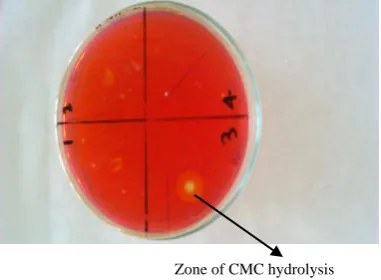
Eight isolates of bacterial organisms were obtained from the fish gut, Isolate no.3 was shown to produce cellulase enzyme in the primary screening carried out on nutrient agar medium supplemented with 1% CMC as seen in figure 2. The colony characteristics and Gram staining are tabulated in the Table 6 and figure 3 respectively.
Zone of CMC hydrolysis
Figure 1 : Screening of Cellulase producing Bacteria from Fish Gut
Table 3 : Colony Characteristics of Well Isolated Colony of Cellulase Producer
Size Medium
Shape Round
Margin Regular
Elevation Convex
Texture Mucoid
Opacity Opaque
Pigmentation Yellowish
Orange
GramNature Nagative
Figure 2 : Gram Staining of Cellulase Producing Bacteria.
Bacteria present an attractive potential for the exploitation of cellulases due to their rapid growth rate, enzyme complexity and extreme habitat variability [14]. The high cost of cellulase production (due to use of pure chemical in production) coupled with low enzyme activities, limits its industrial use. Therefore, efforts are needed to economize cellulase production by media optimization [3] and hence, isolation and characterization of cellulase producing bacteria will continue to be an important aspect of biofuel research [7].
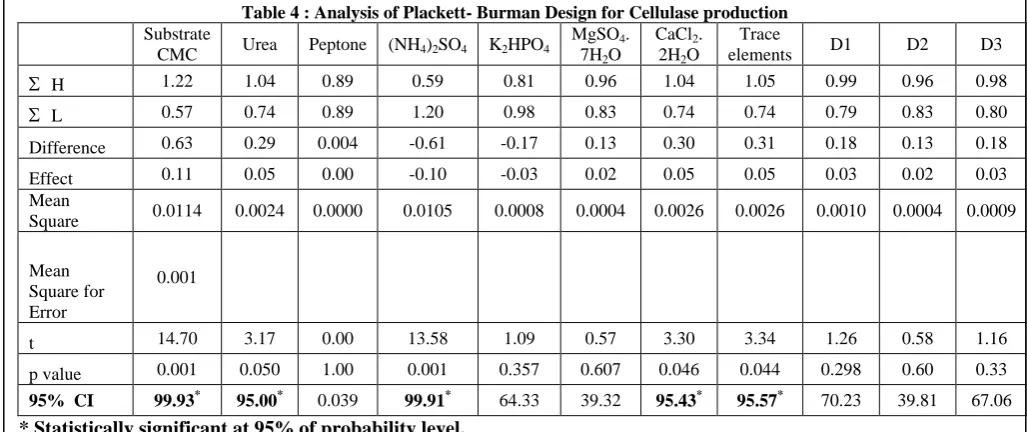
Table 4 : Analysis of Plackett- Burman Design for Cellulase production
Substrate
CMC Urea Peptone (NH4)2SO4 K2HPO4
MgSO4.
7H2O
CaCl2.
2H2O
Trace
elements D1 D2 D3
H
1.22 1.04 0.89 0.59 0.81 0.96 1.04 1.05 0.99 0.96 0.98
L
0.57 0.74 0.89 1.20 0.98 0.83 0.74 0.74 0.79 0.83 0.80Difference 0.63 0.29 0.004 -0.61 -0.17 0.13 0.30 0.31 0.18 0.13 0.18
Effect 0.11 0.05 0.00 -0.10 -0.03 0.02 0.05 0.05 0.03 0.02 0.03
Mean
Square 0.0114 0.0024 0.0000 0.0105 0.0008 0.0004 0.0026 0.0026 0.0010 0.0004 0.0009
Mean Square for Error
0.001
t 14.70 3.17 0.00 13.58 1.09 0.57 3.30 3.34 1.26 0.58 1.16
p value 0.001 0.050 1.00 0.001 0.357 0.607 0.046 0.044 0.298 0.60 0.33
95% CI 99.93* 95.00* 0.039 99.91* 64.33 39.32 95.43* 95.57* 70.23 39.81 67.06
* Statistically significant at 95% of probability level.
In order to evaluate the accuracy of the applied Plackett-Burman statistical design, a verification experiment was applied to compare
between the predicted optimum levels of
independent variables, anti optimum levels and the basal condition settings. The highest cellulase producing ability of isolate from this study was found to be 0.323 IU/ml with 24 hours of incubation (Table 3). This was low when compared with the report of Wen-Jing et al. (2005) [17] who isolated Bacillus cereus with maximum cellulolytic activity of 7.9 – 28.0 IU/ml. Maximum cellulolytic activities of 67.02 IU/ml and 35.8IU/ml as reported by Sangbriba et al. (2006) [16] for Bacillus circulans and Bacillus megaterium respectively is also far higher than those obtained in present study. A possible explanation for the low cellulase yield in this study could be due to inadequate cultural conditions for isolated Gram positive cocci. According to Johnson et al. (1981) [18], Clostridium thermocellum is noted for producing a cellulase complex known as cellulosome which has a very high cellulolytic activity. Cellulosome eliminates the wasteful expenditure of microorganisms thus continuously producing copious amounts of free cellulases [19].
A high accumulation of sugar is a clear manifestation of high enzyme production and activity [20]. Glucose is one of the main products of cellulose breakdown. Glucose can be fermented to form ethanol which can be used as fuel. Ethanol can be dehydrated to produce ethylene – a major compound used in the chemical industries. Glucose
the temperate regions. Cellulolytic organisms by virtue of habitat or source were location and diet specific. Hence findings were peculiar to our environment. Though the total cellulase yield of 0.323 IU/ml as optimized by Plackett Burman design (Table 3) is much lower than commercial cellulase, it can be used in its crude and partially purified forms but at high ratios, to saccharify pre-treated wastes first to sugars, then ethanol, ethylene, methane and biogas.
By performing Plackett-Burman design, Isolate attained maximum cellulolytic activities in high levels of CMC, Urea, Peptone, Calcium chloride, magnesium sulphate and Trace elements and Low levels of Ammonium sulphate, and Di Potassium Hydrogen phosphate, at 37 °C and pH 7.0 which is found to be optimized levels of components. The significant components for maximum cellulase production by isolated bacteria were found to be Carboxymethyl cellulose, Urea, ammonium sulphate, calcium chloride and trace elements (Fe, Mn, Zn and Co) as observed in table 5. The problem of high cost of cellulase production owing to low enzyme activities of organisms used industrially for its production can be solved by meticulously observing the optimal cultural growth conditions reported in this study.
IV. CONCLUSION
optimization of cellulase production by central composite design would give the interactions of various substrates for better cellulase production as well the results would be further helpful for large scale production of cellulase under optimized environmental conditions. Furthermore this work can be extended in aspect of identification of isolate and large scale production, purification and application of cellulase enzyme.
REFERENCES
[1] M. Zaldivar, J. C. Velasquez, and L. M. Contreras – Perez, “Trichoderma aureovi aureoviride, a mutant with enhanced production of lytic enzymes: its potential use in waste cellulose degradation”. Journal of Biotech., 4(3), 1 – 6, 2001. [2] C. M. Wang, C. L. Shyu, and S. P. Ho, “Characterization of
a novel thermophilic cellulose degrading bacterium – Paenibacillus spp strain B39”. Lett. Appl. Microbiol., 47: 46 – 53, 2008.
[3] K. L. Kalra, G. Kocher, and G. Banta, “Optimization of cellulose production by submerged fermentation of rice straw by Trichoderma harzianum RUT-C. 8230”. The Internet Journal of Microbiology, 5(2): 1 – 7, 2008. [4] G. Coral, B. Arikan, and M. N. Unaldi, “Some properties of
crude carboxymet thyl cellulose of Aspergillus niger wild type strain”. Turk J. Biol., 26, 209–213, 2002.
[5] C. H. Ko, W. L. Chen, C. H. Tsai, W. N. Jane, C. C. Liu, and J. Tu, “Paenibacillus campinasensis BL11: a wood material-utilizing bacterial strain isolated from black liquor”. Bioresource Technol., 14, 2727 – 2733, 2007.
[6] W. Li, W. W. Zhang, M. M. Yang, and Y. L. Chen, “Cloning of the thermostable cellulase gene from newly isolated Bacillus subtilis and its expression in Escherichia coli”. Mol. Biotechnol., 2: 195 – 201, 2008.
[7] K. Hirasawa, K. Uchimura, M. Kashima, W. D. Grant, S. Ito, T. Kobayashi, and K. Horikoshi, “Salt activated endoglucanase of a strain of alkaliphilic Bacillus agaradhaerens. Antonie Van Leuwenhoek., 89 (2), 211 – 219, 2006.
[8] O. Perez-Avalos, L. M. Sanchez-Herrera, and T. Ponce-Noyola, “A bifunctional endoglucanase/endoxylanase from Cellulomonas flavigena with potential use in indusrial processes at different pH”. Curr. Microbiol., 57 (1), 39 – 44, 2008.
[9] L. I. Pei-Jun, Z. De-Bing, Qui-xing and Z. Chun-gui, “Optimization of solid fermentation of cellulose from Trichoderma koningii”. L. Envron. Sci., 6, 816–820, 2004. [10] G. Immanuel, R. Dhanusa, P. Prema, and A. Palavesa,
“Effects of different growth parameters on endoglucanase enzyme activity by bacteria isolated from coir retting effluents of estuarine environment”. Int. J. Envir. Sci. Techn., 3(1), 25 – 34, 2006.
[11] A. K. Ray, K. S. Bairagi, A. Ghosh, and S. K. Sen, “Optimization of fermentation conditions for cellulose production by Bacillus subtilis CY5 and Bacillus circulans TP3 isolated from fish gut”. Acat. Icht. Et. Pist., 37, 47– 53, 2007.
[12] H. R. Gohel, C. N. Contractor, S. K. Ghosh, and V. J. Braganza, “A comparative study of various staining techniques for determination of extra cellular cellulase activity on Carboxy Methyl Cellulose (CMC) agar plates”. Int. J. Curr. Microbiol. App. Sci., 3(5), 261-266, 2014. [13] T. K. Ghose, "Measurement of cellulase activities." Pure
Appl Chem., 59:257-268, 1987.
[14] M. Maki, K. T. Leung, and W. Quin, “The prospect of cellulase producing bacteriafor bioconversion of lignocellulosic biomass”. Int. J. Bio. Sci., 5, 500 – 516, 2009. [15] R. H. Doi, “Cellulase of mesophilic microbes: cellulosome
and non–cellulosome producers”. Ann. NY. Acad. Sci., 1125, 267 – 279, 2008.
[16] R. U. Sangbriba, C. J. Duan, and J. L. Tang, “Isolation and characterization of mesophilic Bacillus species cellulase
genes from black liquor”. Bioresour. Technol., 14, 2727 – 2733, 2006.
[17] L. U. Wen – Jing, W. Hong – Tao, Y. Shi – Jian, W. Zhi – Chao, and N. Young Feng, “Isolation and characterization of mesophilic cellulose – degrading bacteria from flower stalk vegetable waste composting system”. J. Gener. Appl. Micro., 51(6), 353 – 360, 2005.
[18] E. A. Johnson, A. Madia, and A. L. Demain, “Chemically defined minimal medium for the growth of the anaerobic cellulolytic thermophile – Clostridium thermocellum”. Appl. Environ. Microbiol., 41, 1060 – 1062, 1981.
[19] Y. Shoham, R. Lamed, and E. A. Bayer, “The cellulosome concept as an efficient microbial strategy for the degradation of insoluble polysaccharides”. Trends Microbiol., 7 (7), 275 – 281, 1999.
[20] B. O. Ejechi, 1991. Biodegradation of some Nigerian Timbers by fungi. Ph.D thesis. pp. 499.