A new record of critically endangered
Saussurea bogedaensis
(Asteraceae) from
Dzungarian Gobi, Mongolia
Shukherdorj Baasanmunkh1, Nudkhuu Nyamgerel2, Gun-Aajav Bayarmaa2, Batlai Oyuntsetseg2, Khurelpurev Oyundelger3, Hyeok Jae Choi1
1 Department of Biology and Chemistry, Changwon National University, Changwon 51140, South Korea 2 Department of Biology, School of Arts and Science, National University of Mongolia, Ulaanbaatar 14201, Mongolia 3 Department of Botany, Senckenberg Museum of Natural History Görlitz, D-02826, Görlitz, Germany
Corresponding author: Hyoek Jae Choi ([email protected])
Academic editor: A. Sukhorukov | Received 18 June 2020 | Accepted 13 August 2020 | Published 8 September 2020
Citation: Baasanmunkh S, Nyamgerel N, Bayarmaa G-A, Oyuntsetseg B, Oyundelger K, Choi HJ (2020) A new record of critically endangered Saussurea bogedaensis (Asteraceae) from Dzungarian Gobi, Mongolia. PhytoKeys 160: 109–121. https://doi.org/10.3897/phytokeys.160.55603
Abstract
A species in the family Asteraceae, Saussurea bogedaensis, was newly described from Bogeda Mountain in Xinjiang, China and is a critically endangered species in China. Morphological and genetic characteristics confirm the presence of this species in Mongolia, as it was found in Baitag Bogd Mountain (in the Dzun-garian Gobi). In addition, the distribution and conservation status of S. bogedaensis are provided.
Keywords
Asteraceae, conservation status, distribution, Mongolia, Saussurea
Introduction
Saussurea DC. is one of the largest genera in the tribe Cardueae (Asteraceae) and com-prises ~500 species, classified into six subgenera and 20 sections (Lipschitz 1979; Raab-Straube 2017). The genus is distributed throughout the Northern Hemisphere, with diverse species in Central Asia (Wang et al. 2009). Saussurea spp. occur in a wide range of habitats, especially at higher altitudes with cold and dry conditions, but they also grow in lowlands. However, Saussurea spp. have a tendency towards habitat specificity (Butola
http://phytokeys.pensoft.net
Copyright Shukherdorj Baasanmunkh et al. This is an open access article distributed under the terms of the Creative Commons Attribution License (CC BY 4.0), which permits unrestricted use, distribution, and reproduction in any medium, provided the original author and source are credited.
and Samant 2010). The highest number of Saussurea spp. is reported from China, with estimated 317 species (Chen and Yuan 2015). Sixty-one species are noted as native to India (Hajra 2000; Ahmad 2005), 54 species are mentioned in the flora of Siberia (Shurupova and Zverev 2017), 41 indigenous species are listed in the flora of Bhutan (Grierson and Springate 2001) and 23 species have been recorded in Pakistan (Ahmad 2005). To date, 53 species of Saussurea have been recorded in Mongolia (Gubanov 1996; Urgamal et al. 2014; Dariimaa 2017). Amongst these, five species, namely S. catharinae
Lipsch., S. gubanovii Kamelin, S. klementzii Lipsch., S. ramosa Lipsch. and S. saichanensis
Komarov ex Lipsch. are endemic to Mongolia (Urgamal and Oyuntsetseg 2017).
Saussurea is known for its wide array of uses, especially for medicinal and religious purposes (Mishra et al. 2018; Qureshi et al. 2018; Semwal and Painuli 2019). Addition-ally, the essential oils of several species are used in high-grade perfumes and as insecti-cides (Butola and Samant 2010). As a result of having a number of medicinal properties and economic uses, several Saussurea species are becoming threatened or endangered owing to over-exploitation and degradation of their habitats (Kamalpreet et al. 2019), as well as their natural rarity and small population size. These valued species include
S. involucrata (Kar. & Kir.) Sch.Bip. and S. orgaadayi Khanm & Krasnob. which are list-ed as endangerlist-ed species in the conservation list of Mongolia (Oyuntsetseg et al. 2018). Our study initially aimed to clarify the taxonomic relationship between S. involucrata
and S. orgaadayi in Mongolia and to assess the conservation status of these species. These two species are classified as endangered at the regional level and occur only in the western part of Mongolia (Grubov 1982; Gubanov 1996; Urgamal et al. 2014; Darii-maa 2017). Furthermore, both species have some morphological similarities, leading to misidentifications. Regarding their distribution range, S. involucrata is noted in four phytogeographical regions in western Mongolia: Mongolian Altai (MA), Dzungar-ian Gobi (DzG), Khovd and the Depression of Great Lakes (Grubov 1982; Darii-maa 2017). Saussurea orgaadayi is only noted in the MA region (Urgamal et al. 2014; Oyuntsetseg et al. 2017). Saussurea involucrata and S. orgaadayi belong to the Saussurea
subg. Amphilaena, known for its taxonomic complexity (Raab-Straube 2017). How-ever, S. orgaadayi can be differentiated from S. involucrata based on morphological characteristics of the capitula (Shi and Raab-Straube 2011; Raab-Straube 2017).
MA is likely to be S. orgaadayi. Thus, inconsistencies in the distribution range of these three Saussurea species, which could have been misidentified in Mongolia as well, motivated us to conduct an in-depth taxonomic assessment. In addition, Chen et al. (2019) recommended the use of nuclear ribosomal (nr) DNA ITS and chloroplast (cp) DNA regions of rbcL and trnH-psbA as candidate DNA barcode markers for species in the subg. Amphilaena. Using these three markers, it was possible to discriminate the
Saussurea species that are morphologically similar and separated very recently.
The main objectives of the present study were to (1) re-identify the above men-tioned Saussurea species recorded in western Mongolia and (2) newly report S. boge-daensis and describe its distribution and conservation status in the Mongolian flora.
Materials and methods
Herbarium and field research
The basic distribution data and photographs of the target Saussurea species, which had been known as S. involucrata and S. orgaadayi in Mongolia, were collected during our fieldwork from 2013 to 2019 in western Mongolia. We also included herbarium materi-als kept at UBA, UBU, OSBU and MW (abbreviations are according to Thiers 2019+).
DNA barcoding
In this study, we investigated the application of combined nrDNA region of ITS and cpDNA regions of trnK, trnH-psbA and rbcL in barcoding analyses of two Mongolian
Saussurea species. Additionally, a total of 36 sequences, based on four markers of three species (S. bogedaensis, S. orgaadayi and S. involucrata), which were used by Chen and Wang (2018) to evaluate the phylogenetic relationships between these species, were obtained from NCBI GenBank (Table 1). Jurinea multiflora (L.) B.Fedtsch. was select-ed as an outgroup basselect-ed on Chen and Wang (2018) and Chen et al. (2019). Detailselect-ed information on sample collection, voucher specimens, Genbank accession numbers and references of each sample is provided in Table 1.
manual adjustments were made using SnapGene Viewer 4.2.6. Sequences were ed-ited manually using SnapGene Sequence Alignment Editor (GSL Biotech LLC). Ambiguous nucleotide bases were corrected using the corresponding base of the sequence that was obtained by the reverse primer. Multiple sequences were aligned using ClustalW with its default parameters (Thompson et al. 1994) and consen-sus sequences were created for each species. For the combined dataset, the genetic
Table 1. Detailed information on taxa, sampled locations, voucher specimens, NCBI GenBank accession numbers and references of the samples used in this study.
Taxon Location & Herbarium
accession number Latitude (N) / Longitude (E) Altitude (m) ITS GenBank accession numberrbcL trnK trnH-psbA Reference
S. bogedaensis Mongolia, Dzungarian
Gobi; UBU20190698 45°13'14.52", 90°55'12.97" 2742 MT209829 MT624048 MT624054 MT624060 This study
S. bogedaensis Mongolia, Dzungarian
Gobi; UBU20190699 45°13'14.52", 90°55'12.97" 2742 MT210906 MT624049 MT624055 MT624061 This study
S. bogedaensis Mongolia, Dzungarian
Gobi; UBU20190700 45°13'14.52", 90°55'12.97" 2742 MT197331 MT624050 MT624056 MT624062 This study
S. bogedaensis China, Xinjiang, Qitai;
WYJ201308006 (38) 43°27'11.56", 89°33'7.67" 3471 MH003708 MH070873 MH070999 MH070746 Chen et al. (2019)
S. bogedaensis China, Xinjiang, Qitai;
WYJ201308006 (39) 43°27'11.56", 89°33'7.67" 3471 MH003709 MH070874 MH071000 MH070747 Chen et al. (2019)
S. bogedaensis China, Xinjiang, Qitai;
WYJ201308006 (40) 43°27'11.56", 89°33'7.67" 3471 MH003710 MH070875 MH071001 MH070748 Chen et al. (2019)
S. orgaadayi Mongolia, Mongolian
Altai; UBU20180340 46°51'08.6", 91°45'27.3" 2848 MT209870 MT624051 MT624057 MT624063 This study
S. orgaadayi Mongolia, Mongolian
Altai; UBU20180341 46°51'08.6", 91°45'27.3" 2848 MT209871 MT624052 MT624058 MT624064 This study
S. orgaadayi Mongolia, Mongolian
Altai; UBU20180342 46°51'08.6", 91°45'27.3" 2848 MT210907 MT624053 MT624059 MT624065 This study
S. orgaadayi China, Xinjiang, Altai;
WYJ201308041 (11) 89°52'47.96"47°13'6.46", 3541 MH003773 MH070934 MH071060 MH070807 Chen et al. (2019)
S. orgaadayi China, Xinjiang, Altai;
WYJ201308041 (12) 89°52'47.96"47°13'6.46", 3541 MH003774 MH070935 MH071061 MH070808 Chen et al. (2019)
S. orgaadayi China, Xinjiang, Altai;
WYJ201308041 (360) 89°52'47.96"47°13'6.46", 3541 MH003775 MH070936 MH071062 MH070809 Chen et al. (2019)
S. involucrata China, Xinjiang, Urumqi;
WYJ20160725 (163) 86°50'31.92"43°6'30.49", 3564 MH003736 MH070900 MH071026 MH070773 Chen et al. (2019)
S. involucrata China, Xinjiang, Urumqi;
WYJ20160725 (165) 86°50'31.92"43°6'30.49", 3564 MH003737 MH070901 MH071027 MH070774 Chen et al. (2019)
S. involucrata China, Xinjiang, Tekesi;
WYJ201308184 (24) 86°50'31.92"43°5'56.94", 3678 MH003738 MH0070902 MH071028 MH070775 Chen et al. (2019)
Jurinea
multiflora China, Xinjiang, Tuoli; WYJ201308102 (377) 83°8'49.63"45°44'8.3", 1753 MH003704 MH070869 MH070995 MH070742 Chen et al. (2019)
Table 2. List of the markers used for the DNA barcoding and phylogenetic analysis.
Fragment Marker Sequence 5’ → 3’ Ta Reference
ITS ITS4 TCCTCCGCTTATTGATATGC 50 °C White et al. (1990)
ITS5A CCTTATCATTTAGAGGAAGG
rbcL rbcL_f ATGTCACCACAAACAGAGAC 56 °C Chase et al. (1993)
rbcL_r CTTCTGCTACAAATAAGAAT
trnK trnK(UUU) TTAAAAGCCGAGTACTCTACC 50 °C Sang et al. (1997)
rps16 AAAGTGGGTTTTTATGATCC
trnH-psbA psbA GTTATGCATGAACGTAATGCTC 56 °C Olmstead et al. (1992)
divergences were calculated using DNASP v.6 (Julio et al. 2017) and used to deter-mine whether a barcoding gap was present. The DNA sequences generated in this study have been deposited in GenBank (Table 1).
The phylogenetic analyses were conducted using Bayesian Inference (BI), Maxi-mum Likelihood (ML) and MaxiMaxi-mum Parsimony (MP). For BI analysis, the best close fit model of evolution for each partition neighbour joining (NJ) tree was estimated using MEGA 7 (Kumar et al. 2016). Posterior probability was determined by Mark-ov Chain Monte Carlo sampling (MCMC) with the programme MrBayes v. 3.2.6 (Huelsenberk and Ronquist 2001; Ronquist and Huelsenberk 2003), as implemented in Geneious v. 10.2.2 (Kearse et al. 2012), using the estimated models of evolution. For each dataset, four simulation Markov chains were run for 1 million generations and trees were sampled every 100th generation. The ML analysis was performed using
RAxML v. 8.2.11 (Stamatakis 2006, 2014) as implemented in Geneious v. 10.2.2 (Kearse et al. 2012), using the GTRGAMMA model with rapid bootstrapping and a search for the best-scoring ML tree algorithm, including 1,000 bootstrap replicates. The MP analyses were performed with MEGA 7 (Kumar et al. 2016), using tree-bisection-reconnection (TBR) as the branch-swapping algorithm. The robustness of the tree was evaluated using 1,000 bootstrap replication indices and the consistency index, retention index and composite index were calculated.
Results
We discovered S. bogedaensis from Baitag Bogd Mt in the DzG region of Mongolia. This species is newly documented in the Mongolian flora. Detailed data on morpho-logical and genetic identification, geographical distribution and conservation status of the S. bogedaensis are provided below.
New record
Saussurea bogedaensis Yu J.Wang & J.Chen, PloS ONE 13(7): e0199416 (12) (2018)
Figs 1, 3
Genetic identification. The combined sequence dataset consisted of 15 samples, including the outgroup, Jurinea multiflora. The sequence dataset comprised 2,315 characteristics, of which 20 were parsimony-informative, 108 were variable and 2,169 were constant. The gene boundaries on the ITS – trnK – trnH-psbA – rbcL multi-locus alignment were as follows: ITS: 1–656, trnK: 657–1,284, trnH-psbA: 1,285–1,680 and rbcL: 1,681–2,315. The final ML optimisation likelihood of ML analysis was: Inl = -3650.7353. A single most parsimonious tree was generated by MP analysis with a tree length of 105 steps, consistency index: 1.0, retention index: 1.0 and composite index: 1.0. The BI phylogeny, including BI posterior probability values, as well as ML and MP bootstrap support values, are provided in Fig. 4.
Our genetic identification revealed a similar topology to that of Chen and Wang (2018) and confirms each distinct clade of S. bogedaensis, S. involucrata and S. or-gaadayi, respectively (Fig. 4). Three individuals of newly-revealed Saussurea specimens from Baitag Bogd Mt formed one cluster with the Chinese S. bogedaensis with high support: BI/ML/MP = 1/100/99. Additionally, sequence divergence amongst the three species was 0–0.002% in our S. bogedaensis specimens, whereas there was 3.02% se-quence divergence in S. involucrata and 2.04% sequence divergence in S. orgaadayi.
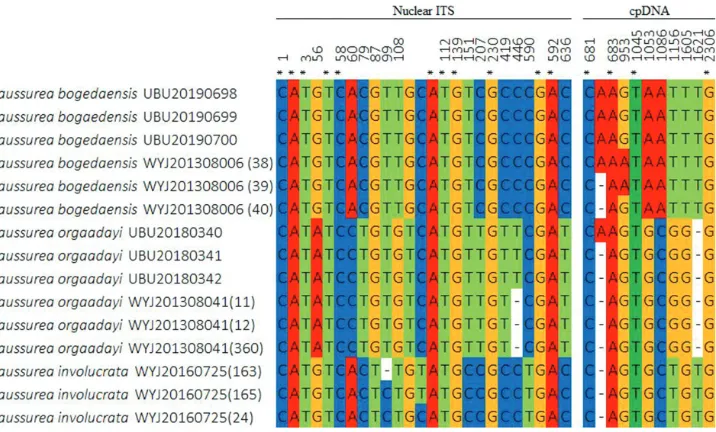
Sequence alignment revealed that the Mongolian and Chinese S. bogedaensis share sev-eral specific nucleotide residues that are different from those of other Saussurea species (Fig. 5). The other three samples (Fig. 2) from Munkhkhairkhan Mt in the MA region
clustered with S. orgaadayi from China (BI/ML/MP = 1/100/99). Therefore, our study proves that the Saussurea samples from the DzG and MA regions are S. bogedaensis
(Fig. 1) and S. orgaadayi (Fig. 2), respectively. Our genetic results provide only the genetic differences between the three related species in the subg. Amphilaena and not a true phylogeny of all related Saussurea species.
General distribution and habitat. Mongolia (Dzungarian Gobi, Baitag Bogd Mt) and China (Xinjiang, Bogeda Mt). In Mongolia, S. bogedaensis grows on high mountain rocky slopes, screes, boulders and river banks in the alpine belt at altitudes of 2400–3300 m a.s.l. This species is closely related to S. involucrata and S. orgaadayi. However, the three species are geographically isolated: S. bogedaensis occurs in the Dzungarian basin and the eastern Chinese Tien-Shan Mts and S. involucrata occurs in the Tien-Shan Mts (which cover parts of China and Central Asian states), whereas
S. orgaadayi is present in the Altai Mts (which cover parts of China, Mongolia and Russia) (Fig. 3), according to Raab-Straube (2017) and Chen and Wang (2018).
Conservation status.Saussurea bogedaensis is new to the Mongolian flora and occurs in the Baitag Bogd Mt in the DzG region. Individuals of the species were found in a few
Figure 4. Phylogenetic tree based on concatenated sequence alignments of nrDNA (ITS) and cpDNA (trnK, trnH-psbA, and rbcL) regions. Bayesian Inference (BI) posterior probability support values above 90% (bold), Maximum Likelihood (ML) and Maximum Parsimony (MP) bootstrap support values above 70% are shown in the branches in the following order BI/ML/MP. The new samples of S. bogedaensis and S. orgaadayi originated from Mongolia are in red and black bolds, respectively.
locations, namely in Baitag Bogd Mt and Altan Ovoo in the DzG region (Fig. 3). During our field surveys, we detected two different populations, which in total, accounted for fewer than 600 individuals in this region. This species is under threat, particularly ow-ing to human interference and random cuttow-ing. Thus, S. bogedaensis has been assessed as Critically Endangered [CR C2a(i)] in Mongolia according to the IUCN Red List catego-ries and criteria (IUCN 2019). This species was also evaluated as critically endangered in China (Chen and Wang 2018). In situ studies on the reproductive biology of S. bogedaen-sis are needed to more accurately assess the conservation status of this species in Mongolia.
Specimens examined (new record). Mongolia. Dzungarian Gobi region: Khovd Province, Uyench sum, Baitag Bogd Mt, Buduun Khargait river, 45°13'14.52"N, 90°55'12.97"E, 2742 m a.s.l., 28 Jul 2019, Sh. Baasanmunkh et al., 20190698,
Discussion
Saussurea bogedaensis, S. orgaadayi and S. involucrata belong to the taxonomically complicated Saussurea subg. Amphilaena (Raab-Straube 2017). Despite their similar morphological characteristics and habitats, there are clear morphological differences, geographically isolated distributions and genetic identities that make these species rec-ognisable with an in-depth investigation (Figs 1–5; Chen and Wang 2018; Chen et al. 2019). There are some distribution records of S. involucrata from the regions of Khovd and the Depression of Great Lake in Mongolia (Urgamal et al. 2014). Due to limited numbers of samples and surveyed areas of the MA and DzG regions in this study, data on Mongolian S. involucrata are still unclear. Hence, correct identification based on this study will provide an important basis for future studies on the taxonomic identity of Mongolian S. involucrata.
Acknowledgements
Our study is supported by a research project (A survey on the vascular flora of Mongolia; Grant Number KNA 1-2-38, 20-5) of the Korean National Arboretum, South Korea and partly supported by the National University of Mongolia’s “Seed Grant”. We are grateful to Dr. Steffen Bien (Senckenberg Museum of National History Görlitz, Germany) for his help with phylogenetic analysis. We also thank to Ms. Joscie Norris (University of Vermont, Burlington, United States) for her help with
improving the English writing of manuscript. Finally, the authors thank Dr. Yu-Jin Wang (Lanzhou University, China) for his careful review with valuable suggestions and personal discussion on the first draft.
References
Ahmad S (2005) Genus Saussurea DC. (Compositae) of Pakistan. PhD Thesis, Quaid-i-Azam University, Pakistan.
Butola JS, Samant SS (2010) Saussurea species in Indian Himalayan region: Diversity, distribu-tion and indigenous uses. Internadistribu-tional Journal of Plant Biology 1(1): 43–51. https://doi. org/10.4081/pb.2010.e9
Chase MW, Soltis DE, Olmstead RG, Morgan D, Les DH, Mishler BD, Duvall MR, Price RA, Hills HG, Qiu YL, Kron KA, Rettig JH, Conti E, Palmer JD, Manhart JR, Sytsma KJ, Michaels HJ, Kress WJ, Karol KG, Clark WD, Hedren M, Gaut BS, Jansen RK, Kim K-J, Wimpee CF, Smith JF, Furnier GR, Strauss SH, Xiang Q-Y, Plunkett GM, Soltis PS, Swensen SM, Williams SE, Gadek PA, Quinn CJ, Eguiarte LE, Golenberg E, Learn GH, Graham SW, Barrett SCH, Dayanandan S, Albert VA (1993) Phylogenetics of seed plants: An analysis of nucleotide sequences from the plastid gene rbcL. Annals of the Missouri Botanical Garden 80(3): 528–580. https://doi.org/10.2307/2399846
Chen J, Wang Y-J (2018) New Saussurea (Asteraceae) species from Bogeda Mountain, eastern Tianshan, China, and inference of its evolutionary history and medical usage. PLoS One 13(7): e0199416. https://doi.org/10.1371/journal.pone.0199416
Chen YS, Yuan Q (2015) Twenty-six new species of Saussurea (Asteraceae, Cardueae) from the Qinghai-Tibetan Plateau and adjacent regions. Phytotaxa 213(3): 159–211. https://doi. org/10.11646/phytotaxa.213.3.1
Chen J, Zhao Y, Wang Y, Li X (2019) Identification of species and materia medica within Saussurea subg. Amphilaena based on DNA barcodes. PeerJ 7: e6357. https://doi. org/10.7717/peerj.6357
Dariimaa S (2017) Flora of Mongolia. (Asteraceae–Asteroideae). Udam Soyol Publishing, Ul-aanbaatar, 1–277. [in Mongolian]
Doyle JJ, Doyle JL (1987) A rapid DNA isolation procedure for small amounts of fresh leaf tissue. Phytochemical Bulletin 19(1): 11–15.
Grierson AJC, Springate LS (2001) Compositae (Asteraceae). In: Grierson AJC, Long DG, Sprin-gate LS (Eds) Flora of Bhutan, Vol. 2(3). Royal Botanic Garden, Edinburgh, 1397–1632. Grubov VI (1982) Key to the vascular plants of Mongolia. Nauka Publishing, Leningrad,
1–443. [in Russian]
Gubanov IA (1996) Conspectus of the flora of Outer Mongolia. Valang Press, Moscow, 1–136. [in Russian]
Hajra PK (2000) Saussurea costus (Falc.) Lipschitz. In: Nayar MP, Sastry ARK (Eds) Red Data Book of Indian Plants, Vol. 2. Botanical Survey of India, New Delhi, 1–279.
IUCN (2019) Guidelines for using the IUCN Red List Categories and Criteria. Version 12. Prepared by the Standards and Petitions Subcommittee. http://jr.iucnredlist.org/
documents/RedListGuidelines.pdf [accessed 10.01.2020]
Julio R, Albert FM, Juan CSD, Sara GR, Pablo L, Sebastián ER, Alejandro SG (2017) DnaSP v6: DNA sequence polymorphism analysis of large datasets. Molecular Biology and Evolu-tion 34(12): 3299–3302. https://doi.org/10.1093/molbev/msx248
Kamalpreet LK, Singh A, Kaur J, Kaur N (2019) A brief review of remedial uses of Saussurea lappa. Journal of Pharmacognosy and Phytochemistry 8(3): 4423–4430.
Kearse M, Moir R, Wilson A, Stones-Havas S, Cheung M, Sturrock S, Buxton S, Cooper A, Markowitz S, Duran C, Thierer T, Ashton B, Meintjes P, Drummond A (2012) Geneious Basic: An integrated and extendable desktop software platform for the organization and analysis of sequence data. Bioinformatics (Oxford, England) 28(12): 1647–1649.
https://doi.org/10.1093/bioinformatics/bts199
Kumar S, Strecher G, Li M, Knyaz C, Tamura K (2016) MEGA 7: Molecular evolutionary genetics analysis version 7.0 for bigger datasets. Molecular Biology and Evolution 33(7): 1870–1874.
https://doi.org/10.1093/molbev/msw054
Lipschitz S (1979) The genus Saussurea DC. (Asteraceae). Nauka Publishing, Leningrad, 1–281. [In Russian]
Mishra AP, Saklani S, Sharifi-Rad M, Iriti M, Salehi B, Maurya VK, Rauf A, Milella L, Rajabi S, Baghalpor N, Sharifi-Rad J (2018) Antibacterial potential of Saussurea obvallata petroleum ether extract: A spiritually revered medicinal plant. Cellular and Molecular Biology 64(8): 65–70. https://doi.org/10.14715/cmb/2018.64.8.10
Olmstead RG, Michaels HJ, Scott KM, Palmer JD (1992) Monophyly of the Asteridae and identification of their major lineages inferred from DNA sequences of rbcL. Annals of the Missouri Botanical Garden 79(2): 249–265. https://doi.org/10.2307/2399768
Oyuntsetseg B, Baasanmunkh S, Oyundelger K, Munkhzul O, Kim JY, Cho HJ, Batkhuu N, Chung GY, Choi HJ (2017) Contribution to the knowledge on the flora of Munkhkhairkhan mountain area, Mongolia. Journal of Asia-Pacific Biodiversity 10(4): 573–582. https://doi. org/10.1016/j.japb.2017.05.005
Oyuntsetseg B, Baasanmunkh S, Nyambayar D, Batkhuu N-O, Lee Ch, Chang KS, Chung GY, Choi HJ (2018) The conservation status of 100 rare plants in Mongolia. Korea Na-tional Arboretum, Pocheon.
Qureshi NA, Khalil AA, Alsanad SM (2018) Spiritual and religious healing practices: Some reflec-tions from Saudi National Center for complementary and alternative medicine, Riyadh. Jour-nal of Religion and Health 59(2): 845–869. https://doi.org/10.1007/s10943-018-0677-0
Raab-Straube EV (2017) Taxonomic revision of Saussurea subgenus Amphilaena (Compositae, Cardueae). Berlin: BGBM, Freie Universität Berlin.
Ronquist F, Huelsenbeck JP (2003) MrBayes 3: Bayesian phylogenetic inference under mixed models. Bioinformatics (Oxford, England) 19(12): 1572–1574. https://doi.org/10.1093/ bioinformatics/btg180
Sang T, Crawford D, Stuessy T (1997) Chloroplast DNA phylogeny, reticulate evolution, and biogeography of Paeonia (Paeoniaceae). American Journal of Botany 84(8): 1120–1136.
Semwal P, Painuli S (2019) Antioxidant, antimicrobial, and GC-MS profiling of Saussurea obvallata (Brahma Kamal) from Uttarakhand Himalaya. Clinical Phytoscience 5(1): 12.
https://doi.org/10.1186/s40816-019-0105-3
Shi Z, Raab-Straube EV (2011) Saussurea Candolle. In: Wu ZY, Raven PH (Eds) Flora of China, Vol. 20. Beijing: Science Press, Beijing & Missouri Botanical Garden Press, St Louis, 56–149. Shurupova MN, Zverev AA (2017) Conservation categories and rarity types of Siberian
Saussurea species. The International Journal of Environmental Studies 74(5): 724–731.
https://doi.org/10.1080/00207233.2017.1283937
Stamatakis A (2006) RAcML-VL-HPC: Maximum likelihood-based phylogenetic analysis with thousands of taxa and mixed models. Bioinformatics (Oxford, England) 22(21): 2688–2690.
https://doi.org/10.1093/bioinformatics/btl446
Stamatakis A (2014) RAxML version 8: A tool for phylogenetic analysis and post-analysis of large phylogenies. Bioinformatics (Oxford, England) 30(9): 1312–1313. https://doi. org/10.1093/bioinformatics/btu033
Thiers B (2019+) [continuously updated] Index Herbariorum: A global directory of public her-baria and associated staff. New York Botanical Garden’s Virtual Herbarium.
http://sweet-gum.nybg.org/ih/ [accessed 15.10.2019]
Thompson JD, Gibson TJ, Plewniak F, Jeanmougin F, Higgins DG (1994) The CLUSTAL_X windows interface: Flexible strategies for multiple sequence alignment aided by quality analysis tools. Nucleic Acids Research 25(24): 4876–4882. https://doi.org/10.1093/nar/25.24.4876
Urgamal M, Oyuntsetseg B (2017) Atlas of the endemic vascular plants of Mongolia. Bembi San Press, Ulaanbaatar, 1–107.
Urgamal M, Oyuntsetseg B, Nyambayar D, Dulamsuren C (2014) Conspectus of the Vascular Plants of Mongolia. In: Sanchir C, Jamsran T (Eds) Admon Press, Ulaanbaatar, 1–334. Wang WJ, Susanna A, Raab-Straube EV, Milne R, Liu JQ (2009) Island-like radiation of
Saussurea (Asteraceae: Cardueae) triggered by uplifts of the Qinghai-Tibetan Plateau. Biological Journal of the Linnean Society. Linnean Society of London 97(4): 893–903.
https://doi.org/10.1111/j.1095-8312.2009.01225.x