An introduction to mesenchymal stem cell modulation of T cell-mediated immune responses
T lymphocytes (T cells) are the primary cellular eff ectors of the adaptive immune system and their functional properties are central to antigen specifi city and memory associated with cognate immunity [1-3]. Antigen-specifi c activation and diff erentiation of naïve T cells result in the generation of a range of T-cell phenotypes that may be defi ned by the acquisition of characteristic cytokine
secre tion profi les, cytolytic mechanisms, or counter-regu latory properties [1-3]. In the wake of antigen-specifi c adaptive immune responses, a small proportion of activated T cells persist as memory cells and have the capacity to respond more rapidly and potently to secon-dary encounters with the same antigen [1,3]. Th ese memory cells may retain the eff ector phenotype imprinted upon them during primary activation [1]. When these
memory cells are appropriately co ordinated and
regulated, the diversity of T-cell eff ector phenotypes allows immune protection against a multi tude of patho-genic microorganisms while maintain ing self-tolerance and homeostasis [2]. On the other hand, overexuberant pro-infl ammatory T-cell responses may lead to auto-immune and allergic diseases, including multiple sclerosis, infl ammatory bowel disease, type 1 diabetes mellitus, and asthma [4-7]. Furthermore, life-saving treatments such as
Abstract
Mesenchymal stem (stromal) cells (MSCs) are rare, multipotent progenitor cells that can be isolated and expanded from bone marrow and other tissues. Strikingly, MSCs modulate the functions of immune cells, including T cells, B cells, natural killer cells, monocyte/macrophages, dendritic cells, and neutrophils. T cells, activated to perform a range of diff erent eff ector functions, are the primary mediators of many autoimmune and infl ammatory diseases as well as of transplant rejection and graft-versus-host disease. Well-defi ned T-cell eff ector phenotypes include the CD4+ (T helper cell) subsets Th1, Th2, and Th17 cells and cytotoxic T lymphocytes derived from antigen-specifi c activation of naïve CD8+ precursors. In addition, naturally occurring and induced regulatory T cells (T
reg) represent CD4 + and CD8+ T-cell phenotypes that potently suppress eff ector T cells to prevent autoimmunity, maintain self-tolerance, and limit infl ammatory tissue injury. Many immune-mediated diseases entail an imbalance between Treg and eff ector T cells of one or more phenotypes. MSCs broadly suppress T-cell activation and proliferation in vitrovia a plethora of soluble and cell contact-dependent mediators. These mediators may act directly upon T cells or indirectly via modulation of antigen-presenting cells and other accessory cells. MSC administration has also been shown to be variably associated with benefi cial eff ects in autoimmune and transplant models as well as in several human clinical trials. In a small number of studies, however, MSC administration has been found to aggravate T cell-mediated tissue injury. The multiple eff ects of MSCs on cellular immunity may refl ect their diverse infl uences on the diff erent T-cell eff ector subpopulations and their capacity to specifi cally protect or induce Treg populations. In this review, we focus on fi ndings from the recent literature in which specifi c modulatory eff ects of MSCs on one or more individual eff ector T-cell subsets and Treg phenotypes have been examined in vitro, in relevant animal models of in vivoimmunological disease, and in human subjects. We conclude that MSCs have the potential to directly or indirectly inhibit disease-associated Th1, Th2, and Th17 cells as well as cytotoxic T lymphocytes but that many key questions regarding the potency, specifi city, mechanistic basis, and predictable therapeutic value of these modulatory eff ects remain unanswered.
© 2010 BioMed Central Ltd
Mesenchymal stem cell eff ects on T-cell eff ector
pathways
Michelle M Duff y, Thomas Ritter, Rhodri Ceredig and Matthew D Griffi
n*
R E V I E W
*Correspondence: matthew.griffi [email protected]
Regenerative Medicine Institute (REMEDI), National Centre for Biomedical Engineering Science (NCBES) and School of Medicine, Nursing and Health Sciences, Orbsen Building, National University of Ireland Galway, University Road, Galway, Ireland
allogeneic bone marrow (BM) and solid organ trans-plantation may be complicated by alloantigen-specifi c T-cell immune responses, resulting in graft-versus-host disease (GvHD) or transplant rejec tion [8].
Mesenchymal stem (or stromal) cells (MSCs) are a heterogeneous population of fi broblast-like progenitor cells that may be isolated and expanded from BM, umbilical cord, fat, gingiva, and other tissues [9]. Th ey have the capacity to self-renew and diff erentiate into various mesodermal cell lineages, including adipocytes, osteocytes, and chondrocytes under controlled culture conditions [9]. In the past two decades, MSCs have garnered considerable attention for their potential use as regenerative therapeutic agents in a range of acute and chronic diseases [8-11]. Mechanistically, the benefi cial eff ects of MSC therapies have been more frequently linked to their ‘trophic’ (paracrine) eff ects rather than their ability to transdiff erentiate [11]. Specifi cally, MSCs are now viewed as having potent anti-infl ammatory and immune-modulating properties that, in many studies, have been shown to be associated with inhibition of eff ector T-cell activation with or without a concomitant increase in regulatory T cell (Treg) numbers [4,6,10-12]. Th e T-cell suppressive eff ects of MSCs were initially described over a decade ago [13] and have since been reported consistently for both CD4+ T helper (Th ) cells
and CD8+ cytotoxic T lymphocytes (CTLs) [8,11,14].
Suppression of T cells by MSCs may be direct or may occur indirectly via modulatory eff ects on antigen-presenting cells such as dendritic cells (DCs), resulting in altered cytokine expression and impaired antigen presen-ta tion [15-17]. MSCs themselves demonstrate a lack of stimu latory capacity toward T cells [18,19]. MSCs iso-lated from various sources (BM, adipose tissue, and Wharton’s jelly) have been reported to equally suppress proliferation of CD4+ and CD8+ T-cell subsets in a
dose-dependent fashion [20]. Reported roles for both cell-cell contact and release of soluble factors in MSC-mediated T-cell suppression are evident throughout the literature, and numerous candidate mediators have been reported: prostaglandin E2 (PGE2), indoleamine-2,3-dioxygenase, nitric oxide, interleukin (IL)-27, transforming growth factor-beta (TGF-β), monocyte chemotactic protein 1 (MCP-1/CCL2), human leukocyte antigen G, and intra-cellular adhesion molecule 1 among others [8,10-12, 17, 21-24]. Th e abundance of mediators identifi ed to date suggests that MSCs exploit diff erent immunosuppressive mechanisms under diff erent disease conditions. MSC therapy has been successful in a range of disease models and some clinical conditions known to be associated with damaging eff ector T-cell responses or failure of Treg -mediated counter-regulation or both [4,6, 8, 11, 22, 25-28]. Overall, it is now very well established that MSCs exert diverse and potent modulatory eff ects on the T-cell
compartment of the immune system, most of which are suppressive in nature and of potential therapeutic value. Nevertheless, some signifi cant controversies and a basic lack of information regarding the range of eff ects that MSCs have on individual T-cell eff ector subsets remain. In the remaining sections of this review, we focus on the most recent data related to MSC modulation of indi-vidual well-defi ned Th cell and CTL eff ector phenotypes in vitro and in vivo. Where possible, we emphasize the relevance of current knowledge on this topic to diseases for which MSC therapy is perceived to be benefi cial. We also highlight key gaps in our understanding and important unanswered questions that may be the subject of future studies.
Mesenchymal stem cell modulation of T helper cell subsets
Th cells are cytokine-producing CD4+ cells that recognize
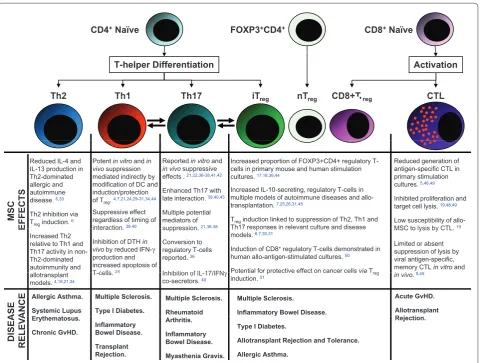
peptides presented to them by major histocompatibility complex (MHC) class II molecules [1-3]. Diff erentiation of Th cells into eff ector cells depends largely on the cytokine milieu present at the time of antigen presen-tation and activation [1-3]. In the context of this article, we will focus on reviewing recent progress (summarized in Figure 1) in understanding MSC eff ects on the well-described subsets Th 1, Th 2, and Th 17 cells, Treg, and CTLs with emphasis, where possible, on mechanistic and disease-specifi c in vivo studies.
T helper type 1 cells
Th 1 cell induction occurs when CD4+ T cells are activated
infusion of MSCs attenuated cutaneous DTH in mice and that this eff ect was associated with reduced infi ltration of CD4+ and CD8+ T cells at the challenge site and increased
apoptosis of activated T cells in the draining lymph nodes. MSCs were detected close to the germinal center and paracortical region in lymph nodes [25], suggesting that they modulate immune responses directly in the area where DCs are likely to activate T cells. In experimental colitis (an animal model of infl am matory bowel disease), dose-dependent xenogenic, allogenic, and autologous adipose-derived MSCs amelior ated disease activity and were specifi cally asso ciated with reduced IFN-γ-pro duc-ing Th 1 cells in association with increased numbers of forkhead box P3 (FOXP3)-expressing T cells (Treg) [7]. Furthermore, when treated with either total CD4+ T cells
or Treg-depleted CD4+ T cells from mesenteric lymph
nodes of MSC-treated colitic mice, mice with induced colitis demonstrated attenuated and enhanced colitis, respec tively [7]. Th ese data suggest that the adminis-tration of MSCs in experimental colitis dampens Th 1 cell responses via induction of Treg but does not eliminate Th 1 cells entirely. MSCs have also been used experimentally to eff ectively prevent or treat Th 1 cell-mediated auto-immune diabetes mellitus in streptozo tocin-treated rats and in nonobese diabetic (NOD) mice [31,32]. In the rat model, the protective eff ects observed following adminis-tration of MSCs were shown to be associated with increased IL-10 and IL-13 expression by T cells and with increased frequencies of both CD4+ and CD8+ FOXP3+
T cells as opposed to a direct reduction of IFN-γ-producing T cells [31]. In NOD mice, a single MSC injection minimized beta-cell destruction following
Figure 1. Diagrammatic summary of the major CD4+ and CD8+ T-cell eff ector subtypes (as derived from naïve CD4+ and CD8+ T cells),
the reported eff ects of mesenchymal stem cells (MSCs) on these eff ectors, and some clinically important disease associations for each.
Bidirectional arrows indicate reported inter-conversion (plasticity) between Th1/Th17 phenotypes and Th17/iTreg phenotypes that may be of relevance to MSC immune modulatory eff ects. Relevant references are indicated numerically for individual statements. CTL, cytotoxic T lymphocyte; DC, dendritic cell; DTH, delayed-type hypersensitivity; FOXP3, forkhead box P3 transcription factor; GvHD, graft-versus-host disease; IFN-γ,
interferon-gamma; IL, interleukin; iTreg, induced regulatory T cell; nTreg, natural regulatory T cell; Th1, T helper type 1 cell; Th2, T helper type 2 cell; Th17, T helper type 17 cell; Treg, regulatory T cell.
CD4+Naïve FOXP3+CD4+ CD8+Naïve
Th1 CTL
Th2 Th17 iT
T-helper Differentiation Activation
nT CD8+T
Th1 CTL
Th2 Th17 iTreg nTreg CD8+ Treg
Potent in vitroand in vivo suppression mediated indirectly by modification of DC and
Reported in vitroand
in vivo suppressive effects . 21,22,36-38,41,42 Reduced IL-4 and
IL-13 production in Th2-dominated allergic and
Reduced generation of antigen-specific CTL in primary stimulation cultures 5,48,49 Increased proportion of FOXP3+CD4+ regulatory
T-cells in primary mouse and human stimulation cultures. 17,18,36,44
MSC
E
FFECTS
modification of DC and induction/protection of Treg. 4,7,21,24,29-31,34,44
Suppressive effect regardless of timing of interaction39,40
Enhanced Th17 with late interaction. 39,40,43
Multiple potential mediators of suppression21,36-38 allergic and
autoimmune disease. 6,33
Th2 inhibition via Treginduction. 6
cultures. 5,48,49
Inhibited proliferation and target cell lysis. 19,48,49
Low susceptibility of allo-MSC to lysis by CTL 19 Increased IL-10-secreting, regulatory T-cells in
multiple models of autoimmune diseases and allo-transplantation. 7,25,26,31,45
Treginduction linked to suppression of Th2, Th1 and
Th17 responses in relevant culture and disease
E interaction. ,
Inhibition of DTH in vivoby reduced IFN-γ
production and increased apoptosis of T cells24
suppression. ,
Conversion to regulatory T-cells reported. 36
Inhibition of IL 17/IFNγ
Increased Th2 relative to Th1 and Th17 activity in non-Th2-dominated autoimmunity and
MSC to lysis by CTL.
Limited or absent suppression of lysis by viral antigen-specific, memory CTL in vitroand
5 49 Th17 responses in relevant culture and disease
models. 6,7,30,31
Induction of CD8+regulatory T-cells demonstrated in
human allo-antigen-stimulated cultures. 50
Potential for protective effect on cancer cellsviaT
A
SE ANCE
T-cells. 24 Inhibition of IL-17/IFNγ co-secretors. 40 allotransplant
models. 4,18,21,34
in vivo. 5,49 Potential for protective effect on cancer cells viaTreg
induction. 51
Allergic Asthma.
Systemic Lupus E t h t
Multiple Sclerosis.
Type I Diabetes.
Multiple Sclerosis.
Rheumatoid
Acute GvHD.
Allotransplant R j t i Multiple Sclerosis.
Inflammatory Bowel Disease.
DISE A RELEV A Erythematosus. Chronic GvHD. Inflammatory Bowel Disease. Transplant Rejection. Arthritis. Inflammatory Bowel Disease. Myasthenia Gravis. Rejection. Type I Diabetes.
Allotransplant Rejection and Tolerance.
transfer of diabetogenic T cells. Protection was shown to be associated with MSC migration to pancreatic lymph nodes and with induction of IL-10-producing FOXP3+
Treg [32]. Th ese examples from the recent literature indicate that, in clinically relevant disease settings, MSCs consistently suppress harmful autoimmune Th 1 cell responses by predominantly indirect mechanisms, includ ing modulation of antigen-presenting DCs and promotion of naturally occurring or induced FOXP3-expressing Treg.
T helper type 2 cells
Th 2 cell diff erentiation occurs when CD4+ T cells are
activated in the presence of IL-4, which itself is produced by Th 2 cells in addition to IL-5, IL-9, IL-10, and IL-13 [2,3,29]. Th e role of Th 2 cells in adaptive immunity is linked to host defense against extracellular parasites, to antibody class switching to IgG1 and IgE in B cells, and to recruitment of eosinophils [2,3,29,33]. Dysregulated Th 2 cell responses are associated with allergic diseases such as asthma [2]. Very few studies have examined MSC eff ects on immune-mediated diseases in which Th 2 cell responses are dominant. However, Kavanagh and Mahon [6] recently reported that allogeneic MSC administration reduced the number of infi ltrating eosinophils, suppres-sed IgE induction, and inhibited IL-13 and IL-4 produc-tion in a mouse model of ovalbuminduced airway in-fl am mation. Additionally, increases in IL-10 and FOXP3 expression were observed in this study, suggesting that MSCs suppress allergen-specifi c Th 2 cell responses in allergic airway infl ammation in part viainduction of Treg. As further evidence of this, depletion of Treg resulted in reversal of the protective eff ects of the MSCs [6]. In human subjects with chronic GvHD (which is also characterized by predominant Th 2 cell activity), MSC infusion has been reported to result in clinical improve-ment with a reduction in IL-4- and IL-10-producing T cells and a concomitant increase in IL-2- and IFN-γ-producing cells [34].
In other circumstances, there is evidence that MSCs may favor the emergence of Th 2 phenotype T cells. Bai and colleagues [4] demonstrated, for example, that mice treated with human BM-derived MSCs recovered function from limb paralysis in relapsing-remitting and chronic experimental allergic encephalomyelitis (EAE), a model for multiple sclerosis, by induction of Th 2 cells. In this study, neurological improvement was associated with reduced CD45+ leukocytic infi ltration of the brain and
spinal cord, with increased levels of the Th 2 cell-related cytokines IL-4 and IL-5, and with potent reduction in the Th 1/Th 17 cell-related cytokines IL-17, IFN-γ, TNF, and IL-12 [4]. Th e results suggested that MSC administration in EAE favorably altered the balance between pro-infl ammatory Th 1/Th 17 cell and anti-infl ammatory Th 2
cell responses. Likewise, Fiorina and colleagues [35] reported a shift in Th 1/Th 2 cell balance toward Th 2 cells following allogeneic MSC administration to NOD mice. Further evidence supporting a shift toward Th 2 cell responses is provided by Batten and colleagues [18], who describe the use of human BM-derived MSCs for tissue engineering of a heart valve. CD4+ T cells co-cultured
with MSCs expressed lower levels of IL-1-α and -β, TNF, and IFN-γ but higher levels of IL-5, IL-8, and IL-3 in response to allogeneic peripheral blood mononuclear cells. Consistent with the fi ndings of Kavanagh and Mahon[6], those of Batten and colleagues [18] additionally indicated increased expression of FOXP3 in CD4+ T cells
co-cultured with MSCs, suggesting the induction of a Treg phenotype. Th us, though relatively limited, the experi-mental evidence to date suggests that MSCs suppress eff ector function of Th 2 cells in Th 2 cell-predominant infl ammation. In other T cell-mediated immunological disorders, however, predominant MSC suppression of the Th 1 and Th 17 cell pathways may result in a relative skewing toward less damaging Th 2 and Treg phenotypes. Whether MSCs actively induce the diff erentiation and expansion of Th 2 cells during primary or secondary antigen-specifi c immune responses has not been well tested but appears less likely.
T helper type 17 cells
Th e Th 17 cell eff ector phenotype is defi ned by prefer en-tial secretion of IL-17A (IL-17) along with other cyto-kines, including IL-17F, IL-21, and IL-22. Th 17 cells are pro-infl ammatory and protect against extracellular patho-gens, including fungi, mycobacteria, and Gram-negative bacteria, via recruitment of neutrophils [36]. Th 17 cells may also be pathogenic and have been shown to have an important role in immunological diseases, including rheumatoid arthritis, multiple sclerosis, and infl amma-tory bowel disease [36]. TGF-β and IL-6, with or without IL-21, IL-23, and IL-1, are necessary for the induction and expansion of Th 17 cells from naïve CD4+ precursors
[2,36]. Recently, MSC eff ects on the Th 17 cell diff eren-tiation pathway have been examined in mice and humans. Ghannam and colleagues [37] observed that human MSCs induce regulatory characteristics in Th 17 cells in an infl ammatory environment by downregulating the Th 17 cell-specifi c transcription factor RORγt (retinoid-acid receptor-related orphan receptor gamma t) and up-regulating FOXP3. Moreover, when re-purifi ed, these regulatory-phenotype Th 17 cells suppressed proliferation of newly initiated CD4+ T cells [37]. In vivo, MSC
reported by Zappia and colleagues [38] and Rafei and colleagues [39], although the studies to date have identifi ed diff erent mechanisms for the MSC anti-Th 17 cell eff ect, including IL-27 [22], alternatively cleaved MCP-1 [39], and induction of a state of T-cell anergy [38]. In our own hands, MSCs potently suppress the in vitro diff erentiation and re-activation of mouse Th 17 cells derived from naïve and memory precursors via
cyclo-oxygenase 2 upregulation and PGE2 production (MM
Duff y, R Ceredig, and MD Griffi n, unpublished work). Although these studies indicate that MSCs have the potential to suppress Th 17 cell-mediated immunity and may do so by several mechanisms, some evidence for a Th 17 cell-promoting eff ect of MSCs also exists. For example, Carrión and colleagues [40] observed that MSCs promoted Th 17 cells while inhibiting Th 1 cells in vitro if their addition to mouse T-cell diff erentiation cultures was delayed by 3 days. Similarly, Darlington and colleagues [41] observed that MSC-conditioned medium suppressed human Th 1 cells in vitro while having an opposing eff ect on Th 17 cells. In the same study, MSC-conditioned medium was found to reduce numbers of IL-17/IFN-γ double-expressing CD4+ T cells; this fi nding
may have clinical implications for patients with multiple sclerosis as this subset was recently described in immune-mediated demyelinating disease [41]. Whether MSCs inhibit or enhance disease-associated Th 17 cells in vivo is less well understood, although Ghannam and colleagues [37] observed that MSCs suppressed the produc tion of IL-17 and IL-22 by established human Th 17 cell clones with a paradoxical increase in IL-10-producing cells. Furthermore, Rafei and colleagues [39] demon strated amelioration of EAE and inhibition of Th 17 cell activity when MSCs were fi rst administered 1 week after the onset of neurological signs of disease, suggesting the inhibition of established T-cell eff ector responses. Inhibition of Th 17 cell-mediated infl ammation and autoimmunity by MSC administration has also been reported in models of type 1 diabetes mellitus, collagen-induced arthritis, and experimental autoimmune myas-thenia gravis in association with shifts toward increased Th 2 or Treg activity or both [23,42,43]. Overall, a signifi -cant amount of evidence for specifi c eff ects of MSCs on the Th 17 cell eff ector pathway is emerging. Th ese eff ects would appear to be suppressive under diverse conditions but with the potential to enhance Th 17 cell activity under some circumstances. In this regard, it is worth noting that MSCs may act as a source of IL-6, which is one of the primary mediators of Th 17 cell diff erentiation [44]. Th e role of MSC-produced IL-6 is likely to be more complex, however, as MSCs derived from IL-6-defi cient mice were
less eff ective than wild-type MSCs in suppressing
infl ammation associated with collagen-induced arthritis in a study by Bouffi and colleagues [42].
Regulatory T cells
A subset of CD4+ T cells have been identifi ed as having
regulatory (suppressor) functions that are essential for the prevention of autoimmunity and the resolution of infl am matory processes. Th ese CD4+ T
reg are best
characterized by surface expression of the IL-2 receptor alpha chain (CD25) and, more specifi cally, by intracellular expression of the transcription factor FOXP3. Th ey can be further subdivided into naturally occurring Treg (nTreg) that develop in the thymus or induced Treg (iTreg) that diff erentiate from naïve peripheral CD4+ T cells in the
presence of TGF-β [2]. Treg exert potent immuno sup-pressive eff ects via cell-cell contact and production of soluble factors and may negatively regulate the activation of each of the major Th cell subtypes as well as other immune and infl ammatory cells [2]. As indicated at several points in the preceding sec tions, there has been a consistent theme among many in vitro and in vivo studies
in support of MSC enhancement of Treg number and
activity [8,10]. English and colleagues [17] showed that human FOXP3+CD25high T
reg were induced upon
co-culture of allogeneic MSCs and CD4+ T cells and exerted
suppressive activity when re-purifi ed and added to a newly initiated mixed lymphocyte culture. Th is was corroborated in a study of human adipose tissue-derived MSCs that, in addition to reducing IL-17, TNF, and IFN-γ production, induced IL-10-producing, FOXP3+ T
reg in vitro among collagen-specifi c peripheral blood T cells of patients with rheumatoid arthritis [45]. Upon re-isolation, the Treg originally generated in the presence of MSCs had the capacity to inhibit IFN-γ production and proliferation of a subsequent collagen-stimulated T-cell culture [45]. In in vivo models of kidney, liver, and heart allo trans plantation, several laboratories have linked the protective eff ects observed with MSC therapy directly to the presence of Treg [26,27,46]. Th e importance of the induced Treg populations in such transplant models, as well as in some models of allergic and autoimmune disease, is well illustrated by the induction of graft rejection or loss of therapeutic benefi t following Treg depletion [6,8,26]. One concern that requires further investigation regarding MSC-induced Treg relates to the potential for phenotypic plasticity of pro- and anti-infl ammatory CD4+ T-cell subsets under varying in vivo
Mesenchymal stem cell modulation of cytotoxic T lymphocytes
CD8+ CTLs recognize cytosolic antigen-derived peptides
presented by MHC class I and thus are essential for the destruction of virus-infected cells and tumor cells. Follow ing their primary activation by professional antigen-presenting cells such as DCs, CTLs induce cell death upon secondary encounter of antigen expressed by any cell type via pro-apoptotic surface receptors or targeted release of cytotoxic granules [3,19]. CTLs also release IFN-γ, TNF, and lymphotoxin-α to inhibit viral replication and to recruit macrophages to the site of infection [3]. Death receptor ligands such as TRAIL (TNF-related apoptosis-inducing ligand) and Fas ligand are upregulated on activated CTLs. In patients receiving allogeneic BM or hematopoietic stem cell transplants, activated CTLs mediate GvHD, causing damage to liver, intestine, skin, and other tissues [19]. Th erapeutically administered MSCs have the potential to reduce disease severity in GvHD and other immune-mediated diseases via direct eff ects on CTLs as well as through inhibition of Th cell responses, which are required for full activation of CTLs [3]. For allogeneic MSC administration, the bene-fi cial eff ects may also be limited by alloantigen-specibene-fi c CTL-mediated MSC lysis. In a study by Rasmusson and colleagues [19], however, MSCs were resistant to CTL lysis despite the expression of MHC class I on their surface. MSCs were also unable to induce pro-infl amma-tory cytokine production or CD25 upregulation by CTLs [19]. Th is same group and others have also demonstrated that MSCs inhibit the formation of CTLs in mixed lymphocyte cultures and prevent CTL-associated lysis of target cells if added during the primary stimulation phase [49,50]. In contrast, MSCs were unable to suppress activated CTLs at the cytotoxic eff ector phase [50]. Such fi ndings were corroborated by Karlsson and colleagues [5], who showed that, while MSCs potently suppressed primary alloantigen-induced proliferation and IFN-γ produc tion by human peripheral blood leukocytes, they had no eff ect on cytomegalovirus (CMV)-induced pro-lifera tion or IFN-γ production. Furthermore, MSCs were unable to suppress proliferation or cytolytic killing in established CMV- or Epstein-Barr virus-specifi c CTL lines [5]. Th ese observations are of particular clinical rele vance to the treatment of GvHD patients who are at high risk from the reactivation of viral infections. However, in this case, administration of MSCs was ineff ective toward CMV-mediated CD8+ T-cell eff ector
functions while potently suppressing alloantigen-induced responses [5].
Interestingly, some of the protective eff ects of MSCs in GvHD may also result from the generation of CD8+ T
reg,
as demonstrated by Prevosto and colleagues [51]. It is proposed that CD8+ T
reg may amplify the immune
modulatory eff ects of MSCs because, when re-purifi ed from peripheral blood leukocytes/MSC co-cultures, these cells potently suppressed subsequent peripheral blood leukocyte proliferation in response to alloantigen and to the non-specifi c mitogen phytohaemagglutinin [51]. It is also important to note that MSC-associated immune modulation may have detrimental eff ects in the setting of cancer. In a recent study by Patel and colleagues [52], the addition of MSCs to co-cultures of breast cancer cells and peripheral blood leukocytes resulted in enhanced Treg numbers and Th 2 cell-related cytokines as well as inhibited proliferation and release of granzyme B by CTLs, all of which resulted in protection of cancer cells from immune-mediated lysis. In vivo studies to examine this phenomenon are essential to fully under-stand the complex interaction between MSCs, T cells, and cancer cells and to ensure that MSC administration is not associated with recurrence or rapid metastasis of cancer in some patient groups. Overall, the experimental and clinical evidence to date suggests that MSCs exert both direct and indirect suppressive eff ects on the generation of antigen-specifi c CTLs and may foster the emergence of CD8+ T
reg but do not signifi cantly inhibit
the immune surveillance functions of pre-existing CD8+
memory T cells.
Concluding remarks and future directions
demonstrated, for example, that the time of administration of MSCs was a critical parameter for successful treatment of EAE since MSC administration prior to or during the early disease course was eff ective whereas MSC benefi t was lost once central nervous system infl ammation was fully established. Similarly, in experi mental arthritis, the timing of MSC administration, the relative eff ects of MSCs on diff erent Th cell subsets, and the local joint conditions have been reported to critically determine the balance between therapeutic efficacy, lack of benefi t, and detrimental eff ects [40,42,44,53]. Th ese studies should in no way dampen enthusiasm for further preclinical and clinical applications of MSCs in disease conditions in which one or more T-cell eff ector pathways are known to be the primary cause for acute or chronic tissue damage. Rather, they highlight the complexity of the interactions that occur between stromal cells and cells of the immune system and the wealth of basic and therapeutic insights that can be gained from continued investigation of these interactions.
Abbreviations
BM, bone marrow; CMV, cytomegalovirus; CTL, cytotoxic T lymphocyte; DC, dendritic cell; DTH, delayed-type hypersensitivity; EAE, experimental allergic encephalomyelitis; FOXP3, forkhead box P3; GvHD, graft-versus-host disease; IFN-γ, interferon-gamma; Ig, immunoglobulin; IL, interleukin; MCP-1, monocyte chemotactic protein 1; MHC, major histocompatibility complex; MSC, mesenchymal stem (stromal) cell; NOD, nonobese diabetic; PGE
2, prostaglandin E2; TGF-β, transforming growth factor-beta; Th, T helper; Th1, T
helper type 1; Th2, T helper type 2; Th17, T helper type 17; TNF, tumor necrosis factor; T
reg, regulatory T cell(s).
Competing interests
The authors declare that they have no competing interests.
Acknowledgments
The authors are funded by grants from Science Foundation Ireland (grant numbers SFI PI 06/IN.1/B652 to MMD and MDG, SFI PI 07/IN.1/B925 to TR, and SFI SRC 09/SRC/B1794 to MDG, TR, and RC), by a Science Foundation Ireland Stokes Professorship to RC, and by grants from the Health Research Board of Ireland (grant numbers HRA_HSR/2010/63 to MDG and RP/2007/60 to TR).
Published: 11 August 2011
References
1. Kaech SM, Wherry EJ, Ahmed R: Eff ector and memory T-cell diff erentiation: implications for vaccine development.Nat Rev Immunol 2002, 2:251-262. 2. Wan YY, Flavell RA: How diverse--CD4 eff ector T cells and their functions.
J Mol Cell Biol 2009, 1:20-36.
3. Janeway C: T-cell mediated immunity. In Janeway’s Immunobiology. 7th edition. Edited by Murphy K, Travers P, Walport M. New York: Garland Science, Taylor & Francis Group; 2008:364-368.
4. Bai L, Lennon DP, Eaton V, Maier K, Caplan AI, Miller SD, Miller RH: Human bone marrow-derived mesenchymal stem cells induce Th2-polarized immune response and promote endogenous repair in animal models of multiple sclerosis.Glia 2009, 57:1192-1203.
5. Karlsson H, Samarasinghe S, Ball LM, Sundberg B, Lankester AC, Dazzi F, Uzunel M, Rao K, Veys P, Le Blanc K, Ringdén O, Amrolia PJ: Mesenchymal stem cells exert diff erential eff ects on alloantigen and virus-specifi c T-cell responses.Blood 2008, 112:532-541.
6. Kavanagh H, Mahon BP: Allogeneic mesenchymal stem cells prevent allergic airway infl ammation by inducing murine regulatory T cells.Allergy
2011, 66:523-531.
7. Gonzalez MA, Gonzalez-Rey E, Rico L, Buscher D, Delgado M: Adipose-derived mesenchymal stem cells alleviate experimental colitis by inhibiting infl ammatory and autoimmune responses.Gastroenterology
2009, 136:978-989.
8. English K, French A, Wood KJ: Mesenchymal stromal cells: facilitators of successful transplantation?Cell Stem Cell 2010, 7:431-442.
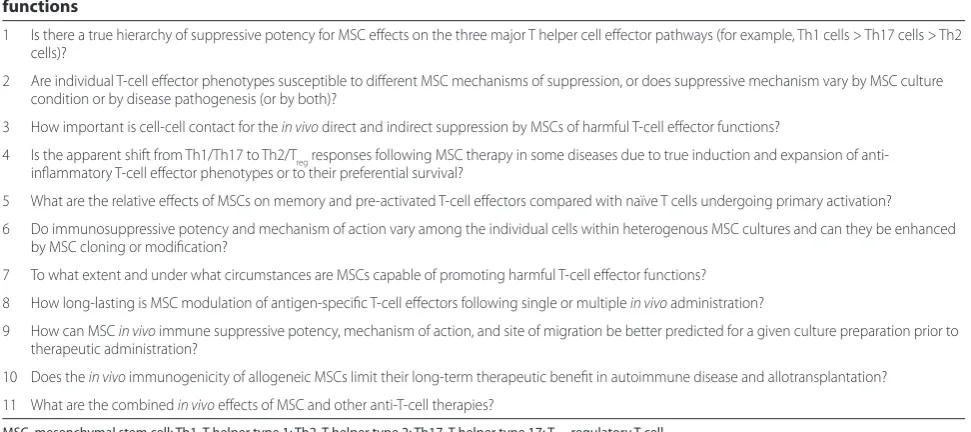
9. Barry FP, Murphy JM: Mesenchymal stem cells: clinical applications and biological characterization.Int J Biochem Cell Biol 2004, 36:568-584. 10. Griffi n MD, Ritter T, Mahon BP: Immunological aspects of allogeneic Table 1. Key unanswered or incompletely answered questions about mesenchymal stem cell eff ects on T-cell eff ector functions
1 Is there a true hierarchy of suppressive potency for MSC eff ects on the three major T helper cell eff ector pathways (for example, Th1 cells > Th17 cells > Th2 cells)?
2 Are individual T-cell eff ector phenotypes susceptible to diff erent MSC mechanisms of suppression, or does suppressive mechanism vary by MSC culture condition or by disease pathogenesis (or by both)?
3 How important is cell-cell contact for the in vivo direct and indirect suppression by MSCs of harmful T-cell eff ector functions?
4 Is the apparent shift from Th1/Th17 to Th2/Treg responses following MSC therapy in some diseases due to true induction and expansion of anti-infl ammatory T-cell eff ector phenotypes or to their preferential survival?
5 What are the relative eff ects of MSCs on memory and pre-activated T-cell eff ectors compared with naïve T cells undergoing primary activation?
6 Do immunosuppressive potency and mechanism of action vary among the individual cells within heterogenous MSC cultures and can they be enhanced by MSC cloning or modifi cation?
7 To what extent and under what circumstances are MSCs capable of promoting harmful T-cell eff ector functions?
8 How long-lasting is MSC modulation of antigen-specifi c T-cell eff ectors following single or multiple in vivo administration?
9 How can MSC in vivo immune suppressive potency, mechanism of action, and site of migration be better predicted for a given culture preparation prior to therapeutic administration?
10 Does the in vivo immunogenicity of allogeneic MSCs limit their long-term therapeutic benefi t in autoimmune disease and allotransplantation?
11 What are the combined in vivo eff ects of MSC and other anti-T-cell therapies?
MSC, mesenchymal stem cell; Th1, T helper type 1; Th2, T helper type 2; Th17, T helper type 17; Treg, regulatory T cell.
mesenchymal stem cell therapies.Hum Gene Ther 2010, 21:1641-1655. 11. Caplan AI: Why are MSCs therapeutic? New data: new insight.J Pathol 2009,
217:318-324.
12. Barry FP, Murphy JM, English K, Mahon BP: Immunogenicity of adult mesenchymal stem cells: lessons from the fetal allograft.Stem Cells Dev
2005, 14:252-265.
13. Bartholomew A, Sturgeon C, Siatskas M, Ferrer K, McIntosh K, Patil S, Hardy W, Devine S, Ucker D, Deans R, Moseley A, Hoff man R: Mesenchymal stem cells suppress lymphocyte proliferation in vitro and prolong skin graft survival in vivo.Exp Hematol 2002, 30:42-48.
14. Gieseke F, Bohringer J, Bussolari R, Dominici M, Handgretinger R, Muller I:
Human multipotent mesenchymal stromal cells use galectin-1 to inhibit immune eff ector cells.Blood 2010, 116:3770-3779.
15. Cutler AJ, Limbani V, Girdlestone J, Navarrete CV: Umbilical cord-derived mesenchymal stromal cells modulate monocyte function to suppress T cell proliferation.J Immunol 2010, 185:6617-6623.
16. Wang Q, Sun B, Wang D, Ji Y, Kong Q, Wang G, Wang J, Zhao W, Jin L, Li H:
Murine bone marrow mesenchymal stem cells cause mature dendritic cells to promote T-cell tolerance.Scand J Immunol 2008, 68:607-615. 17. English K, Ryan JM, Tobin L, Murphy MJ, Barry FP, Mahon BP: Cell contact,
prostaglandin E(2) and transforming growth factor beta 1 play non-redundant roles in human mesenchymal stem cell induction of CD4+CD25(High) forkhead box P3+ regulatory T cells.Clin Exp Immunol
2009, 156:149-160.
18. Batten P, Sarathchandra P, Antoniw JW, Tay SS, Lowdell MW, Taylor PM, Yacoub MH: Human mesenchymal stem cells induce T cell anergy and
downregulate T cell allo-responses via the TH2 pathway: relevance to tissue engineering human heart valves.Tissue Eng 2006, 12:2263-2273. 19. Rasmusson I, Uhlin M, Le Blanc K, Levitsky V: Mesenchymal stem cells fail to
trigger eff ector functions of cytotoxic T lymphocytes.J Leukoc Biol 2007,
82:887-893.
20. Najar M, Raicevic G, Boufker HI, Fayyad Kazan H, De Bruyn C, Meuleman N, Bron D, Toungouz M, Lagneaux L: Mesenchymal stromal cells use PGE2 to modulate activation and proliferation of lymphocyte subsets: Combined comparison of adipose tissue, Wharton’s Jelly and bone marrow sources.
Cell Immunol 2010, 264:171-179.
21. Tatara R, Ozaki K, Kikuchi Y, Hatanaka K, Oh I, Meguro A, Matsu H, Sato K, Ozawa K: Mesenchymal stromal cells inhibit Th17 but not regulatory T-cell diff erentiation.Cytotherapy 2011, 13:686-694.
22. Wang J, Wang G, Sun B, Li H, Mu L, Wang Q, Li G, Shi L, Jin L, Kostulas N:
Interleukin-27 suppresses experimental autoimmune encephalomyelitis during bone marrow stromal cell treatment.J Autoimmun 2008,
30:222-229.
23. Zhao W, Wang Y, Wang D, Sun B, Wang G, Wang J, Kong Q, Wang Q, Peng H, Jin L, Li H: TGF-beta expression by allogeneic bone marrow stromal cells ameliorates diabetes in NOD mice through modulating the distribution of CD4+ T cell subsets.Cell Immunol 2008, 253:23-30.
24. Ren G, Zhao X, Zhang L, Zhang J, L’Huillier A, Ling W, Roberts AI, Le AD, Shi S, Shao C, Shi Y: Infl ammatory cytokine-induced intercellular adhesion molecule-1 and vascular cell adhesion molecule-1 in mesenchymal stem cells are critical for immunosuppression.J Immunol 2010, 184:2321-2328. 25. Lim JH, Kim JS, Yoon IH, Shin JS, Nam HY, Yang SH, Kim SJ, Park CG:
Immunomodulation of delayed-type hypersensitivity responses by mesenchymal stem cells is associated with bystander T cell apoptosis in the draining lymph node.J Immunol 2010, 185:4022-4029.
26. Ge W, Jiang J, Arp J, Liu W, Garcia B, Wang H: Regulatory T-cell generation and kidney allograft tolerance induced by mesenchymal stem cells associated with indoleamine 2,3-dioxygenase expression.Transplantation
2010, 90:1312-1320.
27. Casiraghi F, Azzollini N, Cassis P, Imberti B, Morigi M, Cugini D, Cavinato RA, Todeschini M, Solini S, Sonzogni A, Perico N, Remuzzi G, Noris M:
Pretransplant infusion of mesenchymal stem cells prolongs the survival of a semiallogeneic heart transplant through the generation of regulatory T cells.J Immunol 2008, 181:3933-3946.
28. Ankrum J, Karp JM: Mesenchymal stem cell therapy: two steps forward, one step back.Trends Mol Med 2010, 16:203-209.
29. Hermann-Kleiter N, Baier G: NFAT pulls the strings during CD4+ T helper cell eff ector functions.Blood 2010, 115:2989-2997.
30. Aksu AE, Horibe E, Sacks J, Ikeguchi R, Breitinger J, Scozio M, Unadkat J, Feili-Hariri M: Co-infusion of donor bone marrow with host mesenchymal stem cells treats GVHD and promotes vascularized skin allograft survival in rats.
Clin Immunol 2008, 127:348-358.
31. Boumaza I, Srinivasan S, Witt WT, Feghali-Bostwick C, Dai Y, Garcia-Ocana A, Feili-Hariri M: Autologous bone marrow-derived rat mesenchymal stem cells promote PDX-1 and insulin expression in the islets, alter T cell cytokine pattern and preserve regulatory T cells in the periphery and induce sustained normoglycemia.J Autoimmun 2009, 32:33-42.
32. Madec AM, Mallone R, Afonso G, Abou Mrad E, Mesnier A, Eljaafari A, Thivolet C: Mesenchymal stem cells protect NOD mice from diabetes by inducing regulatory T cells.Diabetologia 2009, 52:1391-1399.
33. Coff man RL: The origin of TH2 responses.Science 2010, 328:1116-1117. 34. Zhou H, Guo M, Bian C, Sun Z, Yang Z, Zeng Y, Ai H, Zhao RC: Effi cacy of bone
marrow-derived mesenchymal stem cells in the treatment of sclerodermatous chronic graft-versus-host disease: clinical report.Biol Blood Marrow Transplant 2010, 16:403-412.
35. Fiorina P, Jurewicz M, Augello A, Vergani A, Dada S, La Rosa S, Selig M, Godwin J, Law K, Placidi C, Smith RN, Capella C, Rodig S, Adra CN, Atkinson M, Sayegh MH, Abdi R: Immunomodulatory function of bone marrow-derived mesenchymal stem cells in experimental autoimmune type 1 diabetes.
J Immunol 2009, 183:993-1004.
36. Awasthi A, Kuchroo VK: Th17 cells: from precursors to players in infl ammation and infection.Int Immunol 2009, 21:489-498.
37. Ghannam S, Pene J, Torcy-Moquet G, Jorgensen C, Yssel H: Mesenchymal stem cells inhibit human Th17 cell diff erentiation and function and induce a T regulatory cell phenotype.J Immunol 2010, 185:302-312.
38. Zappia E, Casazza S, Pedemonte E, Benvenuto F, Bonanni I, Gerdoni E, Giunti D, Ceravolo A, Cazzanti F, Frassoni F, Mancardi G, Uccelli A: Mesenchymal stem cells ameliorate experimental autoimmune encephalomyelitis inducing T-cell anergy.Blood 2005, 106:1755-1761.
39. Rafei M, Campeau PM, Aguilar-Mahecha A, Buchanan M, Williams P, Birman E, Yuan S, Young YK, Boivin MN, Forner K, Basik M, Galipeau J: Mesenchymal stromal cells ameliorate experimental autoimmune encephalomyelitis by inhibiting CD4 Th17 T cells in a CC chemokine ligand 2-dependent manner.J Immunol 2009, 182:5994-6002.
40. Carrión F, Nova E, Luz P, Apablaza F, Figueroa F: Opposing eff ect of mesenchymal stem cells on Th1 and Th17 cell polarization according to the state of CD4(+) T cell activation.Immunol Lett 2011, 135:10-16. 41. Darlington PJ, Boivin MN, Renoux C, Francois M, Galipeau J, Freedman MS,
Atkins HL, Cohen JA, Solchaga L, Bar-Or A: Reciprocal Th1 and Th17 regulation by mesenchymal stem cells: implication for multiple sclerosis.
Ann Neurol 2010, 68:540-545.
42. Bouffi C, Bony C, Courties G, Jorgensen C, Noël D: IL-6-dependent PGE2 secretion by mesenchymal stem cells inhibits local infl ammation in experimental arthritis.PLoS ONE 2010, 5:e14247.
43. Kong QF, Sun B, Wang GY, Zhai DX, Mu LL, Wang DD, Wang JH, Li R, Li HL:
BM stromal cells ameliorate experimental autoimmune myasthenia gravis by altering the balance of Th cells through the secretion of IDO.Eur J Immunol 2009, 39:800-809.
44. Chen B, Hu J, Liao L, Sun Z, Han Q, Song Z, Zhao RC: Flk-1+ mesenchymal stem cells aggravate collagen-induced arthritis by up-regulating interleukin-6.Clin Exp Immunol 2010, 159:292-302.
45. Gonzalez-Rey E, Gonzalez MA, Varela N, O’Valle F, Hernandez-Cortes P, Rico L, Buscher D, Delgado M: Human adipose-derived mesenchymal stem cells reduce infl ammatory and T cell responses and induce regulatory T cells in vitro in rheumatoid arthritis.Ann Rheum Dis 2010, 69:241-248.
46. Wang Y, Zhang A, Ye Z, Xie H, Zheng S: Bone marrow-derived mesenchymal stem cells inhibit acute rejection of rat liver allografts in association with regulatory T-cell expansion.Transplant Proc 2009, 41:4352-4356. 47. Afzali B, Mitchell P, Lechler RI, John S, Lombardi G: Translational mini-review
series on Th17 cells: induction of interleukin-17 production by regulatory T cells.Clin Exp Immunol 2009, 159:120-130.
48. Carrión F, Nova E, Ruiz C, Diaz F, Inostroza C, Rojo D, Monckeberg G, Figueroa FE: Autologous mesenchymal stem cell treatment increased T regulatory cells with no eff ect on disease activity in two systemic lupus
erythematosus patients.Lupus 2010, 19:317-322.
49. Maccario R, Podestà M, Moretta A, Cometa A, Comoli P, Montagna D, Daudt L, Ibatici A, Piaggio G, Pozzi S, Frassoni F, Locatelli F: Interaction of human mesenchymal stem cells with cells involved in alloantigen-specifi c immune response favors the diff erentiation of CD4+ T-cell subsets expressing a regulatory/suppressive phenotype.Haematologica 2005,
90:516-525.
inhibit the formation of cytotoxic T lymphocytes, but not activated cytotoxic T lymphocytes or natural killer cells.Transplantation 2003,
76:1208-1213.
51. Prevosto C, Zancolli M, Canevali P, Zocchi MR, Poggi A: Generation of CD4+ or CD8+ regulatory T cells upon mesenchymal stem cell-lymphocyte interaction.Haematologica 2007, 92:881-888.
52. Patel SA, Meyer JR, Greco SJ, Corcoran KE, Bryan M, Rameshwar P:
Mesenchymal stem cells protect breast cancer cells through regulatory T cells: role of mesenchymal stem cell-derived TGF-beta.J Immunol 2010,
184:5885-5894.
53. Tso GH, Law HK, Tu W, Chan GC, Lau YL: Phagocytosis of apoptotic cells modulates mesenchymal stem cells osteogenic diff erentiation to enhance IL-17 and RANKL expression on CD4+ T cells.Stem Cells 2010, 28:939-954.
doi:10.1186/scrt75