REVI E W
Open Access
Transitional changes in microfossil
assemblages in the Japan Sea from the
Late Pliocene to Early Pleistocene related
to global climatic and local tectonic events
Takuya Itaki
Abstract
Many micropaleontological studies based on data from on-land sections, oil wells, and deep-sea drilling cores have provided important information about environmental changes in the Japan Sea that are related to the global climate and the local tectonics of the Japanese Islands. Here, major changes in the microfossil assemblages during the Late Pliocene to Early Pleistocene are reviewed. Late Pliocene (3.5–2.7 Ma) surface-water assemblages were characterized mainly by cold–temperate planktonic flora and fauna (nannofossils, diatoms, radiolarians, and planktonic foraminifera), suggesting that nutrient-rich North Pacific surface waters entered the Japan Sea via northern straits. The common occurrence of Pacific-type deep-water radiolarians during this period also suggests that deep water from the North Pacific entered the Japan Sea via the northern straits, indicating a sill depth >500 m. A weak warm-water influence is recognized along the Japanese coast, suggesting a small inflow of warm water via a southern strait. Nannofossil and sublittoral ostracod assemblages record an abrupt cooling event at 2.75 Ma that correlates with the onset of the Northern Hemisphere glaciation. Subsequently, cold intermediate- and deep-water assemblages of ostracods and radiolarians increased in abundance, suggesting active ventilation and the formation of the Japan Sea Proper Water, associated with a strengthened winter monsoon. Pacific-type deep-water radiolarians also disappeared around 2.75 Ma, which is attributed to the intermittent occurrence of deep anoxic environments and limited migration from the North Pacific, resulting from the near-closure or shallowing of the northern strait by a eustatic fall in sea level and tectonic uplift of northeastern Japan. A notable reduction in primary productivity from 2.3 to 1.3 Ma also suggests that the nutrient supply from the North Pacific was restricted by the near-closure of the northern strait. An increase in the abundance of subtropical surface fauna suggests that the inflow of the Tsushima Warm Current into the Japan Sea via a southern strait began at 1.7 Ma. The opening of the southern strait may have occurred after the subsidence of southwestern Japan.
Keywords:Radiolaria, Diatom, Calcareous nannofossil, Foraminifera, Ostracoda, Productivity, Paleoceanography, Northern Hemisphere glaciation, Tectonics, Tsushima Warm Current
Correspondence:[email protected]
AIST, Geological Survey of Japan, Higashi 1-1-1, Tsukuba Central 7, Ibaraki 305-8567, Japan
Progress in Earth and
Planetary Science
© 2016 Itaki.Open AccessThis article is distributed under the terms of the Creative Commons Attribution 4.0 International License (http://creativecommons.org/licenses/by/4.0/), which permits unrestricted use, distribution, and reproduction in any medium, provided you give appropriate credit to the original author(s) and the source, provide a link to the Creative Commons license, and indicate if changes were made.
ItakiProgress in Earth and Planetary Science (2016) 3:11
Review
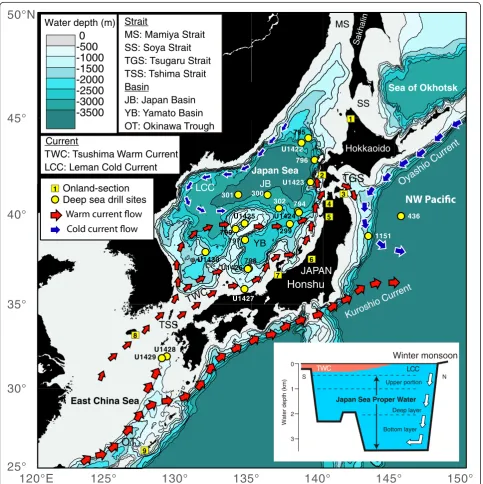
The Japan Sea is a marginal sea in the northwestern Pacific Ocean bounded by the Eurasian continent, the Japanese Islands, and Sakhalin Island (Fig. 1). Although this sea has deep basins with depths to 3700 m, it is con-nected to adjacent marginal seas and the Pacific Ocean by only four shallow straits, with sill depths of 130 m or less. The Tsushima Strait (sill depth, 130 m) connects it to the East China Sea, the Tsugaru Strait (130 m)
connects it to the Pacific, and the Soya (55 m) and Mamiya (12 m) Straits connect it to the Sea of Okhotsk.
The circulation of oceanic water in this marginal sea is driven by the inflow of the Tsushima Warm Current (TWC), which enters from the south via the Tsushima Strait (Fig. 1). The TWC, which branches from the Kuroshio Current and the Taiwan Current in the East China Sea, carries heat and nutrients into the Japan Sea (e.g., Morimoto and Yanagi 2001; Kodama et al. 2015)
120°E
125°
130°
135°
140°
145°
150°
25°
30°
35°
40°
45°
50°N
301 300 302
299 799
797
794
795
Honshu
Hokkaoido 1
2
4 3
5
6
7
Japan Sea
Sea of Okhotsk
East China Sea
1151 Sak
halin
U1422
U1423 796
U1424 U1425
U1426
U1427
U1428 U1429
JB
MS
SS
TGS
TSS
YB
OT
798 U1430
Kuroshio C urrent
Current
TWC: Tsushima Warm Current LCC: Leman Cold Current
TWC
Oyashio C urrent
LCC
JAPAN
9 8
436 Strait
MS: Mamiya Strait SS: Soya Strait TGS: Tsugaru Strait TSS: Tshima Strait Basin
JB: Japan Basin YB: Yamato Basin OT: Okinawa Trough
0
-500
-1000
-1500
-2000
-2500
-3000
-3500
Water depth (m)1
Deep sea drill sites Onland-section
N S
TWC
Upper portion
Deep layer
Bottom layer 0
1
2
3
Water depth (km)
LCC
Japan Sea Proper Water
Winter monsoon
Fig. 1Map showing the bathymetry of the Japan Sea and the flow of surface currents. A schematic figure of the vertical water circulation in the Japan Sea is shown on thelower right
and thus importantly affects the climate and ecosystems of the sea (e.g., Naganuma 2000). Seasonal variations in the sea surface temperature (SST) of the TWC range be-tween 13 and 27 °C in the southern part of the sea and between 3 and 18 °C in the northern part. Part of the TWC flows northwestward and then sinks as its density increases in response to the cooling and sea-ice forma-tion caused by the strong winter monsoon (Talley et al. 2003). As a result, a uniform deep-water mass
character-ized by a low temperature (0–0.5 °C) and a high
dis-solved oxygen content (5 ml/l) forms at depths below
300 m, the so-called “Japan Sea Proper Water” (JSPW)
(Fig. 1; e.g., Gamo et al. 1986; Senjyu and Sudo 1994; Talley et al. 2003). Therefore, the deep-water biofacies in the JSPW are isolated from the open Pacific Ocean (e.g., Naganuma 2000).
In contrast to the well-ventilated deep water of the present day, the bottom conditions are known to have been anoxic during the last glacial period, associated with a covering of low-salinity surface water (e.g., Oba et al. 1991). Tada (1994) demonstrated that such large fluc-tuations between oxic and anoxic bottom conditions oc-curred since the Late Pliocene (2.6 Ma) and were probably related to the onset of the Northern Hemi-sphere glaciation (NHG) with the global cooling trend and to the uplift of the northeastern Japanese Islands.
Microfossils, used as index and facies fossils, are a powerful tool for reconstructing the paleogeographic and paleoenvironmental histories of the Japan Sea. A huge amount of micropaleontological data is available from on-land sections, oil wells, and deep-sea drilling cores obtained during cruises such as Deep Sea Drilling
Project (DSDP) Leg 31 (sites 299–302) and Ocean
Drilling Program (ODP) Leg 127/128 (sites 794–799). In
particular, Expedition 346 of the Integrated Ocean Dril-ling Program (IODP) recently collected deep-sea drilDril-ling cores from seven sites in the Japan Sea and two sites in the northern East China Sea (Tada et al. 2015).
The aim of this article is to review the literature on the microfossil assemblages in the Japan Sea, focusing
on calcareous nannofossils, diatoms, radiolarians,
foraminifera, and ostracods during the Late Pliocene
to Early Pleistocene transition (3.5–0.8 Ma), and to
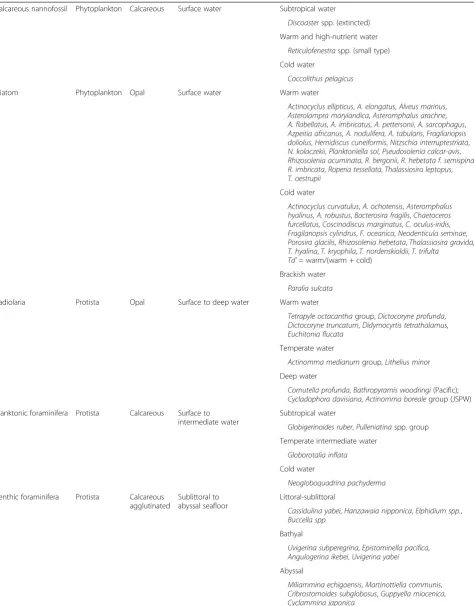
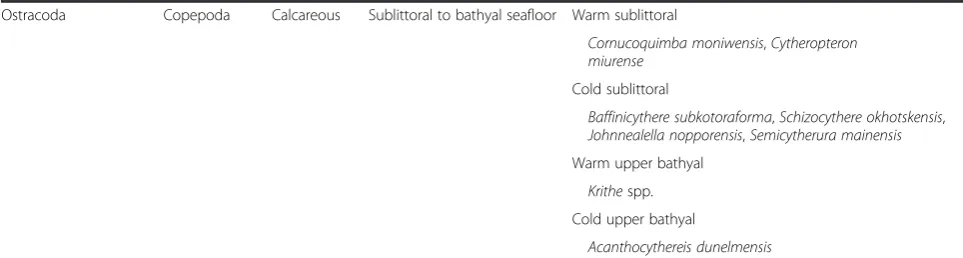
discuss the relationships between the changes in these assemblages and both global climatic changes and local or regional tectonics. Different microfossil groups provide different environmental information according to their ecological preferences, such as habitat depth, and the water masses with which they are associated (Table 1). A comprehensive interpretation of the microfossil assemblages in the Japan Sea during the
Pliocene–Pleistocene transition is expected to improve
our understanding of the oceanographic changes in the sea and their relationships to both variations in
the global climate and the topographic changes caused by regional and local tectonic activities.
Many important publications written in Japanese, in addition to those written in English, are included in this review, so that the information they contain might be-come accessible to a larger group of readers. However, because space is restricted, it is unrealistic to show all the publications dealing with microfossils in the Japan Sea because they are too many. Therefore, papers describing quantitative or semiquantitative data, such as fossil abundances and/or percentages of specific species, have been included, whereas others are only noted in an overview. Most abstracts and reports addressed to closed communities are not included.
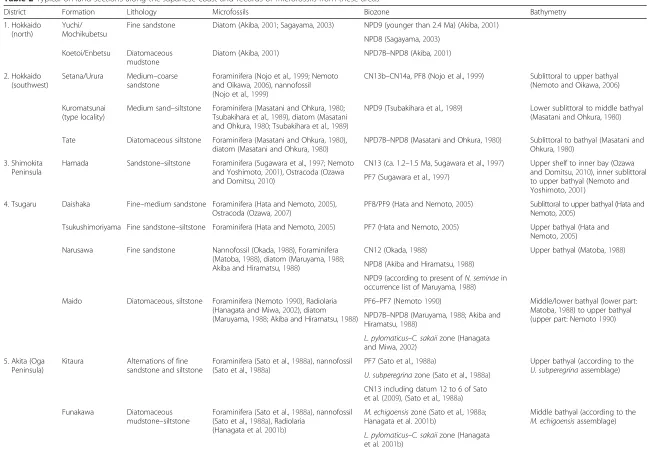
The geological ages of each section of on-land and deep-sea cores are basically referred to the biozones listed in Table 2. All ages in this review have been converted from those of the original publications to the GTS2012 time scale (Gradstein et al. 2012), usually to within 0.1 million years. However, the ages of nannofos-sil bioevents are given to within 0.01 million years, be-cause they are well documented and their age estimates have been correlated with the magnetostratigraphy of the North Atlantic Ocean and the Japan Sea (e.g., Takayama and Sato 1987, Takayama et al. 1988; Sato et al. 1988a, 2009; Watanabe et al. 2003).
Geological and geographic settings
The Japan Sea is a back-arc basin opened during the
Early to Middle Miocene (ca. 25–13 Ma) as a result of
continental rifting throughout the back-arc margin with the extension of regional tectonic stress (e.g., Sato 1994). The Japan Basin is underlain by an oceanic-type crust,
dated at around 24–17 Ma at the basaltic basement at
ODP site 795, whereas the Yamato Basin, which is
youn-ger (21–18 Ma), is unlikely to be an oceanic-type crust
(Tamaki et al. 1992; Kaneoka et al. 1992). The tectonic stress changed to compression after 3.5 Ma, causing the uplift of northeast Japan (e.g., Nakajima et al. 2006). In the southwestern Japan Sea, a tectonic event, such as intra-arc folding under N–S compressive stress, resulted in the closure of the Tsushima Strait during the Late
Miocene, and the attenuation of the N–S compression
in southwest Japan seems to have been related to the reopening of the Tsushima Strait in the Late Pliocene (Itoh et al. 1997).
On-land sections that include Pliocene and Early Pleis-tocene marine deposits are widely distributed from Hokkaido Island southward to central Honshu Island in southwestern Japan (Figs. 1 and 2; Table 2). The Pliocene geography of the Japan Sea has been recon-structed using data from these on-land sections and wells, together with data from ocean drilling cores (Iijima and Tada 1990; Chinzei 1991; Ogasawara 1994;
Table 1Ecological locations of each microfossil group
Calcareous nannofossil Phytoplankton Calcareous Surface water Subtropical water
Discoasterspp. (extincted) Warm and high-nutrient water
Reticulofenestraspp. (small type) Cold water
Coccolithus pelagicus
Diatom Phytoplankton Opal Surface water Warm water
Actinocyclus ellipticus,A. elongatus,Alveus marinus,
Asterolampra marylandica,Asteromphalus arachne,
A. flabellatus,A. imbricatus,A. pettersonii,A. sarcophagus,
Azpeitia africanus,A. nodulifera,A. tabularis,Fragilariopsis doliolus,Hemidiscus cuneiformis,Nitzschia interruptestriata,
N. kolaczekii,Planktoniella sol,Pseudosolenia calcar-avis,
Rhizosolenia acuminata,R. bergonii,R. hebetata f. semispina,
R. imbricata,Roperia tessellata,Thalassiosira leptopus,
T. oestrupii
Cold water
Actinocyclus curvatulus,A. ochotensis,Asteromphalus hyalinus,A. robustus,Bacterosira fragilis,Chaetoceros furcellatus,Coscinodiscus marginatus,C. oculus-iridis,
Fragilariopsis cylindrus,F. oceanica,Neodenticula seminae,
Porosira glacilis,Rhizosolenia hebetata,Thalassiosira gravida,
T. hyalina,T. kryophila,T. nordenskioldii,T. trifulta Td'= warm/(warm + cold)
Brackish water
Paralia sulcata
Radiolaria Protista Opal Surface to deep water Warm water
Tetrapyle octacanthagroup,Dictocoryne profunda,
Dictocoryne truncatum,Didymocyrtis tetrathalamus,
Euchitonia flucata
Temperate water
Actinomma medianumgroup,Lithelius minor
Deep water
Cornutella profunda,Bathropyramis woodringi(Pacific);
Cycladophora davisiana,Actinomma borealegroup (JSPW) Planktonic foraminifera Protista Calcareous Surface to
intermediate water
Subtropical water
Globigerinoides ruber,Pulleniatinaspp. group Temperate intermediate water
Globorotalia inflata
Cold water
Neogloboquadrina pachyderma
Benthic foraminifera Protista Calcareous agglutinated
Sublittoral to abyssal seafloor
Littoral-sublittoral
Cassidulina yabei,Hanzawaia nipponica,Elphidium spp.,
Buccella spp.
Bathyal
Uvigerina subperegrina,Epistominella pacifica,
Angulogerina ikebei,Uvigerina yabei
Abyssal
Miliammina echigoensis,Martinottiella communis,
Cribrostomoides subglobosus,Guppyella miocenica,
Cyclammina japonica
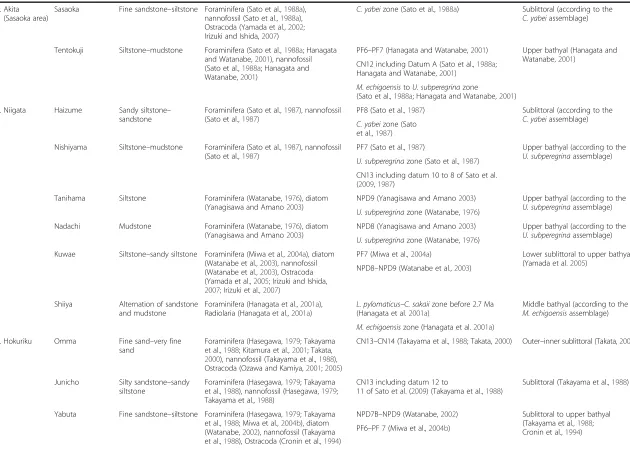
Kitamuta 2008). Figure 2 is a reconstructed geo-graphic map of the Late Pliocene, compiled from these previous works. During the Late Pliocene, a wide strait between southwestern Hokkaido and northern Honshu, corresponding to the modern Tsugaru Strait, connected the Japan Sea with the North Pacific Ocean (Fig. 2). In contrast, the area around the present Tsushima Strait, at the southern end of the sea, was probably occupied by a land bridge or at most, a narrow strait, indicated by the lack of Pliocene marine deposits on
southwestern Honshu and the northern Kyushu
islands.
In on-land stratigraphic sections, the Pliocene sequence is mainly composed of diatom-bearing mudstone, which is covered by sandy, shallow-water Pleistocene deposits, sometimes unconformably (Fig. 3; Table 2). Based on the benthic foraminiferal assemblages in these sequences, the lithological change from mud to sand has been interpreted as reflecting a change from a bathyal (ca. 1000 m) to a sublittoral (<100 m) depo-sitional environment during the Early Pleistocene (Matoba 1984). This large-scale shallowing of the de-positional depth cannot be explained simply by the eustatic fall in sea level (about 100 m) but probably also reflects the uplift of northeastern Honshu Island with intensified compression (Sato 1994; Nakajima et al. 2006), which occurred between 3.5 and 1.7 Ma (Sato et al. 2012).
Figure 3 shows schematically the lithofacies in a deep-sea core obtained during ODP Leg 127 (Tada 1994) and their correlations with typical on-land sec-tions obtained in various districts of Japan. Unit 2 of the deep-sea core, which consists of Pliocene diatom-aceous mudstone, can also be identified in the various on-land sections. Unit 1 in the deep-sea core, which is characterized by alternating dark and light layers of hemipelagic mud, tends to correlate with sandy
se-quences in the on-land sections. The dark–light
alter-nations in the deep-sea core imply that the bottom water became anoxic periodically (Tada 1994).
Changes in the microfossil groups
Figure 4 is a compilation of the Pliocene and Pleisto-cene biostratigraphic zones of the microfossil groups usually used in the Japan Sea. Although most bioe-vents originally proposed based on data from the North Pacific can also be identified in the Japan Sea, the results from the DSDP and ODP cores indicate that some Pleistocene radiolarian events are missing from the Japan Sea or occur with a large time lag (Ling 1992; Alexandrovich 1992). For this reason, the boundaries of the Pleistocene radiolarian zones in Fig. 4 are indicated with dashed lines, reflecting their uncertainty (Tada et al. 2015). In contrast, the plank-tonic and benthic foraminiferal zones are unique to the Japan Sea, probably because the Japan Sea was isolated from the adjacent seas.
In this section, the floral and faunal changes in the diatoms, calcareous nannofossils, radiolarians, plank-tonic foraminifera, benthic foraminifera, and ostracods in the Japan Sea are described. The temporal changes in the absolute abundance of each microfossil group and in the relative abundances of several important species are shown in Figs. 5 and 6, respectively.
Biogeographic distribution patterns are closely related to climatic zonation, such as the tropical, subtropical, transition, subarctic, and arctic zones. Warm- and cold-water species, terms often used in the paper previously
published, include the tropical–subtropical groups and
the subarctic–arctic groups, respectively. Around Japan, warm-water species are usually distributed in the subtropical waters influenced by the Tsushima and Kuroshio Currents, whereas the cold-water species mainly occur in the subarctic waters of the Oyashio Current.
Diatoms
Pioneer work on the biostratigraphy of Neogene dia-toms has been carried out on on-land sections from the Tsugaru district (Koizumi 1966), Akita district
(Oga Peninsula) (Koizumi 1968), and DSDP–ODP
Table 1Ecological locations of each microfossil group(Continued)
Ostracoda Copepoda Calcareous Sublittoral to bathyal seafloor Warm sublittoral
Cornucoquimba moniwensis,Cytheropteron miurense
Cold sublittoral
Baffinicythere subkotoraforma,Schizocythere okhotskensis,
Johnnealella nopporensis,Semicytherura mainensis
Warm upper bathyal
Krithespp. Cold upper bathyal
Acanthocythereis dunelmensis
Table 2Typical on-land sections along the Japanese coast and records of microfossils from these areas
District Formation Lithology Microfossils Biozone Bathymetry
1. Hokkaido (north)
Yuchi/ Mochikubetsu
Fine sandstone Diatom (Akiba,2001; Sagayama,2003) NPD9 (younger than 2.4 Ma) (Akiba,2001)
NPD8 (Sagayama,2003)
Koetoi/Enbetsu Diatomaceous mudstone
Diatom (Akiba,2001) NPD7B–NPD8 (Akiba,2001)
2. Hokkaido (southwest)
Setana/Urura Medium–coarse sandstone
Foraminifera (Nojo et al.,1999; Nemoto and Oikawa,2006), nannofossil (Nojo et al.,1999)
CN13b–CN14a, PF8 (Nojo et al.,1999) Sublittoral to upper bathyal (Nemoto and Oikawa,2006)
Kuromatsunai (type locality)
Medium sand–siltstone Foraminifera (Masatani and Ohkura,1980; Tsubakihara et al.,1989), diatom (Masatani and Ohkura,1980; Tsubakihara et al.,1989)
NPD9 (Tsubakihara et al.,1989) Lower sublittoral to middle bathyal (Masatani and Ohkura,1980)
Tate Diatomaceous siltstone Foraminifera (Masatani and Ohkura,1980), diatom (Masatani and Ohkura,1980)
NPD7B–NPD8 (Masatani and Ohkura,1980) Sublittoral to bathyal (Masatani and Ohkura,1980)
3. Shimokita Peninsula
Hamada Sandstone–siltstone Foraminifera (Sugawara et al.,1997; Nemoto and Yoshimoto,2001), Ostracoda (Ozawa and Domitsu,2010)
CN13 (ca. 1.2–1.5 Ma, Sugawara et al.,1997) Upper shelf to inner bay (Ozawa and Domitsu,2010), inner sublittoral to upper bathyal (Nemoto and Yoshimoto,2001)
PF7 (Sugawara et al.,1997)
4. Tsugaru Daishaka Fine–medium sandstone Foraminifera (Hata and Nemoto,2005), Ostracoda (Ozawa,2007)
PF8/PF9 (Hata and Nemoto,2005) Sublittoral to upper bathyal (Hata and Nemoto,2005)
Tsukushimoriyama Fine sandstone–siltstone Foraminifera (Hata and Nemoto,2005) PF7 (Hata and Nemoto,2005) Upper bathyal (Hata and Nemoto,2005)
Narusawa Fine sandstone Nannofossil (Okada,1988), Foraminifera (Matoba,1988), diatom (Maruyama,1988; Akiba and Hiramatsu,1988)
CN12 (Okada,1988) Upper bathyal (Matoba,1988)
NPD8 (Akiba and Hiramatsu,1988)
NPD9 (according to present ofN. seminaein occurrence list of Maruyama,1988)
Maido Diatomaceous, siltstone Foraminifera (Nemoto1990), Radiolaria (Hanagata and Miwa,2002), diatom (Maruyama,1988; Akiba and Hiramatsu,1988)
PF6–PF7 (Nemoto1990) Middle/lower bathyal (lower part: Matoba,1988) to upper bathyal (upper part: Nemoto1990) NPD7B–NPD8 (Maruyama,1988; Akiba and
Hiramatsu,1988)
L. pylomaticus–C. sakaiizone (Hanagata and Miwa,2002)
5. Akita (Oga Peninsula)
Kitaura Alternations of fine sandstone and siltstone
Foraminifera (Sato et al.,1988a), nannofossil (Sato et al.,1988a)
PF7 (Sato et al.,1988a) Upper bathyal (according to the
U. subperegrinaassemblage)
U. subperegrinazone (Sato et al.,1988a)
CN13 including datum 12 to 6 of Sato et al. (2009), (Sato et al.,1988a)
Funakawa Diatomaceous mudstone–siltstone
Foraminifera (Sato et al.,1988a), nannofossil (Sato et al.,1988a), Radiolaria
(Hanagata et al.2001b)
M. echigoensiszone (Sato et al.,1988a; Hanagata et al.2001b)
Middle bathyal (according to the
M. echigoensisassemblage)
L. pylomaticus–C. sakaiizone (Hanagata et al.2001b)
Itaki
Progress
in
Earth
and
Planetary
Science
(2016) 3:11
Page
6
of
Table 2Typical on-land sections along the Japanese coast and records of microfossils from these areas(Continued)
5. Akita (Sasaoka area)
Sasaoka Fine sandstone–siltstone Foraminifera (Sato et al.,1988a), nannofossil (Sato et al.,1988a), Ostracoda (Yamada et al.,2002; Irizuki and Ishida,2007)
C. yabeizone (Sato et al.,1988a) Sublittoral (according to the
C. yabeiassemblage)
Tentokuji Siltstone–mudstone Foraminifera (Sato et al.,1988a; Hanagata and Watanabe,2001), nannofossil (Sato et al.,1988a; Hanagata and Watanabe,2001)
PF6–PF7 (Hanagata and Watanabe,2001) Upper bathyal (Hanagata and Watanabe,2001)
CN12 including Datum A (Sato et al.,1988a; Hanagata and Watanabe,2001)
M. echigoensistoU. subperegrinazone
(Sato et al.,1988a; Hanagata and Watanabe,2001)
6. Niigata Haizume Sandy siltstone– sandstone
Foraminifera (Sato et al.,1987), nannofossil (Sato et al.,1987)
PF8 (Sato et al.,1987) Sublittoral (according to the
C. yabeiassemblage)
C. yabeizone (Sato et al.,1987)
Nishiyama Siltstone–mudstone Foraminifera (Sato et al.,1987), nannofossil (Sato et al.,1987)
PF7 (Sato et al.,1987) Upper bathyal (according to the
U. subperegrinaassemblage)
U. subperegrinazone (Sato et al.,1987)
CN13 including datum 10 to 8 of Sato et al. (2009,1987)
Tanihama Siltstone Foraminifera (Watanabe,1976), diatom (Yanagisawa and Amano2003)
NPD9 (Yanagisawa and Amano2003) Upper bathyal (according to the
U. subperegrinaassemblage)
U. subperegrinazone (Watanabe,1976)
Nadachi Mudstone Foraminifera (Watanabe,1976), diatom (Yanagisawa and Amano2003)
NPD8 (Yanagisawa and Amano2003) Upper bathyal (according to the
U. subperegrinaassemblage)
U. subperegrinazone (Watanabe,1976)
Kuwae Siltstone–sandy siltstone Foraminifera (Miwa et al.,2004a), diatom (Watanabe et al.,2003), nannofossil (Watanabe et al.,2003), Ostracoda (Yamada et al.,2005; Irizuki and Ishida, 2007; Irizuki et al.,2007)
PF7 (Miwa et al.,2004a) Lower sublittoral to upper bathyal (Yamada et al.2005)
NPD8–NPD9 (Watanabe et al.,2003)
Shiiya Alternation of sandstone and mudstone
Foraminifera (Hanagata et al.,2001a), Radiolaria (Hanagata et al.,2001a)
L. pylomaticus–C. sakaiizone before 2.7 Ma (Hanagata et al.2001a)
Middle bathyal (according to the
M. echigoensisassemblage)
M. echigoensiszone (Hanagata et al.2001a)
7. Hokuriku Omma Fine sand–very fine sand
Foraminifera (Hasegawa,1979; Takayama et al.,1988; Kitamura et al.,2001; Takata, 2000), nannofossil (Takayama et al.,1988), Ostracoda (Ozawa and Kamiya,2001;2005)
CN13–CN14 (Takayama et al.,1988; Takata,2000) Outer–inner sublittoral (Takata,2000)
Junicho Silty sandstone–sandy siltstone
Foraminifera (Hasegawa,1979; Takayama et al.,1988), nannofossil (Hasegawa,1979; Takayama et al.,1988)
CN13 including datum 12 to
11 of Sato et al. (2009) (Takayama et al.,1988)
Sublittoral (Takayama et al.,1988)
Yabuta Fine sandstone–siltstone Foraminifera (Hasegawa,1979; Takayama et al.,1988; Miwa et al.,2004b), diatom (Watanabe,2002), nannofossil (Takayama et al.,1988), Ostracoda (Cronin et al.,1994)
NPD7B–NPD9 (Watanabe,2002) Sublittoral to upper bathyal (Takayama et al.,1988; Cronin et al.,1994) PF6–PF 7 (Miwa et al.,2004b)
Itaki
Progress
in
Earth
and
Planetary
Science
(2016) 3:11
Page
7
of
Table 2Typical on-land sections along the Japanese coast and records of microfossils from these areas(Continued)
8. Jeju Island Sogwipo Fine–coarse sandstone Foraminifera (Kang et al.,2010), nannofossil (Yi et al.1998), Ostracoda (Lee,2014)
CN13a–CN14a (Yi et al.1998) Foreshore–inner shelf (Kang,1995)
9. Okinawa Ryukyu Group Bioclastic limestone/ siltstone
Foraminifera (Yamamoto et al.,2003), nannofossil (Yamamoto et al.,2005)
CN13b–CN14a (Yamamoto et al.,2005) Reef–shelf (Yamamoto et al.,2003)
Shimajiri Group Siltstone Foraminifera (Ujiié and Kaneko,2006), nannofossil (Tanaka and Ujiié1984)
N16–N22 (Ujiié and Kaneko,2006) Upper bathyal (Ujiié and Kaneko,2006)
CN9a–CN13a (Tanaka and Ujiié1984)
Itaki
Progress
in
Earth
and
Planetary
Science
(2016) 3:11
Page
8
of
sites in the Japan Sea (Koizumi 1975, 1992a). These studies have reported that the widely distributed Plio-cene diatomaceous deposits are mainly composed of marine diatoms, suggesting the presence of nutrient-rich seawater. However, the preservation of siliceous microfossils deteriorated from 2.9 to 2.3 Ma (White and Alexandrovich 1992), and diatom abundances de-creased thereafter, most notably from ca. 2.3 Ma until
ca. 1.3 Ma at ODP Leg 127 sites 794–797 (Koizumi
1992a; Koizumi and Yamamoto in press; Fig. 5). This reduction can be interpreted as reflecting a reduced nu-trient supply from the Pacific, resulting from the shal-lowing of the Tsugaru Strait (White and Alexandrovich 1992). After ca. 1.3 Ma, the diatom abundance
fluctuated greatly with the glacial and interglacial cycles (Koizumi 1992a, 1992b). Although the diatom abun-dance data for the Pliocene to Pleistocene have not been reported at Leg 128 ODP site 798 (980 m water depth in the southern Japan Sea), the biogenic opal content, consisting mainly of diatom skeletons, was
higher during 2.6–1.3 Ma at this site (Dunbar et al.
1992), a pattern opposite that of the diatom abundance at the ODP Leg 127 sites in more northerly and deeper waters (Fig. 5).
Koizumi (1992b) noted that the Miocene to Pliocene diatom assemblages collected during ODP Leg 127
were dominated by cold-water species, such as
Coscino-discus marginatus and Neodenticula kamtscatica, and
Late Pliocene
(3.5–2.6 Ma)
301 300
302
799 797
794 795
1151 U1422
U1423 796
U1424
U1425
U1426 798 U1430
U1427 299
1
2
3 4
5
7
6
500 m
436
Fig. 2Reconstructed paleogeography of the late Pliocene, modified from Iijima and Tada (1990) and Ogasawara (1994). The locations of the on-land geological sections and drill sites of the DSDP, ODP, and IODP expeditions are shown
were not significantly influenced by warm water enter-ing from the southern strait. He also reported that
Paralia sulcata was more abundant after 3.5 Ma at southern sites (797 and 794) and after 2 Ma at northern sites (795 and 796), which he attributed to the inflow of
brackish water from the Yellow Sea via the southern strait. Yanagisawa and Amano (2003) noted that in the diatom assemblages from the Nadachi and Tanihama formations in the Niigata district (Fig. 3; Table 2), which correspond to the period from 3.9/3.6 to 2.0/
Stylatractus universus Botryostrobus aquilonaris Eucyrtidium matuyamai Cycladophora sakaii Dictyophimus Larcopyle pylomaticus Radiolaria Neodenticula Proboscia curvirostris Actinocyclus oculatus Neodenticula koizumii Neodenticula koizumii -Neodenticula kamtschatica Diatom NN16 NN17 NN18 NN19 NN20 NN21 CN12 CN13 CN14 CN15 Calcareous nannofossil
2. FO Emiliania huxleyi
6. FO Gephyrocapsa parallela
8. LO Gephyrocapsa spp. (large)
10. FO Gephyrocapsa spp. (large)
13. LO Discoaster brouweri 3. LO Pseudoemiliania lacunosa
7. FO Reticulofenestra asanoi 5. LO Reticulofenestra asanoi
9. LO Helicosphaera sellii 0 PF6 PF7 PF8* PF9 Epoch/Age Pliocene Pleistocene Holocene Late Pleist. Polarity chron C3 C2A C2 C1 Middle Pleistocene Age (Ma) 0 1 2 3 4 5 Planktonic foraminifera No. 1 No. 3 Neo. pachyderma coiling direction Zanclean Piacenzian Gelasian Calabrian sin. dex. N.22 Blow (1969) N.21 N.19 Benthic Gr. inflata bed No. 2 Maiya (1978) Uvigerina subperegrina Miliammina echigoensis Cribroelphidium yabei Neodenticula kamtschatica
12. FO Gephyrocapsa caribbeanica
Datum A 7Bb 8 9 10 11 12 NPD seminae
11. FO Gephyrocapsa oceanica
Martini
(1971) Okada&Bukry(1980) Sato et al.(2009)
Yanagisawa
&Akiba (1998) Motoyama (1996)Kamikuri et al. (2004)
bullatus
Matsunaga
Poor preservation in the Japan Sea
(1963)
Grob. ikebei / Orb. universa
Neo. pachyderma (s.)
/ Grob. qunqueloba
Neo. pachyderma (s.)
/ Grob. incompta
Neo. pachyderma (d.)
/ Grob. orientalis
* PF8 =
foraminifera
Miwa et al. (2004a), Miwa (2014)
a b a b
(Japan Sea) (JapanSea) ) l a b o l g (
(global) (N Pacific) (N Pacific)
Fig. 4Pliocene and Pleistocene biostratigraphic zones of the microfossil groups in the Japan Sea. Updated correlations of the planktonic foraminiferal zonation in the Japan Sea were illustrated based on Miwa et al. (2004a) and Miwa (2014)Dashed linesfor zone boundaries in the radiolarian zonation indicate their uncertainty, arising from the probable time lags in key bioevents (Tada et al. 2015)
Age 1 2 3 4 5 Omma Fm. Yabuta Fm. Haizume Fm. Kitaura Fm.
Daisyaka Fm. Uzura Fm.
Narusawa Fm.
(7) Hokuriku (6) Niigata (5) Akita (4) Tsugaru (2) SW
Kuwae Fm. Tsukushimoriyama Fm. ODP Kuromatsunai Fm. (type loc.) Hokkaido (1) North Hokkaido
Yuchi / Mochikubetsu Fm.
(Oga)
(Sasaoka) Hamada Fm.
(3) Shimokita Unconformity (Ma) Setana Fm. (9) Okinawa Shimajiri Group Ryukyu Gr. (8) Jeju Leg 127 Island Tanihama Fm. Nishiyama Fm. Sandstone
Siltstone / Sand-mud alternations Mudstone
Diatomaceous mudstone Major lithology
Remarkable dark-light alternations Faint dark-light alternations
Tentokuji Fm.
Shiiya Fm.
Funakawa Fm.
Tate Fm.
Maido Fm.
Unit 2
Koetoi / Enbetsu Fm.
Unit 1A Unit 1B Junicho Fm. Sasaoka Fm. Sogwipo Fm. Nadachi Fm.
Fig. 3Geological correlations between the on-land sections along the Japanese coastal area. References for each formation are shown in Table 2. The schematic lithological units of ODP Leg 127 (Tada 1994) are also shown at the right hand of the figure. Numbers inparenthesesfor each district correspond to the numbers in squares in Figs. 1 and 2 showing their locations
ODP site 795A ODP site 796A ODP site 797B
ODP site 794A ODP site 798
Diatom (bold)
ODP site 794A Radiolaria (thin)
Diatom Diatom
Diatom Opal (%) Calcareous
nannofossil
CaCO3 (%)
B C A V
B = Barren V = Very abundant A = Abundant C = Common
R = Rare F = Few H = Highly abundant
0
7 6 5 4 3 2 1
8 Age
(Ma) (10 / g)
7
(10 / g)7 (10 / g)7
(10 / g)3
0 10 20 30
Thin = 798A Thick = 798B
0 4 8 12 16
(10 / g)7
0 4 8 12 16 0 4 8 12 160 4 8 12 16 0 10 20 30 40 50 0 10 20 30 40
Planktonic foraminifera Benthic
foraminifera
(10 / g)3
R F H 0 2 0 (10 g)4 3
Low abundance of siliceous fossils
1.7 Ma
2.7 Ma
Fig. 5Abundance changes in microfossil groups in the Japan Sea. Data has been used for diatoms in cores from ODP sites 794, 795, 796, and 797 (Koizumi 1992a), radiolarians from ODP site 794 (Itaki, unpublished data), calcareous nannofossils from ODP site 798 (Muza 1992), and benthic and planktonic foraminifera from ODP site 798 (Kato 1992) are illustrated. Opal (Dunbar et al. 1992) and calcium carbonate contents (Ingle Jr et al. 1990) from ODP site 798 are also shown
4
1.0
2.0
3.0
4.0
1 2
0 20
(Ma)
3 4 5
1A
1B
0 3 5 1 2
Japan Sea type Pacific type
(‰)
IRD (Site 795)
C. davisiana(%)
A. boreale
C. davisiana A. boreale Age
C. profunda B. woodringi
15 10
0 3 4
(%) (%)
0 5 20
0 100 0 100
planktonic foram.
G. ruber(%) C. pelagicus
(%)
Reticulofenestra
spp. (%)
Thick line: Sasaoka & Tentokuji Formations Thin line: the NKH-3 well
0 1
N. pachyderma Site 798
carbonate % Site 798
Right Left
Datum A
2
0 40 4 8 1216 20
Sites 797 & 436 (°C)
Site 436 Site 797
0 20
(%) (i) Warm-water diatom
Warm-water mollusca
(Japan Sea)
(NW Pacific) 1.7 Ma
2.7 Ma
a b c d e f g h
Fig. 6Characteristic faunal and floral changes from 4 to 0.6 Ma.aStandard marine oxygen isotope curve LR04 (Lisiecki and Raymo 2005);b lithological units with occurrence horizons of the ice-rafted debris (IRD) at site 795, ODP Leg 127 (Tada 1994);cdeep-dwelling radiolarians from DSDP site 302 (Kamikuri and Motoyama 2007);dcalcareous nannofossils from on-land sections in the Akita district (Sato et al. 2012);esubtropical planktonic foraminiferaG. ruberfrom on-land sections in the Hokuriku district (Kitamura and Kimoto 2006);fcoiling ratio ofN. pachydermafrom ODP site 798 (Kheradyar 1992);gcalcium carbonate contents from ODP site 798;h Td’-based sea surface temperatures (SST) from ODP site 797 (central Japan Sea) and DSDP site 436 (northwestern Pacific) (Koizumi and Yamamoto, in press); andiwarm-water diatoms and mollusks from on-land sections in the Niigata district (Yanagisawa and Amano 2003)
2.1 Ma, warm-water species existed alongside the
cold-water assemblage at 3.2–2.7 Ma and 2.4–2.0 Ma,
suggesting the presence of mixed cold and warm water during those intervals (Fig. 6 (i)).
Koizumi and Yamamoto (in press) recently recon-structed the SST changes during the Pliocene to
Pleis-tocene based on Td’ values, a temperature index of
diatom fossil assemblages, from ODP site 797 (central Japan Sea, from 3 Ma), site 798 (southern Japan Sea, from 1.3 Ma), and DSDP site 436 (Northwest Pacific off northern Honshu, from 3.6 Ma) (Fig. 6 (h)). In the Japan Sea (site 797), the SST dropped at 2.6 Ma and in-creased toward 2 Ma. In contrast, on the Pacific side (site 436), the SST was nearly 20 °C during the Late Pliocene but decreased thereafter from 21.7 °C at 2.1 Ma to 10 °C at 1.4 Ma. As shown in Fig. 6 (h), the difference in SST between sites 797 and 436 was larger during the Late Pliocene but declined after 1.7 Ma.
Calcareous nannofossils
Calcareous nannofossils were reported from the deep-sea cores of ODP Leg 127 (Rahman 1992) and Leg 128 (Muza 1992). At site 798, nannofossils occur at well-defined in-tervals, separated by equally well-defined barren inin-tervals, from 1.7 Ma onward, but they occur only sporadically and very sparsely before 2.0 Ma (Muza 1992). Their occur-rence patterns are closely related to the patterns of CaCO3 content (Fig. 5). However, the nannofossil abundances are much lower at deeper sites (794, 2825 m; 795, 3374 m; 796, 2223 m; 797, 2945 m; and 799, 2073 m) (Muza 1992; Rahman 1992) than at site 798 (980 m). Well-preserved nannofossil records during the late Pliocene to Pleistocene (after 3.85 Ma) are also available in on-land sections (e.g., Takayama et al. 1988; Sato et al. 1988a, Sato et al. 2012), which were deposited at shallower water depths than at the ODP sites. These results suggest that the cal-cite compensation depth (CCD) was less than 1000 m before 1.7 Ma and increased to 2000 m thereafter, as it is in the present day (Ujiié and Ichikura 1973).
High-resolution biostratigraphic data collected in the North Atlantic Ocean (Takayama and Sato 1987) have been applied to the Late Pliocene–Pleistocene on-land sections and oil-well data from the Japan Sea side of the Japanese Islands (Fig. 4) (e.g., Takayama et al. 1988; Sato et al. 1988a,
2004). The bioevent known as “Datum A”in the subarctic
area of the North Pacific Ocean, defined as a dramatic floral
change from a Reticulofenestra-dominant assemblage to a
Coccolithus pelagicus-dominant assemblage at 2.75 Ma, has also been identified in the Japan Sea (Fig. 6 (d)) (Sato et al. 2002, 2012). This dramatic floral change probably indicates a change in paleoceanographic conditions. The high abun-dance ofReticulofenestraspp. (small type) before 2.75 Ma in the Japan Sea (Sato et al. 2002, 2012) can be explained by the presence of high-nutrient water (Tanaka and
Takahashi 2001), whereas the rapid increase in the
abundance of the cold-water species C. pelagicus after
2.75 Ma is interpreted as a result of global cooling, known as the onset of the NHG (Sato et al. 2002, 2012).
In the middle- to low-latitude areas on the Pacific side of the central Japanese Islands, the nannofossil assemblages were dominated by the subtropical group
Discoaster spp. in ca. 4–2 Ma, without the “Datum
A” event at 2.75 Ma, but no such subtropical group
is found on the Japan Sea side (Sato et al. 2002). This finding suggests that the biotic province in the Japan Sea was derived from the boreal Pacific province, rather than from the subtropical Pacific province.
Radiolarians
The assemblages of radiolarian fossils preserved in mar-ine deposits in on-land sections along the Japan Sea have been divided into zones and used since the 1950s for the stratigraphic correlation of the geological succes-sion (e.g., Nakaseko 1959, 1960; Nakaseko et al. 1972; Nakaseko and Sugano 1973). More recently, the standard radiolarian biostratigraphy for the mid- to high-latitude North Pacific has been applied to the marine deposits of the Japan Sea (e.g., Motoyama 1996; Motoyama and Maruyama 1996). However, some Pleistocene data could not be applied to the Japan Sea because of the large time lag between their occurrence at the DSDP and ODP sites and their oc-currence in the Pacific (Ling 1992; Alexandrovich 1992; Motoyama 1996). For example, the last
occur-rence of Stylacontalium aquilonaris, which is widely
recognized in the Pacific at 0.33 Ma (Matsuzaki et al. 2015b), is substantially earlier in the Japan Sea.
More-over, the occurrence of Eucyrtidium matsuyamai
be-tween 1.05 and 1.80 Ma in the Pacific (Matsuzaki et al. 2015a) is difficult to identify at all in the Japan Sea. Therefore, it may be necessary to establish a separate radiolarian biostratigraphy for the Japan Sea.
At ODP site 794, radiolarians occurred abundantly during the Miocene to Pliocene and decreased signifi-cantly from 2.3 to 1.3 Ma (Fig. 5). Thereafter, their abundance fluctuated greatly. This fluctuating pattern, which is similar to that in the diatom abundance, re-flects productivity changes in the siliceous plankton in surface waters.
Kamikuri and Motoyama (2007) analyzed the
radio-larian assemblages in the period 8–0.6 Ma from
DSDP site 302 (Fig. 1) and compared them with the assemblages at ODP site 1151, located at almost the same latitude in the northwestern Pacific, and at ODP site 884, in the subarctic Pacific. The species diversity index was almost the same in the Japan Sea and the North Pacific until 3.5 Ma but decreased
significantly in the Japan Sea after 3.5 Ma, probably reflecting the isolation of the Japan Sea from the Pacific at that time. Moreover, typical deep-water spe-cies that are common in the modern world ocean,
such as Cornutella profinda and Bathropyramis
woo-dringi (Casey 1977), disappeared from the Japan Sea
after 2.6 Ma and were replaced by the Cycladophora
davisiana and Actinomma boreale group (Fig. 6 (c)), which is found in the JSPW today (Itaki 2003).
The distributions of tropical and subtropical species,
such as the Tetrapyle octacantha group, Dictocoryne
profunda, Dictocoryne truncatum, Didymocyrtis tetra-thalamus, and Euchitonia flucata, are closely related to the TWC in the Japan Sea (Motoyama et al. in press). The occurrence of warm-water fauna in all samples younger than approximately 1.8 Ma containing pre-served radiolarians from ODP site 797 indicates that the TWC probably began to flow into the Japan Sea at that time (Alexandrovich 1992). According to Kamikuri and Motoyama (2007), who analyzed the radiolarian assem-blages from DSDP site 302, the Pliocene radiolarian assemblages contained temperate-water species, such as the Actinomma medianum group and Lithelius minor, which are minor species during the Pleistocene, whereas the subtropical species appeared after 2.2 Ma. These results suggest that in the Early Pleistocene, the temperate surface water entering the Japan Sea via the northern strait was replaced by subtropical water entering via the southern strait.
Planktonic foraminifera
The biostratigraphic zonation of planktonic foraminifera established by Maiya (1978) for petroleum exploration is unique to the Japan Sea and independent of the standard zonation used in the Pacific Ocean (e.g., Blow 1969). A unique set of bioevents, called the No. 1, No. 2, and No. 3 Globorotalia inflata beds, defined by the abundant occurrence of G. inflata, date to 0.8, 1.2–1.4, and 2.7–
3.3 Ma, respectively (Fig. 4). A high abundance of G.
inflatais known to indicate the presence of warm water (e.g., Maiya et al. 1976; Kitamura et al. 2001). Although
the subtropical planktonic foraminifer Globigerinoides
ruberalso occurs in the No. 1 and No. 2G. inflatabeds, it is not found in the No. 3G. inflatabed (e.g., Kitamura
and Kimoto 2006). Similarly, the Pulleniatina group,
which is characteristic of Kuroshio water, is also absent
from the No. 3 G. inflata bed (Miwa et al. 2004a,
2004b). In the northwestern Pacific, G. ruber is a
sub-tropical surface-water species, whereasG. inflata is dis-tributed in temperate to subtropical waters between 20° and 40° N, at depths shallower than 200 m (Thompson 1981; Tsuchihashi and Oda 2001). In the No. 1 and No. 2G. inflata beds,G. inflata is accompanied byG. ruber, so G. inflata probably entered the Japan Sea via the
southern strait. In contrast, the occurrence of abundant
G. inflata withoutG. ruberor other Kuroshio indicators
in the No. 3 G. inflata bed suggests that the plankton
assemblage entered the Japan Sea with temperate water via the northern strait (Hanagata and Watanabe 2001; Miwa et al. 2004a, 2004b; Kitamura and Kimoto 2006; Hanagata 2007). During the Late Pliocene interval
corresponding to the No. 3 G. inflata bed (2.7–3.3 Ma),
the alkenone-based SST at ODP site 1208 in the
north-western Pacific was 20–24 °C, which is warmer than the
Late Pleistocene SST range (15–20 °C) (LaRiviere et al.
2012). This warmer Pliocene SST probably allowed a
northward shift in the G. inflata distribution,
result-ing in its higher abundance around the mouth of the northern strait.
Kitamura and Kimoto (2006) reconstructed the his-tory of the TWC from the occurrences of the
subtrop-ical speciesG. ruberand other warm-water fossils from
3.5 to 0.8 Ma in on-land sections along the western
coast of Honshu Island. BecauseG. ruberoccurred only
sporadically during the interglacial periods before 1.7 Ma, they inferred its very limited transport by the TWC before that date. However, after 1.7 Ma, a signifi-cant inflow of subtropical water occurred during each interglacial period, as indicated by corresponding
in-creases in G. ruber (Fig. 6 (e)). The initial increase in
the TWC inflow coincided with an increase in the
CaCO3content of the Japan Sea sediments (Fig. 6 (g)).
The TWC inflow was probably initiated by the open-ing of the southern strait and the migration of the Kuroshio water into the East China Sea, which almost coincided with the formation of the Okinawa Trough (Shinjo 1999).
In the subpolar species Neogloboquadrina
pachy-derma, the left-coiling (sinistral) variant is associated with cold-water masses, and this variant was dominant, although with large fluctuations, after 1.2 Ma in the Japan Sea (Fig. 6 (f )) (e.g., Kheradyar 1992), suggesting that large climatic changes accompanied the amplified glacial cycles during the Mid-Pleistocene transition. The proportion of the right-coiling (dextral) variant increases dramatically at SSTs between 6 and 10 °C (Darling et al. 2006).
Benthic foraminifera
The benthic foraminiferal zones in the Japan Sea are mainly based on the characteristic faunal compositions
of on-land sections. Three biozones, the Miliammina
echigoensis, Uvigerina subperegrina, and Cassidulina yabeizones (in ascending order through the Pliocene to Pleistocene sequences), were established by Matsunaga (1963) (Fig. 4). As inferred from the depth distribution of modern foraminifera, the agglutinated fauna of the
M. echigoensis zone (= M. echigoensis–M. nodulosa
zone of Matoba 1990) indicates an abyssal assemblage, usually distributed below the CCD, and the calcareous
fauna of the U. subperegrina and C. yabei zones (= C.
norcrossi–U. akitaensis zone of Matoba 1990) is a
lower–upper bathyal assemblage (Matoba 1990).
There-fore, the faunal change from the M. echigoensiszone to
theU. subperegrinazone probably resulted from a shal-lowing of the water depth, reflecting the uplift of the northern Japanese islands (e.g., Sato et al. 1988b; Matoba 1990). Although the boundary between the agglutinated and calcareous assemblages is generally
recognized around the Pliocene–Pleistocene transition
(Fig. 4), the exact timing of the transition varies among sections, according to the water depth at which each was deposited (e.g., Sato et al. 1988b; Matoba 1992; Kato 1992; Hanagata 2007).
The shallowing of the water depth of benthic forami-niferal deposition from the Late Pliocene to the Early Pleistocene has also been observed in assemblages in on-land sections from the Tsugaru Peninsula (northern Honshu Island) and southwestern Hokkaido Island, where a northern strait was probably located. The upper bathyal assemblage is recognized in the Pliocene
Tsu-kushimoriyama Formation (2.9–2.4 Ma) on the Tsugaru
Peninsula (Hata and Nemoto 2005), and lower
sublit-toral Pleistocene assemblages (1.5–1.1 Ma) are
recog-nized in the Daisyaka Formation on northern Honshu Island (Hata and Nemoto 2005) and in the Setana Formation on southwestern Hokkaido Island (Nojo et al. 1999). The latter two formations unconformably contact the underlying strata (Fig. 3). The widespread distribution of these lower sublittoral assemblages implies the existence of a shallow, wide northern strait from 1.5 to 1.1 Ma.
Ostracods
Shallow-water ostracods from the Sasaoka Formation show a reduction in warm-water species and an increase
in temperate–subarctic species at 2.75 Ma (Irizuki and
Ishida 2007) as a result of cooling at the NHG (e.g., Sato et al. 2002). This change is consistent with the obser-vation of ice-rafted debris (IRD) in the northern Japan Sea beginning in ca. 2.6 Ma (Fig. 6; Tada 1994).
In the Kuwae Formation, the lower sublittoral–upper
bathyal assemblages from 3.5 to 2.6 Ma show cyclic changes with a 41-kyr periodicity, related to eustatic sea level changes (Yamada et al. 2005; Irizuki et al. 2007; Irizuki and Ishida 2007). During the interglacial periods between 3.1 and 2.8 Ma, the assemblage included
tem-perate intermediate-water species, such as Krithe spp.,
which suggests water temperatures between 6 and 20 °C
and a muddy seafloor at depths of 100–800 m (Irizuki et
al. 2007). The intermediate water was probably warmer than it is today, especially from 3.0 to 2.9 Ma. Because
these species are presently distributed in the East China Sea, their occurrence in the Pliocene Japan Sea is inter-preted as indicating their migration via the southern strait (Irizuki et al. 2007). From 2.8 to 2.6 Ma, temperate
intermediate-water species were rare, and cold
intermediate-water species increased in abundance
(Yamada et al. 2005). These results suggest that cold intermediate water, similar to JSPW, formed in associ-ation with the global cooling episode at that time.
The ostracod analysis indicates that the sea level in the Japan Sea fell during the NHG. In the Yabuta Formation (3.4–2.3 Ma), the ostracod assemblages suggest an envir-onmental change from upper bathyal to sublittoral, an estimated sea level fall of 50–60 m, at 2.7 Ma (Cronin et al. 1994). Yamada et al. (2005) also inferred a faunal change from an upper bathyal assemblage to a lower
sublittoral assemblage at 2.7 Ma in the Kuwae
Formation.
Ozawa and Kamiya (2001) reported cyclic changes in the ostracod assemblages in the Omma Formation from 1.5 to 1.3 Ma. During this period, warm-water species increased in abundance during each interglacial period, probably reflecting an increased volume of TWC inflow. A warm-water assemblage was also reported in this period in the Hamada Formation on the Shimokita Peninsula located on the Pacific side of the Tsugaru Strait (Ozawa and Domitsu 2010).
Discussion
The results presented here show that remarkable changes occurred in the faunal and floral assemblages in the Japan Sea during the Late Pliocene to Early Pleisto-cene. The occurrences of microfossil assemblages during
three periods are discussed: the Late Pliocene (3.5–
2.7 Ma), early Early Pleistocene (2.7–1.7 Ma) and late
Early Pleistocene (1.7–0.8 Ma). These three intervals
were bounded by remarkable assemblage changes: from the Reticulofenestra to C. pelagicus assemblages of nannofossils (Fig. 6 (d)) and from the Pacific type to Japan Sea type of deep-dwelling radiolarians (Fig. 6
(c)) at 2.7 Ma, and the first increase in subtropical G.
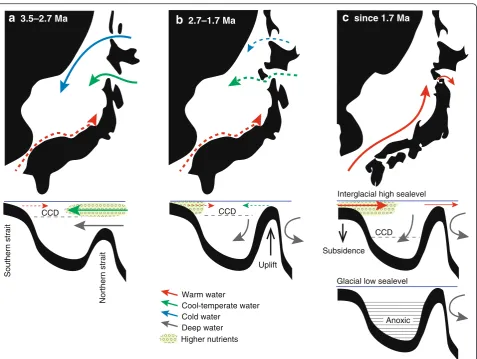
ruber at 1.7 Ma (Fig. 6 (e)). The paleogeographic changes in the Japan Sea inferred from the micropale-ontological record are shown schematically in Fig. 7.
Late Pliocene (3.5–2.7 Ma)
The Late Pliocene climate was globally warmer by
2–3 °C than today’s climate (e.g., Dowsett et al.
2009). In the northwestern Pacific, the Late Pliocene SST has been estimated from the alkenone record at
ODP site 1208 to have been 20–24 °C, which is
about 4 °C warmer than the present SST (LaRiviere et al. 2012). Koizumi and Yamamoto (in press) also reported similar results for the diatom-based SST at
DSDP site 436 in the Pacific off Honshu Island, central Japan (Fig. 6 (h)). Despite these warm SSTs in the northwestern Pacific, the Late Pliocene micro-fossil assemblages in the Japan Sea are characterized by cold- or temperate-water species, with very few warm-water species. Two possible sources of water have been proposed as influencing the Pliocene biota in the Japan Sea, based on the biogeographic distri-bution of fossils: North Pacific water entering via the northern strait and subtropical water entering via the southern strait. The occurrence of warm-water species suggests inflow from the southern strait, like the present Tsushima Current, and inflow via the
northern strait explains the predominance of cold–
temperate species.
The dominance of calcareous nannofossils, diatoms,
planktonic foraminifera, and radiolarians of cold–
tem-perate species in the fossil assemblages, together with the near absence of warm-water species, suggests that
the source water entered via the northern strait (Fig. 7a). A northern source is also consistent with the known Pliocene geography of the Japan Sea (Iijima and Tada 1990; Chinzei 1991). A wide strait was located near the present Tsugaru Strait in northern Japan, whereas in the south, where the Tsushima Strait is today, only a narrow waterway existed at most.
If the North Pacific water flowed into the Japan Sea through the northern strait near the present Tsugaru Strait during the Pliocene, it is expected that the dif-ference in the SST of the North Pacific and Japan Sea would be small because of the influence of the warm
Pacific water. However, the Td’-based differences in
SST between sites 436 (North Pacific) and 797 (Japan Sea) were large during the Pliocene and Early Pleisto-cene and became small after 1.7 Ma (Fig. 6 (h)). These large differences in SST explain the greater oc-currence of cold-water species in the Japan Sea. It is also plausible that the Okhotsk Sea was another
a
3.5–2.7 Mab
2.7–1.7 MaWarm water
Cool-temperate water Cold water
Deep water
c
since 1.7 MaNorthern strait
Southern strait
Uplift
Glacial low sealevel Interglacial high sealevel
Anoxic CCD CCD
CCD
Subsidence
Higher nutrients
Fig. 7Schematic maps showing paleogeographic changes in the Japan Sea during three stages (a,b,c).Solid arrowsshow major inflows of oceanic water, anddashed arrowsindicate restricted inflows
source of this cold surface water, flowing into the Japan Sea via another northern strait, which probably opened around northern Hokkaido Island.
The diatomaceous deposits and the predominance
of the high-nutrient indicator Reticulofenestra spp.
(small type) (Fig. 6 (d)) indicate that the primary productivity of the water mass derived from the northern strait during the Pliocene was high. The
Reticulofenestra spp. (small type) distribution (Sato et al. 2002) also suggests that nutrient-rich water was widespread in the subarctic North Pacific. Based on biogenic opal and nitrogen isotope data from ODP site 882 in the subarctic Pacific, Haug et al. (1999) demonstrated that nutrient-rich deep water was trans-ported into the euphotic zone during the Pliocene but decreased abruptly at 2.73 Ma with the development of the halocline coincident with the onset of the NHG.
According to the benthic foraminiferal assemblage of the Tate and Maido formations, composed of diat-omaceous mudstone, the depth of the northern strait
around the present Tsugaru Strait was upper–lower
bathyal, which is deeper than it is today (Table 2). Furthermore, another northern strait around northern Hokkaido might have been even deeper, because the hemipelagic diatomaceous mudstone of the Koitoi and Enbetsu formations is widely distributed on both sides of the Japan Sea and the Sea of Okhotsk in northern
Hokkaido. The deep-water-dwelling radiolarians C.
pro-finda and B. woodringi, which live today at depths >500 m in the North Pacific (e.g., Casey 1977), were present in the Japan Sea during the Miocene and Plio-cene. They may have migrated from the North Pacific via the northern strait when migration via the southern strait was blocked, even to surface dwellers, by the re-stricted water exchange through an almost-closed chan-nel. The occurrence of these deep-water dwellers implies that the sill depth of the northern strait was >500 m, which is consistent with the results for the benthic for-aminifera in the Tate and Maido formations. The low
CaCO3 contents during the Pliocene probably resulted
from the reduced carbonate preservation in deep-sea
water, with high nutrients and dissolved CO2 derived
from the North Pacific. It has been suggested that the CCD in the Japan Sea was shallower than in the present day, similar to the situation in the North Pacific (e.g., Rea et al. 1995).
However, some evidence of warm-water intrusion from the southern strait has been proposed, based on the fossil records of diatoms, mollusks, and ostracods in on-land sections.
Yanagisawa and Amano (2003) reported that in the Nadachi and Tanihama formations, warm-water diatoms were present in two intervals, 3.2–2.6 and 2.4–2.0 Ma,
whereas warm-water mollusks were only present during the latter period (Fig. 6 (i)). Because diatoms and mollusks reflect the environments of their habitats, such as the sea surface and seafloor, respectively, this result suggests that the cold bottom water was cov-ered with a thin layer of warm surface water during
the warmer interval of the Late Pliocene (3.2–
2.7 Ma), and that the seafloor was influenced by a thick warm-water mass during the warmer Early
Pleistocene interval (2.4–2.0 Ma). Therefore, the
warm surface-water layer was thinner during the Plio-cene than during the PleistoPlio-cene, as suggested by Amano et al. (2000).
The occurrence of the temperate intermediate-water ostracod group Krithespp. in sublittoral–bathyal assem-blages from the Kuwae Formation has been interpreted as the result of the inflow of warm water into the Japan Sea via the southern strait. This is based on the modern distribution of this species group and its similarity to the
occurrence pattern of the planktonic foraminer G.
in-flate, which indicates the presence of temperate– sub-tropical waters shallower than 200 m (Irizuki et al.
2007). The similar occurrence patterns of Krithe spp.
and G. inflata suggest that the abundance changes in both groups reflect the temperature of the same water mass. As mentioned above in the planktonic
foramin-ifera section, the No. 3 G. inflatabed (3.3–2.7 Ma) in
the Japan Sea is probably a result of the migration of this species from the northern strait, with a northward shift in their distribution on the Pacific side during the warm Pliocene period (Hanagata and Watanabe 2001; Miwa et al. 2004a, 2004b; Kitamura and Kimoto 2006; Hanagata 2007). If this scenario is correct, the
occur-rence of Krithe spp. in the Kuwae Formation is also
probably related to the intrusion of temperate inter-mediate water into the Japan Sea from the Pacific via the northern strait.
It can be concluded from this evidence that the major part of the Japan Sea, from its surface layer to depth,
was influenced by nutrient-rich cold–temperate water
that originated in the North Pacific and entered the Japan Sea via northern straits, although a small volume of subtropical water probably flowed into the sea via the southern strait and then along the Japanese coast.
Earliest Pleistocene (2.7–1.7 Ma)
From 3.5 to 1.7 Ma, a regression resulting from a sig-nificant local uplift led to a shallowing of the water around northeastern Japan (Sato et al. 2012). The growth of high-latitude ice sheets in the Northern Hemisphere, a consequence of the global cooling after 3.2 Ma and significantly at 2.7 Ma, also caused the sea level to fall, in the event known as the NHG (Lisiecki and Raymo 2005) and the first major glaciation at
2.15 Ma (Rohling et al. 2014). This drop in sea level has been documented along the central Japanese coast by the changes in the ostracod assemblages, from upper bathyal to sublittoral (Cronin et al. 1994; Yamada et al. 2005). Based on the modern analog technique for ostra-cods, Cronin et al. (1994) estimated that the sea level
dropped 50–60 m. As a result, the northern straits
be-came shallower and the Japan Sea was almost isolated from the Pacific, as it is at present (Fig. 7b).
Calcareous nannofossils (e.g., Sato et al. 2012) and sublittoral ostracods (Irizuki and Ishida 2007) indicate remarkable cooling in the Japan Sea at 2.75 Ma, with an abrupt change from warm Pliocene to cold Pleistocene as-semblages. Furthermore, the upper bathyal ostracod and deep-water radiolarian assemblages related to the
cold JSPW are first observed near the Pliocene–
Pleis-tocene boundary (Yamada et al. 2005; Irizuki et al. 2007; Kamikuri and Motoyama 2007). A reduction in
the planktonic foraminifera G. inflata indicates related
cooling at intermediate depths (Kitamura 2009). After 2.8 Ma, an intensified winter monsoon and sea-ice ex-pansion, indicated by the Chinese eolian loess (Xiong et al. 2003) and IRD at ODP site 795 in the northern Japan Sea (Tada 1994), probably caused increased venti-lation during the interglacial periods, as in the present day, as suggested by an increase in the JSPW-related radiolarian and ostracod fauna at that time.
In contrast, the intermittent development of low-oxygen conditions in the deep water, probably during the glacial periods, is indicated by the alternations of dark and light layers shown as Unit 1 of the Pleistocene deep-sea deposits (Fig. 6 (b)) (Tada 1994). Such low-oxygen conditions would have prevented the survival of
the deep-dwelling radiolarian speciesC. profundaand B.
woodlingi, which were common during the Pliocene. Moreover, as a result of the uplift of northeastern Japan, the northern straits probably became too shallow for these deep-sea dwellers to pass into the Japan Sea, and any that managed to enter the Japan Sea would not have survived the low-oxygen conditions in the deep water.
Although the JSPW-related radiolarians, the A. boreale
group andC. davisiana, are associated with low
temper-atures and high dissolved oxygen contents, their habita-tion depths in the high-latitude oceans are usually shallow or intermediate (e.g., Itaki et al. 2003). There-fore, if low-oxygen conditions prevailed in deep water, these species could have moved to shallower habitats or could have migrated from the North Pacific during each high-stand interglacial period.
The shallower northern strait was a barrier to nutrient input from the North Pacific. The high abundances of diatoms and radiolarians during the Pliocene were pos-sibly related to the inflow of high-nutrient surface water from the North Pacific. However, these abundances
decreased significantly during the Early Pleistocene (ca.
2.3–1.3 Ma) at the ODP 127 sites (Fig. 5). The
sedimen-tological record of the Early Pleistocene (2–1.5 Ma) is
very limited in the coastal areas of northeastern Japan because of a widespread unconformity (Fig. 3), sug-gesting that erosion occurred widely after marine regression. As a result, the northern straits probably became very narrow or closed, even during intergla-cial sea level high stands, which probably restricted the nutrient supply from the North Pacific during this period.
However, the concentration of opal (composed mainly of diatoms and radiolarians) increased during
2.7–1.5 Ma at ODP site 798 in the southern Japan
Sea. This pattern is contrary to that seen in the dia-tom and radiolarian abundances at the other ODP 127 sites (Fig. 5), and its cause is still unknown. It may be a small dissolution effect at the shallow-water depth of site 798, or the nutrient supply may have only been sufficient in the southern Japan Sea be-cause it was supplied by the southern strait.
Late Early Pleistocene (1.7–0.8 Ma)
The global sea level dropped continuously as the Northern Hemisphere ice sheets developed. Nevertheless, the occurrence of subtropical planktonic foraminifera and radiolarians implies that a significant intrusion of the
TWC via the southern strait began around 1.8–1.7 Ma.
The widening of the southern strait is attributed to ac-tive subsidence, which exceeded the reduction in sea level. This active subsidence was probably related to the genesis of the Okinawa Trough in the East China Sea, at ca. 2 Ma (Shinjo 1999). It also coincided with the start of reefal sediment deposition (Ryukyu Group) in Okinawa, southern Japan (Fig. 3), which implies that the intrusion of the Kuroshio Current into the East China Sea also began around this time (Yamamoto et al. 2006). Therefore, both the active subsidence around the southern strait and the intrusion of the Kuroshio Current into the East China Sea could have allowed the TWC to intrude into the Japan Sea. Interestingly, the
abundance of calcareous microfossils and the CaCO3
content increased after the TWC intrusion around 1.7 Ma (Fig. 6 (g)).
The surface and intermediate depths in the Japan Sea
were warmer during the period 1.46–1.3 Ma, according
to the high occurrence ofG. ruberandG. inflate, which
was related to the TWC inflow (Kitamura 2009). Dur-ing this period, the occurrence of warm-water
ostra-cods in the Hamada Formation (ca. 1.5–1.2 Ma) on the
Shimokita Peninsula (Ozawa and Domitsu 2010)
implies that the assemblage on the Pacific side of the Tsugaru Strait was influenced by a water mass from the
Japan Sea, suggesting the outflow of the TWC via the Tsugaru Strait (Fig. 7c).
Conclusions
Micropaleontological studies of the Late Pliocene to Early Pleistocene Japan Sea have been comprehen-sively reviewed, and the relationships between the major changes in the microfossil assemblages and both global climate and local tectonics in the Japanese Islands have been discussed.
Late Pliocene (3.5–2.7 Ma): Although the Late Pliocene
was globally warm, cold–temperate surface and deep
waters with high-nutrient levels delivered from the North Pacific via the northern straits occupied most of the Japan Sea. The weak influence of warm water, identified along the Japanese coast, suggests a small inflow of warm water via the southern strait.
Early Early Pleistocene (2.8–1.7 Ma): An abrupt
cool-ing event at 2.75 Ma, recorded in both nannofossil and ostracod assemblages, can be correlated with global cooling, especially in the Northern Hemisphere. After this period, intermediate- and deep-water assemblages of ostracods and radiolarians were intermittently char-acterized by cold-water dwellers, possibly related to well-ventilated water formations, such as the JSPW, associated with the development of a strong winter monsoon, despite the insignificant inflow of saline TWC water. As a result of the uplift of northeastern Japan and a eustatic fall in sea level in response to the NHG, the northern strait probably became very narrow and very shallow. Consequently, the nutrient supply from the North Pacific was restricted and primary productivity decreased significantly.
Late Early Pleistocene (1.7–0.8 Ma): Subtropical
sur-face faunal assemblages were continuously present after 1.7 Ma, when the inflow of the TWC via the southern strait began. This inflow was facilitated by the subsidence of southwestern Japan. At about the same time, the Kuroshio Current began to intrude into the East China Sea.
Although many important papers have described the microfossils in the Japan Sea, only selected papers could be included in this review. Nevertheless, it is clear that the microfossil assemblages in the Japan Sea changed significantly during the Pliocene to Pleis-tocene transition. Recently, the analysis of materials collected by IODP Expedition 346 is still ongoing, and this work is expected to provide much more detailed information about the temporal and spatial changes in the microfossil assemblages here.
Abbreviations
JSPW:Japan Sea Proper Water; NHG: Northern Hemisphere glaciation; TWC: Tsushima Warm Current.
Competing interests
The author declares that he has no competing interests.
Acknowledgements
The author expresses his gratitude to Prof. Ryuji Tada of the University of Tokyo for providing the opportunity to submit this paper. Most of the ideas in this paper are based on discussions with many paleontologists. Thanks are also due to two anonymous reviewers for their critical review. This work was financially supported by the Japan Society for the Promotion of Science (JSPS), grant numbers 25400504 and 23221022.
Received: 6 April 2015 Accepted: 14 April 2016
References
Akiba F (2001) Fossil diatom assemblages from the Mochikubetsu Formation in the Tenpoku-Haboro areas, northwestern Hokkaido, and their geological implications. Bull Technol Lab JAPEX 15:27–51 (in Japanese with English abstract)
Akiba F, Hiramatsu C (1988) Neogene diatom biostratigraphy in Ajiga-sawa, Gosyogawara, and Shimokita area of Aomori Prefecture. In: Iijima A (ed) Comprehensive study of Tertiary siliceous shale–Reports of Grant-in-Aid for Scientific Research during 1987 fiscal year–., pp 35–52, in Japanese Alexandrovich J (1992) Radiolarians from sites 794, 795, 796, and 797 (Japan Sea).
In: Pisciotto KA, Ingle JC Jr, von Breymann MT, Barron J, et al (eds) Proceedings of the Ocean Drilling Program, Scientific Results, Vol. 127/128, Pt. 1, 291-307
Amano K, Suzuki M, Sato T (2000) Warm-water influx into Japan Sea in the middle Pliocene—molluscan fauna from the Tentokuji Formation around Mt. Taihei in Akita Prefecture. J Geol Soc Jpn 106:299–307
Blow WH (1969) Late Middle Eocene to recent planktonic foraminiferal biostratigraphy. In Bronimann P and Renz HR (eds) Proc. 1st lnternat. Conf. Planktonic Microfossils, Gcncva, 1967, 1, 199-422, E.J. Brill, Leiden
Casey RE (1977) Distribution of polycystine Radiolaria in the oceans in relation to physical and chemical conditions. In: Funnell BM, Riedel WR (eds) The Micropaleontology of the Oceans. Cambridge University Press, Cambridge, pp 151–159
Chinzei K (1991) Late Cenozoic zoogeography of the Sea of Japan area. Episodes 14:231–235
Darling KF, Kucera M, Kroon D, Wade CM (2006) A resolution for the coiling direction paradox inNeogloboquadrina pachyderma. Paleoceanography 21: PA2011. doi:10.1029/2005PA001189
Dowsett HJ, Robinson MM, Foley KM (2009) Pliocene three-dimensional global ocean temperature reconstruction. Clim Past Vol 5:769–783
Cronin T, Kitamura A, Ikeya N, et al (1994) Late Pliocene climate-change 3.4–2. 3 Ma—paleoceanographic record from the Yabuta Formation, Sea of Japan. Palaeogeogr Palaeoclimatol Palaeoecol 108:437–455
Dunbar RB, deMenocal PB, Burckle L (1992) Late Pliocene-Quaternary biosiliceous sedimentation at site 798, Japan Sea. In: Pisciotto KA, Ingle JC Jr, von Breymann MT Barron J, et al (eds) Proceedings of the Ocean Drilling Program, Scientific Results, Vol. 127/128, Pt. 1, 439-455
Gamo T, Nozaki Y, Sakai H, Nakai T, Tsubota H (1986) Spatial and temporal variations of water characteristics in the Japan Sea bottom layer. J Mar Res 44:781–793
Gradstein F, Ogg J, Schmitz M, Ogg G (eds) (2012) The geologic time scale 2012: Elsevier, Amsterdam, 1144 pp
Hanagata S (2007) Historical changes in the Pliocene foraminiferal fauna in the Japan Sea oil-field region and its paleoceanographic implications. Fossils 82: 29–34 (in Japanese with English abstract)
Hanagata S, Miwa M (2002) Miocene-Pliocene microfossil biostratigraphy and paleoenvironment in the Fukaura district, Aomori Prefecture, northern Japan. J Geol Soc Jpn 108:767–780 (in Japanese with English abstract)
Hanagata S, Watanabe K (2001) Pliocene foraminifera and calcareous nannofossils from the well“Kainosawa Osen”in the eastern part of Akita City, Akita Prefecture, northern Japan: their biostratigraphy and paleoenvironmental implications. J Geol Soc Jpn 107:620–639 (in Japanese with English abstract) Hanagata S, Motoyama I, Hiramatsu C, Watanabe K, Tsuji T (2001a)
Biostratigraphy of the Miocene/Pliocene boundary sections in the Jouetsu-Chuetsu district, Niigata Prefecture, northeastern Japan. J Geol Soc Jpn 107: 565-584